

For K-12 schools, the ATS-to-background-check connection is a critical legal workflow, and choosing the wrong platform creates exactly the audit gaps that put districts at legal risk during high-volume, time-pressured hiring cycles. We reviewed the top 10 ATS platforms against the compliance criteria that matter most in K-12 hiring: multi-layer screening support, FCRA adverse action workflows, audit trail features, multi-state legal setup, and outside worker and helper screening. What we found reveals a wide and consequential divide between platforms built for K-12 legal complexity and those that are capable recruiting tools being used in an unideal environment.
Key Takeaways:
- Not all ATS background check integrations carry the same legal weight for K-12 schools. A native or certified partner link with embedded status updates presents the lowest compliance risk, while manual export or portal-based connections create the highest risk of audit gaps.
- Outside worker and helper screening is the most commonly overlooked gap in K-12 legal compliance. These groups must be managed within the same ATS workflow as employees, with audit records that meet the same standard as employee screening records.
- Many ATS platforms can initiate a screening order, but far fewer document the case-by-case review step required under EEOC guidance on criminal history. That distinction determines whether a district's records hold up in a legal review, not simply whether a check was ordered.
- Print-based criminal history checks through state law enforcement or the FBI CJIS Division are generally not consumer reports under the FCRA and are governed by state-specific legal frameworks instead. When a district uses both a CRA-generated report and a state print check, each is subject to its own distinct legal rules.
- FCRA adverse action workflow support in an ATS is a legal requirement for any school using a consumer reporting agency, not an optional feature. The full process must include a pre-adverse action notice, report delivery, a summary of consumer rights, a waiting period, and a final adverse action notice.
Which ATS Platforms Make K-12 Background Screening Easier?
For school districts, charter schools, and private schools, the ATS-to-background-check connection is a critical legal workflow, not simply an added bonus. In fact, ATS platforms with certified partner or native links to background check tools reliably do better than those relying on manual exports or portal-based steps.
Platforms well-suited for K-12 background screening share these traits:
- Certified or native links to background check providers, with instant status updates flowing into the hiring workflow
- Support for multiple screening packages for certified teachers, classified staff, fill-in teachers, outside workers, and helpers
- A review workflow and audit trail built into the ATS, not managed outside of it
- FCRA adverse action workflow support, including a pre-adverse action notice, report delivery, a summary of consumer rights, a fair waiting period, and a final adverse action notice
- Support for pre-report notice and written approval before any consumer report is obtained
- A setup for multi-state legal rules for charter networks and districts working across state lines
- Role-based data access controls to protect sensitive background check data from improper internal access
Why Background Screening Integration Matters More in K-12
K-12 hiring is not a single-screen process. A complete public school background check typically includes print-based criminal history checks through state law enforcement or the FBI CJIS Division, child abuse and neglect registry checks, sex offender registry checks, NASDTEC educator review, license checks, and outside worker or helper screening. Missing even one layer is how legal risk enters a district. High-volume hiring of fill-in teachers and support staff, combined with seasonal urgency, creates quick fixes, and quick fixes create audit gaps. The ATS is, in effect, where those gaps either get caught or get missed.
Key Legal Distinction: Print Checks vs. Consumer Reports. Print-based criminal history checks through state law enforcement or the FBI CJIS Division are generally not "consumer reports" under the FCRA. Instead, they are governed by state-specific legal frameworks. When a district uses both a CRA-generated report and a state print check, each is subject to its own distinct legal rules. K-12 HR teams should consult legal counsel to find out which legal duties apply to each screening part in their state.
How to Choose an ATS for K-12 Background Screening Compliance
Not all types of integration carry the same legal weight.
| Integration Type | How It Works | K-12 Risk Level |
| Native or certified partner | Screening is embedded in the ATS workflow; status updates are instant | Low |
| API or webhook-based | Flexible; requires technical setup and ongoing upkeep | Medium |
| Manual export or portal-based | Data exported by hand and uploaded to a separate screening portal | High |
Beyond integration setup, K-12 HR teams should specifically require:
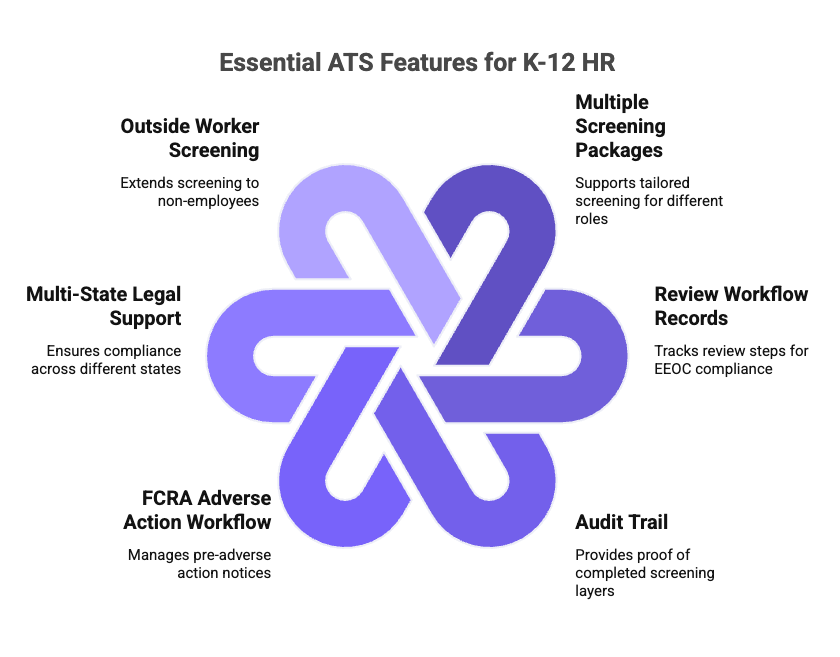
- Support for multiple screening packages. The ATS must support distinct screening packages per role type, not a single default package applied across all hires.
- Review workflow records. The platform should record case-by-case review steps internally, per EEOC guidance on criminal history screens.
- Audit trail and record keeping. Legal audits require documented proof that each screening layer was completed.
- FCRA adverse action workflow. If the school uses a consumer reporting agency, the ATS must support the pre-adverse action notice and waiting period process.
- Multi-state legal support. Charter networks working across states face serious compliance drift if their ATS cannot handle differing state rules.
- Outside worker and helper screening on par with staff. This is the most commonly overlooked gap in K-12 legal compliance. These groups must be managed within the same workflow as employees.
The Top 10 ATS Platforms for K-12 Background Screening Compliance
1. NEOGOV
NEOGOV maintains certified partner links to background check providers, with screening workflows embedded in its applicant tracking and new hire modules and instant status updates. In addition, the platform supports multiple screening packages and audit trail features with new hire holds. K-12 HR teams should confirm that FCRA adverse action workflow, pre-report notice and approval, and state law ban-the-box setup are all supported. One of the most widely used ATS platforms in U.S. public school districts, NEOGOV is well-aligned with the legal structure K-12 HR teams require.
2. Zoho Recruit
Based on publicly documented data, Zoho Recruit's background check integration relies primarily on manual steps or basic third-party connections rather than certified partner links. In particular, review workflow, complete FCRA adverse action workflow, and audit trail support for screening legal needs are not confirmed platform features. As a result, its manual or portal-based steps create meaningful legal risk for schools managing a multi-layer screening stack with FCRA, state law, and ban-the-box duties.
3. UKG Pro
UKG Pro maintains a certified background screening partner network supporting instant status tracking, review records, new hire holds, and multiple screening packages across role types. Confirm that the FCRA adverse action workflow covers all required steps and that state-specific adverse action and ban-the-box rules can be set up. Overall, it is a strong option for mid-size to large districts needing compliance-grade reporting and a verified screening link.
4. Breezy HR
Breezy HR's background check links are limited based on publicly documented data, relying on manual or basic third-party connections rather than certified partner links with embedded workflow tools. In particular, review workflow, complete FCRA adverse action workflow support, and pre-report notice and approval are not confirmed documented features. Managing a multi-layer screening stack through separate steps increases paperwork, creates audit gaps, and raises the risk of partial FCRA and state law compliance.
5. Oracle HCM
Oracle HCM provides enterprise-grade background screening integration through a documented partner network. In addition, it supports multi-state legal setup, review workflow records, strong audit trail features, and new hire integration with screening sign-off. Confirm that the FCRA adverse action workflow covers all required steps and that data access controls properly limit sensitive background check results within the broader HCM setup. Best suited for large public school districts and state education agencies with complex, multi-location legal demands.
6. Recruitee
Recruitee's background check links are limited, and the platform's legal tooling is not designed for U.S. public sector or K-12-specific rules. Screening relies on manual steps, review workflow features are limited, and FCRA adverse action workflow support is not a confirmed feature. For K-12 schools subject to multi-layer screening duties, FCRA rules, and ban-the-box limits, these gaps are significant.
7. Frontline Education
Frontline Education is K-12-native, with certified partner links embedded in applicant tracking and new hire modules. It supports multiple screening packages for teachers, fill-in teachers, support staff, and outside workers, and is specifically designed to handle state-specific print check workflows and educator review. Confirm that FCRA adverse action workflow, pre-report notice and approval, and state law setup are supported for all states in which the school works. Its role-specific screening setup and outside worker and helper screening support address the legal gaps where districts most often face audit risk.
8. Manatal
Manatal focuses on AI-driven candidate matching but has documented limited background check integration features. Multi-layer screening workflow support is not documented, and the platform's screening model creates significant legal gaps for schools managing print-based checks, CPS registry checks, educator review, and FCRA adverse action workflows. Based on current publicly documented features, Manatal is not designed for K-12 legal compliance.
9. Dayforce (by Ceridian)
Dayforce supports background screening through a documented partner network, with screening status flowing through the same platform that manages payroll and HR data. The platform supports review workflow records, new hire holds, and legal reporting for multi-role screening needs. Important Privacy Note: Confirm that criminal history and other sensitive background check results are subject to role-based access controls separate from general payroll and HR data access. Verify that all required FCRA adverse action workflow steps and applicable state law rules are also supported.
10. Pinpoint
Pinpoint's background screening network is limited relative to K-12 legal demands. Screening connections rely on manual or portal-based steps, and review workflow, audit trail features, and complete FCRA adverse action workflow support are not confirmed documented features. Its limited screening links and lack of K-12-specific legal tooling make it a poor fit for school districts managing multi-layer screening stacks subject to FCRA, state adverse action law, and ban-the-box rules.
Scoring Table and Recommendation
ATS Background Screening Compliance Scores for K-12
| ATS | Screening Integration | Multi-Layer Screening | Adjudication and Audit | FCRA Workflow | Multi-Jurisdiction | Contractor/Volunteer | K-12 Fit | Onboarding Integration | Total |
| Frontline Education | 5 | 5 | 4 | 4 | 4 | 5 | 5 | 5 | 37 |
| Oracle HCM | 5 | 5 | 5 | 4 | 5 | 4 | 4 | 5 | 37 |
| NEOGOV | 5 | 5 | 4 | 4 | 4 | 4 | 5 | 5 | 36 |
| Dayforce | 5 | 4 | 4 | 4 | 4 | 3 | 4 | 5 | 33 |
| UKG Pro | 5 | 4 | 4 | 4 | 4 | 4 | 4 | 4 | 33 |
| Zoho Recruit | 1 | 2 | 1 | 1 | 2 | 1 | 1 | 2 | 11 |
| Recruitee | 1 | 1 | 1 | 1 | 2 | 1 | 1 | 2 | 10 |
| Pinpoint | 1 | 1 | 1 | 1 | 2 | 1 | 1 | 2 | 10 |
| Breezy HR | 1 | 1 | 1 | 1 | 1 | 1 | 1 | 2 | 9 |
| Manatal | 1 | 1 | 1 | 1 | 1 | 1 | 1 | 2 | 9 |
Higher scores reflect stronger alignment with K-12 background screening legal needs based on publicly documented features.
What the Scores Tell K-12 HR Teams
Frontline Education and Oracle HCM tied at the top. Frontline's advantage is its K-12-native build and purpose-built screening workflows for fill-in teacher and outside worker hiring. Oracle HCM's high score reflects enterprise-grade audit trail features and multi-state legal setup, making it the strongest option for large districts with complex, multi-location needs.
NEOGOV, Dayforce, and UKG Pro scored well above the midpoint. All three maintain verified partner networks, support multi-layer screening setups, and connect screening status to new hire workflows. These are proven options for public school districts looking for a compliance-grade ATS platform.
The five lower-scoring platforms are capable recruiting tools for general hiring. For K-12 schools, however, their manual or separate screening steps increase paperwork, reduce audit readiness, and create the workflow gaps where legal risk builds up. No platform score should substitute for direct vendor checks and independent legal review of features.
Tips for K-12 HR Teams Reviewing ATS Background Screening Features
- Ask vendors to document their integration setup. Request written confirmation of whether background screening is a native link, a certified partner link, or a manual export step. "We connect with background check providers" is not a sufficient answer.
- Verify multi-package screening support before signing. Confirm the ATS can run distinct packages for teachers, classified staff, fill-in teachers, outside workers, and helpers at the same time. A single default package is a legal gap.
- Check for review workflow and audit trail, not just order initiation. Many ATS platforms can send a screening order. Far fewer document the case-by-case review step required under EEOC guidance or generate an audit trail that holds up in a legal review.
- Confirm FCRA adverse action workflow support if your school uses a consumer reporting agency. The ATS must support the pre-adverse action notice and waiting period process. This is a legal requirement, not a feature preference.
- Review multi-state legal support early for charter networks. Ask vendors how conflicting state rules are handled and who is responsible for keeping legal updates current.
- Include outside worker and helper screening in your review criteria. Ask vendors whether these groups can be managed within the same ATS workflow as employees, with audit records meeting the same standard as employee screening records.
- Consult G2 reviews and education HR peer groups. Vendor demos show best-case scenarios. G2 reviews, SHRM community forums, and education-specific HR networks surface real user experience with screening integration reliability, including sync failures, support gaps, and legal workflow breakdowns.
Disclaimer: This article is for general information and learning only and does not constitute legal advice. Background check legal needs under federal, state, and local law are complex, state-specific, and subject to change. K-12 schools should consult qualified legal counsel before putting in place or changing background screening policies, ATS workflows, or adverse action steps. Platform feature descriptions reflect publicly documented features as of the date of research and are subject to change; verify all features directly with vendors.
References
- NEOGOV Official Website. https://www.neogov.com
- Frontline Education Official Website. https://www.frontlineeducation.com
- Dayforce Official Website. https://www.dayforce.com
- UKG Official Website. https://www.ukg.com
- Oracle Official Website. Oracle HCM Cloud. https://www.oracle.com/human-capital-management
- Texas Education Agency. Do Not Hire Registry. https://tea.texas.gov/texas-educators/investigations/do-not-hire-registry
- NASDTEC. Educator Identification Clearinghouse. https://www.nasdtec.net
- Federal Trade Commission. Using Consumer Reports: What Employers Need to Know. https://www.ftc.gov/business-guidance/resources/using-consumer-reports-what-employers-need-know
- U.S. Equal Employment Opportunity Commission. Enforcement Guidance on Arrest and Conviction Records, No. 915.002 (April 25, 2012). https://www.eeoc.gov/laws/guidance/enforcement-guidance-consideration-arrest-and-conviction-records-employment-decisions
- Fair Credit Reporting Act, 15 U.S.C. § 1681 et seq.
- California Investigative Consumer Reporting Agencies Act, Civil Code § 1786 et seq.
- New York Correction Law, Article 23-A.
- New York City Fair Chance Act, NYC Admin. Code § 8-107(11-a).
- California Government Code § 12952 (AB 1008, Fair Chance Act).
- 29 C.F.R. § 1602.14 (EEOC recordkeeping requirements).
- Driver's Privacy Protection Act, 18 U.S.C. § 2721 et seq.

ABOUT THE CREATOR
Charm Paz, CHRP
Recruiter & Editor
Charm Paz is an HR and compliance professional at GCheck, working at the intersection of background screening, fair hiring, and regulatory compliance. She holds both FCRA Core and FCRA Advanced certifications through the Professional Background Screening Association (PBSA) and supports organizations in navigating complex employment regulations with clarity and confidence.
With a background in Industrial and Organizational Psychology and hands-on experience translating policy into practice, Charm focuses on building ethical, compliant, and human-centered hiring systems that strengthen decision-making and support long-term organizational health.