



Illinois commercial driver screening operates within a three-layer compliance framework where federal CDL safety mandates interact with state-level employment protections and Chicago-specific procedural requirements. Employers must navigate preemption boundaries, understand cannabis testing limitations for safety-sensitive positions, and implement individualized assessment protocols to avoid Illinois Employee Rights Act violations while meeting FMCSA obligations.
Key Takeaways
- Federal Motor Carrier Safety Administration regulations establish baseline CDL screening requirements that state law cannot waive or reduce for interstate commerce operations.
- The Illinois Employee Rights Act prohibits blanket disqualification based on arrest records and requires individualized assessment of conviction history with specific protections for minor cannabis offenses.
- Chicago's Fair Hiring Ordinance imposes timing restrictions on criminal history inquiries and mandates conditional offer sequencing for all positions within city limits.
- Cannabis testing remains permissible for CDL holders in safety-sensitive functions under federal Department of Transportation rules, creating an exception to Illinois Cannabis Regulation and Tax Act employment protections.
- Motor vehicle record checks serve as a distinct screening component separate from criminal background checks, with federal regulations mandating annual review cycles for commercial drivers.
- The Illinois Human Rights Act requires showing a direct relationship between conviction history and job duties, with rebuttable presumption protections for applicants three years post-conviction.
- Multi-state operations must reconcile varying state laws with federal preemption principles, particularly when drivers cross state lines or operate under interstate commerce authority.
- Consent, disclosure, and adverse action procedures must satisfy both Fair Credit Reporting Act requirements and Illinois-specific notice provisions to maintain legal defensibility.
Understanding the Illinois CDL Screening Landscape
Commercial driver screening in Illinois requires employers to operate at the intersection of multiple legal frameworks that do not always align cleanly. Federal safety regulations establish non-negotiable minimums for interstate commerce. State employment protections limit how conviction history and substance use records may inform hiring decisions. Chicago adds a third layer of procedural requirements that affect timing and sequence.
These frameworks create decision points where different rules control different aspects of the screening process. The complexity stems from preemption principles embedded in federal transportation law. When Congress delegates safety authority to agencies like the Federal Motor Carrier Safety Administration, those regulations typically override conflicting state requirements for interstate operations. However, state employment discrimination laws continue to apply to hiring procedures, creating situations where employers must simultaneously comply with federal screening mandates and state-imposed limitations.
Illinois employers face particular challenges due to the state's cannabis legalization framework and expansive criminal history protections. The Illinois Cannabis Regulation and Tax Act generally prohibits employment decisions based on lawful off-duty cannabis use, but this protection does not extend to safety-sensitive positions subject to federal testing requirements. Similarly, the Illinois Employee Rights Act restricts consideration of arrest records and imposes individualized assessment obligations that require case-by-case analysis rather than categorical exclusions.
Federal Baseline: FMCSA Safety Requirements
The Federal Motor Carrier Safety Regulations establish mandatory screening protocols for employers operating commercial motor vehicles in interstate commerce. These requirements apply regardless of state law and create a compliance floor that states cannot waive.
Core federal screening obligations include:
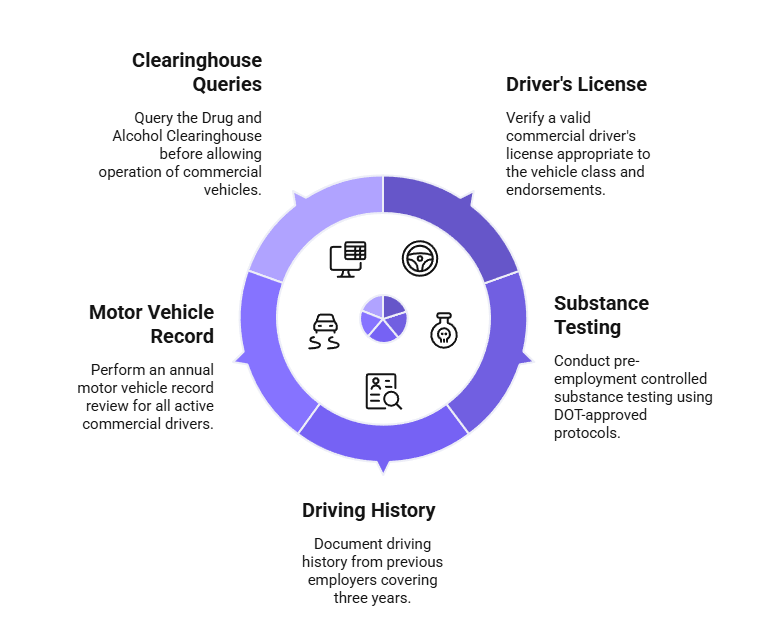
- Valid commercial driver's license verification appropriate to vehicle class and endorsements
- Pre-employment controlled substance testing using DOT-approved protocols
- Driving history documentation from previous employers covering three years
- Annual motor vehicle record review for all active commercial drivers
- Drug and Alcohol Clearinghouse queries before allowing operation of commercial vehicles
Motor vehicle record checks form a separate ongoing obligation distinct from criminal background screening. Federal regulations require annual review of each driver's motor vehicle record with documentation in the driver qualification file. These records reveal traffic violations, license suspensions, and other driving-related incidents that may disqualify a driver under federal safety standards but might not appear in criminal databases.
The Drug and Alcohol Clearinghouse, operational since 2020, functions as a centralized federal database tracking CDL holders who have violated DOT drug and alcohol testing regulations. Employers must query this system before permitting a driver to operate a commercial motor vehicle and conduct annual queries for all employed drivers. Positive results require completion of return-to-duty protocols through a substance abuse professional, including evaluation, treatment or education, follow-up evaluation, and a negative return-to-duty test before resuming safety-sensitive functions.
As HR professionals, we are often required to balance two important responsibilities simultaneously: the need to ensure the safety of the public and the need to adhere to the principles of fair chance employment. The process of screening commercial drivers in Illinois brings this to the forefront in a way that highlights the importance of federal safety regulations and worker protection regulations in the hiring process. The interesting part of this process is that it’s not enough to have the knowledge of the regulations; it’s also important to exercise this knowledge with care and respect for the individuals involved.
Illinois State Layer: Employment Protections and Limitations
The Illinois Employee Rights Act applies statewide and prohibits employers from requesting or considering arrest records that did not result in conviction, with limited exceptions for pending charges directly related to employment circumstances. This restriction applies to all employment decisions, including initial hiring, promotions, and discipline.
Conviction records receive more nuanced treatment under Illinois law. Employers may consider conviction history only when a substantial relationship exists between the criminal conduct and the employment position. This standard requires employers to evaluate the nature of the offense, time elapsed since conviction, evidence of rehabilitation, and specific job duties involved.
The Illinois Human Rights Act creates a rebuttable presumption that individuals are rehabilitated three years after completion of sentence for many offense categories, with specific exceptions and extended timelines for certain convictions. Employers should verify the applicable presumption period based on the specific offense involved, as the three-year period does not apply uniformly to all conviction types.
Cannabis use presents a particularly complex area for commercial driver screening. The Illinois Cannabis Regulation and Tax Act prohibits discrimination based on lawful off-duty cannabis use but explicitly preserves employer rights to enforce federal law requirements. For CDL holders in safety-sensitive positions subject to Department of Transportation testing regulations, employers retain full authority to conduct random testing and take adverse action based on positive results.
Chicago Municipal Requirements: Procedural Overlays
The Chicago Fair Hiring Ordinance imposes additional procedural requirements on employers filling positions that will be performed, in whole or substantial part, within city limits, regardless of where the employer is headquartered. The ordinance delays criminal history inquiries until after a conditional offer of employment has been extended and requires employers to provide specific written notices when conviction history forms the basis for rescinding an offer.
Employers must provide applicants with a copy of the background check report, identify the specific conviction forming the basis for concern, and allow at least five business days for the applicant to respond with evidence of inaccuracy or rehabilitation. This creates timing considerations for employers who need to fill positions quickly, as the mandatory waiting period cannot be compressed.
Best practice involves structuring the conditional offer to explicitly condition employment on both federal qualification requirements and successful completion of all background screening, preserving employer flexibility to respond to disqualifying information discovered through federally mandated databases without violating municipal timing requirements.
Components of Illinois Commercial Driver Background Checks
Commercial driver screening encompasses multiple distinct verification types, each governed by separate legal authorities and serving different risk assessment functions. Different rules control access, permissible use, and retention obligations for each information type.
| Screening Component | Information Source | Primary Legal Authority | Lookback Period |
| Criminal history | Court records, state repositories | FCRA, Illinois Employee Rights Act | Varies by jurisdiction |
| Motor vehicle records | State licensing agencies | FMCSA regulations, DPPA | 3 years (federal minimum) |
| Drug/alcohol violations | Federal Clearinghouse | DOT testing regulations | Lifetime (until cleared) |
| Employment history | Previous employers | FMCSA Part 391.23 | 3 years |
Criminal History Screening: State and Federal Considerations
Criminal background checks for commercial drivers in Illinois typically involve searches of county court records, statewide repositories, and in some cases federal court systems. The Illinois State Police maintains a statewide criminal history repository, with access rules varying based on position type and whether fingerprint-based searches are required.
Employers must distinguish between conviction records, which may be considered subject to substantial relationship analysis, and arrest records, which generally may not be used under the Illinois Employee Rights Act. This creates practical challenges when database reports mix pending charges with historical convictions, requiring screening protocols that identify and separate arrest information before it reaches decision-makers.
Motor Vehicle Record Verification Requirements
Motor vehicle records differ from criminal background checks in both source and content. State licensing authorities maintain these records and document driving history, including traffic violations, license suspensions, at-fault accidents, and administrative actions.
Federal regulations require employers to:
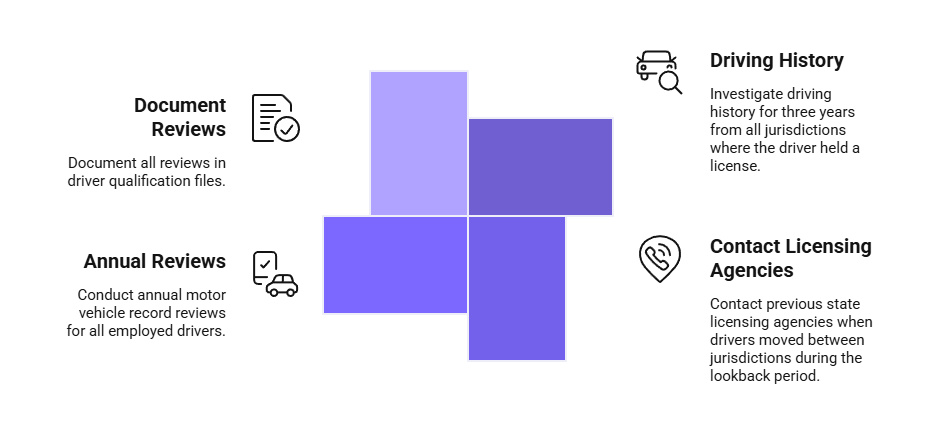
- Investigate driving history for three years from all jurisdictions where the driver held a license
- Contact previous state licensing agencies when drivers moved between jurisdictions during the lookback period
- Conduct annual motor vehicle record reviews for all employed drivers
- Document all reviews in driver qualification files
The Driver's Privacy Protection Act governs access to these records and requires employers to certify permissible use before obtaining information. Failure to conduct multi-state verification can result in regulatory violations even if the driver's current record appears clean.
Federal Clearinghouse and Controlled Substance Testing
The Drug and Alcohol Clearinghouse query functions as a mandatory gateway that employers must clear before allowing any driver to operate a commercial motor vehicle. A positive Clearinghouse result creates an immediate federal disqualification that persists until the driver completes prescribed rehabilitation protocols.
Pre-employment controlled substance testing under Department of Transportation protocols tests for marijuana, cocaine, amphetamines, opioids, and phencyclidine. Medical review officers evaluate test results and consider legitimate medical explanations where DOT protocols allow, though state law variations cannot override federal testing requirements.
Random testing pools require maintaining selection rates meeting federal minimums, with current requirements specifying annual testing of at least 25% of average driver count for controlled substances and 10% for alcohol.
Employment Verification and Previous Employer Inquiries
Federal regulations require employers to document commercial driving employment for the three years preceding application and contact all previous employers from that period where the driver operated commercial motor vehicles to request safety performance history. This must specifically inquire about accidents, violations, and completion of or need for return-to-duty testing.
Federal law requires previous employers to respond to these inquiries, creating a closed-loop information-sharing system that prevents drivers with disqualifying histories from simply changing employers. Illinois employment law protections do not prevent employers from sharing factual safety performance history in response to federally mandated inquiries.
Preemption Analysis: When Federal Rules Override State Protections
Understanding which legal authority controls in conflict situations requires working through preemption principles established by federal transportation law. These principles establish boundaries where federal safety requirements take precedence over conflicting state restrictions.
Interstate Commerce Operations and Federal Authority
The Federal Motor Carrier Safety Administration derives authority from the Commerce Clause and congressional delegation through statutes governing interstate commercial transportation. When regulations are properly promulgated under this authority and directly address safety qualifications for drivers in interstate commerce, they preempt conflicting state requirements that would reduce safety standards or prevent enforcement of federal minimums.
Interstate commerce in this context extends beyond drivers who physically cross state lines. Federal interpretation includes operations where cargo, passengers, or vehicle movements are part of interstate commerce streams, even if specific drivers operate only within Illinois borders.
Safety-Sensitive Position Exemptions to Cannabis Protections
The Illinois Cannabis Regulation and Tax Act explicitly preserves employer authority to comply with federal law, creating a functional exemption from state cannabis protections for positions subject to Department of Transportation testing requirements. This exemption is written directly into the statute, reflecting legislative recognition that federal law would preempt contrary state requirements for safety-sensitive transportation positions.
Key distinctions in cannabis testing authority:
- CDL holders in safety-sensitive positions: Employers retain full testing and adverse action authority under DOT regulations
- Non-safety-sensitive transportation employees: State law protections against cannabis discrimination generally apply
- Medical marijuana cardholders: Federal DOT regulations make no distinction between medical and recreational use
- Random testing protocols: Required for covered positions regardless of state legalization status
The exemption does not extend to non-safety-sensitive positions at transportation companies. Employers must carefully classify positions and apply testing protocols only where federal regulations actually require them.
Individualized Assessment Requirements Under Illinois Law
The Illinois Employee Rights Act and Human Rights Act establish individualized assessment as a mandatory process rather than an optional best practice. This requirement prohibits categorical exclusions based on conviction history categories and instead requires case-by-case evaluation of the relationship between specific criminal conduct and particular job responsibilities.
Elements of Legally Sufficient Individualized Assessment
A compliant individualized assessment examines the nature and gravity of the offense, the time that has passed since conviction or completion of sentence, and the nature of the employment position sought. Employers must consider these factors in relation to each other rather than applying rigid timelines or offense categories.
The assessment should document consideration of information provided by the applicant, including rehabilitation evidence, character references, employment history during the post-conviction period, and changed circumstances. Illinois law does not require employers to accept an applicant's evidence as conclusive, but the assessment must demonstrate that employers reviewed and weighed it.
Written documentation serves both compliance and legal defense functions. Contemporaneous records showing the specific factors considered, the relationship drawn between conviction and job duties, and the individualized nature of the analysis provide evidence that the employer followed legal requirements.
Federal Disqualifications and the Limits of State-Law Individualized Assessment
Federal disqualifications for specific CDL-related offenses create situations where individualized assessment under state law cannot override federal prohibitions. When a driver has been convicted of using a commercial vehicle to commit a felony, federal regulations impose mandatory disqualification periods that vary by offense type. Employers should consult 49 CFR Part 383 and Part 391 to verify applicable disqualification periods for specific offenses.
Employers facing conflicts between federal disqualifications and state individualized assessment requirements should document the federal prohibition as the basis for the adverse decision. This makes clear that the decision stems from legal disqualification rather than employer choice, preserving defenses to state law claims while meeting federal obligations.
Rebuttable Presumption of Rehabilitation and Employer Burden
The Illinois Human Rights Act creates a rebuttable presumption that individuals are rehabilitated three years after completion of sentence for many offense categories. This presumption shifts burden to employers, requiring them to state specific reasons why the conviction continues to present employment-related concerns despite the passage of time.
| Assessment Factor | Employer Obligation | Documentation Standard |
| Nature of offense | Identify specific criminal conduct involved | Cite offense elements, not just charge name |
| Time elapsed | Calculate from sentence completion, not conviction date | Verify probation/parole termination dates |
| Job relationship | Show concrete connection to position duties | Describe specific responsibilities at risk |
| Rehabilitation evidence | Review and weigh applicant-provided information | Document consideration even if unpersuasive |
Rebutting this presumption requires more than generic concerns about trustworthiness. Employers must identify concrete connections between the specific criminal conduct involved and the particular responsibilities of the position at issue. The three-year period runs from completion of sentence, including probation and parole, not from conviction date.
Chicago Fair Hiring Ordinance: Procedural Compliance Requirements
Chicago's municipal overlay creates procedural requirements that apply to all positions filled within city limits. These requirements mandate specific timing and notice procedures without changing substantive standards for when conviction history may justify adverse action.
Conditional Offer Sequencing and Criminal History Inquiry Timing
The ordinance prohibits inquiring about criminal history until after a conditional offer of employment has been extended. Employers must structure their hiring process to complete initial screening, interviews, and offer decisions based on qualifications other than criminal history before accessing conviction records.
The conditional offer must be genuine rather than a procedural workaround. It should specify salary, position duties, start date, and other material terms while conditioning employment on successful completion of background screening. Best practice involves structuring processes so that federal database checks and drug testing occur after conditional offer but before final employment confirmation.
Adverse Action Notice and Response Period Requirements
When conviction history discovered after a conditional offer leads an employer to consider rescinding the offer, the ordinance requires providing specific written notice to the applicant.
Required notice elements include:
- Copy of the background check report showing conviction history
- Identification of the specific conviction(s) raising employment concerns
- Statement of at least five business days for applicant response
- Information about right to provide evidence of inaccuracy or rehabilitation
The five-day period is a minimum, not a maximum. Employers must genuinely consider information provided by applicants during this window. Final adverse action decisions must be provided in writing and include notice of the applicant's right to file a complaint with the Chicago Commission on Human Relations.
Reconciling Municipal Procedures with Federal Safety Disqualifications
Federal disqualifications that make drivers legally ineligible to operate commercial vehicles create tension with Chicago's procedural requirements when discovered post-offer. A risk-mitigated approach involves providing the required Chicago notice and response period even when federal disqualification appears clear, while clearly communicating that federal law prohibits employment during disqualification periods.
Documentation showing federal disqualification as the basis for decision provides the strongest defense to municipal violations claims. Employers should retain records demonstrating that clearinghouse results, motor vehicle records, or specific conviction histories triggered mandatory federal bars rather than discretionary employer policies.
Multi-State Operations and Jurisdictional Complexity
Transportation employers frequently operate across state lines or hire drivers who will work in multiple jurisdictions. This creates compliance challenges as different states impose varying restrictions on background screening and use of criminal history in employment decisions.
Determining Applicable State Law for Multi-Jurisdiction Drivers
Identifying which state's employment laws apply requires analyzing where the employment relationship is formed, where work will primarily be performed, and where the employer maintains its principal place of business. Choice-of-law analysis varies by jurisdiction and depends on multiple factors. No single rule determines applicable law in all situations.
Illinois law generally applies to positions filled for work primarily performed in Illinois, even if the employer is headquartered elsewhere. Employers operating in multiple states often adopt compliance strategies based on the most restrictive state law applicable to any of their operations, applying those standards uniformly.
Regional Operations and Coordinated Compliance Frameworks
Regional carriers operating throughout the Midwest face particularly complex interactions between Illinois employment protections and varying standards in neighboring states.
Comparative state requirements for Midwest transportation employers:
| State | Ban-the-Box | Arrest Record Restrictions | Rehabilitation Presumption |
| Illinois | Conditional offer timing (Chicago only); statewide arrest prohibition | Prohibited except narrow exceptions | 3 years post-sentence |
| Wisconsin | No statewide | Limited protections | No statutory presumption |
| Indiana | No statewide | May consider arrest records | No statutory presumption |
| Michigan | Licensing-specific | Some restrictions | Varies by offense type |
Drivers hired at Illinois facilities for routes that include other states generally remain subject to Illinois employment law for the hiring decision, even if they spend significant time outside the state.
Consent, Disclosure, and Adverse Action Under the FCRA
The Fair Credit Reporting Act establishes procedural requirements for employers who obtain consumer reports from third-party consumer reporting agencies. Whether particular background information constitutes a consumer report depends on the source and assembly method. These requirements are federal and apply uniformly across all states, including Illinois.
Required Disclosures and Authorization Procedures
Employers must provide clear and conspicuous written disclosure that a consumer report may be obtained for employment purposes before procuring the report. This disclosure must be in a standalone document that cannot include extraneous information such as liability waivers or general employment policies.
Written authorization from the applicant is required before the employer may request the report. Illinois law imposes additional notice requirements beyond federal FCRA minimums. Combining federal and state-required notices in a single compliant disclosure document streamlines administration while meeting both sets of obligations.
Pre-Adverse Action and Final Adverse Action Notice Requirements
When information in a consumer report leads an employer to consider taking adverse action, FCRA requires providing pre-adverse action notice before finalizing the decision.
Pre-adverse action notice must include:

- Copy of the consumer report forming the basis for concern
- Written description of consumer rights under FCRA
- Sufficient time for the applicant to review report contents and initiate disputes
- Contact information for the consumer reporting agency
Chicago's five-day requirement for positions within city limits satisfies and exceeds FCRA minimums, creating a unified waiting period that meets both federal and municipal obligations. Final adverse action notice must inform the applicant of the specific action taken, identify the consumer reporting agency that provided the report, and notify the applicant of their right to dispute report accuracy.
Practical Implementation: Building Compliant Screening Protocols
Translating legal requirements into operational screening protocols requires identifying decision points where different rules control, documenting compliance steps, and training personnel who conduct screening and make hiring decisions.
Structuring Compliant Workflows for Illinois CDL Hiring
A compliant Illinois CDL hiring workflow begins with job posting and application processes that avoid prohibited pre-offer criminal history inquiries.
Recommended workflow sequence:
- Post position and accept applications without criminal history questions
- Conduct initial screening based on qualifications, experience, and skills
- Complete interviews focusing on job-related competencies
- Extend conditional offer specifying contingencies including federal and state screening
- Obtain FCRA disclosure, authorization, and Illinois-specific consent documents
- Initiate all required screening components simultaneously
- Route results through compliance personnel trained in individualized assessment
- Provide pre-adverse action notice and waiting period if needed
- Evaluate applicant response and conduct individualized assessment
- Make final decision and provide appropriate notice
Results should be routed through compliance personnel trained in individualized assessment requirements rather than directly to hiring managers who may not understand legal limitations on conviction history use.
Documentation Standards for Legal Defensibility
Each hiring decision involving background screening should generate a compliance file documenting disclosure timing, authorization, conditional offer, screening results receipt, individualized assessment, applicant response to pre-adverse action notice, and final decision rationale.
Federally mandated documents must appear in qualification files subject to regulatory inspection. Individualized assessment documentation involving protected-class considerations should be maintained in personnel files with restricted access to minimize privacy exposure during regulatory audits.
Training Hiring Personnel on Legal Boundaries
Hiring managers and HR personnel conducting commercial driver screening require training on the distinction between federal disqualifications that categorically prevent employment and conviction history that requires individualized assessment.
Critical training topics include:
- Distinction between arrest records (prohibited) and conviction records (permitted with individualized assessment)
- Federal disqualifications that preempt state individualized assessment requirements
- Cannabis testing authority for safety-sensitive versus non-regulated positions
- Chicago Fair Hiring Ordinance procedural requirements
- FCRA pre-adverse and final adverse action notice obligations
- Documentation standards for individualized assessment
Conclusion
Illinois CDL background check requirements demand simultaneous compliance with federal transportation safety mandates, state employment protections, and Chicago municipal procedures. Employers must identify which legal framework controls each aspect of screening, apply individualized assessment where state law requires it, and document federal disqualifications that preempt state protections. Well-functioning workflows, well-trained HR teams, and documentation all help minimize the interfaces between these rules. When compliance is thought of as an operational discipline rather than a checklist, organizations are better equipped to protect their safety, fairness, and workforce sustainability.
Frequently Asked Questions
Can Illinois employers reject CDL applicants based on marijuana use given state cannabis legalization?
Yes, for safety-sensitive positions subject to Department of Transportation testing requirements. The Illinois Cannabis Regulation and Tax Act explicitly preserves employer authority to comply with federal law. DOT regulations require testing and prohibit marijuana use by commercial drivers.
How do Chicago Fair Hiring Ordinance requirements apply when federal disqualifications are discovered?
The ordinance contains no explicit exemption for federally regulated positions. Best practice involves providing required notice and the five-day response period while clearly communicating that federal law prohibits employment during disqualification periods.
What is the difference between motor vehicle record checks and criminal background checks for commercial drivers?
Motor vehicle records document driving history, traffic violations, and license status maintained by state licensing authorities. Criminal background checks reveal arrest and conviction history maintained in court and law enforcement databases. Federal regulations require both types with different access rules and lookback periods.
Does the three-year rehabilitation presumption under Illinois Human Rights Act prevent all use of older convictions?
No. The presumption is rebuttable. Employers can overcome it by stating specific reasons why the conviction continues to present employment-related concerns. Employers must conduct individualized assessments showing concrete connections between the criminal conduct and job responsibilities.
Are Illinois employers required to conduct fingerprint-based criminal background checks for commercial drivers?
Illinois law does not mandate fingerprint-based checks for commercial drivers as a general matter. However, specific carrier types or cargo categories may trigger such requirements under federal security regulations.
How should employers handle situations where previous employers do not respond to federally required safety performance inquiries?
Federal regulations require documentation of good-faith efforts to obtain information even when previous employers cannot be located or fail to respond. Acceptable documentation includes certified mail receipts, records of telephone inquiries, or evidence of business closure.
Can Illinois employers use AI-powered or technology-assisted screening tools for commercial driver background checks?
Technology-assisted screening tools may be used provided they comply with FCRA requirements and do not circumvent Illinois employment protections. Employers remain responsible for ensuring automated systems do not apply blanket disqualification rules.
What record retention requirements apply to commercial driver background check documentation in Illinois?
Federal Motor Carrier Safety Regulations require maintaining driver qualification files, including background check documentation, for three years after driver employment ends. FCRA requires retaining compliance documentation for adverse action decisions for applicable statute of limitations periods.
Additional Resources
- Federal Motor Carrier Safety Administration Driver Qualification Files
https://www.fmcsa.dot.gov/regulations/title49/section/391.51 - Drug and Alcohol Clearinghouse Employer Portal
https://clearinghouse.fmcsa.dot.gov/ - Illinois Department of Human Rights Employment Discrimination Overview
https://dhr.illinois.gov/employment.html - Chicago Commission on Human Relations Fair Hiring Ordinance Guidance
https://www.chicago.gov/city/en/depts/cchr/provdrs/emp/svcs/fair-chance-hiring.html - Federal Trade Commission FCRA Guidance for Employers
https://www.ftc.gov/business-guidance/resources/using-consumer-reports-what-employers-need-know - Illinois Cannabis Regulation and Tax Act Employment Provisions
https://www.ilga.gov/legislation/ilcs/ilcs3.asp?ActID=4333

ABOUT THE CREATOR
GCheck Editorial Team
Meet the GCheck Editorial Team, your trusted source for insightful and up-to-date information in the world of employment background checks. Committed to delivering the latest trends, best practices, and industry insights, our team is dedicated to keeping you informed.
With a passion for ensuring accuracy, compliance, and efficiency in background screening, we are your go-to experts in the field. Stay tuned for our comprehensive articles, guides, and analysis, designed to empower businesses and individuals with the knowledge they need to make informed decisions.
At GCheck, we're here to guide you through the complexities of background checks, every step of the way.