

Illinois employers must navigate overlapping background check restrictions at state, county, and city levels, each with distinct timing rules and applicability thresholds. Understanding where the Employee Background Fairness Act, Cook County ordinances, and Chicago's ban-the-box requirements intersect is critical to maintaining compliant hiring practices.
Key Takeaways
- Illinois operates under a three-layer legal structure governing when and how employers may inquire about criminal history during the hiring process.
- The state Employee Background Fairness Act applies to employers with 15 or more employees and restricts pre-offer criminal history inquiries.
- Chicago's ban-the-box ordinance prohibits asking about criminal history until after a conditional offer for most positions, with additional restrictions on conviction-based disqualifications.
- Cook County maintains separate fair chance hiring rules that may apply differently depending on business location and employee count.
- When state, county, and city laws conflict, employers must generally follow the most restrictive provision applicable to their situation.
- Illinois expungement and sealing statutes remove certain records from public access, making them unavailable for employer consideration.
- Individualized assessment requirements mean employers cannot apply blanket disqualification policies based solely on criminal record categories.
- Compliance requires mapping each hiring decision against geographic location, employer size, position type, and the specific timing of background inquiries.
Understanding Illinois's Layered Legal Framework
Illinois employers navigating background check compliance face a complex regulatory environment where state statutes, county ordinances, and municipal codes operate simultaneously. Unlike states with single, unified fair chance hiring laws, Illinois presents a jurisdictional puzzle that requires employers to identify which combination of rules applies to each specific hiring scenario.
The Three-Layer Structure
The foundation of Illinois background check compliance rests on three distinct legal frameworks:
| Legal Framework | Applicability Threshold | Primary Restriction |
| State Employee Background Fairness Act | 15+ employees | Timing of criminal history inquiries |
| Cook County Ordinance | 1+ employees in county | Pre-application inquiry prohibition |
| Chicago Ban-the-Box | 1+ employees in city | No inquiry until conditional offer |
This stratified approach creates practical challenges because these laws do not simply stack uniformly. They differ in their applicability thresholds, the timing restrictions they impose, the exemptions they recognize, and the individualized assessment standards they require. An employer operating multiple locations across Illinois may find that identical hiring practices comply with law at one facility while violating regulations at another.
When Multiple Frameworks Apply Simultaneously
Determining compliance obligations requires employers to answer several threshold questions for each hiring decision:
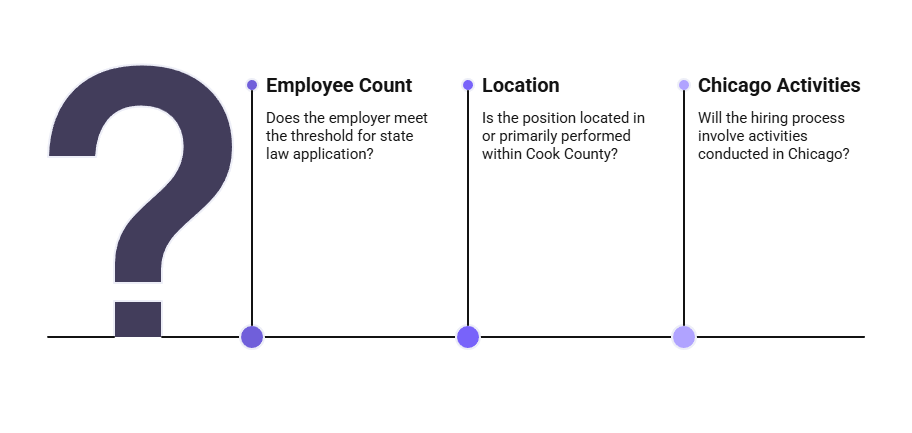
- Does the employer meet the employee-count threshold that triggers state law application?
- Is the position located in or primarily performed within Cook County?
- Will the hiring process involve activities conducted in Chicago?
When multiple frameworks apply to the same hiring decision, employers generally must follow the most protective standard for applicants. This principle means that an employer subject to all three frameworks cannot rely on a state-law exemption if the Chicago ordinance does not recognize that same exemption. The analysis becomes particularly complex when laws impose different timing restrictions, require different forms of individualized assessment, or recognize different categories of exempted positions.
State-Level Requirements: Employee Background Fairness Act
The Illinois Employee Background Fairness Act provides the baseline framework for employers across the state, but its requirements apply only to employers meeting specific criteria. Understanding both the scope and limitations of this state law is essential before layering additional county and municipal obligations.
Applicability and Coverage
The state statute applies to employers with 15 or more employees within Illinois. Employers should verify the specific calculation methodology defined in the statute to determine whether they meet the applicability threshold, particularly during periods of workforce fluctuation.
Certain position categories may fall outside the statute's protections:
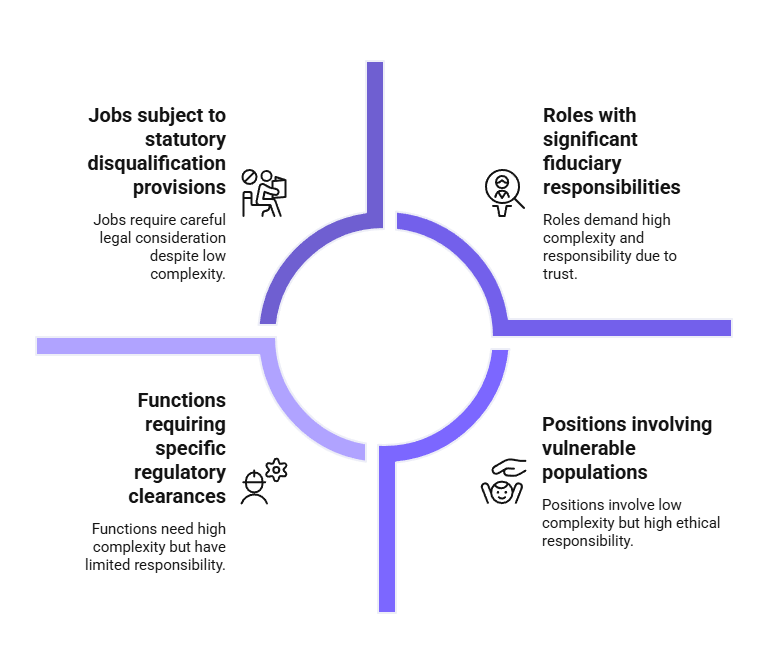
- Positions involving vulnerable populations
- Roles with significant fiduciary responsibilities
- Jobs subject to statutory disqualification provisions
- Functions requiring specific regulatory clearances
Employers must verify that specific positions meet the exemption criteria established in the statute before relying on any exemption.
Criminal History Inquiry Timing
Under state law, covered employers cannot inquire about criminal history or conduct criminal background checks until specific procedural stages are reached. Employers should review the statute's specific timing provisions to determine when criminal history inquiries are permissible for their particular hiring process. This timing restriction applies to application forms, preliminary interviews, and other pre-screening activities.
The statute does not prohibit employers from conducting criminal background checks entirely. Rather, it establishes a procedural sequence designed to ensure that applicants receive preliminary evaluation based on qualifications before criminal history becomes a consideration.
Individualized Assessment Obligations
When criminal history information reveals convictions or other disqualifying records, Illinois employers must conduct an individualized assessment before making adverse employment decisions. This assessment typically considers factors such as the nature and gravity of the offense, time elapsed since conviction or sentence completion, the relationship between the conviction and the job's specific duties, and evidence of rehabilitation. Employers should verify the specific factors required under each applicable legal framework.
Employers should document how these factors relate to the specific position's responsibilities, work environment, and potential risk exposure. This fact-specific analysis protects employers from discrimination claims while allowing legitimate business considerations to inform hiring decisions.
Cook County Fair Chance Hiring Ordinance
Cook County maintains separate criminal history inquiry restrictions that operate independently of state law. Employers with locations or hiring activities in the county must determine whether and how these county-level requirements affect their compliance obligations.
Geographic and Employer Scope
The Cook County ordinance applies to employers with one or more employees working in the county. This broader applicability threshold means significantly more employers fall under county jurisdiction compared to the 15-employee minimum for state law coverage.
Geographic applicability generally relates to where work is performed, meaning employers based outside Cook County may still be subject to the ordinance depending on where employees conduct their duties. Employers should review the ordinance's specific jurisdictional language when employee work locations are unclear or involve multiple locations.
Prohibited Inquiries and Timing Rules
Cook County's ordinance prohibits asking about criminal history on initial employment applications. The specific timing when background checks become permissible differs from state law standards, requiring employers subject to both frameworks to identify and follow the more restrictive timing requirement.
The county ordinance recognizes certain exemptions similar to those found in state law, but the specific position categories and exemption criteria may not align perfectly. Employers cannot assume that a state-law exemption automatically applies at the county level. Each exemption must be verified against the specific language and criteria established in the county ordinance.
Overlap and Conflict Resolution
When Cook County requirements conflict with state standards, employers must determine which provision is more protective of applicant rights and apply that standard. In most cases involving timing restrictions, the law that delays background check inquiries until later in the hiring process represents the more protective standard. For exemptions, employers may only rely on an exemption when both applicable frameworks recognize it for the specific position type.
Chicago Ban-the-Box Ordinance
Chicago imposes the most comprehensive criminal history inquiry restrictions in Illinois. Employers conducting hiring activities within the city must understand both the ordinance's broad prohibitions and its specific procedural requirements.
Covered Employers and Positions
| Coverage Element | Chicago Standard |
| Employer size threshold | 1+ employees |
| Geographic trigger | Hiring activities in city limits |
| Exemption scope | Narrow, position-specific only |
Position-based exemptions exist but are narrowly construed. Employers may not broadly categorize positions as exempt without verifying that the specific role meets the ordinance's exemption criteria. The ordinance's text and implementing guidance from the Chicago Commission on Human Relations provide the authoritative standards for determining exemption eligibility.
Criminal History Inquiry Prohibitions
Chicago's ordinance prohibits inquiries about criminal history until after a conditional offer of employment has been extended. This timing requirement is generally more restrictive than both state and Cook County standards, making it the controlling framework for employers subject to all three layers of regulation.
The prohibition extends to:
- Application forms
- Interview questions
- Pre-offer background checks
- Third-party screening services before conditional offer
Employers cannot use third-party screening services to conduct criminal background checks before extending a conditional offer, even if the employer itself does not directly ask the applicant about criminal history.
Conditional Offer and Adverse Action Process
When a background check conducted after conditional offer reveals potentially disqualifying information, Chicago's ordinance establishes specific procedural steps employers must follow:

- Provide written notice to the applicant
- Include a copy of the background check report
- Identify the specific convictions forming the basis for potential adverse action
- Offer the applicant an opportunity to respond
- Allow sufficient time for rebuttal or clarification
Employers must provide applicants with the response timeframe specified in the ordinance to allow for evidence of rehabilitation, demonstration of factual errors, or presentation of mitigating circumstances.
The Individualized Assessment Requirement
Chicago's ordinance requires a detailed individualized assessment that considers multiple factors beyond the basic elements required by state law. Employers must evaluate the relationship between the conviction and the position's specific duties, the time elapsed since the conviction, evidence of rehabilitation, employment history since the conviction, and other relevant mitigating factors the applicant presents.
This assessment must be documented in writing. The documentation requirement serves both compliance verification and legal defense purposes, demonstrating that the employer conducted the required analysis rather than applying a blanket disqualification policy.
Expungement, Sealing, and Recordkeeping Restrictions
Illinois law provides mechanisms for individuals to expunge or seal certain criminal records, removing them from public access and, in many cases, from lawful consideration by employers.
Expungement Versus Sealing
| Record Modification Type | Effect on Records | Availability |
| Expungement | Physical destruction or return | Arrests not leading to conviction, certain supervision outcomes, specific minor offenses |
| Sealing | Access restricted, not destroyed | Broader range of convictions, subject to waiting periods and eligibility requirements |
When a record is expunged, it is treated as if the underlying incident never occurred. Sealing typically restricts records from public access and standard background check searches, though access may remain available to specific entities as defined by statute. Employers should not assume sealed records are available for employment screening purposes.
Employer Obligations When Records Are Modified
When a record has been lawfully expunged or sealed under Illinois statutes, employers generally cannot consider that record in employment decisions made on the basis of formal criminal background checks. The treatment of information obtained through other means may be subject to additional legal considerations. Employers should consult legal counsel when questions arise about information obtained outside standard background check processes.
Applicants whose records have been expunged or sealed have the right to respond to inquiries as if the arrest or conviction never occurred. Employers cannot penalize applicants for failing to disclose expunged or sealed records, nor can they base employment decisions on information about incidents that have been removed from the record through these legal processes.
Verification and Compliance Challenges
Employers cannot always determine from the face of a background check report whether records have been expunged or sealed. Consumer reporting agencies compiling reports from public databases should not include expunged records, and sealed records should not appear in standard background checks.
When employers receive information suggesting that an applicant has a criminal history that does not appear on a formal background check report, they should not assume the record was incorrectly omitted. The absence of records in formal databases may indicate lawful expungement or sealing. Employers who pursue informal verification or rely on non-database information sources risk violating recordkeeping restrictions and anti-discrimination provisions.
Practical Compliance Mapping for Illinois Employers
Translating legal requirements into operational hiring procedures requires employers to develop decision frameworks that account for all applicable regulatory layers.
Step One: Determine Employer Coverage
Employers should first assess which legal frameworks apply to their organization:
- Calculate total Illinois employee counts using the methodology specified in the state Employee Background Fairness Act to determine applicability. Employers uncertain about how to count specific worker categories should consult legal counsel.
- Identify whether any positions are located in or primarily performed within Cook County
- Determine whether hiring activities, including interviews and candidate assessment, occur within Chicago city limits
This initial assessment establishes the baseline compliance obligations before evaluating position-specific factors. Employers operating multiple facilities should conduct this analysis separately for each location, recognizing that obligations may differ across the organization.
Step Two: Evaluate Position-Specific Exemptions
For positions that may qualify for exemptions, verify exemption eligibility against each applicable framework separately. Do not assume that exemptions recognized in one legal framework automatically apply under another.
Document the basis for exemption determinations, including the specific regulatory provisions relied upon and the position characteristics that satisfy exemption criteria. While documentation supports compliance processes, employers must ensure exemption determinations are substantively correct under applicable law.
Step Three: Establish Inquiry Timing
| Compliance Step | Action Required |
| Identify most restrictive timing | Compare all applicable frameworks |
| Adopt unified standard | Apply Chicago timing when all three laws apply |
| Standardize procedures | Use consistent timing across covered positions |
For positions not subject to exemptions, adopting the most restrictive timing standard applicable to the organization can simplify compliance administration. Employers utilizing exemptions for specific positions should ensure exemption application is clearly documented and justified under all applicable frameworks.
Step Four: Develop Individualized Assessment Protocols
Create documented procedures for conducting individualized assessments that satisfy the most comprehensive standards applicable to the organization:
- Identify the factors that will be considered
- Establish who will conduct the assessment
- Specify documentation requirements
- Train hiring managers and HR personnel
Training hiring managers and HR personnel on individualized assessment requirements is essential. Decision-makers must understand that blanket disqualification policies are prohibited and that each case requires fact-specific analysis relating criminal history to legitimate business considerations.
Step Five: Implement Adverse Action Procedures
When background check results may lead to adverse employment decisions, follow procedural requirements from all applicable frameworks, including federal Fair Credit Reporting Act notice obligations when consumer reporting agencies provide the background information.
Provide applicants with required notices, copies of reports, and opportunities to respond before finalizing adverse decisions. Track timing requirements for applicant responses and document all communications. Maintain records of the information provided to applicants, the opportunities offered for explanation or rebuttal, and the final decision rationale following individualized assessment.
Conclusion
Illinois employers must navigate a complex, multi-jurisdictional framework when conducting criminal background checks, with compliance requirements varying based on employer size, geographic location, and position type. Understanding where state, county, and city requirements intersect, and applying the most protective standard when laws overlap, reduces legal risk while supporting fair hiring practices.
Frequently Asked Questions
What is the difference between Illinois state background check laws and Chicago's ban-the-box ordinance?
State law applies to employers with 15 or more employees and restricts when criminal history inquiries may occur during the hiring process. Chicago's ordinance applies to nearly all employers operating in the city and generally prohibits criminal history inquiries until after a conditional offer, which is typically more restrictive than state requirements. Employers must comply with both frameworks when both apply.
When can Illinois employers legally ask about an applicant's criminal history?
The timing depends on which legal frameworks apply to the employer and position. Under state law, covered employers may inquire about criminal history at specific stages defined in the statute. Employers should verify which timing standard applies to their hiring process and position type. Chicago's ban-the-box ordinance requires waiting until after a conditional offer for most positions.
Do Illinois background check laws apply to small businesses with fewer than 15 employees?
The state Employee Background Fairness Act applies only to employers with 15 or more Illinois employees. However, businesses operating in Cook County or Chicago remain subject to county and city ordinances, which have lower or no employee-count thresholds. Small employers in these jurisdictions must comply with local requirements even if state law does not cover them.
What happens to criminal records that have been expunged or sealed in Illinois?
Expunged records are destroyed or removed from the system and must be treated as if the underlying incident never occurred. Sealed records are typically restricted from public access and standard background check searches. Employers generally cannot consider expunged or sealed records in employment decisions, and applicants may legally respond to inquiries as though these incidents did not occur.
Can Illinois employers use blanket policies that automatically disqualify applicants with certain types of convictions?
No. Illinois law at state, county, and city levels requires individualized assessment of criminal history before making adverse employment decisions. Employers must consider the nature and gravity of the offense, time elapsed, and relationship to the specific position. Automatic disqualification policies based solely on conviction categories or record existence violate these individualized assessment requirements.
How do Illinois employers comply when state, county, and city laws conflict?
When multiple frameworks apply and they conflict, employers should generally follow the most protective standard for applicants. This typically means applying the most restrictive timing requirement, conducting the most comprehensive individualized assessment, and only relying on exemptions recognized by all applicable frameworks. Legal counsel familiar with Illinois employment law can help identify the appropriate standard when conflicts arise.
Are there positions exempt from Illinois criminal history inquiry restrictions?
Yes, but exemptions vary across state, county, and city frameworks and must be verified for each applicable law. Exemptions generally exist for positions involving vulnerable populations, significant fiduciary responsibilities, or roles subject to statutory disqualification provisions. Employers cannot broadly apply exemptions without confirming that the specific position meets the criteria established in each applicable legal framework.
What documentation should Illinois employers maintain regarding criminal background check decisions?
Employers should document which legal frameworks apply to each position, the timing of criminal history inquiries, the individualized assessment conducted for any potentially disqualifying information, and the factors considered in making final employment decisions. This documentation demonstrates compliance efforts and provides support in enforcement proceedings or discrimination claims.
Additional Resources
- Illinois Employee Background Fairness Act Overview
https://www.ilga.gov/legislation/ilcs/ilcs3.asp?ActID=3559&ChapterID=68 - Chicago Commission on Human Relations Fair Chance Ordinance Guidance
https://www.chicago.gov/city/en/depts/cchr.html - Illinois State Police Criminal History Record Information
https://isp.illinois.gov/Foia/CriminlHistoryRecInfo - U.S. Equal Employment Opportunity Commission Background Checks Guidance
https://www.eeoc.gov/laws/guidance/enforcement-guidance-consideration-arrest-and-conviction-records-employment-decisions - Federal Trade Commission Fair Credit Reporting Act Resources
https://www.ftc.gov/legal-library/browse/statutes/fair-credit-reporting-act

ABOUT THE CREATOR
GCheck Editorial Team
Meet the GCheck Editorial Team, your trusted source for insightful and up-to-date information in the world of employment background checks. Committed to delivering the latest trends, best practices, and industry insights, our team is dedicated to keeping you informed.
With a passion for ensuring accuracy, compliance, and efficiency in background screening, we are your go-to experts in the field. Stay tuned for our comprehensive articles, guides, and analysis, designed to empower businesses and individuals with the knowledge they need to make informed decisions.
At GCheck, we're here to guide you through the complexities of background checks, every step of the way.