
LEGAL & COMPLIANCE

Explore the benefits of an I-9 form management system to streamline compliance and reduce administrative burdens during audits.
Created by

I-9 form management systems have evolved from simple document storage solutions into comprehensive compliance platforms that address the complexities of remote workforce verification, audit preparedness, and evolving federal requirements. As organizations navigate heightened ICE enforcement activity and expanded remote work policies in 2026, sophisticated I-9 management technology has become essential infrastructure for mitigating compliance risk while maintaining operational efficiency across distributed teams.
The Immigration Reform and Control Act of 1986 established mandatory employment eligibility verification requirements for all U.S. employers. Every employer must complete Form I-9 for each employee hired after November 6, 1986, documenting the verification of identity and employment authorization. This federal mandate applies universally, regardless of company size, industry, or location.
Form I-9 consists of three sections that create a documented chain of verification:
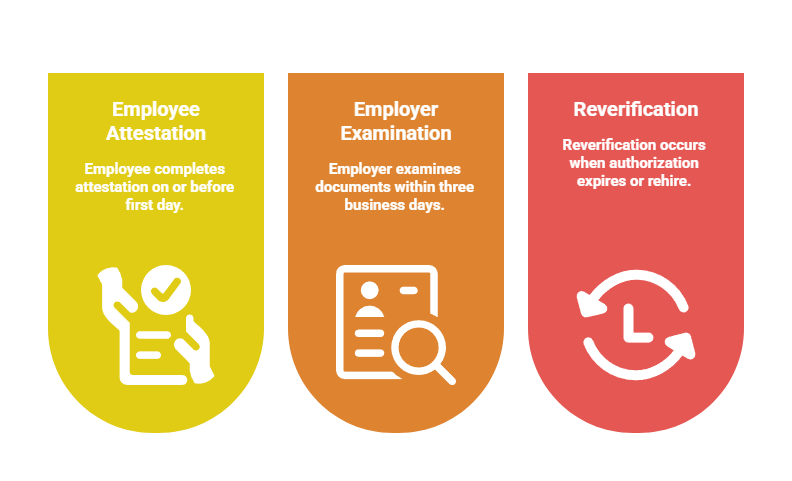
Under standard requirements, employers must retain I-9 forms for three years after the date of hire or one year after employment termination, whichever is later, though longer retention may be required in cases involving pending litigation or government investigations. During this retention period, forms must remain accessible for inspection by authorized government officers from the Department of Homeland Security, Department of Labor, or Department of Justice.
U.S. Immigration and Customs Enforcement conducts thousands of I-9 audits annually, with violation penalties adjusted for inflation each year. Actual penalties vary based on violation type, employer history, and other factors ICE considers during enforcement actions. Technical violations carry substantial penalties when patterns demonstrate lack of good faith compliance efforts.
| Violation Type | Typical Penalty Range | Common Examples |
| Technical Violations | $272 - $2,701 per form | Missing signatures, incorrect dates, incomplete fields |
| Substantive Violations | $272 - $2,701 per form | Failure to verify, accepting unacceptable documents |
| Knowing Hire Violations | $676 - $27,018+ per unauthorized worker | Employing workers without valid authorization |
Beyond direct financial penalties, I-9 compliance failures create operational disruption and reputational damage. Organizations facing ICE audits typically invest substantial legal and administrative resources responding to Notices of Inspection. In cases involving pattern and practice violations, criminal prosecution of company officers is possible, though the majority of I-9 enforcement actions involve civil penalties rather than criminal charges.
Traditional paper-based I-9 processes introduce multiple failure points that compound as organizations grow. Hiring managers across different locations may receive inconsistent training on acceptable documents, proper examination procedures, and timing requirements.
Manual systems create these critical vulnerabilities:
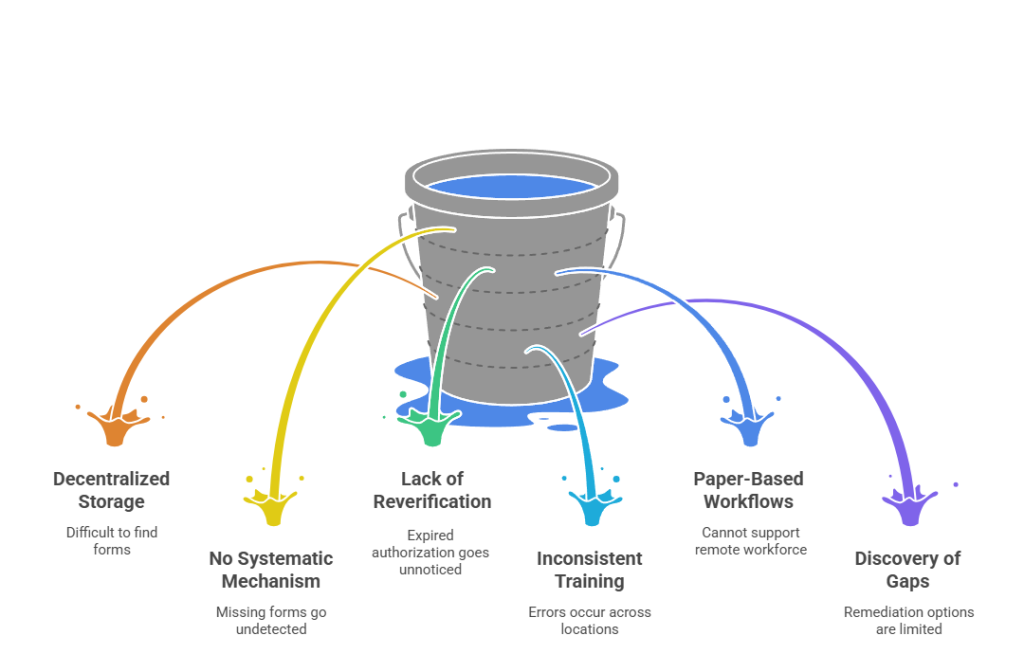
Remote and hybrid work models introduced additional complexity that manual systems cannot adequately address. Organizations discover compliance gaps only during internal audits or ICE inspections, when penalties may be imminent.
Modern I-9 form management systems guide users through compliant form completion with real-time validation that helps prevent common errors before they occur. Smart forms automatically check for required fields, flag inconsistent information, and help guide proper document list selections.
Electronic signature capabilities streamline the execution process while maintaining legal validity. Employees can complete Section 1 remotely using secure authentication, with system-generated timestamps documenting compliance with timing requirements. The technology creates an auditable record showing exactly when each section was completed.
Systematic document examination workflows help employers meet the three-business-day deadline while properly reviewing acceptable documents. The system assigns document review tasks to authorized personnel, tracks when documents were presented, and records specific document details required for compliant Section 2 completion.
Digital document imaging capabilities allow employers to create and store copies of presented documents:
For organizations using authorized representatives for document examination, the system maintains current representative information and helps ensure representatives complete required attestations.
E-Verify participation is mandatory for federal contractors and employers in certain states, while remaining voluntary for most private employers. Organizations that participate in E-Verify must create cases for all new hires, following strict timing and procedural requirements.
Integrated platforms eliminate manual data entry by populating E-Verify cases directly from completed I-9 forms. The system helps enforce proper sequencing by preventing E-Verify case creation before I-9 Section 1 completion or after the three-day document examination window closes. When E-Verify returns Tentative Nonconfirmations, integrated systems manage the employee notification process and track response deadlines.
Employment authorization documents have varying expiration dates that require systematic tracking to help prevent gaps in work authorization. I-9 management systems monitor document expiration dates and trigger reverification workflows before authorization expires.
| Document Type | Typical Validity Period | Reverification Requirement |
| Permanent Resident Card | 10 years (conditional: 2 years) | Required upon expiration |
| Employment Authorization Document | Varies (typically 1-2 years) | Required upon expiration |
| Foreign Passport with I-94 | Varies by visa type | Required when authorization expires |
| U.S. Passport | 10 years (adult) / 5 years (minor) | Not required for citizens |
Automated notifications alert HR personnel and employees of approaching deadlines, providing sufficient time to complete reverification procedures. The reverification process in Section 3 requires specific procedures depending on the employee's authorization type. For organizations with large populations of employees on temporary work authorization, automated expiration tracking becomes essential infrastructure.
Comprehensive audit trails document every action taken on I-9 forms, creating defensible records that demonstrate good faith compliance efforts. The system logs when forms were accessed, what changes were made, who made changes, and the business justification for corrections or updates.
Real-time compliance reporting allows HR leaders to identify systematic issues before they become widespread problems:
This visibility enables proactive remediation rather than reactive crisis management. Organizations can generate reports showing all forms with specific characteristics, making it feasible to conduct regular internal audits even with thousands of employees.
Enterprise I-9 management requires carefully controlled access to sensitive information distributed across multiple stakeholders. Role-based permissions help ensure hiring managers can initiate I-9 processes for their new hires while HR administrators can monitor compliance and conduct audits.
Workflow automation routes forms to appropriate personnel based on organizational structure and employment type. When an employee completes Section 1, the system automatically notifies the designated document examiner. After Section 2 completion, the form routes to HR for final review. Integration with applicant tracking systems eliminates duplicate data entry and helps ensure I-9 processes initiate automatically when offers are accepted.
The Department of Homeland Security implemented temporary flexibility for remote document examination during the COVID-19 pandemic. As of January 2026, DHS has continued to authorize alternative remote examination procedures, though organizations should monitor official USCIS guidance as these temporary measures remain subject to modification or termination. Employees working exclusively in remote status can have their documents inspected via video call under current guidance.
Organizations utilizing alternative examination procedures must maintain detailed documentation:
The alternative procedure may require employers to conduct in-person document examination when employees transition to in-person work or if temporary flexibility provisions change. Systems track which employees were verified remotely and trigger required in-person examination workflows when applicable.
Organizations with employees in locations without on-site HR staff may designate authorized representatives to conduct document examination. Authorized representatives may include various individuals such as notaries or personnel at remote locations, subject to restrictions including that they cannot be the employee's relative or have certain financial interests in the hire. Organizations should consult current USCIS guidance when designating authorized representatives.
I-9 management platforms maintain authorized representative networks, including current contact information and location coverage. When new hires are located in areas requiring authorized representative services, the system automatically routes document examination tasks to appropriate representatives. The technology facilitates secure communication while maintaining confidentiality.
Hybrid work arrangements create ongoing verification challenges as employees transition between remote and in-office status. I-9 management systems must accommodate initial remote verification followed by in-person examination, or vice versa, while maintaining clear records of which procedures were followed.
Mobile-responsive platforms enable employees and employers to complete I-9 requirements on any device. Cloud-based systems help ensure real-time synchronization so all stakeholders access current information regardless of location or device. Digital signature technology paired with identity verification measures provides secure form execution without requiring physical presence.
Successful I-9 management system implementation begins with comprehensive assessment of current processes and compliance status. Organizations should evaluate their current I-9 population, error rates, storage methods, and audit history to establish baseline compliance metrics.
Key assessment factors include:
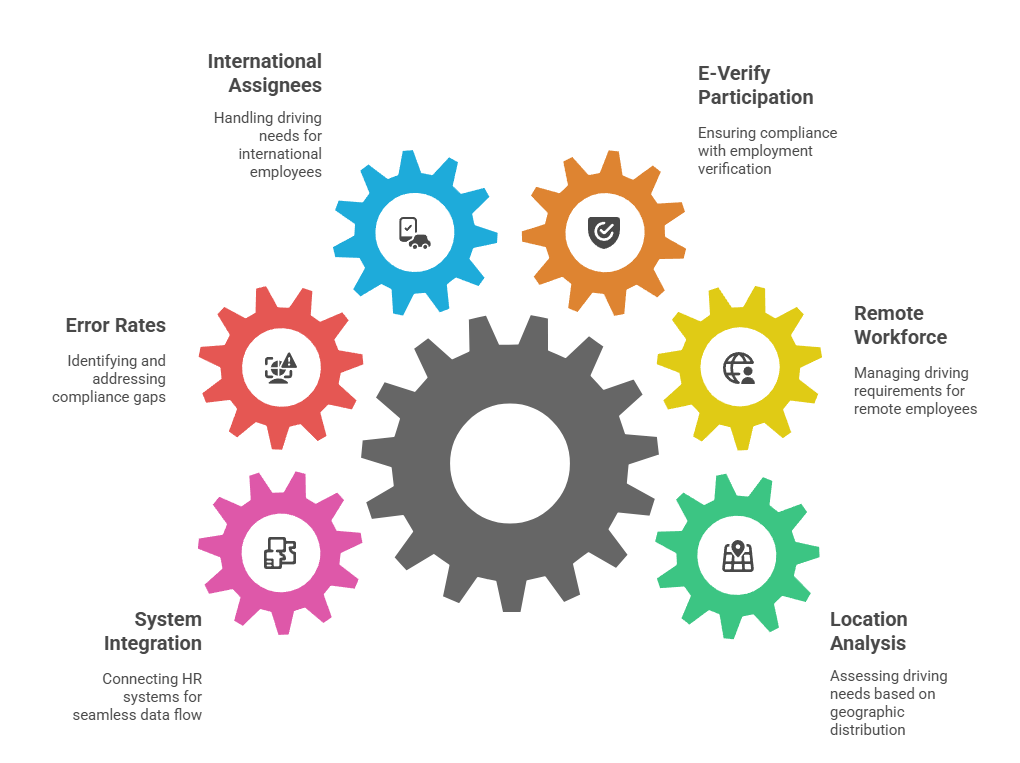
Stakeholder input from HR, legal, IT, and business units helps ensure the selected system addresses actual operational needs. Systems that seamlessly exchange data with applicant tracking systems and payroll platforms deliver greater value than standalone solutions requiring duplicate data entry.
Technology implementation succeeds only when users adopt new systems and follow established processes. Comprehensive training programs for HR staff, hiring managers, and employees help ensure all stakeholders understand their roles and can navigate system functionality.
Organizations should develop role-specific training content that focuses on the tasks each user group performs:
Ongoing support resources facilitate long-term adoption as new personnel join the organization. Regular refresher training keeps compliance knowledge current as regulations evolve.
I-9 management systems provide tools for ongoing compliance monitoring, but organizations must establish processes for regular review. Designated compliance personnel should conduct weekly reviews of pending actions, approaching deadlines, and flagged issues.
| Monitoring Activity | Recommended Frequency | Key Focus Areas |
| Pending Action Review | Weekly | Incomplete forms, missing signatures, approaching deadlines |
| Compliance Dashboard Review | Weekly | Error patterns, training needs, systematic issues |
| Internal Audit Sample | Quarterly | Random sample for substantive and technical compliance |
| Reverification Tracking | Monthly | Upcoming expirations, completed reverifications |
| System Access Review | Quarterly | Role assignments, terminated user access |
Internal audit schedules should include quarterly or semi-annual I-9 compliance reviews using system reporting capabilities. When internal audits identify issues, organizations should document remediation efforts within the I-9 management system itself. This creates a complete compliance record showing the organization's good faith efforts to correct issues.
Immigration law requires organizations to store I-9 forms separately from other personnel records to help prevent unauthorized access and facilitate production during government inspections. While this physical separation was straightforward with paper forms, electronic systems must implement access controls that achieve the same protective effect.
I-9 management platforms should restrict access to employment eligibility information, preventing individuals who do not have legitimate business need from viewing I-9 data. This separation also helps protect against potential discrimination issues by limiting hiring manager access to citizenship status information or document types that might reveal national origin. Organizations must maintain similar separation for E-Verify information.
The Immigration and Nationality Act prohibits document abuse and discrimination based on citizenship status or national origin. Employers cannot specify which acceptable documents employees must present, reject reasonably genuine-appearing documents, or apply different verification standards.
Compliant I-9 systems incorporate these anti-discrimination protections:
When organizations identify suspected fraudulent documents, they must follow specific procedures that avoid discrimination. Systems can facilitate appropriate escalation while avoiding the appearance of disparate treatment.
ICE generally provides three business days' notice when issuing a Notice of Inspection for I-9 audits. Organizations using I-9 management systems are typically able to generate I-9 packages for current and terminated employees more quickly than with manual systems, which may help facilitate responses to government inspections.
The Notice of Inspection specifies which forms must be produced and the timeframe for production. System reporting capabilities allow organizations to quickly identify and produce requested records in organized formats. Organizations should conduct mock ICE audits periodically using the same procedures they would follow during actual inspections.
Emerging digital identity technologies may transform employment eligibility verification in coming years. Biometric verification, blockchain-based identity credentials, and mobile driver's licenses could eventually reduce reliance on physical document examination while enhancing security.
Several states have begun issuing mobile driver's licenses that allow digital presentation and verification of identity documents:
As these digital credentials gain acceptance for I-9 purposes, management systems will need to incorporate technology for secure digital document examination. Organizations implementing I-9 management systems in 2026 should consider platform flexibility to accommodate emerging verification technologies.
Advanced I-9 management platforms are beginning to incorporate artificial intelligence capabilities that analyze patterns across large form populations to identify potential compliance risks. These systems can flag anomalies such as unusual document combinations or systematic errors by specific document examiners.
Predictive analytics may help identify employees at elevated risk for authorization expiration based on document type and historical patterns. Organizations should evaluate these emerging capabilities carefully, ensuring AI-enhanced systems provide explainable recommendations rather than black-box decisions. Human oversight remains essential for compliance decisions that carry legal and ethical implications.
Immigration reform proposals regularly surface in Congress, with potential impacts on employment eligibility verification requirements. Some proposals would expand E-Verify to all employers, while others would modify acceptable document lists or introduce new verification methods.
Organizations should monitor legislative developments and ensure their I-9 management systems can adapt to regulatory changes. Platform providers that maintain systems in accordance with current regulations and deploy updates automatically provide stronger protection against compliance gaps. The Department of Homeland Security periodically updates Form I-9 itself, introducing revised versions that employers must use after specified transition periods.
I-9 form management systems have evolved into essential compliance infrastructure for organizations navigating complex employment eligibility verification requirements in 2026. By helping transition traditionally manual, error-prone processes toward more automated workflows with built-in validation and audit capabilities, these platforms support organizations in working toward federal compliance objectives while reducing administrative burden and helping to mitigate potential violation risks.
An I-9 form management system is a technology platform that automates employment eligibility verification, providing electronic form completion, document examination workflows, and compliance reporting. Organizations benefit from these systems because manual I-9 processes frequently produce substantial error rates, exposing companies to significant penalties per form violation. Modern systems help reduce administrative burden while improving compliance accuracy through real-time validation and centralized record-keeping.
Yes, electronic I-9 systems are fully compliant with federal requirements when they meet specific regulatory standards outlined in USCIS guidance. Electronic systems must ensure document integrity, include audit trails tracking all form access, implement access controls, enable electronic signatures with identity verification, and allow forms to be retrieved for government inspections. The Department of Homeland Security has explicitly approved electronic I-9 completion and storage.
I-9 management systems accommodate remote employees through alternative examination procedures currently authorized by the Department of Homeland Security. These systems typically include video conferencing integration for remote document examination, screen capture capabilities, structured workflows ensuring all steps are completed, and tracking mechanisms identifying which employees may require in-person examination when they transition to in-office work. Organizations may also designate authorized representatives at remote locations.
I-9 compliance is the mandatory federal requirement for all U.S. employers to verify identity and employment authorization using Form I-9. E-Verify is an optional electronic system that most employers may voluntarily use to confirm employment eligibility by matching I-9 information against government databases. E-Verify is mandatory only for federal contractors and employers in certain states with participation requirements.
Under standard requirements, employers must retain I-9 forms for three years after the date of hire or one year after employment termination, whichever is later, though longer retention may be required in cases involving pending litigation, government investigations, or other legal circumstances. I-9 management systems automatically calculate retention deadlines, help prevent premature deletion of forms, archive forms that have met retention requirements, and generate retention compliance reports.
During an ICE I-9 audit, employers receive a Notice of Inspection requiring production of I-9 forms within three business days. I-9 management systems support audits by helping generate form sets more quickly, producing organized digital or printed packages with documentation, creating audit reports showing compliance status, and providing detailed audit trails demonstrating good faith compliance efforts. These capabilities may help facilitate government inspection responses.
I-9 management systems help reduce the likelihood of compliance violations by providing tools to avoid common technical errors and automate tracking of timing-sensitive requirements. However, systems cannot guarantee zero violations because compliance also depends on proper document examination by trained personnel, appropriate system usage following established procedures, and timely action on system-generated alerts. Organizations achieve best results by combining robust technology with comprehensive training, clear policies, and regular internal audits.
The most common I-9 errors include missing signatures, incorrect or missing dates, unchecked boxes, accepting expired documents, failing to complete reverification when authorization expires, improper corrections, missing employer information, accepting unacceptable document combinations, and exceeding the three-business-day deadline. I-9 management systems help address these errors through required field validation, automated signature capture with timestamps, real-time checking of document expiration dates, and automated deadline alerts.
Modern I-9 management systems integrate with applicant tracking systems to automatically initiate I-9 processes when offers are accepted, connect with human resource information systems to synchronize employee data, link to onboarding platforms to coordinate all new hire compliance activities, and interface with payroll systems. Integration methods include application programming interfaces for real-time data exchange, single sign-on for unified user experience, and automated file transfers for batch data updates.
Organizations should evaluate systems based on compliance features including current form versions with automatic updates, comprehensive validation helping prevent common errors, E-Verify integration if applicable, and audit trail capabilities. Additional considerations include user experience factors such as intuitive interfaces, mobile accessibility, multilingual support, and integration capabilities with existing HR technology. Organizations should also assess vendor regulatory expertise, customer support quality, implementation services, and long-term platform stability.
Meet the GCheck Editorial Team, your trusted source for insightful and up-to-date information in the world of employment background checks. Committed to delivering the latest trends, best practices, and industry insights, our team is dedicated to keeping you informed.
With a passion for ensuring accuracy, compliance, and efficiency in background screening, we are your go-to experts in the field. Stay tuned for our comprehensive articles, guides, and analysis, designed to empower businesses and individuals with the knowledge they need to make informed decisions.
At GCheck, we're here to guide you through the complexities of background checks, every step of the way.

Contact us today for efficient, FCRA-compliant screening solutions
designed to keep your hiring process moving safely and smoothly.



LEGAL DISCLAIMER: The information provided in this article is for general informational and educational purposes only and should not be construed as legal advice or a substitute for consultation with qualified legal counsel. While we strive to ensure accuracy, employment screening laws and regulations—including but not limited to the Fair Credit Reporting Act (FCRA), Equal Employment Opportunity Commission (EEOC) guidelines, state and local ban-the-box laws, industry-specific requirements, and other applicable federal, state, and local statutes—are subject to frequent changes, varying interpretations, and jurisdiction-specific applications that may affect their implementation in your organization. Employers and screening decision-makers are solely responsible for ensuring their background check policies, procedures, and practices comply with all applicable laws and regulations relevant to their specific industry, location, and circumstances. We strongly recommend consulting with qualified employment law attorneys and compliance professionals before making hiring, tenant screening, or other decisions based on background check information.