

Verifying international work history requires navigating jurisdiction-specific legal frameworks, documentation standards, and operational constraints that differ substantially from domestic processes. Organizations must adopt risk-based verification strategies that account for employer non-response, documentary evidence quality, and data privacy requirements across borders.
Key Takeaways
- Direct employer contact remains the gold standard but success rates vary significantly by country due to language barriers, data protection laws, and organizational policies.
- Acceptable documentary evidence varies by jurisdiction, with some countries mandating specific certificates while others rely on tax records or statutory declarations.
- GDPR in the European Union and similar comprehensive data protection laws in many countries now require explicit candidate consent before contacting foreign employers for reference information.
- Verification timelines range from 3 days in digitally mature markets to 6+ weeks in jurisdictions requiring consular authentication or manual record retrieval.
- Employer non-response does not indicate deception and often reflects normal business practice in jurisdictions where reference-giving exposes organizations to defamation liability.
- Risk assessment frameworks allow evidence-based hiring decisions when complete verification proves operationally impossible or disproportionately expensive.
- Translation requirements depend on use case, with informal translation sufficient for initial review but certified translation necessary for I-9 compliance or litigation defense.
- Common failures include mistaking HR outsourcing transitions for fraudulent claims and accepting candidate-provided documents without independent validation.
Understanding Verification Method Options
Organizations learning how to check work history internationally must first recognize that verification is not a single process but a decision tree. The path forward depends on the jurisdiction where employment occurred, available documentation, and role-specific risk tolerance.
| Verification Method | Success Rate | Best Use Case | Primary Limitation |
| Direct Employer Contact | Varies significantly by country (lowest in Asia, highest in English-speaking countries) | Large established employers | Language barriers, legal restrictions |
| Documentary Evidence | Moderate to high when available | Countries with mandated certificates | Fraud risk, authentication complexity |
| Third-Party Services | Higher for established providers with local networks | Senior roles, high-value hiring | Cost, timeline extension |
| Inferential Verification | Lower reliability threshold | Junior roles, skill-based assessment | Reduced confidence level |
Direct Employer Contact
Contacting the former employer's human resources department remains the most reliable verification method when successful. The verifier confirms dates of employment, job title, and sometimes performance through conversation with personnel who access authoritative records.
Success rates vary dramatically by country:
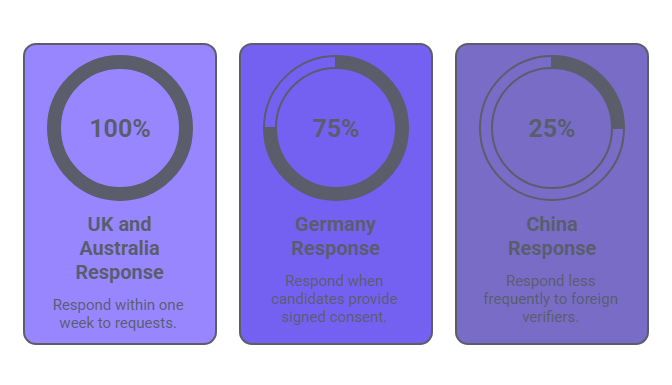
- UK and Australia: Typically respond within one week to properly formatted requests
- Germany: Generally respond when candidates provide signed consent forms referencing GDPR requirements
- China: Respond less frequently to requests from foreign verifiers, with particularly low response rates for employers outside major cities
Direct contact fails predictably in several scenarios. Companies that ceased operations cannot respond. Employers that outsourced HR functions often destroyed historical records. Jurisdictions where defamation liability exists cultivate blanket non-response policies.
Documentary Evidence Review
When employer contact fails, documentary evidence provides verification alternatives if documents meet jurisdiction-specific authenticity standards. Acceptable documents vary substantially. France issues certificats de travail that employers must provide at separation. The UAE requires service certificates for visa processing. The Philippines relies on certificates of employment accompanied by payslips and bank statements.
Documentary evidence introduces fabrication risk that direct employer contact avoids. Sophisticated document fraud operations produce convincing replica letters, certificates, and tax forms complete with forged signatures and official seals.
Third-Party Verification Services
Specialized services maintain employer contact networks, in-country staff, and proprietary databases that improve verification success rates. These services handle language translation, navigate local data protection requirements, and understand jurisdiction-specific documentation standards.
Service quality varies considerably. Established providers maintain direct relationships with HR departments at multinational corporations, achieving higher verification rates for large employers. Cost and timeline trade-offs make third-party services appropriate for senior roles but impractical for volume hiring of junior talent.
Inferential Verification
When other methods fail, verifiers may examine multiple weak signals that collectively suggest employment legitimacy. These signals include LinkedIn employment dates matching resume claims, professional licenses issued during claimed employment periods, and reference letters from supervisors who independently confirm via video call.
Inferential verification never reaches the reliability threshold of direct confirmation but may satisfy risk assessment requirements for roles where employment history matters less than demonstrated skill. Organizations using this method should document the verification attempt path and obtain hiring manager acknowledgment of residual uncertainty.
Navigating Country-Specific Legal Requirements
Effective verification requires understanding that legal frameworks and administrative systems create country-specific constraints that standard processes cannot overcome.
European Union and United Kingdom
GDPR requires explicit consent, purpose limitation, and data minimization. Employers cannot contact EU-based companies for reference information unless the candidate provides written consent identifying the specific employer, information sought, and legal basis for processing.
Key requirements across EU jurisdictions include:
- Germany: Consent forms in German citing GDPR Article 6(1)(a) or Article 88
- France: Verification restricted to factual employment confirmation only
- UK: GDPR-equivalent standards with higher response rates due to cultural acceptance
Verification timelines typically span 7 to 21 days, with delays common during August vacation periods when HR departments operate with skeleton staff.
China and Asia-Pacific
China's Personal Information Protection Law requires consent for cross-border personal data transfers and restricts employer information sharing with foreign entities. Combined with language barriers and HR practices favoring written communication, these factors reduce successful verification rates substantially.
State-owned enterprises typically require verification requests in Mandarin submitted to specific departments with weeks-long response timelines. Chinese candidates can obtain employment verification through government-maintained social insurance records confirming employer relationships and duration, though records require in-person requests at local bureaus.
Japan's corporate culture views reference requests from unknown foreign entities as suspicious, with most inquiries routed to legal departments that default to non-response. Singapore and Hong Kong employers respond within 7 to 14 days for multinational corporations but 14 to 30 days for local companies.
India and Middle East
India's verification landscape centers on experience certificates and relieving letters that employers issue at separation. These documents serve as primary verification artifacts. Former employers rarely respond to post-separation reference requests from foreign entities.
Document fraud remains a significant concern, with services offering fabricated certificates commercially. Verification requires examining paper quality, signature consistency, company registration numbers, and corroboration with Form 16 tax documents and provident fund statements.
GCC countries including UAE, Saudi Arabia, and Qatar require employers to provide service certificates for visa processing, making these documents nearly universal. Certificates confirm dates, position, and salary on company letterhead with authorized signatures.
Latin America
Employment verification practices vary significantly, but formal sector employment generates social security records, tax withholding documentation, and sometimes employment contracts registered with labor ministries. Brazil's carteira de trabalho system creates government-maintained employment records, though quality and accessibility vary by state.
Informal sector employment, representing substantial portions of economic activity in many Latin American countries, produces minimal verifiable documentation. Candidates with legitimate informal sector experience face structural verification barriers unrelated to honesty, requiring risk-based assessment rather than standard verification.
Acceptable Documentary Evidence Standards
Understanding how to check work history internationally requires recognizing that document types and reliability vary substantially by jurisdiction.
| Document Type | Issuing Authority | Reliability Level | Common Jurisdictions |
| Tax Records | Government tax authority | High | France, Germany, Australia |
| Employment Certificates | Employer (legally mandated) | High | UAE, Philippines, India |
| Payslips + Bank Statements | Employer + Financial institution | Medium-High | Universal (when combined) |
| Service Certificates | Employer (visa requirement) | High | GCC countries |
| Employment Contracts | Employer + Labor ministry | Medium | Mexico, some Middle East |
Government-Issued Records
Tax documents provide high-reliability employment verification in jurisdictions where withholding ties to specific employers. France's bulletins de salaire include social security registration numbers, employer SIRET identification, and standardized formatting. Germany issues Lohnsteuerbescheinigung annual tax certificates confirming employer name, dates, and compensation.
Limitations exist. Tax documents typically issue annually, preventing verification of employment duration within a calendar year. Self-employed individuals receive different documentation that does not confirm employment relationships.
Employer-Issued Certificates
Many jurisdictions mandate standardized employment certificates at separation:
- UAE: Service certificates must include employment dates, position title, monthly salary, and employer stamp under Ministry guidelines
- Philippines: Certificates of employment required under Labor Code provisions
- India: Experience certificates follow semi-standardized formats with moderate variation
Authentication requires assessing paper quality, signature authority, company registration details, and consistency with other documentation.
Payslips and Bank Statements
Regular payslips combined with bank statements showing corresponding deposits provide strong corroborating evidence when employer contact proves impossible. This combination demonstrates employment duration, compensation level, and employer identity in ways difficult to fabricate systematically.
Effective verification requires examining multiple months rather than cherry-picked statements, checking payment consistency, and confirming the employer's name appears in bank transaction details. Privacy considerations allow candidates to redact unrelated transactions, providing only pages showing employment-related deposits.
Language and Translation Considerations
Language barriers represent the most common operational failure point in international employment verification.
Translation Requirements
Verification requests to employers in non-English-speaking countries should use local language for substantially higher response rates than English requests. Documents submitted as verification evidence require translation when hiring decision-makers cannot read the source language.
Translation necessity depends on use:
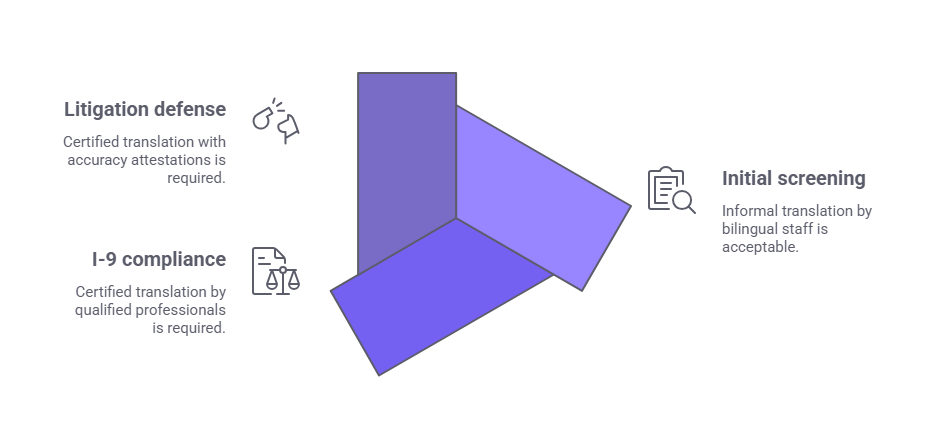
- Initial screening: Informal translation by bilingual staff acceptable
- I-9 compliance: Certified translation by qualified professionals required
- Litigation defense: Certified translation with accuracy attestations required
Detecting Fraudulent Documents
Language barriers complicate fraud detection because verification staff cannot assess whether document content and formatting align with authentic examples. Robust verification requires access to authenticated document examples from each jurisdiction, noting standard formatting, required elements, and common security features.
When high-value hiring justifies additional expense, organizations may engage in-country verification specialists who read native-language documents, recognize authentic formatting, and contact employers using culturally appropriate communication methods.
Managing Employer Non-Response
Non-response represents the most frequent verification failure mode, requiring structured escalation procedures and alternative strategies.
Common Causes
Employer silence rarely indicates deliberate obstruction. Organizational changes disconnected current staff from historical records. Legal advice counsels blanket non-response to avoid defamation exposure. Language and cultural differences prevent requests from reaching appropriate personnel.
Company acquisitions frequently destroy verification pathways. The acquiring company's HR team lacks access to acquired companies' historical records, particularly for asset purchases. Employers that outsourced HR functions face similar challenges when record format conversion and selective data migration occurred during transitions.
Escalation Strategies
First-attempt failures should trigger systematic escalation before concluding verification impossible:
- Week 1: Follow-up to generic HR email with refined contact information
- Week 2: LinkedIn identification of specific HR personnel for personalized outreach
- Week 3: Local-language request submitted by bilingual staff or translation service
- Week 4+: Engagement of local counsel for legal letterhead submission (high-priority only)
This approach signals seriousness, addresses language barriers, and provides legal communication channels receiving priority attention.
Accepting Partial Verification
Risk assessment frameworks should define acceptable verification thresholds below complete confirmation. A candidate claiming four previous employers may produce direct verification for three, documentary evidence for the fourth, and no verification for a brief role seven years ago.
Partial verification acceptability depends on role risk profile, verification gap characteristics, and supporting evidence quality. Documentation of verification attempts, escalation steps, and risk-based acceptance rationale protects employers from negligent hiring claims by demonstrating reasonable diligence.
Timeline Expectations and Planning
Realistic timeline expectations prevent premature escalation and support accurate hiring process communication.
| Region/Country | Standard Timeline | With Authentication | Primary Delay Factors |
| UK, Australia, Canada | 3-7 business days | 17-37 days | Minimal in standard process |
| EU (Germany, France) | 10-21 business days | 24-51 days | GDPR consent processing, vacation periods |
| Singapore, Hong Kong | 7-14 days (MNCs) | 21-44 days | Company size, approval processes |
| China | 21-45 business days | 35-75 days | Language barriers, government procedures |
| Japan | 14-28 business days | 28-58 days | Risk-averse culture, approval chains |
Standard Timelines
English-speaking countries with established verification cultures produce fastest results. UK and Australian employers typically respond within 3 to 7 business days. Canadian employers respond within similar timeframes for private sector positions, though government employment verification may require 2 to 3 weeks.
European Union employers respond within 10 to 21 business days when proper GDPR consent documentation accompanies requests. Asian employers show greater variation. Singapore and Hong Kong respond within 7 to 14 days for multinationals but 14 to 30 days for local companies.
Extended Timeline Factors
Document authentication through consular or apostille processes adds 14 to 30 days. Countries party to the Hague Apostille Convention complete authentication faster than countries requiring full consular certification chains.
Employers that ceased operations require creative verification strategies consuming weeks or months. Bankruptcy trustees, successor companies, or government agencies may eventually provide verification, but locating appropriate contacts extends timelines unpredictably. After 45 to 60 days of systematic escalation producing no response, verification should move to risk assessment rather than indefinite delay.
Risk Assessment for Incomplete Verification
Evidence-based hiring decisions require structured risk assessment when complete verification proves unattainable.
Critical Risk Factors
Employment recency and duration create inverse risk relationships:
- Recent employment: Matters more because it better predicts current capabilities and employers should maintain accessible records
- Extended tenure: Increases verification importance due to greater performance data and increased resume fraud incentive
- Distant employment: Lower priority because relevance diminishes and record availability decreases legitimately
Role sensitivity determines verification necessity independent of timeline. Positions with fiduciary responsibility, sensitive data access, or regulatory compliance obligations typically warrant extended verification efforts and heightened scrutiny.
Supporting Evidence Evaluation
Risk assessment should weigh verification alternatives against direct employer confirmation absence:
- High-quality evidence: Tax documents, government employment records, mandated separation certificates (approaching direct verification reliability)
- Medium-quality evidence: Payslips and bank statements, stronger in combination than individually
- Low-quality evidence: Reference letters and LinkedIn profiles, insufficient alone but valuable as corroboration
Decision Framework
Low-risk scenarios permit proceeding with documented verification attempts. These include entry-level roles, non-sensitive functions, short employment duration, distant employment dates, and strong supporting documentation. The hiring decision acknowledges incomplete verification while documenting risk mitigation through alternative evidence review.
High-risk scenarios typically warrant extended verification efforts and heightened scrutiny before proceeding: senior leadership roles, financial responsibility positions, regulatory compliance functions, and recent long-duration employment without supporting documentation. Organizations should conduct individualized assessments weighing role requirements, verification barriers encountered, and available alternative evidence before making hiring decisions.
Data Privacy and Consent Requirements
Understanding how to check work history internationally requires careful consent management and data handling procedures.
Consent Obligations
GDPR in the European Union and similar comprehensive data protection laws in many countries restrict how employers may obtain and process personal information for employment verification. These frameworks exist in the EU, UK, Brazil, Japan, South Korea, South Africa, Argentina, Thailand, and numerous other jurisdictions, with specific requirements varying by location. These laws generally require explicit, informed, freely given consent before contacting third parties about employment history.
Verification consent forms should include:
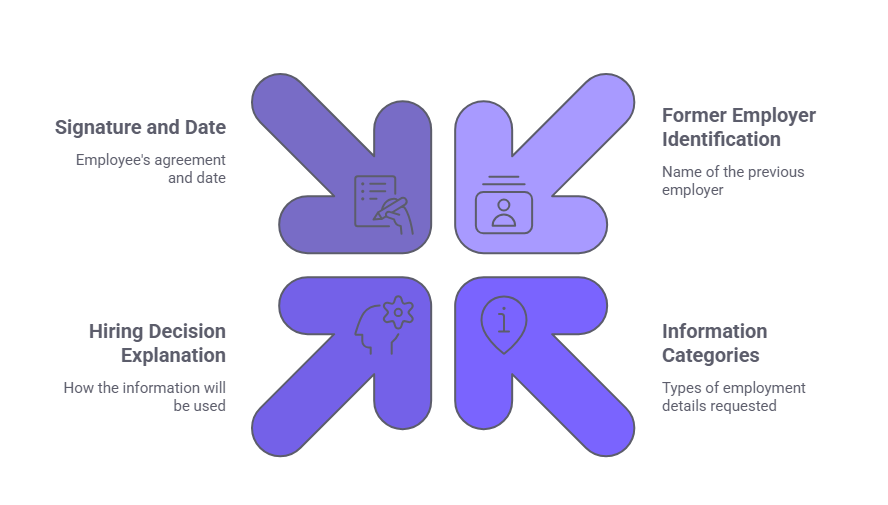
- Specific former employer identification by name
- Information categories sought (employment dates, job title, salary)
- Explanation that information will inform hiring decisions
- Signature line with date
Generic authorization to "contact previous employers" provides insufficient specificity for GDPR compliance.
Cross-Border Data Transfer
When verification involves transferring candidate information between countries, additional data protection obligations may apply. GDPR restricts transfers to countries lacking adequate frameworks, requiring safeguards such as Standard Contractual Clauses. The EU-U.S. Data Privacy Framework provides a compliance mechanism for participating organizations.
Data Retention and Security
Information obtained through international employment verification should receive the same protection and retention controls as other background check information. Data minimization principles require collecting only information necessary for hiring decisions and retaining information only as long as legally required or business necessary.
Avoiding Common Verification Pitfalls
Understanding predictable verification failures prevents misattributing normal operational friction to candidate dishonesty.
HR Outsourcing Transitions
Companies that outsourced human resources during or after a candidate's employment frequently cannot verify that employment because historical records did not fully transfer. The current HR contact has no knowledge of pre-transition employees and no system access to verify claims.
Verification requests produce responses like "no record found," reflecting data limitations rather than fraudulent claims. This scenario occurs commonly with rapid-growth technology companies that operated with minimal HR infrastructure during early years, later engaging professional employer organizations or HR outsourcing firms.
Defunct Company Challenges
Employer bankruptcy, dissolution, or acquisition creates verification dead ends that candidates cannot overcome regardless of employment legitimacy. Verification alternatives include bankruptcy trustees, successor companies that acquired assets, and state unemployment insurance agencies maintaining employer contribution records.
The distinction between "cannot verify due to employer non-existence" and "verification evidence suggests fraud" should drive different outcomes. The former may justify proceeding with supporting documentation, while the latter warrants additional scrutiny or rejection.
Linguistic and Cultural Misunderstandings
Verification communications across language and cultural barriers create misunderstandings that appear suspicious to reviewers unfamiliar with international norms:
- Japanese business culture: Favors indirect communication, with responses that seem evasive simply reflecting cultural norms
- European privacy norms: Employers provide only minimal confirmation reflecting privacy standards rather than deliberate obstruction
- Translation artifacts: Direct translation may produce phrasing that appears uncertain but reflects appropriate business communication in the source language
Reference Letter and LinkedIn Limitations
Candidates frequently submit reference letters as verification evidence, but these provide limited value without independent confirmation. Reference letter fraud operates at industrial scale in some jurisdictions, with services producing convincing letters complete with fake websites and phone numbers answered by co-conspirators.
LinkedIn employment dates matching resume claims provide weak verification evidence that some reviewers overweigh. Candidates control LinkedIn content completely. The platform's utility lies in signals beyond candidate-controlled information such as recommendations from colleagues, shared connections who can informally confirm employment, and position updates timestamped during claimed employment.
Conclusion
Learning how to check work history internationally requires replacing domestic process assumptions with jurisdiction-aware decision frameworks that account for legal constraints, documentation practices, and cultural norms. Organizations that adopt risk-based verification strategies, accept partial verification after reasonable diligence, and properly interpret non-response achieve hiring efficiency without compromising quality or increasing fraud exposure.
Frequently Asked Questions
What is the most reliable way to check work history internationally?
Direct contact with the former employer's human resources department provides the most reliable verification when successful, though response rates vary significantly by country. Verification reliability improves by submitting requests in the local language, including candidate consent documentation meeting data protection requirements, and escalating to specific personnel rather than generic contact addresses. For employers that do not respond, government-issued tax records and mandated separation certificates provide high-reliability alternatives.
How long does international employment verification typically take?
Verification timelines vary from three days to six weeks depending on the country, employer type, and documentation requirements. English-speaking countries with established verification cultures typically respond within one week, while European Union employers require two to three weeks after receiving proper consent documentation. Asian employers often need three to six weeks, with China requiring the longest timelines. Document authentication through apostille or consular processes adds two to four weeks to any verification involving official document certification.
Do I need employee consent to verify international work history?
Yes, GDPR in the European Union and similar comprehensive data protection laws in many countries require explicit consent before contacting employers about candidate work history. Consent must be specific, identifying the employer by name and the information categories sought, rather than blanket authorization. Employers in EU member states, UK, Brazil, Japan, and many other jurisdictions refuse verification requests lacking proper consent documentation due to regulatory compliance concerns. Consent forms should be written, signed, and retained as part of verification documentation.
What should I do when a foreign employer does not respond to verification requests?
After exhausting escalation attempts including follow-up contact, requests in the local language, and outreach to specific personnel, organizations should shift to documentary evidence review and risk assessment rather than indefinite delays. Acceptable alternatives include government employment records, tax documentation, mandated separation certificates, and payslips with corresponding bank statements. Risk assessment should consider role sensitivity, employment duration and recency, and supporting evidence quality before making proceed or decline decisions based on incomplete verification.
Can I accept documents in foreign languages as verification proof?
Yes, with appropriate translation for decision-maker review and certified translation for compliance documentation. Foreign-language employment documents such as German work certificates, Japanese employment records, or Arabic service certificates provide valid verification evidence if authentic. Initial screening may proceed with informal translation by bilingual staff, but employment eligibility verification for I-9 purposes or litigation defense requires certified translation by qualified translators who attest to accuracy. Document authenticity assessment may require consulting native speakers familiar with standard formats.
How do I verify employment at a company that went out of business?
Verification options for defunct companies include contacting bankruptcy trustees who may access employment records, identifying successor companies that acquired assets and possibly inherited records, and requesting government employment records from social insurance or unemployment insurance agencies that maintain employer contribution data. When these alternatives fail, risk assessment should consider the time elapsed since company closure, supporting documentary evidence the candidate retained, and role sensitivity before deciding whether to proceed with unverifiable employment claims.
What documents are acceptable for verifying international employment?
Acceptable documents vary by jurisdiction but generally include government-issued tax records showing employer withholding, mandated employment certificates required at separation, payslips with corresponding bank statements, social insurance records confirming employer contributions, and official employment contracts registered with government agencies. Document combinations provide stronger verification than single documents, such as pairing payslips with bank statements showing corresponding deposits over multiple months. Documents should include employer identification numbers verifiable against business registries and formatting consistent with authentic examples from that jurisdiction.
Are there countries where employment verification is nearly impossible?
Several factors make verification extremely difficult in certain contexts. Countries with large informal employment sectors where workers lack formal documentation, jurisdictions experiencing political instability where record-keeping systems have collapsed, and regions where employers routinely cease operations without transferring records create verification challenges. Additionally, privacy laws in some jurisdictions restrict employer information sharing to government authorities only. In these scenarios, organizations should evaluate whether legitimate candidates face systematic verification barriers requiring alternative assessment methods focused on skills demonstration rather than employment history confirmation.
Additional Resources
- GDPR Employment Data Processing Guidelines
https://edpb.europa.eu/our-work-tools/our-documents/guidelines/guidelines-22021-article-88-gdpr-and-processing-employment_en - FTC Fair Credit Reporting Act Guidance
https://www.ftc.gov/enforcement/statutes/fair-credit-reporting-act - U.S. Citizenship and Immigration Services Document Translation Requirements
https://www.uscis.gov/laws-and-policy/other-resources/plain-language-resources/submitting-translations-with-uscis-applications - Hague Conference Apostille Convention Member States
https://www.hcch.net/en/instruments/conventions/status-table/?cid=41 - European Data Protection Board Cross-Border Transfer Tools
https://edpb.europa.eu/our-work-tools/general-guidance/guidelines-recommendations-best-practices_en

ABOUT THE CREATOR
Charm Paz, CHRP
Recruiter & Editor
Charm Paz is an HR and compliance professional at GCheck, working at the intersection of background screening, fair hiring, and regulatory compliance. She holds both FCRA Core and FCRA Advanced certifications through the Professional Background Screening Association (PBSA) and supports organizations in navigating complex employment regulations with clarity and confidence.
With a background in Industrial and Organizational Psychology and hands-on experience translating policy into practice, Charm focuses on building ethical, compliant, and human-centered hiring systems that strengthen decision-making and support long-term organizational health.