



Healthcare background check requirements by state create a complex compliance environment for employers hiring across jurisdictions, with variations in criminal history lookback periods, exclusion list monitoring, and credentialing standards. As of 2026, organizations commonly integrate federal database screening with state-specific protocols to meet both regulatory obligations and operational risk management goals.
Key Takeaways
- Healthcare background check requirements by state differ significantly in scope, lookback periods, and record accessibility, requiring employers to verify jurisdiction-specific rules before initiating screening.
- Federal exclusion list monitoring through OIG, GSA, and FACIS® databases is essential for organizations participating in Medicare, Medicaid, or federal healthcare programs.
- Many states mandate fingerprint-based criminal history checks for licensed healthcare workers, often requiring submission to both state repositories and the FBI.
- Credentialing requirements for clinical roles vary by state licensing boards, with some jurisdictions requiring additional disclosures beyond standard employment background checks.
- Ban-the-box laws and fair chance hiring ordinances in certain states restrict the timing and use of criminal history information in healthcare hiring decisions.
- Lookback periods for criminal records range from seven years to unlimited in healthcare contexts, depending on state law and the severity of offenses.
- Ongoing monitoring programs may be required or recommended for healthcare employers to detect post-hire arrests, convictions, or exclusion list additions.
- A standardized multi-state compliance framework should incorporate federal database checks, state-specific criminal history requirements, license verifications, and jurisdiction-aware adverse action protocols.
Understanding the Healthcare Background Check Landscape in 2026
Healthcare organizations operate within one of the most regulated employment screening environments in the United States. Specifically, the nature of patient care, access to controlled substances, and participation in federal reimbursement programs create legal and ethical obligations that extend beyond typical pre-employment verification. Furthermore, healthcare background check requirements by state reflect this complexity, with each jurisdiction establishing its own balance between public safety, workforce access, and fairness in hiring.
Healthcare employers must navigate three overlapping compliance domains:
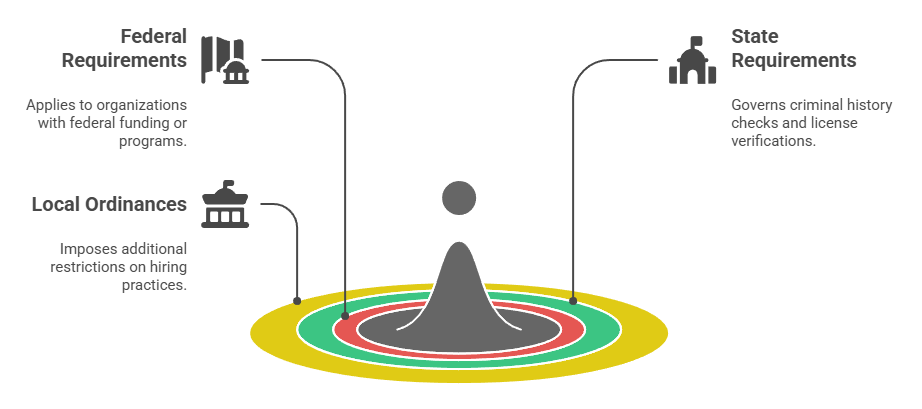
- Federal requirements apply to organizations that bill Medicare or Medicaid, receive federal grants, or operate under specific health programs, typically including exclusion list screening.
- State requirements govern criminal history checks, professional license verifications, and sometimes abuse registry searches.
- Local ordinances may impose additional restrictions on how and when employers can use criminal history information in hiring decisions.
The operational challenge involves orchestrating checks in a sequence and format that satisfies all relevant jurisdictions without creating unnecessary delays or legal risk.
From an HR standpoint, I see the importance of healthcare background screening as far more involved than simply a hiring process. I understand that the differences in the requirements for healthcare background checks necessitate a methodical process. My biggest concern is that of integrating federal exclusion screening, state criminal history checks, and credentialing into a cohesive process. I think that organizations that view the screening process as an ongoing process are more likely to have a more compliant organization with a more trusted workforce.
Why State Variations Matter for Healthcare Employers
Healthcare credentialing requirements and screening protocols vary because states retain primary authority over occupational licensing, criminal justice records, and employment law. Consequently, a hospital system operating in multiple states cannot assume a single screening template will satisfy all locations.
For organizations hiring across jurisdictions, these variations create three operational risks:
| Risk Category | Description |
| Regulatory Non-Compliance | When employers fail to meet state-specific requirements, they can face regulatory penalties, loss of licensure, or exclusion from reimbursement programs. |
| Legal Exposure | Over-screening or using information that state law does not permit can expose employers to discrimination claims or fair chance hiring violations. |
| Process Inconsistency | Inconsistent processes across locations can create internal confusion, audit failures, and disparate treatment concerns. |
Understanding what qualifies as a disqualifying offense, how far back employers can consider records, and whether they may review arrest records without convictions all depend on state law.
Federal Database Screening: The Foundation of Healthcare Compliance
Before examining state-specific requirements, healthcare employers must address federal screening obligations that apply regardless of location. Notably, these databases prevent individuals with certain disqualifying backgrounds from working in federally funded healthcare settings or accessing federal payment systems.
OIG List of Excluded Individuals and Entities
The Office of Inspector General maintains a list of individuals and organizations that federal healthcare programs exclude from participation. Specifically, exclusion can result from convictions related to Medicare or Medicaid fraud, patient abuse, controlled substance violations, or other offenses.
When employers hire excluded individuals for positions that federal healthcare dollars pay, they may face civil monetary penalties, program exclusion, and repayment obligations. Therefore, organizations must implement reasonable screening procedures to detect exclusions. Although no single federal statute universally mandates this screening, most federal contracts, state Medicaid agencies, and healthcare program participation agreements effectively require it.
GSA System for Award Management
The General Services Administration maintains the System for Award Management, which consolidates several exclusion lists including those related to federal contracting and assistance programs. Consequently, healthcare organizations that receive federal grants, participate in research that federal agencies fund, or contract with federal entities must screen against this database. While overlap exists between OIG and GSA lists, they are not identical.
FACIS® and Aggregated Federal Database Screening
Some entities provide aggregated access to federal exclusion databases through systems sometimes referred to as FACIS®. Specifically, these platforms compile OIG, GSA, and additional federal and state exclusion sources into a single search interface. Although not a distinct legal requirement, using an aggregated search tool can improve efficiency and reduce the risk of missing an exclusion.
Moreover, healthcare background check requirements by state increasingly assume federal database screening as a baseline, with state-specific requirements layered on top.
Frequency and Ongoing Monitoring
A one-time federal database search at hire satisfies the immediate compliance need but does not address post-hire events. Therefore:
- Healthcare organizations commonly re-screen employees against federal exclusion lists on a monthly or quarterly basis.
- Some states or payer contracts explicitly require ongoing monitoring programs.
- Where not required, ongoing checks represent a risk management best practice.
State-Specific Criminal History Requirements
Criminal background checks form the core of most healthcare screening programs, but the legal framework governing their use varies significantly by state. In particular, healthcare background check requirements by state differ in terms of which records employers can access, how far back searches may extend, what offenses they consider disqualifying, and what procedural protections apply to applicants.
Fingerprint-Based Checks and State Repositories
Many states require healthcare employers or licensing boards to submit fingerprints for criminal history checks, particularly for licensed clinical roles. Notably, fingerprint-based checks provide access to state criminal history repositories and, through FBI submission, to the Interstate Identification Index.
| Fingerprint Check Component | Purpose |
| State Repository Access | Reveals convictions and pending charges within the state criminal justice system. |
| FBI Interstate Identification Index | Provides multi-state criminal history information through centralized federal records. |
| Licensing Board Integration | In some jurisdictions, boards handle fingerprinting as part of licensure, thereby reducing employer burden. |
State laws may mandate fingerprint checks for specific roles such as nurses, physicians, pharmacists, or long-term care workers. Additionally, the procedural requirements for fingerprint-based checks vary. For example, some states allow electronic fingerprint submission, while others require ink cards.
Lookback Periods and Scope Limitations
Some state laws impose different limits on how far back criminal history checks can reach. Specifically:
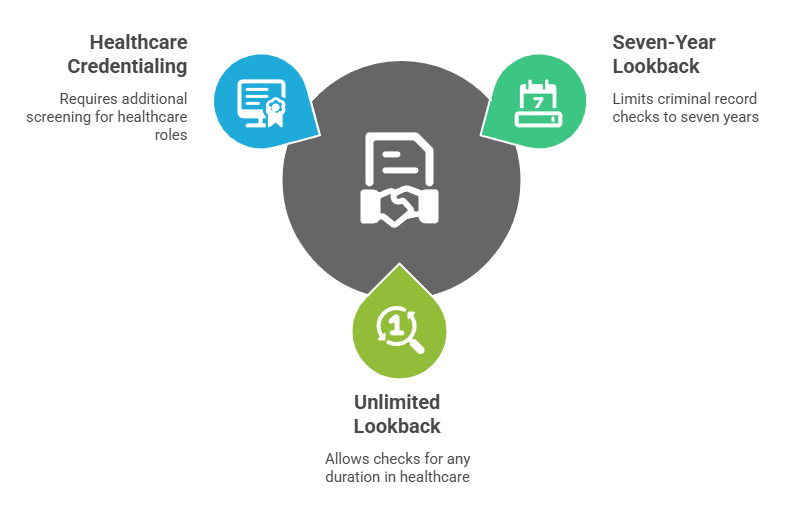
- Some states apply a seven-year lookback period for non-conviction records or for certain types of convictions, thereby aligning with federal Fair Credit Reporting Act guidelines.
- In contrast, others allow or require unlimited lookback for healthcare roles, particularly for offenses involving violence, abuse, fraud, or controlled substances.
- Furthermore, healthcare credentialing requirements often extend beyond general employment screening rules.
Therefore, employers must verify whether their state applies general employment screening rules to healthcare roles or maintains a separate healthcare-specific framework.
Disqualifying Offenses and Individualized Assessments
State laws vary in how they define disqualifying criminal history. For instance, some states maintain categorical bars for certain convictions, such as violent felonies, sexual offenses, or abuse-related crimes. Conversely, others require individualized assessments that consider the nature of the offense, time elapsed, evidence of rehabilitation, and relevance to the job duties.
Federal guidance from the Equal Employment Opportunity Commission emphasizes individualized assessments to avoid disparate impact discrimination. Consequently, healthcare employers must reconcile this guidance with state laws that may impose or permit categorical disqualifications. In some cases, state law explicitly authorizes disqualification for certain offenses. However, while this may provide support in discrimination claims, employers should still document job-relatedness and business necessity, as regulatory agencies may scrutinize policies that create disparate impact.
Healthcare Credentialing Requirements and License Verifications
Beyond criminal history, healthcare background check requirements by state include verification of professional licenses, educational credentials, and specialized certifications. Importantly, these checks serve both legal compliance and quality assurance functions.
Healthcare credentialing standards generally require primary source verification, meaning employers must confirm information directly from the issuing authority. Specifically:
- For professional licenses, this means employers must contact the state licensing board or access its online verification system.
- For educational degrees, this means employers must contact the registrar or use an authorized degree verification service.
State licensing boards maintain public databases that typically show current license status, issue and expiration dates, and any disciplinary actions. Therefore, employers should verify licenses in the state where the individual will practice, even if they hold licenses in other jurisdictions.
Discipline History and Board Actions
State medical, nursing, and pharmacy boards have authority to discipline licensees for professional misconduct, incompetence, or criminal behavior. Specifically, disciplinary actions can include reprimands, probation, license suspension, or revocation. Notably, these actions may or may not appear in criminal history checks.
Consequently, credentialing processes should include review of disciplinary history from all states where an applicant has held or currently holds a license. Additionally, some states report disciplinary actions to national databases such as the National Practitioner Data Bank.
Certification and Specialty Credentials
Many healthcare roles require certifications beyond state licensure, such as board certifications for physicians or specialty certifications for nurses. Therefore, verification involves confirming current status directly with the certifying body, as certificates can lapse or face revocation.
Ban-the-Box and Fair Chance Hiring Laws in Healthcare
A growing number of states and municipalities have enacted ban-the-box or fair chance hiring laws that restrict when and how employers can inquire about criminal history. Importantly, these laws apply to healthcare employers, though some include exceptions for roles with specific legal disqualifications.
Ban-the-box laws typically prohibit asking about criminal history on initial applications, thereby delaying inquiry until after a conditional offer or a specified stage in the hiring process. The following table illustrates common patterns:
| Jurisdiction Type | Common Timing Restriction |
| States with Full Ban-the-Box | No criminal history questions until employers extend a conditional offer. |
| States with Healthcare Exceptions | Earlier inquiry permitted for roles with legal disqualifications or patient access. |
| Local Ordinances | May impose stricter timing rules than state law in specific cities or counties. |
Therefore, healthcare background check requirements by state must account for these timing restrictions even when criminal history is highly relevant to the role.
Use Restrictions and Individualized Assessment Requirements
Beyond timing, fair chance laws often restrict how employers can use criminal history. Specifically, these restrictions include:
- Prohibitions on considering arrest records without convictions
- Requirements for individualized assessments
- Obligations to provide written explanations when criminal history factors into adverse decisions
- Opportunities for applicants to provide context or evidence of rehabilitation
Moreover, fair chance laws typically require employers to document their individualized assessment process and provide applicants with notice before finalizing an adverse decision based on criminal history. Notably, this comes in addition to Fair Credit Reporting Act adverse action requirements. Consequently, this often means employers must follow a multi-step adverse action process that includes pre-adverse action notice with a copy of the report and summary of rights, a reasonable waiting period (typically at least five business days) for the applicant to respond, consideration of any response from the applicant, and then a final adverse action notice if the decision stands.
Abuse Registries and Vulnerable Population Protections
Many states maintain registries of individuals whom authorities have found to have abused, neglected, or exploited vulnerable populations, including children, elderly individuals, or people with disabilities. Specifically, healthcare background check requirements by state often mandate searching these registries for roles involving access to these populations.
State registries vary in scope and accessibility. For example:
- Some registries that departments of social services or health maintain cover substantiated findings of abuse or neglect in licensed care settings.
- In contrast, others focus on criminal justice and include individuals whom courts have convicted of abuse-related offenses.
- Additionally, access rules differ, with some registries publicly searchable and others requiring authorized employer accounts.
Therefore, healthcare employers must identify which state registries apply to their roles. Notably, long-term care facilities, home health agencies, and child care-adjacent health services typically face the most stringent registry check requirements.
National Sex Offender Registry
The National Sex Offender Public Website aggregates information from state sex offender registries, thereby providing a single search point for multi-state checks. Although federal law does not typically mandate this for healthcare employers, many organizations include it in standard screening protocols, particularly for roles involving pediatric care or home visits.
Building a Multi-State Healthcare Screening Framework
Healthcare background check requirements by state demand a systematic approach that accommodates variation while maintaining consistency and efficiency. Specifically, a scalable framework involves categorizing requirements, standardizing core processes, and implementing jurisdiction-specific modules.
Certain screening elements apply across all states and employers can standardize them. For instance:
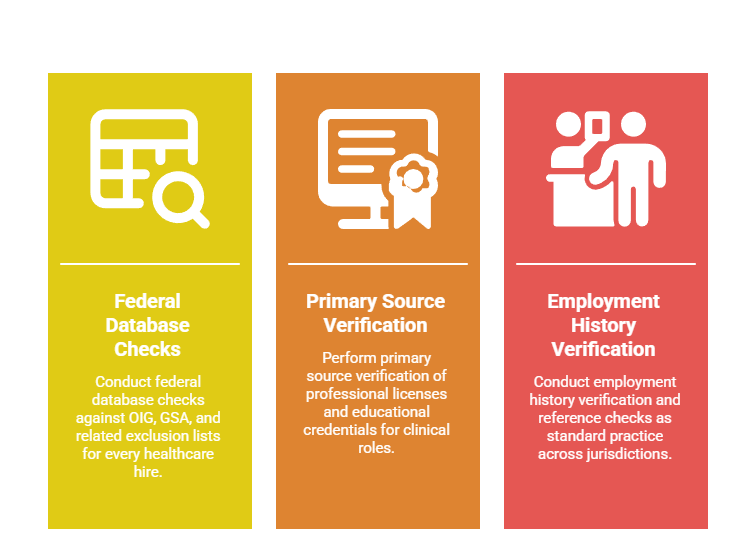
- Employers should conduct federal database checks against OIG, GSA, and related exclusion lists for every healthcare hire
- They should perform primary source verification of professional licenses and educational credentials for clinical roles
- They should conduct employment history verification and reference checks as standard practice across jurisdictions
Standardizing these core components creates a baseline screening protocol that applies nationwide.
State-Specific Modules
Once employers establish the core, they can add state-specific requirements as modules:
| Module Type | Trigger Criteria | Examples |
| Enhanced Criminal History | Licensed clinical roles in states requiring fingerprinting | RN positions in California, Texas, Florida |
| Abuse Registry Checks | Roles with vulnerable population access | Long-term care workers, home health aides |
| Extended Lookback | States authorizing unlimited criminal history review | Physician credentialing in states without seven-year limits |
This modular approach requires maintaining an up-to-date matrix of state requirements, typically organized by role category and jurisdiction.
Role-Based Screening Protocols
Not all healthcare roles require the same level of screening. Specifically:
- Licensed clinical positions such as physicians, nurses, and pharmacists typically trigger the most extensive requirements.
- Support roles with patient access may require criminal history checks and abuse registry searches but not license verifications.
- Administrative roles with no patient contact may fall under general employment screening rules.
Therefore, defining role categories and mapping screening requirements to each category creates consistency and efficiency.
Ongoing Monitoring and Post-Hire Compliance
Background screening does not end at hire. In fact, healthcare background check requirements by state increasingly expect or require ongoing monitoring to detect post-hire events that could affect eligibility or safety.
Some states and healthcare regulators require or recommend continuous monitoring of employee criminal history. Specifically, this typically involves enrollment in services that alert the employer when authorities arrest or convict an employee after hire.
Federal Database Re-Screening
Re-screening employees against OIG, GSA, and other federal exclusion lists represents a widely recognized best practice. The following table shows common approaches:
| Re-Screening Frequency | Common Use Cases |
| Monthly | Most healthcare organizations follow this as standard compliance practice |
| Quarterly | Smaller organizations or lower-risk administrative roles |
| More Frequent | High-risk roles, federal contractor requirements |
Although automated re-screening systems can reduce administrative burden, employers must maintain current employee rosters and ensure they review alerts promptly.
License and Certification Renewals
Professional licenses and certifications expire and require periodic renewal. Therefore, license verifications should occur not only at hire but also at or before each renewal date. Consequently, tracking license expiration dates across a large workforce and multiple states requires a credentialing management system or disciplined manual processes.
Compliance Checklists for Healthcare Employers
A practical compliance checklist can help healthcare organizations ensure that their background screening programs meet applicable requirements.
Pre-Hire Screening Checklist
Employers should complete the following steps:
- Verify that job applications comply with ban-the-box laws in all applicable jurisdictions.
- Confirm that they obtain required disclosures and authorizations before conducting checks.
- Conduct federal database checks for OIG and GSA exclusions for all hires.
- Verify professional licenses through primary sources for all clinical roles.
- Conduct criminal history checks using the method and lookback period that state law requires.
- Search applicable abuse and neglect registries based on role and patient population.
- Verify educational credentials through registrars or authorized services.
Adverse Action Checklist
If employers plan to take adverse action, they should:
- Provide pre-adverse action notice with a copy of the consumer report and summary of rights.
- Allow the applicant a reasonable opportunity to respond, dispute inaccuracies, or provide context.
- Conduct an individualized assessment considering the nature and relevance of the offense, time elapsed, and evidence of rehabilitation.
- Document the assessment process and decision rationale.
- Provide final adverse action notice if they decide not to hire.
Ongoing Monitoring Checklist
For post-hire compliance, employers should:
- Re-screen all employees against federal exclusion lists at least monthly or per contractual requirements.
- Track professional license expiration dates and verify renewals before expiration.
- Enroll employees in continuous criminal monitoring where available and required.
- Maintain audit trails of all screening and monitoring activities for compliance verification.
Technology and Screening Process Efficiency
Healthcare employers increasingly use technology platforms to manage background screening, credentialing, and ongoing monitoring. Notably, these systems can improve efficiency, accuracy, and compliance, but they do not eliminate the need for understanding underlying legal requirements.
Many platforms integrate multiple screening functions, including federal database checks, criminal history searches, license verifications, and registry lookups. Consequently, integration reduces manual data entry, speeds turnaround time, and creates a single audit trail. However, employers must ensure that they configure platforms to meet state-specific requirements.
Artificial Intelligence and Automated Decision Tools
Some screening platforms incorporate artificial intelligence or algorithmic tools to assess criminal history findings. However, employers must use these tools cautiously in healthcare contexts. Specifically, relying on automated disqualification without individualized human review can violate fair chance laws and EEOC guidance.
Therefore, employers using AI-assisted screening should ensure that algorithms are transparent, validated for accuracy and non-discrimination, subject to regular bias audits, and used only as decision-support tools with mandatory human review rather than autonomous decision-makers.
Conclusion
Healthcare background check requirements by state reflect a complex interplay of federal mandates, state laws, and organizational risk management priorities. Ultimately, employers hiring across jurisdictions must build scalable frameworks that integrate federal database screening, state-specific criminal history checks, license verifications, and ongoing monitoring. Not only can a proactive compliance strategy help reduce regulatory risks, but it can also help build trust among patients and credibility for the organization. By investing in clear documentation, processes, and cross-functional collaboration, healthcare employers can turn the background screening process from a compliance burden into a strategic advantage.
Frequently Asked Questions
What background checks are required for healthcare workers in all states?
No single background check applies universally across all states, but federal exclusion list screening through OIG and GSA databases is essential for organizations that participate in federal healthcare programs. Additionally, most states also require criminal history checks, though the method and scope vary.
Do healthcare background check requirements by state allow the use of arrest records?
State laws vary significantly. For instance, some states prohibit employers from considering arrests that did not result in conviction, while others allow it for healthcare roles. Moreover, federal EEOC guidance discourages using arrest records without additional inquiry into underlying conduct.
How far back can criminal history checks go for healthcare employees?
Lookback periods depend on state law. Specifically, some states impose seven-year limits for certain offenses or non-convictions, while others authorize unlimited lookback for healthcare roles, especially for serious crimes.
Are fingerprint-based background checks required for all healthcare workers?
No, fingerprint requirements vary by state and role. However, many states mandate fingerprinting for licensed clinical positions such as nurses, physicians, and pharmacists, often as part of licensure.
What is FACIS® screening and is it required for healthcare employers?
FACIS® refers to aggregated federal database screening that compiles exclusion lists from OIG, GSA, and other sources. Although it is not a distinct legal requirement, it serves as a practical tool for comprehensive federal screening.
How often should healthcare employers re-screen employees for exclusions?
Healthcare organizations commonly re-screen employees against federal exclusion lists on a monthly or quarterly basis. Furthermore, some state Medicaid programs or federal contracts require regular re-screening. Additionally, criminal history continuous monitoring frequency depends on state law.
Do ban-the-box laws apply to healthcare employers?
Ban-the-box laws apply in many jurisdictions, but some states exempt healthcare employers or roles with specific legal disqualifications. Nevertheless, where applicable, these laws restrict when employers can request criminal history and how they can use it.
Can healthcare employers use automated tools to screen out applicants with criminal history?
Employers must use automated tools carefully. Specifically, federal EEOC guidance requires individualized assessments of criminal history to avoid disparate impact discrimination. Additionally, some state fair chance laws explicitly prohibit categorical disqualifications.
Additional Resources
- Office of Inspector General List of Excluded Individuals and Entities
https://oig.hhs.gov/exclusions/ - System for Award Management (SAM) Exclusions
https://sam.gov/content/exclusions - Equal Employment Opportunity Commission Guidance on Arrest and Conviction Records
https://www.eeoc.gov/laws/guidance/arrest-and-conviction-records - National Council of State Boards of Nursing
https://www.ncsbn.org/ - National Practitioner Data Bank
https://www.npdb.hrsa.gov/ - Federal Trade Commission Fair Credit Reporting Act Resources
https://www.ftc.gov/legal-library/browse/statutes/fair-credit-reporting-act - National Sex Offender Public Website
https://www.nsopw.gov/

ABOUT THE CREATOR
GCheck Editorial Team
Meet the GCheck Editorial Team, your trusted source for insightful and up-to-date information in the world of employment background checks. Committed to delivering the latest trends, best practices, and industry insights, our team is dedicated to keeping you informed.
With a passion for ensuring accuracy, compliance, and efficiency in background screening, we are your go-to experts in the field. Stay tuned for our comprehensive articles, guides, and analysis, designed to empower businesses and individuals with the knowledge they need to make informed decisions.
At GCheck, we're here to guide you through the complexities of background checks, every step of the way.