


Florida's education background check requirements, primarily governed by the Jessica Lunsford Act, mandate Level 2 screening for all instructional personnel and certain volunteers working with students. As districts navigate projected staffing shortages through 2026, understanding fingerprinting timelines, registry checks, emergency certification pathways, and re-screening intervals becomes essential for maintaining compliance while accelerating hiring operations.
Key Takeaways
- Florida law requires Level 2 background screenings for all instructional personnel, including teachers, substitutes, and contractor employees with direct student contact.
- The Jessica Lunsford Act requirements apply to public schools, charter schools, and private schools accepting state scholarship funds.
- FDLE fingerprinting processing times typically range from 3-5 business days for electronic submissions but may extend during peak hiring periods.
- Florida's educator abuse registry check and national criminal database searches form mandatory components of compliant screening protocols.
- School volunteer background check requirements vary based on whether volunteers serve in chaperoned or unsupervised capacities.
- Re-screening intervals differ by employment type, with some positions requiring background checks every five years while others follow different timelines.
- Emergency certification pathways do not waive background check requirements, though conditional employment may be permitted under specific circumstances.
- Districts facing teacher shortages must balance accelerated hiring timelines with comprehensive screening protocols to avoid compliance gaps that could expose institutions to regulatory scrutiny.
Understanding Florida's Education Screening Framework
Florida's approach to education background checks reflects decades of legislative development focused on student safety. The framework extends beyond simple criminal history verification to encompass multiple verification layers designed to identify individuals who may pose risks to minors in educational settings.
Legislative Foundation and Scope
The Jessica Lunsford Act, enacted following a 2005 tragedy, established comprehensive screening requirements for anyone working in proximity to students. This legislation fundamentally reshaped how Florida school districts approach personnel vetting, creating obligations that extend to employees, contractors, and volunteers across public and private educational institutions.
| Covered Positions | Screening Requirement | Timing |
| Classroom teachers | Level 2 screening | Before student contact |
| Substitute teachers | Level 2 screening | Before student contact |
| Paraprofessionals | Level 2 screening | Before student contact |
| School administrators | Level 2 screening | Before student contact |
| Student teachers | Level 2 screening | Before clinical placement |
| Unsupervised volunteers | Level 2 screening | Before independent student contact |
| Chaperoned volunteers | Name-based screening | Before event participation |
The Act's requirements apply to instructional personnel, defined broadly to include individuals providing direct services to students. Private schools accepting students through state scholarship programs, including the Florida Tax Credit Scholarship and Family Empowerment Scholarship, fall under these screening requirements despite their non-public status. Applicability depends on the specific scholarship program and regulatory framework governing the school's participation in state-funded initiatives.
Components of Level 2 Screening
Florida education background checks center on Level 2 screening, a designation indicating the most comprehensive level of review available under state law. This screening tier combines state and national criminal history checks with specific registry searches designed to identify individuals with disqualifying backgrounds.
The fingerprinting component uses electronic submission to the Florida Department of Law Enforcement, which then coordinates with the FBI for national criminal history checks. This dual-layer approach captures both in-state and out-of-state criminal records, addressing workforce mobility and ensuring that offenses committed in other jurisdictions do not escape detection.
Required Level 2 Screening Components:
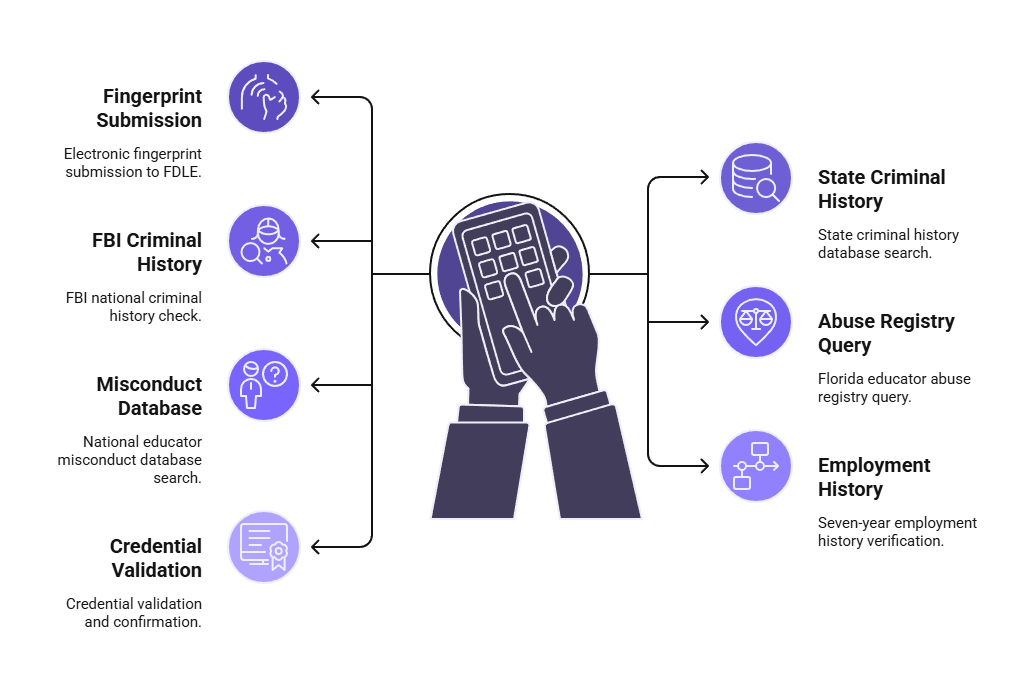
- Electronic fingerprint submission to FDLE
- State criminal history database search
- FBI national criminal history check
- Florida educator abuse registry query
- National educator misconduct database search
- Seven-year employment history verification
- Credential validation and confirmation
Florida's educator abuse registry check functions as a supplementary database specifically tracking individuals who have been found to have committed specified offenses against students or who left educational employment under investigation for such conduct. Unlike criminal databases that require conviction, the abuse registry may include substantiated complaints that did not result in criminal charges, creating a broader net for identifying potentially unsuitable candidates.
Hiring within the education sector has made me aware of the fact that compliance is not merely an activity; it is an activity linked to actual life. Background screening within the education sector is an activity that is required because the stakes are high, and any kind of compromise, even under the pressure of staffing requirements, is an actual risk that any district cannot afford. Hiring is an activity that is built on holding safety, fairness, and urgency together rather than allowing these terms to become oppositional.
Applicability Across Employment Categories
Florida substitute teacher background check requirements mirror those for full-time instructional personnel, a fact that sometimes surprises districts accustomed to more lenient standards in other states. Substitutes must complete Level 2 screening before beginning work, regardless of whether they are district employees or placed through third-party staffing agencies.
When districts use staffing agencies to supply substitute teachers, responsibility for conducting compliant background checks may rest with the agency, the district, or both, depending on contractual arrangements. However, ultimate accountability for ensuring that only properly screened individuals work with students remains with the employing district. Paraprofessionals, including teacher aides and classroom assistants, fall within screening requirements when their duties involve direct student contact.
FDLE Fingerprinting Processing Time and Operational Considerations
Understanding processing timelines for Florida education background checks enables districts to structure hiring workflows that balance urgency with compliance. While technology has accelerated certain aspects of screening, variables affecting turnaround time persist.
Electronic Submission and Standard Timelines
FDLE fingerprinting processing time for electronically submitted prints has historically ranged from 3-5 business days in straightforward cases, though actual processing times vary based on numerous factors including submission quality, database matching complexity, and current volume loads.
Electronic submission has largely replaced ink-and-card methods, reducing processing time and improving accuracy. Candidates schedule appointments at approved livescan vendors, where fingerprints are captured digitally and transmitted directly to FDLE. However, the 3-5 day standard represents best-case scenarios.
Factors That May Extend FDLE Processing Time:
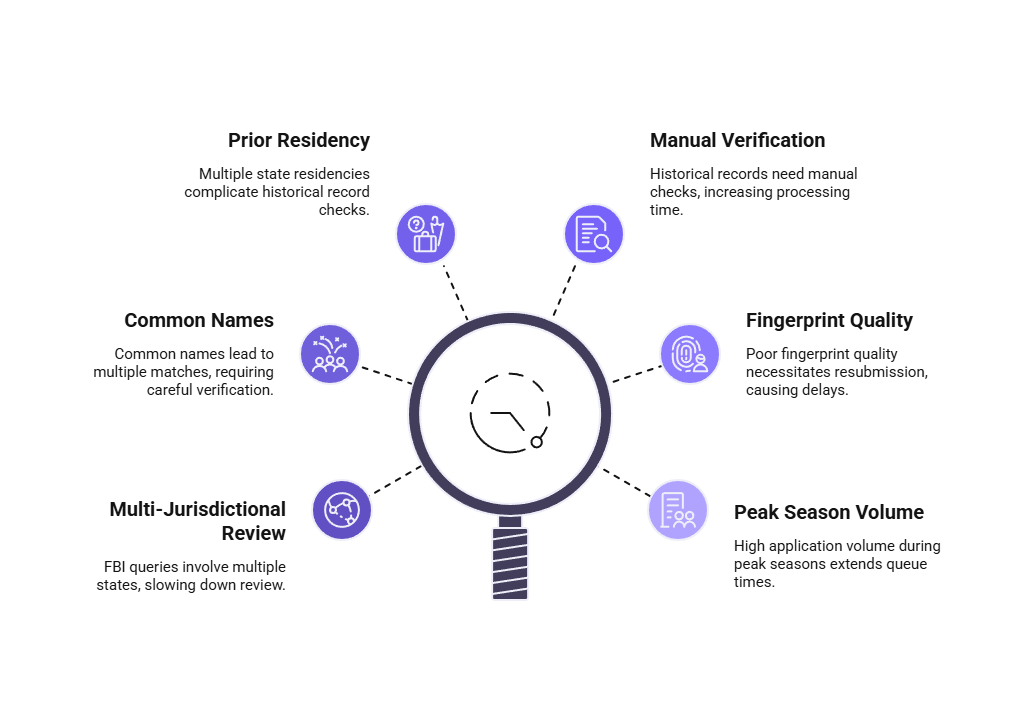
- FBI database queries requiring multi-jurisdictional review
- Common names generating multiple potential matches
- Prior residency in multiple states
- Historical records requiring manual verification
- Incomplete or poor-quality fingerprint submissions
- Peak season volume surges affecting queue times
FBI database queries, which form part of Level 2 screening, may require additional time when records exist in multiple jurisdictions or when name-based searches return multiple potential matches requiring manual review. Candidates with common names or those who have lived in multiple states may experience extended processing as reviewers confirm identity and ensure accurate record attribution.
Peak Period Delays and Planning Implications
Florida school districts experience pronounced hiring seasonality, with the majority of recruitment occurring between March and August for fall semester positions. During peak periods, appointment availability at fingerprinting vendors may become the primary bottleneck rather than FDLE processing itself. Districts in rural areas or those served by limited vendor networks may find candidates waiting one to three weeks for fingerprinting appointments, a delay that occurs before screening even begins.
Forward-thinking districts address seasonal capacity constraints by establishing relationships with multiple approved vendors, communicating expected volumes in advance, and potentially arranging dedicated appointment blocks for district candidates. Some districts operate their own livescan equipment, eliminating dependence on external vendor availability, though this approach requires equipment investment and staff training.
Conditional Employment Provisions
Florida law permits conditional employment pending completion of background screening under limited circumstances. Districts may allow individuals to begin work after fingerprints have been submitted to FDLE but before results return, provided specific safeguards are in place.
Conditional employment requires that the candidate has no self-disclosed disqualifying offenses and that the district implements heightened supervision during the conditional period. The supervising employee must have completed background screening themselves and must maintain direct oversight of the conditionally employed individual's interactions with students. This provision offers flexibility during staffing emergencies or when FDLE fingerprinting processing time extends beyond anticipated ranges.
The conditional employment period cannot extend indefinitely. Districts should consult current Florida statutes, administrative code provisions, and Florida Department of Education guidance to determine appropriate timeframes for conditional employment, as specific limitations or best practice standards may apply. Legal counsel or compliance personnel should review individual circumstances before extending conditional employment beyond typical processing windows.
Florida School Volunteer Background Check Requirements
Volunteers represent a distinct category within Florida education background checks, with requirements varying based on the nature and extent of their involvement with students.
Chaperoned Versus Unsupervised Access
The critical distinction in Florida school volunteer background check requirements hinges on whether volunteers will have unsupervised access to students. Volunteers who serve only in chaperoned capacities, such as assisting at supervised school events or working in settings where a screened employee maintains constant oversight, may be subject to less comprehensive screening.
| Volunteer Type | Access Level | Required Screening | Example Roles |
| Event assistant | Chaperoned only | Name-based check | Fall festival helper, game day volunteer |
| Classroom helper | Teacher-supervised | Name-based check | Reading partner with teacher present |
| Field trip chaperone | Independent groups | Level 2 screening | Leading small group without staff |
| Tutor/mentor | One-on-one sessions | Level 2 screening | After-school mentoring program |
| Regular volunteer | Recurring presence | Level 2 screening | Weekly library assistant |
| Coach/instructor | Direct supervision | Level 2 screening | Sports coach, club advisor |
For chaperoned volunteers, districts typically conduct name-based criminal history checks through commercially available databases rather than fingerprint-based Level 2 screening. Unsupervised volunteers, including those serving as tutors, mentors, or field trip chaperones with independent student contact, require Level 2 screening identical to that required for employees.
Recurring Volunteers and Re-Screening
Volunteers who serve on a recurring basis throughout a school year or across multiple years may require screening only once, provided their engagement remains continuous. However, gaps in service may trigger re-screening obligations, particularly if the volunteer's involvement lapses for an extended period.
Best practices suggest treating regular volunteers who serve more than a specified number of hours per semester similarly to employees for screening purposes, implementing Level 2 checks regardless of supervision levels. Districts should establish clear policies defining when volunteer service triggers Level 2 screening, how long clearances remain valid, and what circumstances require re-screening.
Third-Party Program Providers
Educational programs delivered by external organizations, including tutoring services, enrichment programs, and mentorship initiatives, create screening responsibility questions. When third-party organizations provide programming on campus using their own personnel, determining who bears screening responsibility requires careful contract review and clear agreement documentation.
Florida law holds districts accountable for ensuring that individuals working with students on campus have been appropriately screened, regardless of their employer. Some external organizations maintain their own screening protocols that may not align with Florida education background checks requirements. Contracts should require providers to demonstrate compliance with Florida-specific standards, including Level 2 screening where applicable, and to provide documentation confirming that all personnel working with students have been cleared.
Re-Screening Intervals and Ongoing Compliance
Background screening is not a one-time event but rather an ongoing compliance obligation that extends throughout employment or engagement with school districts.
Statutory Re-Screening Requirements
Florida law establishes re-screening intervals for certain categories of educational personnel. Instructional employees typically must undergo re-screening every five years from their initial clearance date, though specific requirements should be verified based on employment type, as statutory provisions may establish different intervals for different position categories. District policies may impose more frequent screening but cannot extend statutory intervals.
Re-Screening Timeline Framework:
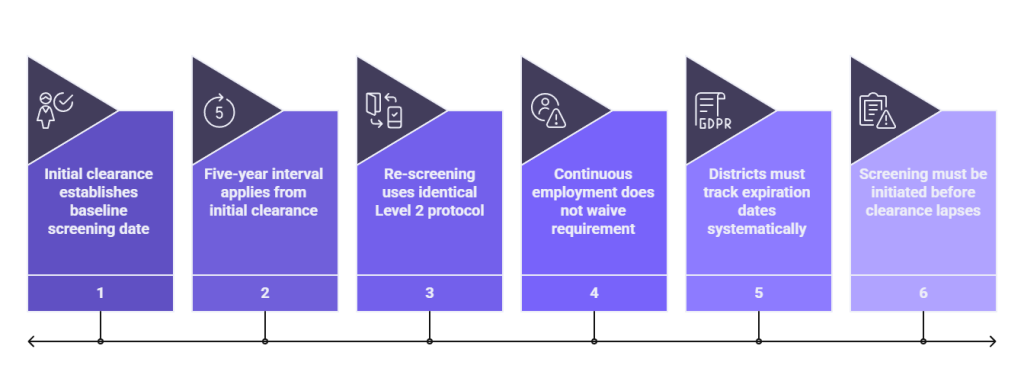
- Initial clearance establishes baseline screening date
- Five-year interval applies from initial clearance
- Re-screening uses identical Level 2 protocol
- Continuous employment does not waive requirement
- Districts must track expiration dates systematically
- Screening must be initiated before clearance lapses
The five-year interval reflects a balance between maintaining current information and avoiding excessive administrative burden. Re-screening uses the same Level 2 protocol as initial screening, including fingerprinting and database searches. Employees cannot avoid re-screening by remaining continuously employed; the statutory interval applies regardless of employment status continuity.
Employees Transferring Between Districts
When instructional personnel move from one Florida school district to another, questions arise regarding whether new screening is required or whether prior clearance remains valid. Generally, if an employee's prior screening was completed within the relevant timeframe using protocols that satisfy current statutory and regulatory requirements, the receiving district may be able to rely on that clearance. However, receiving districts should verify the specific screening components conducted and confirm alignment with current standards before relying on prior clearance.
Receiving districts bear responsibility for verifying that prior screening was conducted properly and remains current. This verification requires obtaining documentation from the prior district or from the candidate confirming screening completion date and results. Some districts require new screening for all incoming employees regardless of prior clearance, a conservative approach that ensures consistency and eliminates reliance on other districts' processes.
Triggering Events and Immediate Re-Screening
Certain events may trigger immediate re-screening obligations outside normal intervals. Arrests for disqualifying offenses, substantiated complaints of misconduct, or other red flags may require districts to conduct supplementary screening even if the employee's regular re-screening date has not arrived.
Districts should establish clear policies regarding employee obligations to report specified events, ensuring such policies comply with applicable restrictions on use of arrest versus conviction information and other employment law requirements. Any disciplinary action related to failure to report must be evaluated in light of what disclosure obligations legally exist under current law. When triggering events occur, districts must balance the employee's due process rights with student safety obligations.
Emergency Certification Pathways and Screening Requirements
Florida's teacher shortage has prompted expanded use of emergency certification pathways, creating questions about how background screening requirements apply to alternatively certified educators.
Temporary Certificates and Screening Timelines
Emergency and temporary teaching certificates allow individuals to begin teaching while completing certification requirements, addressing urgent staffing needs. However, these alternative pathways do not waive Florida education background checks requirements; candidates must still complete Level 2 screening before beginning work with students.
| Certification Type | Screening Requirement | Timeline | Conditional Employment |
| Traditional certification | Level 2 screening | Before hire | Permitted with safeguards |
| Emergency certification | Level 2 screening | Before hire | Permitted with safeguards |
| Temporary certificate | Level 2 screening | Before hire | Permitted with safeguards |
| Alternative route | Level 2 screening | Before hire | Permitted with safeguards |
| Out-of-state certified | Level 2 screening | Before hire | Permitted with safeguards |
The timing of screening relative to temporary certificate issuance sometimes creates confusion. A candidate may receive a temporary certificate from the Florida Department of Education before background screening concludes. The certificate authorizes teaching from a credentialing perspective but does not substitute for district-level screening clearance before the individual can actually enter classrooms.
Alternative Certification Programs and Clearance
Teachers entering the profession through alternative certification programs, including university-based programs and district-operated pathways, require Level 2 screening at the point of employment regardless of their certification route. The screening obligation attaches to the employment relationship and student contact, not to the certification method.
Some alternative programs include background checks as part of program admission requirements. While these program-level checks may satisfy certain gatekeeping functions, they do not necessarily meet Jessica Lunsford Act requirements or eliminate the employing district's obligation to conduct its own compliant screening.
Out-of-State Certified Educators
Florida's teacher shortage has increased recruitment of certified educators from other states. These candidates require Level 2 screening in Florida even if they underwent comprehensive background checks in their prior state, as Florida law mandates state-specific screening protocols.
Out-of-state candidates sometimes express frustration at undergoing repeated background checks across state moves. However, differences in state screening standards, database access, and legal frameworks necessitate Florida-specific screening to ensure compliance with in-state requirements. The timeline for screening out-of-state candidates mirrors that for in-state applicants.
Educator Abuse Registry Check and Disqualifying Offenses
The Florida educator abuse registry check functions as a specialized database designed to capture information beyond what criminal background checks reveal.
Registry Scope and Inclusion Criteria
Florida's educator abuse registry includes individuals found to have committed certain offenses against students, including those who resigned or were terminated while under investigation for such conduct. Inclusion does not require criminal conviction; substantiated findings through administrative or employment investigation processes may result in registry placement.
Registry Inclusion Criteria:
- Substantiated findings of offenses against students
- Resignations during investigation for specified conduct
- Terminations related to student safety concerns
- Administrative findings without criminal prosecution
- Multi-state reporting through national databases
- Permanent placement for qualifying offenses
The registry captures a category of misconduct that might otherwise escape detection during routine background screening. Registry checks are mandatory components of compliant Florida education background checks for instructional personnel. The check occurs as part of the Level 2 screening process, with results typically included in the comprehensive report districts receive from FDLE.
National Registry Integration
Florida's registry check includes queries of national databases tracking educator misconduct, extending the search beyond state boundaries. This national integration addresses workforce mobility and ensures that misconduct in other states does not escape notice when individuals seek Florida employment.
The National Association of State Directors of Teacher Education and Certification maintains databases that some states use to share information about educator misconduct. However, participation varies by state, and not all jurisdictions report comprehensively. This limitation underscores the importance of thorough employment verification as a complement to database searches.
Disqualifying Offenses and Waiver Provisions
Florida law specifies categories of offenses that permanently disqualify individuals from working in positions requiring Level 2 screening. These disqualifying offenses include serious violent crimes, sexual offenses, and crimes against children, among others.
Certain other offenses may be disqualifying unless the individual obtains an exemption from disqualification through a formal waiver process. The waiver process requires demonstrating rehabilitation and that employment would not present an unreasonable risk, a showing that requires substantial documentation and often legal assistance. Districts should understand that they cannot unilaterally decide to employ individuals with disqualifying offenses, even if they believe the person is rehabilitated or the offense is not relevant to educational employment.
Practical Implementation for High-Volume Hiring
School districts facing substantial hiring needs must develop systems that maintain compliance while processing large candidate volumes efficiently.
Workflow Optimization Strategies
Effective Florida education background checks workflows begin at the application stage, with clear communication to candidates about screening requirements, timelines, and their responsibilities in the process. Applications should be designed to capture information needed for screening in compliance with FCRA disclosure and authorization requirements. Required data elements and collection timing should be reviewed with legal counsel to ensure proper consent sequencing and authorization protocols.
Workflow Optimization Elements:
- Application stage screening disclosure and consent
- Automated fingerprinting appointment scheduling
- Batch processing during peak hiring periods
- Real-time status tracking through integrated systems
- Automated alerts when results are received
- Expiration tracking for existing employee clearances
- Vendor coordination for dedicated appointment blocks
Districts can reduce timeline uncertainty by batching candidates for fingerprinting appointments, coordinating with vendors to establish dedicated time blocks during peak hiring periods, and maintaining waitlists that allow rapid scheduling when appointment slots become available. Technology integration streamlines tracking and reduces administrative burden.
Vendor Selection and Management
Many districts engage third-party vendors to manage aspects of the Florida teacher certification background check timeline process, including scheduling coordination, result interpretation, and record management. Vendor selection should evaluate capabilities specific to Florida requirements, including familiarity with Jessica Lunsford Act requirements, integration with FDLE systems, and ability to handle peak volume demands.
Contracts with screening vendors should clearly define service levels for vendor-controlled activities, acknowledge that governmental processing times are outside vendor control, and establish escalation procedures when issues arise within the vendor's operational scope. Periodic audits of vendor performance help ensure that services meet expectations and that the vendor remains current with regulatory changes.
Record Retention and Audit Readiness
Florida law and district policies establish retention requirements for background screening records. Districts must maintain documentation confirming that required screening occurred, the date of clearance, and results, throughout employment and for specified periods after separation.
| Record Type | Required Contents | Retention Period | Access Controls |
| Initial screening | Completion date, results, clearance status | Duration of employment plus statutory period | HR personnel only |
| Re-screening | Five-year interval documentation | Duration of employment plus statutory period | HR personnel only |
| Conditional employment | Supervision logs, interim restrictions | Duration of employment plus statutory period | HR and supervisors |
| Volunteer screening | Screening type, date, clearance status | Duration of service plus statutory period | Designated staff only |
| Vendor reports | Comprehensive screening results | Duration of employment plus statutory period | HR personnel only |
Organized record systems facilitate compliance verification during audits and enable efficient responses to inquiries. Digital record systems with appropriate security controls protect sensitive information while enabling authorized access for compliance reviews and employment verification requests. Audit readiness requires more than simply retaining records; districts should periodically review files to confirm completeness and identify gaps before external reviewers discover them.
Conclusion
Florida education background checks requirements reflect comprehensive student safety priorities that demand district attention amid operational pressures. Understanding Level 2 screening components, processing timelines, volunteer screening distinctions, and re-screening obligations enables compliant high-volume hiring. As districts navigate staffing challenges through 2026, maintaining rigorous screening protocols while optimizing workflows protects both students and institutions from preventable risk exposure. This allows them to avoid delays while remaining compliant with the law. Investing in screening infrastructure today will ensure sustainable hiring practices and foster trust within the educational environment.
Frequently Asked Questions
What is the typical FDLE fingerprinting processing time for Florida teacher background checks?
FDLE fingerprinting processing time typically ranges from 3-5 business days for electronically submitted prints when no complications arise. However, FBI database queries and peak hiring periods may extend this timeline. Districts should plan for up to two weeks from fingerprinting appointment to result receipt when scheduling new hire start dates to accommodate potential delays.
Do Florida substitute teachers require the same background checks as full-time teachers?
Yes, Florida substitute teacher background check requirements mandate Level 2 screening identical to full-time instructional personnel. This applies regardless of whether substitutes are district employees or placed through staffing agencies. Substitutes must complete fingerprinting and all required database checks before beginning work with students.
Are all school volunteers in Florida required to undergo Level 2 background screening?
Florida school volunteer background check requirements vary based on whether volunteers have unsupervised access to students. Volunteers serving only in chaperoned capacities under continuous screened-employee oversight may undergo less comprehensive name-based checks. Volunteers with unsupervised student contact require full Level 2 fingerprint-based screening.
How often must Florida teachers be re-screened after their initial background check?
Florida typically requires re-screening of instructional personnel every five years from the initial clearance date. Re-screening uses the same Level 2 protocol including fingerprinting. These intervals apply regardless of continuous employment, and districts must track expiration dates to initiate renewal screening before clearances lapse.
What is included in the Florida educator abuse registry check?
The Florida educator abuse registry check queries state and national databases tracking individuals found to have committed specified offenses against students or who left educational employment under investigation for such conduct. Registry inclusion does not require criminal conviction; substantiated administrative findings may result in placement. This check is mandatory for all instructional personnel positions.
Can Florida school districts hire teachers with emergency certifications before background checks are completed?
Emergency certification does not waive Florida education background checks requirements. Districts may use conditional employment provisions allowing individuals to begin work after fingerprints are submitted but before results return. This requires heightened supervision by screened personnel and no self-disclosed disqualifying offenses.
Do private schools in Florida have the same background check requirements as public schools?
Private schools accepting students through state scholarship programs, including Florida Tax Credit Scholarship and Family Empowerment Scholarship programs, must comply with Jessica Lunsford Act requirements including Level 2 screening for instructional personnel. Private schools not participating in state-funded programs may have different requirements depending on their specific circumstances.
What happens if a Florida teacher is arrested after being hired and cleared?
Employees have continuing obligations to report arrests for certain offenses to their employing district. Districts may conduct supplementary screening outside regular re-screening intervals when triggering events occur. Districts may also place employees on administrative leave pending investigation. Screening requirements continue throughout employment, not just at initial hire.
Additional Resources
- Florida Department of Law Enforcement Background Screening
https://www.fdle.state.fl.us/Background-Checks - Florida Department of Education Educator Certification
https://www.fldoe.org/teaching/certification - Jessica Lunsford Act Full Text (Florida Statute 1012.315 and related provisions)
http://www.leg.state.fl.us/Statutes/ - Florida School Boards Association Policy Guidance
https://www.fsba.org/ - FBI Criminal Justice Information Services
https://www.fbi.gov/services/cjis

ABOUT THE CREATOR
GCheck Editorial Team
Meet the GCheck Editorial Team, your trusted source for insightful and up-to-date information in the world of employment background checks. Committed to delivering the latest trends, best practices, and industry insights, our team is dedicated to keeping you informed.
With a passion for ensuring accuracy, compliance, and efficiency in background screening, we are your go-to experts in the field. Stay tuned for our comprehensive articles, guides, and analysis, designed to empower businesses and individuals with the knowledge they need to make informed decisions.
At GCheck, we're here to guide you through the complexities of background checks, every step of the way.