

Fingerprint background checks use biometric data to verify identity and search criminal records through state and federal databases, offering higher accuracy than name-based searches in environments where identity assurance is critical. In 2026, these checks function as one component within comprehensive screening strategies, particularly valuable in regulated sectors like healthcare, education, and government contracting where legal mandates or elevated security needs justify the additional time and coordination required for biometric verification.
Key Takeaways
- Fingerprint background checks compare biometric data against FBI and state criminal databases, eliminating common name confusion that affects traditional searches.
- Federal and state regulations mandate fingerprint screening for specific roles in healthcare, childcare, education, and positions requiring security clearances.
- The fingerprint background screening process typically requires 3 to 14 days, depending on whether checks involve only state databases or include federal FBI searches.
- Biometric verification provides definitive identity confirmation, reducing false positives and missed records that occur with name-based criminal background checks.
- Industries handling vulnerable populations or sensitive information benefit most from fingerprint-based verification as part of layered screening protocols.
- Employers must navigate varying state requirements, as some jurisdictions mandate fingerprinting while others permit name-based alternatives for similar positions.
- Modern screening ecosystems combine fingerprint checks with continuous monitoring, credential verification, and consortium databases to create comprehensive risk profiles.
- Understanding when fingerprint background checks add measurable value versus when alternative methods suffice enables cost-effective, compliant hiring decisions.
What Are Fingerprint Background Checks and How Do They Work?
Fingerprint background checks represent a biometric verification method that matches an individual's unique fingerprint patterns against criminal record databases maintained by state agencies and the Federal Bureau of Investigation. Unlike name-based searches that rely on identifying information such as full name, date of birth, and Social Security number, fingerprint screening uses physical characteristics that cannot be altered or misrepresented. This approach eliminates the ambiguity inherent in traditional background screening methods.
The Biometric Verification Process
When an employer initiates fingerprint background checks, applicants visit an authorized fingerprinting location where trained technicians capture digital images of fingerprint patterns. The process involves several key steps:
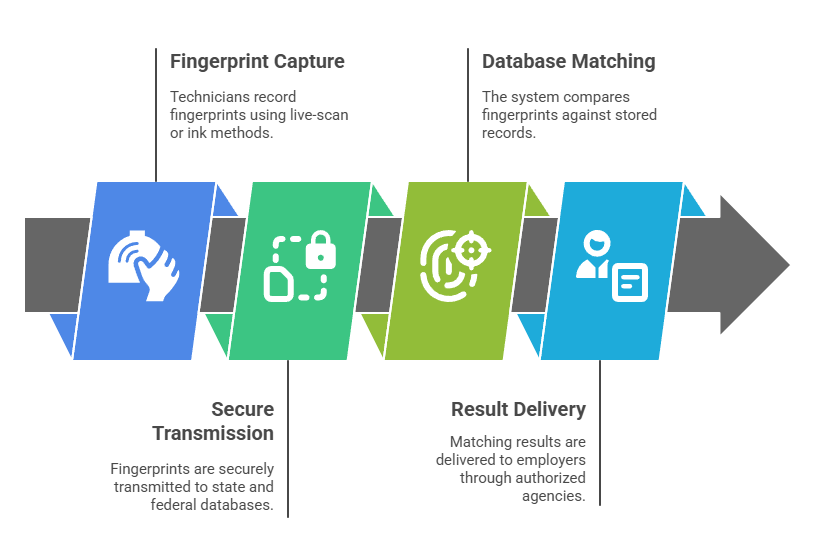
- Electronic capture: Technicians use live-scan technology or traditional ink methods to record fingerprint patterns with precision and clarity.
- Secure transmission: Biometric identifiers travel through encrypted channels to the appropriate state repository and, when required, to the FBI's Next Generation Identification system.
- Database matching: The system compares submitted fingerprints against millions of stored records, searching for criminal history information associated with those specific biometric markers.
- Result delivery: Matching results return to employers through authorized channeling agencies that maintain strict confidentiality protocols.
The FBI maintains the largest biometric database in the United States. This centralized system enables comprehensive searches across jurisdictional boundaries that name-based methods cannot achieve.
How Fingerprint Background Checks Differ from Name-Based Searches
Traditional criminal background checks query court records and criminal databases using biographical identifiers. These searches can miss records filed under slight name variations, fail to connect records across jurisdictions where an individual used different addresses, or incorrectly flag candidates who share names with individuals who have criminal histories. Fingerprint background checks in hiring eliminate these accuracy gaps by anchoring searches to immutable biometric data.
When properly enrolled in state or federal systems, an individual's criminal records link directly to their fingerprints regardless of name changes, aliases, or jurisdictional boundaries. This precision proves particularly valuable in industries that require fingerprint background checks by law, where the consequences of identity errors carry significant regulatory and safety implications.
Industries That Require Fingerprint Background Checks
Regulatory frameworks at federal, state, and local levels mandate fingerprint screening for positions involving vulnerable populations, national security, or sensitive information access. Understanding these requirements helps employers determine when biometric verification serves as a legal obligation versus a voluntary enhancement to standard screening protocols. Compliance depends on accurate interpretation of applicable statutes and industry-specific regulations. Employers should verify current requirements in their specific state and locality, as mandates vary significantly by jurisdiction.
Healthcare and Medical Services

Healthcare facilities employing workers with direct patient contact may face state-mandated fingerprint requirements in certain jurisdictions. Requirements vary significantly by state—some mandate biometric screening for nursing home employees, home health aides, and similar positions, while others permit name-based alternatives or impose no fingerprinting requirements. Several key categories may trigger biometric screening obligations:
| Position Category | Typical Requirement |
| Nursing home employees | Mandatory in many states for direct care staff |
| Home health aides | Required in certain states for unsupervised patient contact roles |
| DEA-registered handlers | Federal mandate for controlled substance access |
| Licensed professionals | State licensure process often includes fingerprint screening |
The Drug Enforcement Administration requires fingerprint background checks for DEA registrants and certain employees with access to controlled substances. Licensed healthcare professionals, including nurses and physicians, typically undergo fingerprint screening as part of initial licensure processes in most states.
Education and Childcare Sectors

Many school districts require fingerprint background checks for teachers, administrators, support staff, and contractors with regular campus access, though requirements vary by state and local jurisdiction. State education agencies in certain locations establish these requirements to protect students from individuals with histories of crimes against children or violent offenses that pose safety risks in educational environments. Childcare facilities face similar mandates in numerous states, with fingerprint screening required for daycare workers, preschool teachers, and other childcare providers.
These regulations extend to home-based childcare operations in many jurisdictions. The vulnerability of the populations served and the supervisory limitations inherent in childcare settings justify enhanced screening protocols. Background check requirements apply regardless of employment classification or part-time versus full-time status.
Government Contractors and Security Clearances
Federal contractors requiring facility security clearances or access to classified information must complete fingerprint background checks as part of personnel security investigations. Key requirements include:
- NISPOM compliance: The National Industrial Security Program Operating Manual establishes biometric verification as a foundational element of the vetting process for cleared contractor employees.
- State and local positions: Government employees in law enforcement, corrections, court systems, or with access to sensitive databases face mandatory fingerprint screening in most jurisdictions.
- Access-based triggers: Authorities or information access levels determine screening requirements rather than job titles alone.
These requirements recognize that government employees often possess authorities or information access that requires enhanced identity verification and criminal history review.
Financial Services and Banking
The Financial Industry Regulatory Authority requires fingerprint background checks for individuals seeking registration as securities industry professionals, including brokers and dealers. These requirements help protect market integrity and public confidence in financial services by ensuring thorough vetting of individuals with access to customer funds and sensitive financial information. Banking institutions may voluntarily implement fingerprint screening for positions involving cash handling, account access, or financial authority.
How Long Do Fingerprint Background Checks Take?
The fingerprint background screening process timeline varies significantly based on whether searches involve only state criminal repositories or include federal FBI database queries. Processing speeds depend on multiple factors including submission method, database technology, and search scope. Understanding these timeframes helps employers plan hiring schedules and set appropriate candidate expectations.
State-Level Fingerprint Processing
State-only fingerprint background checks typically complete within 3 to 5 business days when submitted electronically through authorized channels. States maintaining modernized biometric systems with integrated criminal history databases can often return results within 24 to 48 hours.
| Processing Factor | Typical Impact | Timeline Addition |
| Electronic submission | Faster processing | Standard 3-5 days |
| Manual review requirements | Human adjudication needed | Additional 2-4 days |
| Poor fingerprint quality | Resubmission required | Additional 5-10 days |
| Peak hiring seasons | Higher submission volumes | Additional 1-3 days |
State searches identify criminal records processed within that specific state's jurisdiction. However, they may not capture an individual's complete criminal history if they lived or committed offenses in other states.
FBI Fingerprint Background Checks
When employers request federal-level searches through the FBI's channeling process, how long fingerprint background checks take extends to 7 to 14 business days in most cases. FBI searches provide nationwide coverage by comparing submitted fingerprints against the Next Generation Identification database, which aggregates criminal records from state repositories, federal agencies, and other contributing sources. The FBI prioritizes processing based on submission category and channeler protocols.
Certain regulatory-mandated checks may receive expedited handling. Conversely, voluntary employment screenings follow standard processing queues. Technical issues such as low-quality fingerprint images requiring resubmission can extend timelines by several additional days.
The Accuracy Advantages of Fingerprint Background Checks
Biometric verification delivers measurable accuracy improvements over name-based criminal background checks, particularly in scenarios involving common names, incomplete identifying information, or complex criminal record histories spanning multiple jurisdictions.
Eliminating False Positives
Name-based searches frequently generate false positive results when multiple individuals share similar names, birth dates, or other identifying characteristics. Common challenges include:
- Shared identifiers: Individuals with common names like "John Smith" or "Maria Garcia" face frequent misidentification in traditional database searches.
- Manual review burden: False positives require time-consuming adjudication processes that delay hiring decisions and increase administrative costs.
- Candidate experience impact: Incorrect associations with criminal records belonging to different individuals create adverse experiences and potential legal exposure.
Fingerprint background checks eliminate these misidentification issues by anchoring searches to unique biometric markers that cannot be shared between individuals. When a fingerprint search identifies a criminal record, employers can proceed with confidence that the record belongs to the actual applicant rather than a similarly named person.
Capturing Records Across Jurisdictions
Individuals with criminal histories spanning multiple states or who used variations of their names across different time periods often present incomplete pictures in name-based searches. County court searches miss records filed in jurisdictions not included in the search parameters, while statewide database searches capture only records within that specific state's boundaries. FBI fingerprint searches aggregate records from participating jurisdictions nationwide, creating comprehensive criminal history profiles that reflect an individual's complete record regardless of geographic mobility or name variations.
This completeness proves particularly valuable for positions requiring thorough vetting or serving populations where even minor undiscovered offenses pose unacceptable risks. Geographic mobility among job seekers makes jurisdictional comprehensiveness increasingly important for effective risk assessment.
When Fingerprint Checks Add Strategic Value
Not every position justifies the additional time, coordination, and complexity associated with fingerprint background screening. Employers benefit from frameworks that identify circumstances where biometric verification delivers measurable risk reduction versus situations where name-based methods provide adequate protection. Strategic resource allocation matches screening intensity to position requirements and organizational risk tolerance.
Positions Involving Vulnerable Populations
Roles providing care, supervision, or services to children, elderly individuals, or persons with disabilities warrant enhanced screening protocols that include fingerprint verification. Consider these factors:
- Power imbalance: The inherent vulnerability in caregiver relationships justifies the additional accuracy and completeness that biometric searches provide.
- Unsupervised access: Healthcare positions with direct patient contact, especially those involving access to patients in homes or institutional settings without continuous oversight, benefit from comprehensive criminal history discovery.
- Educational roles: Staff members who interact with students without immediate supervision merit the identity certainty that fingerprint screening delivers.
The consequences of screening failures in these contexts extend beyond individual organizations to affect vulnerable populations who cannot adequately protect themselves.
High-Security Environments
Organizations handling classified information, operating critical infrastructure, or maintaining sensitive proprietary data may voluntarily implement fingerprint screening for positions with elevated access privileges. Security considerations include:
| Environment Type | Screening Rationale | Typical Positions |
| Classified information | National security protection | Defense contractors, intelligence analysts |
| Critical infrastructure | Operational integrity | Utility system administrators, transportation security |
| Valuable IP | Trade secret protection | Research scientists, senior engineers |
| Financial systems | Fraud prevention | Payment processors, treasury staff |
Financial institutions, research facilities, and technology companies dealing with valuable intellectual property increasingly incorporate fingerprint checks into screening protocols for senior positions or roles with privileged system access. This layered approach combines fingerprint verification with other screening methodologies to create comprehensive security frameworks.
When Name-Based Methods Suffice
Many employment positions involve neither vulnerable populations nor security-sensitive responsibilities that necessitate fingerprint screening. For these roles, modern name-based criminal background checks utilizing comprehensive databases and proper identifying information provide adequate risk assessment at lower cost and faster turnaround than biometric methods. Positions in retail, hospitality, general office environments, and other settings where neither regulatory mandates nor elevated risk factors exist typically achieve appropriate due diligence through name-based searches combined with employment verification, education confirmation, and reference checks.
Each organization should assess its specific risk profile, regulatory obligations, and operational needs when determining appropriate screening methods. Consultation with employment law counsel can help ensure screening policies align with legal requirements and business objectives.
Compliance Considerations for Fingerprint Screening
Employers implementing fingerprint background checks should navigate federal Fair Credit Reporting Act requirements alongside state-specific regulations governing biometric data collection, retention, and use. Because requirements vary by jurisdiction and evolve over time, organizations benefit from consulting with legal counsel familiar with employment screening laws. These compliance obligations apply whether fingerprint screening occurs as a regulatory mandate or voluntary enhancement to hiring protocols.
FCRA Requirements for Employment Screening
When employers obtain fingerprint background checks through consumer reporting agencies, federal law generally requires compliance with FCRA disclosure and authorization requirements. Employers should consult with legal counsel to ensure their specific processes meet all applicable federal and state requirements. The process involves several mandatory steps:
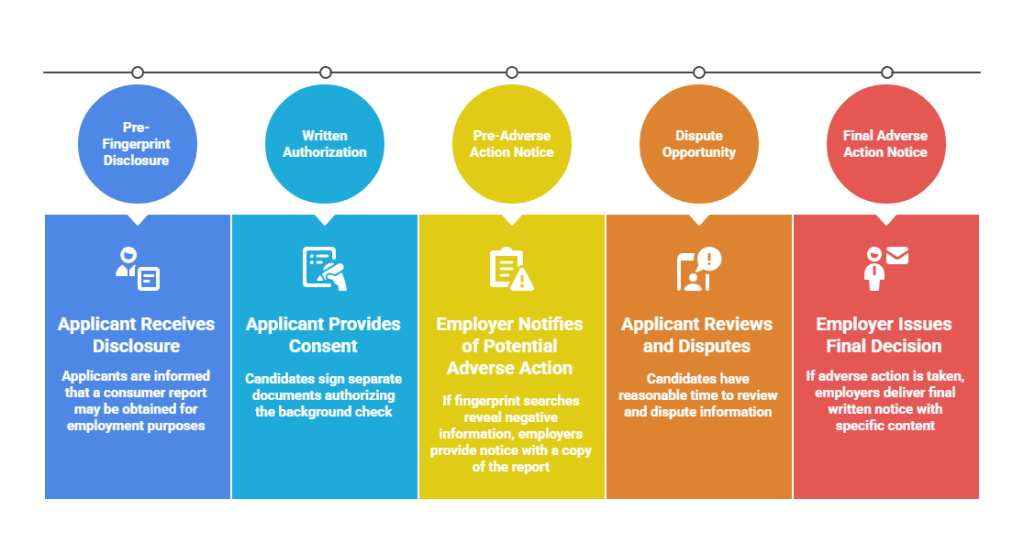
- Standalone disclosure: Applicants receive clear documents disclosing that a consumer report may be obtained for employment purposes before fingerprint collection occurs.
- Written authorization: Candidates provide explicit consent authorizing the background check through separate signed documents.
- Pre-adverse action notice: If fingerprint searches reveal information that may lead to adverse employment decisions, employers must provide notice with a copy of the consumer report.
- Dispute opportunity: Candidates receive reasonable time to review and dispute information before final decisions.
- Final adverse action notice: Employers who proceed with unfavorable decisions must deliver final written notice with specific content requirements.
These FCRA requirements apply when using consumer reporting agencies. Specific procedural details and state law enhancements may vary by jurisdiction and situation.
EEOC guidance recommends employers conduct individualized assessments of discovered criminal records, considering factors such as offense nature, time elapsed since conviction or sentence completion, evidence of rehabilitation, and relevance to position responsibilities. State and local laws may impose additional requirements or restrictions.
State-Specific Fingerprinting Regulations
State laws governing fingerprint background checks in hiring vary significantly across jurisdictions. Some states operate mandatory fingerprint programs for specific industries, require employers to use designated fingerprinting vendors or locations, and establish protocols for transmitting results to both employers and licensing agencies. Several states have enacted biometric privacy laws regulating the collection, storage, and use of fingerprint data.
These statutes may require specific consent language, limit retention periods for biometric information, and establish private rights of action for violations. Employers operating across multiple states must ensure compliance with the most restrictive applicable regulations. Ban-the-box laws in various jurisdictions restrict when employers may inquire about criminal history during the hiring process. Additionally, some states impose lookback period limitations that restrict how far back employers may consider certain criminal records, regardless of screening method used.
Record Retention and Data Security
Fingerprint images and associated criminal records contain sensitive personal information requiring appropriate security safeguards under various privacy frameworks. Employers should implement data protection measures consistent with federal regulations and state-specific privacy laws, including state biometric information privacy acts where applicable, which may impose specific consent, retention, and security requirements. Access should be restricted to authorized personnel with legitimate business needs, and organizations should establish retention schedules that balance legal preservation obligations with privacy principles favoring minimal data retention.
Many regulatory frameworks require employers to destroy fingerprint records after completing the screening process or upon separation of employment, with exceptions for regulated industries where ongoing retention serves specific compliance purposes. Understanding these requirements helps employers avoid liability for unauthorized data retention or inadequate security practices.
Integrating Fingerprint Checks Into Comprehensive Screening Programs
Modern employment screening increasingly adopts multi-layered approaches that combine fingerprint verification with complementary methodologies to create thorough risk assessment frameworks. This strategic integration recognizes that no single screening method addresses all hiring risks. Each component contributes specific insights to comprehensive candidate evaluation.
Combining Biometric and Name-Based Searches
Some employers implement hybrid screening protocols that include both fingerprint background checks for criminal records and name-based searches covering additional data sources. This approach captures the accuracy advantages of biometric criminal searches while accessing information categories not available through fingerprint repositories. Additional verification components include:
- Civil court records: Lawsuits, judgments, and bankruptcies that provide insight into financial responsibility and litigation history.
- Driving records: Motor vehicle histories relevant for positions involving company vehicles or transportation responsibilities.
- Professional licenses: Active license status, disciplinary actions, and credential authenticity for regulated professions.
- Education verification: Degree confirmations and attendance records that validate claimed academic credentials.
The combined methodology proves particularly valuable for positions requiring both thorough criminal vetting and verification of credentials, professional standing, or civil litigation histories.
Continuous Monitoring and Post-Hire Screening
Initial fingerprint background screening provides a point-in-time snapshot of an individual's criminal history at the moment of hire. Organizations in healthcare, education, and other sensitive industries increasingly supplement initial screening with ongoing monitoring programs that alert employers to new criminal activity by current employees. These continuous monitoring systems typically rely on name-based database queries rather than repeated fingerprint submissions, creating cost-effective post-hire risk management.
The combination of initial fingerprint verification establishing identity certainty with ongoing name-based monitoring addressing new criminal activity represents an efficient approach to sustained workforce integrity. Continuous monitoring captures arrests, convictions, and other reportable events that occur after the initial hiring decision.
Conclusion
Fingerprint background checks provide unmatched accuracy and identity verification within employment screening ecosystems, serving essential roles in regulated industries and security-sensitive positions. Understanding when these checks deliver measurable value enables strategic screening decisions that balance thoroughness, efficiency, and regulatory compliance in 2026's evolving hiring landscape.
Frequently Asked Questions
What makes fingerprint background checks more accurate than regular background checks?
Fingerprint background checks use unique biometric identifiers that cannot be altered or misrepresented, eliminating false positives from name confusion. This biometric approach provides definitive identity verification alongside criminal record discovery. Name-based searches depend on matching biographical information that may contain errors or variations across different records systems.
Do all employers have the legal authority to require fingerprint background checks?
Fingerprint screening authority depends on state laws and regulations governing specific industries or position types. While employers in healthcare, education, childcare, and government contracting often face mandatory fingerprint requirements, private employers in unregulated industries may need specific statutory authorization. Some states limit fingerprint screening to positions meeting defined criteria involving vulnerable populations or security responsibilities. Employers should verify their legal authority under applicable state law before implementing fingerprint requirements.
How do applicants get fingerprinted for employment background checks?
Applicants visit authorized fingerprinting locations, which may include law enforcement agencies, state-designated enrollment centers, or private vendors approved to collect fingerprints for employment purposes. The process involves presenting required identification documents and having fingerprints captured electronically using live-scan technology or through traditional ink methods. Collection agencies then transmit fingerprint images through secure channels to appropriate state or FBI repositories.
Can employers access FBI fingerprint background check results directly?
Employers cannot directly access FBI databases but must work through authorized channeling agencies approved to submit fingerprints to the FBI on behalf of specific industry sectors or regulatory programs. Results flow back through these same channeling organizations to employers. Strict protocols govern result confidentiality, retention, and permissible use to protect applicant privacy while meeting legitimate employment screening needs.
What happens if fingerprint background checks reveal old criminal records?
EEOC guidance recommends employers conduct individualized assessments of discovered criminal records, considering factors such as offense nature, time elapsed since conviction or sentence completion, evidence of rehabilitation, and relevance to position responsibilities. State and local laws may impose additional requirements or restrictions. The Fair Credit Reporting Act requires pre-adverse action procedures if employers intend to deny employment based on discovered information, giving applicants opportunity to review records, dispute inaccuracies, and provide mitigating context before final employment decisions.
How long do employers keep fingerprint records after completing background checks?
Retention requirements vary by state law and industry regulation, with many jurisdictions requiring destruction of fingerprint images after completing the screening process unless ongoing retention serves specific regulatory compliance purposes. Some regulated industries maintain fingerprint records throughout employment for reverification or audit purposes. Others retain only the background check results documentation rather than the actual biometric data, balancing legitimate business needs against privacy principles. Organizations should consult with legal counsel or compliance professionals familiar with applicable state biometric privacy laws and industry-specific regulations.
Can applicants dispute errors found in fingerprint background check results?
Applicants possess rights under the Fair Credit Reporting Act to dispute inaccurate or incomplete information in consumer reports, including fingerprint background check results. The dispute process involves notifying the consumer reporting agency of the specific errors. Agencies must investigate by verifying information with the original source, such as the FBI or state criminal repository, and correct or delete confirmed errors.
Additional Resources
- FBI Criminal Justice Information Services - Identity History Summary Checks
https://www.fbi.gov/services/cjis/identity-history-summary-checks - U.S. Equal Employment Opportunity Commission - Background Checks and Arrest and Conviction Records
https://www.eeoc.gov/laws/guidance/arrest_conviction.cfm - Federal Trade Commission - Using Consumer Reports for Employment Purposes
https://www.ftc.gov/business-guidance/resources/using-consumer-reports-employment-purposes - National Conference of State Legislatures - Criminal Records and Employment
https://www.ncsl.org/labor-and-employment/criminal-records-and-employment - U.S. Department of Justice - Fair Credit Reporting Act
https://www.justice.gov/opcl/fair-credit-reporting-act

ABOUT THE CREATOR
GCheck Editorial Team
Meet the GCheck Editorial Team, your trusted source for insightful and up-to-date information in the world of employment background checks. Committed to delivering the latest trends, best practices, and industry insights, our team is dedicated to keeping you informed.
With a passion for ensuring accuracy, compliance, and efficiency in background screening, we are your go-to experts in the field. Stay tuned for our comprehensive articles, guides, and analysis, designed to empower businesses and individuals with the knowledge they need to make informed decisions.
At GCheck, we're here to guide you through the complexities of background checks, every step of the way.