

FCRA compliance for schools requires precise adherence to federal disclosure, authorization, and adverse action procedures when conducting background checks for education and childcare hiring. Schools must navigate overlapping state-specific laws, maintain compliant documentation, and implement procedurally sound screening programs to protect both institutional integrity and candidate rights.
Key Takeaways
- Schools must provide standalone FCRA disclosure documents before obtaining background checks, not embedded within application materials.
- Written authorization from candidates is required separately from disclosure, with clear language explaining the scope of screening.
- Adverse action procedures involve pre-adverse notice, a waiting period, provision of report copies, and final notice with appeal rights.
- State laws often impose additional requirements on education background checks, including fingerprinting, abuse registry searches, and lookback period limitations.
- Childcare background checks typically face stricter regulatory scrutiny due to vulnerable population protection mandates.
- Documentation retention policies must balance FCRA requirements with state record-keeping laws and institutional policy needs.
- Third-party screening vendors must be FCRA-compliant consumer reporting agencies, and schools remain legally responsible for proper procedures.
- Regular compliance audits and staff training reduce liability exposure and ensure procedural consistency across hiring departments.
Understanding FCRA's Role in Education Hiring
The Fair Credit Reporting Act governs how schools obtain and use background information when making employment decisions. Educational institutions, from K-12 schools to universities and childcare facilities, function as employers under FCRA when they use third-party services to compile background reports on applicants or employees. This federal framework establishes baseline procedural protections that apply regardless of institutional type or size.
FCRA compliance for schools begins when a hiring decision involves information assembled by an external consumer reporting agency. The law distinguishes between information a school gathers directly, such as through reference calls or internal interviews, and reports compiled by third parties specifically for employment purposes. Only the latter triggers FCRA obligations, creating a critical first decision point in compliance planning.
The Consumer Reporting Agency Relationship
Schools typically work with consumer reporting agencies to conduct criminal history checks, credential verifications, and employment history reviews. Once this relationship exists, FCRA's procedural requirements activate immediately. The law treats candidates and employees as consumers entitled to specific protections, regardless of the position's nature or the institution's educational mission.
Educational institutions cannot avoid FCRA obligations by characterizing background checks as safety measures or regulatory compliance activities. The law applies based on the functional relationship between employer, screening provider, and candidate, not the underlying purpose of the screening. This means teacher background check requirements must satisfy FCRA procedures even when state education codes independently mandate such checks.
Federal-State Law Intersection
FCRA establishes a floor, not a ceiling, for background check procedures. State laws frequently impose additional requirements on education employers, particularly regarding criminal history checks, abuse and neglect registry searches, and credential verifications.
| Legal Layer | Authority Source | Common Requirements |
| Federal FCRA | Fair Credit Reporting Act | Disclosure, authorization, adverse action procedures |
| State Education Law | State education codes and regulations | Fingerprinting, credential verification, educator discipline database searches |
| Child Protection Law | State child welfare and licensing statutes | Abuse/neglect registry checks, expanded criminal lookback periods |
| Local Ordinances | Municipal fair chance hiring laws | Ban-the-box restrictions, individualized assessments |
Schools must design compliance programs that satisfy both federal FCRA standards and state-specific mandates simultaneously. Some states require educational institutions to conduct fingerprint-based background checks through state or federal databases. These requirements exist alongside, not instead of, FCRA obligations. When schools use third-party agencies to manage or interpret such checks, FCRA procedures apply to the resulting reports even when state law mandates the underlying screening.
Core FCRA Procedural Requirements for Schools

Educational institutions must execute three distinct procedural phases when conducting background checks. Each phase contains specific documentation and timing requirements that cannot be abbreviated or combined without creating compliance risks.
Disclosure Requirements
Schools must provide candidates with a clear, standalone disclosure document before obtaining a background check. This disclosure must inform the individual that a consumer report may be obtained for employment purposes. The document cannot be embedded within applications, employee handbooks, or other materials, though limited additional information may be included under specific conditions.
The disclosure must be in writing and in a format the candidate can retain. Electronic disclosures are permissible if they meet FCRA's standards for conspicuousness and the candidate can print or save the document. Schools serving multilingual communities should consider providing disclosures in languages candidates can understand, though FCRA does not explicitly mandate translation.
Authorization Procedures
After providing disclosure, schools must obtain written authorization from the candidate before requesting a background check. Authorization must be clear, conspicuous, and separate from other application materials. Candidates must actively consent, not merely fail to object, and schools must be able to demonstrate that informed, voluntary authorization was obtained.
Key Authorization Elements:
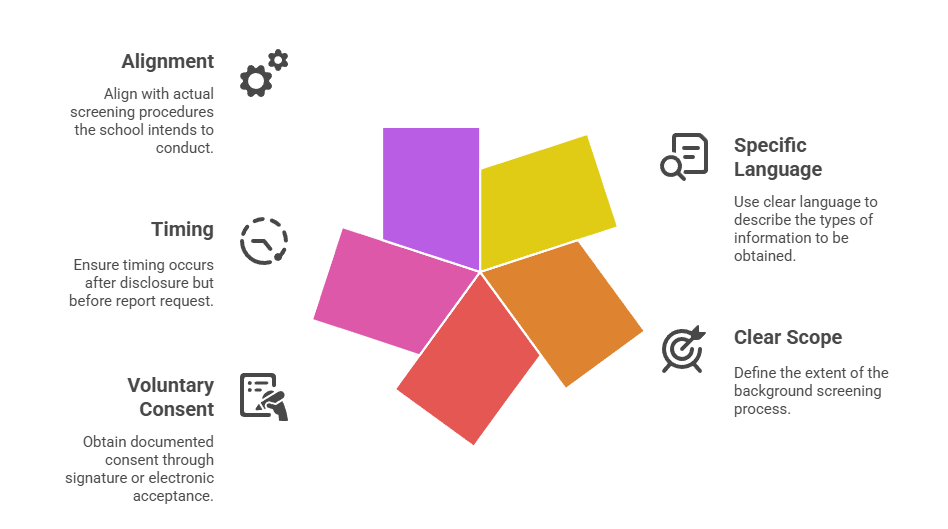
- Specific language describing types of information to be obtained
- Clear scope defining the extent of background screening
- Voluntary consent documented through signature or electronic acceptance
- Timing that occurs after disclosure but before report request
- Alignment with actual screening procedures the school intends to conduct
How to comply with FCRA in education hiring requires particular attention to authorization timing. Schools cannot request or obtain background reports before receiving signed authorization. Conditional job offers may precede background checks, but screening cannot begin until proper authorization is documented.
Adverse Action Procedures
When background information may lead to an adverse employment decision, schools must follow FCRA's multi-step adverse action process. This procedure protects candidates' rights to review report accuracy and provide context before final decisions are made.
The pre-adverse action phase requires schools to provide the following:
- A copy of the consumer report
- Written notice of potential adverse action
- A summary of FCRA rights
- A reasonable period for candidate review and response
After providing the required waiting period and considering any candidate response, if the school decides to proceed with adverse action, it must provide a final adverse action notice. This notice must include the name and contact information of the consumer reporting agency, a statement that the agency did not make the employment decision, and information about the candidate's right to dispute report accuracy with the agency. Schools must maintain documentation of each procedural step to demonstrate compliance if challenged.
Education-Specific Compliance Considerations
Background screening in educational settings involves unique regulatory layers beyond baseline FCRA requirements. Schools face overlapping mandates from state education agencies, child protection statutes, and licensing bodies, all of which must be satisfied alongside federal consumer protection law.
Teacher and Staff Screening Mandates
Many states impose specific background check requirements for teachers and school staff, often administered through state education departments or criminal justice agencies. These mandates frequently require fingerprint-based criminal history checks, and may include federal FBI database searches.
When schools use consumer reporting agencies to facilitate or supplement these checks, FCRA procedures apply to the resulting reports. Teacher background check requirements often include credential verification, prior employment checks with educational institutions, and searches of educator discipline databases. Schools must ensure that third-party providers compiling such information function as compliant consumer reporting agencies and that reports obtained through these services receive proper FCRA procedural treatment.
Childcare Facility Requirements
Childcare background checks face particularly stringent requirements due to the vulnerable populations served. Federal child care funding programs often condition assistance on comprehensive background screening.
| Screening Component | Typical Source | FCRA Application |
| State criminal history | State criminal justice agency | Applies if obtained through CRA |
| Federal criminal history | FBI database | Applies if obtained through CRA |
| Sex offender registry | National or state registry | Applies if part of CRA report |
| Child abuse/neglect registry | State child welfare agency | Applies if part of CRA report |
| Prior employment verification | Educational institutions | Applies when compiled by CRA |
Educational institutions operating childcare programs must satisfy both education employment standards and childcare licensing mandates. This dual compliance obligation requires careful procedural coordination to ensure all required screening components receive appropriate FCRA treatment when obtained through consumer reporting agencies.
Volunteer Screening Complexities
Schools frequently screen volunteers, particularly in programs involving student contact. FCRA's application to volunteer screening depends on whether the volunteer relationship constitutes employment. Courts and regulators generally consider factors such as whether the position is one for which the organization typically pays, whether significant responsibility or authority is granted, and the formality of the relationship.
When volunteer positions fall within FCRA's scope, schools must apply full disclosure, authorization, and adverse action procedures. Conservative practice suggests applying FCRA procedures to all background checks obtained through consumer reporting agencies, regardless of paid or volunteer status.
State Law Overlay and Geographic Considerations
FCRA compliance for schools requires navigation of state-specific requirements that often exceed federal standards. These state laws address criminal history use limitations, disclosure enhancements, timing requirements, and procedural rights beyond FCRA's baseline protections.
Ban-the-Box and Fair Chance Laws
Multiple states and localities have enacted ban-the-box or fair chance hiring laws that restrict when and how employers may inquire about criminal history. These laws typically prohibit criminal history questions on initial applications and may require individualized assessments before adverse action based on conviction information.
Educational institutions may operate under exceptions or modifications to general ban-the-box laws in some jurisdictions due to child safety mandates and regulatory screening requirements. However, exceptions are highly jurisdiction-specific and rarely eliminate all fair chance obligations. Schools must research applicable local laws and design procedures that satisfy both FCRA and state timing and assessment requirements.
Arrest Record and Conviction Limitations
Several states limit employers' use of arrest records that did not result in conviction, restrict consideration of older convictions, or require nexus determinations between criminal history and job duties. Educational employers must verify whether general limitations apply to school hiring or whether education-specific exceptions exist.
When state law restricts the types of criminal history information employers may consider, schools should instruct consumer reporting agencies to provide reports that comply with applicable limitations. However, ultimate compliance responsibility rests with the school as the end user of the information.
State-Mandated Registry Searches
Most states maintain sex offender registries, and many states operate child abuse and neglect registries. Education and childcare employers typically face mandatory search requirements for these registries.
Registry Search Compliance Framework:
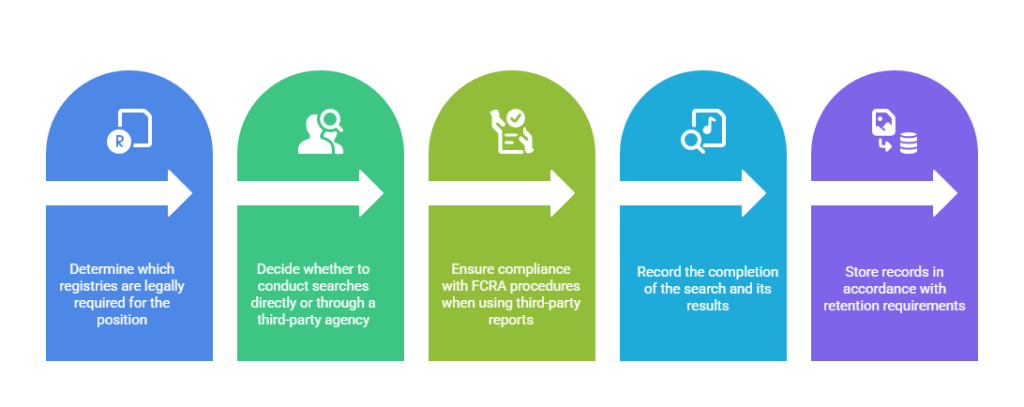
- Identify which registries are legally mandated for the position
- Determine whether searches will be conducted directly or through a consumer reporting agency
- Apply FCRA procedures to registry information obtained through third-party reports
- Document search completion and results appropriately
- Maintain records in accordance with retention requirements
Schools conducting registry searches directly through government databases may not trigger FCRA obligations for that specific component, but comprehensive screening programs often involve mixed direct and third-party elements. Compliance programs should clearly delineate which information sources trigger FCRA procedures and ensure appropriate treatment of each component.
Building FCRA-Compliant Screening Programs
Effective compliance requires systematic program design that embeds procedural requirements into routine hiring workflows. Schools should develop documented procedures, standardized forms, and staff training programs that ensure consistent FCRA application across all departments and hiring scenarios.
Policy Development and Documentation
Schools should adopt written background screening policies that specify when checks are required, what types of information will be obtained, how information will be evaluated, and what procedural protections apply. These policies should reference both FCRA requirements and applicable state law mandates, creating a unified compliance framework.
Policy documentation should include standardized disclosure and authorization forms that satisfy both FCRA and state law requirements. Forms should be periodically reviewed and updated to reflect regulatory changes and compliance guidance.
Vendor Selection and Management
Schools must select consumer reporting agencies that demonstrate FCRA compliance and maintain appropriate procedures for accuracy and dispute resolution. Vendor due diligence should include review of the agency's compliance policies, accuracy procedures, and data security practices.
| Vendor Evaluation Criterion | Assessment Focus |
| FCRA compliance program | Documented policies and procedures for statutory adherence |
| Accuracy procedures | Data verification methods and error correction processes |
| Dispute resolution | Candidate dispute handling and investigation protocols |
| Data security | Information protection and privacy safeguards |
| State law compliance | Awareness of and adherence to jurisdiction-specific requirements |
Contracts with screening vendors should clearly allocate compliance responsibilities and specify that the vendor will provide reports in formats that facilitate the school's FCRA obligations. Schools remain legally responsible for FCRA compliance even when using third-party screening services.
Staff Training and Compliance Culture
Human resources personnel and hiring managers must understand FCRA procedural requirements and their role in compliance. Training should cover disclosure and authorization procedures, adverse action steps, documentation requirements, and the intersection of federal and state law obligations.
Compliance culture should treat background screening procedures as non-negotiable requirements, not administrative preferences. Schools should implement quality control mechanisms, such as compliance checklists and periodic file reviews, to verify that procedures are consistently followed.
Common Compliance Pitfalls and Risk Mitigation
Schools frequently encounter predictable FCRA compliance challenges. Understanding common errors enables proactive risk mitigation and procedural improvement.
Inadequate Disclosure Practices
Many schools fail to provide standalone disclosure documents, instead embedding disclosure language in broader application materials or combining disclosure with authorization. These practices violate FCRA's requirement for clear, conspicuous disclosure that is not obscured by unrelated content.
Schools should review all hiring forms to ensure disclosure documents meet FCRA's "solely" requirement. Disclosure forms should be separate documents presented before authorization requests and should contain only disclosure language and any permissible additional state law notices.
Authorization Timing Errors
Obtaining background checks before receiving signed authorization creates clear FCRA violations. Some schools inadvertently request reports based on oral consent or unsigned applications, believing that formalization can occur later.
Critical Timing Sequence:
- Provide standalone written disclosure
- Obtain signed written authorization
- Submit background check request to consumer reporting agency
- Receive and review consumer report
- Initiate adverse action procedures if necessary
FCRA requires written authorization before reports are obtained, and retroactive authorization does not cure procedural violations. Schools should implement controls to prevent report requests without documented authorization.
Adverse Action Procedure Failures
Schools commonly shortcut adverse action procedures, particularly the pre-adverse action waiting period. Institutional urgency to fill positions or remove unsuitable candidates does not excuse FCRA compliance.
How to comply with FCRA in education hiring requires disciplined adherence to adverse action timelines even under operational pressure. Schools should build waiting periods into hiring timelines and train staff to recognize that adverse action procedures are mandatory, not discretionary.
Inconsistent Procedural Application
Schools sometimes apply FCRA procedures inconsistently across different position types, departments, or employment categories. Inconsistent application creates both compliance risk and potential discrimination claims. FCRA obligations apply uniformly to all background checks obtained through consumer reporting agencies, regardless of position characteristics.
Inadequate Record Keeping
Schools often fail to maintain complete documentation of FCRA compliance steps, making it difficult to demonstrate procedural adherence if challenged.
Documentation should include:
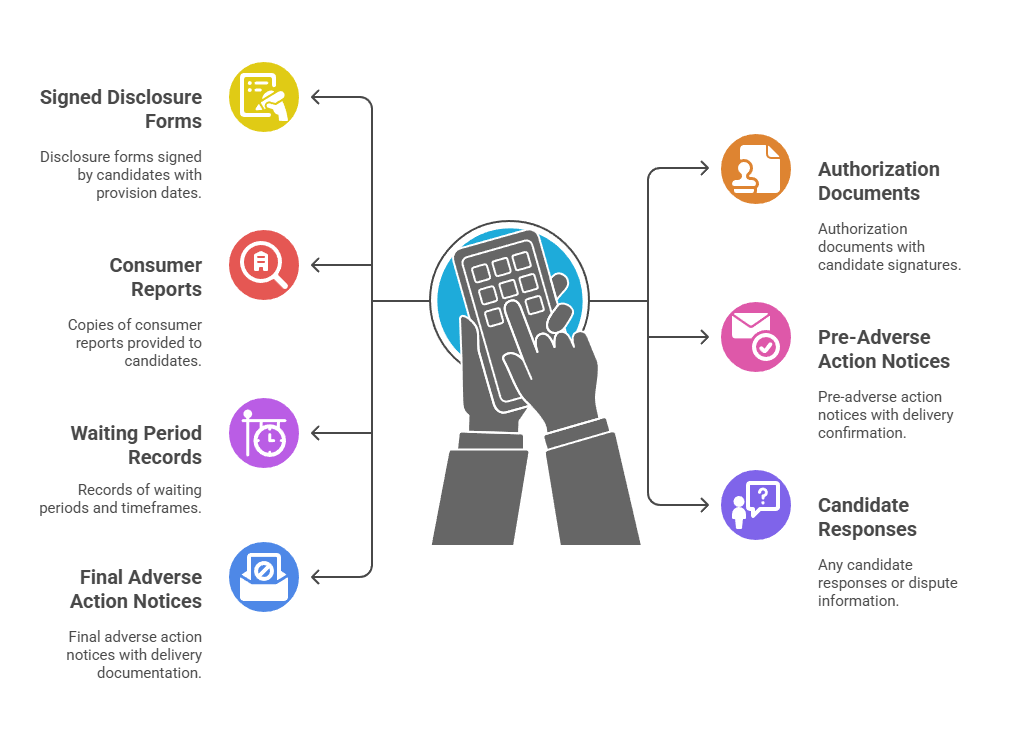
- Signed disclosure forms with provision dates
- Authorization documents with candidate signatures
- Copies of consumer reports provided to candidates
- Pre-adverse action notices with delivery confirmation
- Records of waiting periods and timeframes
- Any candidate responses or dispute information
- Final adverse action notices with delivery documentation
Record retention policies should specify minimum retention periods that satisfy both FCRA and state law requirements.
Practical Implementation Framework
Schools benefit from structured implementation frameworks that translate legal requirements into operational procedures. The following guidance provides actionable steps for building and maintaining compliant programs.
Pre-Screening Phase Checklist
Before initiating background checks, schools should complete the following verification steps:
- Verify that screening is appropriate for the position based on job duties and regulatory requirements
- Confirm that the screening vendor is a compliant consumer reporting agency
- Prepare standalone disclosure documents that meet FCRA requirements
- Provide disclosure to the candidate separately from application materials
- Obtain written authorization using clear, specific language
- Document the date disclosure was provided and authorization was received
- Verify authorization is on file before requesting reports
Screening Evaluation Phase
Upon receiving background reports, schools should review information for completeness and clarity. Schools must identify any adverse information that may lead to an employment decision and determine whether adverse action procedures are necessary. Criminal history or adverse information should be evaluated in light of state law requirements regarding individualized assessment and nexus to job duties.
| Evaluation Step | Action Required |
| Report review | Assess completeness, clarity, and relevance to position |
| Adverse information identification | Flag any information that may support negative employment decision |
| State law assessment | Apply jurisdiction-specific requirements for individualized review |
| Nexus determination | Evaluate relationship between findings and job responsibilities |
| Documentation | Record evaluation process and decision-making rationale |
Adverse Action Phase Protocol
When potentially adverse information is identified, schools must provide the candidate with a copy of the consumer report, include a pre-adverse action notice explaining that the information may lead to an adverse decision, and provide a summary of FCRA rights. Schools must allow a reasonable waiting period for candidate response and consider any information or context the candidate provides.
If proceeding with adverse action, schools must provide a final adverse action notice with consumer reporting agency contact information and dispute rights. Documentation of each step and the dates on which notices were provided is essential.
Ongoing Compliance Maintenance
Schools should implement annual policy reviews to incorporate regulatory changes, regular staff training on FCRA procedures, and periodic audits of background check files to verify procedural compliance. Vendor performance reviews ensure continued consumer reporting agency compliance, while updates to forms and procedures respond to new state law requirements.
Technology and Screening Innovation
Educational institutions increasingly encounter technology-assisted screening tools and data sources. Understanding how FCRA applies to emerging screening methods helps schools evaluate new tools while maintaining compliance.
Digital Screening Platforms
Many consumer reporting agencies now offer digital platforms that automate disclosure delivery, authorization collection, and report distribution. These platforms can enhance compliance by standardizing procedures and creating automatic documentation trails.
Schools should verify that platform workflows satisfy FCRA requirements and that electronic disclosure and authorization processes meet legal standards. Digital platforms must ensure that disclosures are conspicuous and that authorization is clear and voluntary.
Continuous Monitoring Programs
Some institutions implement continuous or periodic monitoring of current employees to identify new criminal activity. These programs typically involve ongoing access to criminal databases or regular re-screening.
When continuous monitoring involves consumer reports, schools must obtain appropriate authorization at the outset and provide required disclosures about the ongoing nature of screening. Adverse action procedures apply to information obtained through continuous monitoring just as they apply to initial background checks.
Alternative Data Sources
Screening programs increasingly incorporate non-traditional data sources, such as professional social media profiles, credential verification databases, and public record aggregators. When this information is assembled by consumer reporting agencies into reports for employment purposes, FCRA procedures apply regardless of the information's public availability.
Alternative Data Source FCRA Application:
- Professional social media compilations: FCRA applies when obtained through consumer reporting agencies
- Credential verification aggregators: FCRA applies to compiled reports even if underlying data is public
- Public record databases: FCRA applies when assembled into employment screening reports
- Direct employer review: May not trigger FCRA if school personnel access sources directly
Schools should understand that even publicly available information becomes subject to FCRA when obtained through third-party reports for employment decisions.
Conclusion
FCRA compliance for schools requires systematic attention to disclosure, authorization, and adverse action procedures within the context of state-specific education screening mandates. Educational institutions that implement documented policies, standardized procedures, and ongoing training create compliant screening programs that protect both institutional interests and candidate rights.
Frequently Asked Questions
What is the difference between FCRA requirements and state teacher background check laws?
FCRA establishes federal procedural protections for how background information is obtained and used, including disclosure, authorization, and adverse action requirements. State teacher background check laws specify which types of screening are mandatory for education employment, such as fingerprinting or registry searches. Schools must satisfy both sets of requirements simultaneously, implementing FCRA procedures when conducting state-mandated checks through consumer reporting agencies.
Do schools need separate authorization for each background check or can one authorization cover all future screening?
FCRA permits authorization that covers reasonable future screening if the scope and timing are clearly explained and the candidate consents. However, authorization must be specific about the types of checks that may be conducted and cannot be open-ended. Schools implementing continuous monitoring or periodic re-screening should obtain authorization that explicitly addresses ongoing screening and complies with any additional state law requirements for re-screening consent.
How long must schools wait between pre-adverse action notice and final employment decisions?
FCRA requires a reasonable period for candidates to respond to pre-adverse action notices, but does not specify an exact timeframe. Regulatory guidance and best practices suggest a minimum of five business days provides reasonable opportunity for candidate response. Schools should document their standard waiting period, apply it consistently, and be prepared to extend it when candidates request additional time to gather dispute or context information.
Are FCRA procedures required for background checks on volunteers in school programs?
FCRA application to volunteer screening depends on whether the volunteer relationship constitutes employment under the law. Factors include whether the position is typically paid, the level of responsibility involved, and relationship formality. When volunteer screening involves consumer reports obtained through third-party agencies, conservative compliance practice applies full FCRA procedures.
Can schools use criminal history information obtained from direct database searches without following FCRA procedures?
When schools access government criminal history databases directly without using a consumer reporting agency intermediary, FCRA typically does not apply to that specific information. However, many schools use comprehensive screening programs that combine direct database access with third-party reports, and FCRA applies to the consumer report components. Schools must correctly distinguish between information sources and apply appropriate procedures to each.
What documentation should schools maintain to demonstrate FCRA compliance?
Schools should retain signed disclosure forms, authorization documents, copies of consumer reports, records of when reports were provided to candidates, pre-adverse action notices with delivery confirmation, documentation of waiting periods, any candidate responses or dispute information, and final adverse action notices. Record retention periods should satisfy both FCRA requirements and state law mandates for education employment records, typically ranging from two to seven years depending on jurisdiction.
How do childcare background checks differ from general education screening under FCRA?
Childcare background checks often involve additional screening components beyond standard education checks, including child abuse and neglect registry searches, expanded criminal history lookback periods, and more frequent re-screening requirements. While these substantive differences reflect heightened regulatory scrutiny of childcare environments, FCRA procedural requirements apply equally to both childcare and general education screening.
What should schools do if a candidate disputes background information after receiving a pre-adverse action notice?
Schools should pause the adverse action process and allow the candidate to resolve the dispute directly with the consumer reporting agency that provided the report. FCRA assigns responsibility for investigating and correcting report inaccuracies to consumer reporting agencies, not employers. Schools should establish reasonable timeframes for dispute resolution, typically 30 days, and may communicate with the consumer reporting agency to determine dispute status.
Additional Resources
- Fair Credit Reporting Act Full Text and Summary
https://www.ftc.gov/legal-library/browse/statutes/fair-credit-reporting-act - Federal Trade Commission FCRA Guidance for Employers
https://www.ftc.gov/business-guidance/resources/using-consumer-reports-what-employers-need-know - Consumer Financial Protection Bureau Background Screening Resources
https://www.consumerfinance.gov/consumer-tools/background-checks/ - U.S. Department of Education Background Check Resources
https://www.ed.gov/ - National Center for Education Statistics School Safety Resources
https://nces.ed.gov/programs/crimeindicators/ - Child Care and Development Fund Background Check Requirements
https://www.acf.hhs.gov/occ/law-regulation/background-checks - Equal Employment Opportunity Commission Criminal Records Guidance
https://www.eeoc.gov/laws/guidance/consideration-arrest-and-conviction-records-employment-decisions-under-title-vii

ABOUT THE CREATOR
GCheck Editorial Team
Meet the GCheck Editorial Team, your trusted source for insightful and up-to-date information in the world of employment background checks. Committed to delivering the latest trends, best practices, and industry insights, our team is dedicated to keeping you informed.
With a passion for ensuring accuracy, compliance, and efficiency in background screening, we are your go-to experts in the field. Stay tuned for our comprehensive articles, guides, and analysis, designed to empower businesses and individuals with the knowledge they need to make informed decisions.
At GCheck, we're here to guide you through the complexities of background checks, every step of the way.