

Employee social media screening has become a standard consideration in modern hiring practices. However, implementing it requires careful attention to federal and state legal frameworks, anti-discrimination laws, and evolving privacy regulations. This guide provides HR professionals with a comprehensive framework for evaluating whether social media screening aligns with their hiring objectives while minimizing legal risks and maintaining candidate trust throughout the recruitment process.
Key Takeaways
- Employee social media screening involves reviewing publicly available social media content to assess candidate fit. It must be conducted within strict legal boundaries to avoid discrimination claims.
- The Fair Credit Reporting Act (FCRA) applies when employers use third-party services to conduct social media screening. This requires specific disclosures, written authorization, and adverse action procedures.
- Numerous states have enacted laws prohibiting employers from requesting social media passwords or private account access from applicants and employees.
- Social media screening may reveal insights about professionalism, communication skills, and cultural alignment. However, it also carries significant risks of uncovering protected class information.
- Employers must establish clear, written policies that define what social media content is relevant to job qualifications and what information screeners should disregard.
- Conducting social media screening after initial interviews rather than during early application stages may reduce discrimination risk and improve assessment accuracy.
- Documentation of screening criteria, decision-making processes, and consistent application across all candidates is essential for defending against potential legal challenges.
- Organizations should regularly audit their social media screening practices to ensure compliance with rapidly evolving state and local privacy laws.
- Social media screening practices and legal requirements vary significantly by jurisdiction, industry, and specific job role. This requires individualized compliance analysis.
Understanding Employee Social Media Screening
What Is Employee Social Media Screening
Employee social media screening refers to the practice of reviewing an applicant's publicly accessible social media profiles, posts, and online presence as part of the hiring evaluation process. This screening typically examines platforms such as LinkedIn, Facebook, Twitter (X), Instagram, and other public forums where candidates maintain a digital presence. The practice typically differs from traditional background checks by focusing primarily on publicly available information that candidates have voluntarily shared.
The scope of social media screening varies significantly depending on organizational policies and the position being filled. Some employers conduct informal reviews of professional networking sites. Others implement structured screening protocols that evaluate specific behavioral indicators across multiple platforms. Understanding this distinction is critical because the legal requirements and compliance obligations change dramatically based on how screening is conducted and who performs it.
The Evolution of Social Media Screening in Hiring
Social media screening emerged in the early 2010s as platforms like Facebook and LinkedIn became ubiquitous. This gave employers unprecedented access to candidate information beyond resumes and interviews. Initially, many organizations conducted informal, unstructured reviews without clear policies or legal guidance. By the mid-2010s, regulatory bodies and state legislatures began addressing social media screening through various legal frameworks.
Federal regulators have indicated that FCRA requirements apply when employers use third-party services to conduct social media screening for employment purposes. Simultaneously, states began enacting laws prohibiting employers from requesting passwords or access to private social media accounts. This recognized the privacy implications of employer overreach. As of 2026, the social media screening landscape has matured considerably. Best practices now emphasize structured approaches, clear policy documentation, and separation between those who conduct screening and those who make hiring decisions.
Each recruitment decision creates ripple effects, and social media background checking is one point where the role of intent is critical. As an HR professional, I've seen how quickly a well-meaning review can cross into bias if it is not grounded in clear purpose, structure, and restraint. When done thoughtfully, social media screening should protect the workplace. The true challenge and responsibility that rests with HR is maintaining a focus on behavior, fairness, and consistency that is relevant to the job, and yet still protects the dignity and trust that must be maintained with candidates.
How Social Media Screening Differs from Traditional Background Checks
Traditional background checks access private records through official channels such as court systems, credit bureaus, educational institutions, and previous employers. These checks follow established legal frameworks with clear permissible purposes under the FCRA. They typically require formal authorization and disclosure processes. Social media screening, by contrast, examines publicly available information that candidates have voluntarily published.
| Traditional Background Checks | Social Media Screening |
| Private records accessed through official channels | Publicly available content voluntarily published |
| Verifiable facts (convictions, employment dates, degrees) | Subjective content open to interpretation |
| Clear FCRA frameworks and procedures | Evolving legal landscape with state variations |
| Minimal exposure to protected class information | High exposure to age, race, religion, disability status |
| Standardized reporting formats | Inconsistent content across platforms |
The most significant difference lies in the potential for encountering protected class information. Traditional background checks are designed to provide specific, job-relevant data while avoiding protected characteristics. Social media profiles, however, routinely display information about age, race, religion, national origin, disability, pregnancy, and other protected categories.
Legal Framework Governing Social Media Screening
Federal Laws and FCRA Requirements
The Fair Credit Reporting Act establishes the primary federal framework governing social media screening when conducted by third-party consumer reporting agencies. When an employer engages an external service to compile and report social media information for employment purposes, that service generally functions as a consumer reporting agency under FCRA. It must comply with applicable requirements. Compliance includes providing candidates with clear written disclosure, obtaining separate written authorization, and following strict adverse action procedures.
Under FCRA adverse action requirements, employers must provide candidates with a pre-adverse action notice. This includes a copy of the consumer report (the social media screening results) and a summary of consumer rights under the FCRA. After allowing reasonable time for the candidate to review and dispute the information, employers must then provide a final adverse action notice. Failure to follow these procedures may result in statutory damages, actual damages, attorney fees, and potential class action liability.
State-Specific Social Media Privacy Laws
As of 2026, numerous states have enacted laws specifically addressing employer access to employee and applicant social media accounts. These laws typically prohibit employers from requesting or requiring passwords, access credentials, or authentication information. Additionally, many of these statutes prohibit employers from asking applicants to access their private accounts in the employer's presence. They also prohibit requiring candidates to change privacy settings to make private content accessible.
States including California, Illinois, New York, Maryland, and Colorado have particularly comprehensive social media privacy protections. California law prohibits employers from requiring or requesting employees or applicants to disclose usernames, passwords, or other authentication information. Illinois extends similar protections and includes provisions preventing employers from disciplining or discharging employees who refuse to provide social media access.
Employers operating in multiple states must ensure their social media screening policies comply with the most restrictive state law applicable to their workforce. Employers should verify current law in all jurisdictions where they operate. Social media privacy legislation continues to evolve rapidly.
Anti-Discrimination Law Considerations
Social media screening creates significant exposure to protected class information. This makes compliance with federal anti-discrimination laws particularly challenging. Federal statutes protect various characteristics from employment discrimination. Courts evaluate discrimination claims using burden-shifting frameworks that require employers to demonstrate legitimate, non-discriminatory reasons for adverse employment actions.
Protected characteristics frequently visible on social media include:
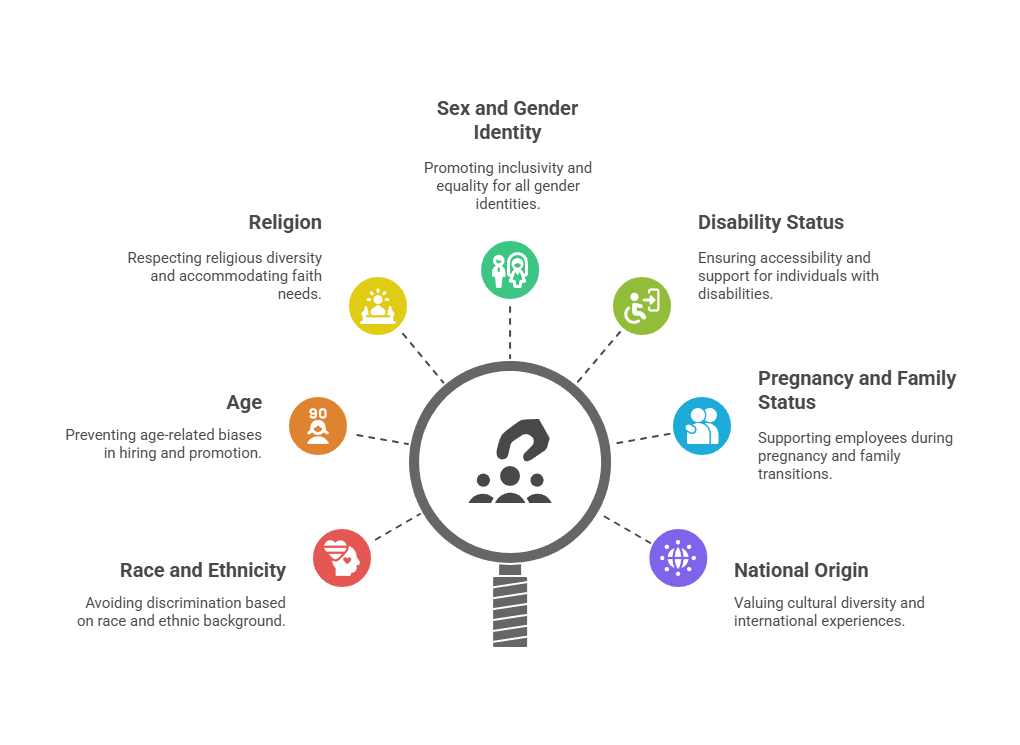
- Race and ethnicity: Profile photographs, cultural references, community affiliations
- Age: Graduation dates, life milestones, birthday celebrations, age-related content
- Religion: Faith-based organizations, religious holidays, spiritual beliefs, worship activities
- Sex and gender identity: Personal pronouns, family roles, gender expression, advocacy activities
- Disability status: Medical treatments, accessibility needs, disability advocacy, health conditions
- Pregnancy and family status: Family photographs, pregnancy announcements, parenting content
- National origin: Language use, cultural traditions, international connections, immigration status
When employers conduct social media screening, plaintiffs can argue that protected characteristics visible on social media influenced the decision. Federal employment discrimination law recognizes that employers may face liability when social media screening produces a disparate impact on protected groups. This applies even without intentional discrimination.
Emerging Privacy Regulations Affecting Social Media Screening
State-level comprehensive privacy laws in California, Virginia, Colorado, Connecticut, Utah, and other jurisdictions have introduced new considerations for social media screening. While these laws primarily focus on how businesses collect, use, and share consumer personal information, they include provisions affecting employment contexts. The California Privacy Rights Act contains specific exemptions for certain employment-related data. However, it still requires employers to provide privacy notices and maintain reasonable security measures.
As of 2026, additional states have implemented or proposed comprehensive privacy legislation. This may impact how employers collect and use social media information during the hiring process. These laws generally require transparency about data collection practices, limitations on data use to specified purposes, and security safeguards. Employers conducting social media screening must ensure their practices align with these requirements.
Strategic Value and Risks of Social Media Screening
When Social Media Screening Adds Value
Some organizations find that social media screening may provide insights for positions where online presence, communication skills, and professional judgment directly impact job performance. For roles in public relations, communications, marketing, executive leadership, and brand representation, a candidate's social media activity may demonstrate relevant competencies. It may also reveal potential risks that traditional background checks would not uncover. Reviewing publicly available professional content can verify claimed expertise and assess communication style.
Organizations hiring for positions involving sensitive populations, fiduciary responsibilities, or significant reputational risk may find social media screening helpful. It can identify concerning behavioral patterns. Posts that demonstrate violence, harassment, discriminatory attitudes, or illegal activity may indicate legitimate job-related concerns. However, employers must carefully document how specific content relates to legitimate job requirements.
Red Flags That Create Legitimate Concerns
Certain categories of social media content may indicate genuine job-related concerns. Identifying truly problematic content requires clear criteria that connect specific behaviors to job requirements. Employers must distinguish between concerning behavior and protected activity or personal expression.
The following table outlines legitimate red flags versus protected or irrelevant content:
| Legitimate Job-Related Red Flags | Protected or Irrelevant Content |
| Explicit threats of violence toward individuals or groups | Political opinions or advocacy activities |
| Harassment or bullying behavior demonstrated in posts | Religious expression or faith-based affiliations |
| Sharing confidential information from previous employers | Personal lifestyle choices during off-duty hours |
| Evidence of illegal activity directly related to job duties | Family status, pregnancy, or parenting content |
| Significant dishonesty contradicting application materials | Participation in protected concerted labor activities |
| Discriminatory statements targeting protected groups | Cultural traditions or national origin expressions |
These categories provide general guidance. However, specific situations may require legal consultation to determine whether particular content is legitimately job-related or protected.
Risks of Discrimination and Legal Liability
The most significant risk of social media screening is exposure to protected class information. This creates discrimination liability. Social media profiles typically reveal age, race, sex, religion, national origin, pregnancy status, disability, and other protected characteristics. Once an employer views this information, candidates who are not hired may claim that protected characteristics influenced the decision.
Even when employers act with good intentions and without discriminatory intent, unconscious bias can influence how they interpret social media content. Studies suggest that identical behavior may be perceived differently depending on the demographic characteristics of the person engaging in that behavior. These subjective interpretations create significant legal exposure when they influence employment decisions.
Documentation failures compound discrimination risks in social media screening. When employers lack clear policies defining what content is relevant, they become vulnerable to successful discrimination claims. Courts are particularly skeptical of social media screening when employers cannot demonstrate that screening criteria were established before viewing candidate profiles.
Industry-Specific Considerations
Different industries face unique considerations when evaluating social media screening implementation. Regulatory requirements, customer expectations, and operational risks vary significantly across sectors.
Financial services organizations face unique considerations due to regulatory requirements and fiduciary responsibilities. Positions involving access to sensitive financial information or customer assets may justify more thorough social media screening. Organizations in this sector should consult with employment counsel to ensure screening approaches comply with industry-specific regulations and applicable state laws.
Healthcare organizations must balance patient safety concerns with legal compliance when conducting social media screening. They must remain particularly cautious about disability-related information. Technology companies and startups often prioritize cultural fit when evaluating candidates. However, organizations in this sector should define cultural fit using specific, observable, job-related criteria. They should consult with employment counsel regarding compliance with applicable laws.
Implementing Compliant Social Media Screening
Developing Written Policies and Procedures
Organizations that choose to conduct social media screening must establish clear written policies. These policies should define the scope, purpose, methodology, and limitations of screening activities. They should specify which positions are subject to social media screening based on job-related justifications. They should also define what platforms will be reviewed and what content is considered relevant.
Policy components typically include:
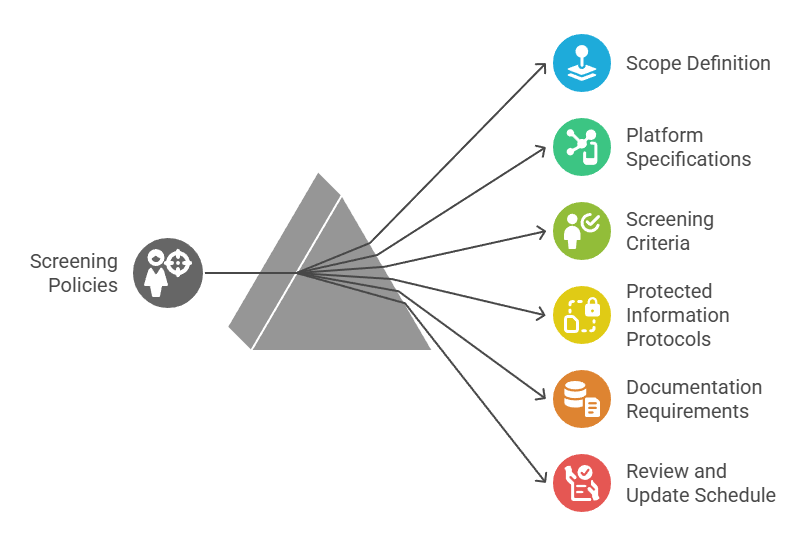
- Scope definition: Which positions undergo screening and why
- Platform specifications: What social media sites will be reviewed
- Screening criteria: Specific behavioral indicators relevant to job requirements
- Protected information protocols: How screeners handle protected class information
- Documentation requirements: What information will be recorded and retained
- Review and update schedule: How frequently policies are evaluated for legal compliance
Policies should explicitly prohibit screeners from considering protected class information observed on social media. The policy should also address how screening results are documented and who has access to screening information. Clear retention schedules help organizations comply with privacy laws.
Timing and Scope Considerations
The timing of social media screening significantly affects both its legal risk and its practical value. Conducting screening during initial resume review stages increases discrimination risk. Screening after initial interviews, when employers have established candidate qualifications through traditional means, may reduce the likelihood that protected characteristics will influence decisions.
Limiting screening scope to publicly accessible professional platforms like LinkedIn for initial reviews creates a staged approach. Expanding to other platforms only for finalist candidates balances thoroughness with efficiency. For most positions, comprehensive social media screening should be reserved for final candidates after preliminary vetting has established basic qualifications.
Separation of Screeners and Decision-Makers
A commonly recommended strategy for managing discrimination risk involves separating individuals who conduct screening from those who make hiring decisions. Under this approach, designated screeners review social media content and prepare reports. These reports include only job-relevant information and explicitly exclude references to protected characteristics. Hiring managers receive these sanitized reports rather than viewing social media profiles directly.
This separation creates a defensible structure for demonstrating that protected characteristics did not influence hiring decisions. When properly implemented, hiring managers make decisions based on traditional application materials, interviews, and screening reports. These reports focus exclusively on job-related behavioral indicators.
Establishing Job-Related Screening Criteria
Employers must define clear, job-related criteria before conducting social media screening. This ensures that evaluations focus on legitimate qualifications rather than subjective personal preferences. Criteria should connect directly to essential job functions, required competencies, or specific workplace conduct standards.
Screening criteria should be documented and applied consistently across all candidates for the same position. This consistency demonstrates that screening serves legitimate business purposes. Criteria should also be reviewed regularly to ensure they remain job-related.
Negative criteria (what disqualifies a candidate) should be particularly specific and tied to demonstrable job requirements. General criteria such as poor judgment or unprofessional behavior are too subjective. More specific criteria, such as public posts demonstrating harassment of others or threats of violence, provide clearer guidance.
Training Hiring Personnel
Comprehensive training for all personnel involved in social media screening is essential for legal compliance. Training coverage should include relevant federal and state laws, recognition of protected class information, and strategies for avoiding bias.
Key training components include:
- Legal foundations: FCRA requirements, anti-discrimination laws, state privacy statutes
- Unconscious bias recognition: How identical behavior may be perceived differently based on demographics
- Screening protocol application: Step-by-step procedures for conducting compliant screening
- Documentation standards: What to record, how to describe findings, what to omit
- Escalation procedures: When to seek guidance on borderline content
- Regular updates: Quarterly or annual refreshers on legal developments
Training should include practical guidance on recognizing and addressing unconscious bias in social media screening contexts. Ongoing training is necessary as laws evolve and new social media platforms emerge.
Practical Implementation Framework

Checklist for Conducting Legal Social Media Screening
Organizations implementing social media screening should consider the following framework, adapted to their specific circumstances and jurisdictions.
Pre-Implementation Phase:
- Establish written policies defining scope, purpose, and methodology
- Determine internal vs. third-party screening approach
- Identify positions requiring screening based on job-related justifications
- Develop job-related screening criteria for each position type
- Create standardized documentation forms and templates
Implementation Phase:
- Train all personnel on legal requirements and protocols
- Establish screener/decision-maker separation procedures
- Implement adverse action procedures complying with FCRA
- Create data retention and destruction policies
- Develop audit procedures for ongoing compliance monitoring
Ongoing Maintenance Phase:
- Conduct quarterly reviews of screening outcomes for disparate impact
- Update policies annually to reflect legal developments
- Provide refresher training when laws or procedures change
- Document all screening activities and decisions comprehensively
This systematic approach demonstrates organizational commitment to legal compliance. Regular audits ensure that policies are followed consistently.
Evaluating Third-Party Screening Services
Organizations considering third-party social media screening services should conduct thorough due diligence. Providers must clearly explain their methodology for collecting social media information and how they filter out protected class information.
Critical evaluation factors include:
- FCRA compliance expertise: Proper disclosure forms, authorization procedures, adverse action protocols
- Filtering methodology: Technical approach to identifying and excluding protected class information
- Report quality: Focus on specific, job-relevant behavioral indicators vs. subjective judgments
- Data security measures: Encryption, access controls, breach notification procedures
- Legal liability allocation: Organizations should work with legal counsel to ensure contract terms appropriately address compliance responsibilities
- References and track record: Demonstrable experience with employers in similar industries
Organizations should work with legal counsel to ensure contract terms appropriately address compliance responsibilities between the provider and the employer.
Documentation Best Practices
Thorough documentation is essential for defending social media screening practices against legal challenges. Documentation should demonstrate that screening was conducted according to established policies and focused on job-related criteria.
Documentation structure should include:
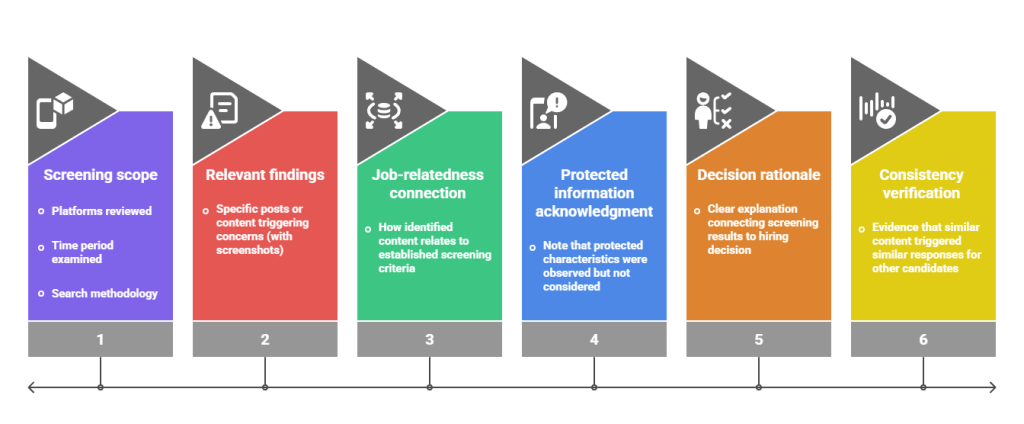
- Screening scope: Platforms reviewed, time period examined, search methodology
- Relevant findings: Specific posts or content triggering concerns (with screenshots)
- Job-relatedness connection: How identified content relates to established screening criteria
- Protected information acknowledgment: Note that protected characteristics were observed but not considered
- Decision rationale: Clear explanation connecting screening results to hiring decision
- Consistency verification: Evidence that similar content triggered similar responses for other candidates
Organizations should consult with employment counsel to develop documentation practices appropriate for their specific circumstances and applicable state requirements.
Alternatives and Complementary Approaches
Professional Reference Checks
Traditional professional reference checks remain widely used and valued tools for evaluating candidate qualifications. Former supervisors, colleagues, and professional contacts can speak directly to job performance, work habits, interpersonal skills, and reliability. These insights are typically more relevant to hiring decisions than social media content.
Structured reference check processes that ask consistent questions across candidates reduce subjectivity. Questions should focus on specific competencies relevant to the position. While reference checks face limitations, they remain legally safer than social media screening because they focus on job performance.
Structured Behavioral Interviews
Structured behavioral interviews that ask all candidates the same job-related questions provide reliable assessment with minimal legal risk. Behavioral interview questions ask candidates to describe how they handled specific situations in previous roles. This provides concrete examples of competencies such as problem-solving, teamwork, communication, and judgment.
Interview best practices include:
- Standardized questions: All candidates for the same position answer identical questions
- Competency alignment: Questions directly assess skills required for the position
- Scoring rubrics: Defined criteria for evaluating strong, adequate, and weak responses
- Multiple interviewers: Panel interviews reduce individual bias
- Documentation: Detailed notes on responses and evaluation rationale
Structured interviews may help reduce the influence of unconscious bias by standardizing the evaluation process.
Skills Testing and Work Samples
Job-related skills testing and work sample evaluations provide objective evidence of candidate capabilities with minimal legal risk. These assessments directly measure whether candidates can perform essential job functions. Skills tests also reduce the influence of unconscious bias by focusing on concrete performance.
Work sample tests should closely simulate actual job tasks. For example, a writing position might require candidates to complete an editing task. A customer service role might include responding to simulated customer complaints. Organizations should prioritize developing effective skills assessments before implementing social media screening.
Conclusion
Employee social media screening presents both opportunities and significant legal risks. Organizations should carefully evaluate with qualified employment counsel before implementation. Employers must establish clear written policies, train personnel thoroughly, and maintain detailed documentation to minimize discrimination liability. As privacy laws continue to evolve, employers should prioritize proven assessment methods such as structured interviews, reference checks, and skills testing.
Frequently Asked Questions
Here are some common questions and answers about conducting a social media screening in a work context. Employers and job candidates have asked these questions about conducting a social media screening in a work context. The questions and answers in this FAQ section aim to help you understand what you can and can’t do when conducting a social media screening in a work context.
Is it legal for employers to check social media before hiring?
In most jurisdictions, employers may review publicly accessible social media content during the hiring process. However, they must comply with applicable federal anti-discrimination laws and state social media privacy laws. FCRA requirements also apply when using third-party screening services. Employers cannot request passwords or access to private accounts in most states.
What can employers legally see on social media during background screening?
Employers may only review publicly accessible social media content that candidates have made available without privacy restrictions. Employers cannot require candidates to provide access to private accounts. They cannot friend or follow the employer to reveal restricted content. Content that candidates have restricted to friends or connections is off-limits.
Can an employer not hire you because of social media posts?
Employers may consider social media content that reveals legitimate, job-related concerns. These include threats of violence, harassment, illegal activity, or dishonesty related to application materials. However, employers cannot base hiring decisions on protected characteristics such as race, religion, age, disability, or pregnancy status that may be visible on social media.
Do I have to disclose my social media accounts to potential employers?
Many states prohibit employers from requiring applicants to disclose social media usernames, passwords, or authentication information. In these states, you have the legal right to refuse such requests without facing retaliation. Even in states without specific social media privacy laws, providing access to private accounts is voluntary.
What are the biggest red flags employers look for on social media?
Employers legitimately consider social media content that demonstrates threats of violence or harassment toward others. They also look for illegal activity directly related to job responsibilities and significant dishonesty compared to application materials. Inappropriate disclosure of confidential information from previous employers is also considered. Employers should not consider lifestyle choices, political opinions, or religious expression.
How far back do employers look at social media posts?
There is no standard lookback period for social media screening. Employers should establish clear, documented policies about how far back they review content. Older posts may be less relevant to current qualifications. Employers should focus on recent content that provides meaningful insight into current competencies.
What should I do if I was denied a job because of social media screening?
If a third-party service conducted the screening, the employer must provide you with a pre-adverse action notice and a copy of the report. Under FCRA, you generally have the right to challenge inaccurate or incomplete information with the screening service. If you believe the decision was based on protected characteristics visible on your social media, you may file a discrimination charge with the EEOC.
Should I delete my social media accounts when job searching?
Deleting social media accounts is unnecessary if your public content is professional. Instead, review your privacy settings to ensure that personal content is restricted to friends and connections. Remove or restrict public posts that could be misinterpreted. Ensure that professional profiles like LinkedIn accurately represent your qualifications and experience.
Can employers monitor employee social media after hiring?
Employers may observe employees' public social media content. However, they face significant legal constraints when taking adverse action based on that content. The National Labor Relations Act generally protects employees who discuss wages, working conditions, or organizing activities on social media. Many states prohibit employers from requiring employees to provide access to private accounts.
How can I make my social media profiles more professional for job searching?
Review all public content and remove or restrict posts that could be misinterpreted. Adjust privacy settings so that personal content is visible only to friends and connections. Ensure that professional profiles accurately represent your qualifications, experience, and accomplishments. Use profile photographs that present you professionally.
Additional Resources
- Fair Credit Reporting Act: Summary of Rights
https://www.consumer.ftc.gov/articles/pdf-0096-fair-credit-reporting-act.pdf - EEOC Compliance Manual: Race and Color Discrimination
https://www.eeoc.gov/laws/guidance/section-15-race-and-color-discrimination - National Conference of State Legislatures: State Social Media Privacy Laws
https://www.ncsl.org/technology-and-communication/state-social-media-privacy-laws - Society for Human Resource Management: Social Media Screening Guide
https://www.shrm.org/topics-tools/tools/toolkits/social-media-screening - Federal Trade Commission: Using Consumer Reports for Employment
https://www.ftc.gov/business-guidance/resources/using-consumer-reports-what-employers-need-know

ABOUT THE CREATOR
GCheck Editorial Team
Meet the GCheck Editorial Team, your trusted source for insightful and up-to-date information in the world of employment background checks. Committed to delivering the latest trends, best practices, and industry insights, our team is dedicated to keeping you informed.
With a passion for ensuring accuracy, compliance, and efficiency in background screening, we are your go-to experts in the field. Stay tuned for our comprehensive articles, guides, and analysis, designed to empower businesses and individuals with the knowledge they need to make informed decisions.
At GCheck, we're here to guide you through the complexities of background checks, every step of the way.