

EEOC compliance for 2026 and beyond requires employers to navigate evolving guidance on criminal record screening, coordinated state-level ban-the-box laws, and emerging considerations around AI-driven hiring tools. This comprehensive guide provides HR professionals with actionable frameworks, risk assessment tools, and step-by-step workflows to build legally defensible hiring processes that align with Title VII enforcement priorities while supporting fair chance hiring objectives.
Key Takeaways
- The EEOC enforces Title VII of the Civil Rights Act of 1964, prohibiting employment discrimination based on race, color, religion, sex, or national origin, with specific guidance on how background screening policies may create disparate impact.
- Employers must conduct individualized assessments before denying employment based on criminal history, evaluating the nature of the offense, time elapsed, and job relevance.
- The Green factors framework remains the cornerstone of compliant criminal record screening, requiring consideration of offense nature, recency, and relationship to job duties.
- As of late 2025, over 37 states and 150+ municipalities have enacted ban-the-box legislation with varying timelines for when criminal history inquiries may occur during the hiring process, with continued expansion expected.
- Employers using AI-driven screening tools face heightened EEOC scrutiny under emerging algorithmic fairness principles that may inadvertently perpetuate historical discrimination patterns.
- Proper FCRA compliance documentation including pre-adverse action notices, individualized assessment records, and final adverse action notices creates essential legal defensibility for hiring decisions.
- A proactive monthly compliance audit schedule significantly reduces enforcement risk compared to reactive policy review after receiving EEOC charges.
- Job seekers benefit from understanding their rights under EEOC guidance, including the right to explain criminal history context and provide evidence of rehabilitation before adverse employment decisions.
Understanding EEOC Authority and Enforcement Landscape
The Legal Foundation of EEOC Background Check Oversight
The Equal Employment Opportunity Commission derives its regulatory authority from Title VII of the Civil Rights Act of 1964. This federal statute prohibits employment discrimination based on protected characteristics including race, color, religion, sex, and national origin. While Title VII does not explicitly mention criminal background checks, the EEOC's enforcement guidance addresses how blanket criminal history exclusions may violate federal anti-discrimination law through disparate impact theory.
Disparate impact occurs when a facially neutral employment policy disproportionately excludes individuals in protected classes. This violation can happen even without discriminatory intent. Because arrest and incarceration rates differ significantly across racial and ethnic groups, policies that categorically exclude individuals with criminal records may violate Title VII if they create unjustified barriers to employment.
The EEOC's 2012 Enforcement Guidance on the Consideration of Arrest and Conviction Records remains the primary interpretive document for employers. Supplementary compliance assistance communications and litigation outcomes provide additional clarity. Employers must recognize that EEOC guidance, while not carrying the force of law like federal statutes, establishes the enforcement framework that determines investigation priorities and litigation risk.
Current Enforcement Trends and Emerging 2026 Priorities
Ongoing EEOC enforcement activity through 2025 demonstrates sustained focus on background screening practices, with these priorities expected to continue into 2026 and beyond. Charges alleging discriminatory background check policies consistently appear among the commission's strategic enforcement priorities, with particular attention to policies that fail to provide individualized assessment opportunities.
Emerging enforcement considerations for 2026 and beyond are expected to include algorithmic screening tools that incorporate criminal history data, third-party vendor compliance accountability, and intersectional discrimination theories that examine how background check policies affect individuals with multiple protected characteristics. Employers should anticipate increased information requests regarding the statistical impact of their screening policies and enhanced scrutiny of business necessity justifications based on recent enforcement patterns.
Coordination Between EEOC and State Fair Employment Agencies
The EEOC maintains worksharing agreements with state and local fair employment practice agencies. These agreements create coordinated enforcement mechanisms that may result in simultaneous federal and state investigations. Many state agencies have adopted guidance that mirrors or exceeds EEOC standards.
| Coordination Element | Compliance Impact |
| Dual-filing procedures | Single charge may trigger both federal and state investigations |
| Information sharing protocols | Evidence provided to one agency may be shared with partner agencies |
| Extended limitation periods | State laws may provide longer filing deadlines than federal requirements |
| Enhanced remedies | State laws may offer damages or remedies beyond federal Title VII provisions |
Some jurisdictions impose additional procedural requirements such as mandatory delay periods, specific notice content, or enhanced documentation standards. Employers operating in multiple jurisdictions must comply with the most restrictive applicable standard for each location.
The Green Factors Framework: Foundation of Compliant Screening
Three-Part Individualized Assessment Standard
The Green v. Missouri Pacific Railroad case established the analytical framework that remains central to EEOC-compliant criminal history screening. Courts and enforcement agencies recognize three specific factors employers must evaluate when considering criminal history information. These elements create the minimum standard for individualized assessment processes.
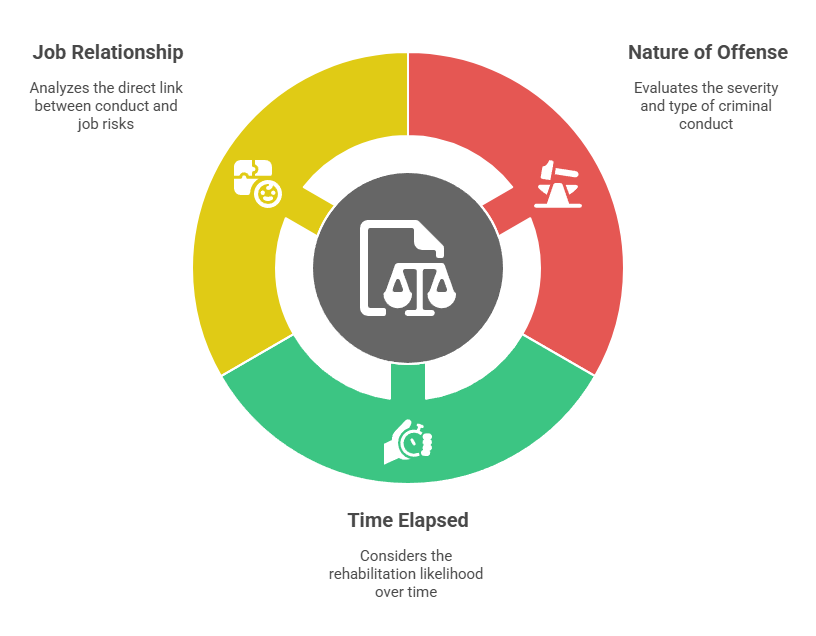
- Nature and Gravity of the Offense: Assessment requires examining the specific conduct underlying the conviction, including whether it involved violence, dishonesty, regulatory violations, or other conduct categories. Employers should evaluate the conviction category rather than relying solely on statutory offense labels. Identical offense names may encompass vastly different conduct across jurisdictions, making label-based screening inherently problematic.
- Time Elapsed Since the Offense or Completion of Sentence: Temporal considerations recognize that rehabilitation likelihood increases with time. Employers should establish clear lookback periods that reflect genuine business necessity rather than arbitrary durational limits. Longer exclusion periods require stronger business justification under EEOC analysis frameworks.
- Nature of the Job Sought or Held: Direct relationship analysis requires specific correlation between the criminal conduct and essential job functions or work environment risks. Generic concerns about reputation, customer comfort, or workplace culture generally do not satisfy business necessity standards. Concrete evidence of job-specific risk must support any exclusionary criteria.
Implementing Effective Individualized Assessments
Compliant individualized assessment processes provide applicants with notice of potentially disqualifying criminal history. Candidates receive disclosure of the specific records under consideration. Meaningful opportunity to present mitigating information before final decisions represents a critical procedural safeguard.
Essential procedural elements include written notice identifying the specific conviction records that may result in adverse action. Offense details must be sufficient for the individual to provide context. Vague references to "criminal history" or "background check results" fail to meet due process standards implicit in EEOC guidance.
Reasonable opportunity to respond typically spans five to ten business days, though some jurisdictions may require longer periods. This timeline allows individuals to submit evidence of rehabilitation, factual errors in records, mitigating circumstances, or evidence that records do not accurately reflect the underlying conduct. Good faith consideration of submitted information by trained decision-makers with proper authority must follow, documented through written assessment summaries.
Documentation Requirements for Legal Defensibility
Comprehensive documentation creates essential evidence that individualized assessments occurred and applied consistent, job-related criteria. Three documentation categories provide legal defensibility:
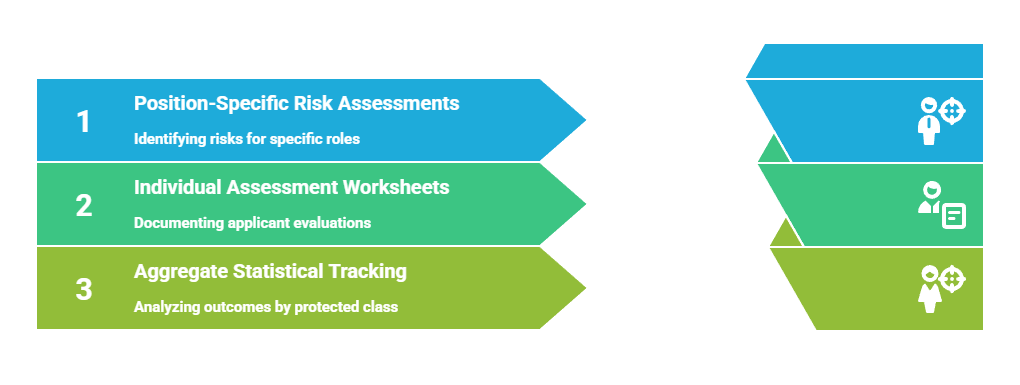
- Position-specific risk assessments: Completed before screening begins, these documents identify essential functions and genuine criminal history categories that would create unacceptable risk for specific duties, establishing prospective business necessity rather than post-hoc justification.
- Individual assessment worksheets: Created for each applicant with potentially disqualifying history, these forms document Green factors analysis, mitigating information received, and explanation of final determination with specific reference to job-related considerations.
- Aggregate statistical tracking: Recording screening outcomes by protected class where feasible enables proactive disparate impact analysis that identifies potential problems before EEOC charges materialize.
Ban-the-Box Compliance: Navigating State and Local Requirements
Understanding Ban-the-Box Scope and Variations
Ban-the-box legislation restricts when during the hiring process employers may inquire about or consider criminal history information. These laws originated in local ordinances and have expanded to state-level comprehensive statutes affecting millions of covered employees. Legislative variations create significant compliance complexity that requires careful jurisdictional analysis.
Some jurisdictions prohibit criminal history inquiries until after a conditional offer. Others allow inquiry at the interview stage. Certain laws apply only to public employers, while others cover private employers above specified employee thresholds. Some jurisdictions require specific notice language or extended response periods beyond EEOC baseline guidance.
Currently, employers must navigate a patchwork of over 150 jurisdictional ban-the-box requirements, with additional legislation under consideration in multiple states for 2026 implementation. Each jurisdiction maintains unique trigger points, covered employer definitions, exemption categories, and procedural mandates. Multi-state employers require jurisdiction-specific application processes and training protocols customized to each operating location.
Critical Compliance Components Across Jurisdictions
| Compliance Element | Common Requirements | Jurisdictional Variations |
| Timing restrictions | No criminal history questions on initial applications | Some ban until conditional offer; others allow at interview stage |
| Individualized assessment | Consideration of offense nature, recency, job-relatedness | Some mandate rebuttable presumptions favoring applicants |
| Notice requirements | Pre-adverse action disclosure with response opportunity | Specific content, delivery methods, and timing vary by location |
| Exemptions | Positions with vulnerable populations or fiduciary duties | Exemption scope and documentation requirements differ |
Despite jurisdictional variations, common compliance requirements create baseline standards. Applications and initial screening materials must not include criminal history questions until the jurisdiction-specified stage. Employers must audit all candidate-facing documents including online applications, paper forms, and verbal screening scripts to ensure compliance.
Many ban-the-box laws codify requirements substantially similar to EEOC guidance. These statutes require consideration of offense nature, recency, and job-relatedness. Some jurisdictions specify additional factors or impose rebuttable presumption structures favoring applicants, creating enhanced procedural obligations.
Building Multi-Jurisdictional Compliance Systems
Effective ban-the-box compliance for multi-state employers requires technology systems capable of jurisdiction detection. Dynamic application routing and location-specific workflow triggers prevent inadvertent violations. Essential system capabilities include geolocation functionality that identifies applicable requirements based on work location.
Conditional logic suppresses criminal history inquiries until the appropriate hiring stage for each jurisdiction. Manual override capabilities for exempt positions must include documentation requirements. Audit trails demonstrate compliance with jurisdiction-specific timing, notice delivery, assessment completion, and response consideration requirements for each candidate in covered locations.
AI Screening Tools and Algorithmic Fairness Considerations
EEOC Scrutiny of Automated Employment Decision Tools
The proliferation of AI-driven screening platforms, resume parsers, and predictive hiring algorithms has created new discrimination risk vectors attracting increasing EEOC attention. The commission's May 2023 technical assistance document on automated systems emphasizes that employers remain responsible for discriminatory outcomes even when using third-party tools developed and maintained by external vendors. This guidance continues to shape enforcement approaches entering 2026.
Algorithmic discrimination may occur through multiple mechanisms. Biased training data reflecting historical discrimination patterns creates one risk pathway. Proxy variables that correlate with protected characteristics represent another concern. Feedback loops that perpetuate existing workforce composition generate additional discrimination potential. Criminal history data incorporated into predictive models may amplify disparate impact beyond traditional screening approaches.
Employers using AI tools for any employment decision component must conduct adverse impact analysis. Resume screening, interview scheduling, assessment administration, and final selection all require validation evidence supporting job-relatedness and business necessity. Documentation of validation studies and ongoing monitoring creates essential legal defensibility.
Due Diligence and Human Oversight Requirements
Vendor selection processes must include detailed inquiry into algorithm design, training data sources, validation studies, and disparate impact testing. Vendors must explain input variables and decision logic sufficiently for employers to understand whether protected characteristics or proxy variables influence outcomes. Black box algorithms that vendors refuse to explain create unmanageable compliance risk. Documentation must demonstrate that tools predict job performance or other legitimate employment outcomes rather than replicating historical hiring patterns that may reflect past discrimination.
Compliant AI tool implementation maintains meaningful human decision-making authority rather than purely automated determinations:
| Safeguard Type | Implementation Requirement | Monitoring Protocol |
| Human review authority | Trained personnel review all algorithmically flagged adverse recommendations before implementation with override capability | Track override rates to ensure genuine judgment |
| Independent assessment capability | Reviewers possess authority and training to disagree with algorithmic recommendations based on holistic applicant evaluation | Audit override justifications for consistency |
| Bias detection protocols | Reviewers receive training on recognizing potential algorithmic bias indicators with escalation procedures | Statistical analysis of outcomes by protected class |
Contractual agreements should require ongoing disparate impact monitoring, immediate notification of identified bias issues, and vendor cooperation with EEOC investigations. Regular auditing of human override patterns ensures reviewers exercise genuine independent judgment rather than rubber-stamping automated recommendations.
Step-by-Step Compliant Background Screening Workflow
Phase One: Position Analysis and Policy Development
Before conducting any background screening, employers must complete prospective analysis establishing job-related screening criteria. Essential function identification begins this process through detailed job descriptions that specify duties, required skills, work environment, and performance standards. Documentation created before screening activities commence demonstrates non-pretextual business justifications.
Risk assessment follows functional analysis. Employers identify specific criminal conduct categories that would create unacceptable risk for the position's essential functions. Generic exclusions lack the specificity required under EEOC guidance. For example, positions with financial authority may justify consideration of theft or fraud convictions, while positions involving vulnerable populations may justify consideration of violent offenses.
Lookback period determination establishes maximum temporal limits reflecting genuine rehabilitation assessment needs. Arbitrary exclusions fail business necessity analysis. Policy documentation creates written screening policies specifying covered positions, disqualifying offense categories, assessment procedures, and appeal rights, ensuring consistency with FCRA requirements and applicable state laws.
Phase Two: Candidate Notice and Authorization
| Compliance Requirement | Documentation Element | Timing Consideration |
| FCRA stand-alone disclosure | Separate document disclosing consumer report use for employment purposes without extraneous content | Before obtaining report |
| Written authorization | Signed candidate consent authorizing background check with state-required language variations | Before obtaining report |
| Ban-the-box timing compliance | Criminal history authorization only at permitted hiring stage in covered jurisdictions | Varies by jurisdiction |
Compliant screening requires clear disclosure and informed consent before obtaining consumer reports. FCRA stand-alone disclosure provides candidates with a separate document explaining that a consumer report may be obtained for employment purposes. This disclosure must not include extraneous content that might obscure the key information.
Written authorization obtains candidate signature permitting the background check. Some states require specific authorization language or impose restrictions on liability waivers that employers must incorporate. Timing compliance in ban-the-box jurisdictions ensures criminal history authorization occurs only at the permitted hiring stage, which may differ from general background check authorization timing for non-criminal checks.
Phase Three: Report Review and Preliminary Assessment
Upon receiving background check results containing potentially disqualifying information, employers begin a structured evaluation process. Accuracy verification reviews the report for obvious errors, incomplete records, or information that may not actually constitute criminal history requiring individualized assessment. Technical errors in reporting agency databases create false positive risks that preliminary review should identify.
Green factors preliminary analysis conducts initial evaluation of offense nature, recency, and job-relatedness. This assessment determines whether individualized assessment is required or whether the information is clearly non-disqualifying. Pre-adverse action notice follows when potentially disqualifying information exists, providing the candidate with a copy of the consumer report, summary of FCRA rights, and notification that adverse action is under consideration.
Phase Four: Individualized Assessment Process
Assessment notice provides written communication identifying the specific criminal record under consideration. Green factors that will be evaluated receive explanation. Invitation to submit mitigating information gives candidates clear understanding of their opportunity to respond.
Response period allows reasonable time for submission, typically five to ten business days, though some jurisdictions may require longer periods. Extension granted upon reasonable request demonstrates good faith employer engagement. Information consideration reviews all submitted materials including rehabilitation evidence, contextual explanations, character references, certificates of completion for treatment or education programs, and employment history demonstrating stability.
Documented determination completes written assessment documenting Green factors analysis. Consideration of mitigating information appears in the record. Explanation of final determination includes specific reference to job duties and business necessity, creating the legal defensibility required during EEOC investigations or litigation.
Phase Five: Final Decision and Notice
After completing individualized assessment, employers must provide proper final notices and maintain comprehensive documentation:
- Adverse action notice: If the decision denies employment, final notice must include identification of the consumer reporting agency, statement that the agency did not make the adverse decision, notice of right to dispute report accuracy with the agency, and information about the right to request an additional free report.
- Record retention: All screening documentation including authorization, reports, assessment worksheets, candidate submissions, and final determination notices must be maintained for the legally required retention period under applicable federal and state laws.
- Appeals process: Internal appeal procedures allowing candidates to request reconsideration by senior HR leadership or compliance personnel not involved in the initial determination provide additional procedural safeguards and may help identify systematic issues in screening processes.
Self-Assessment Compliance Scorecard

Employers can evaluate their current compliance posture using a weighted risk assessment framework. This scoring system identifies vulnerability areas requiring immediate attention. Systematic evaluation across five categories creates comprehensive risk visibility.
| Category | Weight | Evaluation Criteria |
| Policy Documentation | 20% | Written policies specify disqualifying offenses by position, lookback periods with justification, assessment procedures, candidate rights; annual review occurs |
| Training and Competency | 20% | All hiring personnel complete annual training covering EEOC, FCRA, ban-the-box; training includes scenarios and competency assessment |
| Process Compliance | 25% | Documented workflows ensure consistent timing, proper notices, individualized assessments, documented response consideration |
| Documentation Quality | 20% | Position-specific risk assessments exist and are current; worksheets completed for all candidates; assessments demonstrate substantive Green factors analysis |
| Monitoring and Auditing | 15% | Quarterly outcome auditing occurs; disparate impact analysis conducted when feasible; identified issues trigger corrective action |
Employers scoring below 70% across these weighted categories face elevated enforcement risk and should prioritize immediate remediation. Scores between 70-85% indicate moderate risk requiring systematic improvement. Scores above 85% suggest strong compliance practices, though no self-assessment can guarantee immunity from enforcement actions given the evolving nature of compliance requirements and jurisdiction-specific variations.
Monthly Compliance Calendar for Proactive Risk Management
Quarterly Activities (January, April, July, October)
Legal update review monitors EEOC enforcement guidance updates, new ban-the-box legislation, relevant court decisions, and state-level regulatory changes affecting screening practices. Subscription to government agency mailing lists and legal update services ensures timely awareness of developments. Quarterly review cycles align with typical legislative session patterns and regulatory agency publication schedules.
Statistical outcomes analysis examines screening outcomes by protected class when feasible. This analysis identifies potential disparate impact patterns requiring investigation and possible policy adjustment. Vendor performance review evaluates background screening vendor accuracy, turnaround time, compliance with requirements, and quality of adverse action notice support.
Monthly Activities
Policy document review confirms that all application materials, online portals, and candidate communications reflect current policy language. Compliance with applicable ban-the-box timing restrictions requires ongoing verification. Training refresher conducts brief updates for hiring managers covering recent legal developments, common compliance errors identified in auditing, and reinforcement of individualized assessment requirements.
Random file audit selects a sample of recent hiring files to verify complete documentation of screening processes. Proper FCRA notices, completed individualized assessments where required, and appropriate record retention all receive verification. Sample size should represent at least 5-10% of completed background checks during the review period.
Ongoing Activities
Three continuous improvement activities maintain compliance culture:
- New hire orientation: Include background check policy explanation in new employee orientation, emphasizing company commitment to fair chance hiring and legal compliance to build organizational awareness and support.
- Candidate communication: Ensure all candidates subject to background screening receive a clear explanation of the process, their rights, and how to exercise those rights if potentially disqualifying information is found.
- Continuous improvement feedback: Implement a mechanism allowing HR staff and hiring managers to identify process barriers, documentation challenges, or training gaps requiring attention for iterative enhancement.
Special Considerations for High-Volume and Industry-Specific Operations
Organizations processing hundreds or thousands of background checks annually face unique compliance challenges requiring systematic approaches. Manual processes create inevitable compliance gaps under high-volume conditions. Technology solutions with automated workflow triggers, template notice generation, and deadline tracking become essential rather than optional investments.
Specialized background check coordinators or teams with dedicated FCRA and EEOC compliance responsibility ensure consistent expertise. This specialization reduces the burden on hiring managers who may lack detailed compliance knowledge. Quality assurance protocols including supervisor review of individualized assessments, statistical sampling of completed files, and regular error rate reporting create accountability mechanisms that maintain standards despite volume pressures.
Certain industries face enhanced regulatory complexity. Healthcare employers must navigate state licensing restrictions, federal exclusion list requirements, and vulnerable population protection mandates while maintaining EEOC compliance. Financial services organizations must comply with FDIC, SEC, FINRA, and other regulatory screening requirements. Transportation and logistics companies must address DOT background check requirements and state commercial driver licensing standards. Effective compliance in these sectors requires clear delineation of legally mandated exclusions versus discretionary screening policies subject to individualized assessment requirements.
Practical Guidance for Job Seekers: Understanding Your Rights
What EEOC Compliance Means for Applicants
Job seekers with criminal history should understand that federal law does not prohibit employers from considering criminal records. However, the law does require fair, individualized consideration rather than automatic disqualification. Three key applicant protections under EEOC guidance provide important safeguards.
Right to individualized assessment under EEOC guidance means compliant employers will consider the specific details of your situation. How long ago the offense occurred matters. What you have done since then carries weight. Whether the offense relates to the specific job duties requires evaluation. Blanket exclusion rules conflict with EEOC guidance principles and may create Title VII liability for employers.
Right to provide context ensures that when an employer identifies potentially disqualifying criminal history, you should receive notice and opportunity to explain. Circumstances surrounding the offense, evidence of rehabilitation, factual errors in records, or demonstrations that the record does not reflect actual conduct all represent relevant information. Right to accurate information under the FCRA gives you the right to receive a copy of any background check report used in employment decisions and to dispute inaccurate or incomplete information with the reporting agency.
Proactive Disclosure Strategies
While ban-the-box laws often delay when employers can ask about criminal history, applicants may benefit from strategic voluntary disclosure. Timing considerations in jurisdictions without ban-the-box restrictions suggest that carefully timed disclosure after establishing qualifications but before formal background checks may allow framing the information favorably. This approach demonstrates rehabilitation proactively.
Effective disclosure content emphasizes several key elements:
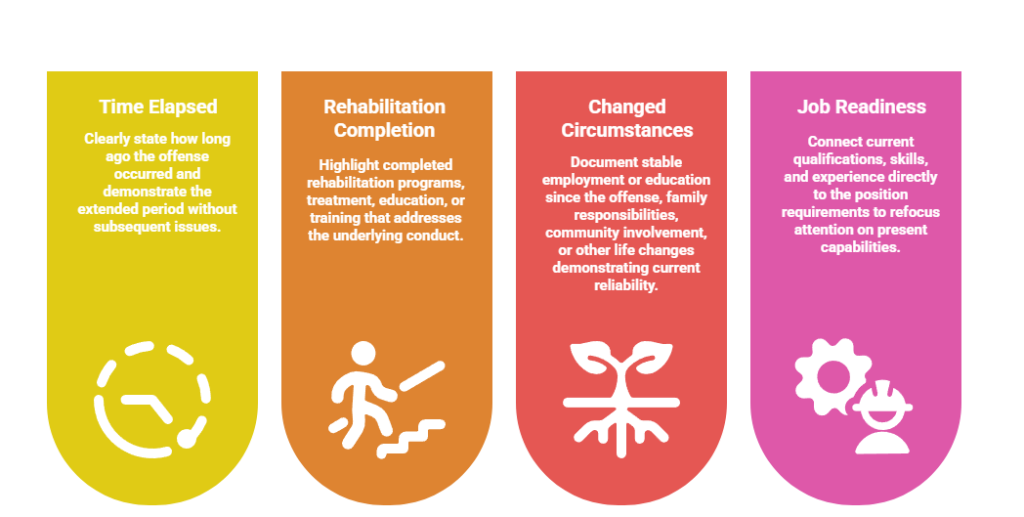
- Time elapsed: Clearly state how long ago the offense occurred and demonstrate the extended period without subsequent issues.
- Rehabilitation completion: Highlight completed rehabilitation programs, treatment, education, or training that addresses the underlying conduct.
- Changed circumstances: Document stable employment or education since the offense, family responsibilities, community involvement, or other life changes demonstrating current reliability.
- Job readiness: Connect current qualifications, skills, and experience directly to the position requirements to refocus attention on present capabilities.
Documentation preparation gathers supporting materials including certificates of completion for treatment or training programs. Character references from employers or community members carry weight. Evidence of career progression or educational achievement demonstrating current qualifications helps shift focus from past conduct to present capabilities.
When to Seek Legal Assistance
Applicants should consider consulting with employment attorneys or legal aid organizations in specific circumstances:
| Situation | Legal Consideration | Potential Action |
| Improper FCRA procedures | No proper notices, report copy, or response opportunity provided before adverse action | FCRA violation claim for statutory damages |
| Unrelated denial basis | Employer's stated reason for denial unrelated to specific job duties | Title VII disparate impact claim |
| Disparate treatment evidence | Similarly situated applicants received different treatment | Title VII intentional discrimination claim |
| Ban-the-box violation | Criminal history inquiry occurred before jurisdiction-specified stage | State/local law violation claim |
You receive adverse action based on criminal history without receiving proper FCRA notices, a copy of the report, or opportunity to respond with mitigating information. The employer's stated reason for denial does not appear related to your specific job duties, suggesting possible unlawful blanket exclusion policies. You have evidence that similarly situated applicants without criminal history or with different protected class characteristics received different treatment under comparable circumstances.
Frequently Asked Questions
What is the difference between EEOC requirements and FCRA requirements for background checks?
The EEOC enforces Title VII anti-discrimination requirements, focusing on whether criminal history screening policies create discriminatory barriers through disparate impact. The Fair Credit Reporting Act governs procedural requirements for obtaining and using consumer reports, including specific notice and disclosure obligations. Employers are subject to both frameworks simultaneously, as they address different legal requirements that overlap in background screening contexts.
Can an employer have a blanket policy against hiring anyone with any criminal record?
Blanket exclusion policies that automatically disqualify all applicants with criminal history create significant Title VII liability risk under EEOC enforcement guidance. Such policies are likely to have disparate impact on protected groups and are difficult to justify as business necessity across all positions and offense types. Compliant screening requires individualized assessment using the Green factors framework to evaluate specific offenses in relation to specific job requirements.
How far back can employers look at criminal history under EEOC guidance?
The EEOC does not specify maximum lookback periods, but emphasizes that longer exclusion periods require stronger business necessity justification because rehabilitation likelihood increases with time. Many state and local laws impose specific lookback limits ranging from five to ten years depending on jurisdiction and offense severity. Employers should establish lookback periods reflecting genuine assessment of rehabilitation and job-related risk rather than arbitrary temporal limits.
Does EEOC guidance apply to employers who conduct their own background research rather than using consumer reporting agencies?
Title VII anti-discrimination requirements apply regardless of how criminal history information is obtained. While FCRA procedural requirements apply only when using consumer reporting agencies, the substantive EEOC requirement to avoid discriminatory screening policies applies to all background investigation methods. Direct court record research, internet searches, or information obtained from references all remain subject to Title VII standards.
What should I do if I believe an employer rejected me based on criminal history without following proper procedures?
Document all communications with the employer including copies of any notices received, timeline of events, and the specific information provided about rejection reasons. Contact the background screening company identified in any notices to verify report accuracy and request a free copy if you have not received one. Consider filing a charge with the EEOC within the applicable time limit (typically 180 or 300 days depending on state) if you believe Title VII was violated, or consult an employment attorney regarding potential FCRA violations.
Are arrest records treated the same as conviction records under EEOC guidance?
The EEOC guidance distinguishes between arrests and convictions, noting that arrest records alone are generally not reliable evidence that criminal conduct occurred. Arrests do not require proof beyond reasonable doubt, making them insufficient basis for employment exclusions. Convictions provide stronger evidence of conduct, but still require individualized assessment considering the Green factors before adverse employment action.
Can employers in ban-the-box jurisdictions ask about criminal history during the interview if they wait until after the interview to make hiring decisions?
Ban-the-box law details vary significantly by jurisdiction. Some laws prohibit inquiry at any time before a conditional offer, while others allow inquiry after initial application screening but before final decisions. Employers should comply with the specific requirements of the applicable jurisdiction where the work will be performed. Making assumptions based on general ban-the-box concepts without verifying local law creates significant compliance risk.
How do licensing restrictions interact with EEOC requirements for individualized assessment?
When state or federal law explicitly prohibits employment of individuals with specified criminal history in licensed positions, employers generally have clear legal justification for following those mandates. However, employers should ensure that exclusions are limited to positions actually subject to licensing restrictions rather than being over-broadly applied. Discretionary licensing board consideration of criminal history does not automatically justify employer exclusions without individualized assessment.
What constitutes adequate evidence of rehabilitation that employers should consider?
Rehabilitation evidence may include completion of incarceration, parole, or probation periods without violations; participation in treatment, counseling, or educational programs; stable employment history since the offense; and community involvement or volunteer work. Character references from employers, counselors, or community leaders carry weight. The EEOC emphasizes that employers should give good faith consideration to such evidence rather than perfunctory review.
Do EEOC background check requirements apply to small businesses?
Title VII applies to employers with 15 or more employees, so smaller employers are not subject to federal EEOC enforcement. However, many state anti-discrimination laws apply to smaller employers and may incorporate similar criminal history screening standards. Ban-the-box laws often have lower employee thresholds or apply to all employers regardless of size in certain jurisdictions. Small employers should verify applicable state and local requirements rather than assuming exemption.
Additional Resources
- EEOC Enforcement Guidance on the Consideration of Arrest and Conviction Records
https://www.eeoc.gov/laws/guidance/enforcement-guidance-consideration-arrest-and-conviction-records-employment-decisions - Federal Trade Commission: Background Checks and the Fair Credit Reporting Act
https://www.ftc.gov/business-guidance/resources/using-consumer-reports-what-employers-need-know - National Conference of State Legislatures: Fair Chance and Ban the Box Licensing Toolkit
https://www.ncsl.org/labor-and-employment/fair-chance-licensing-reform - U.S. Department of Labor: Background Checks and Credit Reports
https://www.dol.gov/general/topic/hiring/background-checks

ABOUT THE CREATOR
GCheck Editorial Team
Meet the GCheck Editorial Team, your trusted source for insightful and up-to-date information in the world of employment background checks. Committed to delivering the latest trends, best practices, and industry insights, our team is dedicated to keeping you informed.
With a passion for ensuring accuracy, compliance, and efficiency in background screening, we are your go-to experts in the field. Stay tuned for our comprehensive articles, guides, and analysis, designed to empower businesses and individuals with the knowledge they need to make informed decisions.
At GCheck, we're here to guide you through the complexities of background checks, every step of the way.