



Education verification has become a critical risk management tool as credential fraud has increased significantly in recent years, with some industry researchers documenting substantial growth in misrepresentation incidents targeting remote work markets. Employers must now navigate traditional degree verification alongside emerging challenges like micro-credentials, bootcamp certificates, and international equivalency assessments while maintaining compliance with federal and state-specific background check regulations.
Key Takeaways
- Education verification confirms the authenticity of academic credentials claimed by candidates, helping employers manage hiring risks and support workforce competency.
- The Fair Credit Reporting Act (FCRA) governs education verification when conducted by third-party consumer reporting agencies, requiring written authorization and specific adverse action procedures.
- Credential fraud has increased substantially in recent years, with diploma mills and AI-generated documents creating sophisticated forgeries that manual reviews often miss.
- Verification timelines vary significantly, ranging from 48 hours for domestic institutions with digital records to 6-8 weeks for international credentials requiring manual authentication.
- Employers should verify education for positions where credentials directly impact job performance, safety, regulatory compliance, or professional licensing requirements.
- Non-traditional credentials like bootcamp certificates and micro-credentials require adapted verification approaches that assess learning outcomes rather than institutional accreditation alone.
- State and local laws impose varying restrictions on background checks, including ban-the-box provisions and lookback period limitations that may affect education verification timing.
- Individualized assessment of discrepancies is legally required under FCRA and Equal Employment Opportunity Commission (EEOC) guidance to avoid discriminatory screening practices.
Understanding Education Verification in Modern Hiring
What Is Education Verification and Why It Matters
Education verification is the process of confirming that a job candidate's claimed educational credentials are accurate, authentic, and issued by legitimate institutions. This practice involves contacting schools, universities, training programs, or credential verification services to validate details such as degrees earned, majors or fields of study, graduation dates, and institutional accreditation status. The verification process protects both employers and maintains hiring integrity across industries.
The practice serves multiple organizational objectives beyond simple fact-checking. For employers, education verification helps manage hiring-related risks by confirming that candidates possess the qualifications they claim for job performance. In regulated industries such as healthcare, finance, and education, verified credentials often represent legal prerequisites for employment.
Beyond compliance considerations, verification builds organizational trust by confirming that workforce competencies align with represented qualifications. This supports informed hiring decisions that affect team performance and customer safety. Meanwhile, candidates who understand verification processes can prevent application delays caused by incomplete academic records or contact information errors.
Trust is established well before day one, and educational verification is a piece of this puzzle. I have seen how a single unchecked credential can quietly erode confidence later, not just in the hire but in the process itself. Educational verification is not about questioning people but about recognizing the roles we give them and the responsibility that comes with these roles. When conducted carefully and equitably, educational verification is about protecting one’s organization and also about recognizing those who’ve rightfully earned their credentials.
The Legal Framework Governing Education Verification
Education verification conducted by employers directly faces fewer federal restrictions than verification performed by third-party consumer reporting agencies. The Fair Credit Reporting Act (FCRA) applies when employers engage external screening companies to conduct background checks that include education verification. Under FCRA requirements, employers are required to follow specific procedural steps to protect consumer rights throughout the screening process.
Required FCRA compliance steps include obtaining written authorization from candidates before procuring consumer reports, providing pre-adverse action notices if verification results may lead to disqualification, supplying copies of reports and summaries of rights to candidates, and delivering final adverse action notices if employment is denied. Violations may expose employers to statutory damages, actual damages, attorney fees, and regulatory enforcement actions that can substantially exceed the cost of proper compliance. Therefore, understanding these obligations is essential for organizations using third-party screening services.
State and local laws add jurisdiction-specific requirements that often exceed federal standards. Ban-the-box ordinances in numerous states and municipalities (including but not limited to California, Illinois, Massachusetts, New York City, Philadelphia, and others) restrict when employers may conduct background checks or inquire about candidate backgrounds. Because these laws vary significantly and continue to evolve, employers should verify current requirements in their specific jurisdictions.
When Education Verification Is Essential for Employers
Not all positions warrant the time and expense of formal education verification. Employers should implement verification protocols based on job-specific risk assessments that consider credential relevance, safety implications, and regulatory requirements. Strategic targeting of verification resources ensures compliance while managing costs effectively.
Positions requiring professional licenses such as registered nurses, certified public accountants, or licensed professional engineers necessitate verification because credentials directly enable legal practice. Similarly, roles involving specialized technical knowledge where unqualified performance creates safety risks benefit from verification that confirms foundational training. Customer-facing positions in regulated industries often require verified credentials to maintain organizational compliance with oversight bodies.
High-volume hiring environments benefit from risk-tiered verification approaches:
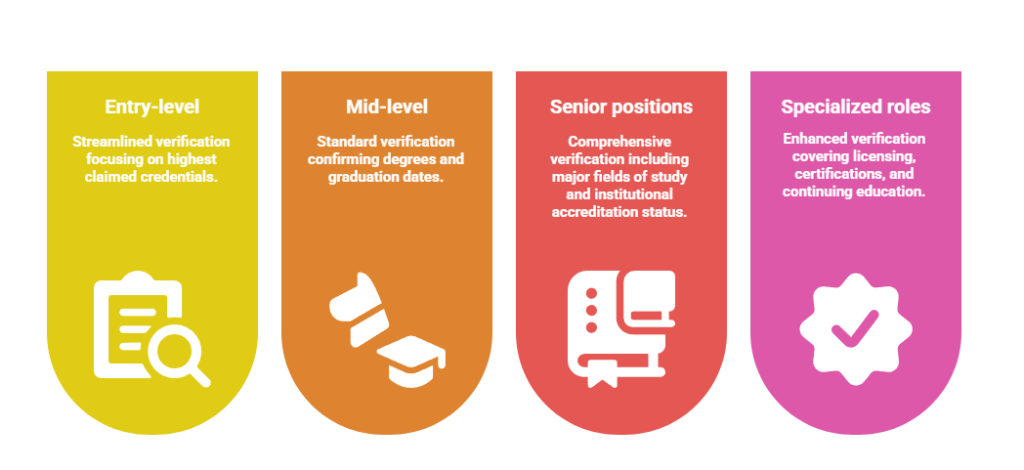
- Entry-level positions: Streamlined verification focusing on highest claimed credentials
- Mid-level roles: Standard verification confirming degrees and graduation dates
- Senior positions: Comprehensive verification including major fields of study and institutional accreditation status
- Specialized roles: Enhanced verification covering licensing, certifications, and continuing education
This balanced approach allocates verification resources according to organizational risk exposure. Cost efficiency improves while maintaining necessary oversight for critical positions.
The Growing Challenge of Credential Fraud
The Significant Increase in Education Fraud
Industry research documents a substantial increase in credential fraud in recent years, representing a significant spike in education misrepresentation. This surge correlates directly with the rapid expansion of remote work arrangements that reduced in-person credential inspection opportunities and increased geographic hiring ranges. As employers recruited across state and international boundaries, verification complexity increased while fraudsters exploited reduced oversight.
Diploma mills have evolved from obvious degree-selling operations into sophisticated enterprises that mimic legitimate institutional infrastructure. Modern fraudulent providers create convincing websites featuring accreditation claims, faculty directories, and course catalogs designed to pass surface-level employer scrutiny. Some operations purchase defunct institution names and accreditation references, issuing credentials under formerly legitimate educational brands.
AI-generated credentials represent an emerging fraud category that traditional verification methods struggle to detect. Artificial intelligence tools now produce realistic transcripts, diplomas, and supporting documentation with accurate formatting, institutional seals, and registrar signatures. These documents pass visual inspection and often include verifiable institutional contact information that routes to accomplices who confirm fraudulent credentials.
Common Red Flags in Education Claims
Experienced HR professionals recognize patterns that warrant enhanced verification scrutiny. Identifying warning signs early in the hiring process prevents costly mistakes and protects organizational integrity. The following table outlines primary credential fraud indicators:
| Red Flag Category | Warning Signs | Verification Response |
| Unaccredited Institutions | Claims from schools lacking recognized accreditation, unfamiliar accrediting bodies | Cross-reference accreditation databases, research institutional legitimacy |
| Timeline Inconsistencies | Degrees during full-time employment elsewhere, compressed completion timelines | Request detailed transcripts showing enrollment continuity |
| Vague Descriptions | Generic degree types without institutions, unusual nomenclature | Require specific institutional names and official documentation |
| Documentation Reluctance | Delays providing transcripts, excuses for unavailable records | Proceed with direct institutional verification regardless of candidate cooperation |
| International Anomalies | Degrees from diploma mill concentrations, unknown foreign institutions | Engage credential evaluation services for authentication |
Claims involving institutions absent from recognized accreditation databases require investigation to distinguish authentic specialized accreditation from diploma mill fabrications. Legitimate regional and national accreditation organizations maintain public databases of accredited institutions that serve as primary verification resources.
Employers should note that many legitimate candidates may present credentials that trigger one or more of these indicators, particularly international degree holders, immigrants, and candidates from non-traditional educational backgrounds. Red flags should prompt additional verification rather than automatic disqualification, and all screening decisions must be based on individualized assessment consistent with EEOC guidance.
International Credential Verification Challenges
International education verification presents unique authentication challenges requiring specialized expertise. Educational systems vary significantly across countries in degree nomenclature, grading scales, credential documentation, and institutional oversight structures. Direct comparison of international credentials to U.S. equivalents demands knowledge of country-specific educational frameworks and accreditation systems.
Many international institutions lack digitized records or dedicated verification services. Manual authentication through institutional registrars may involve limited English language capabilities and extended response times. Response times for international verification often span 4-8 weeks, complicating hiring timelines for employers accustomed to domestic verification completing within days.
Credential evaluation services specializing in international education provide essential authentication for employers lacking internal expertise:
- Database access: Maintain records of legitimate international institutions across countries
- Framework knowledge: Understand country-specific credential structures and grading systems
- Equivalency assessment: Translate international credentials into U.S.-equivalent degree levels
- Fraud detection: Identify diploma mills and fraudulent international credentials
- Documentation review: Evaluate authenticity of transcripts and supporting materials
These organizations issue evaluation reports specifying whether claimed credentials represent legitimate institutions. Reports confirm claimed completion dates and degree types while assessing equivalency to U.S. associate, bachelor's, master's, or doctoral degrees.
How Education Verification Works

The Traditional Verification Process
Traditional education verification begins with candidate authorization. Under FCRA requirements when third-party consumer reporting agencies conduct verification, employers are required to obtain signed authorization forms permitting background check procurement. Authorization documents must appear as standalone forms separate from employment applications, contain specific disclosure language about consumer report use, and clearly inform candidates of their rights under federal and state background check laws.
Once authorized, verification proceeds through institutional contact. For domestic institutions, this typically involves contacting registrar offices through established verification channels. Many colleges and universities participate in centralized verification services that maintain electronic enrollment and degree databases accessible to authorized verification requestors. These services provide rapid confirmation of attendance dates, degrees conferred, graduation dates, and majors within 24-48 hours for participating institutions.
The verification workflow follows these steps:
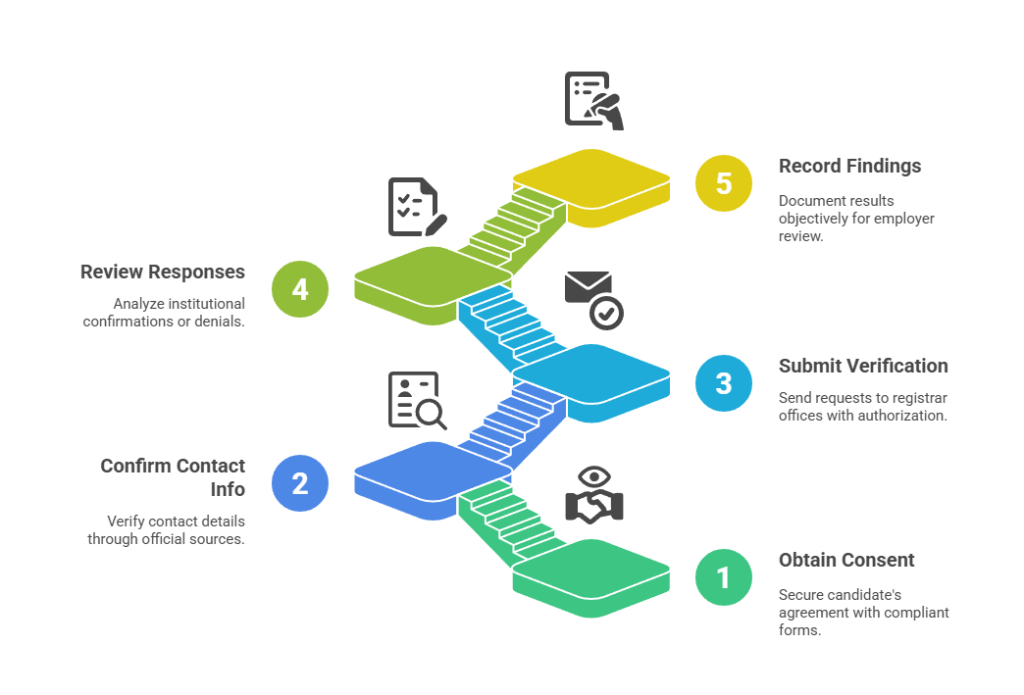
- Obtain candidate consent using compliant disclosure and authorization forms
- Confirm legitimate contact information through official institutional websites
- Submit verification requests with candidate authorization to registrar offices
- Review institutional responses confirming or denying claimed credentials
- Record findings objectively without interpretation for employer review
Institutions not participating in centralized services require direct registrar contact through phone, fax, or mail submission of verification requests.
Emerging Hybrid Verification Approaches
Modern verification increasingly combines traditional institutional contact with technology-enabled validation tools. Blockchain-based credential verification represents an emerging approach where educational institutions issue digital credentials recorded on distributed ledgers. These credentials allow instant verification by employers through cryptographic validation without requiring repetitive registrar contact.
Digital transcript services provide candidate-controlled credential sharing platforms. Students and alumni request official transcripts through these services, which deliver encrypted electronic documents directly to employers with tamper-evident security features. This approach accelerates verification while maintaining document authenticity through cryptographic signatures and secure transmission protocols.
Risk-based verification allocates resources according to fraud probability and position requirements:
- Preliminary screening: Accept candidate-provided unofficial transcripts for initial evaluation
- Finalist verification: Reserve formal institutional verification for candidates advancing to final stages
- High-risk positions: Conduct comprehensive verification including degree, major, and graduation date validation
- Lower-risk roles: Implement streamlined verification confirming only highest claimed degrees
- Ongoing monitoring: Consider continuous verification for positions with mandatory licensing requirements
Employers implementing risk-tiered approaches balance verification thoroughness with hiring efficiency. This strategy optimizes resource allocation while maintaining necessary oversight for critical positions.
Verifying Non-Traditional Educational Credentials
Bootcamp Certificates and Micro-Credentials
The proliferation of coding bootcamps, online learning platforms, and micro-credential programs challenges traditional verification frameworks designed for degree-granting institutions. These alternative educational pathways often provide intensive skill training without formal accreditation, regional oversight, or standardized transcript systems. Employers seeking to verify non-traditional credentials must adapt verification approaches to assess learning outcomes and program legitimacy rather than institutional accreditation alone.
Bootcamp verification focuses on program completion confirmation and curriculum validation. Reputable bootcamp providers maintain student records and respond to verification requests confirming attendance dates, program completion status, and curriculum content. Employers should contact bootcamps directly using official program contact information rather than relying solely on candidate-provided certificates.
Micro-credentials issued by online learning platforms require platform-specific verification approaches. Major platforms provide credential verification tools allowing employers to validate certificates through unique credential identifiers or verification URLs. These tools confirm that specific individuals completed designated courses, earned claimed credentials on specified dates, and that credentials remain valid and unrevoked.
Assessing Alternative Learning Pathway Legitimacy
Employers evaluating non-traditional credentials should focus on learning outcome validation rather than institutional prestige metrics. This competency-based approach assesses whether verified training provided knowledge and skills directly applicable to position requirements, regardless of credential source. Job-relevant skill assessment through technical interviews, work sample evaluations, or skills testing complements credential verification by validating practical competencies.
| Credential Type | Verification Method | Assessment Focus |
| Coding Bootcamps | Direct provider contact, completion confirmation | Curriculum content, skill outcomes, portfolio review |
| Online Platforms | Platform verification tools, credential IDs | Course completion, assessment scores, skill badges |
| Industry Certifications | Certification body databases, license verification | Current status, renewal dates, continuing education |
| Micro-credentials | Issuer verification systems, digital badges | Learning objectives, competency demonstration, issuer reputation |
| Apprenticeships | Program sponsor contact, completion records | Skill mastery, supervised hours, practical assessment |
Program curriculum review helps evaluate alternative credential substance. Employers should request detailed syllabi, course descriptions, and learning objectives from bootcamps and training providers to assess content depth and relevance. Programs offering substantive, structured curriculum with measurable learning outcomes merit greater weight than brief certificate programs lacking defined competency frameworks.
However, employers should ensure that alternative credential evaluation standards do not create disparate impact on protected groups. Candidates from communities with limited access to traditional four-year degree programs may disproportionately rely on alternative learning pathways. Rejection of alternative credentials unrelated to demonstrable job requirements may raise concerns under EEOC guidance regarding potentially discriminatory screening. Employers evaluating any educational credentials should focus on whether the verified training provides the specific knowledge and skills necessary for the position, rather than applying categorical preferences based on credential type or institutional prestige.
Compliance Considerations for Employers
FCRA Requirements in Education Verification
When employers engage third-party consumer reporting agencies to conduct education verification as part of background screening, FCRA compliance obligations typically apply. The specific requirements and their interpretation may vary based on jurisdiction and evolving regulatory guidance, so employers should consult legal counsel for compliance questions specific to their circumstances. The statute requires specific procedural steps protecting consumer rights throughout the background check process.
Pre-screening authorization represents the first compliance checkpoint. Employers must provide candidates with clear, standalone disclosure documents explaining that consumer reports may be obtained for employment purposes. These disclosures cannot be buried in employment applications or combined with liability waivers and other documents.
Critical FCRA compliance checkpoints include:
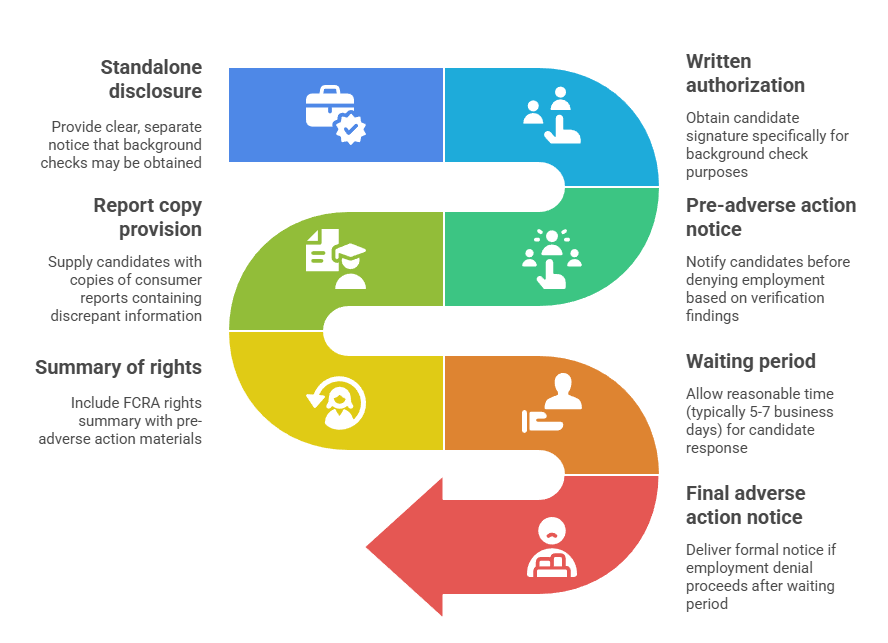
- Standalone disclosure: Provide clear, separate notice that background checks may be obtained
- Written authorization: Obtain candidate signature specifically for background check purposes
- Pre-adverse action notice: Notify candidates before denying employment based on verification findings
- Report copy provision: Supply candidates with copies of consumer reports containing discrepant information
- Summary of rights: Include FCRA rights summary with pre-adverse action materials
- Waiting period: Allow reasonable time (typically 5-7 business days) for candidate response
- Final adverse action notice: Deliver formal notice if employment denial proceeds after waiting period
Following disclosure, employers are required to obtain written authorization from candidates before procuring consumer reports. Authorization forms should appear as separate documents that candidates sign specifically for background check purposes.
State-Specific Background Check Restrictions
State and local background check laws create a complex compliance landscape requiring jurisdiction-specific analysis. Ban-the-box laws restrict when employers may conduct background checks or inquire about candidate backgrounds. While these laws primarily target criminal history inquiries, some jurisdictions extend restrictions to all background checks including education verification.
Employers operating in ban-the-box jurisdictions should delay education verification until after conditional employment offers in positions where local laws require. This sequencing ensures compliance with inquiry timing restrictions while preserving employer ability to verify credentials before final hiring decisions. Clear policy documentation specifying at what hiring stage verification occurs demonstrates good faith compliance efforts.
Salary history ban laws in multiple states and municipalities prohibit inquiring about candidate salary histories. While these laws do not directly restrict education verification, employers should ensure that education verification processes do not serve as proxies for prohibited salary inquiries. Using education level as the primary salary determinant in jurisdictions banning salary history inquiries may circumvent legislative intent and create legal exposure.
Avoiding Discriminatory Screening Practices
Education verification must be applied consistently across candidate pools to avoid disparate treatment discrimination. Employers who verify credentials inconsistently across candidate pools for the same positions may face potential discrimination claims under Title VII of the Civil Rights Act, particularly if verification patterns correlate with protected characteristics like race, national origin, or age. Consistent application of verification policies demonstrates fair hiring practices and reduces legal exposure.
Blanket disqualification policies based on education discrepancies create disparate impact risks. EEOC guidance requires individualized assessment of background check findings rather than automatic disqualification rules. When education verification reveals discrepancies between claimed and verified credentials, employers should conduct individualized reviews rather than implementing categorical exclusions.
Individualized assessment factors:
- Nature of misrepresentation: Distinguish intentional fraud from innocent errors or record-keeping mistakes
- Severity of discrepancy: Evaluate whether discrepancies involve material credentials or minor details
- Time elapsed: Consider how long ago educational activities occurred relative to current job application
- Job relevance: Assess whether discrepant credentials directly affect essential job functions
- Candidate explanation: Review explanations and mitigating factors provided during adverse action periods
Verification policies requiring specific degree types must satisfy job-relatedness and business necessity standards. Employers claiming that positions require particular educational credentials should document how those credentials relate to essential job functions and validate that degree requirements accurately predict job performance.
Best Practices for Job Seekers
Preparing for Education Verification
Job seekers can expedite hiring processes by proactively preparing education verification materials before applications. Gathering official transcripts from all attended institutions provides ready documentation when employers request verification support. Most institutions offer online transcript ordering through registrar websites, with delivery options including electronic transmission to employers or sealed paper transcripts mailed to candidates for forwarding.
Maintaining accurate records of educational history prevents application errors that delay verification. Candidates should document exact institutional names as they appear on official records rather than shortened or colloquial versions. Recording specific degree titles including majors and minors ensures application accuracy.
Essential education documentation includes:
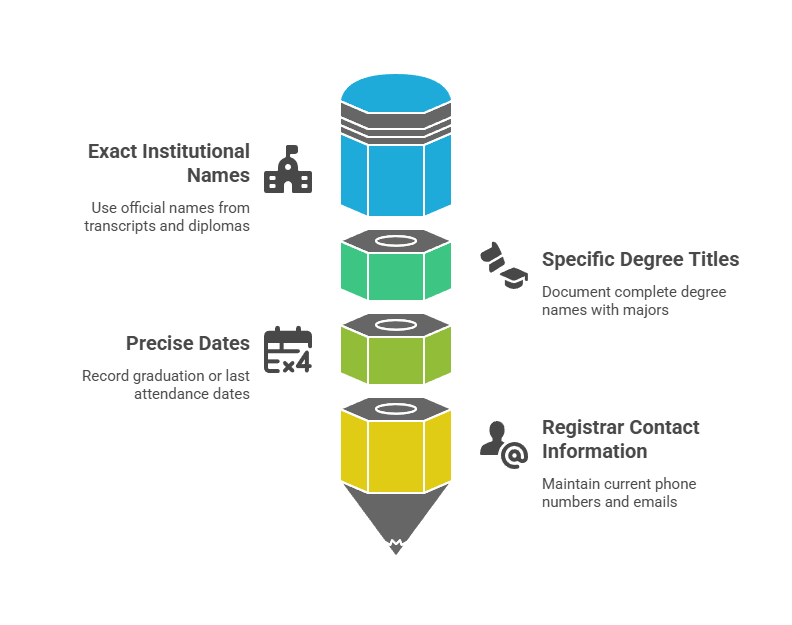
- Exact institutional names: Use official names as they appear on transcripts and diplomas
- Specific degree titles: Document complete degree names including majors and concentrations
- Precise dates: Record graduation dates or last attendance dates for incomplete programs
- Registrar contact information: Maintain current phone numbers and email addresses for verification offices
Candidates with name changes since education completion should prepare supporting documentation linking current legal names to names used during school enrollment. Marriage certificates, court orders, or other legal name change documentation helps verification professionals match current candidate information to historical educational records.
Addressing Credential Discrepancies Honestly
Candidates who did not complete claimed degrees should represent education accurately on applications and resumes. Listing "coursework completed" or "credits earned" with attendance dates communicates educational background honestly without falsely claiming unearned credentials. Many employers value relevant coursework even when degrees were not completed, particularly when combined with work experience demonstrating applied knowledge.
Those who attended institutions that subsequently closed should maintain documentation proving attendance and completion. Transcripts, diplomas, and enrollment documentation from closed institutions become critical when schools no longer exist to confirm records. Some states maintain closed institution record repositories that may assist verification when candidate-held documentation proves insufficient.
If verification reveals discrepancies during hiring processes, candidates should respond promptly and transparently during pre-adverse action periods:
- Review report carefully: Examine verification findings for errors or misunderstandings
- Gather supporting documentation: Collect transcripts, diplomas, or institutional correspondence
- Respond within deadline: Submit explanations and correcting documents during allowed response period
- Acknowledge honest mistakes: Admit application errors while explaining circumstances
Explaining innocent errors, providing correcting documentation, or acknowledging mistakes demonstrates integrity that may preserve candidacy despite credential issues. Employers conducting individualized assessments often distinguish between intentional fraud and honest mistakes, particularly when candidates cooperate during verification problem resolution.
The Future of Education Verification
Technology-Enabled Verification Innovation
Blockchain credential systems promise to transform education verification by creating tamper-proof, instantly verifiable credential records. Educational institutions issuing blockchain-based diplomas and transcripts enable graduates to share verified credentials with employers through cryptographic keys that prove authenticity without requiring repetitive registrar contact. This approach reduces verification costs, accelerates hiring timelines, and decreases administrative burdens on institutional registrars managing verification requests.
Artificial intelligence applications in verification include fraud detection algorithms that identify suspicious patterns in credential documentation. Machine learning models trained on legitimate credential databases can flag unusual formatting, inconsistent institutional information, or documentation characteristics associated with known diploma mills. These tools augment human verification by prioritizing high-risk credentials for enhanced scrutiny while accelerating processing of low-risk verifications.
Standardized digital credential frameworks under development by educational technology consortia aim to create interoperable verification systems. These frameworks would enable credential data exchange across platforms using common technical standards, simplifying verification across diverse institutional systems. Widespread adoption could eventually create universal credential verification similar to credit reporting infrastructure, where authorized parties access centralized credential databases rather than contacting individual institutions.
Balancing Speed and Thoroughness
Employers face ongoing tension between verification thoroughness and hiring speed in competitive talent markets. Comprehensive verification including degree confirmation, major verification, and graduation date validation typically requires several business days for domestic credentials and substantially longer for international verification. The following table provides general timeline estimates that may vary significantly based on institutional resources, verification method, and specific circumstances:
| Verification Approach | Typical Timeline | Best Use Case | Risk Level |
| Instant digital verification | 1-24 hours | Blockchain credentials, digital transcript services | Low |
| Centralized database | 24-48 hours | Participating institutions with electronic records | Low |
| Direct registrar contact | 3-7 days | Non-participating domestic institutions | Medium |
| International verification | 4-8 weeks | Foreign institutions, manual authentication required | High |
| Closed institution | Variable | Depends on record repository availability | High |
Risk-based verification strategies help balance these competing priorities. Preliminary employment offers conditional on successful background check completion allow candidates to accept positions before verification finishes, reducing offer acceptance delays while preserving employer ability to rescind offers if verification reveals disqualifying issues.
Technology adoption reduces verification timelines without compromising accuracy. Digital transcript services, centralized verification databases, and blockchain credentials enable near-instant verification for participating institutions. Employers investing in modern verification infrastructure gain competitive hiring advantages while maintaining verification integrity.
Conclusion
Education verification serves as a foundational organizational risk management practice helping employers manage credential fraud risks while enabling informed hiring decisions in increasingly complex educational landscapes. Employers should navigate federal FCRA requirements, state-specific background check restrictions, and emerging verification technologies while maintaining legally compliant, non-discriminatory screening practices. As credential fraud continues evolving with AI-generated documents and sophisticated diploma mills, verification remains valuable for positions where qualifications directly impact performance, safety, and regulatory compliance. The process of verifying education also supports fairness in the hiring process by making sure that all applicants are judged by the same criteria. This helps to prevent discrepancies in the hiring process that may be influenced by human error. By taking the process of verifying education seriously, companies are able to build integrity among hiring staff, management, and the employees being hired.
Frequently Asked Questions
How long does education verification typically take?
Verification timelines vary based on institutional participation in centralized databases and record formats. Domestic institutions participating in electronic verification services typically provide results within 24-48 hours. Schools requiring manual registrar contact may need 1-3 weeks for response. International verification often requires 4-8 weeks due to manual authentication processes and communication barriers.
Can employers verify education without candidate permission?
Employers conducting verification directly may have greater flexibility depending on state law, but verification through third-party consumer reporting agencies requires written candidate authorization under FCRA. Even when legal, verification without notice creates candidate relations concerns and may violate state privacy laws requiring consent for background information collection. Best practice involves obtaining explicit candidate authorization for all verification activities.
What happens if education verification reveals discrepancies?
When verification conducted by consumer reporting agencies reveals discrepancies that may lead to adverse employment decisions, FCRA requires pre-adverse action procedures. Employers must provide candidates copies of reports, summaries of rights, and reasonable time to respond before final decisions. Individualized assessments should consider discrepancy nature, candidate explanations, and job-relatedness rather than implementing automatic disqualification policies.
Are employers required to verify education for all positions?
No federal law mandates universal education verification. Employers should implement verification based on job-specific risk assessments considering whether credentials directly affect performance, safety, or regulatory compliance. Verification policies should be applied consistently within job categories to avoid potentially discriminatory screening.
How should employers verify coding bootcamp certificates?
Bootcamp verification focuses on program completion confirmation rather than institutional accreditation. Employers should contact bootcamps using official program contact information to verify attendance dates, completion status, and curriculum content. Assess whether verified training aligns with position requirements based on learning outcomes rather than accreditation status.
Can education requirements discriminate against protected groups?
Yes, when degree requirements lack job-relatedness and create disparate impact on protected groups. EEOC guidance requires that educational requirements satisfy business necessity standards and accurately predict job performance. Requirements disproportionately excluding protected groups without demonstrable job-relatedness may raise legal concerns under federal anti-discrimination laws.
What verification challenges do international degrees present?
International credentials require specialized authentication due to varying educational systems, degree nomenclature, and institutional oversight structures across countries. Many international institutions lack digital records or dedicated verification services, necessitating manual authentication with extended timelines. Employers should utilize professional credential evaluation services that assess international degree legitimacy and provide U.S. equivalency determinations.
How should employers handle closed institution verification?
When institutions have permanently closed, verification becomes challenging but remains possible through multiple approaches. Many states maintain closed institution record repositories. Candidates should be asked to provide personal documentation including transcripts, diplomas, or enrollment records obtained before closure. Some closed institutions transferred records to successor institutions or state education agencies that may assist verification.
What are the legal risks of skipping education verification?
Employers who fail to verify credentials for positions where qualifications directly affect safety, compliance, or specialized competency may face increased legal and operational risks if unqualified employees cause harm. Beyond legal exposure, unverified credentials enable credential fraud that undermines workforce competency and organizational reputation. Risk balancing requires targeting verification to positions where credentials meaningfully impact performance and compliance.
Should employers verify education for internal promotions?
Internal promotion verification depends on whether new positions require different credentials than initial hiring verified. If original background checks included comprehensive education verification covering credentials required for promoted positions, re-verification may be unnecessary absent fraud concerns. Promotions to positions requiring specific unverified credentials or roles with heightened regulatory requirements should trigger appropriate verification even for internal candidates.
Additional Resources
- Fair Credit Reporting Act Full Text and Official Summary
https://www.ftc.gov/legal-library/browse/statutes/fair-credit-reporting-act - EEOC Enforcement Guidance on the Consideration of Arrest and Conviction Records
https://www.eeoc.gov/laws/guidance/enforcement-guidance-consideration-arrest-and-conviction-records-employment-decisions - U.S. Department of Education Database of Accredited Postsecondary Institutions
https://www.ed.gov/accreditation - Council for Higher Education Accreditation Directory
https://www.chea.org/search-institutions - Consumer Financial Protection Bureau Guidance on FCRA Compliance
https://www.consumerfinance.gov/compliance/compliance-resources/other-applicable-requirements/fair-credit-reporting-act/

ABOUT THE CREATOR
Charm Paz, CHRP
Recruiter & Editor
Charm Paz is an HR and compliance professional at GCheck, working at the intersection of background screening, fair hiring, and regulatory compliance. She holds both FCRA Core and FCRA Advanced certifications through the Professional Background Screening Association (PBSA) and supports organizations in navigating complex employment regulations with clarity and confidence.
With a background in Industrial and Organizational Psychology and hands-on experience translating policy into practice, Charm focuses on building ethical, compliant, and human-centered hiring systems that strengthen decision-making and support long-term organizational health.