


County background checks search local court records directly at the courthouse level, capturing recent arrests and pending cases that may take weeks or months to appear in national databases. National background checks aggregate data from federal repositories that offer broader geographic coverage but often contain significant time delays and jurisdictional gaps. For employers conducting pre-employment screening, understanding when to deploy county-level searches versus national databases—or a strategic combination of both—directly impacts your ability to detect active warrants, recent criminal activity, and jurisdiction-specific offenses that could pose workplace risks.
Key Takeaways
- County background checks access courthouse records directly, capturing arrests and warrants within 24-72 hours, while national databases may lag 30-90 days or never receive updates from certain jurisdictions.
- National background check databases cover multiple states efficiently but rely on voluntary reporting from approximately 38% of U.S. counties, meaning substantial criminal record data exists exclusively at the county level.
- Warrant detection requires county-level searches in most cases because active warrants often remain in local systems until execution and may never populate federal databases.
- Hybrid screening approaches combining national and county searches deliver optimal coverage for roles involving financial access, vulnerable populations, or security clearances, with costs typically ranging from $35-$75.
- The FBI's National Crime Information Center (NCIC) database is not accessible for pre-employment screening, forcing employers to rely on commercially available national databases.
- County criminal background check accuracy depends on search methodology, with direct courthouse searches providing 95%+ accuracy versus national database searches that may contain outdated information.
- The geographic scope of your candidate pool determines screening strategy, with remote positions requiring expanded county searches across all residence locations from the past 7-10 years.
- Industry-specific compliance requirements mandate county-level searches for healthcare facilities, financial services, and transportation companies, making national-only approaches insufficient for regulatory adherence.
Understanding the Fundamental Differences Between County and National Background Checks
The distinction between county vs national background check methodologies centers on data sources, update frequency, and jurisdictional coverage. County background checks involve direct searches of criminal court records maintained by individual county courthouses, clerk offices, and judicial systems. On the other hand, national background checks aggregate information from state criminal history repositories, Department of Corrections databases, and sex offender registries.
The term "national" can be misleading—no truly comprehensive criminal database exists that captures every arrest, conviction, and warrant from all 3,143 U.S. counties. Commercial background screening companies compile state-level sources into searchable databases marketed as "nationwide" or "multi-jurisdictional" checks. However, these databases only capture information that counties voluntarily report to state repositories.
How County Court Records Are Generated and Maintained
When law enforcement arrests an individual, the case information flows to the appropriate county or municipal court based on jurisdiction. Court clerks create detailed case files containing arrest reports, charging documents, court proceedings, plea agreements, trial outcomes, and sentencing orders. These records remain in the county system as the authoritative source, updated in real-time as cases progress.
County-level warrant databases reflect active bench warrants, arrest warrants, and outstanding warrants issued by local judges. Because these warrants exist specifically within county judicial systems, they appear immediately in county courthouse searches but may never transmit to state or federal databases. For employers concerned about hiring individuals with outstanding legal obligations, this distinction proves critical—a national database search might show a clean record while a county search reveals active warrants.
EXPERT INSIGHT: County and national checks aren’t just data sources, they’re actually two perspectives of the same individual, which I’ve learned is important to understand from both angles. County searches identify what’s happening in real time, new cases, cases in progress, even warrants that haven’t been entered into national systems yet; national searches, of course, allow for an understanding of data across borders. For hiring, I combine both perspectives and leave room for nuance: dispositions, rehab, time served, for the sake of dignity in understanding individuals, rather than merely looking at a record that’s behind the times. - Charm Paz, CHRP
What National Databases Actually Contain
Commercial national criminal databases compile information primarily from state repositories, which function as centralized collections of criminal records within each state. County courts send updates through various mechanisms—electronic transmission, batch file uploads, or manual reporting. The challenge lies in consistency: some states mandate timely electronic reporting, while others operate with minimal infrastructure.
Research from the National Association of Professional Background Screeners indicates that national database searches access approximately 38% of all U.S. counties directly. The remaining jurisdictions either don't report or report inconsistently. States like Kentucky, Connecticut, and Massachusetts have particularly limited county participation in state repositories. Additionally, national databases typically exclude pending cases without dispositions, dismissed charges, misdemeanor offenses in non-reporting jurisdictions, and municipal court violations.
Why Warrant Detection Requires Different Search Strategies
Active warrants represent one of the most time-sensitive screening concerns for employers. An employee with an outstanding warrant faces potential arrest during work hours, creating operational disruptions, workplace safety concerns, and potential liability issues. Local warrant search methods prove substantially more effective than national approaches because warrants primarily exist within the issuing jurisdiction's systems.
When a judge issues a warrant, it enters the county's judicial database and local law enforcement systems immediately. Depending on the warrant type and severity, it may subsequently transmit to state-level law enforcement databases and potentially the National Crime Information Center (NCIC). However, this transmission is neither automatic nor guaranteed, creating gaps that only county-level searches can address.
The NCIC Database Access Restriction
Many employers mistakenly believe background screening companies search the FBI's National Crime Information Center during national background checks. In reality, NCIC access is restricted to law enforcement agencies for official criminal justice purposes. The FBI explicitly prohibits NCIC use for pre-employment screening, tenant screening, or other non-law enforcement purposes under federal regulations.
Commercial background check providers cannot access the most comprehensive warrant database maintained by federal authorities. Instead, they rely on state criminal history repositories and compiled databases that receive limited warrant information. Misdemeanor warrants, bench warrants for failure to appear, and warrants from non-reporting jurisdictions frequently remain invisible in these commercial databases.
Bench Warrants and Civil Warrant Limitations
Bench warrants—issued when individuals fail to appear for court dates, miss payment deadlines, or violate probation terms—rarely propagate to national databases. Typically, these warrants remain in the issuing county's system until executed or recalled. An applicant with multiple bench warrants in their resident county poses attendance reliability concerns and potential mid-employment legal complications.
Civil warrants and capias warrants for contempt similarly remain county-specific. While these may not constitute criminal convictions, they indicate ongoing legal entanglements that could affect job performance. This becomes particularly relevant for positions requiring consistent attendance, travel flexibility, or professional licensure.
Coverage Gaps That Create Risk Exposure
The most consequential difference between local vs national criminal background check approaches manifests in specific coverage gaps that translate directly to hiring risk. Understanding these gaps allows HR professionals to design screening protocols that address vulnerabilities without implementing unnecessarily expensive universal policies. Recent arrests represent the highest-risk coverage gap that employers face today.
When someone is arrested, that information enters the arresting agency's system and the county court records within 24-72 hours. However, the same arrest may not appear in the state repository for 30-90 days—if it appears at all. For positions involving vulnerable populations, financial access, or security responsibilities, this lag period creates a window where national-only screening provides false assurance.
The Disposition Reporting Problem
Even when arrests appear in national databases, disposition information—the case outcome—frequently remains missing or outdated. A national database might show a 2022 arrest for theft but lack information about whether the case resulted in conviction, dismissal, or diversion. Under Fair Credit Reporting Act (FCRA) guidelines, employers cannot make adverse decisions based on arrests without convictions unless the case remains pending.
This creates a compliance dilemma for employers making hiring decisions. Consider these common scenarios:
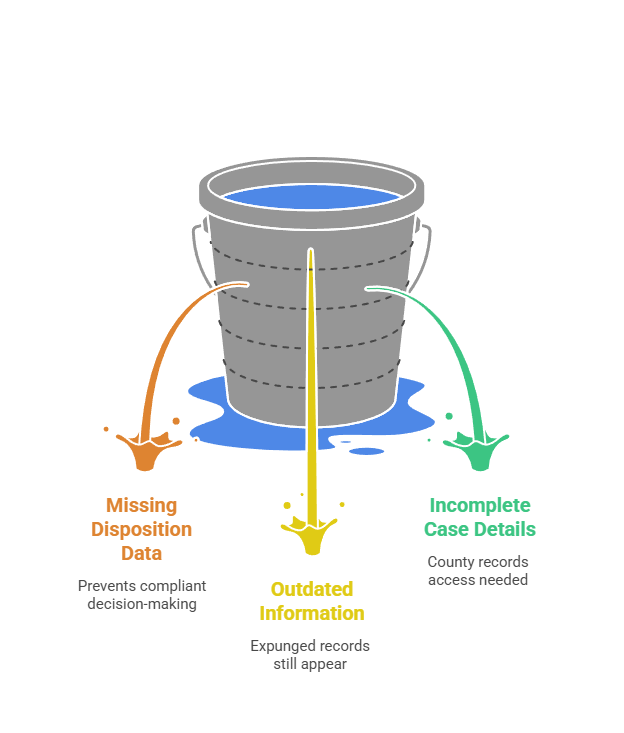
- Missing disposition data: National databases show arrests but lack current case status, preventing legally compliant decision-making under FCRA standards.
- Outdated information: Convictions that were later expunged or dismissed still appear in national databases months or years after county records reflect updates.
- Incomplete case details: Charging documents, sentencing terms, and probation completion status remain unavailable without direct county record access.
County searches provide complete case progression, including current status, disposition dates, sentencing details, and completion of probation or parole. This information proves essential for FCRA-compliant decision-making and risk assessment.
Multi-State Mobility and Address History Gaps
Candidates who have lived in multiple states present particular challenges for national database screening. While a multi-jurisdictional search sounds comprehensive, it only captures records that counties actually reported to state systems. A candidate who lived in five states over ten years may have county-level records in non-reporting jurisdictions that remain completely invisible.
Best practice pre-employment screening protocols require searching each county where a candidate has lived, worked, or attended school for the past seven years. Seven years represents the standard FCRA lookback period for criminal records. For positions requiring deeper scrutiny, extending searches to 10 years captures additional history that national searches might miss entirely.
Decision Framework: When to Use Each Search Type
Designing cost-effective screening policies requires matching search depth to role requirements, compliance obligations, and organizational risk tolerance. Not every position warrants the expense of comprehensive county searches, but national-only approaches prove insufficient for many roles. The following framework helps HR directors establish tiered screening protocols based on risk exposure.
| Position Risk Level | Recommended Search Type | Typical Cost Range | Turnaround Time |
| Entry-level, low access | National database + sex offender registry | $15-$25 | 24-48 hours |
| Mid-level responsibility | National + current residence county | $40-$55 | 3-5 business days |
| High-risk, sensitive access | National + all 7-year address counties | $75-$120 | 5-7 business days |
This tiered approach balances thoroughness with cost efficiency while ensuring appropriate due diligence for each position category. Organizations can adjust criteria based on industry-specific risks and compliance requirements.
Risk-Based Screening Tiers
Entry-level positions with limited access to sensitive information, assets, or vulnerable populations need baseline due diligence only. A national database search combined with sex offender registry verification provides reasonable coverage for high-volume hiring in retail, hospitality, and general labor positions. These searches typically cost $15-$25 and deliver results within 24-48 hours.
Mid-level positions involving financial transactions, customer data access, or unsupervised work environments benefit from hybrid approaches. Combining national searches with county searches in the candidate's current and previous residence counties adds $20-$40 to screening expenses. This captures the most likely sources of relevant criminal history without excessive cost.
High-risk positions demand comprehensive county searches across all jurisdictions from the candidate's seven-year address history. This category includes:
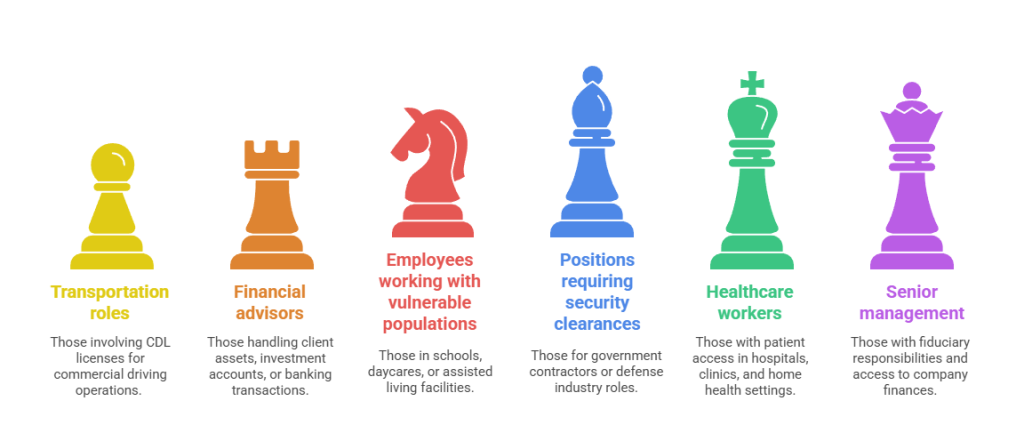
- Transportation roles involving CDL licenses for commercial driving operations
- Financial advisors handling client assets, investment accounts, or banking transactions
- Employees working with children or elderly populations in schools, daycares, or assisted living facilities
- Positions requiring security clearances for government contractors or defense industry roles
- Healthcare workers with patient access in hospitals, clinics, and home health settings
- Senior management with fiduciary responsibilities and access to company finances
For these positions, comprehensive county searches ($50-$100 total) represent minimal expense compared to potential liability. The cost proves negligible when balanced against negligent hiring lawsuit risks.
Industry Compliance Requirements
Certain industries face regulatory mandates that effectively require county-level searches regardless of role. Healthcare facilities accredited by The Joint Commission must verify that employees with patient access don't have disqualifying criminal histories. These standards require thoroughness that national-only searches cannot satisfy due to coverage gaps.
Financial services firms regulated by FINRA must conduct fingerprint-based background checks for registered representatives. While these checks access FBI databases directly, they should be supplemented with county searches for comprehensive due diligence. Transportation companies subject to Department of Transportation regulations must verify driving records and criminal histories for CDL holders, with standards requiring searches in all jurisdictions where the applicant has lived.
County Criminal Background Check Accuracy and Methodology
The accuracy of county background checks depends significantly on search methodology. Three primary approaches exist, each with distinct reliability profiles, cost structures, and turnaround times. Understanding these methodological differences prevents screening gaps that occur when employers assume all "county searches" provide equivalent coverage.
Direct courthouse searches involve physically visiting or electronically accessing the county court's record system to search databases maintained by the clerk of court. This represents the gold standard for county criminal background check accuracy, providing access to the most current case information including recent filings, disposition updates, and active warrant status. Accuracy rates for direct courthouse searches typically exceed 95%, with same-day or next-day updates as cases progress through the judicial system.
Electronic vs. Manual Courthouse Access
Many counties now offer electronic access to court records through secure portals, allowing background screening companies to conduct searches remotely with the same accuracy as in-person visits. However, approximately 40% of U.S. counties still require manual, in-person searches by court record retrievers. These professionals physically visit courthouses to examine paper records or outdated computer systems.
Manual searches introduce additional considerations:
- Extended turnaround time: Results typically require 3-5 business days compared to same-day electronic access.
- Higher costs: Manual courthouse searches cost $30-$50 per county versus $15-$25 for electronic searches.
- Scheduling limitations: Court hours, holidays, and retriever availability can delay results during urgent hiring needs.
Employers should verify what search methodology their background screening vendor uses. Some companies advertise "county searches" but actually conduct database searches against compiled county records rather than accessing courthouse systems directly.
Name-Based vs. Fingerprint-Based Searches
Most employment background checks use name-based searches, matching applicant-provided information (name, date of birth, Social Security number) against court records indexed by defendant name. This approach works effectively when candidates provide accurate information and haven't used aliases. However, name variations, common names, and intentional obfuscation can produce false negatives or false positives requiring manual verification.
Fingerprint-based background checks offer superior accuracy by matching biometric data against criminal records indexed with fingerprints captured during booking. Eliminating name-matching issues represents the primary advantage, though this methodology requires in-person fingerprint collection, FBI processing, and typically 2-4 week turnaround times. For positions requiring the highest verification certainty—security clearances, law enforcement, healthcare practitioners—fingerprint-based searches provide definitive identity confirmation.
National Warrant Database Limitations and Alternatives
Despite the appeal of single-search nationwide warrant verification, national warrant database limitations make comprehensive warrant detection impossible through commercial background check services alone. The absence of a unified, publicly accessible national warrant database forces employers to employ alternative strategies. Commercial background screening companies offer "national warrant searches" that compile warrant information from available state and county sources.
However, these searches access only jurisdictions that voluntarily report warrant data to commercial aggregators—typically 30-40% of counties nationwide. Warrants from non-reporting jurisdictions remain invisible, creating substantial false negative risk. Additionally, warrant database updates lag behind real-time courthouse records by days or weeks. Recently issued warrants won't appear until the next database refresh cycle, which could be weekly or monthly depending on the data provider's update schedule.
State-Level Warrant Databases
Some states maintain statewide warrant databases accessible to the public or background screening companies. Florida's public records laws allow relatively comprehensive warrant searching through state and county systems. Texas offers warrant information through county sheriff websites and state repositories. However, states like California, New York, and Illinois provide limited public access to warrant information.
For employers hiring across multiple states, this patchwork of state-level access creates complexity. Key considerations include:
- Variable access levels: Some states provide comprehensive public access while others restrict warrant information to law enforcement.
- Update frequency differences: States refresh warrant databases on different schedules, from real-time to monthly updates.
- Search cost variations: Public access may be free while third-party database providers charge per-search fees ranging from $5-$20.
A comprehensive warrant search strategy must account for each state's information availability. Determining where national database searches provide adequate coverage versus where supplemental county searches become necessary requires understanding these state-specific differences.
Ongoing Monitoring Solutions
Traditional background checks provide point-in-time snapshots of criminal records and warrant status as of the search date. For existing employees in sensitive positions, ongoing criminal record monitoring offers continuous surveillance of specified databases. These monitoring services typically search national databases monthly or quarterly, with immediate alerts for significant offenses.
However, the same coverage limitations affecting one-time national searches also apply to ongoing monitoring. Events that don't enter monitored databases remain undetected. Comprehensive monitoring programs supplement national database surveillance with periodic county searches in employees' residence jurisdictions. Balancing monitoring efficiency with the superior accuracy of direct courthouse verification characterizes this layered approach.
Implementing Hybrid Screening Approaches
Organizations seeking to optimize background screening effectiveness while managing costs increasingly adopt hybrid approaches that combine national and county searches strategically. Rather than applying uniform screening to all positions, these frameworks match search depth to role-specific risk factors and compliance requirements. A tiered screening policy typically establishes three or four screening levels, with progressively comprehensive searches for positions with greater responsibility or risk exposure.
Level 1 might include only national database searches and sex offender registry verification for low-risk roles. County searches in current residence jurisdiction comprise Level 2. Level 3 expands to county searches in all jurisdictions from seven-year address history. For the highest-sensitivity positions, Level 4 includes all previous levels plus education verification, employment verification, professional reference checks, and credit reports where legally permissible.
Cost-Benefit Analysis for Hybrid Models
The incremental cost difference between screening tiers informs policy decisions. A typical cost structure might show national-only searches at $20, national plus current-county at $45, national plus three-county searches at $75, and comprehensive screening at $125-$150. For an organization hiring 1,000 employees annually with 60% in Level 1 positions, 25% in Level 2, 10% in Level 3, and 5% in Level 4, implementing tiered screening rather than universal Level 1 adds approximately $22,500 annually.
Weighing this incremental expense against potential costs proves essential. A single negligent hiring lawsuit can result in judgments exceeding $1 million when employers fail to conduct reasonable background checks that would have revealed disqualifying criminal history. For most organizations, the risk mitigation value of position-appropriate screening substantially outweighs incremental costs.
Geographic Scope Optimization
Address history verification represents a critical component of effective hybrid screening. Candidates provide residence history on employment applications, but self-reported information may contain gaps, inaccuracies, or intentional omissions. Best practices involve verifying address history through credit header data, which reflects addresses reported by creditors and typically provides more complete histories than candidate disclosure alone.
Once verified, employers must determine which counties warrant direct searches:
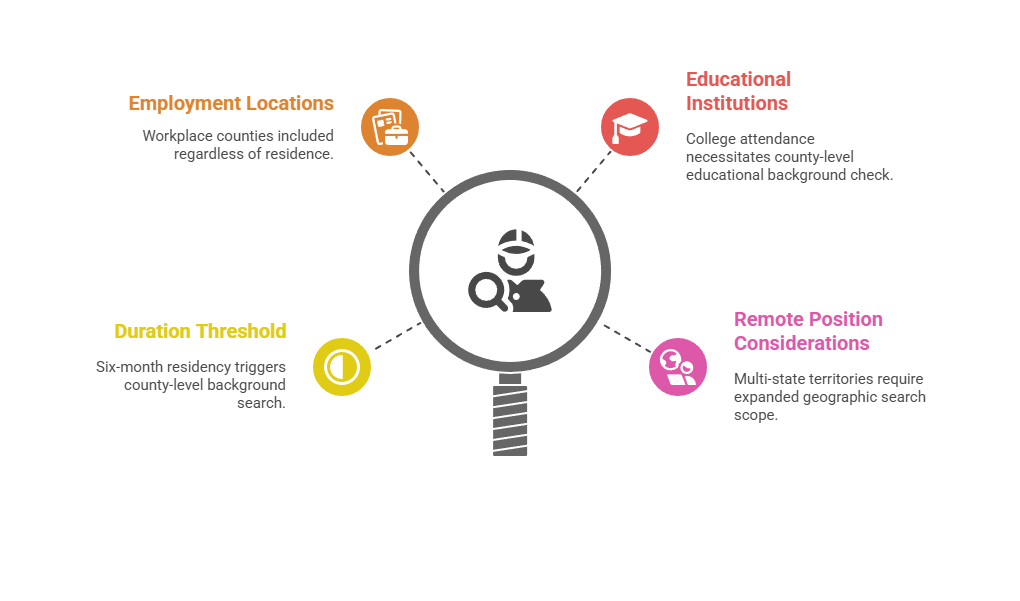
- Duration threshold: Search any county where the candidate resided for six months or longer during the lookback period.
- Employment locations: Include counties containing the candidate's workplace locations, even if different from residence addresses.
- Educational institutions: Search counties where the candidate attended college or other extended education programs.
- Remote position considerations: Expand geographic scope to cover all significant location connections for multi-state territories.
For remote positions or roles involving multi-state territories, expanding geographic scope provides comprehensive coverage that single-jurisdiction searches cannot offer.
Pre-Employment Screening Best Practices

As background screening technology evolves and regulatory scrutiny increases, employers must adapt screening practices to maintain legal compliance while achieving hiring objectives. Several emerging trends and best practices characterize effective pre-employment screening programs in 2025. Individualized assessment protocols have become essential following EEOC guidance on criminal record use in hiring.
Rather than applying blanket exclusion policies based on conviction types, employers must evaluate the nature of the offense, time elapsed since conviction, evidence of rehabilitation, and relationship between the criminal history and job responsibilities. Obtaining complete disposition information—available reliably only through county searches—becomes necessary for this evaluation. Incomplete arrest records from national databases cannot support legally defensible individualized assessments under current regulatory standards.
FCRA Compliance for Multi-Tiered Screening
The Fair Credit Reporting Act requires specific disclosure and authorization procedures when employers obtain background check reports from consumer reporting agencies. For tiered screening approaches, employers must ensure authorization forms encompass all screening activities that might occur based on the position. This includes county searches, credit reports, and ongoing monitoring that may be conducted during the hiring process.
Generic authorization language may prove insufficient if employers subsequently conduct county searches not clearly disclosed during the initial authorization process. Additionally, adverse action procedures—required when employers make hiring decisions based on background check information—must provide candidates with copies of reports and summaries of their rights. When multiple reports contribute to the decision (national database results plus several county searches), employers must provide all reports influencing the decision.
Ban-the-Box and Fair Chance Considerations
Thirty-seven states and over 150 municipalities have enacted "ban-the-box" legislation prohibiting criminal history inquiries on initial employment applications. Typically, these laws require employers to delay background checks until after initial interviews or conditional offer stages. Many mandate individualized assessments rather than categorical exclusions. Some jurisdictions further restrict the types of convictions employers may consider.
Fair chance hiring laws affect screening strategy by compressing background check timelines. When employers cannot conduct background checks until the conditional offer stage, they need reliable searches that capture all relevant history without requiring multiple rounds of verification. This tends to favor comprehensive county searches over national-only approaches that frequently require follow-up county searches when incomplete information appears.
Conclusion
The county vs national background check decision fundamentally affects an employer's ability to detect active warrants, recent arrests, and jurisdiction-specific criminal records that create workplace risk. While national database searches offer cost-effective broad coverage, their substantial gaps—affecting 60%+ of counties and creating 30-90 day reporting lags—leave employers exposed to preventable hiring risks. County-level searches access authoritative courthouse records directly, capturing real-time warrant status and complete case dispositions essential for FCRA-compliant decision-making. For most organizations, hybrid screening approaches that combine national searches with strategic county-level verification based on role sensitivity and address history provide optimal balance between thoroughness and efficiency. At the end of the day, it’s not enough to merely comply. The objective is to be confident, and by understanding where different types of searches work best together, employers can create a safe workplace that is accurate, fair, and trustworthy.
Frequently Asked Questions
What is the main difference between county and national background checks?
County background checks search court records directly at individual county courthouses, accessing the original source of criminal records with updates within 24-72 hours. National background checks search compiled databases that aggregate information from state repositories, which receive updates from only 38% of U.S. counties with typical delays of 30-90 days. County searches provide more current and complete information for specific jurisdictions. National searches offer broader geographic coverage with significant gaps in reporting and timeliness.
Do national background checks show warrants from all states?
No, national background checks only show warrants from jurisdictions that report to the commercial databases being searched, typically covering 30-40% of counties nationwide. Active warrants often remain in the issuing county's system without transmitting to state or national databases, particularly for misdemeanor offenses and bench warrants. Comprehensive warrant detection requires county-level searches in jurisdictions where the individual has lived. Commercial background check companies cannot access the FBI's National Crime Information Center (NCIC) database which is restricted to law enforcement use only.
How much do county background checks cost compared to national searches?
National criminal database searches typically cost $15-$25 through commercial background screening companies, with results delivered within 24-48 hours. Individual county searches range from $20-$50 per county depending on whether the county offers electronic access or requires manual courthouse searches. A comprehensive background check combining a national search with county searches in three jurisdictions typically costs $60-$90 total. For high-sensitivity positions requiring seven-year address history coverage, costs may reach $100-$150 depending on how many counties require searching.
How long does it take to get results from county vs. national background checks?
National database searches typically return results within 24-48 hours since they involve searching pre-compiled electronic databases. County background check turnaround time varies significantly by jurisdiction: electronically accessible counties provide same-day or next-day results, while counties requiring manual courthouse searches typically take 3-5 business days. Comprehensive screening combining national and multiple county searches generally delivers complete results within 5-7 business days.
Which background check is better for pre-employment screening?
The optimal approach depends on position sensitivity, compliance requirements, and geographic scope of hiring. For entry-level roles with limited risk exposure, national database searches provide cost-effective baseline screening. Positions involving financial access, vulnerable populations, security responsibilities, or regulatory requirements benefit from hybrid approaches combining national searches with county-level verification. Industries with specific compliance mandates (healthcare, financial services, transportation, childcare) typically require county searches to satisfy regulatory standards.
Can someone pass a national background check but fail a county check?
Yes, this occurs frequently due to coverage gaps and reporting delays inherent in national databases. A candidate might have recent arrests, pending cases, or convictions in counties that don't report to state repositories, making their record invisible to national searches while clearly appearing in county courthouse records. Active warrants particularly tend to remain county-specific without propagating to national databases. Additionally, someone with older offenses expunged at the county level might still have outdated information in national databases that haven't received disposition updates.
How far back do county and national background checks go?
Under the Fair Credit Reporting Act (FCRA), employment background checks generally cannot report criminal convictions older than seven years, with exceptions for positions paying $75,000+ annually. Many states have enacted stricter limitations—California limits lookback periods to seven years regardless of salary. These time restrictions apply equally to both county and national searches. Note that these limitations apply to convictions; arrests without convictions cannot be reported after seven years under FCRA guidelines.
What industries require county-level background checks?
Healthcare facilities seeking Joint Commission accreditation must conduct comprehensive background checks that effectively require county searches due to coverage standards. Financial services firms regulated by FINRA must perform detailed screening that typically includes county verification. Transportation companies with DOT-regulated positions must search criminal records in all jurisdictions where CDL holders have resided. Childcare centers, schools, and eldercare facilities face state licensing requirements that usually mandate county-level searches.
Additional Resources
- FCRA Compliance Guide for Employers - Federal Trade Commission
https://www.ftc.gov/business-guidance/resources/using-consumer-reports-what-employers-need-know - EEOC Guidance on Use of Criminal Background Checks in Employment
https://www.eeoc.gov/laws/guidance/enforcement-guidance-consideration-arrest-and-conviction-records-employment-decisions - National Association of Professional Background Screeners - Accreditation Standards
https://www.napbs.com/about-napbs/background-screening-agency-accreditation-program - FBI Criminal Justice Information Services - NCIC Access Policies
https://www.fbi.gov/services/cjis/ncic - State-by-State Ban-the-Box Laws and Fair Chance Hiring Legislation
https://www.nelp.org/publication/ban-the-box-fair-chance-hiring-state-and-local-guide/ - Department of Transportation Background Check Requirements for CDL Holders
https://www.fmcsa.dot.gov/regulations/background-checks

ABOUT THE CREATOR
GCheck Editorial Team
Meet the GCheck Editorial Team, your trusted source for insightful and up-to-date information in the world of employment background checks. Committed to delivering the latest trends, best practices, and industry insights, our team is dedicated to keeping you informed.
With a passion for ensuring accuracy, compliance, and efficiency in background screening, we are your go-to experts in the field. Stay tuned for our comprehensive articles, guides, and analysis, designed to empower businesses and individuals with the knowledge they need to make informed decisions.
At GCheck, we're here to guide you through the complexities of background checks, every step of the way.