

Higher education hiring sits at the intersection of FCRA duties, ban-the-box rules, Clean Slate laws, misconduct disclosure requirements, minors-contact screening obligations, and FERPA overlap, and most ATS platforms were never built to handle that level of compliance complexity at the same time. We compare 10 ATS platforms across the capabilities that matter most for higher education screening programs, including native integration depth, role-based package support, FCRA workflow automation, and audit documentation quality. The difference between platforms that can genuinely support a compliant screening program and those that cannot is more significant than most compliance teams realize, and the decisions schools make now will shape their exposure as the regulatory landscape continues to expand.
Key Takeaways:
- Higher education hiring is not a single-tier compliance problem, and your ATS must reflect that. Faculty, adjuncts, staff, student workers, campus police, coaches, and contractors each require different background check packages tied to their role type.
- The integration model your ATS uses is a compliance decision, not a technical one. Native partner integrations provide the strongest audit trail and the lowest data privacy risk, while manual export and portal-based processes create FCRA timing risks and broken audit records.
- Most state universities and community colleges are public employers, which means ban-the-box laws most likely apply to them. Clean Slate laws in Pennsylvania, Michigan, Utah, California, and Connecticut now auto-seal records that previously appeared on background reports, making proper ATS workflow configuration more critical than ever.
- California SB 791 and AB 810 are distinct laws with different compliance duties, and schools that confuse them face serious legal exposure. Any ATS setup in California must be reviewed by legal counsel to ensure both laws are properly reflected in hiring workflows.
- Even the strongest ATS platforms require state-specific configuration to meet applicable federal, state, and local compliance rules. Legal counsel must be part of every ATS compliance setup, not an afterthought.
Platforms with deep, native background screening integrations give higher education schools the audit trails, role-based setup, and FCRA workflow steps their compliance programs need. Platforms without them do not. Universities, colleges, community colleges, and trade schools operate under layered screening duties that make ATS integration depth a compliance issue, not a convenience choice.
Why Background Screening Compliance in Higher Education Is Different
Higher education hiring carries distinct legal duties across many role types at the same time:
- Role-based screening tiers: Faculty, adjuncts, staff, student workers, campus police, coaches, and contractors each require different background check packages tied to the job or role type.
- Minors-contact compliance: Summer camps, dual enrollment, tutoring, and clinical placements often trigger child abuse registry checks, state police checks, and FBI fingerprint needs. In particular, rules vary significantly by state.
- Misconduct disclosure rules: California SB 791 (2023) requires college-level schools to obtain prior confirmed sexual misconduct information before a final hire. California AB 810 (2023) separately addresses employer disclosure duties for findings of sexual assault, abuse, or exploitation. These are distinct laws. As a result, schools must not confuse them and should consult legal counsel for setup needs.
- FCRA duties: When a third-party CRA conducts the check, employers must: (1) provide a separate written notice; (2) obtain written consent; (3) deliver a pre-adverse action notice, consumer report copy, and FCRA Summary of Rights before any adverse action; (4) allow a reasonable response period (five business days is widely used, though state minimums vary); and (5) provide a final adverse action notice if proceeding.
- Ban-the-box and Clean Slate laws: Most state universities and community colleges are public employers and should assume ban-the-box laws apply unless confirmed otherwise by legal counsel. Clean Slate laws in Pennsylvania, Michigan, Utah, California, and Connecticut now auto-seal records that previously appeared on background reports, requiring tighter review standards and ATS setups.
- FERPA overlap: Student worker employment records may cross into FERPA-protected education records. ATS data fields and workflows must not expose protected records without proper consent.
- High-volume adjunct hiring: Contingent faculty growth creates pressure that can compress adverse action waiting periods or bypass case-by-case reviews. In these cases, ATS workflow steps are especially important.
What to Look for in an ATS Background Screening Integration Before You Commit
Integration structure determines FCRA compliance, audit record quality, and day-to-day efficiency. Three models exist:
- Native market or partner integration: Checks are ordered, tracked, and reviewed inside the ATS, with consent and disclosure papers generated within the workflow. This model provides the strongest audit trail and the lowest data privacy risk.
- API or webhook custom integration: This model enables deep data flow but requires significant development resources. Audit trail quality depends entirely on how well the setup is built. As a result, schools must conduct independent compliance reviews.
- Manual export and portal process: Staff must leave the ATS and manually enter sensitive personal data into the screening vendor's portal. This creates broken audit trails, FCRA timing risks, and data privacy exposure. The FCRA's Disposal Rule (16 C.F.R. Part 682) requires secure removal of consumer report information when no longer needed.
For schools managing background checks across dozens of departments, integration model depth is a compliance control, not a convenience feature.
Top 10 ATS Platforms for Higher Education Background Screening and Compliance
1. Workday
The dominant enterprise ATS at large research universities and flagship state systems, Workday supports a well-connected partner market with multiple PBSA-accredited screening vendors. In effect, this enables schools to order, track, and review checks within the ATS. Role-based package setup, FCRA adverse action workflows, and robust audit trail records are all supported. However, schools must set up workflows for state-specific waiting periods and case-by-case review needs. California schools should verify ICRAA-compliant disclosure support. New York schools should confirm Article 23-A records. New York City schools should confirm AEDT compliance.
Higher education fit: Strong (with location-specific setup required)
2. Zoho Recruit
Zoho Recruit relies on manual or portal-based screening steps without documented native integration with multiple PBSA-accredited providers. Role-based package setup and FCRA adverse action workflow steps are not documented native features. For schools managing ban-the-box timing, Clean Slate review, or high-volume hiring cycles, this model creates audit trail gaps, FCRA timing risks, and data privacy exposure for sensitive candidate data.
Higher education fit: Limited
3. NEOGOV
Purpose-built for public sector schools, NEOGOV is among the most relevant ATS platforms for state universities and community colleges. Its background screening network supports native partner integrations, role-based package setup, FCRA adverse action workflows, and compliance reports designed for audit readiness. Schools in multiple states should verify state-specific setup support. In addition, California schools should confirm ICRAA disclosure support, and New York City schools should verify AEDT compliance.
Higher education fit: Strong (with location-specific setup required)
4. Breezy HR
Breezy HR's background screening integration is limited relative to enterprise platforms. Native integrations with multiple PBSA-accredited vendors, role-based package setup across higher education role types, and FCRA adverse action workflow steps are not documented core features. The integration model relies heavily on manual steps that introduce FCRA timing risk, audit trail gaps, and data privacy exposure. As a result, schools using Breezy HR should add documented manual compliance steps and ask legal counsel to review their adverse action workflow.
Higher education fit: Limited
5. Oracle Taleo Enterprise Edition
Taleo has strong presence in large university HR systems and supports integration with multiple screening vendors through a well-developed partner framework. Role-based screening package setup, FCRA workflow support, and enterprise-grade audit records are documented features. For schools with clinical, law enforcement, or licensed trades roles requiring layered license checks alongside standard criminal history screening, Taleo's integration depth handles the complexity. California and New York City-specific setups should be confirmed with the vendor.
Higher education fit: Strong (with location-specific setup required)
6. Ashby
Ashby's background screening network is not designed for higher education legal complexity. Native PBSA-accredited vendor integration, role-based package setup, FCRA adverse action steps, and minors-contact screening flags are not documented features. In that case, schools considering Ashby must request written records of current screening features directly from the vendor before committing. They should also assess how candidate data is handled in any third-party integration.
Higher education fit: Limited
7. PageUp
Purpose-built for complex, multi-department hiring with documented use across major U.S. universities, PageUp supports native partner screening integrations, role-based package setup across higher education role types, and FCRA adverse action workflow records. Audit trail and compliance report tools are designed for institutional review processes. For universities with spread-out hiring across colleges and departments, PageUp's setup options make it one of the more practically suited platforms for managing screening at scale. State-specific compliance support for California, New York, and New York City should be confirmed with the vendor.
Higher education fit: Strong (with location-specific setup required)
8. Freshteam (by Freshworks)
Freshteam's native screening features are not purpose-built for higher education's multi-tier compliance demands. Role-based package setup and FCRA adverse action workflow steps are not documented native features. For schools managing misconduct disclosure rules, minors-contact screening flags, Clean Slate review records, or ban-the-box timing duties across multiple states, Freshteam's integration gaps create meaningful compliance and data privacy exposure.
Higher education fit: Limited
9. Infor
Infor has a meaningful presence in higher education and public sector HR, with documented partner framework integrations supporting role-based screening setup across academic, clinical, trades, and student worker groups. FCRA adverse action workflow support and audit records are part of the compliance tooling. However, state-specific setup is still required. Schools with clinical ties should confirm with legal counsel how health-related license check data is handled under HIPAA and applicable state privacy laws.
Higher education fit: Strong (with location-specific setup required)
10. Teamtailor
Teamtailor's background check network is not built for U.S. higher education legal rules. Native integration with PBSA-accredited vendors, FCRA adverse action workflow steps, ban-the-box compliance tools, and role-based screening setup are not documented core features. New York City schools must verify whether any Teamtailor automated hiring features trigger Local Law 144 AEDT duties. On the whole, Teamtailor's strengths are in candidate experience and employer branding, not compliance-grade screening integration for the U.S. legal environment.
Higher education fit: Limited
Which ATS Platforms Actually Deliver for Higher Education Screening Compliance?
Workday, NEOGOV, Oracle Taleo Enterprise Edition, PageUp, and Infor share a common compliance-capable profile. Each supports a native screening partner network, enables in-ATS check management, supports role-based package setup, and provides audit records for FCRA defense. However, strong platform structure does not remove state-specific setup duties. Each school must work with legal counsel and the platform vendor to set up workflows that reflect applicable federal, state, and local rules.
On the other hand, Zoho Recruit, Breezy HR, Ashby, Freshteam, and Teamtailor offer genuine strengths in interface design, pricing, or analytics. Even so, none provides the compliance tools higher education screening programs require when role-based tiers, FCRA workflows, case-by-case review records, and multi-state duties are all in play at the same time.
ATS Platform Comparison: Background Screening and Compliance Scores
| ATS Platform | Native Screening Integration (1-5) | Role-Based Package Support (1-5) | FCRA Workflow Automation (1-5) | Audit Documentation (1-5) | Higher Ed Configurability (1-5) | Total (/25) |
| Workday | 5 | 5 | 4 | 5 | 5 | 24 |
| NEOGOV | 5 | 5 | 5 | 5 | 4 | 24 |
| Oracle Taleo EE | 4 | 4 | 4 | 4 | 5 | 21 |
| PageUp | 4 | 4 | 4 | 4 | 4 | 20 |
| Infor | 4 | 4 | 3 | 4 | 4 | 19 |
| Zoho Recruit | 2 | 2 | 2 | 2 | 2 | 10 |
| Breezy HR | 2 | 1 | 2 | 2 | 2 | 9 |
| Freshteam | 2 | 1 | 1 | 2 | 2 | 8 |
| Ashby | 1 | 1 | 1 | 2 | 2 | 7 |
| Teamtailor | 1 | 1 | 1 | 1 | 2 | 6 |
NEOGOV's public sector design makes it the leading choice for community colleges and state universities. Workday leads for large research universities with enterprise HR needs. Oracle Taleo EE and PageUp are strong choices for mid-to-large schools with complex department structures. Infor is the strongest documented option for schools with clinical or trades-heavy workforces requiring layered license and credential checks.
How to Choose an ATS with the Right Background Screening Integration for Your School
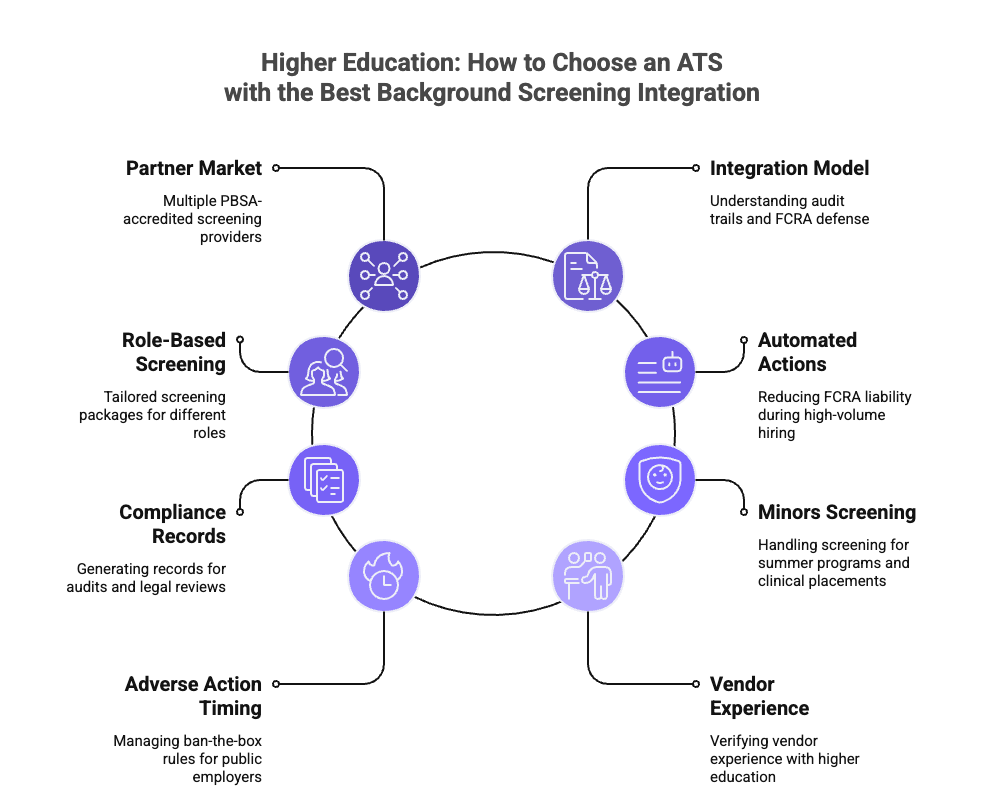
- Ask whether the ATS offers a native partner market including multiple PBSA-accredited screening providers.
- Confirm the integration model type and understand what it means for your audit trail and FCRA defense.
- Verify whether the ATS supports role-based screening package setup across faculty, adjuncts, staff, student workers, and security roles.
- Check whether the ATS auto-runs pre-adverse and adverse action steps to reduce FCRA liability during high-volume hiring cycles.
- Ask whether the platform generates compliance-ready records that can be pulled during an audit or legal review.
- Confirm whether the ATS handles minors-contact screening flags and tiered check packages for summer programs, dual enrollment, and clinical placements.
- Ask how the platform manages adverse action timing under applicable ban-the-box rules, in particular for public employer positions.
- Evaluate whether the vendor has documented experience with higher education schools of your type and size, and request verifiable references.
To sum up, choosing the right ATS is not about the most polished candidate portal. It is about matching the platform's screening network to the school's compliance complexity. As Clean Slate laws expand, misconduct disclosure rules spread nationally, and AEDT rules emerge beyond New York City, the gap between platforms with strong screening networks and those without will continue to widen. Schools that focus on integration depth now will, in the long run, face fewer compliance gaps as the legal landscape evolves.
Disclaimer: This article is provided for informational and educational purposes only and does not constitute legal advice. Background screening and employment law is location-specific, rapidly evolving, and fact-dependent. Schools should consult qualified legal counsel before implementing any background check program, ATS platform, or adverse action procedure. Platform capability reviews reflect publicly available vendor records as of the date of publication. Schools must independently verify current features with each vendor directly.
References
- U.S. Equal Employment Opportunity Commission, Enforcement Guidance on the Consideration of Arrest and Conviction Records in Employment Decisions Under Title VII (2012): https://www.eeoc.gov/laws/guidance/enforcement-guidance-consideration-arrest-and-conviction-records-employment-decisions
- California Legislative Information, SB 791 (2023-2024): https://leginfo.legislature.ca.gov/faces/billNavClient.xhtml?bill_id=202320240SB791
- California Legislative Information, AB 810 (2023-2024): https://leginfo.legislature.ca.gov/faces/billNavClient.xhtml?bill_id=202320240AB810
- California Civil Rights Department, Employment: Background Checks and Investigative Consumer Reports (ICRAA): https://calcivilrights.ca.gov/
- New York State Division of Human Rights, New York Correction Law Article 23-A: https://dhr.ny.gov/
- Professional Background Screening Association (PBSA), Accreditation Program: https://thepbsa.org/accreditation/
- California Privacy Protection Agency, CCPA/CPRA:https://cppa.ca.gov/

ABOUT THE CREATOR
Charm Paz, CHRP
Recruiter & Editor
Charm Paz is an HR and compliance professional at GCheck, working at the intersection of background screening, fair hiring, and regulatory compliance. She holds both FCRA Core and FCRA Advanced certifications through the Professional Background Screening Association (PBSA) and supports organizations in navigating complex employment regulations with clarity and confidence.
With a background in Industrial and Organizational Psychology and hands-on experience translating policy into practice, Charm focuses on building ethical, compliant, and human-centered hiring systems that strengthen decision-making and support long-term organizational health.