

The childcare and early education sector operates under one of the most complex background screening compliance frameworks in HR, combining federal CCDF rules, Head Start performance standards, FCRA duties, and a patchwork of state laws that most ATS vendors never designed for. We break down exactly what these layered compliance requirements demand from any hiring platform, and why the wrong ATS choice creates audit gaps that carry direct legal consequences. We then put 10 ATS platforms head-to-head against the criteria that licensing inspectors and federal program monitors actually care about, so childcare directors and Head Start administrators can make an informed platform decision before the next oversight review arrives.
Key Takeaways:
- The CCDF rule at 45 CFR 98.43 requires background checks spanning multiple registries and every state where an employee lived in the prior five years. Most ATS vendors were never designed to handle this level of compliance complexity.
- Head Start programs require a sex offender registry check before any person begins work and full criminal history results within 90 days of hire. Any ATS used in this setting must automate supervised-start status flags and surface incomplete check items before a start date is confirmed.
- Choosing an ATS based on general HR features without reviewing screening integration depth is the most common purchase mistake childcare operators make. Platforms that rely on manual export and portal processes create audit trail gaps with direct legal consequences under CCDF and Head Start oversight.
- The FCRA requires a standalone written disclosure, written consent, and a two-step adverse action process whenever a provider uses a third-party CRA for background screening. These duties apply on top of federal CCDF and Head Start mandates and do not replace each other.
- HHS has stepped up compliance oversight, and federal fund freeze events in 2025-2026 reinforce how critical audit-ready records have become for childcare and Head Start programs. High sector turnover creates pressure to rush background check processes, which is precisely when compliance risk is highest.
The strongest applicant tracking systems for childcare background check compliance keep screening orders, consent records, registry check statuses, and recheck schedules inside a single audit-ready workflow. In contrast, platforms that rely on manual data export create audit gaps and supervision record failures with direct legal consequences.
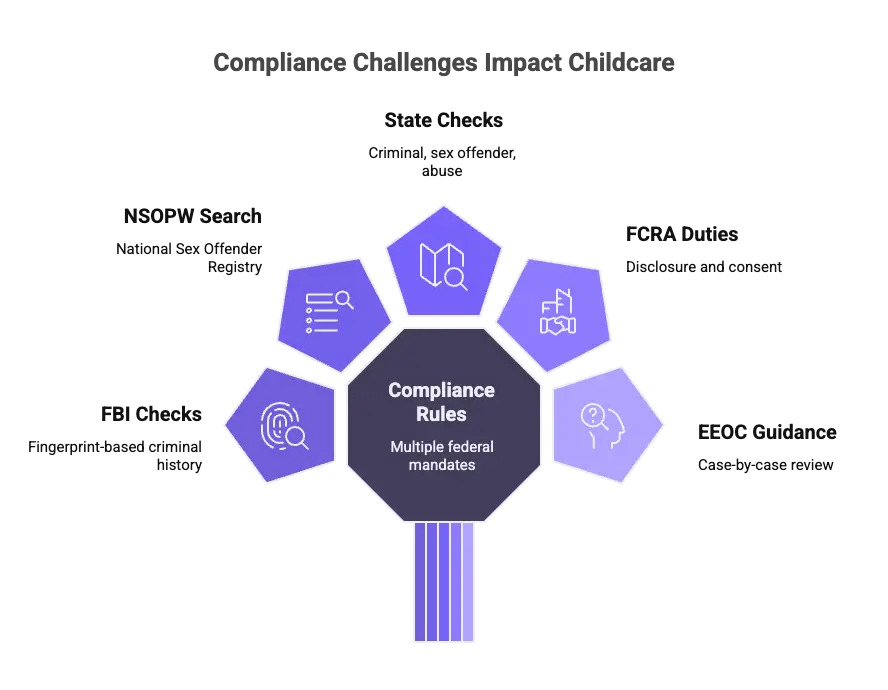
Childcare and early education providers work under a compliance framework most ATS vendors do not design for. The CCDF rule at 45 CFR 98.43 requires FBI fingerprint checks, NSOPW searches, state criminal and sex offender registry checks, and state child abuse and neglect registry checks across all states where an employee lived in the prior five years. Head Start programs add pre-hire sex offender check rules and a 90-day criminal history window. In addition, compliance with federal mandates does not remove FCRA, state hiring law, or biometric privacy duties.
Why Is Background Check Compliance So Much Harder for Childcare and Head Start Programs?
Childcare compliance combines multiple federal mandates, multi-registry checks across state lines, a supervised-start pathway with strict record-keeping, FCRA duties, and a complex state and local legal landscape. All of this exists within a sector defined by high turnover and thin admin capacity.
The CCDF Rule at 45 CFR 98.43
The CCDF rule sets a federal floor for all CCDF-funded providers. Required background checks include:
- FBI fingerprint-based criminal history check, through an FBI-authorized channeler or state repository
- NSOPW search
- State criminal registry check
- State sex offender registry check
- State child abuse and neglect registry checks for every state where the employee resided in the prior five years
In family child care homes, adult household members are also covered.
Note on FBI Fingerprint Access: Childcare providers cannot order FBI checks through a generic CRA unless that CRA is an FBI-authorized channeler or state-authorized system. As a result, ATS platforms should be evaluated on whether their integrated screening partners hold FBI channeler approval.
Head Start and Early Head Start Programs
Federal Head Start Program Performance Standards (45 CFR Chapter XIII) impose a distinct compliance layer:
- A sex offender registry check must be completed before any person begins work
- Full criminal history results must be obtained within 90 days of hire
- Employees with incomplete checks may not have unsupervised access to children during that window
- Programs must document the supervision plan and the point at which full clearance is granted
- A five-year recheck cycle applies to all covered personnel
FCRA Compliance When Using a Third-Party CRA
The FCRA applies whenever a provider uses a third-party CRA for background screening. Before ordering, providers must give the applicant a standalone written disclosure. This must be a separate document, not combined with the application or offer letter. They must also obtain written consent. If results may harm a hiring decision, a two-step adverse action process is required.
EEOC Guidance and Title VII
Blanket exclusions of all applicants with any criminal record carry Title VII disparate impact risk. The EEOC's 2012 Guidance recommends case-by-case review using the Green factors: nature and gravity of the offense, time elapsed, and nature of the job. This does not override mandatory federal bars under 45 CFR 98.43, which must be clearly set apart from optional exclusions in policy.
2026 Policy Environment and Workforce Realities
FY2026 funding sets the Child Care and Development Block Grant at about $8.831 billion and Head Start at about $12.357 billion. HHS has stepped up its compliance oversight, and federal fund freeze events in 2025-2026 reinforce the need for audit-ready records. The BLS projects about 160,200 annual childcare job openings over the 2024-2034 period. Moreover, ongoing sector turnover creates pressure to rush background check processes, which in turn increases compliance risk.
What to Look for in an ATS Background Screening Integration for Childcare Providers
Choosing an ATS based on general HR features without reviewing screening integration depth is the most common purchase mistake childcare operators make.
Integration pattern types:
- Native marketplace or certified partner integration: Lowest compliance risk. Check ordering, consent workflows, and result statuses stay inside the ATS without manual re-entry. However, this only holds if integrated partners hold FBI channeler approval and support the full CCDF multi-registry check set.
- API or webhook-based custom integration: Supports complex multi-registry workflows with real-time data exchange, but requires technical setup.
- Manual export and portal process: Highest compliance risk. Creates data lag, re-entry errors, and audit trail gaps that are dangerous under CCDF and Head Start oversight.
Childcare-specific features to require from any ATS ecosystem:
- Multi-registry check support covering FBI (through an authorized channeler), NSOPW, state criminal, state sex offender, and state child abuse and neglect registries
- Recurring recheck reminders aligned to the five-year CCDF cycle
- Supervised-start status flags with record-keeping capability
- FCRA-compliant disclosure and consent workflow producing a standalone document
- Full two-step adverse action workflow support
- Audit log export for licensing inspections and federal oversight reviews
- Role-based access controls limiting background check result visibility to authorized personnel
- Configurable ban-the-box workflow timing
- Vendor data processing agreement addressing security, use limits, and deletion
10 ATS Platforms Compared: Background Screening Ecosystems for Childcare and Head Start
1. Frontline Recruiting and Hiring
- Integration model: Purpose-built partner ecosystem for K-12 and public education employers, including Head Start grantees.
- Supports in-platform check ordering, education-sector screening provider integrations, candidate status tracking, and onboarding workflows suited to regulated education settings.
- Compliance watch: Confirm multi-state child abuse registry support, FBI channeler approval, standalone FCRA disclosure capability, two-step adverse action support, and ban-the-box setup options.
2. Zoho Recruit
- Integration model: Connects to a limited set of screening providers through manual API setup, without a native certified partner marketplace.
- No documented native multi-registry workflow. As a result, status updates require manual oversight.
- Flexible setup and lower cost suit smaller operators.
- Compliance watch: Lacks documented support for supervised-start tracking, multi-state registry checks, and audit log export. A thorough compliance gap review is required before use.
3. TalentReef
- Integration model: Integrates with screening providers through its hourly hiring platform, supporting automated check ordering, high-volume multi-location processing, and status tracking within candidate records.
- Designed for franchise and multi-location care operators.
- Compliance watch: Verify full CCDF multi-registry check coverage, FBI channeler approval, ban-the-box setup, and two-step adverse action support.
4. Breezy HR
- Integration model: Background check triggering through a narrow partner list. Integration depth for multi-registry childcare compliance is limited.
- No documented multi-registry or multi-state lookback support. Accessible pricing suits independent operators.
- Compliance watch: Does not document CCDF-specific multi-registry workflows, supervised-start flags, or audit log export. A compliance gap review is required before use.
5. Apploi
- Integration model: Integrates background screening directly into care-sector hiring workflows, with in-platform check ordering, status tracking, and credential and clearance tracking alongside screening.
- Mobile-first design suited to hourly care workers.
- Compliance watch: Confirm multi-state child abuse registry support, FBI channeler approval, standalone FCRA disclosure capability, two-step adverse action support, and ban-the-box setup options.
6. HireVue
- Integration model: No native background screening. Integration requires separate manual setup with a third-party provider.
- No documented childcare-specific compliance features.
- Strengths lie in AI-assisted video interviewing and enterprise review tools.
- Compliance watch: Not designed for CCDF or Head Start compliance. Manual setup increases audit gap risk and supervised-start tracking failure risk. In addition, budget for significant custom work and independent legal review before use.
7. NEOGOV
- Integration model: Integrates background screening through its government HR ecosystem, serving state and local agencies including Head Start programs.
- Audit trail records are suited for public agency oversight, with onboarding aligned to civil service standards.
- Compliance watch: Confirm CCDF multi-registry check support, supervised-start flag availability, FBI channeler approval, and standalone FCRA disclosure capability.
- Also confirm whether civil service rules modify FCRA adverse action requirements.
8. Hireology
- Integration model: Documents basic background check integration for franchise and retail sectors. Not designed around childcare multi-registry compliance.
- No documented CCDF-specific recheck scheduling or multi-state child abuse registry support.
- Compliance watch: Does not document the five-year CCDF recheck cycle, supervised-start tracking, or audit log export for licensing inspections. A compliance gap review is required before use.
9. Fountain
- Integration model: Integrates background screening into high-volume hourly hiring flows, with automated check ordering, status tracking, and a mobile candidate experience suited to large care operations.
- Compliance watch: Confirm full CCDF multi-registry check coverage and FBI channeler approval.
- Given Fountain's speed-first design, pay particular attention to FCRA disclosure sequencing before any check is ordered. Also verify ban-the-box setup for multi-location operations.
10. Recruitee (Tellent)
- Integration model: Relies on manual export and portal processes for background check ordering. There is no automated status sync and no documented childcare-specific compliance features.
- Suited to mid-size hiring teams that work closely together.
- Compliance watch: Manual screening creates audit trail gaps and re-entry errors that are particularly dangerous under CCDF and Head Start oversight.
- Increases risk of FCRA consent failures and missed adverse action deadlines. Evaluate carefully whether this workflow can support CCDF or Head Start compliance duties.
Platform Scoring Summary
| Platform | Native Integration (30) | Multi-Registry (25) | Compliance Workflow (20) | Audit Trail (15) | Sector Fit (10) | Total |
| Frontline Recruiting and Hiring | 25 | 18 | 16 | 13 | 10 | 82 |
| Zoho Recruit | 10 | 8 | 5 | 6 | 5 | 34 |
| TalentReef | 24 | 17 | 15 | 12 | 9 | 77 |
| Breezy HR | 12 | 7 | 5 | 6 | 6 | 36 |
| Apploi | 26 | 18 | 17 | 13 | 10 | 84 |
| HireVue | 8 | 5 | 4 | 6 | 4 | 27 |
| NEOGOV | 24 | 17 | 16 | 14 | 9 | 80 |
| Hireology | 12 | 8 | 6 | 7 | 6 | 39 |
| Fountain | 24 | 16 | 15 | 12 | 9 | 76 |
| Recruitee (Tellent) | 7 | 5 | 4 | 5 | 5 | 26 |
Which ATS Platforms Score Highest for Childcare Background Screening Compliance?
Apploi, Frontline Recruiting and Hiring, NEOGOV, TalentReef, and Fountain score highest because each integrates background screening directly into the applicant workflow rather than routing staff through a manual process. In contrast, platforms relying on manual portal entry consistently underperform on the criteria that matter most to licensing inspectors and federal program monitors.
Care-sector-designed platforms outperform general-purpose tools on audit trail function, supervised-start tracking, and multi-registry ordering depth. Head Start programs face the strictest pre-hire supervision rules in the sector and, as a result, benefit most from platforms that automate supervised-start flags and surface incomplete check items before a start date is confirmed.
Frequently Asked Questions
What background checks are legally required for daycare and childcare workers?
CCDF-funded providers must conduct FBI fingerprint checks (through an authorized channeler or state repository), NSOPW searches, state criminal and sex offender registry checks, and state child abuse and neglect registry checks for every state where an employee lived in the prior five years. In family child care homes, adult household members are also covered. Providers using third-party CRAs must comply with FCRA rules, including standalone written disclosure, written consent, and the full two-step adverse action process. State licensing may impose additional rules beyond the federal floor.
Can an ATS help with Head Start background check compliance?
Yes, meaningfully. An ATS with strong screening integration can automate supervised-start status flags, track the 90-day criminal history window, and trigger five-year recheck reminders. However, the integration is only as compliant as its setup. Programs must confirm that their screening partner can order all required checks. This includes multi-state lookbacks and FBI fingerprint checks through an authorized channeler. In addition, programs must confirm that FCRA disclosure and consent is correctly sequenced before any check is ordered.
How can a childcare director tell whether an ATS has a strong background screening integration?
Ask whether background check orders, consent records, and result statuses live inside the applicant record or require a separate vendor portal. Platforms with native certified partner marketplaces create a clean, continuous audit trail. In contrast, platforms relying on manual export carry the highest compliance risk. Before purchasing, ask each vendor:
- Does your platform support multi-state child abuse and neglect registry checks?
- Are your integrated screening partners FBI-authorized channelers?
- Does your disclosure workflow produce a standalone FCRA-compliant document?
- Does your platform support both pre-adverse action and final adverse action notice management?
- Can the screening workflow be set up to delay criminal background check initiation until after a conditional offer, to comply with ban-the-box laws?
- Does the platform maintain a role-based access control system for background check result data?
- What is the platform's data retention and deletion policy for consumer report data?
- Does the platform have a data processing agreement available?
Disclaimer: This article is provided for informational purposes only and does not constitute legal advice. Background check laws vary significantly by jurisdiction. Childcare operators should consult qualified legal counsel before implementing or modifying background screening policies or workflows.
Additional Resources
- U.S. Government Publishing Office, Electronic Code of Federal Regulations. "45 CFR 98.43: Background checks." https://www.ecfr.gov/current/title-45/subtitle-A/subchapter-C/part-98/subpart-E/section-98.43
- Office of Head Start, HHS. "Head Start Program Performance Standards: 45 CFR Chapter XIII." https://eclkc.ohs.acf.hhs.gov/policy/45-cfr-chap-xiii
- U.S. Bureau of Labor Statistics. "Childcare Workers: Occupational Outlook Handbook." https://www.bls.gov/ooh/personal-care-and-service/childcare-workers.htm
- Child Care Aware of America. "Research and Data."https://www.childcareaware.org/our-issues/research/

ABOUT THE CREATOR
Charm Paz, CHRP
Recruiter & Editor
Charm Paz is an HR and compliance professional at GCheck, working at the intersection of background screening, fair hiring, and regulatory compliance. She holds both FCRA Core and FCRA Advanced certifications through the Professional Background Screening Association (PBSA) and supports organizations in navigating complex employment regulations with clarity and confidence.
With a background in Industrial and Organizational Psychology and hands-on experience translating policy into practice, Charm focuses on building ethical, compliant, and human-centered hiring systems that strengthen decision-making and support long-term organizational health.