



California healthcare employers must reconcile federal exclusion mandates, Title 22 facility licensing requirements, and Fair Chance Act protections that restrict reliance on criminal history and cannabis test results. As automated screening system regulations reach full enforcement in 2026, compliance officers face escalating penalties for procedural gaps, making facility-type-specific workflows and individualized assessment protocols critical to risk mitigation.
Key Takeaways
- California healthcare background check requirements 2026 enforcement focuses on automated screening system accuracy and individualized assessment documentation.
- Federal exclusion list checks (OIG LEIE, SAM.gov) remain mandatory for all Medicare/Medicaid-billing facilities regardless of state law protections.
- Title 22 regulations impose facility-specific criminal history restrictions that vary by license type, with skilled nursing facilities facing the strictest prohibitions.
- California Fair Chance Act limits arrest record consideration and requires written individualized assessments before adverse action based on conviction history.
- California cannabis testing for healthcare workers is permissible only in limited circumstances and cannot serve as sole disqualification basis without nexus analysis.
- California healthcare licensing background check processes must include Live Scan fingerprinting for licensed professionals, with results retained by the Department of Justice.
- California patient safety background check standards require documentation of nexus between criminal history and job duties, not blanket categorical exclusions.
- Employers using third-party screening vendors face joint liability for FCRA violations, accuracy disputes, and state-mandated notice failures.
Understanding California's Three-Layer Compliance Framework
Healthcare employers operating in California navigate a compliance structure that operates simultaneously at three distinct levels. Each layer imposes obligations that may conflict in application, requiring reconciliation through documented policies and facility-type-specific workflows.
Federal Exclusion Mandates Override State Protections
The Office of Inspector General List of Excluded Individuals and Entities (OIG LEIE) and the System for Award Management (SAM.gov) exclusion databases create non-discretionary hiring prohibitions for any position where the individual's compensation derives, directly or indirectly, from federal healthcare program funds. This includes clinical, administrative, and contractor roles involved in claim submission, service provision, or medical direction for Medicare or Medicaid beneficiaries. Facilities must verify all workforce members against these databases before engagement and monthly thereafter.
Fair Chance Act protections do not apply to federal exclusion checks. Employers may reject applicants based solely on exclusion status without individualized assessment, pre-adverse action notice, or nexus analysis. Documentation requirements focus on the following elements:
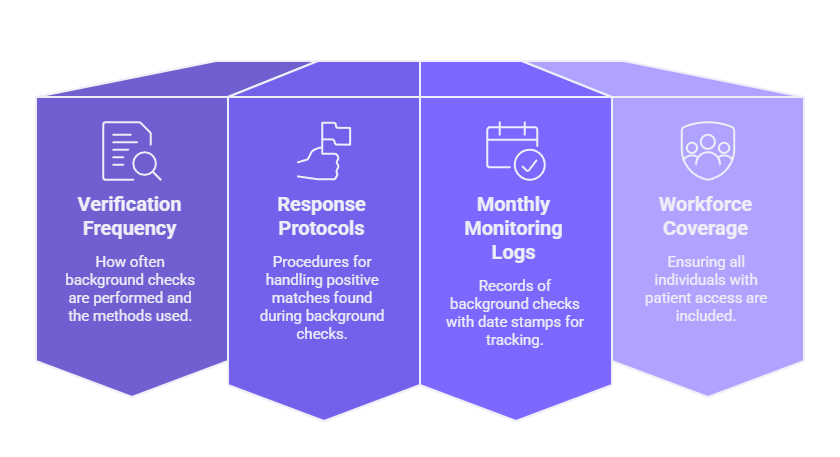
- Verification frequency and search methodology
- Response protocols for positive matches
- Monthly monitoring logs with date stamps
- Workforce coverage including contractors, volunteers, and vendors with patient access
Title 22 Facility Licensing Requirements Create Categorical Restrictions
California Code of Regulations Title 22 establishes criminal history restrictions tied to facility license type. These restrictions operate as licensing conditions, not employment laws. The California Department of Public Health and Department of Social Services enforce compliance through survey processes, complaint investigations, and license renewal audits.
| Facility Type | Governing Code | Disqualification Scope | Exemption Process |
| Skilled Nursing Facilities | HSC §§ 1522, 1568.09 | Permanent bars for specified offenses | Limited exemptions through DOJ |
| Intermediate Care Facilities | Title 22 § 80019 | Categorical restrictions on abuse, neglect, fraud | Department of Social Services review |
| Home Health Agencies | HSC § 1725 | Criminal background check within 7 days of hire | Case-by-case exemptions available |
| Acute Care Hospitals | HSC § 1250 | Live Scan for licensed professionals | Provisional privileges pending results |
Violations may result in deficiency citations, civil penalties, provisional licenses, or license revocation.
From the HR side of things, healthcare screening has become less about checking boxes and more about holding responsibilities with care. Every move is at the crossroads of safety, law, and someone’s livelihood. Accuracy and fairness matter just as much as they do in terms of precision. What I see in healthcare organizations is that the strongest screening programs are built on clarity, not fear. When screening happens with intention and transparency, it can be both safe and respectful of the humanity of the people who serve.
Fair Chance Act Employment Protections Require Individualized Assessment
California Labor Code Sections 12952 and 432.7 through 432.9 prohibit consideration of specific categories of criminal history. Employers may inquire about criminal history only after conditional offer, and adverse action based on conviction requires written individualized assessment.
Protected history categories include:
- Arrest records not resulting in conviction
- Participation in diversion programs
- Sealed or dismissed charges
- Convictions older than seven years, except for positions with annual salary reasonably expected to exceed $125,000
Cannabis use protections under Labor Code Section 432.8 extend to off-duty consumption. Testing remains permissible only for safety-sensitive positions or federal compliance requirements. Healthcare employers must document job-specific safety rationale and nexus between impairment risk and patient care duties before implementing testing protocols.
Facility-Type-Specific Workflow Requirements
Compliance obligations vary significantly by facility license type, payor mix, and workforce composition. The workflows below address the most common California healthcare employer categories.
Acute Care Hospitals and Medical Centers
Hospitals licensed under Health and Safety Code Section 1250 must complete Live Scan fingerprinting for all licensed professionals. Criminal history results transmit to the California Department of Justice, with automated notification to the Department of Public Health for convictions involving patient abuse, controlled substances, or fraud.
Background check sequences typically proceed through these stages:
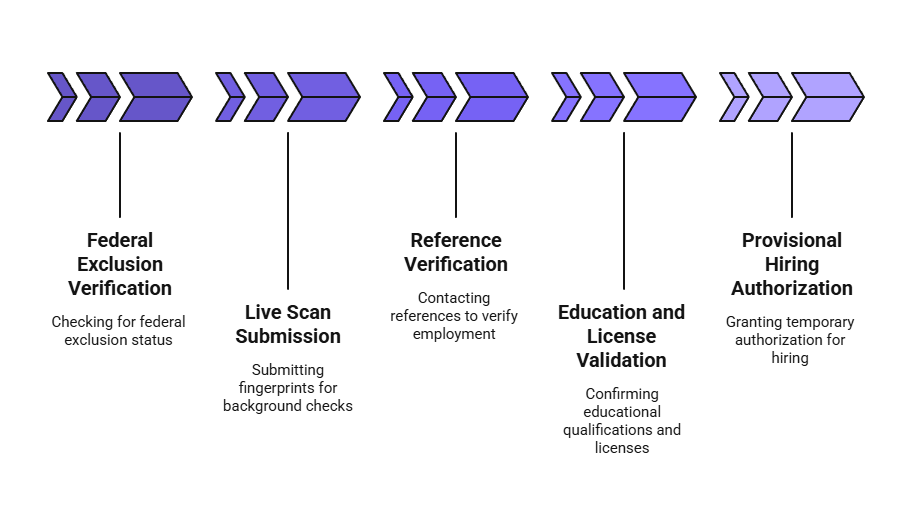
- Federal exclusion verification
- Live Scan submission
- Reference verification
- Education and license validation
- Provisional hiring authorization
Conditional offers precede criminal history inquiry, with Fair Chance Act individualized assessment protocols activated only after conviction disclosure or Live Scan results. Hospital compliance officers must reconcile Title 22 categorical restrictions with Fair Chance Act protections by documenting that disqualifications result from regulatory mandate rather than discretionary employer policy.
Skilled Nursing and Intermediate Care Facilities
Skilled nursing facilities face the most restrictive criminal history prohibitions under Health and Safety Code Sections 1522 and 1568.09. Specified convictions, including but not limited to abuse, neglect, fraud, and controlled substance offenses, create permanent employment bars. Exemption processes exist for a narrow subset of offenses through the California Department of Justice, but many convictions carry absolute disqualification with no waiver available. Employers must verify exemption eligibility on a conviction-by-conviction basis rather than assume discretionary authority.
Employers must submit criminal background check requests within seven days of hire for non-licensed personnel. Licensed professionals undergo fingerprinting through their respective licensing boards, with results accessible to facility administrators through verification portals. Facilities may not employ individuals pending background check results in direct patient care roles.
California Department of Public Health guidance clarifies that Fair Chance Act protections do not override Title 22 categorical restrictions. Individualized assessments apply only to convictions falling outside statutory disqualification lists.
Home Health and Hospice Agencies
Home health agencies licensed under Health and Safety Code Section 1725 must conduct criminal background checks on all personnel with patient contact or access to patient information. The unsupervised nature of in-home services justifies more extensive screening protocols.
Required screening components include:
- Criminal background checks for all patient-contact personnel
- Motor vehicle record checks for employees using personal vehicles
- Elder abuse registry verification
- Ongoing monitoring regardless of employment status
Compliance challenges arise from the distributed workforce model and contractor classifications. Agencies remain responsible for background check completion regardless of employment status. Written agreements with independent contractor clinicians must assign responsibility for license verification, exclusion checks, and criminal history disclosure.
Ambulatory Surgery Centers and Outpatient Clinics
Outpatient facilities face fewer categorical criminal history restrictions than institutional providers but remain subject to federal exclusion mandates and Fair Chance Act protections. Medical directors and compliance officers must establish screening protocols proportional to procedure complexity, anesthesia use, and controlled substance inventory.
Credentialing processes for physicians and advanced practice providers should incorporate primary source verification. Automated alerts from the National Practitioner Data Bank and state medical board disciplinary databases provide ongoing monitoring between re-credentialing cycles. Support staff background checks follow Fair Chance Act sequencing, with criminal history inquiry postponed until after conditional offer.
Navigating Fair Chance Act and Patient Safety Conflicts
California healthcare employers frequently encounter tension between Fair Chance Act mandates and perceived patient safety obligations. Resolution requires understanding the Act's scope, exemptions, and documentation requirements. The reality is that these situations require disciplined decision-making rather than exclusive decision-making, which distinguishes regulatory mandates from employer judgment. Careful documentation and risk analysis by role can assist organizations in serving the needs of patients while remaining compliant with fair chance employment principles.
When Fair Chance Act Protections Apply
The Fair Chance Act applies to all employers with five or more employees. Protections extend to applicants and employees, covering initial hiring, promotions, and transfers.
| Prohibited Inquiry | Scope | Exceptions |
| Arrest history | All arrests not resulting in conviction | None |
| Pending charges | Charges without disposition | None |
| Diversion programs | Referral to or participation | None |
| Sealed convictions | Expunged, dismissed, or sealed records | None |
| Conviction history timing | Before conditional offer | Regulatory mandate positions only |
Cannabis protections under Labor Code Section 432.8 prohibit adverse action based on off-duty marijuana use detected through drug testing. Exceptions exist where federal law requires testing or the position is designated as safety-sensitive through documented risk assessment.
Conducting Legally Compliant Individualized Assessments
When criminal history information becomes available after conditional offer, employers must conduct individualized assessments before adverse action. Assessments must consider offense nature and severity, time elapsed since offense and completion of sentence, and the nature of the job sought or held.
Written assessments should document the following elements:

- Job duty analysis with specific responsibilities
- Nexus evaluation between offense and position requirements
- Consideration of rehabilitation evidence provided by applicant
- Comparison to Title 22 categorical restrictions if applicable
- Position-specific risk factors rather than generic categories
Employers must provide preliminary adverse action notice including a copy of the consumer report, written summary of rights under the FCRA, individualized assessment results, and opportunity to respond with mitigating information. California law requires a minimum five business-day response period before final decision.
Documenting Regulatory Mandate Defenses
Healthcare employers may rebut Fair Chance Act claims by demonstrating that adverse action resulted from regulatory mandate rather than discretionary policy. Effective documentation includes citation to specific Title 22 sections or federal exclusion requirements, verification that conviction falls within categorical prohibition, and evidence that no exemption or waiver process exists.
Policies should separate regulatory compliance requirements from discretionary background check criteria. Position descriptions must identify which screening elements derive from licensing conditions versus employer risk management preferences.
California Cannabis Testing Protocols for Healthcare Workers
California's legalization of recreational cannabis use and employee protections under Labor Code Section 432.8 create implementation challenges for healthcare employers. Facilities accustomed to zero-tolerance drug policies must now navigate limited testing circumstances.
Safety-Sensitive Position Designations
Employers may test for marijuana and make employment decisions based on results only for positions designated as safety-sensitive or where federal law mandates testing. Safety-sensitive designation generally requires documented analysis of job duties showing that impairment creates substantial risk of death or serious bodily injury to the employee, coworkers, or public, though California courts have not yet established binding precedent defining this threshold in healthcare settings. Employers should consult legal counsel when designating clinical positions as safety-sensitive and document position-specific risk factors conservatively.
Healthcare positions potentially qualifying as safety-sensitive include:
- Roles involving controlled substance access
- Anesthesia administration responsibilities
- Operation of medical equipment with injury potential
- Provision of direct patient care where impairment affects clinical judgment
- Responsibilities under federal Department of Transportation regulations
Generic classifications such as "all clinical staff" or "patient-facing roles" fail to satisfy documentation requirements. Employers must conduct and preserve position-specific risk assessments identifying particular duties, potential impairment effects, and nexus to safety risk.
Testing Methodology and Impairment Assessment Limitations
Standard drug screening panels detect marijuana metabolites that remain present for days or weeks after consumption. Unlike alcohol testing, no scientifically validated threshold exists for cannabis impairment in workplace settings. Employers relying on positive marijuana test results as sole basis for adverse action face challenges demonstrating nexus between off-duty consumption and workplace performance.
| Testing Type | Detection Window | Impairment Correlation | Legal Defensibility |
| Urine screening | 3-30 days post-use | None (metabolites only) | Low without additional evidence |
| Blood testing | Hours to days | Limited scientific consensus on impairment threshold | Moderate with contemporaneous behavior documentation |
| Oral fluid | 24-48 hours | Potential recent use indicator | Moderate with incident nexus |
| Reasonable suspicion | Immediate observation | Strong if documented | High with supervisor training |
Best practices include pairing drug testing with observable behavior documentation, supervisor statements regarding performance concerns, and incident-specific reasonable suspicion protocols.
Federal Contractor and Regulatory Compliance Considerations
Healthcare facilities receiving federal contracts or grants may face Drug-Free Workplace Act obligations. These requirements mandate written substance abuse policies and employee awareness programs but do not mandate drug testing or create exemptions from state employment protections.
Positions subject to Department of Transportation regulations remain subject to federal testing protocols that include marijuana regardless of state law. Employers must segregate these federally mandated programs from discretionary workplace policies to avoid over-application of testing requirements. Facilities should audit federal compliance obligations annually to identify which workforce segments face mandatory testing versus discretionary policies subject to California restrictions.
California Healthcare Licensing Background Check Integration
Licensed healthcare professionals undergo criminal background checks through their respective licensing boards as conditions of initial licensure and renewal. Employers must coordinate facility-based screening with regulatory processes to avoid duplication while ensuring comprehensive coverage.
Live Scan Fingerprinting Requirements and Record Retention
California Business and Professions Code Section 144 authorizes licensing boards to require fingerprint-based background checks for license applicants. Results transmit to the Department of Justice, which maintains records and provides subsequent arrest notification to the licensing board when licensees face criminal charges.
Healthcare facilities employing licensed professionals may access license verification portals showing current status, disciplinary history, and restrictions or conditions. These systems do not display underlying criminal history, requiring employers to implement supplemental screening for non-licensed personnel.
Key compliance requirements include:
- Appropriate applicant type code specification
- Authorized recipient agency designation
- Test transactions when implementing new programs
- Error resolution protocols for rejected submissions
Coordinating Multi-State License Verification
Healthcare professionals holding licenses in multiple states may face varying background check requirements and disciplinary standards. Employers in border regions or telehealth programs must verify all relevant licenses and monitor disciplinary databases for each jurisdiction.
Interstate compacts for nursing, physician, and psychology licenses create additional complexity. Compact privileges allow practice across member states based on home state licensure, but background check requirements and disciplinary actions may vary. Employers should verify both home state license and compact privilege status, monitoring both jurisdictions for disciplinary actions.
Managing Third-Party Screening Vendor Relationships and Liability
Healthcare employers typically engage consumer reporting agencies for background check services, creating joint compliance obligations under federal and state law. Vendor selection and ongoing oversight remain critical to risk mitigation.
FCRA Compliance and Disclosure Requirements
The Fair Credit Reporting Act requires employers to provide clear and conspicuous disclosure that consumer reports may be obtained for employment purposes. Disclosure must appear in a standalone document separate from employment applications.
California Civil Code Section 1786 imposes additional requirements:
- Seven-day advance notice before obtaining investigative consumer reports
- Provision of state-specific summary of rights
- Authorization obtained before report procurement
- Applicant signature acknowledging disclosure
Pre-adverse action procedures require employers to provide report copy and summary of rights before adverse action becomes final. Applicants receive a minimum of five business days to dispute inaccurate information. Final adverse action notices must include contact information for the screening vendor, statement of vendor's limited role in decision-making, and notice of applicant's right to dispute accuracy.
Evaluating Vendor Capabilities for Healthcare-Specific Screening
Healthcare background check requirements exceed standard employment screening protocols. Vendor evaluation should assess capability to conduct federal exclusion monitoring with monthly updates, integrate with state licensing board verification systems, and process Live Scan fingerprint submissions.
Service level agreements should specify the following elements:
- Turnaround time standards with escalation protocols
- Accuracy guarantees with measurable validation processes
- Data security protocols meeting HIPAA business associate standards if applicable
- Ongoing monitoring services for exclusion lists and license status changes
- Indemnification provisions allocating liability for accuracy failures and compliance violations
Healthcare employers remain jointly liable for vendor FCRA violations and accuracy failures that result in wrongful adverse action. Due diligence in vendor selection, ongoing performance monitoring, and audit rights in service agreements provide risk mitigation but do not eliminate employer liability.
Building Compliant Background Check Policies for 2026
Healthcare employers should conduct policy audits addressing compliance elements as enforcement activity intensifies. Comprehensive policy frameworks reduce regulatory risk and create defensible documentation for adverse action decisions.
Position-Specific Screening Matrices
Develop written matrices identifying which screening elements apply to each position classification. Matrices should distinguish between regulatory mandates and discretionary criteria.
Categories should include:
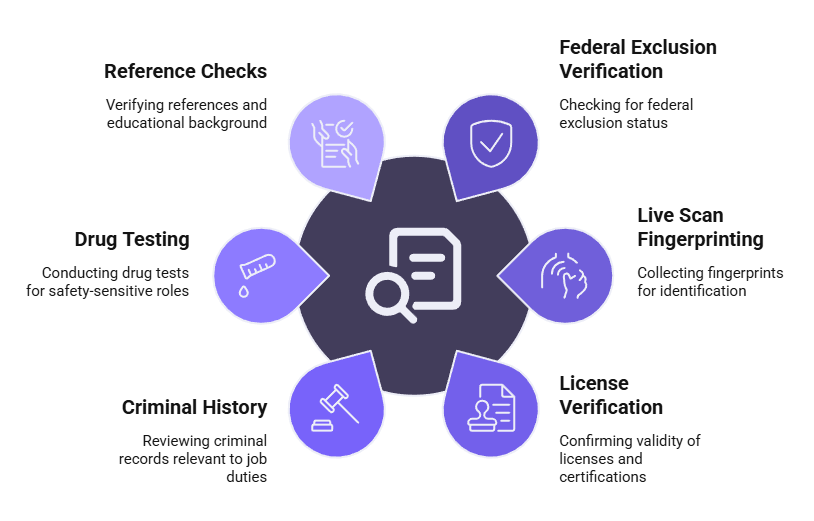
- Federal exclusion verification requirements
- Live Scan fingerprinting obligations
- License and certification verification frequency
- Criminal history categories relevant to job duties
- Drug testing protocols and safety-sensitive designations
- Reference check and education verification standards
Matrices provide documentation that screening criteria reflect job-specific requirements rather than blanket policies. This documentation supports Fair Chance Act individualized assessments and responds to disparate impact challenges.
Individualized Assessment Templates and Training
Create structured assessment forms that guide hiring managers through nexus analysis, consideration of mitigating factors, and documentation requirements. Forms should prompt for position duty analysis, offense-to-duty relationship evaluation, rehabilitation evidence review, time elapsed calculations, and comparison to regulatory restrictions.
| Training Topic | Target Audience | Frequency | Documentation |
| Prohibited inquiries and timing | All hiring managers | Annual + new hire | Completion certificates |
| Pre-adverse action procedures | HR staff | Annual | Process acknowledgment |
| Individualized assessment completion | Hiring managers, HR | Semi-annual | Case study evaluation |
| Regulatory mandate documentation | Compliance officers | Quarterly | Policy audit logs |
| Escalation protocols | All stakeholders | Annual | Contact tree verification |
Training programs reduce implementation errors and create evidence of good-faith compliance efforts in enforcement proceedings.
Ongoing Monitoring and Re-Screening Protocols
Background checks conducted at hire do not satisfy ongoing compliance obligations for exclusion monitoring, license verification, and criminal history updates. Policies should establish monthly exclusion list verification for all workforce members, license renewal confirmation before expiration dates, and subsequent arrest notification review from the Department of Justice for Live Scan submissions.
Automated monitoring services reduce administrative burden but require validation that alerts reach appropriate personnel and trigger timely response protocols. Gaps between database updates and alert generation create compliance risk, requiring backup manual verification processes.
Conclusion
California healthcare background check requirements 2026 compliance depends on facility-specific workflows that reconcile federal mandates, Title 22 categorical restrictions, and Fair Chance Act protections. Employers must audit screening policies, vendor contracts, and automated systems to address accuracy obligations and algorithmic transparency requirements as enforcement activity intensifies across regulatory and employment law contexts.
Frequently Asked Questions
What are the California healthcare background check requirements 2026 employers must prioritize?
Employers should prioritize federal exclusion list verification protocols with monthly monitoring, Fair Chance Act individualized assessment documentation, automated screening system accuracy audits, and coordination between facility-based checks and professional licensing board processes. Enforcement focus has shifted toward procedural compliance and transparency rather than categorical screening policies.
How does the California Fair Chance Act apply to healthcare employers with patient safety concerns?
The Fair Chance Act prohibits arrest record consideration and requires individualized assessment before conviction-based adverse action, but does not override Title 22 categorical restrictions or federal exclusion mandates. Healthcare employers must document which disqualifications result from regulatory requirements versus discretionary policies, conducting nexus analysis only for convictions outside categorical prohibitions.
When is California cannabis testing for healthcare workers legally permissible?
Cannabis testing is permissible only for positions designated as safety-sensitive through documented risk assessment or where federal law mandates testing. Employers must establish job-specific rationale showing impairment creates substantial safety risk and cannot rely solely on positive test results without a documented nexus between off-duty consumption and workplace performance or safety concerns.
What California healthcare licensing background check obligations apply to contracted staff?
Healthcare facilities remain responsible for verifying that contracted clinical staff maintain current, unrestricted licenses and clear federal exclusion status regardless of employment classification. Written agreements should assign responsibility for background check completion and ongoing monitoring, but facilities face regulatory liability for non-compliant contractors providing patient care services.
Do California patient safety background check standards allow blanket disqualification policies?
California law prohibits blanket disqualification policies not based on regulatory mandate. Employers must conduct individualized assessments considering offense nature, time elapsed, job duties, and rehabilitation evidence before adverse action based on criminal history. Title 22 categorical restrictions provide the only basis for automatic disqualification without individualized review.
How should healthcare employers document compliance with California healthcare background check requirements 2026?
Compliance documentation should include position-specific screening matrices identifying regulatory versus discretionary criteria, individualized assessment forms with offense-to-duty nexus analysis, vendor contracts specifying accuracy validation and FCRA compliance processes, and exclusion list monitoring logs with monthly verification dates. Training records showing hiring manager education on Fair Chance Act requirements provide additional evidence of good-faith compliance efforts.
What are the penalties for California healthcare background check compliance failures?
Penalties vary by violation type and include Department of Public Health licensing deficiencies and civil penalties for Title 22 violations, Civil Rights Department complaints and damages for Fair Chance Act violations, and FCRA statutory damages of $100 to $1,000 per willful violation plus attorney fees. Federal exclusion sanctions include loss of Medicare and Medicaid billing privileges and civil monetary penalties.
How do automated screening systems affect California healthcare background check compliance?
Automated systems create accuracy and transparency obligations requiring validation processes, manual review of adverse matches, and documentation of decision criteria. Employers using algorithmic risk scoring or vendor-supplied standard disqualification categories may violate Fair Chance Act individualized assessment requirements and face liability for accuracy failures or algorithmic bias producing disparate impact.
Additional Resources
- California Department of Public Health - Title 22 Background Check Requirements
https://www.cdph.ca.gov/Programs/CHCQ/LCP/Pages/Background-Checks.aspx - Office of Inspector General - List of Excluded Individuals and Entities
https://oig.hhs.gov/exclusions/ - California Civil Rights Department - Fair Chance Act Guidance
https://calcivilrights.ca.gov/fair-chance-act/ - California Department of Justice - Live Scan Information
https://oag.ca.gov/fingerprints/locations - Federal Trade Commission - Using Consumer Reports for Employment Decisions
https://www.ftc.gov/business-guidance/resources/using-consumer-reports-what-employers-need-know

ABOUT THE CREATOR
GCheck Editorial Team
Meet the GCheck Editorial Team, your trusted source for insightful and up-to-date information in the world of employment background checks. Committed to delivering the latest trends, best practices, and industry insights, our team is dedicated to keeping you informed.
With a passion for ensuring accuracy, compliance, and efficiency in background screening, we are your go-to experts in the field. Stay tuned for our comprehensive articles, guides, and analysis, designed to empower businesses and individuals with the knowledge they need to make informed decisions.
At GCheck, we're here to guide you through the complexities of background checks, every step of the way.