

Implementing background checks for construction workers requires balancing thoroughness with operational speed, addressing unique industry challenges like high turnover, temporary staffing, and site-based risks. A well-structured screening program considers credential verification, criminal history review, role-specific risk factors, and compliance obligations while supporting efficient hiring workflows.
Key Takeaways
- Construction industry screening must account for temporary hires, subcontractors, and permanent staff with differentiated approaches based on role responsibilities and site access requirements.
- Criminal history reviews should consider the nature, time elapsed, and relevance of offenses to specific job duties rather than applying automatic disqualification policies.
- Credential verification confirms licenses, certifications, and training records required for specialized construction roles and regulatory compliance.
- Timing challenges in construction hiring demand pre-planned screening protocols that balance speed-to-hire pressures with thorough vetting requirements.
- Multi-layered screening approaches may combine database searches, manual verifications, and ongoing monitoring depending on workforce composition and project risk profiles.
- Federal, state, and local regulations create varying requirements for authorization, disclosure, individualized assessment, and record retention that differ by jurisdiction.
- Screening decisions should document clear job-relatedness criteria and consider rehabilitative factors, particularly for positions without direct safety or security responsibilities.
- Technology-assisted screening tools exist but require human oversight to ensure accuracy, context evaluation, and compliance with legal protections for applicants.
Understanding Construction Industry Screening Needs
The construction sector presents distinct workforce screening challenges that differ substantially from traditional employment environments. Projects operate on compressed timelines with fluctuating labor demands, creating pressure to onboard workers rapidly while maintaining safety and security standards. Organizations managing large-scale construction projects typically employ a mix of permanent staff, seasonal workers, day laborers, and subcontracted specialists, each category requiring tailored screening approaches.
| Workforce Category | Typical Screening Priority | Key Consideration |
| Permanent employees | Comprehensive initial vetting | Long-term employment relationship justifies thorough checks |
| Seasonal workers | Streamlined core checks | Balance speed with risk management needs |
| Day laborers | Expedited minimum screening | Immediate availability requirements create timing pressure |
| Subcontractor staff | Contractual verification | General contractors rely on subcontractor compliance |
Defining Screening Objectives
Construction worker background checks serve multiple organizational objectives beyond basic identity verification. Safety-sensitive positions involving heavy equipment operation, elevated work, or hazardous materials handling require confirmation that candidates can perform duties without creating unacceptable risks to themselves or others. Projects at government facilities, healthcare construction sites, or financial institutions often mandate enhanced screening protocols as contractual obligations.
Credential verification addresses industry-specific concerns about unlicensed work and unqualified labor. Many construction roles require valid state licenses, OSHA certifications, or specialized training documentation that screening processes should confirm before assignment. Organizations face potential liability exposure when workers lacking proper credentials cause accidents or produce substandard work that later fails inspection.
Role-Specific Risk Assessment
Not all construction positions present equivalent screening requirements. A corporate office administrator working for a construction company faces different risk considerations than an electrician entering occupied residential properties or a crane operator on high-rise projects.
Effective screening programs categorize positions using these assessment factors:

- Access to sensitive areas or secured facilities
- Interaction with vulnerable populations
- Equipment operation responsibilities
- Potential for property damage or personal injury
- Degree of supervision versus autonomous work
- Financial transaction authority
Entry-level laborers performing ground-level work under direct supervision may require less extensive vetting than foremen with autonomous decision-making authority or workers entering secured facilities. This differentiation allows organizations to allocate screening resources proportionally to actual risk factors while avoiding unnecessarily restrictive policies that limit qualified applicant pools.
Components of Construction Worker Screening
Background checks for construction workers typically incorporate multiple verification elements rather than relying on single-source data. The combination of screening components varies based on position requirements, project specifications, and jurisdictional regulations that may mandate particular checks for certain work environments.
Criminal History Considerations
Criminal record searches represent a common component of construction industry screening, though their application requires careful consideration of legal limitations and relevance standards. When obtained through third-party consumer reporting agencies, these searches constitute consumer reports under federal law and trigger specific authorization, disclosure, and adverse action requirements. Records may originate from county courthouses, state repositories, or multi-jurisdictional databases, each with different coverage areas, update frequencies, and accuracy characteristics.
Organizations should establish clear criteria for evaluating criminal history information:
- Nature of offense: Violent crimes versus non-violent violations
- Time elapsed: Recent convictions versus decades-old records
- Rehabilitation evidence: Completion of programs, stable employment history
- Job-relatedness: Direct connection to position responsibilities
Federal guidance encourages individualized assessments rather than blanket exclusion policies, which may create heightened legal exposure under employment discrimination principles. For example, a decade-old non-violent offense may have minimal relevance to current fitness for construction work, while recent convictions for workplace violence or equipment-related crimes warrant closer evaluation.
Jurisdictional variations significantly affect what information appears in criminal record searches and how employers may use it. Some states limit consideration of arrests without conviction, restrict lookback periods for certain offense categories, or prohibit inquiry into criminal history until after conditional employment offers.
Credential and License Verification
Construction trades rely heavily on formal credentials that screening processes should independently verify rather than accepting candidate representations at face value. State licensing boards maintain databases of current electricians, plumbers, HVAC technicians, and other licensed trades, typically accessible for employer verification.
| Credential Type | Verification Source | Typical Turnaround |
| State trade licenses | State licensing board databases | 1–3 business days |
| OSHA certifications | Training provider records | 2–5 business days |
| Equipment operator cards | Issuing organization verification | 1–3 business days |
| Apprenticeship completion | Program administrator confirmation | 3–7 business days |
These checks confirm active licensure status, discipline history, and any restrictions or conditions placed on credentials. Professional certifications from recognized training organizations validate specialized skills in areas like welding, rigging, confined space work, or equipment operation.
Independent verification through issuing bodies confirms that certificates remain current and were legitimately earned rather than fraudulently obtained or expired. Some certifications require periodic renewal through continuing education or skills testing that verification should confirm has occurred.
Employment History Review
Previous employment verification helps confirm candidates' claimed experience and uncover information about work performance, reliability, and termination circumstances. Construction industry employment history verification faces unique challenges due to high business turnover rates, informal hiring arrangements, and company closures that make past employers difficult to contact.
When previous employers can be reached, verifications typically confirm dates of employment, positions held, and eligibility for rehire. Some organizations provide additional information about attendance, safety record, or reasons for separation, though many limit responses to basic factual confirmations due to legal concerns.
Reference checks supplement employment verification by gathering qualitative assessments from supervisors or colleagues familiar with candidates' work. Construction-specific reference questions might address safety consciousness, ability to follow technical specifications, teamwork in crew environments, and reliability under weather-related schedule changes.
Motor Vehicle Record Checks
Driving records become relevant for construction positions requiring commercial vehicle operation, material transport, or travel between job sites using company vehicles. Motor vehicle record checks accessed through state licensing agencies reveal traffic violations, license suspensions, DUI convictions, and accident history that inform fitness to operate vehicles as a job duty.
Organizations should establish clear standards for acceptable driving records based on position requirements rather than universal policies. A worker who never operates vehicles as part of job duties needs no driving record evaluation, while positions involving daily commercial truck operation warrant more stringent driving history standards.
Drug Screening Considerations
Substance testing programs in construction address safety concerns related to impairment on job sites with inherent hazards:
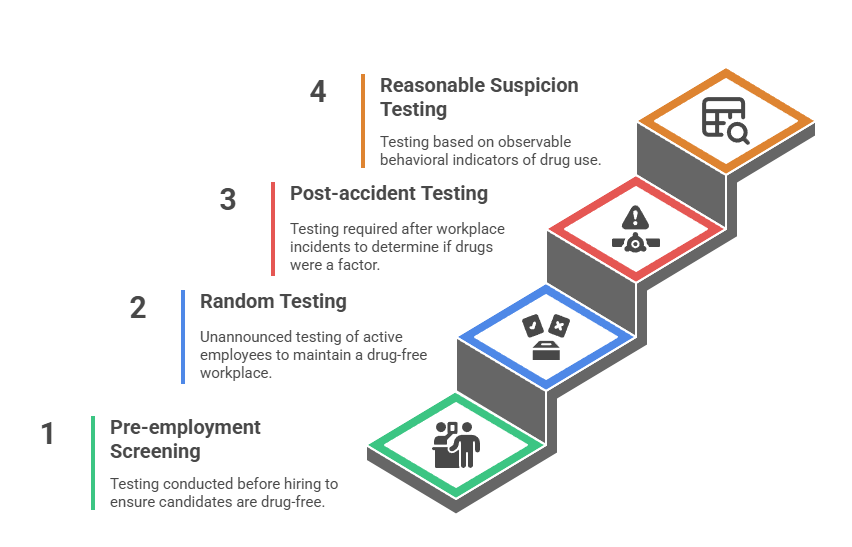
- Pre-employment screening: Conducted before work begins
- Random testing: Unannounced testing of active employees
- Post-accident testing: Required after workplace incidents
- Reasonable suspicion testing: Based on behavioral indicators
Organizations must maintain consistent policies regarding which positions undergo testing and under what circumstances. Federal contractor requirements may mandate drug-free workplace programs for construction projects receiving government funding.
Building Screening Protocols for Different Workforce Categories
Construction companies typically manage multiple workforce segments simultaneously, each presenting distinct screening considerations and operational constraints. Developing differentiated protocols based on employment relationship, project duration, and role responsibilities creates more efficient and appropriate screening programs than applying uniform requirements across all workers.
Permanent Employee Screening
Full-time permanent construction employees warrant comprehensive screening at hire given the ongoing employment relationship and potential for progressive responsibility growth. Initial screening for permanent positions might include criminal history review, employment verification, credential checks, reference contacts, and drug testing where applicable.
Periodic rescreening of existing employees addresses changes that occur post-hire, such as license expirations, criminal convictions during employment, or certification lapses. Some organizations implement annual or biennial rescreening for positions with elevated risk factors, while others rely on self-reporting requirements that obligate employees to disclose disqualifying changes.
Temporary and Seasonal Worker Approaches
Construction's cyclical demand creates reliance on temporary workers during peak seasons or specific project phases. Screening temporary hires presents timing challenges since positions often need immediate filling, yet abbreviated vetting creates potential risk exposure.
| Strategy | Implementation | Advantage |
| Pre-qualified pools | Advance screening before immediate need | Rapid deployment when projects start |
| Streamlined packages | Focused checks on critical elements | Faster completion within tight timelines |
| Staffing agency partnerships | Outsource screening to labor suppliers | Transfer administrative burden |
| Risk-tiered approaches | Match depth to assignment duration | Proportional resource allocation |
Some construction companies maintain pre-qualified temporary worker pools by conducting advance screening of potential seasonal hires before immediate need arises. When projects require additional labor, pre-screened candidates can onboard quickly since vetting has already occurred.
Temporary staffing agencies that supply construction labor may conduct their own screening processes, though hiring organizations should verify what checks occur rather than assuming comprehensive vetting. Contracts with staffing providers should specify minimum screening requirements and documentation that must be completed before worker placement. When staffing agencies obtain background checks as consumer reporting agencies, they typically bear compliance obligations for those reports, though end-user employers retain responsibility for job site safety decisions and any additional screening they directly conduct.
Subcontractor and Vendor Management
General contractors overseeing construction projects often lack direct employment relationships with many on-site workers employed by specialized subcontractors. Managing screening requirements through subcontractor agreements ensures that all personnel accessing job sites meet minimum vetting standards regardless of formal employment status.
Pre-qualification programs evaluate subcontractor capabilities including their screening protocols before contract awards. Organizations can assess whether subcontractors maintain systematic background check processes or conduct inconsistent ad hoc vetting. Some general contractors require subcontractors to use specific screening providers or meet certification standards that demonstrate established workforce vetting programs.
Operational Implementation Considerations
Translating screening requirements into functioning operational processes requires attention to timing, workflow integration, documentation management, and communication protocols that support hiring objectives while maintaining compliance safeguards. Implementation failures often stem from inadequate process design rather than flawed screening concepts.
Timing and Workflow Integration
Construction hiring timelines create tension between screening thoroughness and speed-to-hire pressures. Projects facing labor shortages or weather-dependent schedule compression generate pressure to onboard workers before screening completes.
Organizations should establish clear policies regarding whether workers may begin employment with screening pending or must wait for completed results before starting. Conditional employment offers that explicitly state final confirmation depends on satisfactory screening results provide a middle path.
Screening workflow design should identify bottlenecks that cause unnecessary delays beyond inherent verification timelines:
- Waiting for candidate authorization form returns
- Manual result routing between screening providers and hiring managers
- Redundant approval layers without added value
- Incomplete initial information requiring follow-up
- Unclear escalation paths for unusual situations
Automated result routing eliminates delays from manual information transfers. Electronic signature systems accelerate authorization completion compared to paper-based processes.
Managing High-Volume Screening
Large construction projects or companies with continuous hiring needs process screening at volumes requiring systematic workflows rather than case-by-case handling. Standardized screening packages for defined position categories reduce decision-making for individual requisitions while ensuring appropriate checks occur consistently.
Technology platforms that integrate screening requests with applicant tracking systems reduce manual data entry and transcription errors that cause processing delays. Automated status tracking provides hiring managers visibility into where screening stands without requiring inquiries to HR staff.
| Volume Challenge | Solution Approach | Expected Impact |
| Manual data entry errors | ATS integration with auto-population | 60–80% reduction in transcription mistakes |
| Status inquiry calls to HR | Self-service tracking portals | 40–50% decrease in administrative inquiries |
| Inconsistent package selection | Position-based automated workflows | 90%+ consistent application of policies |
| Batch processing delays | Real-time API connections | Same-day initiation versus weekly batches |
Volume screening arrangements with background check providers may offer service level agreements that guarantee maximum turnaround times for standard searches. Organizations should understand what circumstances fall outside guaranteed timeframes, such as manual verification requirements or county courthouse closures that delay criminal record retrieval.
Documentation and Record Retention
Background check processes generate documentation that organizations must maintain in compliance with various retention requirements while protecting sensitive personal information. Screening records should be stored separately from general personnel files with restricted access limited to staff with legitimate need to review such information for employment decisions or compliance audits.
Authorization forms, disclosure notices, individualized assessment documentation, and adverse action notices represent key records that demonstrate compliance with procedural requirements. Organizations should retain these documents for specified periods that vary by jurisdiction but typically extend several years beyond employment termination.
Rejected applicant records require particular attention since unsuccessful candidates represent higher litigation risk than hired employees. Files should document legitimate, non-discriminatory reasons for non-selection with clear connection to job-related requirements.
Applicant Communication
Clear communication with candidates about screening processes, timelines, and potential outcomes reduces confusion and legal risk:
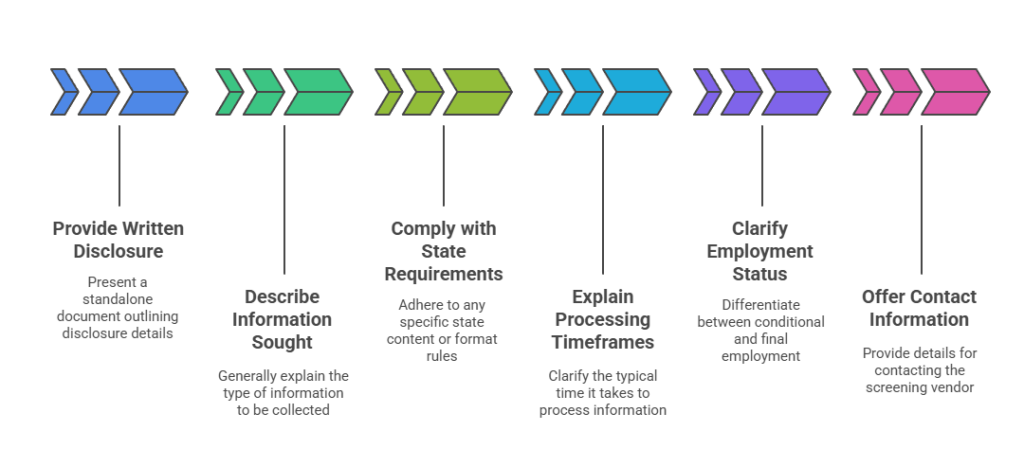
- Provide written disclosure in a standalone document before obtaining authorization
- Describe generally what information will be sought
- Comply with any additional state-specific content or format requirements
- Explain typical processing timeframes
- Clarify conditional versus final employment status
- Offer contact information for screening vendor questions
Pre-adverse action procedures require notifying candidates before making final negative employment decisions based on background check information, providing copies of the consumer report, furnishing a Summary of Rights document, and allowing reasonable opportunity to address potentially inaccurate or incomplete information. This process takes additional time that hiring timelines should accommodate rather than treating as optional delay.
Candidates frequently have questions about screening processes, timelines, and potential impacts of information in their backgrounds. HR staff should be prepared to explain general screening procedures without making premature representations about how specific information will be evaluated.
Addressing Common Implementation Challenges
Construction organizations implementing or refining screening programs encounter recurring challenges related to candidate pool impacts, false positive information, incomplete records, and cost management that require thoughtful problem-solving rather than abandoning screening efforts.
Balancing Thoroughness with Candidate Pool
Overly restrictive screening criteria can eliminate qualified candidates unnecessarily, creating labor shortages that delay projects or force hiring of less experienced workers. Organizations should regularly evaluate whether screening requirements actually relate to job duties or represent legacy policies that exceed legitimate needs.
Industry labor shortages make talent competition fierce, encouraging some organizations to minimize screening requirements to avoid losing candidates to competitors with faster hiring processes. This race-to-the-bottom approach increases risk exposure and may violate contractual obligations on projects with mandated screening requirements.
Second-chance hiring initiatives consciously include candidates with criminal histories by focusing on rehabilitation evidence, offense relevance, and time elapsed rather than automatic exclusion. Construction trades offer viable career paths for individuals seeking stable employment after justice system involvement.
Managing Inaccurate or Incomplete Information
Background check reports sometimes contain errors, outdated information, or incomplete records that create false impressions about candidates:
- Identity confusion: Common names causing records from different individuals to appear
- Outdated records: Expunged or sealed cases still showing in databases
- Incomplete reporting: Missing disposition information or partial criminal histories
- Data entry errors: Misspelled names, incorrect dates, or wrong offense classifications
Candidates must receive opportunity to review consumer report information and dispute inaccuracies before final employment decisions. When disputes are raised, consumer reporting agencies have legal obligations to conduct reasonable reinvestigation. Organizations should pause hiring decisions during this process and may independently verify information with original sources when appropriate.
Missing information represents another common challenge, particularly in criminal record searches that rely on incomplete databases or when candidates have lived in multiple jurisdictions requiring separate searches. Organizations should understand search limitations rather than treating absence of information as confirmation that nothing exists.
Compliance Framework Considerations
Construction worker background checks occur within a complex regulatory environment including federal laws, state statutes, local ordinances, and contractual requirements that vary by jurisdiction and project type. Organizations must build awareness of applicable rules and implement procedures that support compliance rather than creating legal exposure.
Federal Requirements
The Fair Credit Reporting Act governs consumer reports obtained from consumer reporting agencies (third parties that regularly assemble or evaluate consumer information for furnishing to others) for employment purposes, establishing requirements for disclosure, authorization, adverse action procedures, and permissible purposes. Organizations using background check vendors to obtain reports must provide clear written disclosure in a standalone document that background checks will occur before obtaining authorization. The disclosure should describe generally what information will be sought and comply with any additional state-specific content or format requirements.
Pre-adverse action procedures require providing the report, Summary of Rights, and reasonable time to respond before final decisions. Final adverse action notices must include specific information about the consumer reporting agency, clarify that the agency did not make the employment decision, and inform candidates of their right to dispute report accuracy with the agency.
Federal contractors may face additional screening requirements or drug-free workplace obligations under specific contract terms or funding source rules. Projects at federal facilities often mandate particular background check components or specify disqualifying factors.
Equal Employment Opportunity Commission guidance addresses discriminatory screening practices, particularly regarding criminal history use:
- Avoid blanket exclusion policies that disproportionately impact protected groups
- Apply individualized assessment procedures
- Consider offense nature, time elapsed, and job-relatedness
- Document business necessity justification for screening criteria
Organizations should implement structured evaluation frameworks that demonstrate good-faith efforts to comply with non-discrimination principles.
State and Local Variations
State laws create diverse requirements affecting background check procedures, permissible information use, and candidate rights. Ban-the-box statutes in various jurisdictions restrict when during the hiring process employers may inquire about criminal history. Requirements vary significantly by location, with some prohibiting questions on initial applications, others delaying inquiry until after interviews or conditional offers, and some applying only to public sector employers. Organizations must verify requirements in each applicable jurisdiction.
| Regulatory Area | Common Variations | Compliance Impact |
| Criminal history inquiry timing | Application versus post-interview restrictions | Multi-state form customization required |
| Lookback period limits | 7-year versus 10-year limitations | Database filtering by jurisdiction |
| Arrest record consideration | Prohibited versus permitted with conditions | Evaluation policy adjustments |
| Salary history inquiries | Banned in some locations | Application redesign for affected areas |
Lookback period limitations prevent consideration of criminal records older than specified timeframes, commonly seven or ten years depending on jurisdiction and offense type. Some states prohibit considering arrests without conviction or limit use of certain offense categories.
State-specific authorization and disclosure requirements sometimes exceed federal minimums, mandating particular form language or additional candidate notifications. Organizations should ensure screening forms comply with requirements in states where candidates reside and where work will be performed when these differ.
Building Sustainable Screening Programs
Effective construction worker background check programs require ongoing attention rather than one-time implementation efforts. Sustainable approaches include regular policy reviews, training updates, metrics tracking, and continuous improvement based on operational experience and regulatory changes.
Policy Development and Documentation
Written screening policies document what checks occur for which positions, evaluation criteria for concerning information, adverse action procedures, and record retention practices. Clear policies promote consistent application across hiring managers, reducing arbitrary decisions that create legal vulnerability.
Regular policy reviews ensure alignment with current legal requirements, business needs, and industry practices:
- Conduct annual review cycles to incorporate regulatory changes
- Address implementation challenges identified during the year
- Update position-specific requirements as roles evolve
- Involve legal counsel or compliance specialists in reviews
Policy communication to hiring managers, HR staff, and supervisors ensures those making screening decisions understand requirements and procedures. New hire orientations should cover relevant policies for supervisors involved in employment decisions.
Training and Quality Assurance
Staff conducting or reviewing background checks need training on procedural requirements, legal compliance obligations, and company-specific policies:
- Authorization and disclosure requirements
- Adverse action procedures
- Anti-discrimination principles
- Documentation expectations
- Role-specific responsibilities
Quality assurance processes identify compliance failures and procedural errors before they create significant legal exposure. File audits reviewing samples of completed background check documentation verify that required forms were properly executed, appropriate searches occurred, and evaluation decisions aligned with established criteria.
Common error patterns revealed through quality reviews suggest systemic issues requiring process improvements. Continuous improvement based on quality findings strengthens programs over time rather than repeatedly noting the same deficiencies.
Metrics and Performance Evaluation
Tracking screening program metrics enables data-driven evaluation of effectiveness, efficiency, and cost management:
| Metric Category | Key Measurements | Decision Value |
| Efficiency | Time-to-hire, screening completion rates | Identify workflow bottlenecks |
| Cost | Per-hire expenses, total screening budget | Support vendor negotiations and resource allocation |
| Effectiveness | Adverse action rates, post-hire incidents | Evaluate screening criteria appropriateness |
| Candidate experience | Application abandonment rates, complaint frequency | Assess process friction points |
Time-to-hire metrics broken down by screening-related delays versus other factors identify whether background check processes create bottlenecks requiring attention. Completion rate tracking reveals how many candidates abandon application processes at screening stages, potentially indicating unnecessarily burdensome requirements.
Cost per hire allocation showing screening expenses relative to total recruitment costs provides context for budget discussions. Organizations spending disproportionate amounts on screening compared to industry benchmarks should evaluate whether comprehensive checks are necessary for all positions.
Regular analysis of disqualification patterns helps organizations evaluate whether screening criteria remain appropriately job-related and identify opportunities to refine evaluation procedures.
Conclusion
Implementing background checks for construction workers demands operational frameworks that address industry-specific challenges, balance competing priorities, and comply with complex regulatory requirements. Effective programs differentiate screening approaches based on risk factors, integrate efficiently with hiring workflows, and maintain focus on job-related criteria that support legitimate business needs while avoiding unnecessarily restrictive practices.
Frequently Asked Questions
What screening components should be included for temporary construction workers?
Temporary construction workers typically require at minimum identity verification, criminal history review for offenses directly relevant to job duties and site safety, and confirmation of credentials required for specific roles. The appropriate scope depends on position responsibilities, site access requirements, and project duration, with briefer assignments potentially warranting streamlined checks while longer-term temporary roles justify more comprehensive screening.
How long do construction industry background checks typically take to complete?
Background check timelines vary based on search components required and information sources involved. Identity verification and database searches often return results within 24 to 48 hours, while employment verifications, education confirmations, and county courthouse criminal record searches may require several days to two weeks depending on third-party responsiveness. Organizations should plan hiring timelines accommodating typical processing periods rather than assuming instant results.
Can construction companies use different screening criteria for various positions?
Organizations may and should apply different screening criteria based on legitimate job-related factors, ensuring that checks and evaluation standards align with specific position responsibilities and risk profiles. Equipment operators, workers entering secured facilities, and employees with financial responsibilities warrant different screening components than general laborers performing routine tasks under direct supervision. Differentiated approaches should be documented in written policies with clear business justification.
What criminal history information can disqualify construction worker candidates?
With limited exceptions for certain licensed positions or jurisdictional prohibitions, most criminal record evaluations should reflect individualized assessment considering offense nature, time elapsed, rehabilitation evidence, and direct relationship to job responsibilities rather than automatic disqualification rules. Organizations should avoid blanket exclusion policies, instead evaluating whether specific convictions indicate unacceptable risk for particular positions. Recent violent offenses, theft convictions for roles with property access, or substance violations for safety-sensitive equipment operation represent examples of potentially disqualifying history.
How should construction companies handle screening for subcontractor employees?
General contractors should establish minimum screening requirements in subcontractor agreements, specifying what background checks must be completed before workers access job sites. Verification procedures confirm that subcontractors have conducted required screening by reviewing documentation, certificates of compliance, or individual worker clearance records before issuing site access credentials. Ultimate responsibility for site safety and security requires verification rather than merely accepting subcontractor representations.
Are construction employers required to conduct background checks?
No universal federal requirement mandates background checks for all construction positions, though specific project types, government contracts, or state licensing boards may require screening for particular roles or work environments. Beyond legal obligations, prudent risk management motivates screening for safety-sensitive positions and roles with access to secured areas or vulnerable populations. Organizations should conduct screening based on legitimate business needs and contractual requirements rather than treating it as optional.
What happens if a background check reveals inaccurate information?
Candidates must receive an opportunity to review consumer reports and dispute inaccurate information before final adverse employment decisions. Organizations should pause hiring decisions while disputes are investigated, contacting screening vendors or information sources to verify accuracy. Pre-adverse action procedures provide time for candidates to identify and correct errors, preventing wrongful disqualification based on mistaken identity, outdated records, or data entry mistakes.
Can construction companies screen current employees after initial hire?
Employers may conduct background checks on current employees when job-related reasons exist, such as promotions to positions with different responsibilities, transfers to sites with enhanced security requirements, or periodic rescreening required by policy or regulation. The same authorization, disclosure, and adverse action procedures that apply to applicant screening govern employee rescreening. Organizations should clearly communicate rescreening policies and timing rather than conducting surprise checks without advance notice.
Additional Resources
- Fair Credit Reporting Act Summary of Rights
https://www.ftc.gov/legal-library/browse/statutes/fair-credit-reporting-act - EEOC Guidance on Arrest and Conviction Records
https://www.eeoc.gov/laws/guidance/arrest-and-conviction-records - OSHA Construction Industry Standards
https://www.osha.gov/laws-regs/regulations/standardnumber/1926 - State Labor Department Directory
https://www.dol.gov/agencies/eta/contacts/state-directories - National Institute for Occupational Safety and Health Construction Resources
https://www.cdc.gov/niosh/construction/

ABOUT THE CREATOR
GCheck Editorial Team
Meet the GCheck Editorial Team, your trusted source for insightful and up-to-date information in the world of employment background checks. Committed to delivering the latest trends, best practices, and industry insights, our team is dedicated to keeping you informed.
With a passion for ensuring accuracy, compliance, and efficiency in background screening, we are your go-to experts in the field. Stay tuned for our comprehensive articles, guides, and analysis, designed to empower businesses and individuals with the knowledge they need to make informed decisions.
At GCheck, we're here to guide you through the complexities of background checks, every step of the way.