


Healthcare employers face a version of FCRA compliance that is materially more demanding than what standard employer guides describe, because it must be coordinated with statutory screening mandates, licensing verification, multi-party staffing relationships, and a higher-stakes individualized assessment obligation. This article provides the operational framework that healthcare HR and compliance teams need to build a program that is defensible in practice, not just compliant on paper.
Key Takeaways
- FCRA compliance in healthcare requires coordinating the standard disclosure-authorization-adverse action sequence with statutory screening obligations that operate on a different legal timeline.
- The standalone disclosure requirement is the most frequently litigated FCRA violation in healthcare. Embedding disclosure in a multi-document onboarding packet does not satisfy it.
- The adverse action process is a two-step sequence. Compressing it into one step, which clinical staffing urgency frequently creates pressure to do, generates FCRA liability regardless of whether the underlying hiring decision was correct.
- Individualized assessment is a legal obligation, not a best practice. Healthcare employers who apply blanket criminal history policies using patient safety as a justification are exposed under Title VII and the FCRA adverse action framework.
- When a staffing agency and a facility both use background check results on the same candidate, FCRA obligations attach to both parties independently. Neither party’s process satisfies the other’s obligation.
- The sequencing conflict between FCRA’s standard process and statutory screening mandates, including OIG exclusion checks and state registry requirements, is the most technically complex and least addressed aspect of healthcare FCRA compliance.
- Ban-the-box laws have expanded into healthcare jurisdictions in ways that most employer programs have not caught up to. Sequencing conflicts in those states require state-specific legal review.
- Generic FCRA compliance checklists are not sufficient for healthcare employers. Healthcare-specific program design, reviewed by qualified legal counsel, is the appropriate standard.
What FCRA Requires of Employers, and Why Healthcare Adds Complexity
The Standard FCRA Employer Obligation Framework
The Fair Credit Reporting Act sets four core obligations for employers who use consumer reports in hiring decisions. First, the employer must give the applicant a clear written disclosure before obtaining the report. Second, the employer must get written authorization. Third, the employer must certify to the CRA that it has a permitted purpose and will follow FCRA requirements. Fourth, if the report is a factor in an adverse hiring decision, the employer must follow a specific two-step adverse action process. These obligations apply to every healthcare employer that uses a CRA-sourced background check, regardless of employer size, role type, or hiring urgency.
Three Features That Make Healthcare Different
Healthcare employers face three structural problems that do not appear in general employer FCRA guides. Each one creates compliance exposure that a standard checklist will not catch.
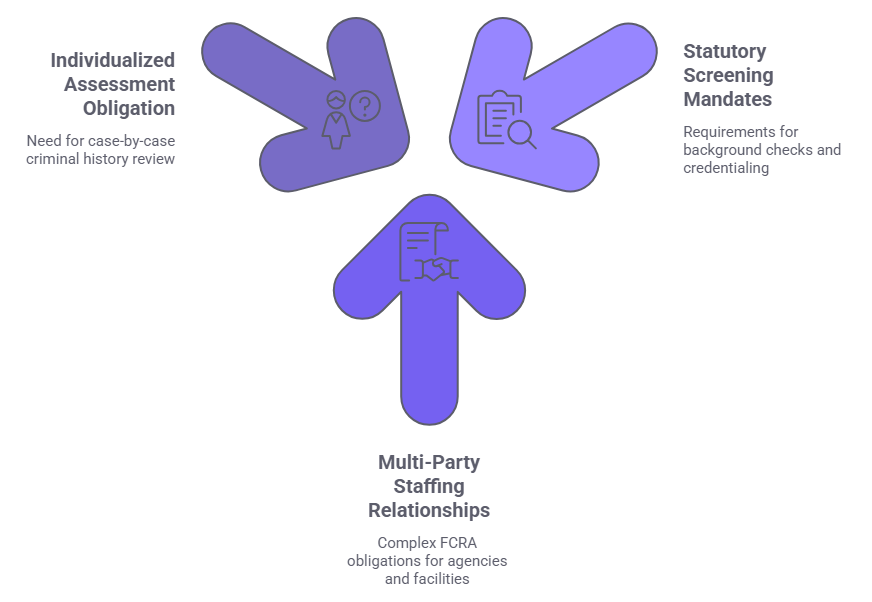
- Statutory screening mandates. Healthcare employers must satisfy FCRA’s standard sequence while also complying with OIG exclusion checks, state healthcare worker registry requirements, and facility-specific credentialing standards. Some of these mandates require criminal history inquiry before a conditional offer. This creates a direct conflict with FCRA’s best practice sequence and with ban-the-box laws in covered states.
- Multi-party staffing relationships. When a staffing agency places a clinical worker at a healthcare facility, FCRA obligations may attach independently to both parties. The standard single-employer FCRA model does not address this structure, and most agency-facility contracts do not resolve it.
- The individualized assessment obligation. Healthcare employers often invoke patient safety to justify blanket criminal history policies. That argument is legally available in narrow cases but is routinely applied more broadly than the law allows. The result is FCRA adverse action exposure combined with Title VII disparate impact liability.
When it comes to recruiting in the healthcare sector, compliance becomes more complex where patient safety, staffing, and regulatory issues coincide. One major danger is that of assuming that time and pressure can make up for a lack of process. Successful healthcare organizations are those that have developed systems that can balance between urgency and consistency, and documentation and personal attention. In a high-trust environment like healthcare, hiring process defense is just as important as competence. �
Step 1: Disclosure and Authorization
The Standalone Requirement
FCRA requires that the disclosure given to an applicant before a background check consist solely of the disclosure. The document may contain nothing else. This is a statutory requirement under 15 U.S.C. Section 1681b(b)(2)(A), not a formatting preference. Healthcare onboarding packets are dense. They typically include state-mandated forms, credentialing authorizations, policy acknowledgments, and licensing paperwork alongside employment documents. This creates a systematic violation risk. The fix is straightforward: the FCRA disclosure must be a separate document, provided before any other onboarding materials, and kept as a standalone record.
Electronic Authorization and Common Errors
Electronic authorization for background checks is permitted under FCRA when it meets the requirements of the Electronic Signatures in Global and National Commerce Act. The applicant must actively consent, and the authorization must be separate from the disclosure. Healthcare employers using applicant tracking systems should confirm that their electronic workflow produces a distinct, identifiable FCRA disclosure document. It should not embed the disclosure within a multi-step application flow in a way that hides its standalone character. A frequent error in healthcare is a single-click authorization that covers both FCRA background check consent and facility-specific credentialing authorization at the same time. These are separate authorizations with separate legal bases and should therefore be presented and collected independently.
Step 2: Permissible Purpose and CRA Certification
Employer Certification Obligations
Before a CRA may provide a consumer report for employment purposes, the employer must certify three things: that it has a permitted purpose, that it has provided the required disclosure and received authorization, and that it will not use the report in violation of any applicable law. The employer remains legally responsible for the accuracy of this certification. A healthcare employer that certifies FCRA disclosure compliance and then delivers a bundled disclosure has breached its certification obligation to the CRA. This creates civil liability independent of any FCRA violation the applicant may assert directly.
The Multi-Party CRA Problem in Healthcare Staffing
When a staffing agency places a nurse or clinical worker at a facility, both parties may independently obtain consumer reports on the same person. Each report requires a separate disclosure, a separate authorization, and a separate CRA certification. In practice, most agency-facility arrangements do not address this clearly. The applicant may have authorized one check but not the other. Alternatively, both disclosures may have been delivered in a combined format that satisfies neither party’s standalone requirement. Resolving this requires clear contract language about which party obtains which report, who provides the corresponding disclosure, and how adverse action accountability is assigned if a finding occurs.
Step 3: Adverse Action
The Two-Step Sequence
The FCRA adverse action process is a two-step sequence, and both steps are required. Step one is the pre-adverse action notice. Before taking any adverse action based in whole or in part on a consumer report, the employer must give the applicant a written notice. This notice must include a copy of the report and a copy of the Summary of Rights Under the FCRA. The employer must then allow a reasonable waiting period, generally at least five business days per CFPB and FTC guidance. This gives the applicant time to review the report and dispute any inaccurate information.
Step two is the final adverse action notice. It identifies the CRA, states that the CRA did not make the decision, and tells the applicant of their right to dispute the report’s accuracy and get a free copy within 60 days. Skipping the pre-adverse action notice and going directly to a final decision is among the most common and most litigated FCRA violations in healthcare hiring programs. It is also one of the most documentable, because it is objectively verifiable and generates statutory damages without requiring the applicant to prove actual harm.
Clinical Staffing Urgency and Adverse Action Compression
Clinical positions have start dates set by the facility, not the agency. When a background check returns a finding close to a start date, the employer faces pressure to skip the pre-adverse action step. The waiting period is not negotiable. An employer who proceeds with an adverse decision before the waiting period ends has violated FCRA regardless of the clinical urgency involved. The correct response is to start background checks early enough in the hiring timeline that the waiting period does not fall on the critical path to a start date. For per-diem and travel placements where timelines are compressed by nature, this requires a specific process design that starts screening at the earliest possible stage.
Documentation Requirements
Every step in the adverse action process must be documented. The employer should keep the pre-adverse action notice, proof of delivery, the waiting period record, and the final adverse action notice for each adverse decision. Many healthcare programs carry out the adverse action steps correctly but fail to keep the documentation. This leaves them unable to show compliance when challenged. Documentation retention should be part of the program design from the start.
Individualized Assessment in Clinical Hiring
The Legal Obligation and Its Healthcare Application
Individualized assessment means evaluating a specific criminal history finding against a specific role before taking adverse action. Title VII’s disparate impact framework requires it, and it is also part of a defensible FCRA adverse action process. The assessment must consider the nature and gravity of the offense, the time elapsed since the offense or completion of sentence, and the direct relationship between the offense and the job duties.
EEOC guidance has historically identified these as the core assessment factors. However, the specific guidance documents have been subject to revision and change. Employers should therefore confirm the current operative framework with qualified legal counsel. The underlying Title VII obligation to conduct individual review remains in force regardless of the status of any specific agency guidance.
In healthcare, the link between offense type and job duties is often clearer than in general employment. A conviction for patient abuse has an obvious connection to a direct patient care role. However, the same logic does not automatically extend to all clinical roles, all offense types, or all timeframes. A medication theft conviction from 12 years ago, assessed against a non-dispensing administrative role, requires individual analysis rather than automatic rejection.
Where Healthcare Employers Overextend the Patient Safety Rationale
Patient safety is a valid individualized assessment factor for roles that involve direct patient contact, access to medications, or supervision of vulnerable people. It is not a blanket override that removes the individualized assessment obligation for all healthcare positions. A healthcare employer who rejects all applicants with any felony conviction for any clinical role, without documented individual assessment, is applying a blanket rule rather than a patient safety analysis. That rule creates Title VII disparate impact exposure. It also fails to meet the FCRA adverse action standard, which requires record-specific review before an adverse decision is made. The documentation requirement is not optional. It is the evidence that separates a defensible adverse action from an actionable one.
FCRA and Statutory Screening: The Sequencing Conflict
The Core Tension
FCRA’s standard framework assumes a conditional-offer-before-background-check sequence. Healthcare employers cannot always follow this. Federal law requires background screening of certified nursing assistants before employment in Medicare and Medicaid-certified facilities. The OIG exclusion check must be completed before a covered individual begins providing federally reimbursed services. Some state healthcare worker registry statutes require registry checks before the first day of work, not after a conditional offer. These mandates do not align with FCRA’s implied best practice sequence. They also directly conflict with ban-the-box delayed inquiry requirements in states without healthcare carve-outs.
Navigating the Conflict in Practice
The resolution requires distinguishing between screening components that are consumer reports under FCRA and those that are not. An OIG LEIE exclusion check run directly by the employer against a public federal database is not a consumer report under FCRA. The employer obtains it directly, not through a CRA. Therefore, FCRA’s disclosure-and-authorization sequence does not apply to the LEIE check itself. However, if the LEIE check is bundled into a CRA-produced report, the combined product becomes a consumer report and the full FCRA process applies.
State registry checks vary by method. Some states give employers direct access to registry databases that are not CRA-sourced. Others route registry data through credentialing services that may qualify as CRAs. Healthcare employers should therefore confirm with qualified legal counsel which parts of their screening program are consumer reports under FCRA and which are not. This ensures the disclosure, authorization, and adverse action obligations apply to the right components.
FCRA Obligations for Staffing Agencies in Healthcare
When FCRA Obligations Attach to the Agency
A healthcare staffing agency that obtains a consumer report on a candidate is a user of that report under FCRA. It must provide the standalone disclosure, obtain authorization, certify to the CRA, and follow the adverse action process if a finding affects the placement decision. The FCRA’s employment provisions apply to consumer reports used in hiring decisions, and the consensus view covers temporary and contingent placements. Agencies should confirm with qualified legal counsel that all placement types in their operations fall within the FCRA’s employment definition.
The adverse action obligation is especially significant for agencies. In a placement context, adverse action may mean deciding not to place a worker at a particular facility, not adding the worker to an approved vendor list, or removing a worker from active placement status. Each of these decisions, if based in whole or in part on a consumer report, triggers the full two-step adverse action process.
When Obligations Extend to the Facility
A healthcare facility that receives background check results from a staffing agency and uses those results in its own credentialing or access decision may independently qualify as a user of a consumer report under FCRA. FTC guidance has indicated that employers who receive and rely on third-party-obtained background check results in hiring decisions may be treated as users of those reports. However, the specific facts of each arrangement determine the applicable obligations. The safest approach is for facilities to treat their use of agency-provided results as triggering their own FCRA obligations, including adverse action accountability. Contractual clarity about FCRA responsibility is the right risk management tool for both parties.
Common FCRA Failure Modes in Healthcare Programs
The Five Failure Modes Most Likely to Generate Liability
The following failure modes reflect common patterns in healthcare employer compliance programs. Each is specific to the healthcare context and each creates documentable FCRA liability.
| Failure Mode | Severity | Healthcare-Specific Driver |
| Disclosure form bundled with other onboarding documents | High | Healthcare onboarding packets are dense. The FCRA standalone requirement is frequently violated in multi-document packet formats. |
| Pre-adverse action notice skipped under time pressure | High | Clinical staffing urgency creates pressure to move fast. Pre-adverse notice and waiting period steps are the most commonly skipped. |
| Blanket criminal history policy without individualized assessment | High | Healthcare employers overuse patient safety rationale to justify blanket policies that do not satisfy individualized assessment requirements. |
| Staffing agency and facility both running checks without coordinated FCRA process | Medium | Dual-CRA usage creates duplicate authorization issues and unclear adverse action accountability that neither party has formally resolved. |
| FCRA process designed for permanent hires applied unchanged to per-diem or travel placements | Medium | Rapid-cycle placements compress the adverse action timeline in ways the standard FCRA process does not accommodate. |
Each of these failure modes is correctable through process redesign rather than legal remedy. Identifying and fixing them before a complaint or litigation event costs a fraction of the defense and settlement cost after.
FCRA Compliance Checklist for Healthcare Employers
Pre-Screening Requirements
Before obtaining any consumer report, the healthcare employer must complete the following steps in order.
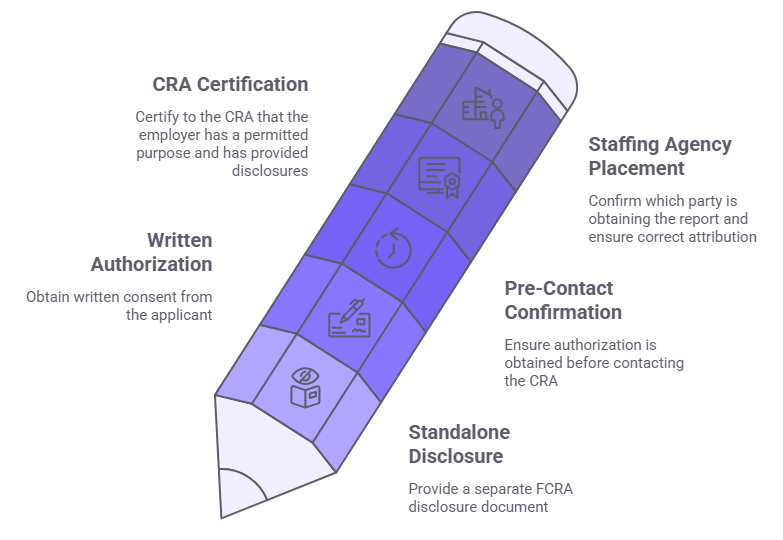
- Provide a standalone FCRA disclosure document containing nothing other than the disclosure. Do not bundle it with any other form.
- Obtain written authorization from the applicant separately from the disclosure.
- Confirm the authorization is obtained before the CRA is contacted, not after.
- Certify to the CRA that the employer has a permitted purpose and has provided all required disclosures.
- For staffing agency placements, confirm which party is obtaining the report and ensure the corresponding disclosure and authorization are correctly attributed to that party.
Adverse Action Requirements
If a consumer report finding is a factor in a decision not to hire or place, the employer must complete the following steps in order.
- Provide the applicant with a pre-adverse action notice that includes a copy of the consumer report and the CFPB Summary of Rights Under the FCRA.
- Allow at least five business days, per CFPB and FTC guidance, for the applicant to review and dispute before taking any final action.
- Conduct and document individualized assessment for any non-statutory finding before proceeding to final adverse action. Confirm the current operative individualized assessment framework with qualified legal counsel, as EEOC guidance documents on this topic have been subject to revision and change.
- Provide a final adverse action notice identifying the CRA, stating that the CRA did not make the decision, and informing the applicant of their dispute rights.
- Retain all adverse action documentation, including delivery records and waiting period logs.
Ongoing Program Requirements
Beyond individual hire events, the healthcare employer’s FCRA compliance program must maintain the following on an ongoing basis.
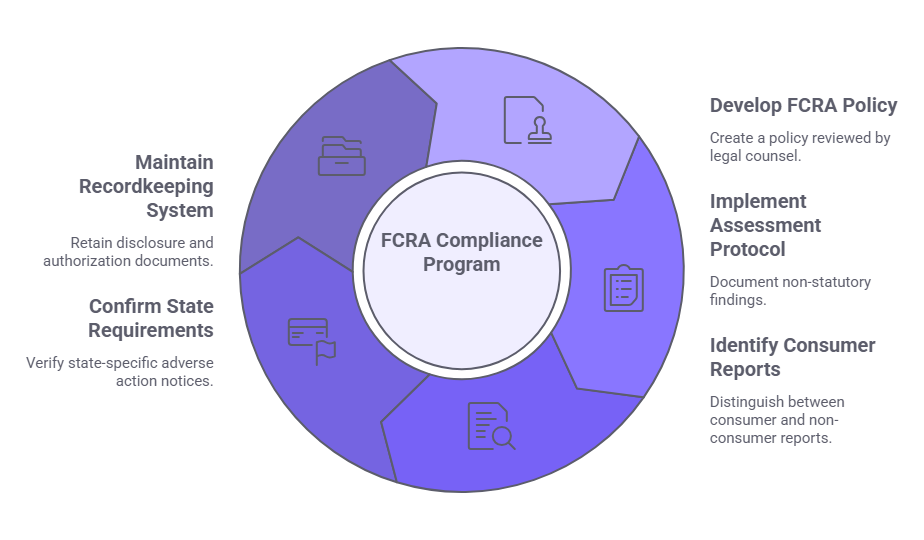
- A written FCRA policy reviewed by qualified legal counsel and updated to reflect current state law, including ban-the-box requirements in each hiring state.
- An individualized assessment documentation protocol covering all non-statutory findings.
- A confirmed understanding of which screening components are consumer reports under FCRA and which are not.
- For multi-state programs, confirm state-specific adverse action notice requirements with qualified legal counsel in each hiring state, as several states, including California, New York, and others, impose obligations that exceed the federal FCRA floor, including additional notice content and delivery requirements.
- A recordkeeping system that retains disclosure, authorization, and adverse action documents for the applicable retention period.
Conclusion
FCRA compliance for healthcare employers is not a checkbox exercise. It is a program design challenge that requires coordinating the statute’s requirements with statutory screening mandates, staffing structure, and a higher-stakes individualized assessment obligation. Healthcare employers who follow a generic FCRA checklist will meet the minimum form requirements while leaving the most significant liability exposures unaddressed. Building a defensible program means understanding the healthcare-specific failure modes, resolving the sequencing conflicts with other screening obligations, and executing the adverse action process correctly under the time pressures that clinical hiring creates. All FCRA compliance decisions should be reviewed with qualified legal counsel.
Frequently Asked Questions
The Frequently Asked Questions list brings out some of the most common compliance problems that health care facilities encounter when screening their clinical employees. Owing to the fact that health care recruitment takes place under urgent circumstances and stringent regulations, having an adequate knowledge of FCRA duties becomes mandatory. The answers provided below will be useful for you in creating better compliance in your recruitment process.
What does FCRA compliance require of healthcare employers?
Healthcare employers must provide a standalone written disclosure before obtaining a background check, receive written authorization from the applicant, certify their permitted purpose to the consumer reporting agency, and follow a two-step adverse action process if a report finding affects the hiring decision. These obligations apply regardless of employer size, role urgency, or patient safety considerations. Healthcare-specific statutory screening mandates operate alongside these requirements, not instead of them.
What is the standalone disclosure requirement and why does it matter?
The FCRA requires that the disclosure provided before a background check consist solely of the disclosure and nothing else. Healthcare employers frequently violate this by bundling the disclosure with employment applications or onboarding paperwork. A bundled disclosure does not satisfy the standalone requirement regardless of whether the applicant signs it.
What is the FCRA adverse action process in healthcare hiring?
The adverse action process has two required steps. First, provide the applicant with a pre-adverse action notice including the consumer report and a Summary of Rights, then allow a reasonable waiting period that CFPB and FTC guidance indicates is generally at least five business days. Second, issue a final adverse action notice identifying the consumer reporting agency and the applicant’s dispute rights. Skipping the first step is among the most common and most litigated FCRA failures in healthcare programs.
Do staffing agencies have FCRA obligations when placing clinical workers?
Yes. A staffing agency that obtains a consumer report on a candidate is a user of that report under FCRA and must satisfy all corresponding obligations, including standalone disclosure, authorization, CRA certification, and adverse action requirements. These obligations apply to short-term and per-diem placements as well as permanent hires. Agencies should confirm with qualified legal counsel that all placement types in their operations fall within the FCRA’s employment definition.
Does the OIG exclusion check count as an FCRA background check?
An OIG LEIE exclusion check run directly by the employer against the public federal database is not a consumer report under FCRA because the employer obtains it directly, not through a CRA. However, if the LEIE check is bundled into a CRA-produced report, the combined product is a consumer report and the full FCRA process applies.
How does individualized assessment work in healthcare hiring?
Individualized assessment requires evaluating a specific criminal history finding against a specific role before taking adverse action. The assessment must consider the nature and gravity of the offense, the time elapsed, and the direct relationship between the offense and the job duties. Patient safety is a valid factor for direct-care roles but does not justify blanket rejection policies across all healthcare positions. The current operative framework should be confirmed with qualified legal counsel.
How do ban-the-box laws affect FCRA compliance in healthcare?
Ban-the-box laws restrict when employers may ask about criminal history, which conflicts with healthcare statutory screening mandates that require checks before employment in some regulated roles. Some states have healthcare carve-outs, and others do not. Healthcare employers in states with active ban-the-box laws must confirm with qualified legal counsel whether their roles fall within an applicable exemption.
What records should healthcare employers keep for FCRA compliance?
Healthcare employers should retain the standalone disclosure, signed authorization, CRA certification, pre-adverse action notice and delivery confirmation, waiting period record, individualized assessment documentation, and final adverse action notice for each hiring decision involving a consumer report. These records are the primary evidence of FCRA compliance in litigation or regulatory review.
Additional Resources
- CFPB: Summary of Consumer Rights Under the FCRA
https://www.consumerfinance.gov/consumer-tools/credit-reports-and-scores/consumer-reporting-companies/fcra-summary-of-rights/ - FTC: Using Consumer Reports for Employment Purposes
https://www.ftc.gov/business-guidance/resources/using-consumer-reports-employment-purposes - EEOC Enforcement Guidance on Consideration of Arrest and Conviction Records in Employment Decisions
https://www.eeoc.gov/laws/guidance/enforcement-guidance-consideration-arrest-and-conviction-records-employment-decisions - OIG List of Excluded Individuals and Entities (LEIE) Search Tool
https://exclusions.oig.hhs.gov - 15 U.S.C. Section 1681: Fair Credit Reporting Act Full Text
https://www.govinfo.gov/content/pkg/USCODE-2022-title15/pdf/USCODE-2022-title15-chap41-subchapIII.pdf - CMS: Background Check Requirements for Long-Term Care
https://www.cms.gov/Medicare/Provider-Enrollment-and-Certification/SurveyCertificationGenInfo/Downloads/Survey-and-Cert-Letter-12-46.pdf

ABOUT THE CREATOR
Charm Paz, CHRP
Recruiter & Editor
Charm Paz is an HR professional at GCheck, specializing in background screening, fair hiring, and regulatory compliance. She holds from the Professional Background Screening Association (PBSA) and helps organizations navigate employment regulations with clarity and confidence.
With a background in Industrial and Organizational Psychology, she translates policy into practice to build ethical, compliant, human-centered hiring systems that strengthen decision-making over time.