


Reference checks and self-reported employment history have long served as the final backstop in hiring verification, but recent data reveals a systematic problem: candidates are not just embellishing their qualifications, they are actively scripting the instruments employers use to catch embellishment. According to GCheck’s 2026 Trust in Hiring Report, based on a survey of 1,500 U.S. full-time workers who actively applied for jobs in the prior 18 months, 93% admitted to at least one form of misrepresentation, and nearly half had coordinated their references in advance. The result is a verification process that produces the feeling of due diligence without delivering genuine signal.
Key Takeaways
- 93% of recent job seekers admitted to at least one form of embellishment or misrepresentation during the hiring process.
- 45% of candidates coached their references on what to say, meaning nearly half of all reference calls follow a candidate-scripted narrative.
- 41% had a friend or family member pose as a professional reference, and 33% asked a coworker to impersonate a manager or supervisor.
- Only 26% of embellishers reported that an employer actually detected a discrepancy, suggesting the verification process catches far less than it appears to.
- Only 28% of embellishers lost an opportunity as a result of a detected discrepancy, meaning even detection rarely produces consequences.
- 53% of embellishers acted because they believed employers would not verify everything, creating a self-reinforcing cycle of low deterrence and rising deception.
- 56% of candidates did not know what employers can see or verify, which fuels the perception that embellishment carries minimal risk.
- Independent verification, meaning direct confirmation from source-of-record institutions rather than candidate-provided contacts, addresses the structural gap that reference coaching cannot defeat.
The Institutional Trust Problem
Why Reference Checks Became the Default Backstop
Reference checks hold a specific and trusted position in most hiring workflows. After teams screen resumes, conduct interviews, and score assessments, the reference call serves as a final validation layer. It is the step where a neutral third party, someone who has actually worked with the candidate, confirms or contradicts the picture the candidate has presented.
This trust is not arbitrary. Reference checks offer something that documents cannot: a human account of observed behavior. An employer calling a previous manager expects candor, and they expect that manager’s perspective to work as an independent check on what the candidate has claimed. That expectation is the problem. It rests on an assumption that has become increasingly hard to sustain: that the people a candidate lists as references have not been prepared, coached, or replaced.
What Employers Believe the Process Delivers
Most hiring teams treat a completed reference check as a meaningful signal. If a reference confirms employment dates, describes the candidate positively, and answers follow-up questions clearly, the team considers the process complete.
The underlying model assumes independent confirmation. The reference exists outside the candidate’s control, holds their own memory and professional judgment, and has no reason to mislead. This model is structurally reasonable. Based on current data, however, it no longer holds.
Self-Reported History and the Verification Assumption
When a candidate submits their employment history, most verification processes treat those claims as accurate unless something contradicts them. What this model misses is the degree to which the self-reported record shapes what verification can find. If a candidate has adjusted their dates, inflated their title, and prepared their references to confirm those changes, the verification process does not catch manipulation. It confirms it.
One area that HR teams should consider putting more effort into is the distinction between doing a reference check and performing an actual verification of information from scratch. In my opinion, preparation of candidates has become a much more advanced practice than before. Therefore, the simple act of reference checks might prove to be inadequate for providing a degree of certainty as assumed by many companies. I think strong hiring processes are not built on blind trust or fear. They are built on layered verification, consistency, and clear communication about what will actually be validated throughout the process. �
The Three-Layer Reference Manipulation Playbook
How Common Is Reference Manipulation?
Reference manipulation in hiring is more widespread and more coordinated than most HR professionals expect. Researchers measured three distinct manipulation behaviors across the candidate population, each targeting a different point of contact in the verification process.
| Behavior | Prevalence |
| Coached references on what to say | 45% |
| Had a friend or family member pose as a professional reference | 41% |
| Asked a coworker to impersonate a manager or supervisor | 33% |
These are not isolated behaviors. They form a layered counter-strategy that targets every point of contact in the reference verification process: what references say, who picks up the phone, and what professional relationship the caller claims to hold.
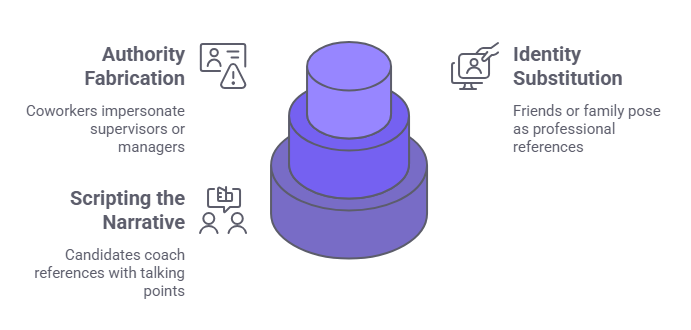
Layer One: Scripting the Narrative
Coaching a reference is the most common behavior and the hardest to detect. When nearly half of candidates brief their references with specific talking points, the reference call becomes a performance rather than an independent account. The employer does not hear someone recalling their own experience. They hear a version of events the candidate has approved in advance.
This does not require the reference to lie outright. Selective emphasis, rehearsed phrasing, and careful omission can shape a reference call without triggering obvious red flags. A well-coached reference sounds credible precisely because they prepared to sound that way.
Layer Two: Identity Substitution
Having a friend or family member pose as a professional reference moves beyond narrative control into identity substitution. The employer believes they are speaking with a former colleague or manager, but they are speaking with someone who holds no professional relationship with the candidate at all. At 41%, this is not a fringe behavior. It turns the reference call from a verification step into a vulnerability, and better questions do not close that gap if the person answering is not who they claim to be.
Layer Three: Authority Fabrication
Asking a coworker to impersonate a supervisor or manager targets the most influential reference type. A peer vouching for a candidate carries weight, but a manager confirming performance, responsibilities, and reporting relationships carries far more. When 33% of candidates place coworkers in that role, the implied authority of the managerial reference no longer holds at scale. Taken together, these three layers mean a completed reference check can confirm coaching, impersonation, and authority fabrication, all while appearing to confirm genuine professional history.
The Detection Gap
What Employers Are Actually Catching
If reference manipulation is this common, the natural question is: what does detection look like? Only 26% of those who embellished reported that an employer found a discrepancy.
Many readers misinterpret this figure. The common reading is that 74% of candidates embellished successfully because their claims were minor or hard to catch. The more accurate reading is that the detection instruments had already been prepared to produce clean results. When candidates coach references, substitute identities, and fabricate authority, a clean check does not signal accuracy. It signals that the manipulation worked before the check began.
The Consequence Gap
Detection, when it does occur, rarely changes the outcome. The data shows a compounding effect across two thresholds.
| Stage | Rate |
| Embellishers whose discrepancy was detected | 26% |
| Of those detected, who lost an opportunity | 28% |
A candidate weighing whether to embellish faces not just a low probability of detection, but an even lower probability that detection will cost them anything. When the expected cost runs this low, embellishment becomes a rational calculation, even for candidates who know it creates organizational risk. This does not mean all detected misrepresentation warrants the same employer response, as applicable law may require individual assessment before an employer takes adverse action.
Hiring Fraud Detection Rates in Context
The gap between how often manipulation occurs and how rarely employers catch it creates a false confidence problem. An HR team that checks every finalist and flags discrepancies in 26% of cases is not running an effective process. The 74% clean checks are not clean because nothing was wrong. They are clean because the manipulation finished before the check started. A low disqualification rate from reference checks is not a sign of strong candidates. It may be a sign of a compromised instrument.
The Verification Feedback Loop
How Low Detection Licenses Higher Embellishment
The link between detection rates and embellishment behavior is not a coincidence. It is causal. 53% of embellishers cited the belief that employers would not verify everything as a reason for their behavior. This is the feedback loop running:
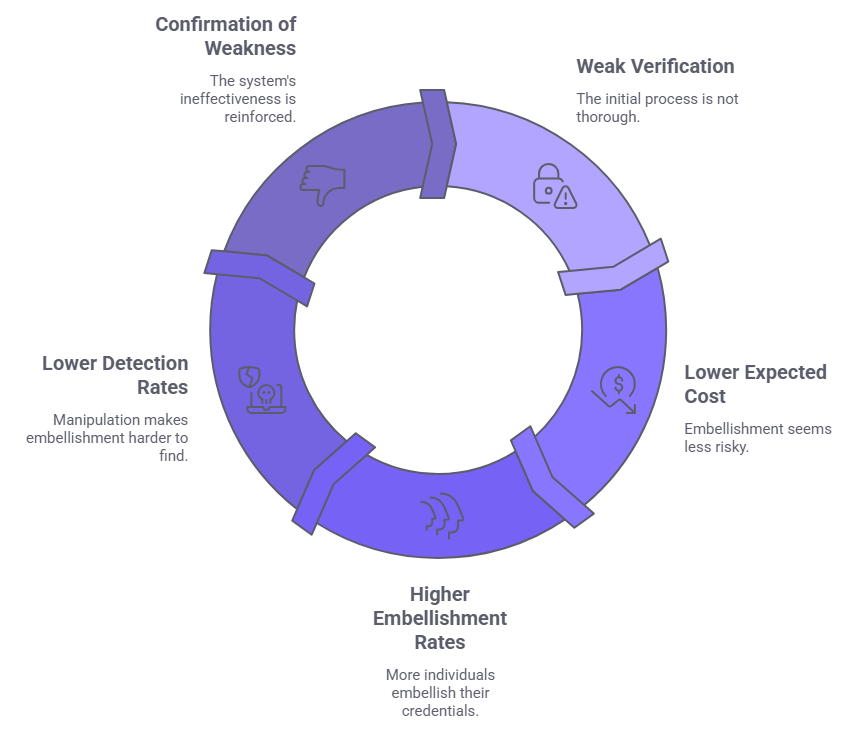
- Weak verification creates the perception of weak verification.
- That perception lowers the expected cost of embellishment.
- Lower expected costs push embellishment rates higher.
- Higher embellishment rates, combined with manipulation that defeats detection instruments, push detection rates lower.
- Lower detection rates confirm the perception that the system is not checking closely.
Each cycle through this loop makes embellishment more rational, more common, and harder to catch.
Why the Loop Accelerates
The feedback loop does not correct itself. No natural force raises detection rates as embellishment grows more sophisticated. Coached references do not begin to sound coached. Impersonators do not begin to sound unprofessional. The only way to break the loop is to change the verification method. As long as employers rely on candidate-provided contacts and self-reported history, the candidate holds the preparation advantage.
Candidate Misrepresentation Statistics and Market Norms
93% of recent job seekers admitted to at least one form of embellishment or misrepresentation. This is not a population of bad actors. It is a population responding to an incentive structure that rewards polish and applies minimal consequences to inaccuracy. Treating embellishment as a market behavior, rather than a character flaw, is essential to diagnosing the verification problem correctly. Candidates who embellish most are reading the system accurately and acting on what they find.
False Confidence vs. Genuine Signal
The Difference Between Completing a Check and Running One
Completing a reference check and running one that produces genuine signal are not the same thing. A completed check confirms that calls went out, that references answered, and that no obvious contradictions came up. A check that produces genuine signal confirms that the people contacted were who they claimed to be, that their accounts were independent, and that their answers reflected real professional knowledge of the candidate.
Most organizations complete checks. Very few can confirm they produce genuine signal. A reference check run against coached or fabricated contacts may produce limited actionable signal. The degree to which any screening step reduces organizational risk depends on the methods used, the role in question, and applicable legal requirements, which vary by jurisdiction.
Are Reference Checks Reliable?
Reference checks remain a standard and appropriate step in hiring verification. Their reliability as an independent signal, however, has suffered from the scale of coordinated candidate preparation the data documents. A reference check produces the most reliable results when employers identify contacts independently, rather than accepting the names a candidate supplies. It produces the least reliable results when the candidate controls who receives the call, what that person says, and whether that person actually held the claimed role.
The Institutional Confidence Problem
Organizations that rely heavily on reference checks as their primary verification tool operate with more confidence than the data supports. The reference check process has not changed significantly as reference manipulation has grown more coordinated. The background check vs. reference check distinction matters here. Background checks that draw on independent data sources do not carry the same preparation vulnerability that reference calls do. Reference checks add value as qualitative context. They do not reliably confirm facts when candidate-controlled contacts supply the answers.
What Self-Reported History Can and Cannot Verify
What Self-Reported History Actually Contains
When a candidate submits their employment history, they hand employers a set of claims that most verification processes accept as accurate unless something contradicts them. Each element carries a specific manipulation risk, documented across the candidate population surveyed.
| Misrepresentation Type | Prevalence |
| Adjusted employment dates | 45% |
| Inflated job title | 34% |
| Described termination as voluntary | 34% |
| Listed fake references | 27% |
| Claimed unearned educational credentials | 25% |
The attack surface for self-reported history extends well beyond reference checks, and each category presents a distinct challenge for verification.
Employment Verification Gaps by Category
Date manipulation is particularly hard to catch through reference calls, because most references cannot recall exact start and end dates. Title inflation resists reference-based detection for the same reason: a coached reference confirms an inflated title without hesitation. The categories that candidate preparation cannot easily reach are those confirmed directly against records held by institutions: educational credentials through degree verification, employment dates through payroll or HR records, and professional licenses through official registries. These sources hold no relationship with the candidate and do not respond to coaching.
How to Verify Employment History Accurately
Verification processes that produce genuine signal share one structural feature: they confirm claims against sources that sit outside the candidate’s network. In practice, this means:
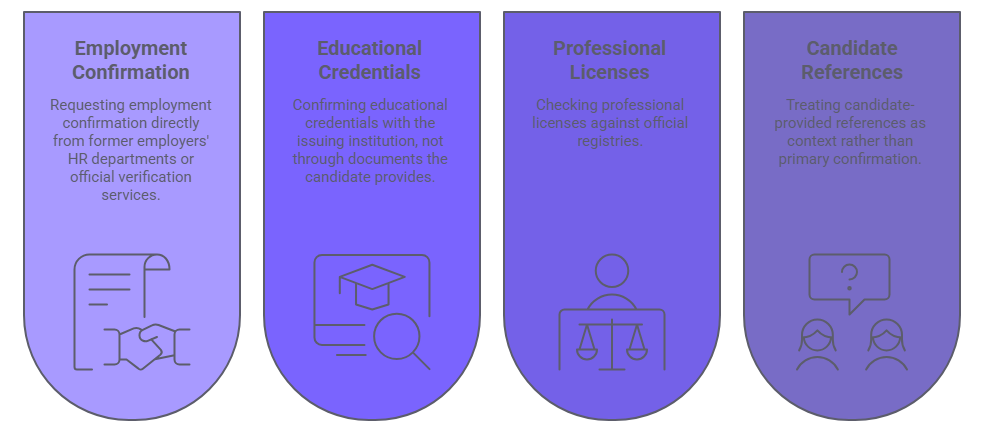
- Requesting employment confirmation directly from former employers’ HR departments or official verification services.
- Confirming educational credentials with the issuing institution, not through documents the candidate provides.
- Checking professional licenses against official registries.
- Treating candidate-provided references as context rather than primary confirmation.
Reference calls carry more weight when employers identify contacts independently, such as through direct HR contacts at former employers, rather than names the candidate supplies.
The Structural Response
Why the Gap Requires a Structural Fix
More reference calls, better questions, and recruiter training do not close the verification gap this article describes. The manipulation happens before the call starts. Candidates substitute identities before the phone rings and coordinate narratives before anyone asks a question. Closing the gap means moving verification to sources that no candidate can prepare in advance.
What Independent Verification Addresses
Independent source verification means confirming employment and credential history directly with the institutions that hold those records. These sources hold no direct relationship with the candidate and do not carry the same preparation risks that affect candidate-controlled contacts. No verification method eliminates all risk, but source-of-record confirmation cuts the attack surface that reference coaching and identity substitution exploit.
- Direct employment verification confirms dates and titles against payroll or HR records, not candidate-provided contacts.
- Credential verification confirms degrees and certifications against records held by the issuing institution, not self-reported claims.
- Professional license verification confirms current standing against official registries.
When any of these steps involve consumer reports that a consumer reporting agency produces, federal law sets specific requirements for disclosure, authorization, and the steps an employer must take before acting on the findings. Requirements vary and employers should verify them with legal counsel.
Positioning Reference Checks Within a Multi-Layer Process
The case here is not for eliminating reference checks. It is for repositioning them. Reference calls, especially with contacts employers identify independently, provide qualitative context about working style, team fit, and collaboration that records cannot capture. The problem arises when reference calls serve as the primary tool for confirming factual claims about employment history, credentials, and dates. Independent source verification handles that function. Reference calls contribute most when employers already hold confirmed facts and use the call to add human context.
Transparent Communication as a Pre-Screening Deterrent
The 56% Who Don’t Know What Will Be Checked
56% of candidates reported that not knowing what employers can see or verify was among their primary concerns. When candidates do not know what employers will check, they assume the answer is minimal and adjust their behavior accordingly. This is where a deterrence-based approach to verification begins. A candidate who knows that employers confirm employment dates through institutional records, not just reference calls, makes a different choice than one who expects only a reference call.
Reference Check Best Practices: Transparency as Architecture
The most effective reference check best practices extend beyond the call itself. They include the communication structure around the entire verification process. Organizations benefit from:
- Stating verification scope in the job posting or application process.
- Specifying which categories of history they will confirm and through what methods.
- Making clear that employers confirm factual claims against source records, not only through candidate-provided contacts.
This approach serves two purposes. It deters embellishment by raising the perceived chance of detection, and it builds candidate trust by showing that the screening process follows consistent, defined rules rather than arbitrary ones.
Screening Communication and the Trust Equation
82% of surveyed workers wanted a clear explanation of what employers would check, a figure that spans both embellishers and honest candidates. 80% said ongoing or periodic background screening matters, which suggests the workforce accepts screening as fair when employers communicate it clearly. The hiring process does not require a trade-off between strong verification and candidate trust. It requires verification that is both structurally sound and clearly communicated, so candidates understand what employers will confirm before they submit claims that will not hold up.
Conclusion
GCheck’s 2026 Trust in Hiring Report documents a verification environment that candidates have systematically compromised from the supply side. The 26% detection rate does not show that embellishment is rare. It shows that the instruments employers most commonly use to catch embellishment have already been defeated. Closing this gap requires verification that draws on sources no candidate can prepare, combined with clear communication that raises the perceived cost of misrepresentation before candidates submit their applications.
About the 2026 Trust in Hiring Report
The 2026 Trust in Hiring Report is a proprietary research study published by GCheck, based on a national survey of 1,500 U.S. adults employed full-time who actively applied for at least one job in the past 18 months. Fielded February 14-22, 2026 via Pollfish, the study examines how Careerfishing, AI-assisted deception, identity concealment, and broken verification expectations are reshaping the employer-candidate trust gap. The report introduced the Careerfishing framework and documented that 93% of recent job seekers have engaged in at least one form of resume embellishment or misrepresentation. The full report, including methodology, demographic breakdowns, and the Compliance for Good framework for rebuilding trust in hiring, is available at gcheck.com/whitepapers/trust-in-hiring-report/.
Frequently Asked Questions
How common is reference manipulation in job applications?
Reference manipulation in hiring is widespread. 45% of candidates coached their references on what to say, 41% had a friend or family member pose as a professional reference, and 33% asked a coworker to impersonate a manager or supervisor. These behaviors form a coordinated strategy, not a set of isolated incidents.
Are reference checks reliable as a hiring verification tool?
Reference checks remain a standard step in hiring, but their reliability as an independent signal has suffered. When nearly half of candidates prepare their references in advance, and when 41% substitute non-professional contacts, the reference call confirms a candidate-managed narrative. Employers get the most reliable results when they identify contacts independently rather than accepting the names candidates provide.
What is the current hiring fraud detection rate?
Only 26% of candidates who embellished reported that an employer detected a discrepancy. Of those, only 28% lost an opportunity as a result. The expected consequence of embellishment, even when employers catch it, is low, which reinforces the behavior across the candidate population.
What is the difference between a background check and a reference check?
A reference check involves contacting individuals listed as professional contacts to gather accounts of a candidate’s history. A background check typically draws on independent institutional sources, such as criminal records, educational credential databases, or employment verification services. When those checks involve consumer reports that a consumer reporting agency produces, federal law sets specific requirements for disclosure, authorization, and the steps an employer must follow before taking adverse action. Requirements vary and employers should verify them with legal counsel.
What are the most effective reference check best practices for employers?
Effective practices include requesting employment confirmation directly from former employers’ HR departments, stating verification scope clearly in job postings, and using educational and credential databases to confirm claims independently. When any of these steps involve consumer reports that a consumer reporting agency produces, applicable federal and state requirements govern how employers may obtain and use those reports. Requirements vary and employers should verify them before proceeding.
What percentage of job applicants misrepresent their qualifications?
93% of recent job seekers admitted to at least one form of embellishment or misrepresentation. The most common behaviors included exaggerating expertise in a skill (61%), inflating the scope of previous roles (59%), and fabricating interview stories (47%). At the more serious end, 27% listed fake references and 25% claimed educational credentials they never earned.
How do employment verification gaps affect organizational risk?
When employers rely primarily on candidate-controlled sources, they cannot tell the difference between a candidate whose history is accurate and one whose references have been coached or substituted. This creates risk in two directions: hiring decisions that rest on unverified claims, and gaps in the organization’s documented due diligence because the process did not confirm facts against independent records. Organizations should consult legal counsel to understand how their verification practices interact with applicable federal and state requirements.
How does transparent communication about screening affect embellishment rates?
56% of candidates cited not knowing what employers can see as a primary concern. Candidates adjust their embellishment behavior based on what they expect employers to check. Organizations that communicate verification scope clearly before candidates apply raise the perceived chance of detection, which disrupts embellishment at the point of origin rather than trying to catch it afterward.
Additional Resources
- Federal Trade Commission, Fair Credit Reporting Act
https://www.ftc.gov/legal-library/browse/statutes/fair-credit-reporting-act - U.S. Equal Employment Opportunity Commission, Employment Tests and Selection Procedures
https://www.eeoc.gov/employee-rights/employment-tests-and-selection-procedures - U.S. Department of Labor, Employment Law Guide
https://webapps.dol.gov/elaws/ - Federal Trade Commission, Using Consumer Reports for Employment Purposes
https://www.ftc.gov/tips-advice/business-center/guidance/using-consumer-reports-employment-purposes

ABOUT THE CREATOR
Charm Paz, CHRP
Recruiter & Editor
Charm Paz is an HR professional at GCheck, specializing in background screening, fair hiring, and regulatory compliance. She holds from the Professional Background Screening Association (PBSA) and helps organizations navigate employment regulations with clarity and confidence.
With a background in Industrial and Organizational Psychology, she translates policy into practice to build ethical, compliant, human-centered hiring systems that strengthen decision-making over time.