


GCheck’s 2026 Trust in Hiring Report, a national survey of 1,500 job seekers conducted via Pollfish, found that 93% admitted to at least one form of embellishment or misrepresentation during the hiring process, with behaviors spanning every stage at once, from resume submission through remote interviews. The data reframes candidate fraud not as an isolated act but as a coordinated, multi-layer strategy that most employer verification systems were never built to detect.
Key Takeaways
- 93% of surveyed applicants admitted to at least one form of misrepresentation, making embellishment the norm rather than the exception.
- Misrepresentation spans five distinct categories at once: resume content, reference manipulation, identity presentation, AI use, and remote interview behavior.
- Only 12% of respondents believed candidate misrepresentation creates no business risk, meaning the vast majority of embellishers understand the consequences of their behavior.
- Single-point verification, typically reference checks alone, covers one attack surface while leaving four others open.
- 88% of all respondents, including those who embellished, agreed that candidate misrepresentation puts businesses at risk.
- 80% of respondents said ongoing or periodic background screening is important, signaling openness to better systems rather than blanket resistance to screening.
- 82% of respondents want a clear explanation of what employers are checking, making transparent communication the most useful deterrence lever available.
- Transparent, well-explained screening processes represent the most cost-effective deterrence tool available to employers operating in this environment.
The Deception Stack, Defined
Five Categories, One Coordinated System
Most organizations treat candidate fraud as a taxonomy problem: identify the lie type, build a check for it, and repeat. What the 2026 Trust in Hiring Report reveals, however, is that this approach is structurally inadequate. Candidate misrepresentation no longer operates as a taxonomy. It operates as a stack.
The report documents five categories: resume content misrepresentation, reference manipulation, identity or credential presentation, AI-assisted application behavior, and deception tied to remote or virtual interview conditions. Individually, each is a known hiring risk, and organizations have built responses to most of them. What the data shows, though, is that these categories are not happening in isolation. The same candidates deploy them across the same hiring process, driven by the same competitive pressures.
That is the deception stack. It is not a metaphor for “lots of lies.” Instead, it describes a system in which each layer reinforces the others. A candidate who misrepresents qualifications on a resume benefits from a fabricated reference who can vouch for those qualifications, an AI-polished cover letter that contextualizes the embellishments, and a virtual interview format that limits the employer’s ability to probe in real time. Remove any single layer and the others remain intact. Address only one layer through verification, and you have not reduced the risk. You have simply identified the surface your system happens to cover.
What the Scale of Embellishment Actually Means
The findings show that 93% of respondents admitted to at least one form of misrepresentation. That figure does not describe a deviant minority. It describes the hiring market as it currently operates. The behaviors range from exaggerating expertise in a skill, cited by 61% of respondents, to listing fake educational credentials, cited by 25%. Between those two endpoints lies a spectrum of 13 documented embellishment behaviors, covering inflation, fabrication, and concealment.
The breadth of that spectrum matters as much as the headline percentage. Misrepresentation is not concentrated in one layer. Instead, it spreads across every stage of the hiring funnel, from the resume a candidate submits to the interview they conduct remotely. That spread is what makes the deception stack concept useful: it names the system that the data describes.
Why Framing Matters for Verification Design
Understanding the stack concept is not an academic exercise. Rather, it is a prerequisite for understanding why verification strategies fail. If an organization believes “some candidates lie on their resumes,” the logical response is a resume verification protocol. If the correct model is “most misrepresenting candidates operate across multiple reinforcing layers,” the logical response is a verification architecture that covers all of them. The gap between those two mental models is where most hiring risk currently lives.
I believe one of the most significant challenges faced by the HR sector at the moment is recognizing that the fraud associated with job search no longer takes place at one point in time. Fraudulent practices can range from resumes and reference checks to AI-driven interviews or remote assessment. To me, what really caught my attention was how aware most applicants are of these threats, indicating that this problem is not merely human nature-based but also process-based. The companies who will adapt to these times well will probably be those that do not focus solely on detection but also on the creation of an honest process. �
The Scale of Misrepresentation
Reading the Full Distribution
The 93% embellishment rate is the headline, but the distribution across behavior types reveals the structural depth of the problem. Researchers documented 13 distinct embellishment behaviors, and the most common were not the most obvious. Candidates cited exaggerating expertise in a skill at 61%, and inflating the scope of previous roles at 59%. Neither behavior surfaces through a standard criminal background check or a basic reference call.
At the fabrication end of the spectrum, 27% listed fake references and 25% claimed educational credentials they never earned. Primary-source verification can detect these behaviors, but only if employers actually conduct it. The report found that only 26% of embellishers said someone verified their claims and found a gap, and only 28% lost an opportunity because of a detected exaggeration. When the probability of detection is this low, embellishment becomes a rational choice.
Depth of Misrepresentation Across Layers
Reference manipulation data shows how multi-layer the behavior has become. Among all 1,500 respondents, 45% coached a reference on what to say, 41% had a friend or family member pose as a professional reference, and 33% asked a coworker to pose as a manager or supervisor. These figures come from the full sample. Reference manipulation, in other words, is not a behavior limited to the most aggressive embellishers. It is broadly distributed across the applicant pool.
AI use follows a similar pattern. Sixty-one percent used AI to practice interview answers until they sounded more impressive than authentic. Forty-eight percent used AI to complete take-home assignments. Furthermore, 27% used AI during live interviews for real-time answer generation, and 25% used an AI avatar in a virtual meeting. These behaviors span a spectrum from preparation to active impersonation, yet they leave no trace in most standard hiring workflows.
The Non-Embellishing Population
The data confirms that 93% of respondents admitted to at least one embellishment, which places the non-embellishing population at roughly 7% of the sample. For HR leaders setting baseline assumptions, the realistic expectation is that most candidates engage in some degree of misrepresentation, and that a significant portion do so across multiple categories at once.
Why Single-Point Verification Fails
The Verification Gap by Layer
Standard employment verification tends to focus on one or two of the five deception layers. Reference checks cover the reference layer. Education and credential verification covers one part of the resume layer. Background checks, depending on their scope, may cover portions of the identity and criminal history dimensions. What most workflows do not cover, however, is the AI-assisted behavior layer and the remote interview behavior layer. That leaves two of five attack surfaces structurally open.
The problem is not only the uncovered layers. Covering one layer also creates a false sense of security. An organization that runs thorough reference checks has addressed the reference manipulation layer. It has not, however, addressed the resume content the reference is vouching for, the AI assistance that shaped the candidate’s interview responses, the identity presentation that came before both, or the remote conditions that limited real-time assessment.
Each Layer and Its Corresponding Gap
The table below maps each deception layer to the specific verification gap it exploits. This is a structural diagnostic, not a compliance framework. Its purpose is to show where standard workflows leave exposure.
| Deception Layer | What Candidates Do | Where the Verification Gap Lives |
| Resume content | Exaggerate expertise, inflate role scope, adjust employment dates, alter performance metrics | Resume review is a plausibility filter, not a verification step |
| Reference manipulation | Coach contacts, supply friends or family as references, ask coworkers to pose as managers | Standard checks verify what references say, not who they are |
| Identity and credentials | Claim unearned credentials, describe terminations as voluntary, remove work history | Identity verification conducted through lawful means consistent with applicable federal and state requirements, including I-9 compliance where relevant. Timing and permissible scope vary by jurisdiction and role. |
| AI-assisted behavior | Use AI for interview responses, complete take-home assignments, use avatars in video meetings | No standard verification mechanism exists in most workflows |
| Remote interview conditions | Use off-camera notes, receive real-time coaching, have others assist with technical assessments | Limited employer visibility without structured adaptive protocols |
Each layer exploits a gap that exists in most hiring workflows today. Closing one of them does not close the others.
The Single-Point Trap
When organizations invest in screening at a single layer, they do not reduce overall deception risk in proportion to that investment. They reduce risk at one surface while leaving the others open. A candidate who knows their references are solid has less incentive to worry about that layer. The rest of the stack, however, remains intact.
The Paradox of the Self-Aware Deceiver
What the Data Reveals
The most striking finding is not the 93% embellishment rate. It is what embellishers report when asked about the consequences of their own behavior. Two findings, drawn from the full sample of 1,500 respondents, define the paradox:
- 88% agreed that candidate misrepresentation puts businesses at risk.
- 80% said ongoing or periodic background screening is important.
So the population that embellished at a 93% rate also supports, in overwhelming majority, the very verification system that would catch them. These are not reckless actors who lack awareness of consequences.
Reframing the Actor
The instinct is to read these findings as hypocrisy, a contradiction between stated values and observed behavior. That reading, however, leads to the wrong policy responses. The more accurate frame is rational behavior inside a broken incentive structure.
A candidate who believes honesty is a competitive disadvantage, that other candidates are misrepresenting and advancing ahead of honest alternatives, acts rationally when they embellish despite knowing the risk. The data confirms this directly: 72% said competitive market pressure drove them to exaggerate, and 60% said they would not have been hired if they had been fully accurate. The awareness of risk does not produce abstention because abstention carries its own cost, being passed over by employers who, even unintentionally, reward embellishment by advancing candidates who look stronger on paper.
What This Means for Employer Strategy
The self-awareness paradox shifts the strategic frame for employers in two important ways. First, deterrence works. Candidates who already understand the risk they are creating are reachable. They respond to incentives, so changing the incentive structure changes behavior. Second, the 80% who support ongoing background checks are signaling that their friction is not with screening itself. The data suggests the friction is with how employers communicate, structure, and apply screening. That is a systems problem, and it has a systems solution.
The Role of Market Pressure
Competitive Pressure as the Primary Driver
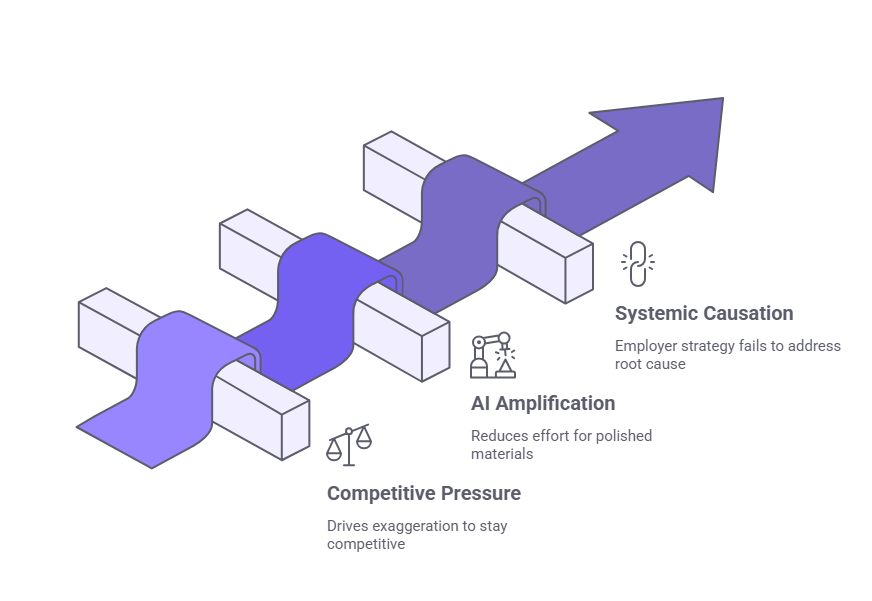
To understand why misrepresentation is this widespread, it helps to understand what drives it. The findings point clearly toward competitive labor market pressure as the main cause, not indifference to ethics, not a calculation of detection odds, and not a belief that the behavior is harmless. Among the 1,394 embellishers in the sample, 72% said competitive market pressure drove them to exaggerate, 71% said minor exaggeration felt necessary to stay competitive, and 57% assumed other candidates were doing the same. These are not the responses of isolated bad actors. They are the responses of rational people inside a system that has made honesty a competitive liability.
The Dose-Response Relationship with AI
AI use among candidates follows a clear escalation pattern, moving from preparation into active misrepresentation. Sixty-one percent used AI to practice interview answers until they sounded more impressive than authentic. That sits at the preparation end of the range. At the active misrepresentation end, however, 27% used AI during live interviews for real-time answer generation and 25% used an AI avatar in a virtual meeting. The move from one end to the other is not a leap. It is a gradual shift along a continuum, enabled by the same tools and driven by the same competitive pressure.
This is not evidence that AI causes deception. Rather, it is evidence that AI amplifies existing incentive structures. A candidate already motivated to present the strongest possible version of their qualifications will use whatever tools are available. AI tools have sharply reduced the effort required to produce polished application materials, interview prep frameworks, and real-time response support. They have not created new motivations. They have lowered the cost of acting on motivations that were already there.
Systemic Causation Does Not Mean Individual Absolution
The systemic explanation for this behavior is not an argument that individual candidates bear no responsibility for misrepresentation. Rather, it is an argument that employer strategy focused entirely on catching and excluding bad actors will fail to address root cause. A verification system that makes misrepresentation harder to execute, more likely to surface, and less competitively necessary addresses the incentive structure. A system that only looks for lies after the fact does not.
What Full-Funnel Verification Actually Requires
Mapping the Stack to a Verification Model
The deception stack defines five attack surfaces, and a sound verification model needs to cover all five. That does not require five separate vendor solutions. It requires a verification architecture with five corresponding coverage points, some of which employers can address through process design rather than third-party tools.
The framework below is conceptual. Specific implementation, vendor selection, and compliance requirements vary by jurisdiction, industry, and role. Employers should consult legal counsel before implementing or modifying any screening program. The Fair Credit Reporting Act, applicable state laws, and local ordinances govern what checks employers may conduct, when, and under what conditions.
Layer-by-Layer Verification Framework
The table below describes the verification gap at each deception layer and outlines what closing that gap requires in practice. This is a structural framework, not a compliance checklist. Requirements vary by jurisdiction and role type.
| Layer | Primary Verification Gap | What Closing the Gap Requires |
| Resume content | Review is plausibility-based, not evidence-based | Primary-source employment verification for material roles |
| References | Identity and relationship of references unconfirmed | Confirm reference identity, role, and relationship before treating content as valid |
| Identity and credentials | Credential claims unverified at primary source | Direct verification with issuing institutions; identity verification conducted through lawful means consistent with applicable federal and state requirements, including I-9 compliance where relevant. Timing and permissible scope vary by jurisdiction and role. |
| AI-assisted behavior | No standard detection mechanism exists | Competency-based assessment under conditions that cannot be AI-assisted |
| Remote interview | Limited employer visibility into real-time performance | Structured, adaptive interview protocols requiring historically grounded responses |
Closing any single layer reduces exposure at that surface. Closing all five, however, reduces the information gap across every dimension employers use to make hiring decisions.
The Compliance Consideration
Any expansion of screening scope requires attention to applicable legal requirements. The Fair Credit Reporting Act governs the use of consumer reports in employment decisions, covering disclosure, authorization, and adverse action procedures. State and local ban-the-box laws, lookback period limits, and individualized assessment requirements vary significantly by jurisdiction. Employers should confirm the legal permissibility of each layer in every applicable location before moving forward. Requirements that differ by jurisdiction require verification before implementation.
The Transparency Signal
What Candidates Actually Want
The data shows that 82% of respondents want a clear explanation of what employers check during the screening process. That figure comes from the full sample of 1,500, including the 93% who admitted to embellishing. The finding is counterintuitive if employers view this as an adversarial relationship. Why would a population with near-universal embellishment rates want more transparency about the verification process?
The answer becomes clear when you apply the rational actor frame. Candidates who understand what employers verify are better positioned to make accurate disclosures in those areas. Moreover, the 2026 Trust in Hiring Report found that 56% of respondents did not know what employers can see or verify, and that uncertainty itself acts as a green light for embellishment. When candidates do not know what employers will check, they assume the answer is minimal and adjust their behavior accordingly.
Transparency as Architecture, Not Theater
The difference between transparency as a compliance formality and transparency as a functional deterrent comes down to specificity:
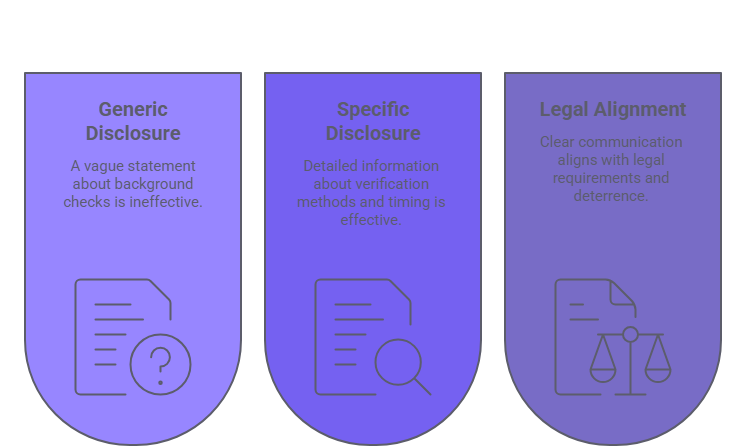
- A generic disclosure that “background checks may be conducted” does not meaningfully change candidate behavior.
- A specific, timed disclosure that explains which application elements employers will verify, through what methods, and at what stage gives candidates accurate information about the consequences of misrepresentation before they decide. This applies to supplemental candidate communications and does not substitute for the standalone disclosure required under the FCRA or applicable state law.
- This approach aligns with FCRA disclosure and authorization requirements, meaning clear communication serves both legal compliance and deterrence goals at the same time.
Designing candidate-facing disclosures to be specific and informative, rather than minimally compliant, is not a legal risk. It is a design choice with real deterrence value.
The Cost Argument
The transparency lever is also the lowest-cost intervention available. It requires no new vendor relationship, no additional data access, and no expanded scope of inquiry. It simply requires redesigning candidate-facing communications to be specific about what employers check and why. For organizations looking for a starting point in closing the verification gap, communication design offers measurable deterrence value at near-zero added cost.
What This Means for Hiring Quality
Downstream Risk: The Business Case Closes Here
The data captures what happened to candidates after employers hired them on the basis of embellished qualifications. Two figures define the organizational cost of verification failure:
- 39% of embellishers reported post-hire stress or anxiety tied to the gap between their stated qualifications and their actual ability to do the job.
- 25% of the same group reported negative workplace outcomes directly tied to skill mismatch, including performance management, role reassignment, or departure.
These figures come from the embellisher subgroup of 1,394 respondents and are confirmed directly by the source report. Together, they describe hires who consume training and onboarding resources, drag on team performance, and eventually leave, triggering a replacement cycle that the original verification failure made more likely.
The Compounding Effect of Multi-Layer Deception
The downstream risk is more severe for candidates who misrepresented across multiple layers than for those who embellished in just one area. A candidate who inflated one job title has introduced one area of potential mismatch. A candidate who engaged across all five deception layers, combining resume embellishment with fabricated references, AI-assisted interview responses, and real-time remote coaching, may have misrepresented qualifications, experience, and competency across every dimension employers used to make their decision.
In that scenario, the skill mismatch risk is not incremental. It compounds across every layer where stated qualifications diverged from reality. The verification gap is not just the difference between what a candidate claimed and what was true in one area. It is the accumulated difference across every dimension the employer used to evaluate fit.
Connecting Verification Investment to Talent Outcomes
Full-funnel verification does not guarantee better hires. No screening system removes all risk. What it does, however, is reduce the information gap between what candidates claim and what employers actually know, across more dimensions and with greater reliability. In a labor market where 93% of candidates admit to at least one form of embellishment, and where a significant portion do so across all five deception layers at once, that reduction in information asymmetry is the mechanism through which hiring quality improves.
Conclusion
The verification gap in most hiring processes is not a resource problem or an awareness problem. It is an architecture problem. The deception stack operates across five layers at once, and most verification systems were built to address one. Closing that gap requires treating full-funnel verification as a design discipline, not an add-on, and treating transparent screening communication as the most cost-effective deterrence tool available. The candidates most engaged in misrepresentation already understand the risk. The next step is building systems that give them a rational reason to be honest instead.
About the 2026 Trust in Hiring Report
The 2026 Trust in Hiring Report is a proprietary research study published by GCheck, based on a national survey of 1,500 U.S. adults employed full-time who actively applied for at least one job in the past 18 months. Fielded February 14-22, 2026 via Pollfish, the study examines how Careerfishing, AI-assisted deception, identity concealment, and broken verification expectations are reshaping the employer-candidate trust gap. The report introduced the Careerfishing framework and documented that 93% of recent job seekers have engaged in at least one form of resume embellishment or misrepresentation. The full report, including methodology, demographic breakdowns, and the Compliance for Good framework for rebuilding trust in hiring, is available at gcheck.com/whitepapers/trust-in-hiring-report/.
Frequently Asked Questions
Below is a list of the most commonly asked questions which help tackle issues surrounding candidates’ misrepresentations, AI-powered applications, and verification deficiencies in contemporary recruiting. As hiring fraud becomes an increasing concern for many companies in various stages of the hiring process, there is a pressing need for the industry to be aware of the pitfalls of existing recruiting procedures.
What does “cheating the hiring process” actually mean in this context?
In this context, candidate misrepresentation refers to deliberate inaccuracies across five categories: resume content, reference selection or coaching, identity and credential presentation, AI-assisted application behavior, and deception enabled by remote interview conditions. GCheck’s 2026 Trust in Hiring Report shows these behaviors occurring across the same hiring process, not as isolated incidents. That simultaneity is what distinguishes the current landscape from the traditional concept of resume fraud.
How common is candidate misrepresentation, really?
According to the 2026 Trust in Hiring Report, 93% of 1,500 U.S. job seekers admitted to at least one form of embellishment or misrepresentation. The behavior spans every generation, gender, and demographic group. Only roughly 7% of the sample reported no embellishment. Multi-layer misrepresentation, rather than complete honesty or isolated embellishment, is the baseline condition in the current hiring environment.
Why do candidates who know misrepresentation creates business risk still do it?
88% of all respondents acknowledged their behavior creates employer risk, yet embellishment rates remain at 93%, according to the 2026 Trust in Hiring Report. This reflects a rational response to competitive market pressure: 72% cited competitive pressure as the primary driver, and 60% said they would not have been hired if fully honest. The behavior follows the incentive structure, not a lack of awareness.
Does AI use cause candidate misrepresentation?
Not according to the 2026 Trust in Hiring Report. The report shows a clear escalation pattern in AI use, from preparation behaviors such as practicing interview answers, through active misrepresentation such as using AI avatars in virtual meetings. The more accurate interpretation is that AI amplifies existing incentive structures by lowering the effort cost of misrepresentation. It does not create new motivation to deceive.
What is background check effectiveness against multi-layer deception?
Limited, when measured against the full scope of misrepresentation documented in the 2026 Trust in Hiring Report. Standard checks cover portions of the identity and criminal history dimensions but do not systematically address resume content accuracy, reference integrity, AI-assisted behavior, or remote interview conditions. Effectiveness against multi-layer deception depends on the scope and design of the screening program, not on any single check.
What are candidate verification gaps that employers most commonly overlook?
Two layers go largely unaddressed in most verification programs, based on the 2026 Trust in Hiring Report: AI-assisted application and interview behavior, for which no standard verification mechanism exists in most workflows, and remote interview conditions, which limit employer visibility into real-time candidate performance. Both require process design responses rather than third-party data solutions.
Do candidates actually want clearer screening explanations?
Yes, and the preference is stronger than most employers expect. The 2026 Trust in Hiring Report found that 82% of respondents preferred clear explanations of what screening involves, including 56% who said they do not know what employers can see or verify. That uncertainty acts as a green light for embellishment. Transparent screening communication serves both legal disclosure requirements and deterrence goals at the same time.
What are the downstream consequences of hiring through a verification gap?
Significant, on both sides of the employment relationship. Among candidates who embellished material qualifications, the 2026 Trust in Hiring Report found that 39% experienced post-hire stress or anxiety and 25% faced negative workplace outcomes including performance management, reassignment, or departure. These figures, drawn from the embellisher subgroup of 1,394 respondents, represent the organizational cost of verification failure: not just a bad hire, but a hire whose tenure generates measurable performance and retention risk.
Additional Resources
- Fair Credit Reporting Act (FCRA) Full Text, Consumer Financial Protection Bureau
https://www.consumerfinance.gov/compliance/compliance-resources/other-applicable-requirements/fair-credit-reporting-act/ - EEOC Enforcement Guidance on the Consideration of Arrest and Conviction Records in Employment Decisions
https://www.eeoc.gov/laws/guidance/questions-and-answers-clarify-and-provide-common-interpretation-uniform-guidelines - FTC Background Checks: What Employers Need to Know
https://www.ftc.gov/business-guidance/resources/background-checks-what-employers-need-know - Ban the Box: U.S. Cities, Counties, and States Adopt Fair Hiring Policies, National Employment Law Project
https://www.nelp.org/insights-research/ban-the-box-fair-chance-hiring-state-and-local-guide/

ABOUT THE CREATOR
Charm Paz, CHRP
Recruiter & Editor
Charm Paz is an HR professional at GCheck, specializing in background screening, fair hiring, and regulatory compliance. She holds from the Professional Background Screening Association (PBSA) and helps organizations navigate employment regulations with clarity and confidence.
With a background in Industrial and Organizational Psychology, she translates policy into practice to build ethical, compliant, human-centered hiring systems that strengthen decision-making over time.