



Continuous MVR monitoring enables employers to detect driver license suspensions, restrictions, and violations as they occur, rather than months later during annual reviews. This approach reduces liability exposure by closing the knowledge gap between when a disqualifying event happens and when an employer learns about it, supporting proactive fleet risk management and compliance with evolving regulatory expectations.
Key Takeaways
- Continuous MVR monitoring provides ongoing visibility into driver license status, replacing static annual checks with recurring updates.
- The average gap between a license suspension and an employer’s annual MVR pull can exceed six months, creating significant liability exposure.
- State DMV reporting timelines vary widely, with some violations appearing within days while others may take weeks to reflect in accessible records.
- DOT regulations require annual MVR reviews for commercial motor vehicle operators, but non-regulatory employers face similar negligent entrustment risks.
- Continuous monitoring supports negligent entrustment defenses by demonstrating an employer’s reasonable diligence in verifying driver qualifications.
- Industries beyond trucking, including ride-share fleets, delivery logistics, and field service operations, are adopting continuous monitoring as operational standard practice.
- Monitoring frequency options range from monthly batch updates to real-time alerts, with selection driven by fleet size, risk tolerance, and regulatory requirements.
- Effective implementation requires clear alert protocols, documentation standards, and integration with existing HR and fleet management systems.
The Operational Reality of Driver Oversight
Transportation employers operate under a persistent assumption: that they know whether their drivers are legally qualified to operate company vehicles. This assumption collapses when a driver with a suspended license causes an accident, and the employer discovers that the suspension occurred eight months earlier, well after the last MVR check. Continuous MVR monitoring addresses this knowledge gap by providing recurring updates on driver license status, moving beyond the snapshot approach of annual or biennial reviews.
Rather than functioning as a technology feature, it operates as a risk management discipline designed to align employer knowledge with real-world driver behavior and state enforcement actions. The business case is grounded in liability exposure. When an employer entrusts a vehicle to a driver whose license has been suspended or restricted, and that driver causes harm, the legal doctrine of negligent entrustment creates direct employer liability.
The employer’s defense hinges on demonstrating reasonable diligence in monitoring driver qualifications. A single annual MVR pull, conducted months before an incident, may not satisfy this standard. The term “continuous” in this context does not mean real-time tracking of every DMV transaction. It refers to a structured program of recurring MVR pulls, typically conducted monthly or quarterly, designed to detect changes in driver status with greater frequency than traditional annual reviews.
Understanding Continuous vs. Periodic Monitoring
Periodic monitoring refers to one-time or infrequent checks conducted at fixed intervals, such as annually or biennially. This approach satisfies minimum regulatory requirements for certain industries but leaves employers exposed during the months between reviews. The distinction matters because liability does not pause between scheduled checks.
Employers implementing continuous MVR monitoring for fleet drivers gain visibility into several categories of disqualifying events:
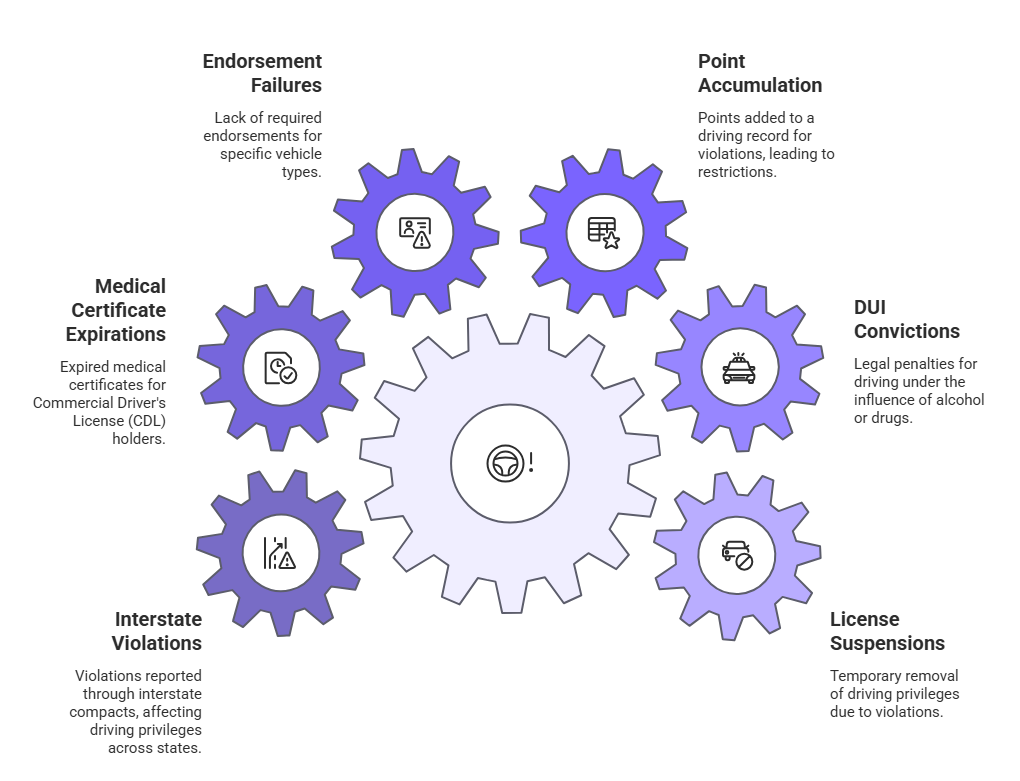
- License suspensions
- DUI convictions
- Accumulation of points leading to restrictions
- Failure to maintain required endorsements
- Medical certificate expirations for CDL holders
- Out-of-state violations reported through interstate compacts
The Liability Gap: What Happens Between Annual MVR Pulls
The interval between MVR reviews creates a window of exposure during which an employer may unknowingly allow a disqualified driver to operate a company vehicle. Consider a driver who receives a DUI conviction in March. If the employer conducts annual MVR reviews each January, the suspension will not appear in the employer’s records until the following January, potentially ten months later.
When an accident occurs involving a driver with a suspended license, plaintiffs’ attorneys routinely investigate the employer’s monitoring practices. Discovery requests focus on when the employer last checked the driver’s record, whether the employer had policies requiring self-reporting of violations, and whether the employer took reasonable steps to verify ongoing qualification. A ten-month gap between the suspension and the employer’s next scheduled review is difficult to defend as reasonable diligence.
“Risk doesn’t wait for the next review.” This sentence made me stop and think about how many companies consider their fleet to be qualified, even when there can be a long lag between what happens on the road and what shows up in the record. With continuous monitoring, the focus is no longer on checking periodically but on being constantly aware of the situation, especially when the focus is on safety as a primary goal. And then there is the realization that the goal is no longer simply to meet the minimum requirements to be compliant but to lower the risk of a problem occurring at all. �
Quantifying Exposure Across Fleet Size
The probability of operating with at least one disqualified driver increases with fleet size. A company with ten drivers conducting annual reviews has ten driver-years of exposure between checks. A company with 100 drivers has 100 driver-years of exposure. A single incident involving a disqualified driver can result in damages exceeding the cost of monitoring the entire fleet for a decade.
Employers often assume that drivers will self-report suspensions or violations as required by company policy. This assumption does not align with operational experience. Drivers facing license suspensions have strong financial incentives not to report them, particularly when their employment depends on maintaining a valid license.
How Violations Propagate Through State Systems
Understanding the liability gap requires understanding how violations move from citation to employer awareness:
| Stage | Process | Typical Delay |
| Citation Issued | Driver receives traffic citation | Immediate |
| Court Adjudication | Violation adjudicated through court system | Days to weeks |
| DMV Notification | Court transmits conviction to state DMV | Days to weeks |
| Record Update | DMV processes violation and updates driver record | Days to weeks |
| Employer Detection | Monitoring service requests and receives updated MVR | Varies by monitoring frequency |
Even continuous monitoring programs do not eliminate delay entirely. They compress it. A monthly monitoring program reduces the average detection window from six months to approximately 30 days, depending on state processing times and the monitoring provider’s update frequency.
How State DMV Reporting Timelines Affect Monitoring Accuracy
State DMV systems do not operate on a uniform reporting schedule. The speed at which violations, suspensions, and convictions appear in accessible MVR records varies by state, by violation type, and by the efficiency of the underlying administrative systems. Some states process and report violations within days of adjudication, while others may take weeks or months.
Out-of-state violations reported through the Driver License Compact or the Non-Resident Violator Compact introduce additional delay. The violating state must report the conviction to the driver’s home state, which then processes and applies penalties according to its own laws.
Multi-State Fleet Challenges
For employers operating multi-state fleets, this means that a driver licensed in one state who receives a citation in another state may not have that violation reflected in their home-state MVR for an extended period.
Variation in Violation Reporting by Event Type
DUI convictions, because they often trigger automatic license suspensions, typically process more quickly than minor traffic infractions. Court schedules and administrative backlogs may delay violations that require court appearances. Medical certificate expirations for CDL holders typically process more quickly because the DMV administers them directly rather than through the court system.
Employers should understand that continuous MVR monitoring detects violations as they appear in state records, not as they occur in real time. Employers should also be aware that some states impose limits on how far back certain violations may be reported for employment purposes, which may affect the completeness of MVR data.
Regulatory and Compliance Context Across Industries
Continuous MVR monitoring exists at the intersection of regulatory compliance, liability management, and operational risk control. Different industries face different regulatory requirements, but the underlying risk remains consistent: an employer who allows a disqualified driver to operate a vehicle faces both legal liability and reputational harm.
DOT and FMCSA Requirements for Commercial Motor Vehicles
The Federal Motor Carrier Safety Administration requires motor carriers subject to Part 391 to review the driving record of each covered commercial motor vehicle driver at least once every 12 months. This requirement, codified in 49 CFR § 391.25, generally applies to interstate operations involving vehicles with a gross vehicle weight rating of 10,001 pounds or more, vehicles designed to transport 16 or more passengers, or vehicles transporting hazardous materials in quantities requiring placards.
Exemptions and state-specific requirements may apply. Employers should verify applicability to their specific operations.
Covered Vehicles:
- Gross vehicle weight rating of 10,001 pounds or more
- Vehicles designed to transport 16 or more passengers
- Vehicles transporting hazardous materials in quantities requiring placards
The annual MVR review establishes a minimum standard, not a safe harbor. Many carriers adopt continuous monitoring programs to reduce the risk of operating with disqualified drivers between annual checks. For CDL holders, drivers must notify their employer within 30 days of any traffic conviction, excluding parking violations. In practice, reliance on driver self-reporting alone proves insufficient.
Non-DOT Employers and State-Level Requirements
Employers operating non-commercial fleets are not subject to FMCSA regulations but remain exposed to negligent entrustment liability under state tort law. Some states have enacted statutes requiring employers to verify driver license status at specified intervals, while others rely on common-law standards of reasonable care. In the absence of explicit statutory requirements, courts evaluate employer diligence based on industry standards and the foreseeability of harm.
Insurance Carrier Requirements and Risk-Based Mandates
Many commercial auto insurance carriers now require or strongly encourage continuous monitoring as a condition of coverage or as a factor in premium calculation. Some carriers offer premium discounts for fleets that implement monthly or quarterly monitoring, while others reserve the right to deny claims when an accident involves a driver whose disqualifying violation could have been detected through more frequent monitoring. Employers should review their insurance policies to determine whether continuous monitoring is required, recommended, or incentivized.
Industry Applications Beyond Trucking
Continuous MVR monitoring is no longer confined to the trucking and logistics sectors. A growing range of industries with vehicle-dependent operations have adopted recurring driver qualification checks as operational standard practice.
| Industry | Driver Profile | Primary Risk Factor |
| Ride-Share & Delivery | Multi-platform drivers, high daily mileage | Violations across personal and commercial use |
| Field Service | Technicians, sales representatives | High annual mileage, vulnerable customer contact |
| Healthcare | Home health workers, medical equipment delivery | Vulnerable populations, reputational exposure |
Ride-Share and Delivery Fleet Management
Companies managing fleets of ride-share or delivery drivers face unique challenges in maintaining driver oversight. Drivers may operate across multiple platforms, reducing any single platform’s visibility into total driving exposure. Platform operators have increasingly adopted continuous monitoring to manage this risk, particularly as regulatory scrutiny of gig economy labor practices intensifies.
Field Service and Sales Organizations
Organizations that employ sales representatives, technicians, or other personnel who regularly drive company vehicles or personal vehicles for business purposes face similar exposure. A pharmaceutical sales representative driving 30,000 miles annually represents significant liability if their license becomes suspended. As awareness of negligent entrustment liability has increased, more organizations now implement continuous monitoring for all employees with regular driving responsibilities.
Negligent Entrustment Doctrine and Employer Exposure
Negligent entrustment is a tort doctrine that imposes liability on a vehicle owner who entrusts that vehicle to a driver the owner knows, or should know, is incompetent or unfit to drive. The doctrine applies when the driver causes harm to a third party, and the injured party seeks to hold the vehicle owner directly liable for the owner’s negligence in allowing the unfit driver to operate the vehicle.
To establish negligent entrustment, a plaintiff must generally prove, though elements vary by state:
- The defendant owned or controlled the vehicle
- The defendant entrusted the vehicle to a driver
- The driver was unlicensed, incompetent, or otherwise unfit
- The driver’s unfitness proximately caused the plaintiff’s injuries
- The defendant knew or should have known of the driver’s unfitness
Employers should consult legal counsel in their jurisdiction to understand the specific standard that local courts apply.
Employer Knowledge and Constructive Notice
The “should have known” standard is where continuous MVR monitoring becomes operationally significant. Courts evaluate whether an employer exercised reasonable diligence in monitoring driver qualifications. If an employer conducts only annual MVR reviews, and a driver’s license becomes suspended three months after the last review, the question becomes whether annual monitoring constitutes reasonable diligence in the industry.
As continuous monitoring becomes more common, courts in some jurisdictions may consider whether annual reviews alone satisfy the standard of reasonable care, particularly for high-risk operations. Whether an employer’s failure to implement more frequent monitoring constitutes constructive knowledge depends on the facts of each case, industry standards, and the specific legal standards that the relevant jurisdiction applies. Employers should evaluate their monitoring practices in consultation with legal counsel.
Vicarious Liability vs. Direct Liability
Negligent entrustment imposes direct liability on the employer, separate from the vicarious liability that arises under respondeat superior when an employee causes harm in the course and scope of employment. Commercial auto insurance typically covers vicarious liability, subject to policy limits. Negligent entrustment, because it represents a direct tort by the employer, may expose the employer to liability exceeding policy limits.
Evaluating Monitoring Frequency and Coverage Models
Employers implementing continuous MVR monitoring must determine the frequency and scope of checks appropriate for their operations. This decision should be based on fleet size, driver risk profiles, regulatory requirements, insurance carrier mandates, and organizational risk tolerance.
Monitoring Frequency Options:
- Monthly Monitoring: Reduces detection window to ~30 days, balances cost and risk for most fleets
- Quarterly Monitoring: Extends window to ~90 days, significantly better than annual reviews
- Real-Time Monitoring: Provides alerts within days of state reporting, may not be necessary given inherent state delays
Some monitoring programs provide automated alerts when a disqualifying violation appears in a driver’s record. Others conduct scheduled batch reviews and deliver periodic reports summarizing changes across the fleet. Automated alerts enable faster response but require defined internal protocols for alert triage and driver suspension.
Defining Disqualifying Events and Thresholds
Not all violations warrant immediate driver disqualification. Employers must define which violations trigger suspension or termination, which require additional review, and which are tracked but do not result in immediate action. Common disqualifying events include license suspension or revocation, DUI or DWI convictions, multiple moving violations within a defined period, accumulation of points exceeding a specified threshold, and failure to maintain required endorsements for CDL holders.
Employers should document these thresholds in written policies and apply them consistently across the fleet. Employers should define disqualifying events based on convictions rather than arrests or pending charges, unless specific regulatory or safety requirements permit consideration of pending violations. Some states restrict the use of arrest records or non-conviction data in employment decisions.
Implementation Considerations and Internal Process Alignment
Implementing continuous MVR monitoring requires defining internal workflows, assigning responsibilities, establishing documentation standards, and integrating monitoring results with existing HR and fleet management systems. Organizations must determine who receives monitoring alerts and how they escalate those alerts when action becomes required.
Critical Implementation Components:

- Alert routing protocols and responsible personnel
- Response timelines by violation severity
- Documentation and record retention policies
- System integration with HRIS and fleet management platforms
- FCRA-compliant authorization and notice procedures
Establishing Response Protocols
Escalation protocols should define response timelines for different violation types. A DUI conviction resulting in immediate license suspension may require same-day action, while a minor moving violation may require review within five business days. Employers must maintain records of all MVR reviews, monitoring alerts, actions taken in response to violations, and driver notifications. These records serve as evidence of reasonable diligence in the event of litigation.
System Integration Requirements
Continuous monitoring achieves maximum effectiveness when integrated with existing systems. When a disqualifying violation is detected, the driver’s status should be updated in the HRIS, fleet management system, and any other platforms used to assign vehicles or schedule routes.
FCRA Compliance and Authorization
Employers must comply with applicable notice and consent requirements when conducting ongoing MVR monitoring. The Fair Credit Reporting Act requires employers to provide a clear and conspicuous written disclosure, in a standalone document, that a consumer report may be obtained for employment purposes, and to obtain the applicant’s or employee’s written authorization before procuring a consumer report, which includes MVRs obtained through consumer reporting agencies.
Employers must also comply with pre-adverse action and adverse action notice requirements if they take adverse action based on the report. Some states, including California, New York, Washington, and Massachusetts, impose additional or more specific authorization, disclosure, and notice requirements that may differ from federal FCRA standards. Employers should include continuous monitoring authorization in onboarding documents and ensure that authorization language complies with both federal and applicable state laws.
Common Misconceptions and Operational Pitfalls
Employers adopting continuous MVR monitoring often operate under assumptions that prove incorrect in practice. While annual reviews satisfy minimum DOT requirements for commercial drivers, they do not eliminate liability exposure. Courts evaluating negligent entrustment claims focus on whether the employer exercised reasonable care, not whether the employer met minimum regulatory standards.
Frequent Misconceptions:
| Misconception | Reality |
| Annual MVR reviews are sufficient | Creates 6-12 month exposure window, may not satisfy reasonable care standard |
| Insurance covers us regardless | Coverage may be limited or denied depending on policy terms and state law; negligent entrustment claims can exceed policy limits |
| Drivers will self-report violations | Strong financial incentive not to report; self-reporting policies alone generally do not satisfy reasonable care standard |
| All states report at same speed | Significant variation by state, violation type, and interstate compacts |
| Continuous monitoring eliminates risk | Compresses exposure window but doesn’t eliminate inherent reporting delays |
State DMV reporting timelines vary significantly. Employers operating multi-state fleets should not assume that violations will appear in MVRs on a predictable schedule. No monitoring program eliminates risk entirely. Employers should view continuous monitoring as a significant risk reduction measure, not a guarantee of zero exposure.
Conclusion
Continuous MVR monitoring represents a shift from reactive compliance to proactive risk management, enabling employers to detect driver disqualifications as they occur rather than months later. As industries beyond trucking adopt fleet operations, and as courts increasingly evaluate employer diligence through the lens of available technology and standard practice, periodic monitoring is becoming the expected standard of care.
Frequently Asked Questions
What is the difference between continuous MVR monitoring and annual MVR checks?
Continuous MVR monitoring involves recurring checks of driver license status, typically monthly or quarterly, while annual MVR checks occur once per year. Continuous monitoring reduces the window of time during which a driver may operate with a suspended or restricted license without the employer’s knowledge, from an average of six months under annual reviews to approximately 30 days under monthly monitoring.
Are employers legally required to conduct continuous MVR monitoring?
DOT regulations require annual MVR reviews for commercial motor vehicle drivers but do not mandate continuous monitoring. However, some insurance carriers require more frequent checks as a condition of coverage, and some states are beginning to adopt regulations requiring periodic verification of driver license status. Even absent explicit legal requirements, continuous monitoring may be considered evidence of reasonable diligence in negligent entrustment cases.
How do state DMV reporting delays affect the effectiveness of continuous monitoring?
State DMVs process and report violations at varying speeds, with some violations appearing within days and others taking weeks. Continuous monitoring does not eliminate these delays but compresses the detection window by checking records more frequently. The effectiveness of monitoring depends on both the frequency of checks and the efficiency of the relevant state’s reporting systems.
Can continuous MVR monitoring detect out-of-state violations?
Yes, but with caveats. Interstate compacts report out-of-state violations to a driver’s home state, but reporting timelines vary. A driver licensed in State A who receives a conviction in State B may not have that conviction reflected in their home-state MVR for weeks. Continuous monitoring increases the likelihood of detecting these violations by checking more frequently.
What happens when a monitoring alert identifies a disqualifying violation?
Employers should have documented protocols for responding to alerts, typically including immediate review of the violation, suspension of driving privileges pending investigation, consultation with legal counsel if the violation is serious, and determination of whether the violation warrants termination or requires corrective action. Response timelines should be defined in advance and applied consistently.
Does continuous MVR monitoring satisfy FCRA notice and consent requirements?
Employers must obtain written authorization before procuring consumer reports, including MVRs obtained through consumer reporting agencies. Authorization should be sufficiently broad to cover recurring checks throughout employment. Before taking adverse action based on MVR information, employers must provide the individual with a pre-adverse action notice, a copy of the consumer report, and a summary of rights under the FCRA, and allow a reasonable period, typically at least five business days, for the individual to respond. After this period, if the employer proceeds with the adverse action, employers must provide a final adverse action notice. Some states impose additional requirements.
What is the cost-benefit analysis for implementing continuous monitoring?
The cost of continuous monitoring typically ranges from a few dollars to several dozen dollars per driver per year, depending on frequency and provider. Organizations measure the benefit in reduced liability exposure. A single negligent entrustment judgment can exceed millions of dollars, far outweighing the cost of monitoring an entire fleet for years.
Can employers use continuous MVR monitoring for non-driving employees?
MVR monitoring is typically limited to employees whose job duties include driving company vehicles or personal vehicles for business purposes. Under the FCRA, consumer reports may only be obtained for permissible purposes, including employment purposes where the information is relevant to the employee’s job duties. Using MVR information for employees without driving responsibilities may not satisfy FCRA permissible purpose requirements and could expose the employer to liability under the FCRA and state privacy laws.
Additional Resources
- Federal Motor Carrier Safety Administration: Driver Qualification Files
https://www.fmcsa.dot.gov/regulations/title49/section/391.51 - FMCSA Annual Driving Record Review Requirements
https://www.fmcsa.dot.gov/regulations/title49/section/391.25 - Federal Trade Commission: Using Consumer Reports for Employment Decisions
https://www.ftc.gov/business-guidance/resources/using-consumer-reports-what-employers-need-know - AAMVA Commercial Driver’s License Information System
https://www.aamva.org/topics/commercial-driver-license-information-system - National Highway Traffic Safety Administration: State Traffic Safety Information
https://www.nhtsa.gov/state-traffic-safety-information

ABOUT THE CREATOR
GCheck Editorial Team
Meet the GCheck Editorial Team, your trusted source for insightful and up-to-date information in the world of employment background checks. Committed to delivering the latest trends, best practices, and industry insights, our team is dedicated to keeping you informed.
With a passion for ensuring accuracy, compliance, and efficiency in background screening, we are your go-to experts in the field. Stay tuned for our comprehensive articles, guides, and analysis, designed to empower businesses and individuals with the knowledge they need to make informed decisions.
At GCheck, we're here to guide you through the complexities of background checks, every step of the way.