



Florida’s commercial driver screening landscape is defined by overlapping federal DOT mandates, state-level “good moral character” standards, and port-specific security protocols. Employers operating across intrastate freight, interstate commerce, and port logistics face compliance blind spots when driver classifications trigger different background check obligations under each jurisdictional framework.
Key Takeaways
- Federal DOT requirements apply to interstate CDL holders, while Florida state law governs intrastate commercial drivers differently.
- The FMCSA Drug and Alcohol Clearinghouse mandates real-time queries for CDL holders, but state-level criminal checks follow separate timelines.
- Florida’s “good moral character” standard for CDL issuance is enforced through DHSMV procedures, not employer-initiated screening.
- Port operations trigger additional TWIC and Maritime Transportation Security Act requirements independent of DOT compliance.
- Multi-state carriers must reconcile Florida’s seven-year lookback period with more restrictive state laws where drivers are domiciled.
- Intrastate freight operations under 10,001 pounds may fall outside DOT jurisdiction but remain subject to state employment screening laws.
- Clearinghouse query failures often stem from incomplete driver consent documentation, not the absence of disqualifying violations.
- Compliance gaps frequently emerge when employers misclassify driver roles or conflate federal transportation safety rules with state employment law.
Understanding Florida’s Layered Screening Framework
Florida’s commercial transportation sector operates under three distinct regulatory layers, each imposing separate background check obligations. Employers frequently encounter compliance gaps when they assume federal DOT requirements satisfy all applicable screening mandates. Conflating uniform processes across driver classifications that trigger different jurisdictional rules compounds these errors.
The Federal Layer: DOT and FMCSA Requirements
The Federal Motor Carrier Safety Administration governs interstate commerce involving commercial motor vehicles. Employers hiring CDL holders to operate vehicles in interstate trade must comply with Part 391 of the Federal Motor Carrier Safety Regulations. These regulations require investigation of a driver’s safety performance history, including previous employment verification, motor vehicle record checks, and evaluation of crash and traffic violation history.
The Drug and Alcohol Clearinghouse, operational since January 2020, requires employers to conduct pre-employment queries and annual checks for CDL holders. Queries reveal drug and alcohol program violations reported by previous employers, medical review officers, and substance abuse professionals. Under 49 CFR 382.701(d), drivers must provide electronic consent through the Clearinghouse system before employers can conduct queries. This consent requirement is specific to the federal Clearinghouse and distinct from general background check authorizations.
Working in the hiring process for commercial drivers is a quick education in understanding that compliance is not just about checking boxes. Every position is different in terms of responsibility, and when those differences are not taken into account, it manifests down the road in some way. I have seen firsthand the power of understanding classifications, consent, and timing in building trust with your drivers and your business at the same time. When done well in the screening process, it is a safeguard for people and business, not just a checkbox exercise. �
The State Layer: Florida Statutory Requirements
Florida law establishes “good moral character” as a prerequisite for CDL issuance and renewal, enforced by the Department of Highway Safety and Motor Vehicles. This standard incorporates criminal history review but is administered through the licensing process, not employer screening. Employers do not perform the state’s good moral character determination for licensing purposes, but they conduct separate criminal background evaluations for employment suitability and may encounter drivers whose licenses are suspended or revoked based on DHSMV findings.
When using consumer reports for hiring decisions, employers should evaluate convictions in relation to job duties, consider time elapsed since the offense, and assess evidence of rehabilitation, consistent with FCRA requirements and applicable state or local fair chance hiring laws. Florida’s general employment screening framework permits consideration of criminal history but prohibits blanket disqualification policies.
The Port and Maritime Layer: TWIC and MTSA
Drivers accessing port facilities or transporting cargo in maritime environments may require Transportation Worker Identification Credentials issued by the Transportation Security Administration. TWIC eligibility depends on criminal background checks covering categories defined in 49 CFR 1572.103, including terrorism-related offenses, espionage, sedition, and other specified crimes with varying disqualification periods.
The Maritime Transportation Security Act imposes additional security requirements on certain port operations, creating compliance obligations distinct from DOT or state employment law. Employers operating in port-adjacent logistics must determine which driver roles trigger TWIC requirements and ensure screening processes align with TSA standards.
Clearinghouse Query Requirements in Florida: Common Compliance Pitfalls
The FMCSA Clearinghouse requirement represents one of the most frequently misunderstood elements of Florida commercial driver screening laws. Employers often conflate Clearinghouse queries with traditional background checks, leading to procedural errors that delay hiring or create audit exposure.
When Clearinghouse Queries Are Mandatory
Clearinghouse queries are required for CDL holders performing safety-sensitive functions in interstate commerce. Pre-employment queries must occur before the first safety-sensitive duty. Annual queries for current employees must be conducted once per year for each driver subject to DOT drug and alcohol testing regulations.
Intrastate CDL holders operating exclusively within Florida under Part 383 state-administered programs may not be subject to Clearinghouse requirements unless they cross state lines or meet specific weight and cargo thresholds triggering federal jurisdiction.
| Driver Type | Clearinghouse Requirement | Trigger Condition |
| Interstate CDL holder | Mandatory pre-employment and annual queries | Any safety-sensitive function in interstate commerce |
| Intrastate CDL holder (Florida-only) | Generally not required | Unless vehicle weight/cargo triggers federal jurisdiction |
| Non-CDL commercial driver | Not applicable | Clearinghouse applies only to CDL holders |
Employers must evaluate each driver’s operational scope to determine applicability.
Consent Documentation and Query Execution
Under 49 CFR 382.701(d), drivers must provide electronic consent through the Clearinghouse system before employers can conduct queries. Generalized background check consent forms do not satisfy this specific federal requirement. Consent is query-specific, meaning employers must obtain fresh consent for pre-employment, annual, and reasonable suspicion queries.
Key consent requirements include:
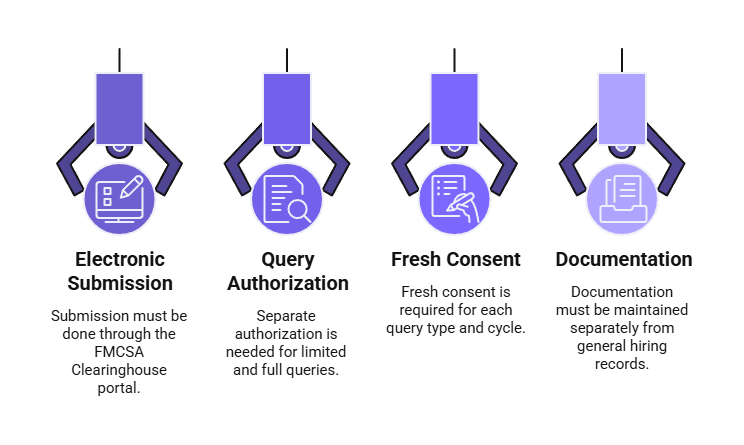
- Electronic submission through the FMCSA Clearinghouse portal
- Separate authorization for limited queries versus full queries
- Fresh consent for each query type and cycle
- Documentation maintained independently from general hiring records
Limited queries reveal only whether a driver has violations on record. Full queries, requiring additional driver consent, disclose specific violation details. Employers must determine which query type is appropriate based on hiring stage and regulatory obligation.
Timing and Coordination with Other Checks
Clearinghouse queries do not replace motor vehicle record checks, employment verification, or criminal background screening. Each serves a distinct compliance function. Employers must sequence these checks appropriately to avoid conditional offer complications and ensure timely onboarding.
Clearinghouse results are immediate, while criminal history checks may take several days depending on jurisdiction and record availability. Motor vehicle record turnaround varies by state. Employers should structure hiring timelines to accommodate the longest-duration check while maintaining Clearinghouse query proximity to the first safety-sensitive function.
Florida CDL Background Check Requirements: Distinguishing State Licensing from Employer Screening
Florida’s “good moral character” standard creates confusion about which entity performs criminal history evaluation and at what stage. Employers do not enforce the good moral character standard, but they must understand how DHSMV licensing decisions affect driver eligibility.
DHSMV’s Role in Criminal History Review
The Department of Highway Safety and Motor Vehicles conducts fingerprint-based background checks as part of CDL application and renewal processes. Certain disqualifying offenses, including felonies involving controlled substances or violent crimes, may result in license denial or revocation. The specific criteria are defined in Florida statutes related to licensing, not employment.
DHSMV evaluates licensing eligibility independently from employer hiring decisions:
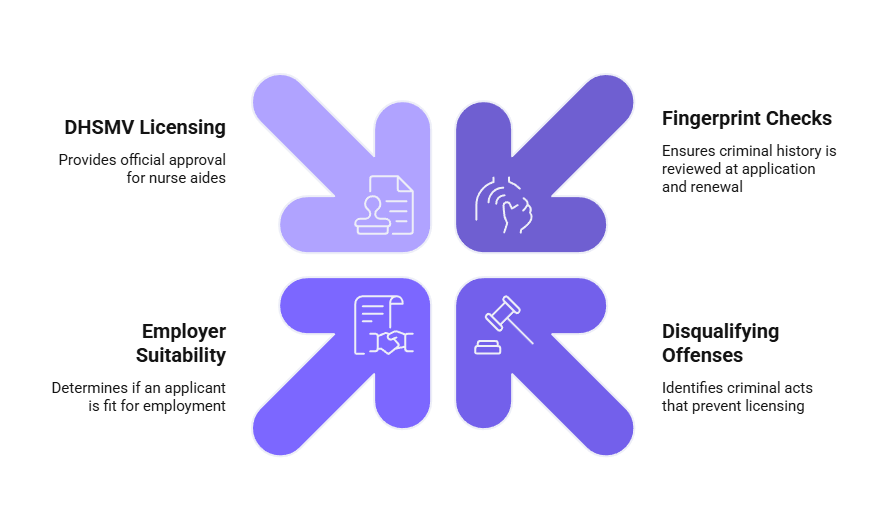
- Fingerprint-based criminal history checks conducted at application and renewal
- Disqualifying offenses may include drug felonies, violent crimes, and other statutory bars
- License issuance does not guarantee employer suitability determination
- Employers cannot replicate or override DHSMV licensing determinations
Employers do not have access to the same databases or decision frameworks used by DHSMV. They cannot replicate or override DHSMV determinations. If a driver holds a valid Florida CDL, DHSMV has concluded that licensing requirements are satisfied, but this does not mean the driver meets employer-specific suitability standards.
Employer-Initiated Criminal Background Checks
Employers may conduct criminal background checks as part of their hiring process, subject to federal and state employment screening laws. These checks serve a different purpose than DHSMV’s licensing review. Employers evaluate criminal history in relation to job responsibilities, workplace safety, and insurance requirements.
Florida law does not mandate criminal background checks for commercial driver employment, but federal DOT regulations require employers to investigate safety performance history and make determinations about driver qualification. Criminal history may be relevant to these determinations depending on offense nature, recency, and relationship to driving duties.
Lookback Periods and Reporting Restrictions
Florida’s seven-year lookback period for criminal history reporting generally applies to non-licensure employment background checks, with exceptions for positions involving vulnerable populations or other statutorily specified roles. Employers should verify whether their industry or position type falls under an exception.
| Check Type | Typical Lookback Period | Regulatory Source |
| Criminal history (employment) | 7 years | Florida state law (with exceptions) |
| Employment verification | 3 years | Federal DOT Part 391 |
| Motor vehicle records | 3 years (or state maintenance period) | Varies by state |
*Criminal history lookback applies primarily to consumer reports provided by third-party screening companies. Direct employer-obtained records may be subject to different standards.
Federal DOT regulations do not impose a uniform lookback period for all checks. Employers must reconcile these varying timeframes when structuring screening protocols.
Florida DOT Background Check vs State Law: Navigating Interstate and Intrastate Distinctions
The division between interstate and intrastate commerce determines which regulatory framework governs driver qualification and background check obligations. Employers frequently misclassify operations, applying federal rules where state law controls or vice versa.
Defining Interstate vs Intrastate Operations
Interstate commerce involves trade, traffic, or transportation across state lines or between points within one state through another state. Intrastate commerce occurs entirely within a single state without crossing state boundaries or connecting to interstate routes.
Vehicle weight, cargo type, and operational scope all influence whether a driver’s activities constitute interstate or intrastate commerce. A driver operating a vehicle under 10,001 pounds exclusively within Florida may fall outside federal DOT jurisdiction but remains subject to Florida employment and motor vehicle laws.
When Federal Rules Preempt State Requirements
Federal Motor Carrier Safety Regulations may preempt state laws that directly conflict with federal safety standards, though preemption determinations are context-specific. Employers should consult legal counsel when state and federal requirements appear to conflict. Interstate CDL holders must comply with Part 391 qualification requirements regardless of more lenient state standards.
However, federal preemption does not eliminate state employment law obligations unrelated to motor carrier safety. Anti-discrimination protections, wage and hour rules, and general employment screening requirements apply to commercial driver hiring even when federal DOT rules govern vehicle operation.
Florida-Specific Rules for Intrastate Drivers
Florida administers its own intrastate CDL program for drivers operating commercial vehicles exclusively within state borders. These drivers must meet state-established medical and licensing standards, which may differ from federal requirements in certain respects.
Intrastate driver screening considerations:
- State medical certification requirements may differ from federal standards
- DHSMV good moral character review applies at licensing stage
- Employer screening follows Florida employment law, not federal DOT Part 391
- Clearinghouse queries generally not required unless federal jurisdiction triggered
Employers hiring intrastate drivers must determine which background check elements are mandated by Florida law versus recommended as best practice. The absence of a federal requirement does not mean screening is optional, but the specific checks, lookback periods, and disqualification criteria may differ from interstate standards.
Compliance Blind Spots in Multi-Jurisdictional Freight Operations
Employers operating across multiple compliance layers encounter predictable gaps where regulatory frameworks intersect imperfectly. These blind spots generate audit risk and create inconsistent hiring outcomes.
Misclassification of Driver Roles
The most common compliance failure involves treating all drivers identically regardless of their operational classification. A yard jockey moving trailers within a single facility faces different screening requirements than an over-the-road interstate trucker, yet employers often apply uniform processes.
Proper classification requires analyzing vehicle weight, cargo type, route scope, and frequency of interstate travel. Seasonal or occasional interstate trips may bring otherwise intrastate drivers under federal jurisdiction for specific periods. Employers must document classification decisions and update them when operational assignments change.
Port Security Requirements Overlooked
Drivers assigned to port pickup or delivery routes may require TWIC credentials even if their primary duties involve non-port locations. TWIC applications trigger TSA background checks covering different offense categories and lookback periods than DOT or state employment screening.
Port-related compliance obligations include:
- TWIC eligibility screening through TSA covering terrorism-related offenses
- Documentation of TWIC status maintained separately from driver qualification files
- Verification before dispatch to restricted port areas
- Maritime Transportation Security Act requirements for certain cargo operations
Employers must identify which positions involve port access, obtain driver consent for TSA checks, and maintain documentation of TWIC status. Failure to verify TWIC credentials before dispatching drivers to restricted areas creates both security and contractual liability.
Out-of-State Hiring and License Transfer Gaps
Drivers relocating to Florida from other states may carry licenses issued under different standards. Florida’s good moral character review occurs at license transfer, not at the point of employer hiring. Employers cannot assume that an out-of-state CDL reflects the same criminal history evaluation Florida would conduct.
Motor vehicle records from the driver’s previous state of licensure must be obtained during the hiring process. Some states maintain longer lookback periods or report different violation categories. Relying solely on Florida MVR checks for recently transferred drivers creates information gaps.
Clearinghouse Consent Lapses
Annual Clearinghouse queries require fresh consent each time. Employers conducting queries on the anniversary of hire without confirming current consent validity risk non-compliance. Driver turnover, system updates, and administrative errors can invalidate consent between query cycles.
Maintaining a consent management process separate from general onboarding documentation helps ensure query authorization remains current. Employers should audit consent status before executing annual queries and document all consent renewals.
Technology-Assisted Screening Methods: Capabilities and Limitations in Florida Commercial Driver Context
Employers increasingly encounter technology platforms offering automated background check services, continuous monitoring, or integrated compliance tracking. These tools can enhance efficiency but do not eliminate the employer’s obligation to understand applicable legal requirements and exercise proper judgment.
Automated Clearinghouse Query Platforms
Third-party platforms can facilitate Clearinghouse query execution, consent management, and result tracking. These systems may integrate with applicant tracking software or HRIS platforms, reducing manual data entry and improving record consistency.
However, automation does not replace the employer’s responsibility to determine when queries are required, obtain proper consent, interpret results in light of DOT regulations, or comply with FCRA obligations such as adverse action procedures and dispute resolution.
| Technology Function | Capability | Limitation |
| Automated Clearinghouse queries | Streamlines consent and query execution | Does not determine when queries are required |
| Continuous MVR monitoring | Provides real-time violation alerts | May not satisfy specific DOT periodic review requirements |
| AI criminal record parsing | Identifies potentially disqualifying offenses | Cannot perform individualized legal assessment |
| Integrated compliance dashboards | Centralizes screening documentation | May not capture jurisdiction-specific obligations |
System-generated alerts may flag drivers with violations, but employers must follow regulatory procedures for evaluation, determination, and notice.
Continuous Motor Vehicle Record Monitoring
Some services offer ongoing MVR monitoring that alerts employers to new violations, license suspensions, or other changes in driver status. This approach can supplement required annual MVR checks and provide earlier notice of disqualifying events.
Continuous monitoring does not satisfy specific DOT requirements for periodic record review unless it captures the same data elements at the required intervals. Employers must verify that monitoring services align with federal and state record-check mandates and document compliance separately from alerts.
AI-Enhanced Criminal Record Review
Technology tools may assist in parsing criminal records, identifying potentially disqualifying offenses, or flagging inconsistencies requiring further investigation. These tools can reduce manual review time and improve consistency in initial screening stages.
Artificial intelligence systems do not perform legal analysis or make hiring decisions. When considering information from consumer reports, employers must conduct individualized assessments as required by FCRA and applicable state fair chance laws, meaning two applicants with identical criminal records may receive different hiring outcomes based on contextual factors such as evidence of rehabilitation, time elapsed, and specific job duties. Automated flags should prompt human review, not mechanically drive disqualification.
Employers must obtain written consumer authorization before procuring consumer reports, whether reviewed manually or through AI-assisted tools, in compliance with FCRA Section 604(b).
Integrated Compliance Dashboards
Platforms consolidating Clearinghouse status, MVR results, employment verification, and other screening elements can improve visibility into driver qualification status and simplify audit preparation. Centralized tracking reduces the risk that required checks are missed or documentation is lost.
Employers must ensure that integrated systems capture all jurisdiction-specific requirements relevant to their operations. A system designed for interstate carriers may not flag intrastate-specific obligations or port security needs. Configuration and validation are essential to prevent false confidence in incomplete processes.
Practical Implementation for Small and Midsize Carriers
Smaller employers often lack dedicated compliance staff and must build screening processes that balance thoroughness with operational capacity. Practical implementation focuses on classification accuracy, documentation, and trigger-based review.
Start with Accurate Driver Classification
Before designing background check processes, employers should inventory driver roles and classify them by operational scope. Categories such as “interstate CDL,” “intrastate CDL,” “port access,” and “non-CDL commercial” should be created based on vehicle type, routes, and cargo.
Classification framework elements:
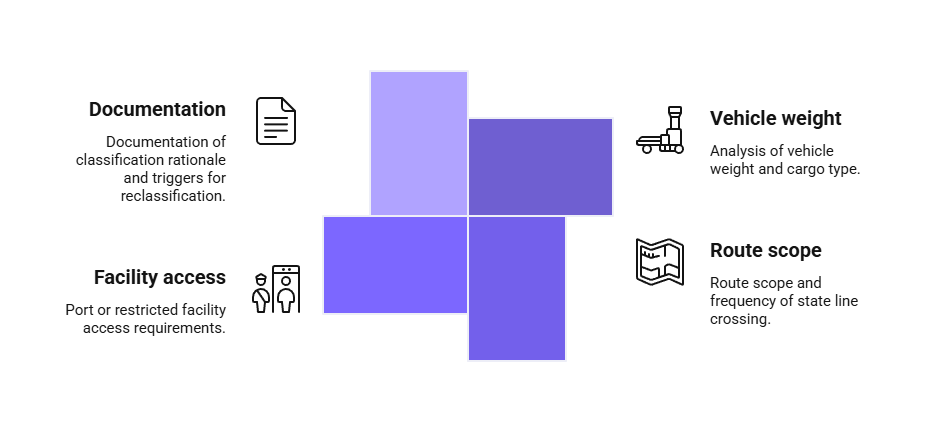
- Vehicle weight and cargo type analysis
- Route scope and frequency of state line crossing
- Port or restricted facility access requirements
- Documentation of classification rationale and triggers for reclassification
Each category should map to a specific set of required checks, including Clearinghouse queries, MVR review, employment verification, and any port or state-specific requirements.
Build Documentation Protocols
Compliance depends on demonstrating that required checks were completed, results were evaluated, and decisions were documented. Simple templates should be developed for recording consent, query results, MVR findings, employment verification, and decision rationale.
Documentation should be sufficient to reconstruct the hiring process during an audit without requiring recall of undocumented conversations or assumptions. Dates, sources, and decision-maker identities for each screening step must be included.
Establish Trigger-Based Review Cycles
Beyond initial hiring checks, employers must schedule periodic reviews based on regulatory requirements and risk factors. A calendar for annual Clearinghouse queries, MVR checks, and employment verification updates should be tied to driver hire dates or operational milestones.
Triggers for interim review may include insurance carrier requests, customer audits, incident investigations, or operational changes such as new port routes. Documenting the trigger and resulting review ensures that ad hoc checks are captured consistently.
Designate a Compliance Point Person
Even small carriers benefit from assigning screening oversight to a specific individual who receives training on applicable requirements and maintains current knowledge of regulatory updates. This person coordinates with third-party screening providers, tracks documentation, and escalates questions requiring legal or technical expertise.
The compliance designee need not perform all checks personally but should verify that processes are followed, documentation is complete, and periodic reviews occur as scheduled. Cross-training a backup ensures continuity during absences.
Conclusion
Florida commercial transportation background checks 2026 operate within a complex regulatory structure where federal DOT mandates, state licensing standards, and port security protocols overlap imperfectly. Employers must classify driver roles accurately, apply jurisdiction-specific screening requirements, and document compliance consistently. Understanding these layered obligations reduces audit risk and supports defensible hiring decisions in multi-jurisdictional freight operations.
Frequently Asked Questions
What is the difference between a Clearinghouse query and a traditional criminal background check for Florida commercial drivers?
A Clearinghouse query searches the FMCSA database for drug and alcohol program violations reported by previous employers or testing entities. It applies only to CDL holders in safety-sensitive functions and requires specific driver consent through the federal system. A criminal background check reviews arrest and conviction records through state or national databases and serves employment screening purposes under separate legal requirements.
Do intrastate Florida commercial drivers need Clearinghouse queries if they never cross state lines?
Clearinghouse requirements apply to CDL holders performing safety-sensitive functions in interstate commerce. Drivers operating exclusively within Florida under intrastate authority may not be subject to Clearinghouse mandates unless their vehicle weight, cargo type, or operational scope triggers federal jurisdiction. Employers must evaluate each driver’s duties to determine applicability.
How does Florida’s seven-year lookback period interact with federal DOT background check requirements?
Florida’s seven-year lookback generally limits criminal conviction reporting in employment screening contexts, with exceptions for positions involving vulnerable populations or other statutorily specified roles. Federal DOT regulations do not impose a uniform criminal history lookback but require employment verification covering three years and motor vehicle record review. Employers must comply with the most restrictive applicable standard, which may vary by check type and driver classification.
What happens if a driver refuses to provide Clearinghouse consent during hiring?
Employers cannot allow CDL holders to perform safety-sensitive functions without completing required Clearinghouse queries. If a driver refuses consent, the employer cannot proceed with hiring for positions requiring Clearinghouse compliance. Refusal does not disqualify the driver from non-CDL or non-safety-sensitive roles where Clearinghouse queries are not mandated.
Are Florida employers required to conduct fingerprint-based background checks for commercial drivers?
Florida law requires fingerprint-based checks for CDL issuance administered by DHSMV, not for employment screening by private employers. Employers may choose fingerprint-based checks as part of their hiring process, but state employment law does not mandate this method. Federal DOT regulations similarly do not require fingerprinting but impose other investigation obligations.
How do port operations change background check requirements for Florida commercial drivers?
Drivers accessing port facilities may require TWIC credentials, which involve TSA background checks covering categories defined in 49 CFR 1572.103, including terrorism-related and other disqualifying offenses distinct from DOT or employment screening criteria. Employers must determine which roles involve port access, verify TWIC status before dispatch, and maintain documentation separate from general driver qualification files.
Can Florida employers use continuous monitoring to replace annual MVR checks for commercial drivers?
Continuous MVR monitoring can supplement required periodic checks and provide earlier notice of violations, but employers must verify that monitoring captures the same data elements at intervals satisfying DOT and state requirements. Documentation should demonstrate compliance with specific regulatory mandates, not merely the existence of a monitoring service subscription.
What should Florida carriers do when federal and state background check requirements conflict?
When conflict exists, employers should consult legal counsel, as preemption determinations are context-specific. Federal law may preempt state rules in motor carrier safety areas, but state employment and anti-discrimination laws apply alongside federal obligations. Employers should document the rationale for their chosen compliance approach.
Additional Resources
- FMCSA Drug and Alcohol Clearinghouse
https://clearinghouse.fmcsa.dot.gov/ - Federal Motor Carrier Safety Regulations Part 391
https://www.ecfr.gov/current/title-49/subtitle-B/chapter-III/subchapter-B/part-391 - Florida Department of Highway Safety and Motor Vehicles CDL Information
https://www.flhsmv.gov/driver-licenses-id-cards/commercial-drivers-license/ - Transportation Security Administration TWIC Program
https://www.tsa.gov/for-industry/twic - Florida Statutes Title XXIII Motor Vehicles
http://www.leg.state.fl.us/statutes/

ABOUT THE CREATOR
GCheck Editorial Team
Meet the GCheck Editorial Team, your trusted source for insightful and up-to-date information in the world of employment background checks. Committed to delivering the latest trends, best practices, and industry insights, our team is dedicated to keeping you informed.
With a passion for ensuring accuracy, compliance, and efficiency in background screening, we are your go-to experts in the field. Stay tuned for our comprehensive articles, guides, and analysis, designed to empower businesses and individuals with the knowledge they need to make informed decisions.
At GCheck, we're here to guide you through the complexities of background checks, every step of the way.