


California’s education background check framework operates through three overlapping jurisdictions: the Department of Justice, the FBI, and the Commission on Teacher Credentialing. Requirements differ based on employment type, credential status, and district policies. Understanding the decision points between LiveScan fingerprinting and FBI channeling methods helps district administrators maintain compliant onboarding workflows while navigating evolving procedural updates.
Key Takeaways
- California education background checks involve DOJ, FBI, and CTC clearances with requirements varying by role, credential, and employment status.
- Credentialed teachers undergo CTC-coordinated screening, while non-credentialed staff may require direct DOJ/FBI submissions through district protocols.
- LiveScan fingerprinting serves as California’s primary method for state and federal background checks, though channeling options exist for out-of-state applicants.
- Substitute teachers face different requirements depending on 30-day or emergency permit status versus day-to-day assignments.
- Processing timelines typically range from 3-5 business days for DOJ-only checks to 8-12 weeks when FBI results are required for credential clearance, though actual durations vary based on case complexity and processing volumes.
- Credential renewal background checks follow different protocols than initial applications, with specific triggering events requiring new fingerprinting.
- Charter and private schools maintain independent authority to establish screening standards exceeding minimum state requirements.
- District administrators must navigate fragmented compliance frameworks where role type, not just job title, determines applicable background check pathways.
Understanding California’s Education Screening Framework
California education employers operate within a compliance ecosystem where three separate agencies maintain overlapping authority over background check requirements. The California Department of Justice handles criminal history searches for state-level offenses. The Federal Bureau of Investigation processes national criminal records. Meanwhile, the Commission on Teacher Credentialing coordinates clearance requirements for credential holders. This jurisdictional fragmentation creates decision points where employment type, credential status, and district policy intersect to determine which screening pathway applies.
Public school districts follow Education Code provisions establishing minimum screening standards. Charter schools and private institutions may implement additional requirements within their independent authority. The result is a role-based compliance framework rather than a uniform statewide process.
| Agency | Jurisdiction | Primary Responsibility |
| California Department of Justice (DOJ) | State-level | Criminal history searches for California offenses |
| Federal Bureau of Investigation (FBI) | Federal-level | National criminal record processing |
| Commission on Teacher Credentialing (CTC) | Credential-specific | Clearance coordination for credential holders |
District HR coordinators must identify which combination of clearances applies to each position category before starting background check procedures.
In education HR, background checks are often not as straightforward as they might seem. What seems like a simple process can quickly become a series of judgment calls based on position responsibilities, employment status, and district practices. I have also witnessed firsthand how a lack of alignment within a process can cause delays and confusion for both district administrators and candidates. When a process is well-aligned from the outset, compliance does not feel like a reactive, but rather a proactive, supportive process. �
DOJ and FBI Screening Requirements by Role Category
The distinction between credentialed and non-credentialed positions creates the first major branching point in California’s education background check system. Certificated staff pursuing or holding teaching credentials complete background checks as part of the CTC application process, which includes both DOJ and FBI components. These individuals receive a Certificate of Clearance or credential document that serves as verification of completed screening for employment purposes.
Non-credentialed employees follow different pathways:
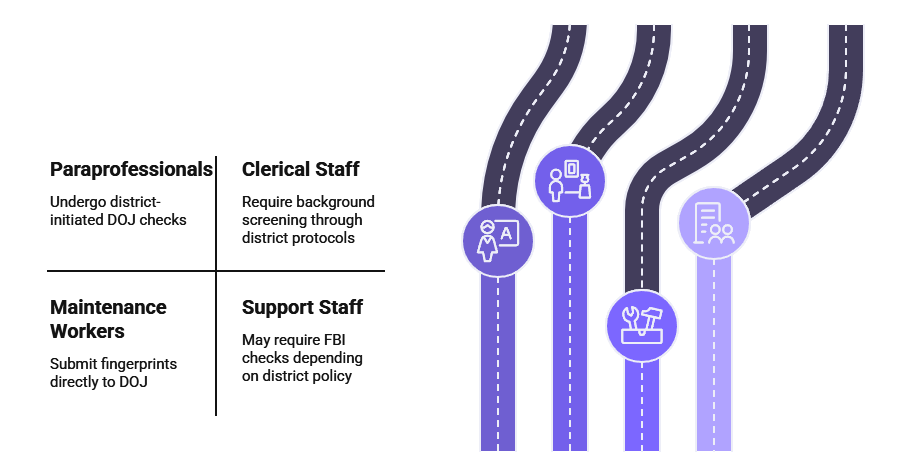
- Paraprofessionals typically undergo district-initiated DOJ checks
- Clerical staff with student contact require background screening through district protocols
- Maintenance workers with student access submit fingerprints directly to DOJ
- Support staff may require FBI checks depending on district policy and position classification
Some districts request FBI checks for all employees with student access when job duties and allowed purposes support such screening. Others limit federal screening to specific job classifications. Either way, district policies must align with allowed purpose requirements and applicable employment laws. School districts submit fingerprints directly to DOJ, which may also forward prints to the FBI depending on district policy and position requirements.
The CTC Clearance Process for Credential Applicants
Individuals applying for California teaching credentials submit fingerprints through the Commission on Teacher Credentialing’s processing system. The CTC forwards fingerprint data to both the DOJ and FBI, then evaluates results against statutory disqualification criteria before issuing credentials or certificates of clearance.
The CTC reviews criminal history information against Education Code provisions to determine whether convictions trigger mandatory review or require individualized fitness assessments. Even for statutory disqualifications, the Commission may consider rehabilitation evidence and individual circumstances. Applicants receive notification if their records trigger further review. At that point, they may submit evidence of rehabilitation or context documentation. Processing timelines for CTC clearances depend on whether criminal records appear and whether additional review becomes necessary.
LiveScan Fingerprinting vs. FBI Channeling Decision Points
California’s LiveScan system captures fingerprints electronically and transmits them to DOJ for processing. Most education background checks in California begin with LiveScan appointments at authorized scanning locations. The technology eliminates delays associated with physical fingerprint card mailing and reduces rejection rates caused by poor print quality.
When applicants complete LiveScan fingerprinting for education purposes, they perform the following steps:
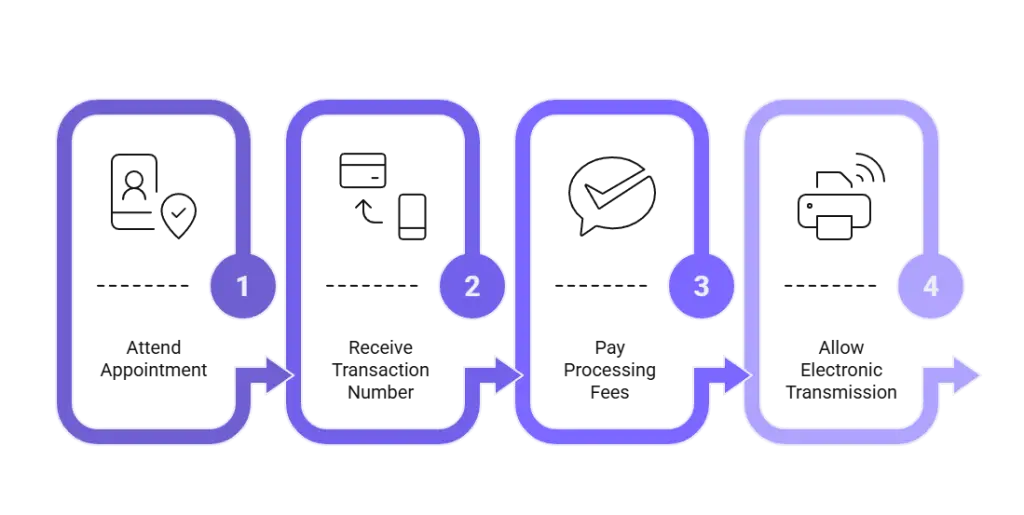
- Attend an appointment at an authorized scanning location
- Receive a transaction number for tracking purposes
- Pay applicable processing fees at the time of service
- Allow electronic transmission of prints to DOJ
The scanning station transmits prints to the DOJ, which searches state criminal records. When requested, the DOJ forwards prints to the FBI for national searches. Results return to the requesting agency, either the school district or the CTC, depending on the purpose of the background check.
When FBI Channeling Applies
FBI channeling provides an alternative pathway for obtaining federal criminal history checks outside California’s LiveScan system. This method typically applies when credential applicants live out of state and cannot access California LiveScan locations. It also serves candidates relocating from other jurisdictions when districts need to process background checks remotely.
| Method | Primary Use Case | Processing Path | Typical Timeline |
| LiveScan | In-state applicants | DOJ → FBI (when requested) | 3-5 days (DOJ only) |
| FBI Channeling | Out-of-state applicants | Direct to FBI | 8-12 weeks |
The CTC accepts FBI channeling results for credential applicants who demonstrate inability to complete California LiveScan due to geographic location. Applicants must use CTC-approved channeling services and ensure results are transmitted according to Commission specifications. Processing timelines through channeling routes often extend longer than LiveScan methods due to additional handling steps and coordination requirements.
Technology-Assisted Screening Methods
Some background check processes now incorporate electronic fingerprint capture devices that transmit data through secure networks to processing agencies. These systems may operate at school district offices, county offices of education, or mobile enrollment locations. The technology maintains the same legal standards as traditional LiveScan but expands access points for applicants.
Districts evaluating technology-assisted screening options should verify that systems meet California DOJ requirements for electronic fingerprint transmission. They must also maintain proper security protocols for biometric data handling and comply with applicable state privacy laws governing the collection, storage, and protection of sensitive biometric information. The method of fingerprint capture does not change core legal requirements or allowed uses of criminal history information.
Substitute Teacher Background Check Requirements
California substitute teachers fall into distinct categories with different background check requirements based on assignment duration and credential status. Substitute teachers holding valid California teaching credentials have already completed CTC background clearance as part of their credential application. Districts verify credential status through the CTC’s online verification system rather than starting separate background checks for these individuals.
30-Day and Emergency Permit Substitutes
Substitutes working under 30-day substitute permits or emergency credentials complete background checks through the CTC permit application process. These permits allow individuals without full credentials to teach for limited periods or in shortage areas.
The CTC requires DOJ and FBI fingerprint clearance before issuing such permits. The process follows the same review standards applied to credential applicants:
- Fingerprints submitted through CTC processing system
- DOJ and FBI searches conducted for criminal history
- Results reviewed against statutory disqualification criteria
- Permits issued only after clearance completion
Emergency permit holders undergo the same criminal history screening as credential candidates. Districts employing emergency permit substitutes verify that permits remain valid and that the required background clearance was completed during the permit application process.
Day-to-Day Substitute Assignment Protocols
Some districts employ day-to-day substitutes who do not hold credentials or 30-day permits. These individuals typically work under district intern or pre-intern arrangements that require district-level background checks rather than CTC processing.
| Substitute Type | Credential Status | Background Check Path | Renewal Frequency |
| Credentialed Substitute | Valid teaching credential | CTC clearance (completed) | Per credential cycle |
| 30-Day/Emergency Permit | Limited permit | CTC permit process | Per permit issuance |
| Day-to-Day Non-Credentialed | No credential/permit | District-initiated | Varies by district policy |
Districts submit fingerprints through LiveScan for DOJ screening and may also request FBI checks depending on local policy. The specific requirements for non-credentialed day-to-day substitutes vary by district and may depend on factors such as assignment frequency, grade levels served, and supervision arrangements.
Processing Timelines and Workflow Considerations
Background check processing timelines in California education settings depend on multiple variables. These include the agency conducting the review, whether FBI results are required, and current processing volumes. Understanding realistic timeframes helps district administrators plan hiring timelines and avoid compliance gaps during peak onboarding periods.
DOJ-Only Processing Timeframes
When districts submit fingerprints to the DOJ for state-level criminal history checks without requesting FBI processing, results typically return within 3-5 business days for applicants with no criminal records. Cases where records exist may require additional processing time as DOJ compiles disposition information and arrest details.
Districts receive electronic notifications when results become available through the DOJ system. Faster DOJ processing does not indicate lower screening standards but reflects the scope of databases searched. State-only checks capture California arrests, convictions, and court records. However, they omit criminal history from other states unless those records were reported to California authorities through interstate information sharing systems.
CTC Clearance Processing Duration
Initial credential applications requiring CTC background clearance typically process within 8-12 weeks when no criminal history issues appear. Actual durations vary based on case complexity, processing volumes, and whether criminal history appears requiring additional review. This timeline includes:
- Fingerprint processing by DOJ and FBI
- Transmission of results to the CTC
- Commission review of submitted materials
- Final clearance determination
Applicants can track application status through the CTC’s online system, which updates as applications move through processing stages. Applications flagged for criminal history review may extend beyond standard timelines as the CTC conducts fitness determinations. Applicants receive notice of flagged records and have opportunities to provide rehabilitation evidence, context documentation, and other information relevant to fitness assessments before final decisions are made. The Commission notifies applicants when additional information is needed and provides timeframes for submission.
Managing Peak-Period Workflows
School districts face concentrated onboarding volumes before the start of each academic year. This creates pressure on background check processing capacity. Planning strategies that distribute fingerprinting appointments across longer timeframes help avoid bottlenecks.
Some districts require spring completion of background checks for positions starting in fall. This approach builds buffer time into hiring workflows. Districts should account for potential variations in FBI processing timelines, which may be affected by processing volumes and other operational factors. Building contingency time into hiring timelines protects against compliance gaps when processing extends beyond typical ranges.
Credential Renewal Background Check Requirements
California teaching credential renewal does not automatically trigger new background check requirements. Credential holders renewing standard credentials typically do not submit new fingerprints unless specific circumstances apply. The CTC maintains records of initial background clearance and does not routinely require repeated fingerprinting at five-year renewal intervals for standard documents.
Triggering Events for New Background Checks
Certain situations require credential holders to complete new background checks even when credentials remain valid:
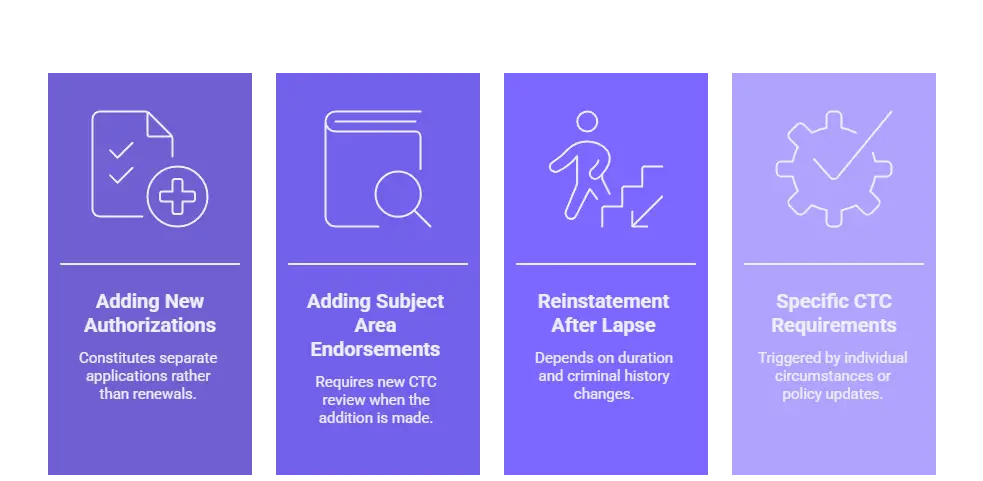
- Adding new credential authorizations that constitute separate applications rather than renewals
- Adding subject area endorsements when the addition requires new CTC review
- Reinstatement after lapse depending on duration and criminal history changes
- Specific CTC requirements triggered by individual circumstances or policy updates
Credential holders should verify with the CTC whether their specific transaction requires new clearance. Individuals whose credentials lapsed and are seeking reinstatement may face new background check requirements. The CTC evaluates reinstatement applications individually to determine whether previous clearance remains sufficient or new fingerprinting is necessary.
District-Initiated Re-Screening Protocols
Some school districts implement policies requiring periodic re-screening of employees independent of credential renewal cycles. These district-level requirements exist separately from CTC credential background checks and reflect local governance decisions about ongoing employment screening.
| Requirement Type | Trigger Event | Authority | Fingerprinting Required |
| CTC Credential Renewal | 5-year renewal cycle | State statute | Generally no |
| CTC Authorization Addition | New subject/authorization | Commission policy | Case-by-case |
| District Re-Screening | Local policy cycle | District governance | Varies by policy |
Districts establishing such policies must ensure compliance with applicable legal limits on repeated background check requests. When districts require incumbent employees to complete new fingerprinting, they should provide clear communication about the legal basis for the requirement. This includes whether it stems from credential changes, policy updates, or other triggering events.
Charter School and Private School Authority
Charter schools in California operate with autonomy to establish background check requirements that exceed statutory minimums while remaining subject to certain baseline mandates. These petitions typically outline screening protocols, and governing boards maintain authority to require additional checks beyond those specified in Education Code provisions for traditional public schools.
Independent Screening Standards
Private schools that do not receive public funding typically are not subject to CTC jurisdiction for non-credentialed positions. However, many voluntarily follow similar standards. Specific licensing or regulatory requirements may apply depending on school type and accreditation status. Private institutions may establish their own background check requirements, fingerprint processing arrangements, and review criteria.
Some private schools require all employees and volunteers with campus access to complete DOJ and FBI fingerprinting regardless of job duties or student contact levels. The flexibility available to charter and private schools means that individuals working across different school types may encounter varying background check requirements even within the same geographic area.
Staffing agencies serving multiple school clients must navigate these differences. They ensure that background check documentation meets the specific requirements of each placement location.
Multi-District Employment Considerations
Educators working for multiple districts simultaneously or moving between districts during the same credential cycle do not typically need to repeat background checks for each new employer. The CTC clearance completed for credential issuance serves as verification of background screening for any California district employing the credential holder.
However, individual districts may require supplemental checks or verification procedures as part of their local onboarding protocols:
- Credentialed employees rely on CTC clearance across districts
- Non-credentialed employees may face new checks with each employer
- County-coordinated systems allow some shared access to results
- Local arrangements vary by regional coordination agreements
Non-credentialed employees moving between districts may face new background check requirements with each employer, as district-level clearances do not automatically transfer. Some counties operate shared background check systems allowing participating districts to access results. This remains a local coordination arrangement rather than a statewide standard.
Compliance Documentation and Record Retention
District HR departments must maintain documentation demonstrating that required background checks were completed before employees began service in positions requiring clearance. This documentation typically includes fingerprint submission receipts, DOJ clearance notifications, credential verification records, or certificates of clearance issued by the CTC.
Record systems should allow authorized personnel to retrieve documentation during audits or compliance reviews while maintaining appropriate access controls and confidentiality protections for sensitive background check information. Districts organize documentation to support efficient verification of:
- Completion dates for background checks
- Clearance status for current employees
- Documentation of any exceptions or delays
- Verification of credential status through CTC systems
Verification Systems and Processes
The CTC provides an online credential verification system allowing districts to confirm credential status and validate that individuals hold current, valid credentials with appropriate authorizations. This system serves as the primary verification tool for credentialed positions and provides real-time status information.
| Position Type | Verification Method | Primary Source | Frequency |
| Credentialed Staff | CTC online verification | Commission database | Before employment + periodic |
| Non-Credentialed Staff | DOJ clearance records | District documentation | Before employment |
| Substitute Teachers | Credential/permit verification | CTC system or district records | Per assignment cycle |
For non-credentialed positions, districts maintain clearance documentation received directly from the DOJ after fingerprint processing. These records confirm that criminal history checks were completed and cleared according to district standards. Systems for organizing and accessing this documentation should account for the volume of employees processed and the need for audit-ready retrieval.
Audit Preparation Considerations
Education agencies face periodic audits examining compliance with background check requirements. These often occur as part of broader reviews of personnel practices and fiscal management. Audit prep involves ensuring that documentation exists for all current employees in positions requiring clearance. Verification must have occurred before service began. Any exceptions or delays require proper documentation with explanatory records.
Districts should establish protocols addressing situations where employees began service with pending background checks due to emergency staffing needs or processing delays. While such situations should remain exceptional, documenting the circumstances provides an audit trail. This includes supervisory arrangements during the pending period and eventual clearance completion.
Procedural Updates
California’s education background check system experiences ongoing procedural adjustments as agencies update technology systems, refine processing workflows, and implement policy clarifications. These updates typically involve operational improvements rather than fundamental statutory changes. However, they may affect timelines, submission methods, or documentation requirements for district administrators.
Technology System Transitions
The DOJ and CTC periodically upgrade electronic systems handling fingerprint submissions, result transmissions, and clearance notifications. System transitions may temporarily affect processing timelines or require districts to update their local procedures for accessing results.
Agencies typically provide advance notice of major system changes and offer training or guidance materials for users. Districts should monitor communications from DOJ, FBI, and CTC regarding system updates. Staff responsible for background check coordination need access to relevant training materials. Technology transitions may also create opportunities to streamline workflows through improved electronic interfaces or automated verification tools.
Policy Clarifications and Guidance Updates
Education agencies issue periodic guidance clarifying existing requirements or addressing questions that arise in practice. These clarifications help resolve ambiguities about which positions require specific types of background checks, how to handle unique employment situations, or what documentation satisfies compliance obligations.
While not representing new law, guidance updates affect how administrators interpret and apply existing requirements:
- Position classification questions receive agency clarification
- Documentation requirements are refined through guidance
- Procedural questions are addressed in updated materials
- Implementation practices are standardized through agency communications
Staying current with guidance updates requires monitoring agency websites, subscribing to notification systems, and participating in professional networks where compliance information is shared. County offices of education often serve as intermediaries providing local districts with synthesized updates and practical implementation guidance.
Conclusion
California’s education background check system requires administrators to navigate overlapping jurisdictional authorities, role-specific requirements, and fragmented processing pathways. Success depends on accurately mapping each position type to applicable screening requirements. Understanding the distinction between CTC credential clearances and district-level checks helps maintain compliance. Building sufficient timeline buffers into hiring workflows accommodates processing variables and protects against onboarding delays.
Frequently Asked Questions
What is the difference between a CTC background check and a district background check in California?
A CTC background check occurs during credential application processing and includes both DOJ and FBI clearance reviewed against Commission standards for credential eligibility. District background checks are started by school employers for positions not requiring credentials or for verification purposes, typically processing through the DOJ with optional FBI components based on district policy. The CTC check determines credential eligibility, while district checks verify employment clearance.
How long does a California teacher background check take in 2026?
Processing timelines vary based on the type of check required. DOJ-only background checks typically complete within 3-5 business days when no criminal history appears. CTC credential clearances requiring both DOJ and FBI processing generally take 8-12 weeks for straightforward applications. Cases involving criminal history review may extend beyond these ranges depending on the complexity of the review and information needed.
Do California substitute teachers need new background checks each year?
Substitute teachers holding valid California teaching credentials do not need annual background checks, as their credential clearance remains valid throughout the credential term. Substitutes working under 30-day permits or emergency credentials complete background checks as part of the permit application, not annually. Non-credentialed day-to-day substitutes follow district policies that may vary in re-screening requirements.
What is LiveScan fingerprinting and when is it required for California education jobs?
LiveScan is California’s electronic fingerprint capture and transmission system used to submit prints to the Department of Justice for criminal history checks. It is required for most education background checks in California, including credential applications and district employee screening. LiveScan captures prints digitally at authorized locations and transmits them immediately to the DOJ, which may forward them to the FBI when federal checks are requested.
Do I need a new background check when renewing my California teaching credential?
Standard credential renewal typically does not require new background checks. The initial clearance completed during credential application generally remains sufficient for renewal purposes. New fingerprinting becomes necessary when adding credential authorizations that constitute new applications, when credentials have lapsed for extended periods, or when specific circumstances trigger CTC requirements for updated clearance. Verification with the CTC regarding specific renewal situations is recommended.
Can California charter schools require additional background checks beyond state minimums?
Charter schools maintain authority to establish background check requirements exceeding statutory minimums for public schools. Charter petitions and governing board policies may specify additional screening components, expanded eligible populations for fingerprinting, or supplemental checks beyond DOJ and FBI clearances. These enhanced requirements reflect charter school autonomy in operational decision-making while maintaining compliance with baseline mandates.
How do California education background checks handle out-of-state criminal records?
FBI fingerprint checks capture criminal records from all states, providing national coverage beyond California databases. When districts request only DOJ checks without FBI processing, out-of-state records may not appear unless they were reported to California through interstate information sharing systems. CTC credential clearances include FBI checks, ensuring that out-of-state criminal history is reviewed for credential applicants.
What happens if something appears on my California education background check?
When criminal history appears during CTC credential processing, the Commission reviews records against statutory disqualification criteria and may request additional information for fitness determinations. Applicants receive notification and opportunities to provide context or rehabilitation evidence. For district-level checks, employing districts must follow FCRA adverse action procedures if considering denial based on background check results, including providing pre-adverse action notices, copies of reports, summaries of rights, and opportunities to respond before final decisions.
Additional Resources
- California Commission on Teacher Credentialing: Credential Information
https://www.ctc.ca.gov/credentials - California Department of Justice: Fingerprinting Requirements
https://oag.ca.gov/fingerprints - FBI: Identity History Summary Checks
https://www.fbi.gov/services/cjis/identity-history-summary-checks - California Education Code: Fingerprinting Requirements
https://leginfo.legislature.ca.gov/faces/codes.xhtml - California County Superintendents Educational Services Association
https://www.ccsesa.org/

ABOUT THE CREATOR
GCheck Editorial Team
Meet the GCheck Editorial Team, your trusted source for insightful and up-to-date information in the world of employment background checks. Committed to delivering the latest trends, best practices, and industry insights, our team is dedicated to keeping you informed.
With a passion for ensuring accuracy, compliance, and efficiency in background screening, we are your go-to experts in the field. Stay tuned for our comprehensive articles, guides, and analysis, designed to empower businesses and individuals with the knowledge they need to make informed decisions.
At GCheck, we're here to guide you through the complexities of background checks, every step of the way.