



Screening substitute teachers requires balancing legal compliance, operational speed, and risk mitigation across fragmented state and local requirements. This guide provides school HR professionals with a tactical framework for designing screening protocols that address turnover, state-by-state variance, and the tension between thoroughness and hiring velocity during chronic staffing shortages.
Key Takeaways
- Substitute teacher background check requirements vary significantly by state, district, and school type, with no uniform federal standard governing all hiring decisions.
- Multi-jurisdictional criminal record searches, fingerprint-based checks, and child abuse registry queries form the baseline for most education screening programs.
- Turnaround times for fingerprint processing and out-of-state record verification can create bottlenecks during urgent staffing needs.
- Continuous monitoring systems offer an alternative to periodic rescreening but introduce data privacy and procedural fairness considerations.
- Education and credential verification processes must account for substitute-specific certification pathways that differ from full-time teacher licensure.
- State laws governing lookback periods, disqualifying offenses, and individualized assessments create compliance complexity for multi-district employers.
- Private schools may face different regulatory frameworks than public institutions, particularly regarding fingerprinting and state database access.
- Effective substitute teacher screening programs require documented policies that address pre-adverse action procedures, records retention, and dispute resolution.
Understanding the Unique Screening Context for Substitute Teachers
Substitute teachers occupy a distinct position within education workforce planning. Unlike permanent staff, substitutes often work across multiple districts, require immediate placement with minimal notice, and may have limited prior contact with hiring personnel. These operational realities create tension between the thoroughness expected in education settings and the speed required to fill classrooms.
The regulatory landscape for substitute teacher screening exists as a patchwork of state statutes, local board policies, and federal guidelines. While the Every Student Succeeds Act and state education codes establish baseline expectations, implementation varies based on jurisdiction, funding source, and school governance model. Public school districts typically operate under state-mandated frameworks, while private and charter schools may navigate overlapping or alternative requirements.
Scale and Velocity Challenges
School districts managing substitute pools ranging from dozens to hundreds of candidates face screening workflows that differ fundamentally from full-time hiring. High turnover rates, seasonal demand fluctuations, and emergency placements require systems designed for rapid onboarding without sacrificing due diligence. Many HR teams must process background checks for individuals who may work a single day or maintain long-term availability across academic years.
Multi-Jurisdictional Complexity
Substitutes who work in border regions or seek placement across county lines introduce cross-jurisdictional screening considerations. A candidate cleared in one state may require supplemental checks when working in neighboring districts. Reciprocity agreements, interstate data-sharing compacts, and variance in disqualifying offense definitions create operational friction for regional staffing coordinators.
Core Components of Substitute Teacher Background Checks
Designing a legally compliant and operationally effective screening program for substitute teachers requires understanding the distinct types of checks, their limitations, and how they interact within a layered verification strategy. The following table outlines common screening components and their typical characteristics.
| Screening Component | Scope | Typical Timeline | Key Considerations |
| County Criminal Search | Court records in specific counties | 2–5 business days | Coverage limited to searched jurisdictions |
| State Repository Check | Centralized state criminal database | 1–7 business days | Completeness varies by state reporting |
| FBI Fingerprint Check | National arrest and conviction records | 3–10 business days | Most comprehensive, requires state submission |
| Sex Offender Registry | State and national registry databases | Same day to 2 days | Public records, no consent required |
| Child Abuse Registry | State child welfare records | 3–14 business days | Access policies vary by state |
| Education Verification | Degree and credential confirmation | 5–15 business days | Substitute certifications differ from standard licenses |
| Employment History | Prior employer contact and verification | 7–21 business days | Reference disclosure laws vary by state |
Criminal History Searches
Criminal background screening for education personnel typically includes multiple search tiers. County-level searches examine court records in jurisdictions where a candidate has lived, worked, or attended school. State repository checks query centralized databases maintained by state police or justice departments. National database searches aggregate records from multiple sources but may not capture recent filings or jurisdictions with incomplete reporting.
Fingerprint-based checks submitted to state agencies and processed through FBI databases provide the most comprehensive criminal history available to education employers. These searches compare submitted prints against arrest and conviction records nationwide. Processing times vary by state infrastructure, with some jurisdictions returning results within days and others requiring weeks during high-volume periods.
The process of screening substitute teachers is an example of how often the HR function is called upon to provide answers that involve speed and safety at the same time. With varying state regulations, lengthy fingerprint processing, and always a staffing need, the perfect solution is usually not an option. The most successful programs are those that focus on policy, process, and transparency, as opposed to quick fixes based on pressing demand. When the HR function does it right, the classroom stays full and the process stays strong.
Sex Offender Registry Verification
Most states require education employers to verify candidates against state and national sex offender registries before hire. Registry checks typically return results quickly, but interpretation requires care. Registries may include individuals convicted under offenses that occurred decades prior, raising questions about relevance and rehabilitation that may require individualized assessment under EEOC guidance.
Child Abuse and Neglect Registries
Many states maintain central registries of individuals found to have committed child abuse or neglect through civil or administrative proceedings. Access policies vary, with some states restricting registry checks to licensed childcare providers or specific educator categories. Substitute teachers may fall within or outside mandated check populations depending on state definitions and employment relationship structures.
Education and Credential Verification
Verifying educational credentials and teaching certifications presents unique considerations for substitute staff. Some states offer alternative or emergency substitute certification that requires fewer qualifications than standard teaching licenses. HR teams must confirm that candidates hold the specific credential tier required by district policy and state law for the assignment duration and subject matter.
[email protected] - GCh
Degree verification through registrars or third-party services confirms attendance and completion but does not validate that coursework aligns with current teaching assignments. Transcript review may be necessary for substitute roles requiring content-area expertise, particularly in secondary education or specialized subjects.
Employment History and Reference Checks
Previous employment verification serves as both a credential check and a behavioral reference source. Gaps in employment, patterns of short tenure, or separation circumstances may provide relevant context for hiring decisions. Many districts require contact with prior education employers specifically, as references from non-education settings may lack insight into classroom management or student interaction concerns.
State laws vary on what former employers may disclose. Some jurisdictions protect good-faith references, while others limit disclosures to dates of employment and eligibility for rehire. These limitations affect the utility of reference checks as a risk mitigation tool.
Navigating State-by-State Variance in Screening Requirements
Substitute teacher background check mandates differ across states in scope, process, timing, and disqualifying criteria. Understanding these variances is essential for multi-state employers and for districts near state borders where candidates may hold certifications in multiple jurisdictions.
Fingerprinting Mandates
States differ on whether substitute teachers must submit fingerprints for FBI database checks. Requirements typically fall into the following categories:
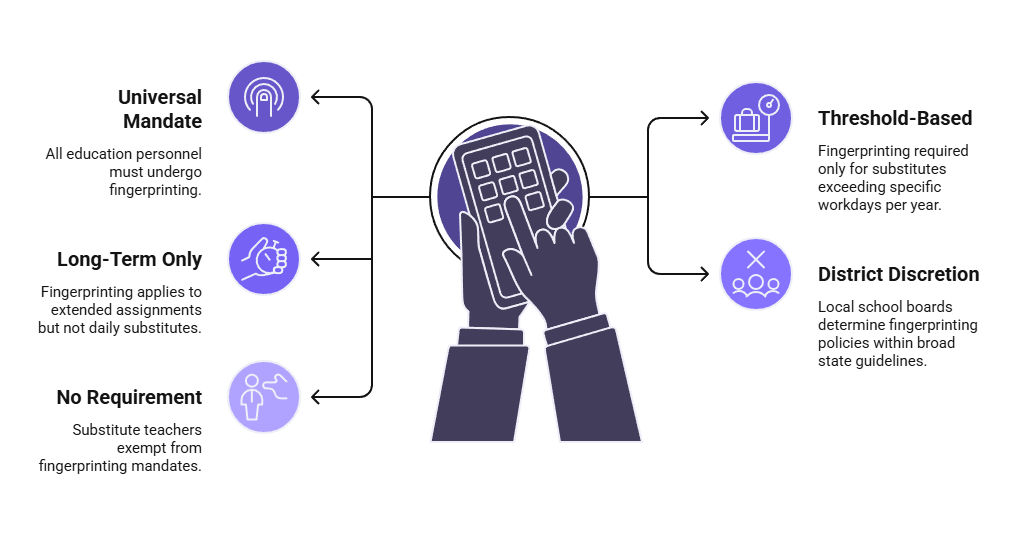
- Universal Mandate: All education personnel, including short-term substitutes, must undergo fingerprinting
- Threshold-Based: Fingerprinting required only for substitutes exceeding specific workdays per year
- Long-Term Only: Fingerprinting applies to extended assignments but not daily substitutes
- District Discretion: Local school boards determine fingerprinting policies within broad state guidelines
- No Requirement: Substitute teachers exempt from fingerprinting mandates
Fingerprinting infrastructure also varies. Some states operate centralized processing through education or justice departments with contracts for electronic submission. Others require candidates to visit specific locations for ink-and-roll fingerprinting, creating logistical barriers in rural areas.
Lookback Periods and Reportable Offenses
State laws establish varying timeframes for which criminal records remain relevant to hiring decisions. Seven-year lookback periods are common but not universal. Some states restrict consideration of records beyond a certain age, while others permit review of all available history. Federal guidance complicates this landscape by discouraging blanket exclusions based on arrest records or old convictions unrelated to job duties.
Disqualifying offense lists vary significantly. Convictions involving violence, drugs, sexual offenses, or crimes against children appear on most exclusion lists, but definitions and categorical approaches differ. Some states mandate automatic disqualification for specific offenses, while others require individualized assessment considering offense age, evidence of rehabilitation, and job-relatedness.
Rescreening Intervals
Policies governing how frequently substitute teachers must undergo new background checks create operational and budgetary implications:
| Rescreening Frequency | Operational Impact | Common in States |
| Annual | High administrative burden, consistent current data | Northeast region, some urban districts |
| Every 3 years | Moderate workload, balances cost and currency | Midwest and Southern states |
| Every 5 years | Lower cost, aligns with certification renewal | Western states, rural districts |
| One-time (certification duration) | Minimal rescreening burden, greater gap risk | States with continuous monitoring alternatives |
Districts employing substitutes across multiple years must track individual check expiration dates and manage rescreening workflows to avoid lapses in clearance status.
Out-of-State Applicants
Candidates relocating from other states or holding multi-state certifications present screening challenges. Some states accept prior background checks completed in other jurisdictions if conducted within a specified timeframe. Others require new fingerprinting regardless of recent clearances elsewhere. Interstate data-sharing agreements facilitate some reciprocity, but gaps in participation and variance in state database completeness limit reliability.
Turnaround Time Considerations and Workflow Optimization
Speed-to-hire directly affects classroom coverage and district operational continuity. Background check turnaround times vary based on search type, vendor infrastructure, jurisdiction responsiveness, and candidate history complexity.
Fingerprint Processing Timelines
State and FBI fingerprint processing times fluctuate based on submission volume, technical infrastructure, and staffing levels at reviewing agencies. Electronic fingerprint submissions generally process faster than ink cards, but candidate print quality and database match algorithms affect automated processing success. Manual reviews triggered by potential matches can extend timelines by days or weeks.
Districts in states with slower processing should consider initiating fingerprinting early in the hiring cycle, potentially before final hiring decisions for pre-approved candidate pools. However, legal and budgetary constraints may limit who can be fingerprinted before a conditional offer.
County and State Repository Delays
County court record searches depend on courthouse operating hours, digitization levels, and search request volumes. Rural counties with paper-based records systems may require manual retrieval, extending timelines beyond electronic jurisdictions. State repository checks typically process quickly when systems are modernized, but legacy databases and inter-agency coordination issues create variance.
Managing Urgent Placement Needs
Teacher absences requiring same-day or next-day substitute placement create tension with background check timelines. Some districts implement tiered clearance systems, allowing provisional placement for pre-vetted candidates with partial screenings complete while awaiting final results. These approaches require clear policies on the following elements:

- Permissible activities during provisional status
- Supervision requirements and student contact restrictions
- Documentation and tracking protocols
- Disqualification triggers requiring immediate removal
- Insurance and liability coverage verification
- Communication procedures with school administrators
- Time limits for provisional placements
Emergency or provisional hiring practices must align with state law and district insurance requirements. State laws vary significantly: some prohibit any student contact before full background clearance, others allow restricted contact under specific conditions, and some permit conditional employment with documented safeguards. Employers should verify their jurisdiction's specific requirements before implementing provisional placement protocols.
Building Pre-Cleared Talent Pools
Proactive screening of substitute candidate pools during low-demand periods can reduce time-to-placement during peak absence seasons. Rolling recruitment and continuous screening workflows allow districts to maintain rosters of fully vetted substitutes ready for immediate assignment. This approach requires investment in year-round recruiting and database management to track clearance status and expiration dates.
Ongoing Monitoring vs. Point-in-Time Screening Models
Traditional background checks provide a snapshot of records available at the time of inquiry. Subsequent arrests, convictions, or registry additions occur outside the awareness of employers relying solely on hire-date screenings. Ongoing monitoring systems offer an alternative by providing alerts when new records appear for enrolled individuals.
Continuous Monitoring Mechanisms
Continuous criminal record monitoring services typically enroll candidates after initial screening and track new filings in state and national databases. When a new record matching an enrolled individual appears, the system generates an alert to the employer. Monitoring scope varies by service and jurisdiction, with some systems tracking only specific databases or offense types.
Fingerprint-based monitoring through state systems, sometimes called "rap back" services, notifies enrolled agencies when new arrests or convictions are reported for individuals whose prints are on file. Participation in these programs varies by state and may be limited to specific employer types or job categories.
Legal and Procedural Considerations
Ongoing monitoring introduces procedural questions about how to handle alerts. Not all alerts indicate disqualifying conduct, as records may reflect arrests without conviction, identity matches requiring further investigation, or offenses outside relevant criteria. Employers must establish clear protocols for alert review, candidate notification, and determination processes that comply with adverse action requirements.
Privacy and consent considerations also arise. Enrollment in monitoring programs typically requires candidate authorization. The scope and duration of monitoring, data retention practices, and use limitations should be clearly disclosed. State laws governing employee surveillance and background check permissible purposes may affect monitoring program design.
Cost and Resource Implications
Continuous monitoring adds recurring costs compared to point-in-time checks. The following table illustrates typical cost structures for different screening approaches:
| Screening Model | Initial Cost Profile | Ongoing Cost Profile | Best Fit Scenarios |
| Point-in-Time Only | Moderate per-check fee | Rescreening costs at intervals | Low-frequency substitutes, limited budgets |
| Continuous Monitoring | Higher setup and enrollment | Per-person annual monitoring fee | High-frequency substitutes, specialized roles |
| Hybrid (monitoring for frequent, periodic for occasional) | Variable based on pool composition | Tiered costs by utilization | Large districts with diverse substitute categories |
Budget-conscious districts must weigh the risk reduction value against per-person monitoring fees, particularly for large substitute pools with variable utilization rates. Monitoring may be most cost-effective for high-frequency substitutes or those in specialized roles, while periodic rescreening remains viable for occasional or seasonal workers.
Balancing Thoroughness with Hiring Speed During Shortages

Chronic teacher shortages and substitute coverage gaps pressure HR teams to accelerate hiring without compromising safety standards. Strategic screening design can address both imperatives through risk-based prioritization and process optimization.
Tiered Screening Protocols
Implementing screening tiers based on role responsibilities, student population characteristics, and employment duration allows differentiation in check scope and timing. For example, long-term substitutes filling extended absences might undergo more comprehensive screening than occasional day-to-day substitutes. Positions involving vulnerable populations or unsupervised settings might trigger enhanced checks regardless of duration.
Tiered approaches must align with legal mandates and avoid creating disparate impact on protected groups. Criteria for assigning individuals to screening tiers should be job-related and consistently applied.
Parallel Processing Workflows
Running multiple background check components simultaneously rather than sequentially reduces overall turnaround time. Initiating fingerprinting, education verification, and reference checks concurrently allows results to arrive on overlapping timelines. Technology platforms that automate status tracking and integrate data from multiple sources support parallel workflows without increasing manual coordination burdens.
Conditional Hiring with Risk Controls
When urgency justifies conditional employment before final clearance, risk controls mitigate exposure during the interim period. Options include:
- Limiting unsupervised student contact to group settings only
- Assigning co-teachers or instructional aides for monitoring
- Restricting access to sensitive information systems and student records
- Designating specific campuses with available administrative supervision
- Requiring documented acknowledgment of provisional status conditions
- Establishing clear timelines for clearance completion
- Implementing escalation protocols if final results indicate disqualifying information
These measures should be documented in policy and applied consistently to avoid discrimination claims.
Vendor Selection and SLA Management
Background check vendors differ in average turnaround times, database access, customer service responsiveness, and compliance support. Service level agreements specifying maximum processing times for different check types allow districts to hold vendors accountable and plan staffing workflows. Evaluating vendor performance metrics and exploring alternative providers when timelines consistently exceed standards can improve operational outcomes.
Compliance Frameworks: FCRA, State Laws, and Procedural Fairness
Understanding legal obligations governing how background checks are obtained, used, and communicated is essential to avoiding liability and ensuring fair treatment of candidates.
Fair Credit Reporting Act Applicability
When schools use third-party consumer reporting agencies to obtain background checks, the FCRA governs disclosure, authorization, and adverse action procedures. Employers must provide clear standalone disclosure that a background check will be obtained and secure written authorization before procuring the report. Authorizations bundled into general employment applications or containing liability waivers may violate FCRA requirements.
If information in a background report contributes to a decision not to hire or to terminate employment, pre-adverse action procedures require providing the candidate a copy of the report and a summary of FCRA rights. Employers must allow a reasonable period for the candidate to dispute inaccuracies before finalizing the decision. Final adverse action notices must explain the decision and provide contact information for the reporting agency.
State-Specific Background Check Laws
Many states impose requirements beyond federal FCRA standards. State laws may dictate permissible lookback periods, restrict consideration of certain record types, require specific notice language, or mandate individualized assessments before disqualification. Ban-the-box laws in some jurisdictions restrict when employers may ask about criminal history during the hiring process. Education employers should verify whether their specific jurisdiction provides exemptions, as applicability varies by state, locality, school type, and position.
California's Fair Chance Act, New York's Article 23-A, and similar laws in other states require employers to consider factors such as offense age, rehabilitation evidence, and job-relatedness before making adverse decisions based on criminal records. These laws may apply differently to education employers or specific offense categories, requiring legal review of state-specific frameworks.
Documentation and Records Retention
Maintaining accurate records of screening decisions, candidate communications, and policy applications supports both compliance audits and defense of employment practices claims. Documentation should demonstrate consistent application of screening criteria, individualized assessments where required, and adherence to procedural timelines.
Records retention policies must balance operational needs, legal defensibility, and privacy considerations. FCRA and state laws may prescribe minimum or maximum retention periods for background check records. Education sector regulations may impose additional requirements for personnel file contents and access controls.
Conclusion
Screening substitute teachers effectively requires balancing legal compliance, operational efficiency, and risk management across diverse state requirements and staffing realities. HR professionals should develop documented protocols that address multi-jurisdictional complexity, turnaround constraints, and ongoing monitoring options while ensuring procedural fairness and candidate transparency throughout the screening process. This proactive planning, including pre-cleared talent pools and concurrent screening workflows, can help districts mitigate these shortages without compromising quality. In high-pressure situations, consistency and documentation remain the strongest tools that an HR has to protect the students, schools, and integrity of the hiring process.
Frequently Asked Questions
How long does a substitute teacher background check typically take?
Turnaround times range from a few days to several weeks depending on check components, state processing infrastructure, and candidate history complexity. Electronic fingerprint-based checks often return results within three to ten business days when no manual review is required. Districts should plan for two to four weeks in typical cases and longer for candidates with multi-state histories.
Do substitute teachers need fingerprinting in all states?
No. Fingerprinting requirements for substitute teachers vary by state. Some states mandate FBI fingerprint checks for all education personnel, including substitutes. Others require fingerprinting only for long-term substitutes or leave the decision to local districts.
What disqualifies someone from working as a substitute teacher?
Disqualifying factors vary by state law and district policy but commonly include convictions for violent crimes, sexual offenses, child abuse, drug offenses, and other crimes against children. Some states maintain specific lists of disqualifying offenses, while others require individualized assessment of criminal history relevance to education employment.
Can schools run ongoing monitoring on substitute teachers instead of periodic rescreening?
Yes, where available and legally permissible. Continuous monitoring systems provide alerts when new criminal records appear for enrolled individuals, offering an alternative to fixed rescreening intervals. Implementation requires candidate consent, clear policies on alert response procedures, and compliance with privacy laws.
Are private schools subject to the same background check requirements as public schools?
Not necessarily. Private school background check requirements vary by state and may differ from public school mandates. Some states impose identical requirements on all schools serving children, while others regulate only public institutions or limit requirements based on school accreditation, religious affiliation, or participation in state programs.
How should schools handle substitute candidates with out-of-state criminal records?
Out-of-state records should be evaluated using the same legal standards and individualized assessment processes applied to in-state records. EEOC guidance discourages blanket disqualifications and recommends considering offense nature, time elapsed, and job-relatedness. State laws may specify how to treat out-of-state convictions, particularly when offense definitions or sentencing structures differ.
What education verification is required for substitute teachers?
Requirements depend on state law and district policy. Most jurisdictions require confirmation of minimum educational attainment, such as a bachelor's degree or specific coursework hours. Verification should confirm the candidate holds the specific credential required for the substitute role, which may involve contacting state certification agencies, colleges, or credential verification services.
Do FCRA adverse action requirements apply to substitute teacher background checks?
Yes, when schools use consumer reporting agencies to obtain background checks. FCRA requires providing candidates with pre-adverse action notices, copies of reports, summaries of rights, and opportunity to dispute inaccuracies before making final decisions based on report information. Schools conducting checks directly through government databases without third-party involvement may not trigger FCRA obligations, but state laws often impose parallel procedural requirements.
Additional Resources
- U.S. Equal Employment Opportunity Commission: Background Checks and Employment
https://www.eeoc.gov/laws/guidance/background-checks-what-employers-need-know - Federal Trade Commission: Background Checks and the Fair Credit Reporting Act
https://www.ftc.gov/business-guidance/resources/using-consumer-reports-what-employers-need-know - U.S. Department of Education: Every Student Succeeds Act (ESSA)
https://www.ed.gov/essa - National Center for Education Statistics: Schools and Staffing Survey
https://nces.ed.gov/surveys/sass/ - FBI Criminal Justice Information Services: National Fingerprint File
https://www.fbi.gov/services/cjis/fingerprints-and-other-biometrics

ABOUT THE CREATOR
GCheck Editorial Team
Meet the GCheck Editorial Team, your trusted source for insightful and up-to-date information in the world of employment background checks. Committed to delivering the latest trends, best practices, and industry insights, our team is dedicated to keeping you informed.
With a passion for ensuring accuracy, compliance, and efficiency in background screening, we are your go-to experts in the field. Stay tuned for our comprehensive articles, guides, and analysis, designed to empower businesses and individuals with the knowledge they need to make informed decisions.
At GCheck, we're here to guide you through the complexities of background checks, every step of the way.