



Screening for international hires requires integrated risk assessment frameworks that balance regulatory compliance, credential verification challenges, and operational scalability. Effective global background check programs combine jurisdiction-specific methodology with technology-enabled coordination across varied legal environments.
Key Takeaways
- International background screening operates within a complex matrix of U.S. federal requirements, foreign data protection laws, and jurisdiction-specific access limitations that vary significantly by country.
- Risk-tiered screening approaches allow organizations to calibrate verification depth based on role sensitivity, employment type, and geographic considerations rather than applying uniform processes.
- Foreign credential verification faces structural challenges including non-standardized educational systems, limited database access, and authentication requirements that differ from domestic processes.
- Technology platforms can facilitate workflow coordination and status tracking across multiple jurisdictions, though they cannot eliminate underlying legal or access constraints.
- Criminal record access varies dramatically by country, with some jurisdictions providing centralized databases while others require court-level searches or prohibit employment-related background checks entirely.
- Employment verification for international candidates often requires direct employer contact and may encounter language barriers, time zone differences, and varying record retention practices.
- Data protection regulations in candidate home countries may impose consent requirements, purpose limitations, and cross-border transfer restrictions that affect screening methodology.
- Scalable international screening programs require documented policies addressing geographic scope, verification standards, turnaround expectations, and decision-making protocols for ambiguous results.
Understanding the International Screening Landscape
Organizations hiring talent from outside the United States encounter a fundamentally different background verification environment than domestic screening processes. While U.S.-based checks operate within established regulatory frameworks and mature information infrastructure, screening for international hires involves navigating diverse legal systems, inconsistent data availability, and significant procedural variation across jurisdictions.
Key distinctions include:
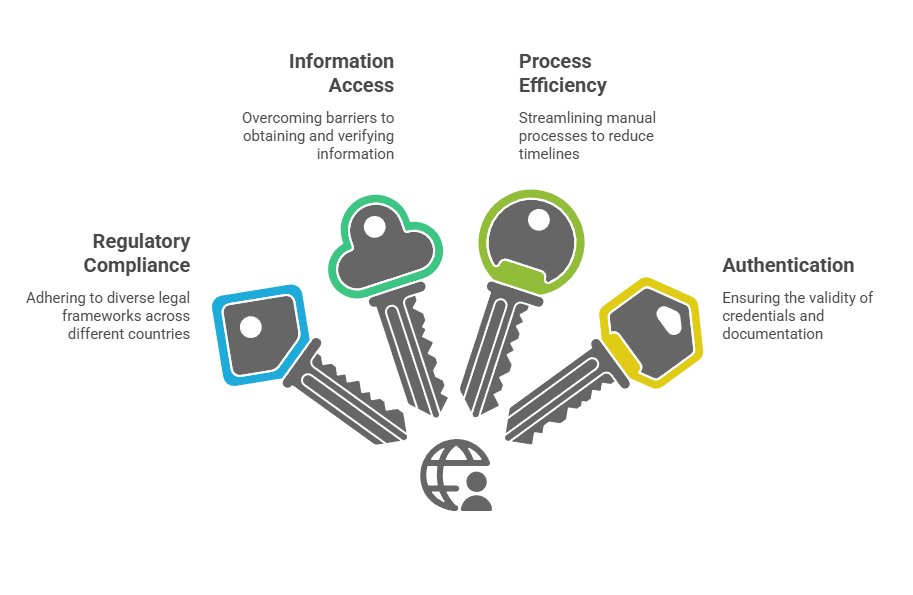
- Regulatory requirements spanning multiple legal systems simultaneously
- Information access constraints varying by country and verification type
- Extended timelines due to manual processes and coordination challenges
- Authentication complexities for credentials and documentation
Regulatory Framework Considerations
Background checks for international candidates must satisfy U.S. employment law requirements while respecting the legal constraints of candidate home countries. The Fair Credit Reporting Act applies when organizations obtain consumer reports from consumer reporting agencies for employment purposes, requiring proper disclosure, authorization, and adverse action procedures regardless of candidate location. Organizations must ensure that background screening serves a permissible purpose under U.S. law while respecting foreign data protection standards.
Foreign data protection laws, particularly comprehensive privacy regimes in the European Union, United Kingdom, and similar jurisdictions, impose additional requirements on information collection and processing. These frameworks may mandate specific consent language, limit permissible verification scope, or restrict cross-border data transfers.
Employment eligibility verification under U.S. immigration law creates additional documentation requirements for international hires. While Form I-9 compliance occurs after hiring, the background screening phase should coordinate with immigration status considerations to ensure verification efforts align with work authorization realities.
The hardest part of hiring internationally isn’t the paperwork; it’s accepting that some things you can verify at home simply aren’t available everywhere else. A criminal record check that takes days in the US might be impossible to get in another country, not because anyone is hiding something, but because the system there was never built to share that information. Good screening in this context means knowing when to lean on references, probation periods, or other honest alternatives instead of forcing a process that doesn’t fit. That’s not a compliance shortcut. It’s what fair actually looks like when you’re hiring across borders. �
Information Access Realities
Perhaps the most significant distinction between domestic and international screening involves fundamental differences in information availability. Many countries lack centralized criminal record databases accessible for employment purposes. Some jurisdictions prohibit employer access to criminal records entirely, while others require candidate-initiated requests or impose strict limitations on reportable information.
Educational verification encounters similar constraints. Degree mills, credential fraud, and non-standardized educational systems complicate authentication efforts. Many foreign institutions lack online verification portals or designated credential verification contacts, requiring direct communication with registrar offices that may have limited English-language support.
Building Risk-Tiered Screening Approaches
Effective international background check programs avoid one-size-fits-all methodologies in favor of risk-calibrated approaches that align verification depth with role requirements and jurisdiction-specific considerations. Position sensitivity should drive screening scope decisions, with roles involving financial authority, access to sensitive information, or vulnerable population contact warranting more comprehensive verification than positions with limited risk exposure.
| Risk Tier | Role Examples | Verification Components |
| High | Executive leadership, financial officers, compliance roles | Comprehensive criminal searches (where accessible), detailed employment verification, credential authentication, enhanced reference checks |
| Medium | Customer-facing positions, technical roles with system access | Standard criminal searches, employment confirmation, educational verification |
| Low | General operational positions, limited-access roles | Basic employment verification, educational confirmation for degree-required roles |
Organizations can develop internal risk classification systems that categorize positions into tiers, each associated with defined verification requirements. For international hires specifically, risk assessment should also evaluate the feasibility and value of various verification components given jurisdiction-specific constraints. When comprehensive criminal record checks prove impossible in a candidate’s home country, organizations might emphasize alternative verification methods such as enhanced reference checks or extended probationary periods.
The distinction between full-time employees, contractors, and temporary workers should influence screening approaches. Full-time positions typically justify more extensive verification efforts given the longer-term relationship and deeper organizational integration, while contract arrangements might warrant focused screening addressing specific risk areas relevant to the engagement scope.
Implementing Credential Verification for International Candidates
Foreign credential verification represents a critical component of screening for international hires, particularly for positions requiring specific educational qualifications or professional licensure. The verification process differs substantially from domestic degree confirmation due to educational system variations, authentication challenges, and limited verification infrastructure in many countries.
Educational Verification Methodologies
Direct verification with foreign educational institutions requires navigating diverse administrative processes, language barriers, and varying institutional responsiveness. Organizations should request that candidates provide original or certified copies of diplomas, transcripts, and certificates as a foundation for verification efforts. These documents serve both as information sources for verification outreach and as authentication subjects when submission to credential evaluation services is appropriate.
Verification approaches include:
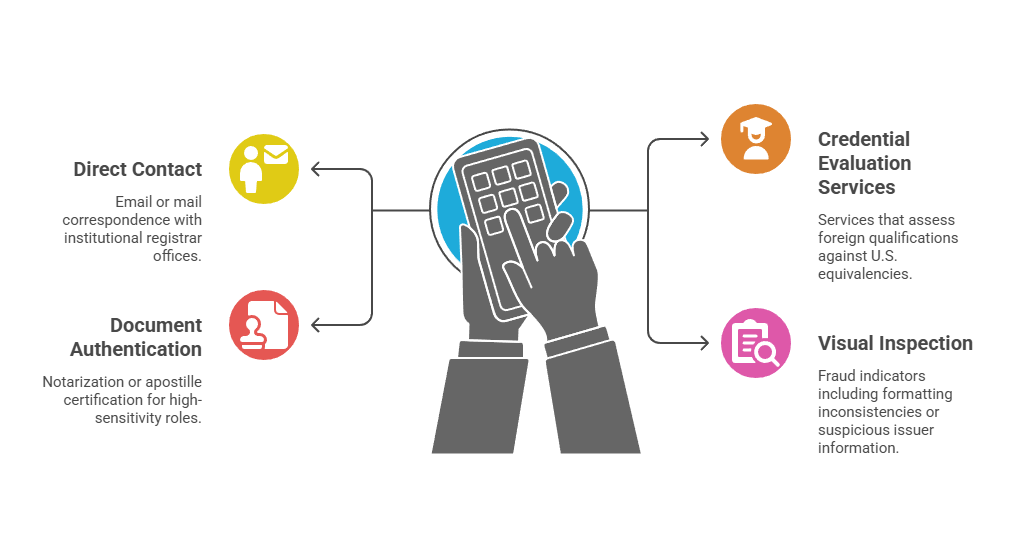
- Direct contact with institutional registrar offices via email or mail correspondence
- Credential evaluation services that assess foreign qualifications against U.S. equivalencies
- Document authentication through notarization or apostille certification for high-sensitivity roles
- Visual inspection for fraud indicators including formatting inconsistencies or suspicious issuer information
Credential evaluation services specialize in assessing foreign educational qualifications against U.S. standards. These organizations analyze academic credentials to determine comparable U.S. degree levels and accreditation status. However, organizations should understand whether evaluation reports include primary verification or represent secondary assessment of submitted documents.
Professional Credentials and Fraud Prevention
International candidates claiming professional licenses or certifications require verification with the issuing bodies in their home countries. This process varies significantly by profession and jurisdiction. Some professional organizations maintain online license verification systems accessible internationally, while others require written requests or lack verification infrastructure entirely.
Organizations should evaluate whether foreign professional credentials hold relevance for U.S.-based positions. A license to practice law in another country, for example, does not confer U.S. practice rights, though it may validate analytical capabilities and educational background.
Document fraud represents a significant concern in international credential verification. Diploma mills, forged certificates, and altered transcripts can appear authentic without careful scrutiny. Organizations should implement authentication measures appropriate to role risk levels, including requesting official notarization or apostille certification for high-stakes positions.
Navigating Criminal Background Checks Across Jurisdictions
Criminal record verification for international candidates presents perhaps the most challenging aspect of global background screening. Access to criminal records varies dramatically by country, with legal frameworks ranging from comprehensive employer access to complete prohibition of employment-related criminal checks.
Understanding International Criminal Record Systems
National criminal record systems reflect diverse legal traditions, privacy philosophies, and administrative structures. Some countries maintain centralized national databases accessible for employment screening, while others operate decentralized systems requiring searches at local court or police levels. Some jurisdictions prohibit employer access to criminal records entirely or limit reportable offenses based on crime type, disposition, or time elapsed.
| Access Level | Example Regions | Characteristics |
| Open Access | Some Commonwealth countries, select Asian nations | Centralized databases, standardized processes, English-language support available |
| Restricted Access | European Union member states, Latin American countries | Limited to candidate-initiated requests, specific industries, or role types with vulnerability considerations |
| Prohibited/Highly Limited | Some European nations, Middle Eastern countries | Employment-related checks legally restricted or practically unavailable |
European Union member states, for example, operate under data protection frameworks that significantly restrict criminal record use in employment decisions. While criminal record access exists, it may be limited to candidate-initiated requests, specific industry contexts, or roles involving particular vulnerabilities.
Organizations screening for international hires should research criminal record access rules in candidate home countries rather than assuming verification feasibility. This research should address not only whether criminal records exist but whether employment-related access is legally permissible and practically achievable.
Alternative Verification and Result Interpretation
When direct criminal record access proves impossible or limited, organizations can implement alternative verification methods to address criminal background concerns within legal constraints. Enhanced reference checks with previous employers or professional contacts can provide informal screening for concerning behavioral patterns. Some organizations implement extended probationary periods for international hires from jurisdictions where comprehensive background checks prove infeasible.
When criminal record access is available, result interpretation requires cultural and legal context that differs from domestic record review. Legal systems categorize offenses differently, apply distinct terminology, and impose varying consequences for similar conduct. Organizations should conduct individualized assessments of international criminal records considering offense nature, disposition, relevance to job duties, and time elapsed, consistent with fair chance hiring requirements in applicable jurisdictions.
Translation of foreign-language criminal records requires qualified translators familiar with legal terminology rather than general translation services. Legal concepts often lack direct equivalents across languages, and accurate translation proves critical for appropriate record interpretation.
Employment and Reference Verification Strategies
Confirming employment history and obtaining professional references for international candidates requires adapted approaches that account for time zones, language differences, business practice variations, and record availability challenges.
Effective verification practices include:

- Email verification requests providing non-native English speakers time to formulate responses
- Video conferencing technology enabling visual communication across time zones
- Clear, concise verification requests identifying specific information sought
- Professional reference services with local expertise in target geographies
- Recognition of cultural communication differences affecting reference conversations
Some countries have cultural practices or legal frameworks that limit employment verification information. Privacy laws may restrict employment detail disclosure, or business customs may consider detailed reference provision unusual. Organizations should recognize these limitations rather than interpreting minimal verification responses as candidate misrepresentation indicators.
Professional references take on increased importance for international hires when objective verification methods face constraints. Reference discussions can provide qualitative insight into candidate capabilities, work style, and professional reputation that complements limited documentary verification.
Technology-Enabled Coordination and Compliance
Technology platforms designed for background screening coordination offer tools that can improve international verification workflow management, status tracking, and compliance documentation. Screening platforms may consolidate multi-jurisdictional verification into unified workflows with standardized data collection, automated status updates, and centralized result reporting.
However, technology cannot eliminate underlying structural challenges in international screening. When criminal records prove legally inaccessible in a particular country, platform features cannot create access. When educational institutions lack verification infrastructure, automated query systems cannot generate responses. Technology improves process coordination but does not resolve fundamental information availability constraints.
| Technology Benefit | Realistic Scope | Limitations |
| Workflow consolidation | Unified interface for multi-jurisdiction requests | Cannot override legal access restrictions |
| Status tracking | Real-time visibility into verification progress | Cannot accelerate institutional response times |
| Compliance documentation | Automated consent collection and record retention | Cannot substitute for jurisdiction-specific legal review |
Technology platforms handling international background check information must navigate complex data protection requirements, particularly cross-border data transfer restrictions. Organizations should verify that screening technology vendors maintain appropriate compliance mechanisms for international data handling, which may include Standard Contractual Clauses, adequacy frameworks, or other legally recognized transfer mechanisms that satisfy applicable data protection requirements.
Integration between screening platforms and applicant tracking systems can streamline candidate experience and reduce administrative workload. However, organizations should evaluate whether screening platform integration capabilities accommodate the increased variability inherent in international background checks, as fixed workflow assumptions designed for domestic screening may not translate effectively to processes where verification timelines vary significantly by candidate geography.
Developing Scalable International Screening Policies
Sustainable global hiring programs require documented policies that provide clear screening frameworks while maintaining flexibility for jurisdiction-specific adaptation. Policy development should balance consistency in risk management standards with recognition of practical variation in verification approaches across geographies.
Essential Policy Components
Comprehensive international screening policies should address screening scope based on role risk classification, geographic protocols acknowledging verification feasibility differences, timeline expectations and hiring decision protocols for pending verifications, and result interpretation procedures that account for international record complexity.
Policy framework elements include:
- Risk-based verification requirements by position category
- Country-specific protocols with alternative approaches for restricted jurisdictions
- Authorization for conditional employment offers or start date scheduling during pending verifications
- Individualized assessment requirements rather than automatic disqualification standards
- Documentation expectations for screening decisions and verification limitation acknowledgments
Written authorization and disclosure requirements for background screening extend to international hires but may require adaptation to also satisfy foreign data protection consent standards. Organizations should develop disclosure and authorization forms that satisfy both FCRA requirements and applicable foreign privacy law standards.
Documentation and Continuous Improvement
Maintaining thorough documentation of international screening processes supports compliance efforts, provides decision-making records, and creates institutional knowledge for future hires from similar geographies. Documentation should capture screening scope determinations, verification methods employed, results obtained, and decision rationale.
Records should reflect the individualized assessment process when screening identifies potentially disqualifying information. Documentation of factors considered, including offense nature, relevance to job duties, time elapsed, and rehabilitation evidence, demonstrates fair process and supports defensibility if hiring decisions face challenge.
Privacy and confidentiality requirements apply to international screening records just as they do to domestic background check information. Organizations should implement secure storage, access limitations, and retention policies that comply with applicable requirements in both the United States and candidate home countries when records contain personal information subject to foreign data protection laws.
Conclusion
Screening for international hires requires strategic frameworks that integrate regulatory compliance, risk management priorities, and practical verification constraints across diverse legal environments. Organizations building scalable global hiring programs benefit from risk-tiered approaches, documented policies balancing consistency with geographic adaptation, and realistic expectations about verification capabilities in different jurisdictions.
Frequently Asked Questions
What are the primary challenges in conducting background checks for international hires?
The most significant challenges include inconsistent criminal record access across jurisdictions, varying data protection laws that may restrict information collection or cross-border transfer, educational credential verification complexities due to non-standardized systems, and employment verification difficulties related to language barriers and business practice differences. Organizations must adapt verification approaches to each jurisdiction’s legal framework and information availability rather than applying uniform processes.
How does FCRA apply to background checks for candidates located outside the United States?
The Fair Credit Reporting Act applies when organizations obtain consumer reports from consumer reporting agencies for employment purposes regardless of candidate location. This means proper disclosure, written authorization, pre-adverse action procedures, and final adverse action notices remain required for international candidates when third-party screening services are engaged. However, FCRA represents only one regulatory layer, and organizations must also address data protection requirements in candidate home countries.
Can employers access criminal records from all countries for employment screening purposes?
No, criminal record access varies dramatically by country. Some jurisdictions maintain centralized databases accessible for employment screening, others require court-level searches, and some prohibit employment-related criminal background checks entirely or limit them to specific industries or role types. Data protection regulations in many countries impose strict constraints on criminal record use in employment contexts. Organizations should research verification feasibility in specific countries rather than assuming access availability.
What verification methods work when comprehensive background checks are legally impossible in a candidate’s home country?
When direct verification faces legal or practical constraints, organizations can implement alternative approaches including enhanced professional reference checks emphasizing behavioral patterns and work performance, credential evaluation services for educational qualification assessment, extended probationary periods allowing performance observation, and focused verification of specific risk areas most relevant to job duties. These alternatives provide partial risk mitigation rather than comprehensive background review.
How should organizations handle foreign educational credential verification?
Foreign credential verification typically involves requesting original or certified documents from candidates, direct verification attempts with educational institutions through registrar offices, and potentially engaging credential evaluation services that assess foreign qualifications against U.S. equivalencies. Organizations should anticipate verification challenges including language barriers, limited institutional responsiveness, and non-standardized documentation. For sensitive positions, apostille certification provides stronger fraud protection than document review alone.
What data protection considerations affect background screening for international candidates?
Data protection laws in candidate home countries may impose requirements including specific consent language, purpose limitations on information collection, restrictions on cross-border personal data transfers, individual rights to access and correct information, mandatory security measures, and limited retention periods. European Union privacy regulations require that data processing serve legitimate purposes and remain proportionate to those purposes. Organizations must design screening processes satisfying both U.S. requirements and applicable foreign data protection frameworks.
How long do international background checks typically take compared to domestic screening?
International background check timeframes vary significantly based on verification methods required, jurisdictions involved, and information source responsiveness. While domestic U.S. background checks often complete within days, international screening may extend to several weeks or longer. Factors contributing to extended timelines include time zone differences affecting communication, language barriers requiring translation, manual verification processes in countries lacking automated systems, and slower institutional response rates.
Should screening approaches differ for international contractors versus full-time employees?
Employment type should influence screening scope along with role risk assessment. Full-time positions typically justify comprehensive verification given longer-term relationships and deeper organizational integration, while contract engagements might warrant focused screening addressing specific risk areas relevant to the work scope. However, role sensitivity should take precedence over employment classification. High-risk contract positions may require extensive screening despite temporary nature, while low-risk full-time roles might involve streamlined verification.
Additional Resources
- Fair Credit Reporting Act Overview
https://www.ftc.gov/legal-library/browse/statutes/fair-credit-reporting-act - U.S. Equal Employment Opportunity Commission: Background Checks
https://www.eeoc.gov/laws/guidance/background-checks-what-employers-need-know - Department of Homeland Security: Form I-9 Central
https://www.uscis.gov/i-9-central - European Commission: Data Protection
https://commission.europa.eu/law/law-topic/data-protection_en - National Association of Credential Evaluation Services
https://www.naces.org

ABOUT THE CREATOR
GCheck Editorial Team
Meet the GCheck Editorial Team, your trusted source for insightful and up-to-date information in the world of employment background checks. Committed to delivering the latest trends, best practices, and industry insights, our team is dedicated to keeping you informed.
With a passion for ensuring accuracy, compliance, and efficiency in background screening, we are your go-to experts in the field. Stay tuned for our comprehensive articles, guides, and analysis, designed to empower businesses and individuals with the knowledge they need to make informed decisions.
At GCheck, we're here to guide you through the complexities of background checks, every step of the way.