



FCRA compliance in transportation forms the legal foundation for screening workers across trucking, warehousing, and logistics delivery roles, requiring employers to integrate federal consumer reporting standards with DOT and FMCSA regulations. Transportation employers must build defensible workflows that address initial hiring, ongoing driver monitoring, and role-specific risk assessment while navigating state-level transportation laws.
Key Takeaways
- FCRA compliance in transportation requires coordinating federal consumer reporting rules with DOT medical certification requirements and FMCSA safety regulations across multiple worker categories.
- Transportation subsectors face distinct compliance challenges, with long-haul trucking governed by interstate commerce rules while last-mile delivery often operates under local employment frameworks.
- Continuous monitoring programs allow fleet operators to identify disqualifying events between hiring cycles, but employers must structure these systems to comply with FCRA authorization and disclosure requirements.
- Warehouse roles, dispatcher positions, and driver classifications each trigger different screening obligations based on vehicle type, cargo sensitivity, and access to controlled facilities.
- State-level transportation regulations may impose lookback period limits, ban-the-box restrictions, or conviction reporting thresholds that override blanket disqualification policies.
- Adverse action procedures must account for transportation-specific timelines, allowing candidates to dispute driving record inaccuracies or explain safety violations before final decisions.
- DOT background check requirements operate independently of FCRA but often use the same data sources, creating coordination obligations for employers managing dual compliance frameworks.
- Technology-assisted screening tools can streamline multi-jurisdictional record retrieval, but employers remain responsible for ensuring that automated systems generate FCRA-compliant disclosures and maintain required documentation.
Transportation Hiring Compliance as Multi-Layered Risk Management
Transportation and logistics employers operate within overlapping regulatory systems that treat background screening as both a legal compliance obligation and a safety risk mitigation strategy. FCRA compliance in transportation establishes the procedural framework for obtaining, using, and acting on consumer reports, while DOT regulations impose independent screening mandates for commercial drivers. State transportation laws add jurisdiction-specific restrictions on what records may be considered and how long disqualifying events remain relevant.
Unlike industries where background checks serve primarily as employment gatekeeping mechanisms, transportation screening functions as ongoing operational infrastructure. Fleet managers must verify initial eligibility, monitor driver performance throughout employment, and respond to triggering events such as license suspensions or moving violations. This continuous compliance model requires employers to structure authorization forms, notification protocols, and recordkeeping systems that satisfy both federal consumer protection standards and transportation safety mandates.
The transportation sector encompasses distinct subsectors with divergent screening needs:
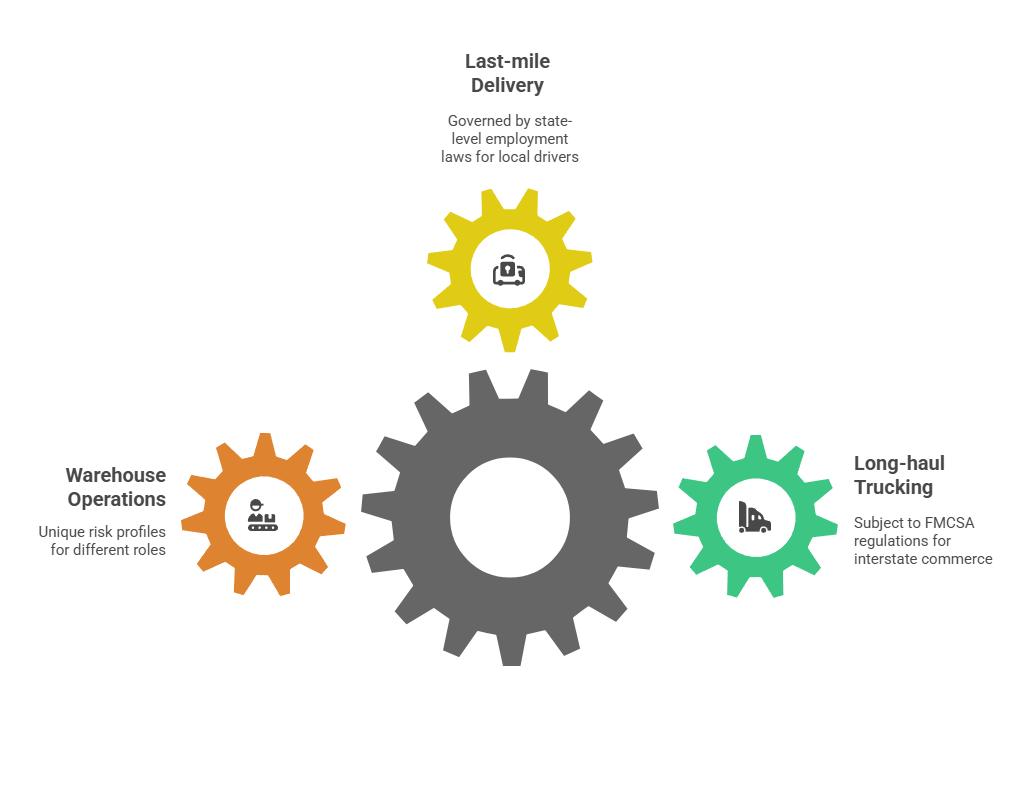
- Long-haul trucking operations crossing state lines face FMCSA regulations governing hours of service, vehicle maintenance, and driver qualifications.
- Last-mile delivery services employing local drivers may fall outside interstate commerce definitions, subjecting them to different state-level employment laws.
- Warehouse operations involve material handling equipment operators, inventory managers, and security personnel, each presenting unique risk profiles that inform screening scope decisions.
FCRA Foundations for Transportation Workforce Screening
The Fair Credit Reporting Act governs how employers obtain and use background check information compiled by consumer reporting agencies. Transportation employers must comply with FCRA disclosure requirements, authorization protocols, and adverse action procedures regardless of whether they use third-party screening services or attempt to gather records independently.
In the world of transportation, background screening is never simply an exercise in complying with HR requirements. It’s an intersection of safety, compliance, and business continuity. My advice for the HR and fleet management teams is to build screening processes that thoughtfully integrate the requirements of the FCRA with the requirements of the DOT, rather than treating them as two separate ‘check the box’ exercises. Monitoring, authorization, and adverse action are all important components of protecting the interests of the business, as well as the driver, while they support a positive safety culture rather than hindering it. �
Disclosure and Authorization Requirements
Before obtaining a consumer report for employment purposes, transportation employers must provide clear written disclosure to applicants, delivered as a standalone document separate from employment applications or policy handbooks. Authorization forms require explicit written consent from applicants, allowing employers to request screening reports.
| FCRA Requirement | Transportation Application | Common Compliance Gap |
| Standalone disclosure document | Must separate from job application and policy handbooks | Embedding authorization in offer letters or employee agreements |
| Clear identification of CRA | Name the consumer reporting agency providing the report | Using vague language like “third-party screeners” |
| Written consent | Obtain explicit authorization before requesting reports | Assuming verbal consent or implied agreement suffices |
| Purpose-specific authorization | Limit scope to disclosed screening activities | Using initial hiring authorization for continuous monitoring |
| Timeframe specification | State how long authorization remains valid | Failing to renew authorization for ongoing checks |
Transportation hiring compliance 2026 practices should ensure disclosure documents avoid embedding authorization language within broader employment terms or conditional offer letters. Fleet managers working with high-volume hiring cycles must verify that applicant tracking systems generate compliant disclosure formats before distributing authorization forms.
Authorization remains valid only for the purposes disclosed and the timeframe specified. Employers implementing continuous monitoring programs must obtain separate authorization for ongoing screening activities, clearly explaining that background checks will recur throughout employment.
Adverse Action Procedures in Transportation Contexts
When background check information leads employers to consider denying employment or taking disciplinary action, FCRA mandates a two-step adverse action process. Pre-adverse action notices must provide applicants with a copy of the consumer report, a summary of FCRA rights, and reasonable time to dispute inaccurate information before final decisions occur.
Fleet managers may encounter scenarios where DOT regulations appear to mandate immediate driver removal following safety violations, creating tension with FCRA timelines requiring pre-adverse action delays. Employers must structure policies that satisfy both transportation safety obligations and consumer reporting procedural protections. This may involve temporary reassignment to non-driving roles, paid administrative leave, or other interim measures that protect safety interests while preserving FCRA compliance.
Final adverse action notices must inform candidates that employment decisions occurred, identify the consumer reporting agency that provided the report, and explain the individual’s right to dispute report accuracy with the reporting agency. Transportation employers should document compliance with each procedural step, maintaining records that demonstrate timely notice delivery and candidate opportunity to respond before adverse actions become final.
Permissible Purposes and Scope Limitations
FCRA restricts background check use to permissible purposes, including employment decisions, but prohibits using consumer reports for unauthorized purposes such as general monitoring unrelated to job qualifications. Transportation hiring compliance requires connecting screening scope to legitimate business needs, avoiding overly broad inquiries that extend beyond role-specific risk factors.
Trucking background checks for commercial driver positions may appropriately include:
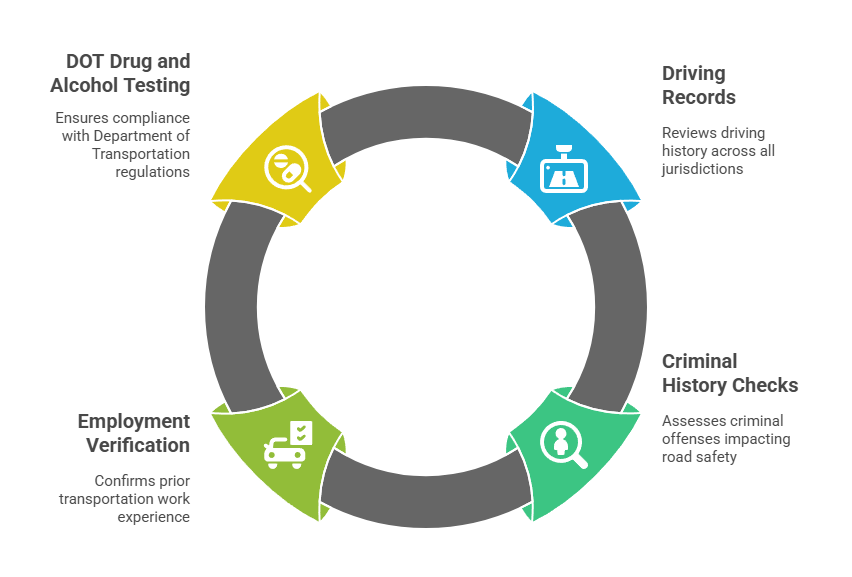
- Driving records covering all jurisdictions where licenses were held
- Criminal history checks for offenses affecting road safety
- Employment verification covering prior transportation roles
- Drug and alcohol testing records as required by DOT
Blanket screening policies applying identical background check protocols across all transportation roles risk FCRA violations if screening scope exceeds legitimate employment purposes. Employers should document the business justification for each screening component, explaining how specific checks relate to position responsibilities and safety obligations.
DOT and FMCSA Regulatory Intersection With Consumer Reporting
Department of Transportation regulations impose independent background check obligations for commercial motor vehicle operators, functioning separately from FCRA but often relying on similar data sources. These DOT background check requirements create parallel compliance obligations that transportation employers must coordinate with FCRA procedures.
Driver Qualification Files and Record Retention
FMCSA regulations mandate that motor carriers maintain driver qualification files containing specific documentation. Employers must obtain this information before permitting drivers to operate commercial vehicles and update files annually.
Required Driver Qualification File Components:
- Employment applications covering three years of work history
- Motor vehicle records from all jurisdictions where drivers held licenses
- Road test certificates or commercial learner’s permit documentation
- Medical examiner certificates demonstrating physical fitness
- Annual driving record review documentation
- Employer investigation of safety performance history
Driver qualification files serve regulatory compliance functions distinct from FCRA-governed background checks, but employers often gather required documentation through consumer reporting agencies. When carriers use third-party services to retrieve driving records or verify employment history, those activities trigger FCRA disclosure and authorization requirements even though DOT regulations independently mandate the same inquiries.
Transportation hiring compliance 2026 frameworks must integrate DOT recordkeeping mandates with FCRA procedural protections. Record retention policies must account for DOT requirements specifying three-year employment history verification and FCRA provisions governing consumer report storage and disposal.
Drug and Alcohol Clearinghouse Obligations
FMCSA’s Drug and Alcohol Clearinghouse maintains real-time records of commercial driver drug and alcohol program violations, requiring employers to query the system before hiring drivers and annually thereafter. Clearinghouse checks function as safety screening mechanisms but involve accessing government-maintained records rather than consumer reports compiled by reporting agencies.
| Clearinghouse Query Type | When Required | Authorization Needed | FCRA Applicability |
| Full query (pre-employment) | Before first driving assignment | Yes, driver consent required | No, government database not CRA report |
| Limited query (annual) | Once per year for current drivers | Yes, general consent at hiring | No, but parallel authorization practices recommended |
| Full query (reasonable suspicion) | When specific safety concerns arise | Yes, case-specific consent | No, but adverse action fairness principles apply |
Transportation employers should clarify for applicants that clearinghouse queries operate under DOT regulations separate from FCRA-governed background checks. Authorization forms may address both processes but must explain the distinct legal frameworks and purposes.
Clearinghouse violations trigger return-to-duty protocols and follow-up testing requirements, creating ongoing monitoring obligations that extend beyond initial hiring. Employers implementing continuous compliance programs must coordinate clearinghouse monitoring with FCRA-governed ongoing screening activities.
Safety Measurement System and Carrier Performance Data
FMCSA’s Safety Measurement System compiles carrier and driver performance data from inspections, crashes, and enforcement actions, generating safety ratings that influence hiring decisions. Employers evaluating driver applicants may review SMS records to assess safety histories, but these government-compiled records differ from consumer reports subject to FCRA.
Transportation hiring compliance policies should establish clear standards for evaluating SMS data, connecting specific safety events to job-related risk factors. Employers must allow candidates to explain safety violations, dispute inaccurate records, or provide mitigating context for events that may not reflect current fitness.
Subsector-Specific Screening Frameworks
Transportation and logistics operations encompass diverse subsectors with distinct regulatory exposures and operational risk profiles. FCRA compliance in transportation requires adapting screening workflows to address role-specific requirements rather than applying uniform protocols across all positions.
Long-Haul Trucking and Interstate Commerce
Long-haul trucking operations transporting goods across state lines fall under FMCSA jurisdiction, subjecting drivers to federal commercial vehicle regulations. Employers hiring for these roles must conduct trucking background checks covering driving records from all states where applicants held licenses, verify employment history with previous motor carriers, and review safety performance records.
Screening for long-haul driver positions appropriately includes:
- Criminal record checks focused on offenses affecting safety or cargo security, such as theft, violence, or drug trafficking convictions
- Driving records covering all jurisdictions, not just current state of residence
- Employment verification with previous motor carriers for the past three years
- DOT medical certification and physical examination records
- Drug and alcohol clearinghouse query results
Employers should establish lookback periods aligned with FMCSA disqualifying offense timelines, typically extending three to seven years depending on violation severity. Indefinite or lifetime bans require strong safety justifications and should allow individualized assessments considering offense age, rehabilitation, and relevance to current driving responsibilities.
Long-haul carriers implementing continuous monitoring must structure ongoing screening programs that detect license suspensions, moving violations, or criminal convictions occurring during employment. These programs require FCRA-compliant authorization explaining that background checks will recur and establishing notification procedures when disqualifying events appear.
Last-Mile Delivery and Local Transportation Services
Last-mile delivery services employing drivers for local package distribution or meal delivery often operate outside FMCSA jurisdiction if vehicles fall below commercial weight thresholds. These employers face state-level employment laws governing background checks, wage standards, and worker classification.
| Screening Component | Long-Haul Trucking | Last-Mile Delivery |
| Regulatory framework | FMCSA, federal DOT regulations | State employment laws, local ordinances |
| Driving record scope | All states where licenses held | Current state, possibly limited lookback |
| Criminal record limits | Federal disqualifying offenses apply | State ban-the-box, conviction reporting limits |
| Medical certification | DOT physical required | Generally not required unless state mandates |
| Drug testing | Clearinghouse participation mandatory | May be voluntary or state-specific |
| Continuous monitoring | Common industry practice | Varies by company policy |
Screening protocols for local delivery drivers must distinguish between independent contractor relationships and employee classifications, as FCRA applies differently depending on employment status. Employers using background checks for contractor onboarding should verify that screening purposes fall within FCRA permissible use definitions.
Criminal record screening for last-mile positions should connect offense types to legitimate safety or security concerns specific to the role. State laws may prohibit considering arrest records without convictions, limit lookback periods to seven years, or require individualized assessments before adverse actions.
Warehouse and Logistics Facility Operations
Warehouse operations involve material handling equipment operators, inventory managers, loading dock personnel, and security staff, each presenting different risk profiles that inform screening scope.
Role-Specific Screening Considerations:
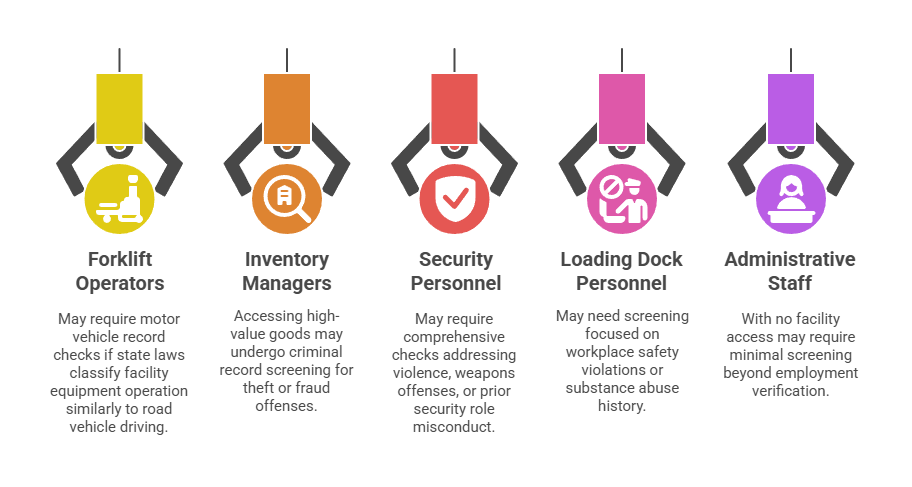
- Forklift operators may require motor vehicle record checks if state laws classify facility equipment operation similarly to road vehicle driving.
- Inventory managers accessing high-value goods may undergo criminal record screening for theft or fraud offenses.
- Security personnel may require comprehensive checks addressing violence, weapons offenses, or prior security role misconduct.
- Loading dock personnel may need screening focused on workplace safety violations or substance abuse history.
- Administrative staff with no facility access may require minimal screening beyond employment verification.
Transportation hiring compliance 2026 for warehouse roles should establish screening protocols tailored to position-specific risks rather than applying driver-focused checks to all facility staff. Employers must document why specific screening components relate to each role’s responsibilities.
Continuous Monitoring and Ongoing Compliance Programs

Transportation employers increasingly adopt continuous monitoring programs that identify disqualifying events occurring between initial hiring and periodic re-screening cycles. Implementing FCRA-compliant ongoing monitoring requires careful attention to authorization scope, notification procedures, and adverse action protocols.
Authorization and Disclosure for Recurring Checks
Continuous monitoring constitutes a distinct FCRA activity requiring separate authorization beyond initial hiring background checks. Employers must provide clear disclosure explaining that screening will recur throughout employment, specify the types of records monitored, and describe how often checks occur.
Elements of Compliant Continuous Monitoring Authorization:
- Explicit statement that background checks will recur during employment
- Specific identification of record types subject to ongoing monitoring
- Frequency of monitoring activities (daily, weekly, monthly, triggered by events)
- Explanation of how employees will be notified of adverse findings
- Duration of monitoring authorization (employment term or requiring renewal)
- Separate signature line distinct from initial hiring authorization
Some employers mistakenly assume that initial hiring authorization covers all future background checks, leading to FCRA violations when recurring checks occur without proper consent. Transportation hiring compliance policies should implement annual authorization renewal or clearly worded initial authorization that explicitly covers continuous monitoring for the duration of employment.
Employers should verify that continuous monitoring vendors provide FCRA-compliant services, including proper authorization forms, timely adverse action notices, and accurate record reporting. Transportation employers remain legally responsible for FCRA compliance even when third-party vendors conduct ongoing monitoring.
Responding to Triggering Events
Continuous monitoring alerts require employers to evaluate whether new information warrants adverse employment actions while satisfying FCRA procedural protections. Fleet managers receiving notification of driver license suspensions, moving violations, or criminal charges must determine whether events constitute immediate safety risks or whether drivers may continue working during investigation periods.
| Event Type | Typical Safety Impact | Recommended Response | FCRA Consideration |
| License suspension | High, immediate driving prohibition | Temporary reassignment to non-driving role | Pre-adverse action required before termination |
| Minor moving violation | Low to moderate | Document in file, no immediate action | Generally no adverse action needed |
| Criminal arrest (no conviction) | Varies by charge | Investigate facts, avoid premature action | Cannot base decision on arrest alone in many states |
| DUI/DWI charge | High for safety-sensitive roles | Administrative leave pending resolution | Pre-adverse action required if considering termination |
| Serious criminal conviction | High, case-dependent | Individualized assessment required | Full adverse action process mandatory |
FCRA adverse action procedures apply when continuous monitoring information leads to employment termination, suspension, or reassignment to non-driving roles. Employers must provide pre-adverse action notices including copies of consumer reports, allow reasonable dispute periods, and issue final adverse action notices after decisions become final.
Technology-assisted monitoring systems may generate false positives or report information belonging to individuals with similar names, requiring employers to verify record accuracy before taking action. Employers should implement confirmation procedures that validate monitoring alerts against driver-provided information.
Balancing Safety Obligations With Procedural Fairness
Transportation employers face competing pressures to remove unsafe drivers immediately while following FCRA procedures requiring reasonable time for candidates to dispute inaccurate information. Policies that automatically terminate drivers upon receiving adverse monitoring alerts risk FCRA violations if pre-adverse action procedures are bypassed.
Drivers accused of serious violations retain rights to contest charges, dispute report accuracy, or provide mitigating context before employment decisions become final. Transportation hiring compliance requires integrating these procedural protections into safety-focused response plans, documenting compliance with each step of the adverse action process.
State-Level Transportation Employment Law Variations
State laws governing background checks, employment discrimination, and transportation-specific hiring practices create jurisdiction-specific compliance obligations that operate alongside federal FCRA requirements. Transportation employers hiring across multiple states must navigate varying ban-the-box restrictions, conviction reporting limits, and lookback period rules.
Ban-the-Box Laws and Initial Inquiry Restrictions
Many states and municipalities prohibit asking about criminal history on initial employment applications, delaying background check inquiries until later hiring stages. These ban-the-box laws apply to transportation employers despite industry safety concerns, requiring companies to restructure hiring workflows that defer criminal record screening until after initial interviews or conditional offers.
Transportation hiring compliance 2026 policies should identify which jurisdictions impose ban-the-box restrictions and adjust hiring procedures accordingly. Employers operating in multiple states may need location-specific application forms that remove criminal history questions in restricted jurisdictions while retaining them where permitted.
Violations of ban-the-box laws may result in state-level enforcement actions separate from FCRA penalties, making state law compliance essential even when federal procedures are followed.
Conviction Reporting Limits and Lookback Periods
State laws frequently limit how far back criminal record checks may extend, prohibiting consideration of convictions older than seven or ten years. These lookback period restrictions override FCRA provisions allowing conviction reporting regardless of age, creating state-specific ceilings on screening scope.
Common State Lookback Period Variations:
- Seven-year limit for most convictions (California, Colorado, Kansas, Maryland, Massachusetts, Montana, New Hampshire, New Mexico, New York, Washington)
- Ten-year limit for felony convictions (Texas for positions under $75,000 salary)
- No lookback limit (many states allow unlimited conviction reporting)
- Position-specific exceptions for transportation safety roles (varies by state)
Transportation employers must determine which state laws apply based on work location, job site, or employee residence, as jurisdictional rules vary. Some states distinguish between conviction reporting limits and employment consideration rules, allowing background check reports to include older convictions while prohibiting employers from basing decisions on that information.
Automated screening systems should incorporate state-specific filtering that suppresses non-reportable or non-actionable records based on jurisdiction. Exceptions to lookback period limits may apply for transportation positions involving specific vehicle types, cargo categories, or facility access requirements.
Individualized Assessment Requirements
Some jurisdictions require employers to conduct individualized assessments before denying employment based on criminal records, evaluating offense nature, time elapsed, rehabilitation evidence, and relationship to job responsibilities. These laws prohibit automatic disqualification policies that categorically exclude applicants with any criminal history.
Transportation employers must balance individualized assessment obligations with safety-driven hiring standards. Individualized assessments should document the specific factors considered, explain how criminal history relates to transportation role risks, and provide applicants the opportunity to present rehabilitation evidence or challenge record accuracy.
Technology-assisted screening tools may streamline individualized assessment workflows by flagging which offenses require human review, generating assessment templates, or tracking documentation compliance. Employers remain responsible for ensuring that automated systems produce genuinely individualized evaluations rather than mechanically applying predetermined disqualification rules.
Technology-Assisted Screening in Transportation Contexts
Transportation employers increasingly use technology platforms that automate record retrieval, monitor ongoing compliance, and streamline high-volume hiring workflows. While technology can enhance screening efficiency, employers must ensure that automated systems comply with FCRA disclosure requirements, generate accurate reports, and avoid discriminatory outcomes.
Automated Record Retrieval and Multi-Jurisdictional Screening
Technology platforms streamline trucking background checks by querying multiple state driving record databases, criminal court systems, and federal enforcement databases simultaneously. Automated retrieval reduces manual research time and improves record completeness compared to single-jurisdiction checks.
Multi-jurisdictional screening tools must account for state-specific reporting restrictions, ensuring that automated reports suppress records prohibited under local laws. Employers using nationwide criminal database searches should implement secondary verification procedures confirming that database matches reflect accurate, current records rather than erroneous or outdated information.
Technology efficiency cannot override FCRA accuracy requirements, making vendor quality control and error correction protocols essential compliance components.
Algorithmic Decision Support and Risk Scoring
Some screening platforms generate risk scores or hiring recommendations based on algorithmic analysis of background check data, employment history, and other inputs. Transportation employers using these tools must understand what factors drive algorithmic outputs, ensure that scoring methodologies comply with anti-discrimination laws, and retain human oversight over final employment decisions.
| Technology Feature | Potential Benefit | Compliance Risk | Required Safeguard |
| Automated risk scoring | Consistent evaluation standards | May perpetuate historical bias | Human review of all adverse decisions |
| Predictive safety algorithms | Identifies high-risk patterns | Lacks individual context | Individualized assessment required |
| Resume screening AI | Faster candidate processing | May filter protected characteristics | Regular bias audits and testing |
| Automated adverse action notices | Ensures timely delivery | May omit required information | Legal review of template accuracy |
FCRA compliance in transportation requires that employers using algorithmic tools provide applicants with copies of underlying consumer reports, not just algorithm-generated scores. Adverse action notices must identify the consumer reporting agency providing factual data, even when algorithms produce final recommendations.
Employers cannot delegate FCRA compliance responsibilities to technology vendors, maintaining legal accountability for all screening activities regardless of automation level.
Continuous Monitoring Technology and Alert Systems
Continuous monitoring platforms automate ongoing driver record checks, generating alerts when new violations, convictions, or license changes occur. These systems improve fleet safety by detecting disqualifying events promptly, but employers must structure alert response procedures that satisfy FCRA adverse action requirements.
Automated alerts do not eliminate obligations to provide pre-adverse action notices, allow dispute periods, or verify record accuracy before taking action. Transportation hiring compliance 2026 frameworks should integrate continuous monitoring technology with human review processes that validate alerts, investigate discrepancies, and document compliance with procedural protections.
Technology platforms should support rather than replace careful individualized assessment, ensuring that efficiency gains do not compromise legal compliance or procedural fairness.
Conclusion
FCRA compliance in transportation requires integrating federal consumer reporting standards with DOT safety regulations and state employment laws across diverse subsectors and roles. Transportation employers must build continuous compliance frameworks that address initial hiring, ongoing monitoring, and adverse action procedures while accounting for jurisdiction-specific restrictions. Effective screening programs balance operational efficiency with procedural fairness, using technology to streamline workflows while maintaining human oversight and individualized assessment.
Frequently Asked Questions
What makes FCRA compliance in transportation different from other industries?
Transportation employers must coordinate FCRA consumer reporting procedures with DOT and FMCSA safety regulations that impose independent screening mandates. Continuous monitoring requirements, driver qualification file obligations, and clearinghouse queries create ongoing compliance activities beyond initial hiring. Subsector variations between long-haul trucking, last-mile delivery, and warehouse operations require role-specific screening protocols rather than uniform industry standards.
Do DOT background check requirements replace FCRA obligations for commercial drivers?
DOT regulations impose separate screening requirements but do not replace FCRA compliance when employers use consumer reporting agencies to gather required information. Transportation employers must satisfy both regulatory frameworks, obtaining FCRA-compliant authorization before requesting reports and maintaining driver qualification files that meet FMCSA documentation standards. The two systems operate in parallel, creating dual compliance obligations.
How do state ban-the-box laws affect trucking background checks?
State ban-the-box laws prohibit early-stage criminal history inquiries, requiring transportation employers to defer background checks until later hiring stages even for safety-sensitive positions. Exceptions may apply for federally mandated disqualifying offenses, but employers must verify exception applicability before conducting early criminal record screening. Multi-state carriers need jurisdiction-specific hiring procedures that comply with varying state restrictions.
What authorization is required for continuous driver monitoring programs?
Continuous monitoring requires separate FCRA authorization beyond initial hiring consent, clearly disclosing that background checks will recur throughout employment. Authorization forms should explain monitoring frequency, record types checked, and how employers will notify drivers of adverse findings. Some states impose additional consent requirements for ongoing driving record or criminal history monitoring that operate alongside federal FCRA mandates.
Can transportation employers use automated screening tools for hiring decisions?
Technology-assisted screening tools may streamline record retrieval and compliance workflows, but employers remain legally responsible for FCRA compliance and decision accuracy regardless of automation. Algorithmic risk scoring or automated recommendations must not replace individualized assessment or eliminate required adverse action procedures. Employers must provide applicants with underlying consumer reports, not just algorithm-generated outputs, when taking adverse actions.
How should employers handle driving violations discovered through continuous monitoring?
New driving violations detected through ongoing monitoring trigger FCRA adverse action procedures if employers consider termination or suspension. Employers must provide pre-adverse action notices including report copies, allow reasonable dispute periods, and issue final notices after decisions become final. Safety concerns may justify temporary reassignment or administrative leave during investigation periods, but automatic termination without following adverse action procedures risks FCRA violations.
What criminal records can transportation employers consider for warehouse positions?
Screening scope for warehouse roles should connect to position-specific risks rather than applying driver-focused protocols. Offenses related to theft, violence, or drug possession may justify disqualification for inventory or facility security roles, but employers must establish clear connections between offense types and job responsibilities. State lookback period limits and individualized assessment requirements apply to warehouse screening regardless of transportation industry classification.
Do FMCSA clearinghouse queries require FCRA authorization?
Clearinghouse queries operate under DOT regulations separate from FCRA, but employers must obtain driver consent before conducting queries. Authorization forms may address both clearinghouse access and FCRA-governed background checks but should explain the distinct legal frameworks. Clearinghouse violations trigger return-to-duty protocols independent of FCRA adverse action procedures, creating parallel compliance obligations that employers must coordinate.
Additional Resources
- FMCSA Driver Qualification Files
https://www.fmcsa.dot.gov/regulations/title49/section/391.51 - FTC Guide to FCRA for Employers
https://www.ftc.gov/business-guidance/resources/using-consumer-reports-what-employers-need-know - Commercial Driver’s License Drug and Alcohol Clearinghouse
https://clearinghouse.fmcsa.dot.gov/ - EEOC Guidance on Arrest and Conviction Records
https://www.eeoc.gov/laws/guidance/enforcement-guidance-consideration-arrest-and-conviction-records-employment-decisions - National Conference of State Legislatures: Criminal Record in Employment
https://www.ncsl.org/labor-and-employment/criminal-record-in-employment-and-licensing

ABOUT THE CREATOR
GCheck Editorial Team
Meet the GCheck Editorial Team, your trusted source for insightful and up-to-date information in the world of employment background checks. Committed to delivering the latest trends, best practices, and industry insights, our team is dedicated to keeping you informed.
With a passion for ensuring accuracy, compliance, and efficiency in background screening, we are your go-to experts in the field. Stay tuned for our comprehensive articles, guides, and analysis, designed to empower businesses and individuals with the knowledge they need to make informed decisions.
At GCheck, we're here to guide you through the complexities of background checks, every step of the way.