Monitor driving records continuously to detect license suspensions, major violations, DUI arrests, and status changes as they occur throughout employment rather than during scheduled annual reviews.
Driving risk evolves over time due to new violations, accidents, and license suspensions that occur between annual MVR checks, leaving extended periods when driver problems go undetected.
Real Time Driving Risk Signals
Driving records are monitored for violations, accidents, license suspensions, and status changes with alerts triggered when disqualifying events occur.
Reduced Safety and Liability Risk
Early identification enables coaching, retraining, or driver reassignment before serious incidents occur that create liability and insurance consequences.
Ongoing MVR Oversight
MVR changes are tracked throughout employment with continuous monitoring detecting the license problems that annual checks miss between scheduled reviews.
Reduced Safety Incidents
Early identification enables coaching, training, or driving privilege suspension before violations escalate into serious accidents.
HOW IT WORKS
A Structured Driver Monitoring Workflow
Driving risk monitoring from enrollment to alert notification in four steps:
Enroll Drivers
Drivers and license details are enrolled for monitoring with license numbers, issuing states, and monitoring scope defined.
Monitor Driving Records
MVR sources are monitored for violations, accidents, license status changes, and suspensions with detection occurring as states publish updates.
Validate Driving Events
Driving events are reviewed for accuracy and identity confirmation ensuring alerts reflect actual driver violations rather than database errors.
Receive Alerts and Reports
Alerts notify teams of driving risk changes with violation details, accident information, and license status updates formatted for fleet safety review.
Safer Driver Oversight with Compliance for Good™
Driver data is handled securely with controlled access and documented monitoring activity supporting safety oversight and defensible compliance review.
Fleet and Transportation Teams
Fleet and transportation teams use continuous monitoring to maintain real-time visibility into driver eligibility across distributed operations where delayed violation discovery creates accidents and regulatory violations. Multi-location fleets struggle when violation discovery lags behind DMV posting, allowing ineligible drivers to continue operating between locations. GCheck’s centralized monitoring ensures every location has instant visibility into driver status changes, enabling coordinated response that prevents ineligible drivers from dispatch regardless of location or shift assignment.
Commercial Driving Programs
Commercial driving programs use monitoring to satisfy DOT requirements for ongoing driver qualification oversight that annual MVR reviews alone cannot demonstrate. DOT compliance requires knowledge of driver violations and license status changes, not just annual snapshot reviews that miss interim events. GCheck’s continuous monitoring demonstrates the ongoing awareness that DOT compliance demands, protecting your program from the violations that result when audits reveal you operated drivers with violations and suspensions that monitoring would have detected between annual MVR checks.
Risk and Safety Teams
Risk and safety teams use monitoring alerts to triage driver events requiring immediate action versus those warranting documentation without immediate intervention. Alert overload from unfiltered driving events creates response fatigue when every minor violation generates urgent notifications. GCheck’s intelligent alerting distinguishes serious events requiring immediate response from routine events warranting documentation only, enabling focused attention on the driving changes that actually demand swift action without the alert fatigue that causes serious events to be missed in notification noise.
Liability Reduction
Liability reduction protects your organization from the crushing negligent entrustment verdicts that result when preventable accidents are caused by drivers whose violations should have triggered removal. Plaintiff attorneys prove negligent entrustment by showing you failed to monitor drivers when available monitoring would have revealed the violations that predicted the accident your driver caused. GCheck’s monitoring protects against negligent entrustment by demonstrating continuous driver oversight, showing you maintained reasonable care that defeats the negligence claims that unmonitored drivers create when their preventable accidents cause catastrophic injuries.
Scalable Monitoring
Scalable monitoring maintains consistent driver oversight quality from dozens to thousands of monitored drivers without the coverage gaps and quality inconsistencies that manual programs create at scale. Manual driver monitoring produces uneven coverage when staff capacity limits how many drivers can be effectively tracked. GCheck’s automated platform ensures every enrolled driver receives identical monitoring quality regardless of fleet size, maintaining the consistent oversight that protects against the coverage gaps that manual monitoring inevitably creates when driver populations exceed manual management capacity.
Centralized Reporting
Centralized reporting provides unified visibility into driver status, alerts, and safety actions across all locations and business units from one dashboard. Fragmented driver monitoring across divisions creates blind spots when safety managers cannot see driver issues occurring in other locations. GCheck’s enterprise reporting ensures complete driver visibility across your entire organization, enabling coordinated safety response that prevents dangerous drivers from transferring between locations without their violation history following them and triggering appropriate intervention.
Trust & Compliance
Driver Monitoring You Can Trust
Driver data is handled securely with controlled access and documented monitoring activity. Program documentation supports safety oversight and defensible compliance review.
COMMON CONCERNS ANSWERED
See How Our Approach Supports Compliance and Consistency
What does driver monitoring include?
Driver monitoring includes new traffic violations, license suspensions, revocations, restrictions, medical card expirations, DUI arrests, and major moving violations reported to state DMV systems. Monitoring captures the post-hire driving events that hire-time MVR checks cannot predict and that periodic MVR reviews discover weeks or months after events occur. GCheck’s monitoring provides the immediate driving event visibility that enables swift response to driver eligibility changes rather than delayed discovery during quarterly MVR reviews when suspended drivers have already operated vehicles illegally.
Are license changes detected automatically?
Yes, license changes are detected automatically through daily DMV database monitoring that identifies suspensions, expirations, and restrictions as state systems publish updates. Automatic detection eliminates the manual MVR ordering, tracking, and review that periodic monitoring requires. GCheck’s automated detection ensures license status changes are identified within 24-72 hours of DMV posting without any manual intervention required from your team, providing the immediate awareness that manual MVR ordering cannot match in timeliness or administrative efficiency.
Does this support DOT drivers?
Yes, driver monitoring fully supports DOT-regulated commercial drivers with monitoring configured to detect the violations, suspensions, and medical certificate changes that DOT compliance requires tracking. DOT driver monitoring includes both FMCSA-regulated violations and state-level driving events that affect commercial driver eligibility. GCheck’s DOT monitoring ensures you maintain the continuous driver qualification awareness that federal regulations require, protecting your program from the DOT violations that result when driver disqualifications are discovered during audits rather than through the ongoing monitoring that regulations expect.
Are violations verified before alerts are sent?
Yes, detected driving events undergo validation to confirm they belong to the correct driver and represent material changes requiring notification before alerts are generated. Unverified monitoring produces false positive alerts that waste fleet manager time investigating events that don’t actually belong to your drivers. GCheck’s validation ensures only accurate driving events trigger alerts, protecting operational efficiency while ensuring actual driver violations and license changes are never missed due to verification steps that balance accuracy against notification speed.
Who manages driver monitoring programs?
Fleet safety managers, compliance directors, risk managers, and transportation coordinators manage driver monitoring for commercial fleets, delivery operations, sales forces, and any organization where employee driving creates liability exposure. Driver monitoring is essential for organizations where driving violations and license status affect business operations and liability. GCheck’s monitoring serves organizations from small fleets to enterprise transportation operations, providing scalable driver oversight that maintains consistent quality regardless of fleet size or geographic distribution.
Can driver monitoring scale as programs grow?
Yes, driver monitoring scales from small fleets to thousands of drivers across multiple locations, business units, and operating companies while maintaining consistent monitoring quality and alert standards. Scalability without quality loss is essential as fleets grow. GCheck’s platform handles enterprise-scale monitoring without the quality degradation that manual programs experience when driver populations exceed staff capacity, ensuring consistent monitoring quality regardless of how large your fleet grows or how many locations require driver oversight.
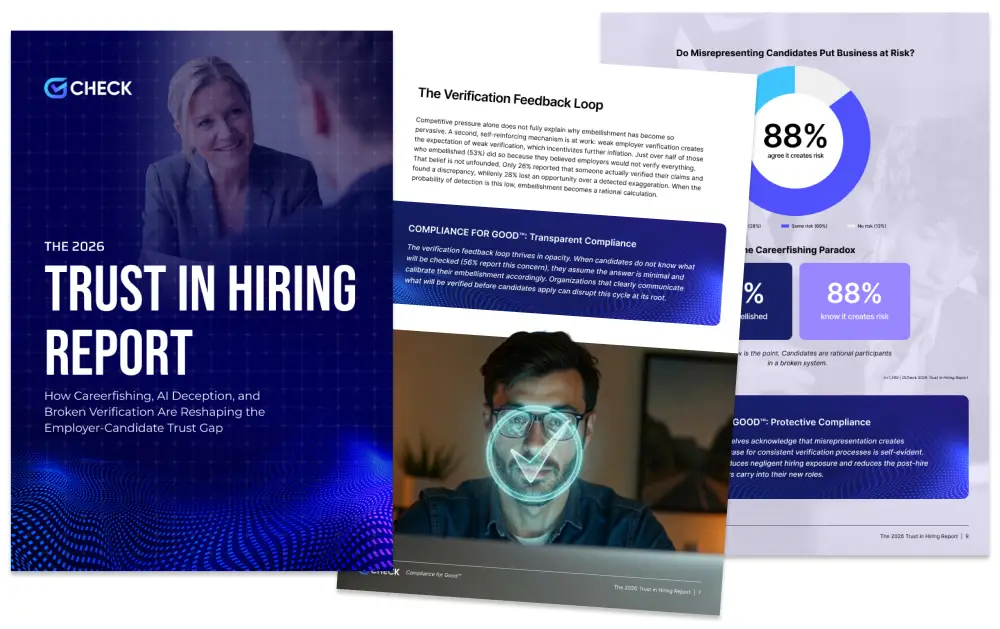
Competitive pressure and low confidence in verification are fueling resume exaggeration, underscoring the need for stronger candidate verification to ensure qualified hiring LOS ANGELES - March 24, 2026 – Ninety-three percent of recent job seekers admit to embellishing or lying during the hiring process to appear more qualified, according to the Trust in Hiring Report released today by GCheck, a modern, compliance-first...
Cannabis background screening operates under two simultaneous rule sets that most industries never face at the same time, and an ATS that cannot support both layers quietly transfers compliance risk onto HR staff. We evaluated 10 ATS platforms against the specific demands of cannabis hiring, including background check integration depth,...