

Free background check tools typically surface only publicly indexed records such as court case listings, property ownership, and social media profiles. They omit critical employment verification data, education credentials, national criminal databases, and motor vehicle records. Professional screening services access this information through direct courthouse relationships and proprietary data partnerships. Employers must understand that "free" tools operate outside the consumer reporting framework and generally should not be used as the sole basis for employment screening decisions that require FCRA compliance.
Key Takeaways
- Free background check services access only publicly available online records and miss approximately 40-60% of criminal case data.
- Most free tools are not Consumer Reporting Agencies under the FCRA, creating increased legal exposure for employers.
- No-cost platforms cannot verify employment history, education credentials, or professional licenses directly with issuing institutions.
- Free services often display outdated information with database refresh cycles ranging from 30 days to several years.
- The "free" model involves data broker monetization through targeted advertising, paid report upsells, or search data resale.
- Job seekers researching their own background face different legal constraints than employers conducting pre-employment screening.
- Many free platforms lack audit trails, version control, and documentation features needed for EEOC compliance demonstrations.
- Professional screening services provide legally required disclosure forms, authorization workflows, and adverse action notification systems.
Understanding What Free Background Check Services Actually Access
The Public Record Foundation of Free Screening Tools
Free background check platforms aggregate publicly accessible information from government databases, court websites, and data brokers. These services typically include basic identity confirmation through name and address matching. They also pull property ownership records from county assessor offices. Civil court case listings that have been digitized appear through state or county court portals. The scope of available public records varies dramatically by jurisdiction.
Some states maintain comprehensive online court case management systems. These display criminal filings, dispositions, and sentencing information. Others provide only minimal case indexing without substantive details. This creates a patchwork coverage model where free services may return extensive results for digitally advanced counties while showing nothing for adjacent jurisdictions using paper-based systems.
Most free platforms also incorporate data from the National Sex Offender Public Website, federal bankruptcy court records through PACER, and Federal Aviation Administration pilot certifications. However, these specialized databases represent narrow slices of background information and do not constitute comprehensive screening for employment purposes.
The Critical Gaps in Free Database Coverage
Free background check services fundamentally cannot access the same data sources that professional screening companies utilize through direct courthouse relationships, law enforcement partnerships, and proprietary database development. County criminal records remain the most significant gap. Approximately 3,200 U.S. counties maintain their own record-keeping systems with varying levels of digital accessibility.
A free service may return "no criminal records found." This result more accurately means "no digitized criminal records appeared in the public databases we searched." It does not confirm the absence of a criminal history. Many serious offenses process through county courts that do not participate in statewide record aggregation systems.
| Information Type | Available in Free Services | Requires Professional Screening |
| Digitized court records | Yes (partial) | Yes (verified and complete) |
| County criminal records | Limited (40-60% coverage) | Yes (direct courthouse access) |
| Employment verification | No | Yes |
| Education credentials | No | Yes |
| Motor vehicle records | No | Yes |
| Professional licenses | No | Yes |
| National criminal database | Yes (unverified) | Yes (verified) |
Employment verification represents another category entirely absent from free screening tools. Confirming dates of employment, job titles, eligibility for rehire, and salary history requires direct contact with former employers or access to payroll databases that are not public records.
How Data Broker Models Fund "Free" Services
The economic model behind free background check platforms relies on converting free users into paying customers. Detailed reports typically cost between $20 and $50 for expanded searches. Many free services generate revenue through advertising partnerships that target users based on search behavior.
When someone searches for criminal records or address history, this query data becomes valuable for marketing financial services, legal representation, or security products. Some platforms also aggregate and anonymize search patterns to sell as market research data. This business model creates inherent conflicts of interest.
Free platforms benefit from maximizing user engagement and encouraging upgrade purchases. This manifests in interface designs that overemphasize negative findings, use alarming language around incomplete data, or create urgency around information gaps.
Legal Compliance Frameworks That Free Tools Cannot Satisfy
Note: The following information serves educational purposes only and does not constitute legal advice. Employers should consult with qualified legal counsel to ensure compliance with all applicable federal, state, and local laws governing background checks and employment decisions.
FCRA Permissible Purpose Requirements for Employment Screening
The Fair Credit Reporting Act establishes specific procedural requirements for employment-related consumer reports. The following represents key FCRA obligations:
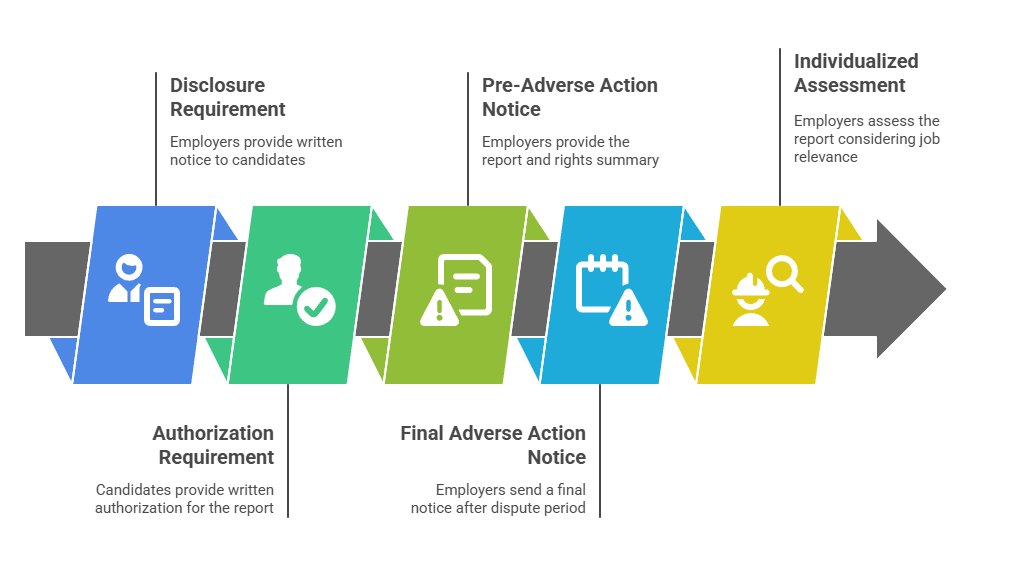
- Disclosure requirement: Employers must provide clear, standalone written notice before requesting the report.
- Authorization requirement: Candidates must provide written authorization before the employer obtains the consumer report.
- Pre-adverse action notice: Employers must provide the candidate with a copy of the report and a summary of consumer rights under the FCRA.
- Final adverse action notice: Employers must send a final notice after allowing reasonable time for dispute.
- Individualized assessment: The employer should conduct an individualized assessment considering the nature of the offense, time elapsed, and job relevance.
Most free background check services explicitly state in their terms of service that they are not Consumer Reporting Agencies and that their data cannot be used for employment decisions. Free platforms typically cannot meet these regulatory standards and therefore prohibit employment use of their data.
State and Local Hiring Law Compliance Gaps
Employers must navigate an expanding web of state and municipal hiring laws beyond federal FCRA requirements. Ban-the-box legislation in more than 35 states and over 150 cities prohibits asking about criminal history on initial job applications. Some jurisdictions restrict when in the hiring process background checks may be conducted.
Free background check services provide no guidance on these jurisdiction-specific requirements. They offer no workflow controls to prevent premature criminal history inquiries. Platforms lack documentation systems to demonstrate compliance with individualized assessment obligations.
California's Fair Chance Act requires employers to conduct individualized assessments considering the nature and gravity of the offense, time elapsed since the offense, and the nature of the job sought. Several states have enacted lookback period limitations that restrict how far back employers can consider certain criminal records.
The Absence of Adverse Action Workflow Management
Professional employment screening services provide integrated adverse action management systems that automatically generate required notices, track mandated waiting periods, and document compliance. These systems include template libraries with legally reviewed disclosure and authorization language, applicant portals for dispute submission, and audit logs.
| Compliance Component | Free Background Check Services | Professional Screening Services |
| Pre-adverse action notice templates | Not provided | Automatically generated |
| Consumer rights summary | Not provided | Included with every report |
| Dispute resolution portal | Limited or absent | Full-featured system |
| Waiting period tracking | Manual (employer responsibility) | Automated tracking |
| Documentation audit trail | Not provided | Complete audit logs |
| State-specific disclosure forms | Not provided | Jurisdiction-customized |
Free background check tools provide none of this infrastructure. Employers must independently create compliant disclosure documents, establish their own dispute procedures, manually track required waiting periods, and maintain documentation that may face scrutiny during regulatory investigations.
Accuracy and Data Currency Limitations
Database Refresh Cycles and Outdated Information
Free background check platforms typically refresh their databases on irregular schedules ranging from monthly updates for frequently accessed sources to annual refreshes for less popular jurisdictions. This creates situations where search results may display dismissed criminal cases, expunged records that should no longer appear, or outdated addresses.
The lag between real-world events and database updates can span months or years. Courts order records sealed. States grant certificates of rehabilitation. These updates may not propagate to data broker aggregation systems that supply free background check platforms.
Identity Matching Errors and False Positive Risks
Free background check services typically use algorithmic name matching without the human verification steps that professional screening companies employ. When searching for "John Smith" in a jurisdiction with dozens of individuals sharing that name, free platforms may return aggregated results without clearly distinguishing which records belong to which individual.
This creates false positive risks where an employer views criminal records belonging to someone with a similar name and assumes the records apply to their candidate. Identity matching errors may lead to improper denial of employment opportunities or potential negligent hiring exposure when employers fail to discover relevant history under name variations.
Missing Context That Professional Verification Provides
Raw criminal records displayed by free services often lack critical context that determines their relevance to employment decisions. Case listings may show an arrest or charge filing without indicating the final disposition. Free platforms typically do not distinguish between felonies and misdemeanors or provide sentencing details.
Professional screening services employ trained researchers who interpret court records, distinguish between charges and convictions, verify final dispositions, and present information in standardized formats. Context matters significantly when evaluating how past conduct relates to future job performance.
Appropriate Use Cases for Free Background Check Tools

Personal Safety Research and Preliminary Information Gathering
Free background check services serve legitimate purposes in contexts outside formal employment screening. Individuals concerned about personal safety can use free tools when meeting someone for the first time through dating applications or online marketplaces. While the information may be incomplete, it provides a preliminary risk assessment at no cost.
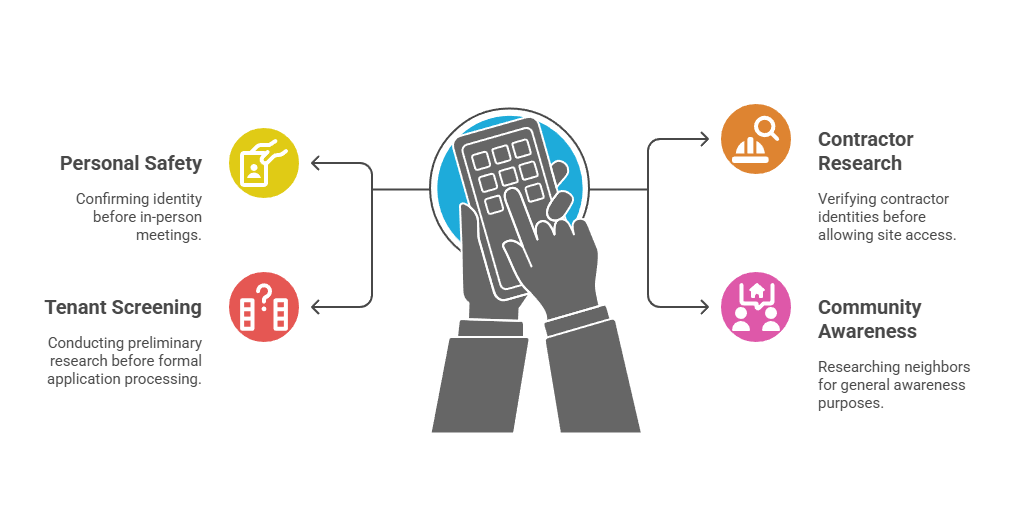
- Personal safety verification: Confirming identity before in-person meetings with individuals met through online platforms.
- Preliminary contractor research: Small business owners verifying contractor identities before allowing site access.
- Tenant screening preparation: Landlords conducting preliminary research before formal application processing.
- Community awareness: Individuals researching neighbors for general awareness purposes unrelated to employment decisions.
These scenarios involve lower legal compliance stakes than employment decisions and serve as preliminary research rather than definitive verification.
Self-Checks and Personal Record Monitoring
Job seekers preparing for employment background checks can use free services to preview what information may appear and identify potential issues requiring explanation or correction. This helps candidates prepare accurate disclosure statements or initiate record expungement processes for eligible offenses.
However, a clean result on a free background check does not guarantee clean results from comprehensive pre-employment screening that includes direct courthouse searches, education verification, and employment history confirmation.
The Critical Boundary: When Free Tools Become Legally Risky
The line between appropriate and problematic use centers on whether the information influences hiring decisions. Using free tools for preliminary candidate research creates several legal vulnerabilities.
| Use Case | Legal Risk Level | Recommended Approach |
| Personal safety check | Low | Free services acceptable |
| Job seeker self-check | Low | Free services as preview only |
| Informal candidate research by employer | High | Avoid or limit to public social media |
| Pre-employment screening by employer | Very High | Use only FCRA-compliant professional services |
| Tenant screening for housing decisions | High | Use FCRA-compliant tenant screening services |
| Post-employment monitoring | Very High | Implement formal continuous monitoring program |
Employers should establish clear policies that either prohibit informal background research on candidates entirely or limit it to professional networking platform reviews. Any information gathering intended to inform employment decisions should occur through compliant channels that provide candidates with procedural protections.
Decision Framework: When Professional Screening Becomes Essential
Risk Assessment Based on Position Responsibilities
The decision to invest in professional background screening should begin with assessment of position-specific risks and regulatory requirements. Roles involving financial authority, access to sensitive data, unsupervised contact with vulnerable populations, or operation of vehicles require verified screening that free tools cannot provide.
Many industries face mandatory background check requirements under federal or state law. Healthcare employers must conduct FACIS searches for providers excluded from federal programs. Financial services firms need verified screening to satisfy FINRA registration requirements. Transportation companies require access to state DMV databases to verify motor vehicle records.
Even for positions without regulatory mandates, employers should consider potential costs of negligent hiring claims, employee theft, workplace violence, or data breaches that result from inadequate screening.
Volume and Consistency Requirements for Growing Organizations
As organizations scale hiring operations, the administrative burden of manually conducting free background checks becomes unsustainable. Professional screening services provide applicant tracking system integrations, bulk processing capabilities, and standardized workflows that ensure consistent treatment of all candidates.
Consistency matters both for operational efficiency and legal defensibility. EEOC investigations or discrimination litigation require employers to demonstrate uniform application of background check procedures. Professional screening services create audit trails documenting that every candidate underwent identical searches with the same decision criteria.
The Hidden Time Costs of DIY Screening
Calculating the true cost of free background checks requires accounting for staff time spent conducting searches, interpreting results, creating compliance documentation, and managing dispute processes. When an HR manager spends three hours researching a candidate, the labor cost may exceed professional screening service fees.
Approximate time investments include:
- Search execution time: 45-90 minutes per candidate
- Result interpretation: 30-60 minutes per candidate with records found
- Compliance documentation: 60-120 minutes per candidate
- Dispute management: 2-5 hours per disputed item
These time investments also divert HR staff from higher-value activities such as candidate engagement and retention program development.
What Comprehensive Professional Screening Includes
Direct County Courthouse Criminal Searches
Professional employment screening services conduct searches directly at courthouses in counties where candidates have lived and worked, accessing records that exist only in local filing systems. County criminal searches include trained researchers who distinguish between active warrants and closed cases, identify records that have been sealed or expunged, and verify that records match the candidate's identity.
National Criminal Database Searches as Supplements
Professional services use national criminal databases as supplementary pointers to guide direct verification rather than as standalone screening tools. When a national database indicates a potential record, the professional service conducts a direct courthouse search to verify the record's current status and retrieve complete information.
Employment and Education Verification
Professional screening includes direct verification of employment history and education credentials with former employers, universities, and credential-issuing organizations.
| Verification Type | Information Confirmed | Typical Sources Contacted |
| Employment verification | Dates of employment, job title, eligibility for rehire | Former employers' HR departments, payroll processors |
| Education verification | Degree earned, dates of attendance, graduation date, major | Registrar offices, National Student Clearinghouse |
| Professional license | License number, issue/expiration dates, status, disciplinary actions | State licensing boards, professional associations |
Education verification has become particularly important as credential fraud has proliferated. Industry research suggests that a significant percentage of resumes may contain embellishment or misrepresentation.
Specialized Searches for Position-Specific Risks
Professional screening services can conduct motor vehicle record checks for driving positions, credit history reviews for financial roles where legally permitted, professional license verifications for regulated occupations, and federal sanctions searches for healthcare and government contractor positions.
Building a Defensible Background Check Policy
Establishing Position-Specific Screening Tiers
Effective background check programs establish different screening levels based on position risk profiles. Entry-level positions with limited access to assets may require only basic criminal record checks and employment verification. Senior roles or positions involving vulnerable populations warrant comprehensive screening including financial reviews where legally permitted.
This tiered approach allocates screening budgets efficiently while ensuring that verification depth matches actual risk exposure. Organizations should document the business justification for each screening component and periodically review tier assignments.
Documenting Job-Related Justification for Screening Components
Each element of the background screening program should have documented justification connecting it to legitimate business requirements. Criminal history checks should link to specific job duties involving asset access, unsupervised authority, or vulnerable population contact. Motor vehicle record checks should apply only to positions requiring driving as an essential function.
This documentation provides a roadmap for consistent policy application and establishes the business necessity defense if screening practices are challenged.
Creating Individualized Assessment Procedures
Background screening may reveal criminal history or other potentially disqualifying information. Employers should follow individualized assessment procedures that consider the nature and gravity of the offense, time elapsed since the offense, and the nature of the job sought.
| Assessment Factor | Evaluation Considerations | Documentation Requirements |
| Nature and gravity of offense | Violence, fraud, theft vs. minor infractions | Written analysis of offense type and severity |
| Time elapsed | Years since offense; completion of sentence | Documentation of conviction date and sentence completion |
| Nature of job sought | Direct relationship between offense and job duties | Job description highlighting relevant responsibilities |
| Rehabilitation evidence | Educational achievements, stable employment history | Candidate-provided evidence and employer evaluation |
Organizations should train hiring managers on conducting individualized assessments consistently and provide templates that document the assessment process.
Conclusion
Free background check services provide limited value for preliminary personal safety research but generally should not substitute for professional employment screening that meets legal compliance standards, accesses comprehensive data sources, and provides verification procedures that ensure accuracy.
Frequently Asked Questions
What information do free background checks typically include?
Free background check services include publicly indexed records such as addresses, property ownership, civil court case listings, bankruptcy filings, and sex offender registry matches. They cannot access county criminal records in courthouse filing systems, verify employment or education history directly, or retrieve motor vehicle records and professional license verifications.
Can employers legally use free background checks for hiring decisions?
Employers who use free background check services for hiring decisions may face similar legal obligations as conducting research directly, potentially including FCRA adverse action requirements. Most free platforms explicitly prohibit employment use because they do not operate as Consumer Reporting Agencies and cannot meet FCRA accuracy standards.
How accurate are free background check services compared to professional screening?
Free services display information only as accurate as the public databases they access, which often contain outdated records, identity matching errors, and incomplete information. Research suggests error rates ranging from 20% to 50%. Professional services employ trained researchers who verify information directly with courthouses and institutions.
What are the main things that free background checks miss?
Free services typically miss county criminal records in local courthouse systems, employment history verification, education credential confirmation, professional license verification, motor vehicle records, workers compensation claims history, and federal sanctions list matches beyond the sex offender registry.
How often do free background check databases get updated?
Free platforms update databases on schedules ranging from monthly refreshes for frequently accessed sources to annual or less frequent updates for smaller jurisdictions. This creates situations where search results may be months or years outdated, particularly for sealed, expunged, or corrected records.
Are there any situations where free background checks are sufficient?
Free services may be sufficient for preliminary personal safety research such as verifying identity before in-person meetings, conducting informal due diligence on contractors in non-employment contexts, or for job seekers previewing their own information. However, formal employment decisions require professional screening services.
What should I do if a free background check shows inaccurate information about me?
Document the specific errors and gather evidence of correct information. Contact the platform to request correction, though many have limited dispute resolution procedures. For errors in underlying public records, petition the court or government agency that maintains the original record.
How much do professional background check services typically cost?
Professional services typically charge between $25 and $150 per candidate depending on comprehensiveness. Basic packages may cost $25 to $40, while comprehensive screening with direct county courthouse searches, employment verification, and education verification may range from $75 to $150.
Do free background checks show arrest records or only convictions?
Free services display whatever information appears in public databases, which may include both arrest and conviction records. However, most employment screening best practices and many state laws require employers to focus primarily on conviction records rather than arrests that did not result in convictions.
Can I run a free background check on myself before applying for jobs?
Job seekers can run searches on themselves to preview what may appear during employment screening, though free services show only a small portion of what professional screening will uncover. Self-checks help identify potential issues, but passing a free background check does not guarantee passing professional employment screening.
Additional Resources
- Using Consumer Reports: What Employers Need to Know
https://www.ftc.gov/business-guidance/resources/using-consumer-reports-what-employers-need-know - Background Checks: What Employers Need to Know
https://www.eeoc.gov/laws/guidance/background-checks-what-employers-need-know - Fair Credit Reporting Act - Federal Trade Commission
https://www.ftc.gov/legal-library/browse/statutes/fair-credit-reporting-act - State Laws on Use of Criminal Records in Employment
https://www.ncsl.org/labor-and-employment/use-of-criminal-record-information-in-hiring

ABOUT THE CREATOR
GCheck Editorial Team
Meet the GCheck Editorial Team, your trusted source for insightful and up-to-date information in the world of employment background checks. Committed to delivering the latest trends, best practices, and industry insights, our team is dedicated to keeping you informed.
With a passion for ensuring accuracy, compliance, and efficiency in background screening, we are your go-to experts in the field. Stay tuned for our comprehensive articles, guides, and analysis, designed to empower businesses and individuals with the knowledge they need to make informed decisions.
At GCheck, we're here to guide you through the complexities of background checks, every step of the way.