



Texas healthcare employers must navigate overlapping background check requirements from state licensing boards, facility-specific regulations, and county-level ordinances that vary by worker role and location. This guide clarifies which screenings apply to different healthcare positions, how to interpret results within legal boundaries, and when rescreening obligations arise under current Texas law.
Key Takeaways
- Texas healthcare background check requirements differ by role, with nurses, direct care staff, and administrative employees subject to distinct screening mandates.
- The Texas Department of Public Safety oversees criminal history checks for many healthcare roles, but additional screenings may be required by facility type or licensing board.
- Employers must distinguish between disqualifying offenses and records requiring individualized assessment under federal and state legal frameworks.
- The Texas Nurse Aide Registry maintains a separate verification system with distinct compliance obligations for facilities employing certified nurse aides.
- Background check turnaround times vary based on fingerprint processing, out-of-state record requests, and the type of verification performed.
- Rescreening intervals are not universally mandated but may be required by specific facility licenses, accreditation standards, or organizational policy.
- Counties and municipalities may impose additional hiring restrictions or disclosure requirements that layer onto state-level mandates.
- Proper documentation of background check procedures, adverse action processes, and individualized assessments protects employers during audits and surveys.
Understanding the Texas Healthcare Background Check Regulatory Framework
Texas healthcare employers operate within a multi-layered compliance environment where state statutes, administrative rules, and facility-specific licensing requirements intersect. Unlike states with unified healthcare screening mandates, Texas applies different standards depending on worker classification, facility type, and the populations served.
Key regulatory sources include:

- Texas Occupations Code: Establishes baseline requirements for licensed healthcare professionals
- Texas Health and Safety Code: Governs facility-level obligations for hospitals, nursing homes, assisted living centers, and home health agencies
- County ordinances: Apply additional requirements in urban jurisdictions with enhanced patient safety protocols
- Federal certification standards: Impose Medicare and Medicaid participation conditions
These frameworks do not operate in isolation. Employers must synthesize requirements across all applicable sources to build compliant screening programs.
State-Level Criminal History Check Systems
The Texas Department of Public Safety administers criminal history background checks through multiple channels. Employers may request name-based checks or fingerprint-based checks depending on statutory requirements and the level of access a worker will have to vulnerable populations.
| Check Type | Database Access | Typical Use Case |
| Name-based check | State repositories only | Administrative roles with limited patient contact |
| Fingerprint-based check | State repositories plus FBI databases | Direct care positions and roles requiring licensing |
| Rap Back monitoring | Ongoing arrest notifications | Facilities with continuous monitoring mandates |
Fingerprint-based checks provide a more comprehensive view of an applicant's criminal history across jurisdictions. Some healthcare facilities may enroll eligible employees in the DPS Rap Back service, which provides notifications of subsequent criminal activity after initial hire. Enrollment eligibility and requirements vary based on facility type and applicable regulations.
Licensing Board Requirements by Profession
Professional licensing boards impose distinct background check obligations for credentialed healthcare workers. The Texas Board of Nursing, Texas Medical Board, and other regulatory agencies require applicants to disclose criminal history as part of initial licensure and renewal processes. These boards maintain independent disciplinary databases that employers should consult in addition to criminal background checks.
Employers cannot rely solely on active licensure as proof of background clearance. Some licensing boards issue conditional licenses or licenses with practice restrictions while investigations remain pending. Employers should verify license status directly through the board's official verification system and contact the board if questions arise about license conditions or restrictions.
As an HR professional, I can tell you that background checks are not just about checking boxes or avoiding risk; they are about people, trust, and responsibility in a way that respects the dignity of every individual, even as we are ensuring the interests of our organization are protected by a thoughtful approach to background checks. At its best, compliance is not about caution; it is about intentionality and humanity in building our teams.
Role-Specific Background Check Requirements in Texas Healthcare Settings
Texas law imposes different screening obligations based on job function, level of patient contact, and access to controlled substances or protected health information. Understanding which requirements apply to each position prevents both over-screening and compliance gaps.
Licensed Clinical Professionals
Physicians, nurse practitioners, physician assistants, and other licensed practitioners must undergo criminal background checks as part of their licensing board application process. Employers should verify current licensure status and check for disciplinary actions or practice restrictions through the appropriate board's online verification system.
For physicians, the Texas Medical Board maintains public profiles that include board actions, malpractice judgments, and hospital privilege restrictions. These records provide information beyond criminal history that may be relevant to employment decisions. Similar disclosure systems exist for nursing and allied health professions, though the scope of publicly available information varies by board.
Registered Nurses and Licensed Vocational Nurses
The Texas Board of Nursing requires criminal background checks for initial licensure and may request additional checks during license renewal or in response to complaints. Employers must verify licensure through the Board's online system and confirm that no practice restrictions or probationary conditions exist.
Facilities that employ nurses in direct patient care roles should establish policies for responding to board disciplinary actions that occur during employment. While active licensure generally permits continued practice, certain probationary terms may restrict the settings or patient populations a nurse can serve.
Certified Nurse Aides and Direct Care Workers
Employment of certified nurse aides triggers specific obligations under both state licensing requirements and federal Medicare/Medicaid certification standards. Verification requirements include:
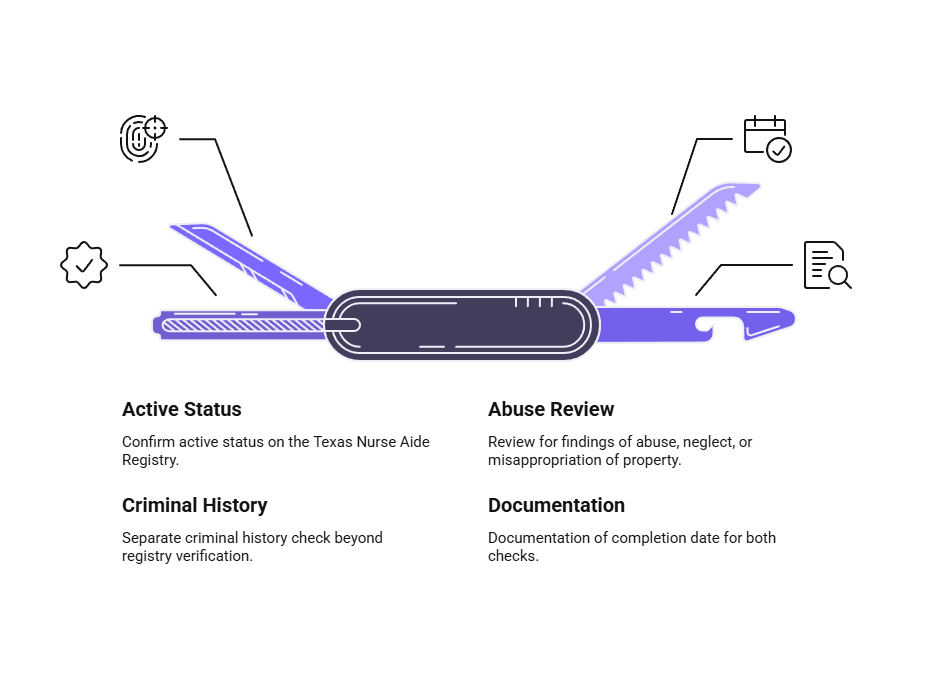
- Confirmation of active status on the Texas Nurse Aide Registry
- Review for findings of abuse, neglect, or misappropriation of property
- Separate criminal history check beyond registry verification
- Documentation of completion date for both checks
The registry check requirement applies regardless of whether the facility participates in federal reimbursement programs. Texas Health and Safety Code provisions extend this verification mandate to most long-term care settings, assisted living facilities, and home health agencies employing individuals who provide hands-on care.
Administrative and Support Staff
Non-clinical employees who have access to patient information, controlled substances, or vulnerable populations may be subject to background check requirements depending on facility type and licensing conditions. Administrative roles in hospitals, nursing homes, and facilities serving children or individuals with disabilities often require the same level of screening as direct care positions.
Employers should review their facility license conditions and any agreements with state or federal oversight agencies to determine which non-clinical roles trigger mandatory background checks. In many cases, facilities adopt screening policies that exceed minimum legal requirements to manage risk consistently across all positions with access to sensitive areas.
Components of a Compliant Texas Healthcare Background Check
A thorough background screening process in Texas healthcare settings typically includes multiple verification components, each serving a distinct compliance or risk management function.
| Screening Component | Primary Purpose | When Required |
| Criminal history verification | Identify disqualifying offenses and assess risk | Most healthcare positions |
| Professional license verification | Confirm active, unrestricted credentials | All licensed practitioners |
| Exclusion list screening | Prevent employment of federally barred individuals | All roles in federally funded programs |
| Nurse aide registry check | Verify absence of abuse/neglect findings | Direct care workers in long-term care |
Employers must determine which elements are legally required versus organizationally prudent based on the specific role and facility type.
Criminal History Verification
Criminal background checks may be conducted through county court records, statewide repositories, or multi-state databases. Texas employers must obtain appropriate consent and provide required notices under the Fair Credit Reporting Act when using third-party screening services to compile criminal history information.
The scope of criminal history searches should align with legal requirements and organizational policy. Some facilities limit reviews to convictions within specific lookback periods, while others consider arrests, pending charges, and deferred adjudications. Employers must apply consistent standards and conduct individualized assessments before making adverse employment decisions based on criminal records.
Professional License and Credential Verification
Verification of active, unrestricted licensure is essential for all positions requiring state credentials. Employers should check license status at the time of offer and establish procedures for monitoring renewals and any disciplinary actions that occur during employment.
Beyond verifying that a license is active, employers should review public disciplinary records for patterns of violations, practice restrictions, or conditions that may affect job duties. Licensing boards publish varying levels of detail about disciplinary actions, and some information may require direct contact with the board to obtain.
Exclusion List Screening
Healthcare employers participating in federal healthcare programs must screen all employees and contractors against the HHS Office of Inspector General List of Excluded Individuals and Entities and the System for Award Management exclusion records. Employment of excluded individuals can result in loss of federal reimbursement, substantial financial penalties, and potential False Claims Act liability.
Best practices for exclusion screening include:

- Initial screening before hire or contract execution
- Monthly or quarterly rescreening during employment
- Documented procedures for responding when current employees appear on lists
- Immediate removal from duties involving federal program beneficiaries
- Consultation with legal counsel before termination decisions
Many organizations incorporate automated screening tools that flag additions to exclusion databases, though manual verification remains advisable.
Nurse Aide Registry Verification
For positions involving direct patient care in long-term care settings, verification through the Texas Nurse Aide Registry is mandatory. The registry identifies individuals with findings of abuse, neglect, or misappropriation of property that disqualify them from employment in certified facilities.
Registry checks must be completed before an individual begins work in a direct care capacity. Some facilities conduct preliminary checks during the application phase to avoid investing time in candidates who cannot legally be employed in these roles. The registry verification requirement applies to both certified and non-certified individuals performing nurse aide-equivalent duties.
Interpreting Background Check Results Within Texas Legal Standards
Receiving background check results is only the first step in a legally compliant hiring process. Texas employers must evaluate findings in accordance with federal anti-discrimination laws, state-specific standards, and facility policy before making employment decisions.
Distinguishing Disqualifying Offenses from Reviewable Records
Texas law establishes absolute disqualifications for certain offenses in specific healthcare contexts. Permanently barred offenses in vulnerable population settings typically include:
- Violent crimes against persons
- Sexual offenses
- Exploitation of elderly or disabled individuals
- Abuse or neglect of children or vulnerable adults
Outside of explicitly disqualifying offenses, employers must conduct individualized assessments that consider the nature of the crime, time elapsed since conviction, evidence of rehabilitation, and relationship between the offense and job responsibilities. Blanket exclusion policies based on criminal history categories create legal risk under Equal Employment Opportunity Commission guidance.
Evaluating Convictions Versus Arrests and Pending Charges
Texas employers should focus adverse employment decisions on convictions rather than arrests without disposition. Arrest records indicate that an individual was suspected of criminal activity but do not establish that the conduct occurred. Employers who consider arrest records must evaluate whether the conduct underlying the arrest (if it occurred) would make the individual unfit for the specific position, and should provide the candidate opportunity to explain the circumstances.
Pending criminal charges present a more complex scenario. Employers may consider pending charges when making initial hiring decisions but should evaluate whether the nature of the charge creates a direct conflict with job duties or facility safety requirements. Individualized assessment remains necessary, and employers should document the specific reasons for any decision based on pending matters.
Considering Deferred Adjudications and Expunged Records
Deferred adjudication dispositions are not final convictions under Texas law. Whether they may be considered in employment decisions depends on the specific healthcare role, facility type, and applicable statutory disqualification provisions. Employers should review governing statutes and consult legal counsel to determine appropriate treatment of deferred adjudications.
| Record Type | Legal Status | Consideration in Employment Decisions |
| Conviction | Final determination of guilt | May be considered, subject to individualized assessment |
| Deferred adjudication | Guilty plea with deferred finding | Consideration depends on role and applicable statutes |
| Expunged record | Legally erased | Should not appear; consult counsel if disclosed |
| Sealed record | Hidden from public view | Should not appear; consult counsel if disclosed |
Expunged and sealed records generally should not appear in background check results. If such records are disclosed, employers should consult legal counsel before considering them in employment decisions.
Texas Healthcare Screening Turnaround Time and Process Considerations
Understanding realistic timelines for background check completion helps employers plan hiring workflows and manage candidate expectations. Multiple factors influence how quickly verification processes can be completed in Texas healthcare settings.
Fingerprint Processing and State Repository Checks
Fingerprint-based criminal history checks processed through the Texas Department of Public Safety typically return results within three to five business days when submissions are complete and legible. However, delays occur when fingerprint quality is poor or when records must be manually reviewed due to name matches or out-of-state history.
FBI database searches included in fingerprint-based checks may add processing time, particularly when records exist in multiple states or when name variations require additional verification. Employers should build buffer time into hiring timelines to accommodate these variables.
Out-of-State Record Requests and Multi-Jurisdictional Searches
Candidates with residence or employment history outside Texas require additional verification steps. Some background check processes include multi-state database searches, but these may not capture county-level records from all jurisdictions.
Common timeline factors include:
- Manual processing requirements in some jurisdictions
- Limited online access to court records in certain counties
- Varying response times from out-of-state courts
- Additional fees for expedited processing
Employers with stringent screening requirements may need to request direct court record searches in states where candidates previously lived or worked. Out-of-state record requests can extend turnaround times significantly. Employers should typically plan for seven to fourteen days for comprehensive screening packages, though actual timelines vary based on jurisdiction, record availability, and case complexity. Additional time is often needed when multi-state record searches are required.
License Verification and Registry Checks
Professional license verification through state board websites typically provides immediate results. However, confirming the absence of disciplinary actions or practice restrictions may require additional research, particularly when board records indicate investigations or pending actions.
Nurse aide registry checks through the Texas Health and Human Services system generally process quickly when performed online. Employers should document the date of registry verification and retain confirmation records as proof of compliance with pre-employment screening requirements.
When to Rescreen Healthcare Workers in Texas
Unlike some states with mandatory rescreening intervals, Texas does not impose uniform requirements for periodic background checks on existing healthcare employees. However, specific circumstances and facility types may trigger rescreening obligations.
Facility License and Accreditation Requirements
Certain Texas facility licenses include conditions requiring periodic rescreening of employees. Long-term care facilities, behavioral health centers, and facilities serving vulnerable populations should review their license conditions and any agreements with state oversight agencies to identify rescreening mandates.
Accreditation organizations may impose rescreening standards that exceed state minimum requirements. Facilities pursuing or maintaining accreditation should incorporate these standards into their background check policies and ensure consistent application across all applicable positions.
Change in Job Duties or Access Levels
When an employee's responsibilities change in ways that increase access to vulnerable populations, controlled substances, or protected information, conducting an updated background check may be appropriate. Internal transfers or promotions that significantly alter risk profiles warrant consideration of rescreening, even absent a specific legal mandate.
Job changes that may trigger rescreening include:
- Transfer from administrative role to direct patient care
- Promotion to supervisory position over vulnerable populations
- Assignment to medication administration duties
- Relocation to facility serving higher-risk patient populations
Facilities should establish clear policies defining which types of role changes trigger rescreening requirements. Consistent application of these policies prevents claims of discriminatory treatment and ensures that screening practices align with actual risk levels.
Triggering Events and Continuous Monitoring
Employers enrolled in continuous monitoring programs through the Texas Department of Public Safety receive notifications when employees are arrested or convicted of crimes after initial hire. These notifications create an obligation to evaluate whether the new criminal activity affects the individual's fitness for continued employment.
Facilities without access to continuous monitoring systems should consider establishing self-reporting requirements in employee handbooks. Policies requiring employees to disclose arrests or convictions enable employers to conduct rescreening and risk assessments when circumstances change.
County and Municipal Variations in Texas Healthcare Background Check Requirements
While state law establishes baseline requirements, some Texas counties and municipalities impose additional screening or disclosure obligations on healthcare employers.
| Jurisdiction Type | Common Additional Requirements | Affected Employers |
| Major metropolitan counties | Ban-the-box provisions, salary history restrictions | Large healthcare systems with urban locations |
| Counties with vulnerable populations | Extended lookback periods, expanded disqualifying offenses | Long-term care and pediatric facilities |
| Municipalities with local ordinances | Enhanced disclosure requirements, fair hiring rules | Facilities within city limits |
Understanding local variations prevents compliance gaps in multi-location operations.
Urban Jurisdiction Enhanced Standards
Major metropolitan areas in Texas may have county or city ordinances affecting healthcare hiring practices, including potential ban-the-box provisions, salary history restrictions, or enhanced disclosure requirements. Employers should verify current local requirements with municipal authorities or legal counsel, as ordinances vary and may change.
Employers operating in multiple jurisdictions should maintain a compliance matrix that tracks applicable requirements by location. This approach ensures that screening processes meet the most stringent standards applicable to each facility or worksite.
Facility-Specific Requirements Based on Population Served
Counties with large populations of vulnerable residents may impose additional screening requirements on facilities serving children, elderly individuals, or people with disabilities. These requirements often exceed statewide standards and may include more extensive criminal history lookback periods or expanded categories of disqualifying offenses.
Employers should consult county health departments, licensing authorities, and facility surveyors to identify location-specific requirements. Documentation of compliance with local standards should be maintained separately from general background check records to facilitate audits and inspections.
Documentation and Recordkeeping for Texas Healthcare Background Checks
Proper documentation of background check processes protects employers during state surveys, federal audits, and legal challenges.
Personnel File Organization
Background check records should be maintained in a secure system with access limited to personnel responsible for employment decisions and compliance verification. Separation of screening documentation from general personnel files may be advisable to protect confidential information and facilitate audit preparation.
Essential documentation elements include:
- Evidence of written consent to conduct background checks
- Copies of disclosure notices required under the Fair Credit Reporting Act
- Records of individualized assessments for candidates with criminal history
- Verification confirmations for license and registry checks
- Dated proof of exclusion list screening
- Copies of pre-adverse and final adverse action notices
The specific retention requirements vary based on facility type and applicable regulations. Employers should consult legal counsel to determine appropriate retention periods for their organization.
Audit Trail for Adverse Action Decisions
When background check findings lead to adverse employment actions, employers must document the decision-making process in detail. Records should demonstrate that required pre-adverse and final adverse action notices were provided in accordance with the Fair Credit Reporting Act, that the candidate had opportunity to dispute accuracy of information, and that an individualized assessment was conducted that evaluates the nature of the offense, time elapsed, and relationship to job duties.
Audit trails become critical evidence in discrimination claims or wrongful termination litigation. Contemporaneous documentation that shows consistent application of screening standards across all candidates provides stronger protection than reconstructed explanations created after a dispute arises.
Conclusion
Texas healthcare employers must synthesize requirements from state licensing boards, facility-specific regulations, and local ordinances to build compliant background check processes. Understanding which screenings apply to different roles, how to evaluate results within legal boundaries, and when rescreening becomes necessary enables organizations to protect patients while respecting candidate rights and maintaining operational efficiency.
Frequently Asked Questions
The requirements of the background checks may seem overwhelming, especially considering the fact that these requirements may vary depending on the type of position, facility type, and even location. This FAQ section has been designed to answer the most common queries employers have when they seek to implement these requirements in an equal manner and in full compliance with the law.
What makes Texas healthcare background check requirements different from other industries?
Healthcare employers in Texas face role-specific requirements that vary based on professional licensing, patient populations served, and facility type. While general employers may conduct discretionary background checks, healthcare facilities often must complete specific verifications mandated by licensing boards, federal certification standards, and state health codes. The overlay of multiple regulatory frameworks creates complexity not present in most other sectors.
How long do Texas healthcare background checks typically take to complete?
Standard fingerprint-based criminal history checks through the Texas Department of Public Safety generally process within three to five business days. However, total turnaround time varies based on license verification complexity, out-of-state record requests, registry checks, and exclusion list screening. Employers should plan for seven to fourteen days for comprehensive screening packages, with additional time needed when multi-state record searches are required.
Are Texas healthcare facilities required to rescreen employees periodically?
Texas does not impose universal rescreening requirements for healthcare workers. However, specific facility licenses may include rescreening conditions, and accreditation standards sometimes mandate periodic checks. Employers enrolled in continuous criminal monitoring programs receive ongoing notifications of employee arrests. Organizations should review their license conditions and accreditation requirements to determine applicable rescreening obligations rather than assuming statewide mandates exist.
Can Texas healthcare employers hire someone with a criminal record?
Employment of individuals with criminal history depends on the nature of the offense, the healthcare role, and applicable disqualification provisions. Texas law prohibits hiring individuals with certain convictions into positions involving vulnerable populations, but many criminal records require individualized assessment rather than automatic disqualification. Employers must evaluate the relationship between an offense and job duties, time elapsed since conviction, and evidence of rehabilitation before making decisions.
What is the Texas Nurse Aide Registry and when must employers check it?
The Texas Nurse Aide Registry maintains records of certified nurse aides and findings of abuse, neglect, or misappropriation of property that disqualify individuals from employment in certain healthcare settings. Employers must verify registry status before hiring anyone who will provide direct patient care in long-term care facilities, nursing homes, assisted living centers, or home health agencies. Registry checks are required regardless of whether an individual currently holds active certification.
Do Texas healthcare background check requirements differ by county?
While state law establishes baseline requirements, some counties and municipalities impose additional screening or disclosure obligations. Urban jurisdictions may have ban-the-box ordinances, enhanced patient safety standards, or facility-specific requirements based on populations served. Employers operating in multiple locations should verify local requirements with county health departments and licensing authorities to ensure compliance with the most stringent applicable standards.
What happens if a Texas healthcare employee is arrested after being hired?
Employers enrolled in continuous monitoring programs receive notifications when existing employees are arrested or convicted. Organizations without monitoring systems should establish policies requiring employees to self-report criminal activity. Upon notification, employers should conduct a risk assessment to determine whether the new criminal matter affects the individual's fitness for continued employment. Decisions must consider job duties, patient safety, facility license requirements, and applicable disqualification provisions.
Are Texas healthcare employers required to use fingerprint-based background checks?
Fingerprint-based criminal history checks are required for certain healthcare roles, particularly those involving vulnerable populations or positions in facilities with specific licensing conditions. Requirements vary based on facility type and worker classification. Employers should consult Texas Health and Safety Code provisions applicable to their facility type and review license conditions to determine whether fingerprint checks are mandatory or whether name-based searches satisfy legal requirements.
Additional Resources
- Texas Department of Public Safety Criminal History Background Checks
https://www.dps.texas.gov/section/crime-records/criminal-history-background-checks - Texas Board of Nursing License Verification
https://www.bon.texas.gov/licensure_verification.asp - Texas Health and Human Services Nurse Aide Registry
https://www.hhs.texas.gov/doing-business-hhs/provider-information/long-term-care-providers/nurse-aide-training-competency-evaluation-program - U.S. Department of Health and Human Services Office of Inspector General Exclusions Database
https://oig.hhs.gov/exclusions/ - Texas Medical Board Physician Profile Search
https://www.tmb.state.tx.us/page/look-up-a-license - Equal Employment Opportunity Commission Guidance on Arrest and Conviction Records
https://www.eeoc.gov/laws/guidance/arrest-and-conviction-records

ABOUT THE CREATOR
GCheck Editorial Team
Meet the GCheck Editorial Team, your trusted source for insightful and up-to-date information in the world of employment background checks. Committed to delivering the latest trends, best practices, and industry insights, our team is dedicated to keeping you informed.
With a passion for ensuring accuracy, compliance, and efficiency in background screening, we are your go-to experts in the field. Stay tuned for our comprehensive articles, guides, and analysis, designed to empower businesses and individuals with the knowledge they need to make informed decisions.
At GCheck, we're here to guide you through the complexities of background checks, every step of the way.