



Texas maintains a permissive state-level approach to employment background checks, but employers in Austin, Dallas, and other municipalities face enforceable fair chance ordinances that regulate timing, disclosure, and use of criminal history. Compliance requires jurisdiction-specific assessment rather than statewide assumptions.
Key Takeaways
- Texas has no statewide ban-the-box law, but Austin and Dallas enforce mandatory delays on criminal history inquiries.
- Employers must identify whether job locations fall within city limits subject to municipal ordinances.
- Federal FCRA requirements apply universally, including disclosure, authorization, and adverse action procedures.
- Expunged and sealed records in Texas are legally considered non-existent and cannot lawfully support employment decisions.
- Industry-specific mandates from state agencies may impose fingerprint-based checks regardless of municipal rules.
- Credit history use is unrestricted at the state level but may face scrutiny under federal and local anti-discrimination frameworks.
- Multi-location Texas employers need jurisdiction-aware policies to avoid under-compliance in regulated cities and over-restriction in permissive areas.
- Individualized assessment practices help mitigate discrimination claims even where not legally mandated.
Understanding Texas's Dual-Layer Background Check Framework
Texas employers navigate a compliance landscape shaped by two distinct regulatory tiers. State law provides broad operational latitude, while municipal ordinances in major metro areas impose enforceable restrictions that function as localized overrides. This dual-layer structure requires location-aware policy development rather than uniform statewide approaches.
State-Level Permissiveness and Its Limits
Texas does not impose statewide restrictions on when employers may ask about criminal history, whether on initial applications or during interviews. Unlike states with comprehensive fair chance statutes, Texas background check laws 2026 reflect a legislative approach that defers screening protocol decisions to employers, subject to federal baseline protections and municipal override.
This permissiveness creates operational latitude in several areas:
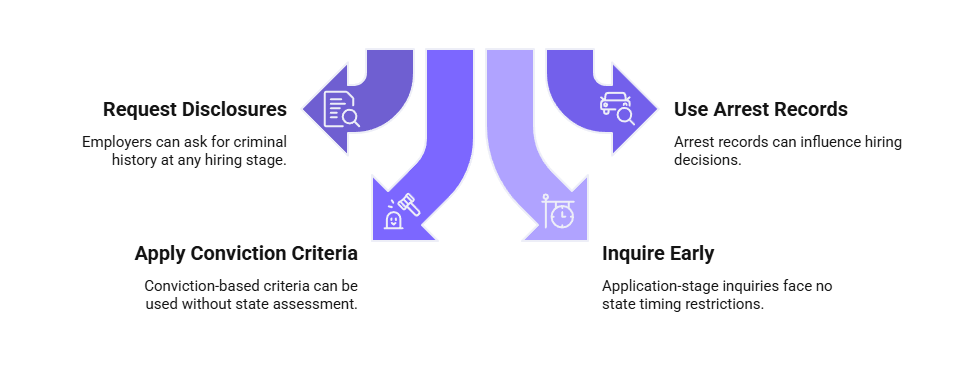
- Employers may request criminal history disclosures at any hiring stage
- Arrest records can be used in decision-making processes
- Conviction-based criteria may be applied without state-mandated individualized assessment frameworks
- Application-stage inquiries face no state-level timing restrictions
However, this latitude does not extend to all jurisdictions within Texas. Municipal ordinances in Austin, Dallas, and potentially other cities establish enforceable obligations that function as localized state law overrides. Employers operating under the assumption that Texas imposes no rules risk significant compliance gaps when hiring within city limits subject to these ordinances.
Texas is a good reminder that background check compliance can often depend on local regulations, even if the state’s structure feels flexible. In cities such as Austin and Dallas, timing and disclosure issues can create a hiring process that looks quite different from the rest of the state. Hiring organizations should recognize that location can be a critical factor in how background checks are conducted so that the appropriate steps are being taken at the appropriate times. When hiring organizations get the fundamentals of FCRA right and assessments are job-related, hiring can become a fair chance process.
Municipal Fair Chance Ordinances as Operational Law
| City | Employer Coverage | Timing Restriction | Enforcement Mechanism |
| Austin | 15+ employees | After conditional offer | Administrative complaints and city enforcement procedures |
| Dallas | 15+ employees | After initial interview | Administrative complaints and city enforcement procedures |
Austin's fair chance hiring ordinance prohibits covered employers from inquiring about criminal history until after a conditional offer. The ordinance has been in effect since early implementation and includes enforcement mechanisms through the city's equal employment office. Violations can result in administrative penalties, required policy revisions, and reputational exposure.
Dallas has implemented similar restrictions, delaying criminal history inquiries until after initial interviews for most positions. The ordinance exempts roles where state or federal law mandates background checks, creating a regulatory carve-out that aligns municipal rules with industry-specific requirements.
These ordinances represent binding law within their jurisdictions. Employers must treat compliance with the same rigor applied to state statutes, including policy documentation, training protocols, and audit readiness.
Industry-Specific State Agency Requirements
Certain Texas industries face mandatory background check requirements imposed by licensing or regulatory bodies:

- Childcare: Texas Department of Family and Protective Services mandates fingerprint-based criminal history checks for all childcare workers
- Education: Texas Education Agency requires similar checks for educators and school personnel
- Healthcare: Texas Health and Human Services Commission specifies checks for facility employees with patient access
These requirements operate independently of municipal ordinances and cannot be waived by local fair chance rules. Employers in regulated industries must integrate state agency mandates into their screening workflows, ensuring that municipal compliance obligations do not delay checks required by licensing authorities.
FCRA Compliance as Universal Baseline
All Texas employers using third-party consumer reporting agencies must comply with the Fair Credit Reporting Act regardless of state or local law variations. This federal framework establishes non-negotiable procedural steps that apply uniformly across all jurisdictions.
Disclosure and Authorization Requirements
Employers must provide clear and conspicuous written disclosure that a consumer report may be obtained for employment purposes. The disclosure must appear as a standalone document, not embedded within application materials or employment agreements. Authorization from the applicant must be secured in writing before requesting the report.
These requirements apply uniformly across Texas. An employer in Houston faces the same FCRA obligations as one in Austin, even though municipal ordinances differ. Failure to provide proper disclosure or obtain valid authorization exposes employers to statutory damages, regulatory action, and class-action litigation risk.
Adverse Action Procedures
When an employer intends to take adverse action based in whole or part on information in a consumer report, FCRA mandates a two-step notice process:
Pre-Adverse Action Notice Requirements:
- Provide a copy of the consumer report
- Include a summary of rights under FCRA
- Allow reasonable time for the applicant to review and dispute report contents
Final Adverse Action Notice Requirements:
- Identify the consumer reporting agency that provided the report
- State that the agency did not make the employment decision
- Inform the applicant of their right to dispute report accuracy
- Provide agency contact information
Texas employers often conflate municipal timing restrictions with FCRA adverse action timelines. These are distinct obligations. Municipal ordinances regulate when inquiries occur during the hiring process, while FCRA governs procedural fairness after adverse information is obtained.
Permissible Purpose and Scope Limitations
| FCRA Requirement | Employer Obligation |
| Permissible purpose | Obtain reports only for employment decisions with written consent |
| Data retention | Retain reports only for legitimate business needs |
| Information sharing | Share report contents only with authorized personnel |
| Accuracy verification | Verify report contents and provide opportunity to correct errors |
Employers may not obtain reports without a permissible purpose as defined by FCRA, retain reports beyond legitimate business needs, or share report contents with unauthorized personnel.
Texas background check requirements under FCRA also include accuracy obligations. Employers relying on reports containing incomplete or inaccurate information may face liability if adverse actions result.
Expunged and Sealed Records in Texas Employment Decisions
Legal Status of Expunged Records
Texas law treats expunged records as legally non-existent. When a court orders expungement under Texas Code of Criminal Procedure Article 55.01, all records of arrest, charges, and proceedings are destroyed or returned to the individual.
Key principles governing expunged records include:
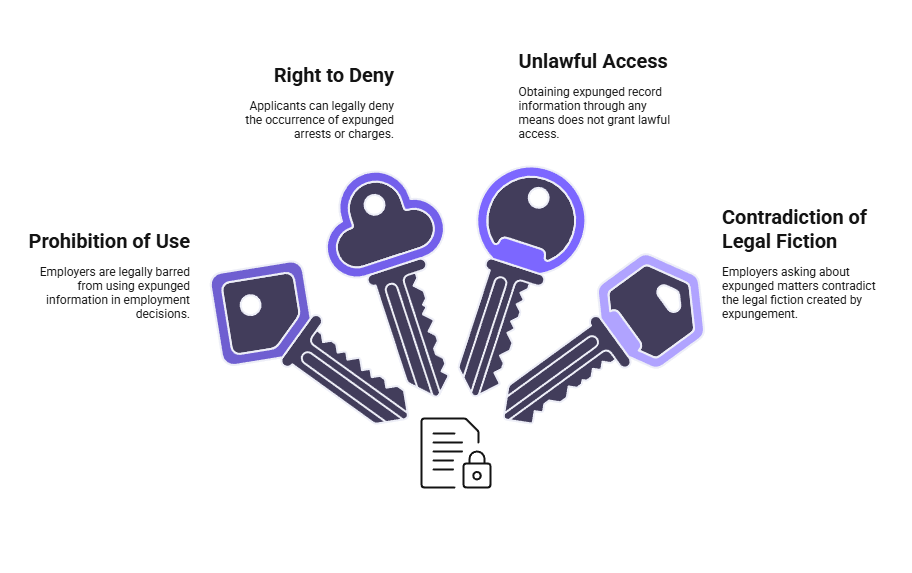
- Employers cannot lawfully use expunged information in employment decisions
- Applicants may legally deny the occurrence of expunged arrests or charges
- Obtaining expunged record information through any means does not create lawful access
- Employers who ask about expunged matters contradict the legal fiction created by expungement
This principle applies regardless of how the employer obtained the information. Consumer reporting agencies and public record databases sometimes contain outdated or legally prohibited information, including expunged records.
Orders of Nondisclosure and Employer Access
Sealed records under orders of nondisclosure occupy a different legal space. These records are not destroyed but are restricted from public access. Many orders of nondisclosure contain exceptions allowing certain categories of employers to access sealed information, particularly in healthcare, education, and positions involving vulnerable populations.
Employers must determine whether their operations fall within exceptions specified in the nondisclosure order. Access without legal authorization constitutes improper use of confidential criminal history information. Even where access is permitted, employers should apply individualized assessment to avoid disparate impact on protected classes.
Practical Verification Challenges
When an applicant asserts that a record has been expunged or sealed, employers should request documentation of the court order and remove the information from consideration. Continuing to rely on expunged information after notice creates liability exposure under both Texas law and federal anti-discrimination frameworks.
Verification steps should include:
- Request court order documentation from the applicant
- Remove expunged information from all decision-making materials
- Document the removal process in compliance files
- Retrain decision-makers on the legal status of expunged records
Navigating Austin and Dallas Municipal Ordinances
Municipal fair chance ordinances in Texas's largest cities create binding obligations that override state-level permissiveness. Employers hiring in these jurisdictions must implement location-specific compliance protocols.
Austin Fair Chance Hiring Ordinance
Austin's ordinance prohibits covered employers from inquiring about criminal history until after a conditional employment offer. The definition of "inquiry" includes application questions, interview discussions, and background check authorizations requested before the conditional offer stage.
Coverage and Exemptions:
| Element | Specification |
| Covered employers | Private entities with 15+ employees and City of Austin |
| Timing requirement | After conditional employment offer |
| Narrow exceptions | Federal/state-mandated background checks |
| Enforcement mechanism | Administrative complaints and city enforcement procedures |
Enforcement occurs through complaint-driven investigations. Remedies include cease-and-desist orders, civil penalties, and required policy revisions. Employers hiring in Austin must implement location-specific application processes to ensure ordinance compliance.
Dallas Background Check Timing Restrictions
Dallas has implemented similar restrictions, delaying criminal history inquiries until after the initial interview for most positions. This framework allows earlier inquiry than Austin's conditional-offer standard but still restricts application-stage questions.
The ordinance applies to employers with 15 or more employees conducting business within Dallas city limits. Exemptions exist for positions subject to state or federal background check mandates and roles involving unsupervised access to vulnerable populations.
Compliance requires:
- Documentation of the interview stage at which criminal history discussions occur
- Training for hiring personnel on permissible timing
- Applicant tracking system flags for Dallas-based positions
- Workflow triggers for ordinance-compliant processes
Jurisdictional Boundary Considerations
Texas's major metro areas include territory both within and outside city limits subject to municipal ordinances. An employer with locations in Austin city limits and nearby unincorporated Travis County must apply different protocols depending on work location.
Job postings should specify work location with sufficient precision to determine applicable rules. Employers cannot avoid municipal ordinances by conducting interviews outside city limits if the position requires work within the regulated jurisdiction. The location of job duties, not the interview site, determines ordinance applicability.
Credit History and Financial Background Checks
Texas provides employers broad discretion in using financial information for hiring decisions, subject to federal restrictions and anti-discrimination principles.
Absence of State-Level Credit Check Restrictions
Texas does not prohibit or restrict employer use of credit history in hiring decisions. Employers may request credit reports, inquire about bankruptcy history, and consider financial background as a qualification criterion without violating Texas background check laws 2026. This permissiveness contrasts with states like California, Colorado, and Illinois, where statutes limit credit check use to specific job categories.
FCRA Requirements for Credit Reports
Credit reports used for employment purposes are consumer reports under FCRA, triggering the same disclosure, authorization, and adverse action requirements applicable to criminal background checks:
- Provide standalone written disclosure before obtaining the report
- Obtain written consent from the applicant
- Follow pre-adverse action procedures if credit information influences decisions
- Provide final adverse action notice with agency contact information
The Equal Employment Opportunity Commission has identified credit check policies as potential sources of disparate impact discrimination. Employers should ensure that credit history criteria relate to specific job functions and apply consistently across applicant pools to mitigate discrimination claims.
Bankruptcy Protections Under Federal Law
| Protected Action | Prohibited Employer Conduct |
| Bankruptcy filing | Refusing to hire solely because of bankruptcy status |
| Bankruptcy status | Terminating employment based exclusively on bankruptcy |
| Debt discharge | Altering employment terms due to bankruptcy proceedings |
Federal bankruptcy law prohibits employers from discriminating against individuals solely because they filed for bankruptcy protection. Credit reports often include bankruptcy filings. Employers must distinguish between permissible consideration of broader credit history and impermissible discrimination based on bankruptcy alone.
Technology-Assisted Screening and Emerging Methods
Employers increasingly incorporate technological tools into background screening workflows. These methods present both operational benefits and compliance considerations that require careful management.
Artificial Intelligence in Background Screening
Some employers incorporate technology platforms that use algorithms to assess criminal history, employment gaps, or predictive risk scores. These tools function as decision-support systems, applying programmed criteria to background check data.
Key compliance considerations include:
- FCRA obligations apply if the system relies on consumer report data
- Disclosure and authorization requirements remain mandatory
- Adverse action procedures must be followed if algorithmic outputs influence decisions
- Algorithmic tools present discrimination risk if they encode biased criteria
Employers should validate that algorithmic factors relate to job performance and monitor outcomes for demographic disparities. Use of algorithmic screening does not eliminate legal compliance obligations established under federal and municipal frameworks.
Continuous Monitoring Programs
Continuous monitoring involves ongoing checks of employee criminal records after initial hiring. This approach allows employers to receive alerts about new arrests or convictions rather than relying solely on pre-hire screening.
Program Design Elements:
| Component | Requirement |
| Authorization | Renewed FCRA consent for post-hire monitoring |
| Triggering events | Specified incidents requiring assessment |
| Employee notification | Clear communication protocols |
| Assessment procedures | Individualized review before action |
Texas law does not prohibit continuous monitoring, but FCRA requires renewed authorization if monitoring involves consumer reports. Automatic termination based on monitoring alerts without individualized review increases discrimination liability.
Social Media and Internet-Based Research
Employers may conduct internet searches and review publicly available social media content without triggering FCRA restrictions, as this activity does not involve consumer reporting agencies. However, employers should ensure that such research complies with applicable privacy laws and does not request access to private or password-protected accounts.
Screening social media for protected class information such as religion, national origin, disability status, or pregnancy creates documentation of knowledge that may support discrimination claims. Employers should limit internet research to job-related factors and document legitimate business reasons for decisions influenced by online content.
Multi-Jurisdictional Compliance Strategies
Employers with locations across Texas face the challenge of developing coherent policies that satisfy varying legal requirements without imposing unnecessary restrictions in permissive jurisdictions.
Policy Segmentation by Location
Employers with locations across Texas should develop tiered background check policies reflecting jurisdictional variation. A single statewide policy risks under-compliance in regulated municipalities and unnecessary restriction in permissive areas.
Implementation steps include:
- Document which rules apply to each hiring location
- Flag positions subject to municipal ordinances in applicant tracking systems
- Route regulated positions through compliant workflows
- Provide jurisdiction-specific training for hiring personnel
Location-based policy segmentation requires clear documentation and system-level controls to ensure consistent application.
Centralized Compliance Oversight with Local Flexibility
| Baseline Standard | Local Adaptation Opportunity |
| FCRA procedural compliance | Timing of inquiries by jurisdiction |
| Expunged record exclusions | Scope of checks based on local needs |
| Individualized assessment frameworks | Decision criteria reflecting municipal rules |
Centralized human resources teams can establish baseline standards meeting the most restrictive jurisdiction's requirements while allowing local adaptation where permissible. This approach ensures that no location falls below minimum compliance thresholds while preserving operational flexibility.
Baseline standards should include FCRA procedural compliance, expunged record exclusions, and individualized assessment frameworks. Local policies may adjust timing of inquiries, scope of checks, and decision criteria based on applicable municipal rules and business needs.
Documentation and Audit Readiness
Compliance with overlapping federal, state, and municipal frameworks requires comprehensive documentation. Employers should maintain records of disclosure forms, authorization signatures, adverse action notices, individualized assessment worksheets, and policy training completion.
Audit readiness involves periodic review of background check practices against current legal requirements. Municipal ordinances may change, enforcement guidance evolves, and case law establishes new interpretive standards.
Individualized Assessment and Discrimination Mitigation
Even where not legally mandated, individualized assessment of criminal history provides legal protection and supports defensible hiring decisions.
EEOC Guidance on Criminal History Use
The Equal Employment Opportunity Commission's guidance on criminal records in employment recommends individualized assessment to reduce disparate impact on protected classes. While not binding law, EEOC guidance influences court interpretation of Title VII claims related to background checks.
Individualized assessment involves considering:
- The nature and gravity of the offense
- Time elapsed since conviction or completion of sentence
- Relationship between the criminal conduct and job responsibilities
Texas employers not subject to municipal individualized assessment mandates may still adopt these practices voluntarily to mitigate discrimination liability. Blanket exclusion policies face higher legal risk than case-by-case evaluation frameworks.
Green Factors as Assessment Framework
Courts have recognized factors from Green v. Missouri Pacific Railroad as relevant to assessing criminal history's relationship to employment. These factors provide a structured approach to individualized evaluation.
Assessment Worksheet Elements:
| Green Factor | Evaluation Question |
| Nature and gravity | How serious was the offense and what harm occurred? |
| Time passage | How much time has elapsed since conviction or release? |
| Job relationship | Does the offense relate to duties of the position? |
Employers can operationalize Green factors through structured worksheets requiring hiring personnel to document analysis of each factor before rejecting applicants with criminal history. This documentation demonstrates that decisions reflect individualized judgment rather than automatic exclusion.
Conditional Offers and Preliminary Assessments
Some employers extend conditional offers contingent on satisfactory background checks, then conduct individualized assessment if disqualifying information appears. This approach satisfies Austin's conditional-offer timing requirement while preserving employer discretion to evaluate criminal history.
Preliminary assessment can occur between conditional offer and final hiring decision. Employers notify applicants of concerns, provide opportunity to submit mitigating information, and document final decision rationale.
Industry-Specific Compliance Considerations
Certain industries face regulatory mandates that create exemptions from municipal fair chance ordinances and impose additional screening obligations.
Healthcare and Direct Care Positions
Texas Health and Human Services Commission mandates criminal history checks for individuals with access to patients or vulnerable adults. Certain convictions create permanent or temporary disqualifications from healthcare employment.
Key compliance elements include:
- Mandates override municipal fair chance ordinances under state-law-required exemptions
- Checks must occur at stages required by licensing rules
- Documentation of regulatory basis for exemption claims is required
- Exemptions should be limited to positions actually subject to mandatory checks
Healthcare employers must conduct checks at stages required by licensing rules, even if municipal ordinances would otherwise delay inquiry. Extending exemptions beyond legally required scope undermines fair chance compliance.
Education and Childcare Roles
| Industry | Regulatory Agency | Check Type |
| Education | Texas Education Agency | Fingerprint-based criminal history |
| Childcare | Department of Family and Protective Services | Fingerprint-based criminal history |
The Texas Education Agency and Department of Family and Protective Services require fingerprint-based background checks for educators and childcare workers. These checks access state and federal criminal history databases unavailable through standard consumer reporting agencies.
Fingerprint requirements apply regardless of municipal ordinance timing restrictions. Employers must integrate these checks into hiring timelines and communicate regulatory obligations to applicants.
Financial Services and Fiduciary Positions
Employers in banking, insurance, and investment services may face federal bonding requirements or regulatory expectations regarding employee criminal history. These considerations affect risk tolerance for certain convictions even where Texas law imposes no specific restriction.
Employers should identify which positions trigger regulatory scrutiny and develop job-specific criminal history criteria. Broad exclusions applied to all positions create unnecessary fair chance conflicts and discrimination exposure.
Conclusion
Texas background check laws 2026 reflect a fragmented regulatory landscape where state permissiveness coexists with municipal enforcement and federal baseline protections. Employers must assess obligations based on specific work locations, industry requirements, and information sources rather than applying uniform statewide assumptions. Compliance requires jurisdiction-aware policies, documented procedures, and ongoing monitoring of evolving local ordinances.
Frequently Asked Questions
Texas background check laws and regulations sometimes create operational challenges due to the fact that the manner in which the state, cities, and the federal government implement background check laws and regulations differs. This is to say that an employer may enjoy flexibility in one place and timing in another. The following section provides answers to the most common questions about criminal history checks, expunged criminal history records, and compliance in Austin, Dallas, and other cities in Texas.
Can Texas employers ask about criminal history on job applications?
Texas state law does not prohibit criminal history questions on applications. However, employers hiring within Austin or Dallas city limits face municipal ordinances restricting inquiry timing. Austin requires waiting until after conditional offers, while Dallas delays questions until after initial interviews. Employers must determine whether job locations fall within regulated jurisdictions.
Are expunged records accessible to Texas employers?
Expunged records are legally non-existent under Texas law. Employers cannot lawfully access or use expunged information in employment decisions. Applicants may deny expunged arrests or charges. If expunged information appears in a background check report due to database errors, employers must disregard it after receiving notice of expungement.
Do Texas background check laws 2026 require individualized assessment of criminal history?
Texas state law does not mandate individualized assessment, but Austin's fair chance ordinance requires it for covered employers. Even where not legally required, individualized assessment helps mitigate discrimination claims under federal equal employment opportunity law. Employers should document consideration of offense nature, time elapsed, and job relevance.
What FCRA compliance steps must Texas employers follow?
Texas employers using consumer reporting agencies must provide standalone written disclosure before obtaining reports and secure written authorization from applicants. If adverse action is considered based on report contents, employers must provide pre-adverse notice with a report copy and summary of rights, allow reasonable time for dispute, then issue final adverse action notice.
Can Texas employers use credit checks for all positions?
Texas does not restrict credit check use by job category. Employers may request credit reports for any position, subject to FCRA disclosure and authorization requirements. However, bankruptcy-based discrimination violates federal law, and credit criteria producing disparate impact may violate equal employment opportunity protections.
How do Dallas and Austin background check ordinances differ?
Austin prohibits criminal history inquiries until after conditional employment offers for covered positions. Dallas delays inquiries until after initial interviews. Both ordinances exempt positions subject to state or federal background check mandates. Austin's ordinance reflects longer enforcement history, while Dallas's framework represents more recent implementation.
Are fingerprint checks required for all Texas employees?
Fingerprint-based checks are not universally required. Specific industries including education, childcare, and healthcare face fingerprint check mandates from state licensing agencies. These requirements operate independently of municipal ordinances and apply regardless of employer size or location. Employers should verify industry-specific obligations through relevant regulatory bodies.
What happens if a background check reveals sealed records?
Sealed records under nondisclosure orders are restricted from public access but may contain exceptions allowing employer access in specific industries. Employers must determine whether they qualify for exception categories before using sealed information. Records sealed without exceptions cannot lawfully support employment decisions.
Additional Resources
- Fair Credit Reporting Act (FCRA) Summary of Rights
https://www.consumer.ftc.gov/articles/pdf-0096-fair-credit-reporting-act.pdf - EEOC Guidance on Consideration of Arrest and Conviction Records
https://www.eeoc.gov/laws/guidance/consideration-arrest-and-conviction-records-employment-decisions-under-title-vii - Austin Fair Chance Hiring Ordinance Information
https://www.austintexas.gov/department/equal-employment-fair-housing - Texas Code of Criminal Procedure Article 55.01 (Expunction)
https://statutes.capitol.texas.gov/Docs/CR/htm/CR.55.htm - Texas Department of Family and Protective Services Background Check Information
https://www.dfps.texas.gov/background_checks/

ABOUT THE CREATOR
GCheck Editorial Team
Meet the GCheck Editorial Team, your trusted source for insightful and up-to-date information in the world of employment background checks. Committed to delivering the latest trends, best practices, and industry insights, our team is dedicated to keeping you informed.
With a passion for ensuring accuracy, compliance, and efficiency in background screening, we are your go-to experts in the field. Stay tuned for our comprehensive articles, guides, and analysis, designed to empower businesses and individuals with the knowledge they need to make informed decisions.
At GCheck, we're here to guide you through the complexities of background checks, every step of the way.