


The SAM exclusion database search represents a critical compliance checkpoint for organizations working with federal agencies, yet many HR professionals struggle with the complex government interface and ambiguous search results. Understanding how to navigate SAM.gov effectively, interpret exclusion records accurately, and integrate federal screening into existing background check workflows separates compliant organizations from those facing contract disqualification and regulatory penalties.
Key Takeaways
- SAM exclusion list background verification serves as the federal government's consolidated system for identifying individuals and entities barred from receiving federal contracts, requiring mandatory screening before contract awards and throughout employment relationships with federal contractors.
- The SAM exclusion database contains records from over 50 federal agencies including GSA, DOD, HHS, and USDA, consolidating previously separate exclusion lists into a single searchable repository that replaced the former EPLS system in 2012.
- Federal contractor screening best practices require verification at multiple hiring stagesâÂÂinitial candidate screening, final pre-employment checks, and periodic re-verificationâÂÂto ensure continuous compliance with FAR requirements governing contractor personnel eligibility.
- Common search errors including name variation mismatches, entity versus individual confusion, and terminated exclusion misinterpretation cause false negatives that expose organizations to compliance violations and contract performance challenges.
- Manual SAM exclusion database searches take 8-15 minutes per candidate when performed correctly, while automated integration with existing background screening platforms reduces verification time to under 60 seconds per check with improved accuracy.
- Exclusion classifications vary significantly in scope and severity, with some prohibiting all federal work while others restrict specific agency contracts or program participation, requiring careful interpretation beyond simple "excluded" or "clear" determinations.
- Organizations must develop documented screening policies addressing search frequency, record retention, dispute procedures, and remediation protocols to satisfy federal compliance audits and demonstrate due diligence in contractor eligibility verification.
Understanding the SAM Exclusion Database System
The System for Award Management exclusion database consolidates federal debarment and suspension records into a centralized verification tool. The system evolved from fragmented agency-specific lists into a unified platform serving procurement officers, grant administrators, and compliance professionals across federal contracting ecosystems.
What the SAM Exclusion Database Contains
The database aggregates exclusion actions from federal agencies enforcing contractor eligibility standards under various statutory authorities. Records include individuals and entities subject to suspension, debarment, proposed debarment, voluntary exclusion, and ineligibility determinations. Each entry reflects formal administrative or legal proceedings resulting in federal work restrictions.
The system maintains historical records of terminated exclusions, preserving accountability trails even after reinstatement. This comprehensive archive enables verification of past exclusion status relevant to risk assessment and due diligence inquiries. Organizations should understand that SAM contains only federal exclusionsâÂÂstate and local government debarment lists require separate verification through jurisdiction-specific systems.
Legal Requirements for SAM Database Screening
Federal Acquisition Regulation provisions establish mandatory verification requirements for contracting officers before contract awards. FAR 9.405 and agency-specific supplements prohibit agencies from soliciting offers from, awarding contracts to, or consenting to subcontracts with excluded parties except under limited waiver circumstances. While FAR directly obligates federal agencies rather than contractors, practical compliance necessitates contractor-initiated screening since prime contractors face contract termination risk if excluded subcontractors or personnel perform federal work.
Beyond contract-specific requirements, prudent risk management drives proactive exclusion screening. Engagement with excluded parties creates reputational exposure, performance complications, and potential suspension or debarment referral for the hiring organization. Legal counsel should review specific contract terms and applicable regulations to determine exact verification obligations for particular engagements.
How SAM Differs from Other Background Screening Databases
The SAM exclusion database serves a specialized compliance function distinct from criminal background checks, credit reports, or professional license verification. SAM identifies administrative determinations of federal contracting ineligibility rather than underlying criminal convictions or civil judgments that may have triggered those determinations. An individual may appear in criminal records databases without SAM inclusion if no federal agency initiated exclusion proceedings, while SAM entries may reflect non-criminal bases including contract disputes or regulatory violations without corresponding criminal records.
Comprehensive background screening requires SAM verification as a complement to, not replacement for, traditional background checks. Organizations working across multiple regulatory contexts require layered screening addressing each applicable system including healthcare exclusion lists, state licensing boards, and industry-specific credentialing bodies.
Trust begins well before the first day of work, and the hiring process carries more significance than most of us can imagine. Through my experiences, I have come to understand the power of background checks in being not about expecting the worst but doing the right thing in regard to the individuals who are depending on us. By choosing to wait in order to verify, document, and be consistent, we not only protect the institution but the work itself.
Step-by-Step SAM Exclusion Database Search Process
Effective SAM verification requires systematic search procedures addressing the database's technical limitations and interpretation challenges. The following process guides HR professionals through accurate, defensible searches.
Accessing the SAM.gov Search Interface
Navigate to SAM.gov and select "Entity/Exclusions" under Search Records to access the exclusion verification tool. The interface requires no account creation or login for basic searches, though registration enables advanced features and saved searches.
Organizations conducting personnel screening should focus on the "Exclusions" section rather than "Entity Registration" results, which show active SAM registrations unrelated to exclusion status. Understanding this critical distinction prevents common interpretation errors where users incorrectly assume entity registration presence confirms non-excluded status.
Conducting Individual Name Searches
Enter the candidate's full legal name in the "Individual" field under Exclusion search parameters. SAM searches exact matches by default, creating false negative risk when candidates use name variations. Search both full legal names and commonly used variations including nicknames, maiden names, and name order inversions.
The interface allows multiple search refinements including state, country, ZIP code, and exclusion classification. Geographic filters help distinguish individuals with common names but may exclude legitimate matches if the candidate previously resided in unreported locations. Initial broad searches followed by progressive narrowing typically yield more reliable results than highly filtered initial queries.
The system returns results displaying name, address, classification (Individual/Entity/Vessel), exclusion type, agency, and active/terminated status. Review all returned records carefullyâÂÂmiddle initials, suffix variations (Jr., Sr., III), and similar addresses may indicate matches requiring deeper investigation. Birth dates would definitively confirm identity but do not appear in public SAM records, necessitating alternative verification approaches when ambiguous matches emerge.
Searching Entity and Business Names
Organizations screening business entitiesâÂÂvendors, subcontractors, consultantsâÂÂmust search the "Entity" classification separately from individual searches. Enter the complete legal business name as it appears in formation documents, noting that DBAs, trade names, and informal business references may not return results.
Entity searches encounter similar variation challenges as individual searches. Search multiple variations including full legal name with entity designation (LLC, Inc., Corp), name without entity designation, abbreviated and spelled-out versions of common words, and name order variations if the business name contains personal names.
The system displays Unique Entity Identifier (UEI), CAGE code, physical address, and exclusion details for entity matches. Cross-reference these identifiers against vendor-provided documentation to confirm accurate matches. Organizations should verify entities at both the parent company and subsidiary levels when corporate structures involve multiple legal entities.
Interpreting Search Results and Exclusion Classifications
SAM results display exclusion classifications reflecting different regulatory authorities and restriction scopes. Understanding these distinctions enables appropriate risk assessment rather than treating all exclusions identically.
Major exclusion types include:
| Classification | Authority | Typical Scope |
| Reciprocal (Proceedings Pending) | FAR 9.407 | Government-wide suspension during investigation |
| Reciprocal (Proceedings Completed) | FAR 9.406 | Government-wide debarment after adjudication |
| Non-Procurement (Department of Agriculture) | 7 CFR Part 3017 | USDA program restrictions |
| Non-Procurement (Department of Health and Human Services) | 45 CFR Part 76 | HHS grants/programs limitations |
| Voluntary Exclusion | Various | Variable scope by settlement agreement |
Non-procurement exclusions restrict participation in specific federal assistance programs rather than contracts. Organizations must assess whether exclusion scope affects their specific federal engagement. Review the "Active" and "Termination Date" fields carefullyâÂÂterminated exclusions no longer restrict federal work but remain visible in search results. Legal counsel should guide policy development addressing terminated exclusion treatment.
Common Search Errors and How to Avoid Them
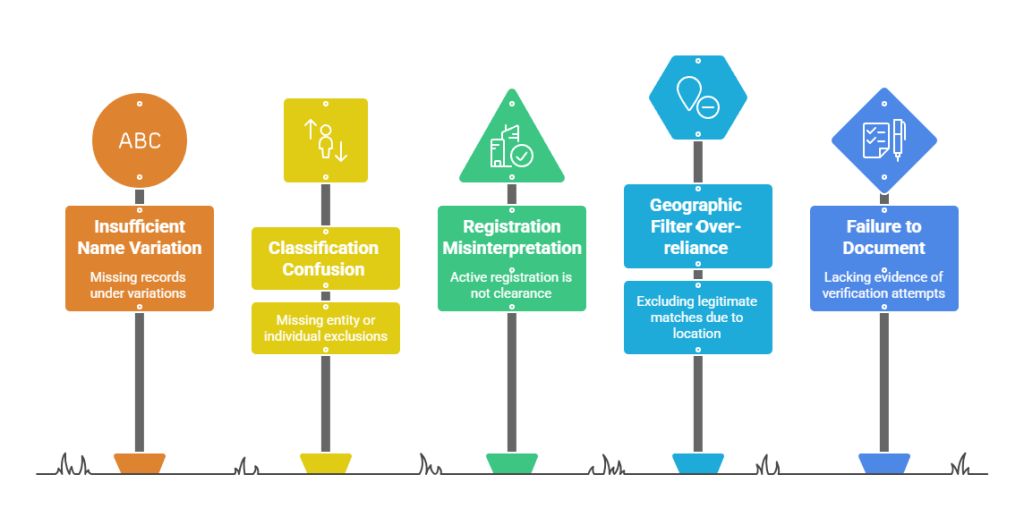
- False negatives from insufficient name variation searches: The most frequent error involves single-name searches missing records under variations. Mitigation requires systematic multi-variation searches following documented protocols. Organizations should develop standard search procedures specifying minimum variation requirementsâÂÂtypically 3-5 name formats for individuals, 2-4 for entities.
- Entity versus individual classification confusion: Users searching only the individual classification miss entity exclusions and vice versa. Comprehensive verification requires both individual searches for the person and entity searches for any businesses they own or control. Small business owners and sole proprietors may appear under either or both classifications.
- Misinterpretation of entity registration as exclusion clearance: The SAM system includes entity registration records for businesses actively pursuing federal contracts alongside exclusion records. Presence of an active entity registration does not confirm non-excluded statusâÂÂexclusion searches require separate verification using exclusion-specific search parameters.
- Geographic filter over-reliance creating false clearances: Filtering searches by state or ZIP code improves disambiguation for common names but risks excluding legitimate matches if the subject moved or used multiple addresses. Initial broad geographic searches followed by progressive narrowing provide better coverage than narrow initial parameters.
- Failure to document search methodology and results: Compliance audits and disputes require evidence of verification attempts, search parameters, and results obtained. Organizations should maintain search documentation including dates, search terms, filters applied, and screen captures of results pages.
Integrating SAM Screening into Background Check Workflows
Federal exclusion verification functions most effectively when incorporated systematically into existing hiring and vendor management processes. Strategic integration points balance compliance assurance against operational efficiency.
Pre-Employment Screening Integration
Organizations should position SAM verification at two critical pre-employment checkpoints to balance efficiency with compliance certainty. Initial screening during resume review identifies obvious exclusions before investing interview resources, while final verification immediately before offer extension confirms continued eligibility addressing lag between initial screening and hiring decisions. This dual-checkpoint approach prevents wasted recruiting effort on ineligible candidates while ensuring current status before employment commitment.
Key integration points:
- Resume review stage for preliminary exclusion screening
- Final offer stage for definitive verification
- Concurrent processing with criminal background checks
- Earlier timing for security clearance positions
Organizations typically position SAM checks alongside criminal background checks in the final pre-employment screening phase, enabling concurrent processing through background screening vendors offering SAM verification services. Automated integration with applicant tracking systems triggers SAM searches upon candidate advancement to final hiring stages.
Vendor and Subcontractor Onboarding
Prime contractors bear responsibility for subcontractor and vendor eligibility verification throughout the contracting relationship. Verification at vendor qualification establishes baseline eligibility, pre-execution searches confirm current status before subcontract signing, and periodic monitoring detects post-award exclusions. Organizations should incorporate SAM clearance requirements into master subcontract agreements and purchase order terms creating contractual verification obligations.
- Initial qualification: During vendor qualification process
- Pre-execution: Before subcontract execution
- Ongoing monitoring: Monthly or quarterly automated reverification
- Contractual requirements: SAM clearance terms in agreements
- Vendor certifications: Non-excluded status representations in proposals
Vendor management systems increasingly include automated SAM verification functionality monitoring supplier exclusion status continuously. Monthly or quarterly automated reverification provides practical compromise between continuous monitoring and resource constraints.
Periodic Re-Verification Schedules
Initial hire verification may provide insufficient ongoing assurance for high-risk positions or long-term contracts, as exclusions can occur any time during employment. Organizations should evaluate reverification needs based on contract requirements, position sensitivity, and risk tolerance, establishing schedules that balance compliance assurance against operational resources. Common approaches include annual reverification for all federal contractor personnel, event-triggered searches following adverse actions or performance issues, and random sampling programs verifying workforce percentages quarterly.

- Annual reverification: Baseline schedule for all personnel
- Event-triggered searches: Following adverse actions or issues
- Random sampling: Quarterly verification of workforce percentage
- Clearance alignment: Sync with security reinvestigation cycles
- Automated monitoring: Continuous verification services
Contracts requiring security clearances or facility access badges often mandate periodic reinvestigation including SAM verification. Organizations should align SAM reverification schedules with existing periodic investigation requirements to minimize redundant processing.
Creating Documentation and Audit Trails
Federal contract audits and suspension or debarment proceedings may require organizations to demonstrate reasonable exclusion verification efforts. Comprehensive documentation proves due diligence and supports defenses against negligent hiring or vendor management claims. Essential documentation elements include search date and time, searched name variations, search parameters and filters applied, complete search results including negative results, and name of individual conducting search.
- Search details: Date, time, parameters, filters, results
- Screen captures: Visual evidence of search result pages
- Tracking databases: Centralized verification record systems
- HRIS integration: Connection with personnel management systems
- Retention compliance: Minimum three-year record maintenance
Organizations should develop verification tracking databases recording all searches performed, results obtained, and follow-up actions taken. These systems enable compliance reporting, audit response, and trend analysis identifying verification gaps or process failures.
Systematic integration at strategic workflow points ensures consistent verification while minimizing operational disruption and creating defensible audit trails demonstrating compliance diligence.
Federal Contractor Screening Best Practices Beyond SAM
Comprehensive federal contractor screening extends beyond SAM verification to encompass additional databases and verification processes addressing related compliance obligations.
Multi-Database Screening Approaches
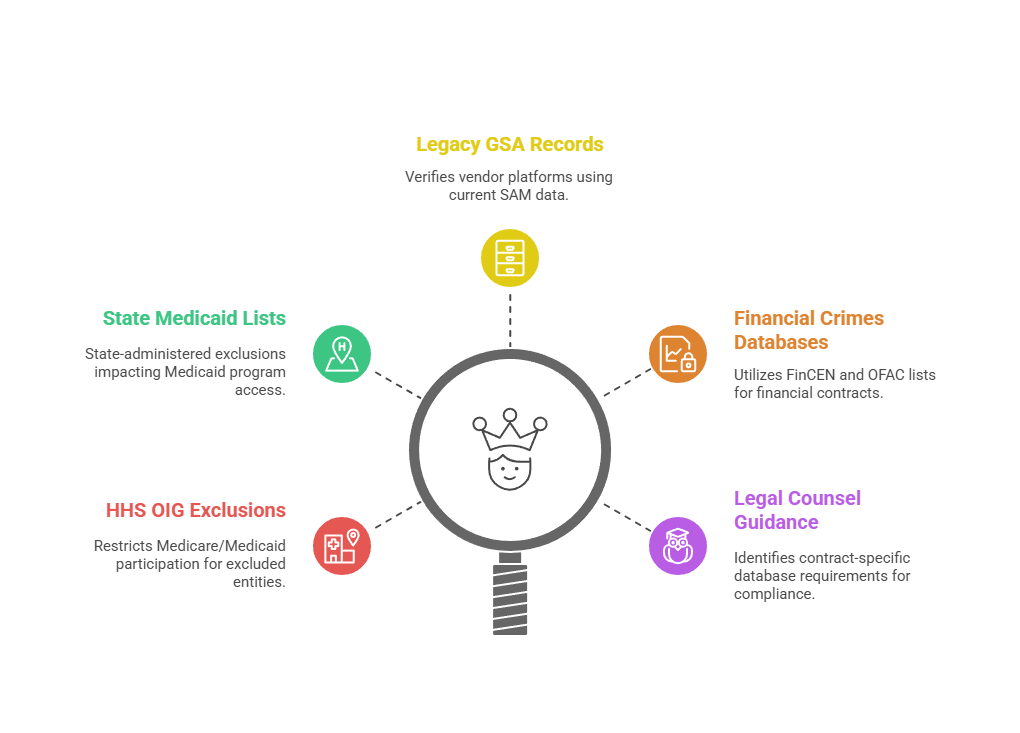
- HHS OIG healthcare exclusions: Medicare/Medicaid program participation restrictions
- State Medicaid lists: State-administered program exclusions
- Legacy GSA records: Verify vendor platforms query current SAM data
- Financial crimes databases: FinCEN 314(a) and OFAC lists for financial contracts
- Legal counsel guidance: Identification of contract-specific database requirements
Security Clearance Coordination
Security clearance investigations undergo extensive government review but operate on different criteria and timeframes than SAM verification. Organizations should conduct independent SAM verification even for cleared personnel, particularly given clearance investigation lags and reinvestigation cycles ranging from five to ten years. An individual granted clearance nine months ago may have received SAM exclusion in intervening months requiring immediate action.
- Independent verification: SAM checks regardless of clearance status
- Different criteria: Clearances address security risk vs. contracting eligibility
- Timing gaps: Exclusions may occur between clearance cycles
- FSO coordination: Facility security officer guidance on verification timing
Facility security officers can provide guidance on verification timing and integration with clearance processing to avoid wasted costs for obviously ineligible candidates.
Developing Internal Exclusion Policies
Organizations should establish written policies governing screening frequency, covered personnel categories, remediation procedures, and documentation requirements. Policies provide operational consistency, audit defensibility, and clear communication to workforce and vendors regarding expectations. Policy elements should address which positions require SAM verification, specify remediation procedures when searches identify exclusions, and define training requirements ensuring HR personnel understand screening obligations and procedures.
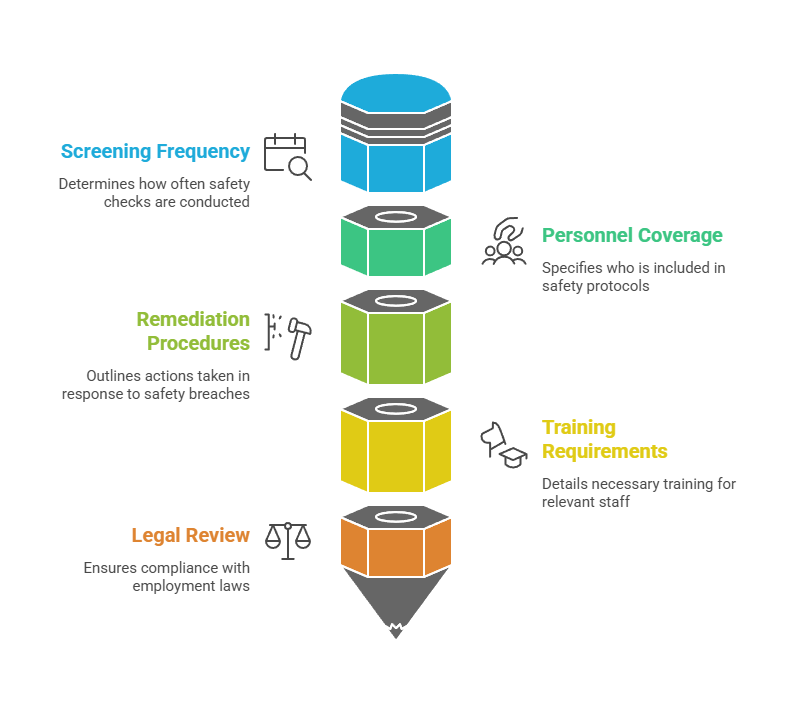
- Screening frequency: Annual, event-triggered, or continuous monitoring
- Personnel coverage: All federal workers vs. key personnel only
- Remediation procedures: Suspension, alternative assignment, or termination
- Training requirements: HR, hiring managers, procurement staff
- Legal review: Counsel approval of employment law compliance
Legal counsel should review policies for employment law and contractual obligation consistency before implementation and dissemination.
Organizations should prioritize SAM verification as the baseline federal screening requirement, then layer additional databases based on specific contract requirements and agency mandates identified through legal counsel review.
Time-Saving Strategies for High-Volume Screening
Background screening vendors increasingly incorporate SAM verification into comprehensive screening packages, conducting searches, interpreting results, and delivering formatted reports through standardized interfaces integrating with client systems. These services eliminate manual SAM navigation while providing expert result interpretation and compliance support. Service evaluation should assess search methodology, update frequency, result accuracy, and reporting format to ensure vendors conduct multi-variation name searches rather than single-query lookups vulnerable to false negatives.
- Comprehensive packages: SAM verification with other background checks
- Multi-variation searches: Automatic name variation processing
- Real-time synchronization: Daily or immediate database updates
- Pricing models: Per-search fees vs. unlimited subscription services
- System integration: API connections with HR and procurement platforms
Pricing models vary from per-search fees to subscription services including unlimited verifications, with per-search pricing benefiting low-volume users while subscriptions offer savings for organizations conducting dozens of monthly verifications.
Handling Positive Matches and Ambiguous Results
Exclusion discoveries or uncertain search results require structured response procedures balancing legal compliance, operational continuity, and individual fairness.
Investigative Procedures for Potential Matches
Search results returning names similar to searched individuals require careful disambiguation before concluding positive matches. Organizations should not immediately assume common name matches indicate excluded status without corroborating evidenceâÂÂ"John Smith" searches may return dozens of exclusion records requiring individual evaluation.
Investigation procedures should request candidates provide additional identifying information supporting or refuting potential matches. Confirmation factors include address history matches, birth year consistency if available through other records, known business entity affiliations, and timeline plausibility given career history. When exclusion record details closely match candidate information but absolute confirmation remains elusive, legal counsel should guide decision frameworks addressing uncertain situations balancing compliance risk against false positive consequences.
Employee Notification and Due Process
Fair Credit Reporting Act requirements may govern how organizations communicate adverse information depending on verification methods employed. Organizations conducting direct SAM.gov searches typically do not trigger FCRA obligations, though using third-party screening services for SAM verification generally requires FCRA compliance. Legal counsel should clarify applicable requirements based on specific verification approach.
Best practices include providing written notice of potential exclusion matches before adverse employment actions, supplying copies of relevant SAM records to affected individuals, allowing reasonable time periods for individual response, and documenting investigation efforts and conclusions. Organizations should consult legal counsel regarding appropriate remediation measures including alternative assignment, suspension, or termination based on exclusion circumstances and employment agreements. Contractual obligations to federal clients may require immediate personnel removal from contract performance regardless of internal policy preferences.
Conclusion
SAM exclusion database search capability represents an essential compliance competency for HR professionals supporting federal contracting operations. Effective verification requires understanding the system's structure and limitations, implementing systematic search protocols addressing common error sources, and integrating screening into existing background check workflows at strategic points throughout hiring and vendor management processes.
Frequently Asked Questions
The following frequently asked questions are aimed at covering common concerns related to requirements, timelines, and best practices that are addressed in this article. Answering these concerns will help in achieving clarity and avoiding ambiguity.
How often should organizations conduct SAM exclusion database searches for current employees?
Organizations should evaluate reverification needs based on contract requirements, position sensitivity, and risk tolerance. Annual reverification provides reasonable assurance for most federal contractor personnel, with more frequent verification for high-risk positions involving sensitive information or facility access. Event-triggered searches should occur following adverse actions, criminal charges, or performance issues that might trigger exclusion proceedings. Automated continuous monitoring services provide optimal protection by detecting exclusions within 24-48 hours of database updates, enabling immediate response before contract performance issues arise.
What should organizations do if they discover a current employee appears in the SAM exclusion database?
Organizations should consult legal counsel immediately upon discovering potential employee exclusions to determine appropriate interim measures, which typically include suspension from federal contract work pending investigation into whether the exclusion record matches the employee and remains active. Specific actions should consider employment agreements, applicable labor laws, and contract requirements, including notifying the contracting officer if required by contract terms, investigating whether mistaken identity explains the match, determining if alternative non-federal assignment is feasible, and evaluating termination necessity based on exclusion circumstances and policy requirements. Documentation of investigation steps and decisions proves critical for potential audits or legal challenges.
Does passing a federal background investigation or receiving a security clearance eliminate the need for SAM exclusion verification?
NoâÂÂsecurity clearances and background investigations serve different purposes than SAM exclusion verification, and organizations must conduct independent SAM searches regardless of clearance status. Background investigations examine criminal history, financial records, and personal conduct to assess security risk, while SAM exclusions reflect administrative determinations of federal contracting ineligibility that may post-date clearance grants. Organizations should conduct SAM verification before sponsoring individuals for clearances to avoid wasting processing costs on ineligible candidates.
Can organizations use free SAM.gov searches or must they purchase commercial screening services?
Organizations may use free SAM.gov manual searches for individual verification, though commercial screening services provide advantages including automated multi-variation name searches reducing false negatives, continuous monitoring alerting to new exclusions affecting existing workforce, formatted reports integrating with existing background check results, and expert interpretation of ambiguous results and complex exclusion classifications. Smaller organizations conducting occasional searches typically find manual SAM.gov verification sufficient, while high-volume screening operations benefit substantially from commercial service integration.
How do organizations verify SAM exclusion status for international contractors or foreign nationals?
International individuals and foreign entities appear in SAM exclusion records if federal agencies have issued exclusion determinations, regardless of citizenship or business formation jurisdiction. Search procedures remain identicalâÂÂorganizations should search individual names and entity names using available information. Foreign address formats and name conventions from non-English-speaking countries may complicate searches, requiring transliteration variations and attention to name order differences. Organizations should consult legal counsel regarding verification obligations for international personnel given varying contract requirements and jurisdictional considerations.
What is the difference between SAM exclusions and OIG healthcare exclusions?
SAM exclusions restrict federal contracting eligibility across government agencies and result from procurement-related violations, while OIG exclusions specifically prohibit Medicare and Medicaid program participation resulting from healthcare-specific violations. Healthcare contractors must verify both systems since individuals may appear on one list but not the other depending on violation type. Some violations trigger both SAM and OIG exclusions, while others affect only one system. Organizations should identify which exclusion types affect their specific contracts and verify all applicable databases.
How long do organizations need to retain SAM verification documentation?
Organizations should retain SAM verification records for at least three years after final payment on contracts where verified individuals performed work, consistent with standard federal contract record retention requirements under FAR 4.7, though longer retention may be necessary if contracts involve claims, disputes, litigation, or state law requirements. Organizations should consult legal counsel regarding specific retention obligations under applicable regulations and contract terms that may exceed federal minimums.
Additional References
- Federal Acquisition Regulation Subpart 9.4 - Debarment, Suspension, and Ineligibility
https://www.acquisition.gov/far/subpart-9.4 - General Services Administration SAM.gov User Guide
https://www.fsd.gov/gsafsd_sp - SHRM Federal Contractor Compliance Resources
https://www.shrm.org/topics-tools/employment-law-compliance/federal-contractor-compliance - Department of Defense Suspension and Debarment Procedures
https://www.esd.whs.mil/DD/ - HHS Office of Inspector General Exclusions Program
https://oig.hhs.gov/exclusions/

ABOUT THE CREATOR
GCheck Editorial Team
Meet the GCheck Editorial Team, your trusted source for insightful and up-to-date information in the world of employment background checks. Committed to delivering the latest trends, best practices, and industry insights, our team is dedicated to keeping you informed.
With a passion for ensuring accuracy, compliance, and efficiency in background screening, we are your go-to experts in the field. Stay tuned for our comprehensive articles, guides, and analysis, designed to empower businesses and individuals with the knowledge they need to make informed decisions.
At GCheck, we're here to guide you through the complexities of background checks, every step of the way.