

Motor vehicle record regulations vary significantly across 46 states with distinct reporting standards, creating complex compliance obligations for employers screening drivers in 2026. Recent legislative trends toward enhanced driver privacy and expanded automatic sealing provisions have altered employer access requirements, data retention periods, and Driver's Privacy Protection Act interpretation. This guide equips HR professionals with actionable frameworks for implementing legally compliant MVR screening programs across multiple state jurisdictions.
Key Takeaways
- State-specific MVR laws govern employer access to driving records, with 46 states maintaining distinct reporting standards that directly impact hiring decisions.
- Recent state legislative trends toward automatic record sealing generally restrict employer access to certain traffic violations after specified timeframes, with exceptions for specific role types.
- Emerging commercial driver privacy protections in several states may limit how employers use MVR data for positions where driving is not a primary job function.
- The Driver's Privacy Protection Act establishes federal baseline requirements, but state laws frequently impose stricter limitations on permissible uses.
- Employers managing multi-state workforces typically must comply with MVR laws in every jurisdiction where employees operate vehicles for work purposes.
- Lookback periods for violations vary by state, generally ranging from 3 to 10 years for standard reporting and longer for serious violations.
- Written consent requirements differ substantially across states, with some mandating separate MVR-specific authorization forms.
- Continuous monitoring programs must account for state-specific restrictions on frequency, notification requirements, and permissible adverse action triggers.
Understanding Motor Vehicle Records and Legal Frameworks
What Are Motor Vehicle Records and Why They Matter
Motor vehicle records are official documents maintained by state Departments of Motor Vehicles that chronicle an individual's driving history. These records include license classifications, traffic violations, accidents, suspensions, revocations, DUI convictions, and accumulated penalty points. Employers use MVR data as a risk management tool when evaluating candidates for positions involving vehicle operation.
Comprehensive MVR reviews help organizations assess safety risks, ensure adequate insurance coverage, meet regulatory compliance obligations, and protect against negligent hiring liability. The importance of MVR screening has intensified with expanded delivery services, ride-sharing platforms, and remote work arrangements that blur geographic boundaries. Additionally, organizations face complex compliance challenges when employees drive across state lines or relocate while maintaining employment.
The Federal Foundation: Driver's Privacy Protection Act
The Driver's Privacy Protection Act of 1994 establishes federal baseline protections for personal information in motor vehicle records. Codified at 18 U.S.C. §§ 2721-2725, the DPPA restricts state DMVs from disclosing personal information without driver consent, subject to 14 enumerated permissible use exceptions. For employment purposes, Section 2721(b)(3) allows disclosure for use by government agencies or private entities acting on their behalf.
However, the DPPA establishes a floor, not a ceiling, for privacy protections. State laws may impose additional restrictions, consent requirements, or limitations beyond federal minimums. This creates a compliance landscape where employers generally must satisfy both federal DPPA standards and more stringent state-specific regulations. The DPPA also distinguishes between highly restricted personal information (photographs, Social Security numbers, medical data) and other MVR data, with enhanced protections for sensitive categories.
State-Specific MVR Access and Reporting Standards
Geographic Variation in MVR Regulations
While all 50 states maintain motor vehicle records, 46 jurisdictions have enacted distinct frameworks governing employer access and reporting limitations. These state motor vehicle record laws create substantial variation in what information appears on records, how long violations remain reportable, and restrictions on employment decisions. Recent legislative trends have significantly altered the compliance landscape for employers conducting MVR screening.
Several states have enacted fair chance provisions that prohibit employers from considering records that have been judicially sealed, dismissed, or statutorily eradicated. Recent legislative developments have expanded automatic record sealing to certain traffic violations after completion of court requirements and specified waiting periods. This may affect what employers can lawfully consider during MVR reviews, depending on the specific role and applicable exceptions.
State individualized assessment requirements mandate evaluation of factors such as offense nature, time elapsed since conviction, evidence of rehabilitation, and specific job duties before denying employment based on driving record information. Emerging commercial driver privacy protections in several jurisdictions may limit employer use of MVR data for certain positions that do not involve regular vehicle operation as a primary job duty, subject to specific statutory requirements and exceptions. Some states restrict MVR requests to positions with documented driving requirements and prohibit blanket screening for all applicants.
Consent and Authorization Requirements by State
State consent procedures for obtaining motor vehicle records diverge significantly across jurisdictions. Some accept general background check authorization, while others mandate separate MVR-specific consent forms with prescribed disclosure language. Understanding these requirements prevents compliance violations and ensures legally defensible screening processes.
The following table provides general guidance on consent framework variations as of January 2026. State requirements are subject to change through legislation, regulation, or judicial interpretation. Employers should consult with legal counsel and verify current requirements in applicable jurisdictions before implementing screening protocols.
| State | Consent Type | General Considerations (Verify Current Requirements) |
| California | Separate MVR authorization recommended | Generally should specify scope and purpose of record request |
| Massachusetts | Separate written authorization typically required | Certification to Registry that information used only for driving positions |
| Colorado | Separate consent under Consumer Protection Act | Clear, conspicuous disclosure typically required |
| Florida | General authorization acceptable with enhanced disclosure | Should explain relationship between MVR data and job duties |
| New York | General authorization acceptable | No separate MVR-specific form typically mandated under state law |
| Oregon | Separate authorization recommended | Generally must provide copy of MVR before adverse action |
| Washington | Separate authorization recommended | Should explain how MVR influenced employment decision |
| Texas | General authorization acceptable | Standard FCRA disclosure typically satisfies state requirements |
Employers operating across multiple states should implement consent procedures satisfying the most restrictive requirements across all applicable jurisdictions. This approach ensures consistent application of screening criteria and minimizes inadvertent violations.
Lookback Periods and Reporting Limitations
State motor vehicle record laws establish varying lookback periods determining how long violations remain visible to employers. These timeframes significantly impact risk assessment capabilities and create compliance obligations to avoid considering information beyond permissible reporting windows. Understanding jurisdiction-specific limitations prevents unlawful use of aged violation data.
Standard traffic violations typically remain on state MVRs for approximately 3 to 5 years in most jurisdictions. States generally maintain reporting periods of 3-4 years for most violations, though specific timeframes may vary by violation type and statutory updates. Major violations such as DUI convictions, reckless driving, and license suspensions remain reportable for substantially longer periods, often permanently with designations as "historical" after specified timeframes.
Accident information presents particular complexity because states differ on fault determinations and reporting thresholds. Some jurisdictions report all accidents regardless of fault for specified periods (often 3-5 years). Others limit reporting to at-fault accidents or exclude accidents below certain damage thresholds. Commercial driver license holders face enhanced record retention under federal Motor Carrier Safety Administration regulations that may supersede some state limitations.
Recent Legislative Trends Affecting MVR Compliance
Expanded Automatic Sealing Provisions
Several states have enacted or expanded automatic record sealing frameworks for certain traffic violations in recent years. This legislation typically addresses infractions where individuals completed court-ordered requirements, paid fines, and maintained violation-free records for specified periods. These new frameworks fundamentally alter what driving record information remains accessible to employers conducting MVR screening.
Qualifying traffic violations may be automatically sealed after completion timeframes ranging from 3 to 5 years, depending on violation severity and state-specific provisions. Once sealed, these records typically are not accessible through standard MVR requests. Applicants generally have no legal obligation to disclose sealed violations during hiring processes. Employers cannot lawfully consider sealed information in employment decisions where sealing provisions apply.
These changes require employers to update MVR screening protocols to account for potentially incomplete driving histories. Organizations must implement processes to verify that position-specific safety requirements can be satisfied despite limited lookback visibility. Sealing provisions typically contain exceptions for positions requiring commercial driver licenses, public safety roles, and employment with transportation network companies subject to regulatory oversight.
Commercial Driver Privacy Protections
Recent legislative trends in several states have established enhanced privacy protections for commercial drivers and restrictions on employer MVR use. These laws may require employers to demonstrate a direct, substantial relationship between driving record information and essential job functions before using MVR data in employment decisions. This legislation responds to concerns about potential discrimination based on driving records for roles with minimal vehicle operation requirements.
Employers in jurisdictions with enhanced privacy protections should conduct position-specific analyses to determine whether MVR screening is legally justified based on driving duty frequency, nature, and criticality. Emerging frameworks may include the following key requirements, among others:
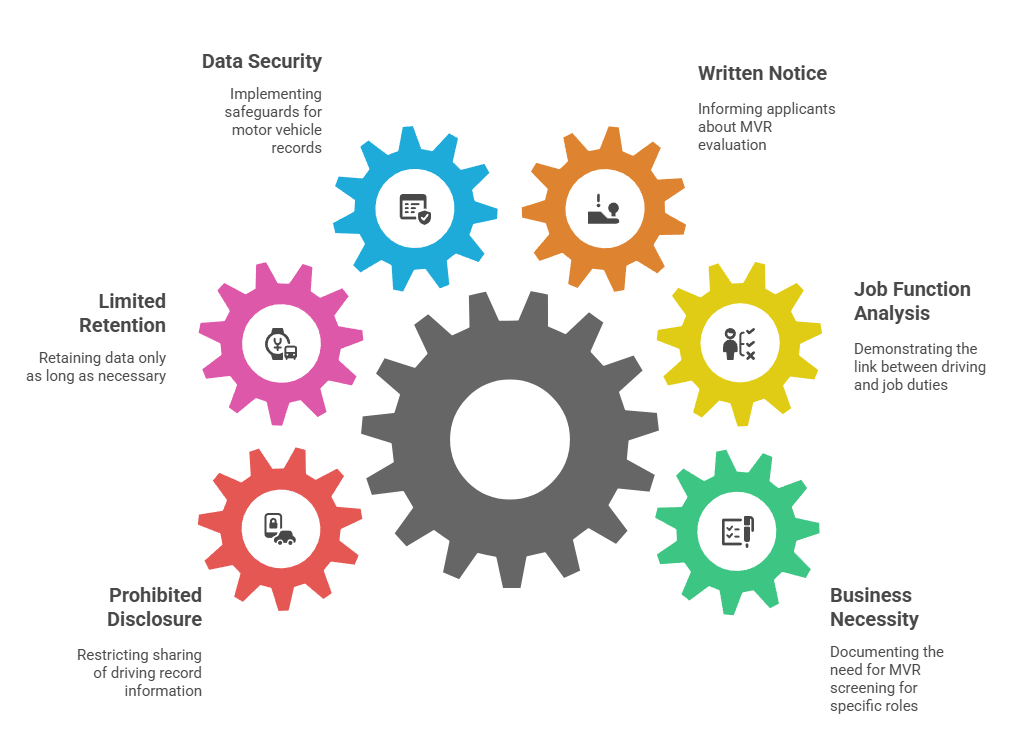
- Business Necessity Documentation: Employers may need to document why MVR screening is necessary for the specific position.
- Job Function Analysis: Organizations should maintain records demonstrating the relationship between driving requirements and job duties.
- Written Notice to Applicants: Employers may need to explain how driving record information will be evaluated in hiring decisions.
- Enhanced Data Security: Specific technical safeguards may be mandated for entities accessing motor vehicle records.
- Limited Data Retention: Information typically should be retained only as long as reasonably necessary for employment purposes.
- Prohibited Unauthorized Disclosure: Sharing or re-using driving record information obtained for employment verification may be restricted.
Positions involving regular company vehicle operation, passenger or goods transportation, or driving as a primary job function typically remain subject to full MVR screening without additional justification. However, roles with occasional or incidental driving may require careful analysis before implementing MVR screening protocols.
Multi-State Compliance for Remote and Mobile Workforces
The proliferation of remote work arrangements has created unprecedented MVR compliance challenges for employers. When employees relocate across state lines while maintaining employment or perform duties requiring driving in multiple jurisdictions, organizations must navigate competing state laws. This complexity requires sophisticated compliance frameworks accounting for overlapping regulatory requirements.
Employers typically should consider compliance with MVR laws in multiple jurisdictions, which may include:
- State where employee is licensed: The jurisdiction issuing the driver's license maintains the official motor vehicle record and governs access procedures.
- State where driving occurs: Jurisdictions where employees operate vehicles for work purposes may impose their own restrictions on employer use of MVR data.
- State where employment decisions are made: The location of the employer's decision-making authority may trigger additional compliance obligations under local privacy laws.
A California-based company hiring a remote worker licensed in Texas who drives for work in Arizona should generally plan to satisfy the most restrictive requirements across applicable jurisdictions, subject to specific facts and legal analysis. Several states have enacted provisions specifically addressing multi-state employment scenarios, extending certain privacy protections to residents employed by out-of-state companies.
Implementing Compliant MVR Screening Programs
Establishing Position-Specific Driving Requirements
Legally defensible MVR screening programs begin with thorough job analysis to identify positions genuinely requiring driving as an essential function. This analysis protects against discrimination claims, ensures compliance with state laws restricting unnecessary screening, and focuses resources on positions presenting actual driving-related risks. Organizations must differentiate between essential driving positions, occasional driving roles, and positions with minimal vehicle operation requirements.
Position categories typically require different screening approaches:
- Essential Driving Positions: Roles where vehicle operation consumes significant work time, represents a primary duty that cannot be reassigned, or involves specialized licensing.
- Occasional Driving Positions: Employees who drive company or personal vehicles with some regularity but where driving is not a primary function.
- Minimal Driving Positions: Roles with infrequent or incidental vehicle operation that could potentially be accommodated through alternative arrangements.
For positions with minimal driving requirements, employers should generally avoid MVR screening unless specific business necessity or regulatory obligations exist. Using driving record information for non-driving roles may create potential discrimination liability and could violate state privacy protections or fair hiring laws.
Developing State-Specific Screening Protocols
Organizations operating across multiple states must develop jurisdiction-specific screening protocols accounting for varying requirements. This necessitates maintaining current knowledge of MVR laws in all states where employees are licensed or perform driving duties. Compliance frameworks should identify the most restrictive requirements and implement procedures satisfying heightened standards in all locations. Written MVR screening policies typically should address several key elements, which may include:
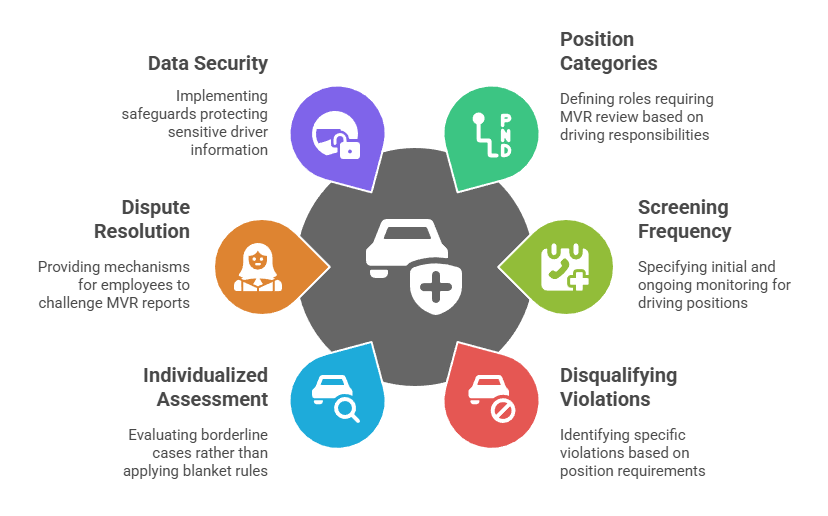
- Position Categories Subject to Screening: Define which roles require MVR review based on documented driving responsibilities.
- Screening Frequency: Specify initial pre-employment screening and any ongoing monitoring for existing employees in driving positions.
- Disqualifying Violations: Identify specific violations that may raise concerns based on position requirements and safety considerations.
- Individualized Assessment Procedures: Establish processes for evaluating borderline cases rather than applying blanket disqualification rules.
- Dispute Resolution Processes: Provide mechanisms for employees to challenge MVR report accuracy or present mitigating circumstances.
- Data Security and Retention: Implement safeguards protecting sensitive driver information and limiting retention to necessary timeframes.
Employers should establish partnerships with reputable sources accessing motor vehicle records through legally authorized channels. Direct state DMV access, authorized resellers certified by state agencies, or consumer reporting agencies operating under FCRA requirements represent the primary compliant channels.
Individualized Assessment and Adverse Action Procedures
When motor vehicle records reveal violations raising concerns about candidate suitability, employers typically should conduct individualized assessments rather than applying blanket disqualification rules. This approach aligns with Equal Employment Opportunity Commission guidance, state fair chance laws, and negligence principles. Organizations must connect specific record information to actual job-related risks through documented analysis.
The following table provides general considerations for illustrative purposes only. Actual assessment decisions must be based on position-specific requirements, applicable laws, individualized circumstances, and consultation with legal counsel. This table does not constitute legal advice or guarantee compliant decision-making.
| Violation Type | Assessment Factors | Potential Considerations (Not Exhaustive) |
| Single Speeding Ticket (3+ years ago) | Time elapsed, position driving requirements, violation severity | May not necessarily disqualify for some occasional driving roles, depending on circumstances |
| Multiple Minor Violations (within 2 years) | Pattern of behavior, accumulated points, position risk profile | Enhanced supervision, restricted routes, probationary monitoring may be options |
| DUI Conviction (5+ years ago) | Completion of treatment programs, subsequent clean record, evidence of rehabilitation | May warrant consideration for some non-commercial roles with strong rehabilitation evidence |
| Recent Reckless Driving | Circumstances of incident, position safety sensitivity, insurance implications | May raise significant concerns for safety-sensitive and commercial driving positions requiring further analysis |
| License Suspension (administrative) | Reason for suspension (non-payment vs. safety violation), current license status | Underlying cause evaluation important; may not disqualify if unrelated to driving safety |
| At-Fault Accidents (multiple) | Fault determinations, injury severity, time between incidents | Significant concern for any driving role; individualized assessment required |
When employers decide to take adverse action based on MVR information obtained through consumer reporting agencies, they must follow FCRA's two-step process. First, provide a pre-adverse action notice with a copy of the report and summary of rights, allowing reasonable time for dispute. Second, issue final adverse action notice after dispute resolution. State laws may impose additional notice requirements beyond FCRA mandates.
Special Considerations for Continuous Monitoring
Ongoing MVR Monitoring Programs
Many organizations implement continuous MVR monitoring to identify driving record changes for employees in safety-sensitive positions. These programs automatically notify employers when license suspensions, serious violations, or other significant events occur. However, state motor vehicle record laws impose varying requirements and restrictions on continuous monitoring practices that organizations must understand.
Continuous monitoring authorization requirements vary by state. Some jurisdictions allow ongoing monitoring based on initial consent with proper disclosure of the monitoring program. Others may require periodic re-authorization. Employers should review state-specific requirements and clearly communicate monitoring practices, frequency, and potential employment consequences to employees in writing. Federal Motor Carrier Safety Regulations require annual MVR review for interstate commercial drivers, which may supersede some state limitations for covered commercial drivers.
Employment Actions Based on Post-Hire Driving Record Changes
When continuous monitoring reveals new violations, accidents, or license issues for existing employees, employers must carefully navigate employment law obligations extending beyond initial hiring decisions. Termination or discipline based on driving record changes implicates wrongful discharge protections, disability accommodation obligations, and state restrictions on at-will employment. Organizations need clear policies specifying review triggers while allowing individualized consideration.
Employers should consider maintaining written policies identifying events that may trigger review, such as:
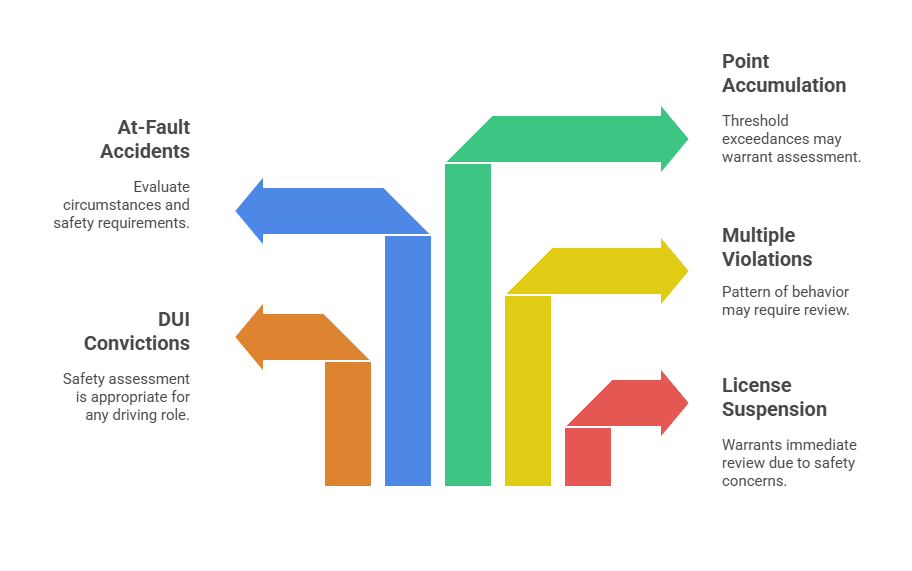
- License suspension or revocation: Typically warrants immediate review, though underlying reason may be relevant.
- DUI convictions: Safety assessment generally appropriate for any driving position.
- Multiple serious violations: Pattern of behavior within specified timeframes may warrant review.
- At-fault accidents: Evaluation of circumstances and position-specific safety requirements.
- Point accumulation: Threshold exceedances under state penalty systems may warrant assessment.
License suspension presents particular complexity because suspensions may result from factors unrelated to driving safety, such as unpaid parking tickets or child support obligations. Some states prohibit employment discrimination based on license suspensions arising from inability to pay fines or fees. Employers should evaluate the underlying suspension reason before taking adverse action. When driving record changes raise concerns but do not automatically disqualify employees under company policy, explore whether reasonable accommodations such as temporary non-driving duty reassignment, alternative transportation with supervision, or enhanced training interventions may be feasible.
Privacy, Data Security, and Record Retention Requirements
Protecting Sensitive Driver Information
Motor vehicle records contain substantial personal information protected under federal DPPA requirements and state privacy laws. Employers accessing MVR data assume legal obligations to implement appropriate safeguards preventing unauthorized disclosure. Access controls should restrict MVR data to personnel with legitimate business need, including HR compliance staff, hiring managers for positions requiring driving, risk management professionals overseeing fleet safety, and legal counsel addressing employment matters.
Physical security measures for paper MVR reports should include locked storage, controlled access environments, and secure disposal through cross-cut shredding or certified destruction services. Electronic MVR data requires encryption during transmission and storage, access logging to track who views records, and technical controls preventing unauthorized copying or distribution. Several states have enacted enhanced data security requirements specifically for motor vehicle record information, with provisions addressing driving record data and data minimization obligations limiting collection to information reasonably necessary for identified purposes.
MVR Data Retention and Disposal Obligations
Employers must establish record retention policies for motor vehicle records balancing legitimate business needs, litigation preparedness, regulatory requirements, and privacy principles favoring minimal retention. Indefinite retention creates unnecessary privacy risks and may violate state data minimization requirements. Organizations should implement timeframe-specific retention schedules based on applicant versus employee status.
Retention considerations typically include:
- Applicants Not Hired: MVR records often should be retained for 1-3 years to defend against potential discrimination claims, consistent with applicable statutes of limitations and EEOC recordkeeping requirements, though specific circumstances and legal requirements may vary.
- Employees in Driving Positions: Retention typically should continue throughout employment plus the period necessary to address potential employment claims or liability exposure, often 3-7 years post-employment based on state-specific statutes of limitations.
- Commercial Motor Carriers: Federal Motor Carrier Safety Regulations require retention of driver qualification files, including MVR documentation, for 3 years after driver employment ends.
Disposal of MVR records must ensure complete destruction of personal information through cross-cut shredding for paper documents, secure electronic deletion with overwriting to prevent recovery, or certified destruction services providing documentation. Disposal logs documenting dates and methods provide evidence of compliance with privacy obligations.
Industry-Specific MVR Requirements

Transportation, Logistics, and Delivery Services
The transportation and logistics sector faces heightened MVR compliance obligations stemming from federal safety regulations, insurance requirements, and substantial liability exposure. Federal Motor Carrier Safety Administration regulations establish comprehensive driver qualification requirements for commercial motor vehicle operators, including initial MVR review and annual monitoring for interstate commercial drivers.
FMCSA standards prohibit commercial vehicle operation by individuals with multiple serious traffic violations, major disqualifying offenses (DUI, leaving accident scenes), or violation patterns indicating traffic law disregard. These federal standards create baseline disqualification rules that typically apply regardless of state law. Insurance carriers providing commercial vehicle coverage often impose their own driver qualification standards as policy conditions, frequently exceeding regulatory minimums. Transportation network companies face state-specific driver screening requirements varying substantially by jurisdiction.
The expansion of delivery services and gig economy platforms has created new driving role categories that blur traditional employment classifications. Many delivery drivers operate as independent contractors rather than employees, affecting the legal framework governing driver screening. However, platforms may face negligent selection liability if reasonably foreseeable harm results from using drivers with disqualifying records. Several states have enacted legislation addressing background screening for gig economy drivers, with requirements for delivery network companies to conduct MVR screening and prohibitions on use of drivers with specified disqualifying violations.
Job Seeker Rights and Guidance
Accessing Your Motor Vehicle Record
Job seekers applying for driving positions should proactively obtain their own motor vehicle records before employers request them. This allows you to identify inaccuracies, understand visible information, and prepare explanations for violations that may raise concerns. Each state provides mechanisms for drivers to request their own MVR through online portals, mail requests, or in-person DMV visits, with fees typically ranging from $5 to $25.
When reviewing your MVR, verify that personal information is accurate, license status is correctly reflected, and violation history matches your actual driving record. If you identify errors, contact the issuing state DMV immediately to initiate correction processes, which typically require supporting documentation such as court records, insurance reports, or identification documents. Resolving inaccuracies before employer screening prevents unnecessary complications.
Understanding Your Rights During MVR Screening
Before obtaining an MVR through a consumer reporting agency, employers must provide clear written disclosure and obtain your written authorization on a standalone document. If an employer decides not to hire you based on your MVR, FCRA requires pre-adverse action notice with a copy of the report and summary of rights, allowing reasonable time to review information and dispute inaccuracies.
You have the right to dispute inaccurate information by contacting the reporting agency and the state DMV providing underlying data. State laws may provide additional rights beyond FCRA requirements, such as requiring employers to provide MVR copies before taking adverse action or explain specifically how driving record information influenced decisions. When your driving record contains violations or incidents, honest disclosure with appropriate context often produces favorable outcomes, focusing on circumstances surrounding incidents, steps taken to address issues, time elapsed demonstrating improved behavior, and commitment to safe driving.
Conclusion
The state-specific landscape of motor vehicle record laws requires employers to implement jurisdiction-aware screening protocols accounting for varying consent requirements, reporting limitations, and privacy protections. Recent legislative trends toward enhanced driver privacy and restrictions on employment use of driving record information reflect ongoing evolution in this regulatory area. Organizations that maintain current compliance knowledge, conduct individualized assessments, and implement appropriate data security measures position themselves to make informed hiring decisions while minimizing legal risk.
Frequently Asked Questions
The following answers provide general information only and do not constitute legal advice. Specific situations may require consultation with legal counsel familiar with applicable jurisdictions and circumstances.
What is the difference between DPPA requirements and state MVR laws?
The Driver's Privacy Protection Act establishes federal baseline privacy protections for motor vehicle record information. State MVR laws may impose additional restrictions on employer access, consent requirements, and permissible uses beyond federal minimums. Employers generally must comply with both federal DPPA standards and any more stringent state-specific requirements that may apply to their operations.
Can employers run MVR checks on all employees?
State laws increasingly restrict MVR screening to positions with documented driving requirements as essential job functions. Blanket screening for all employees regardless of job duties may violate state privacy laws or fair hiring ordinances. Employers typically should limit MVR screening to positions where driving represents a primary or regular job responsibility, consistent with applicable state laws and business necessity requirements.
How long do traffic violations stay on driving records?
Lookback periods vary significantly by state, often ranging from 3 to 7 years for standard moving violations. Serious offenses like DUI convictions often remain reportable for 10 years or permanently, though designated as historical after specified timeframes. Some states now automatically seal certain qualifying violations after completion of court requirements and waiting periods, though specific timeframes may vary by violation type and statutory updates.
Do I need separate consent forms for MVR checks?
Consent requirements vary by state. Some jurisdictions accept general background check authorization encompassing MVR screening. Others mandate separate MVR-specific consent forms with prescribed disclosure language. Employers should verify current requirements in each state where they screen applicants to ensure proper authorization procedures.
What should employers do when an employee's license is suspended?
Employers should review company policies regarding license status requirements and evaluate the reason for suspension to determine if it relates to driving safety concerns. Consider whether temporary accommodations such as non-driving duty reassignment may be feasible, depending on operational requirements and applicable legal obligations. Some states prohibit discrimination based on license suspensions from inability to pay fines rather than safety violations.
Are there different MVR requirements for commercial drivers?
Yes. Federal Motor Carrier Safety Administration regulations impose comprehensive driver qualification standards for commercial motor vehicle operators. These include specific MVR review requirements, annual monitoring obligations, and disqualifying violations that may supersede general state employment law in many respects. Commercial drivers typically face more stringent screening than non-commercial driving positions.
Can employers continuously monitor employee driving records?
Continuous monitoring authorization requirements vary by state. Some jurisdictions allow ongoing monitoring based on initial consent with proper disclosure of the monitoring program. Others may require periodic re-authorization. Employers should review state-specific requirements and clearly communicate monitoring practices, frequency, and potential employment consequences to employees in writing.
What are consequences of using MVR information for non-permissible purposes?
Using motor vehicle record information for purposes not permitted under DPPA or state law can result in civil liability, statutory damages, attorney fees, and regulatory enforcement actions. Employers must limit MVR data use to employment evaluation for positions with driving requirements and implement safeguards preventing unauthorized disclosure or access.
How do remote work arrangements affect MVR compliance?
Employers typically must comply with MVR laws in the state where employees are licensed, where driving occurs for work, and where employment decisions are made. Remote workers who relocate or drive in multiple jurisdictions may trigger compliance obligations in several states simultaneously, requiring employers to satisfy applicable requirements across relevant jurisdictions.
What MVR violations typically disqualify candidates from driving positions?
Disqualifying violations depend on position-specific risk assessment and applicable regulatory requirements. Common concerns include DUI convictions, reckless driving, leaving accident scenes, multiple serious violations within short timeframes, or license suspensions. Employers typically should conduct individualized assessments considering factors such as violation severity, time elapsed, position requirements, and rehabilitation evidence rather than applying blanket disqualification rules, consistent with applicable fair chance laws and EEOC guidance.
Additional Resources
- Driver's Privacy Protection Act - Federal Trade Commission Overview
https://www.ftc.gov/legal-library/browse/statutes/drivers-privacy-protection-act - Federal Motor Carrier Safety Administration - Driver Qualification Files
https://www.fmcsa.dot.gov/regulations/title49/section/391.51 - Equal Employment Opportunity Commission - Background Checks Guidance
https://www.eeoc.gov/laws/guidance/background-checks-what-employers-need-know - National Highway Traffic Safety Administration - State Traffic Safety Information
https://www.nhtsa.gov/state-traffic-safety-information - Federal Trade Commission - Fair Credit Reporting Act
https://www.ftc.gov/legal-library/browse/statutes/fair-credit-reporting-act

ABOUT THE CREATOR
GCheck Editorial Team
Meet the GCheck Editorial Team, your trusted source for insightful and up-to-date information in the world of employment background checks. Committed to delivering the latest trends, best practices, and industry insights, our team is dedicated to keeping you informed.
With a passion for ensuring accuracy, compliance, and efficiency in background screening, we are your go-to experts in the field. Stay tuned for our comprehensive articles, guides, and analysis, designed to empower businesses and individuals with the knowledge they need to make informed decisions.
At GCheck, we're here to guide you through the complexities of background checks, every step of the way.