



Maryland employers must navigate overlapping state ban-the-box timing requirements, Baltimore City's stricter fair chance ordinance, and evolving expungement rules under the Second Chance Act that affect record visibility. Compliance requires jurisdiction-specific timing protocols, understanding which records remain accessible versus legally restricted, and implementing individualized assessment frameworks before making adverse hiring decisions based on criminal history.
Key Takeaways
- Maryland's statewide ban-the-box law prohibits criminal history inquiries until after a conditional job offer for most private employers.
- Baltimore City's fair chance ordinance imposes stricter timing restrictions and additional notice requirements that supersede state law within city limits.
- The Second Chance Act expanded automatic expungement eligibility, making certain records legally inaccessible and unactionable for employment decisions.
- Employers must conduct individualized assessments considering offense nature, time elapsed, and job relevance before denying employment based on criminal records.
- Arrest records without conviction, expunged records, and certain misdemeanor convictions carry specific legal restrictions on employer use.
- Multi-state employers hiring Maryland residents must apply Maryland-specific timing rules and assessment protocols regardless of company headquarters location.
- Written adverse action procedures must include specific notice elements, waiting periods, and documentation to satisfy both FCRA and Maryland state requirements.
- Coordination between HR, legal counsel, and screening vendors is essential to maintain compliance across jurisdictional boundaries and evolving expungement databases.
Understanding Maryland's Multi-Layered Background Check Framework
Maryland's employment screening environment operates through three distinct but interconnected regulatory systems. State-level ban-the-box provisions establish baseline timing restrictions for when employers may inquire about criminal history. Baltimore City maintains a separate municipal ordinance with more stringent requirements that apply to employers operating within city boundaries. Simultaneously, Maryland's expungement and shielding laws determine which records remain legally visible and usable in employment decisions.
This layered structure creates complexity for employers who must identify which rules apply based on hiring location, position type, and record characteristics. The framework does not prohibit background checks entirely but instead regulates timing, permissible inquiries, and decision-making processes.
| Regulatory Layer | Primary Focus | Geographic Scope |
| State Ban-the-Box Law | Timing of criminal history inquiries | Statewide (covered employers) |
| Baltimore City Ordinance | Enhanced timing and assessment requirements | Baltimore City boundaries |
| Expungement/Shielding Laws | Record accessibility and usability | Statewide (all records) |
Employers conducting screening in Maryland must verify current applicability, as requirements vary by jurisdiction, employer size, and industry sector.
Looking at the Maryland hiring process through the HR lens, it makes me realize that it is not just the information we are gathering, but also the timing and judgment involved. With the laws on state, city, and expungement, we cannot take a one-size-fits-all approach to the hiring process. I think the key to the hiring process is the individual assessment, where we take the time to really think about the information, rather than simply reacting to it. When HR creates processes and managers understand the importance of fair chance hiring, it becomes part of the culture, not an afterthought. When it comes to Maryland, it is all about the opportunity and integrity.
State-Level Ban-the-Box Requirements
Maryland law restricts when most private employers may inquire about an applicant's criminal history during the hiring process. The state prohibition generally prevents criminal history questions on initial employment applications and during preliminary interview stages. Employers must wait until after extending a conditional offer of employment before requesting disclosure of criminal records or conducting background checks for most positions.
Key timing requirements include:

- No criminal history questions on initial applications
- No criminal history inquiries during preliminary interviews
- Background checks permitted only after conditional offer extends
- Individualized assessment required before adverse actions
The timing restriction applies to employers with specific employee threshold requirements. Certain industries and position types may have different timing protocols based on regulatory exemptions or legally required pre-employment screening mandates.
Baltimore City's Enhanced Fair Chance Ordinance
Baltimore City maintains a separate fair chance hiring ordinance that imposes requirements beyond state law for employers conducting business within city boundaries. The municipal ordinance applies stricter timing protocols, expanded notice obligations, and specific assessment criteria that supersede state provisions when hiring for positions based in Baltimore.
Employers with operations in multiple Maryland jurisdictions face the challenge of applying different protocols depending on work location. A consistent approach involves applying the most restrictive applicable standard across all Maryland hiring to ensure compliance regardless of specific job site location. However, this requires understanding which provisions differ between state and municipal frameworks and how those differences affect operational screening procedures.
Expungement and Record Shielding Impacts
Maryland's Second Chance Act and related expungement statutes affect which criminal records remain accessible through background checks and legally usable in employment decisions. Expunged records are removed from public databases and generally may not be considered or used as basis for adverse employment actions. Shielded records remain in restricted databases but carry limitations on accessibility and use.
Automatic expungement provisions apply to certain offense categories and timeframes without requiring individuals to petition courts. Expanded eligibility criteria have increased the volume of records subject to expungement, meaning records previously visible to employers may no longer appear in screening results.
Critical implications for employers:
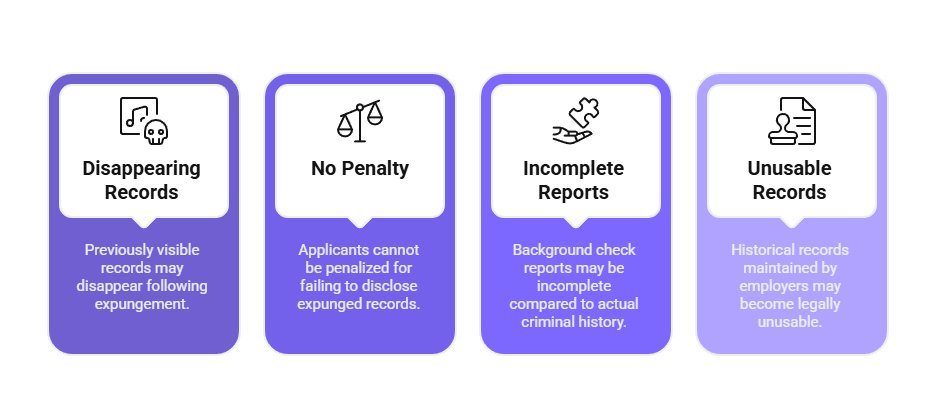
- Previously visible records may disappear following expungement
- Applicants cannot be penalized for failing to disclose expunged records
- Background check reports may be incomplete compared to actual criminal history
- Historical records maintained by employers may become legally unusable
Maryland Ban-the-Box Law Timing and Application
Maryland's ban-the-box provisions establish specific timing protocols that structure when criminal history inquiries may occur during the hiring process. Understanding these timing gates, which employers are covered, and what constitutes permissible versus prohibited inquiry requires detailed attention to statutory language and regulatory guidance.
When Employers Can Ask About Criminal History
Under Maryland's state-level framework, covered employers generally may not inquire about criminal history on initial employment applications or during preliminary screening phases. The statutory trigger point typically occurs after the employer has extended a conditional offer of employment.
A conditional offer represents a preliminary employment decision contingent on satisfactory completion of background screening and other final verification steps. Under Maryland guidance, the offer should be genuine and specific, identifying position, compensation, start date, and material terms, with all discretionary hiring decisions already made. Conditional offers made solely to trigger background check eligibility without actual hiring intent do not satisfy the statutory framework. Employers should consult legal counsel to ensure offer language meets Maryland regulatory expectations.
| Hiring Stage | Criminal History Inquiry | Permitted Actions |
| Application Submission | Prohibited | Skills assessment, experience verification |
| Initial Interview | Prohibited | Job duties discussion, cultural fit evaluation |
| Secondary Interview | Prohibited | Reference checks, work sample tests |
| Conditional Offer Extended | Permitted | FCRA disclosure, authorization request |
| Post-Authorization | Permitted | Background check order, individualized assessment |
Once a conditional offer is extended and criminal history information obtained, employers must follow individualized assessment protocols before withdrawing the offer based on criminal record information.
Covered Employers and Exemptions
Maryland's ban-the-box law generally applies to private employers with 15 or more employees, though employers should verify current applicability thresholds and any amendments with legal counsel or the Maryland Department of Labor. Smaller employers may fall outside statutory coverage, though best practices often suggest voluntary compliance with timing protocols.
Certain employer categories may be partially or fully exempt from timing restrictions based on industry sector or regulatory requirements. Healthcare facilities, financial institutions, and positions requiring specific professional licenses may have different frameworks based on federal or state regulations mandating pre-employment criminal history screening.
Government contractors and federally regulated entities must reconcile Maryland state timing requirements with federal screening mandates. When conflicts arise between federal requirements and state timing restrictions, employers should document the applicable federal provision and seek guidance on compliance approaches that satisfy both frameworks where possible.
Application Form and Interview Restrictions
Maryland's framework prohibits including criminal history questions on employment applications for covered positions during the initial application phase. This restriction extends to questions about arrests, convictions, charges, and criminal case involvement.
Employers must review application forms, online application systems, and preliminary screening questionnaires to ensure compliance. During initial interviews conducted before conditional offer stage, interviewers may not ask candidates about criminal history. This prohibition applies regardless of whether the candidate voluntarily raises the topic.
Prohibited inquiry areas include:
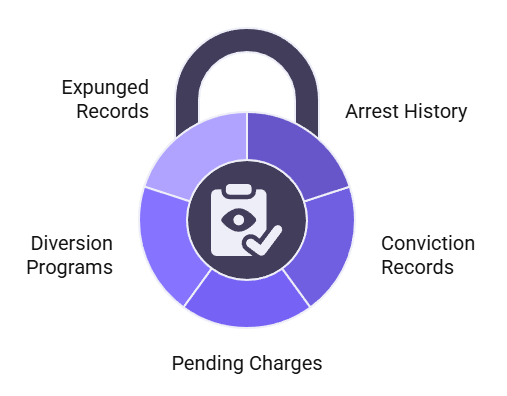
- Arrest history regardless of disposition
- Conviction records of any type
- Pending criminal charges or cases
- Participation in diversion programs
- Expunged or sealed record disclosure
The restriction does not prevent employers from conducting interviews, skills assessments, reference checks, or other non-criminal-history verification before conditional offer. Employers may evaluate qualifications, experience, cultural fit, and all relevant non-criminal factors during preliminary hiring stages.
Baltimore City Fair Chance Hiring Requirements
Baltimore City's municipal ordinance creates additional compliance layers for employers hiring within city boundaries. The ordinance's stricter provisions supersede state law and require enhanced procedural steps beyond Maryland's baseline requirements.
Jurisdictional Scope and Covered Employers
Baltimore City's fair chance ordinance applies to employers conducting business operations within city limits and hiring for positions based in Baltimore. The geographic scope typically includes any employer with a physical presence in the city or hiring employees who will work primarily within Baltimore boundaries.
Baltimore City's ordinance generally applies to employers with 10 or more employees working within city limits, a threshold that differs from Maryland's state-level requirement. Employers should verify current size thresholds as ordinances may be amended. Employers operating in multiple Maryland jurisdictions must determine which standard applies based on where specific positions are located.
| Employer Type | Jurisdictional Determination | Applicable Law |
| Single Baltimore location | Position based in Baltimore | Baltimore City ordinance |
| Multi-location (including Baltimore) | Position-by-position analysis | City ordinance for Baltimore positions |
| Remote position (Maryland resident) | Primary work location assessment | State or city law based on location |
| Temporary/contract staffing | Client work site location | Ordinance applies if Baltimore-based |
Franchise operations, temporary staffing agencies, and multi-location employers must assess compliance obligations for each Baltimore-based hiring decision separately.
Enhanced Timing Protocols
Baltimore's ordinance imposes stricter timing restrictions compared to Maryland state law. The municipal framework may prohibit criminal history inquiries until a later stage in the hiring process or require additional procedural steps before background screening may commence.
The ordinance may require specific written notices to applicants before conducting background checks, detailing what information will be sought and how it may be used. These notice requirements typically exceed FCRA disclosure standards and Maryland state provisions. Employers must provide Baltimore-specific notices in addition to federal and state-required documents.
Waiting periods between notice provision and background check initiation may apply under Baltimore's framework. These cooling-off periods allow applicants time to prepare responses or identify potential record issues before screening occurs.
Individualized Assessment Mandates
Baltimore's ordinance specifies factors employers must consider during individualized assessments when criminal records are identified:
- Nature and gravity of the offense
- Time elapsed since conviction or sentence completion
- Relationship between criminal history and job duties
- Evidence of rehabilitation presented by applicant
- Applicant's employment history since conviction
- References and character evidence
Documentation requirements under Baltimore law may exceed state-level standards. Employers must maintain written records demonstrating that individualized assessments were conducted, which factors were considered, and how the decision was reached.
Baltimore's ordinance requires employers to provide applicants with written assessment results and opportunity to respond before final adverse decisions. The ordinance establishes specific procedural steps that employers must follow, and violations may result in administrative penalties, complaint investigations, and potential civil liability.
Maryland Second Chance Act and Expungement Impacts
Maryland's evolving expungement framework directly affects which records employers can access and legally consider during background screening. Understanding automatic versus petition-based expungement, restricted record categories, and employer obligations when expunged records are disclosed creates operational clarity.
Automatic Expungement Provisions
Maryland law provides for automatic expungement of certain offense categories after specified waiting periods without requiring individuals to file court petitions. Automatic expungement applies to particular misdemeanor convictions, dismissed charges, and cases resulting in acquittal.
Time periods for automatic expungement eligibility vary by offense type and disposition, typically calculated from the date of disposition, case dismissal, or sentence completion. Records may become eligible after three years for certain eligible misdemeanor categories, seven years for other specified offenses, or other timeframes depending on statutory criteria, disposition type, and individual case characteristics. Eligibility requirements are complex and offense-specific.
Key characteristics of automatic expungement:
- No court petition required from individual
- Triggered by statutory timeframes and offense criteria
- Records removed from public databases
- No advance employer notice when records disappear
- Background check results may change between screening dates
The automatic nature means individuals need not take action to trigger expungement, and employers have no advance notice when records disappear from databases.
Petition-Based Expungement and Shielding
Beyond automatic provisions, Maryland permits individuals to petition courts for expungement of additional record categories. Petition-based expungement applies to broader offense types and may occur on faster timelines when courts grant requests.
Shielding provisions create a distinct category where records are not fully expunged but are restricted from public access while remaining available to limited entities. Shielded records typically do not appear on standard employment background checks obtained through consumer reporting agencies.
| Record Status | Public Accessibility | Employer Visibility | Employment Use |
| Active (non-expunged) | Publicly available | Visible on background checks | May be considered with restrictions |
| Automatically expunged | Removed from public databases | Not visible | May not be considered |
| Petition-expunged | Removed from public databases | Not visible | May not be considered |
| Shielded | Restricted access | Not visible on standard checks | May not be considered |
The distinction between expungement and shielding affects database accessibility but produces similar employer obligations.
Employer Obligations Regarding Expunged Records
Maryland law prohibits employers from requiring applicants to disclose expunged records. When application forms or interviews ask about criminal history after the permissible timing threshold, questions must clarify that expunged records need not be disclosed.
Applicants who respond "no" to criminal history inquiries despite having expunged records are not providing false information. If an applicant voluntarily discloses an expunged record or an expunged record appears on a background check report through database error, employers may not consider that information in hiring decisions.
Employers should implement verification procedures with background check vendors to ensure screening processes include updated expungement database checks. Consumer reporting agencies providing background checks must maintain systems that incorporate expungement data and exclude expunged records from reports.
Permissible Use of Criminal Records in Maryland Employment Decisions
Maryland law permits employers to consider criminal history information in employment decisions when obtained through legally compliant timing and procedures, but imposes restrictions on what records may be considered and how they must be evaluated.
Restricted and Prohibited Record Categories
Maryland employers may not consider certain record categories regardless of when they are obtained:
- Arrest records without conviction
- Expunged records (automatic or petition-based)
- Shielded records
- Acquittals and dismissals
- Nolle prosequi dispositions
- Certain aged misdemeanor convictions
The distinction between arrest and conviction is critical. An arrest indicates an accusation, while a conviction requires adjudication of guilt. Records resulting in acquittal, dismissal, nolle prosequi, or other non-conviction dispositions receive similar treatment to arrests without conviction.
Certain misdemeanor categories may be restricted from consideration after specified time periods. Maryland law may prohibit considering low-level misdemeanors beyond designated lookback windows.
Individualized Assessment Requirements
When criminal record information is obtained through compliant procedures and involves permissible record categories, Maryland employers must conduct individualized assessments before making adverse employment decisions. Individualized assessment means evaluating the specific criminal history in relation to the particular job's duties, requirements, and circumstances rather than applying blanket disqualification policies.
| Assessment Factor | Evaluation Questions | Documentation Requirements |
| Nature and gravity of offense | How serious was the offense? Does it involve violence, theft, or conduct relevant to job duties? | Written analysis of offense characteristics |
| Time elapsed | How long ago did the conviction occur? Has the sentence been completed? | Timeline documentation from conviction to present |
| Job relationship | Does the offense conduct directly relate to job responsibilities? | Job duty comparison to offense behavior |
| Rehabilitation evidence | What has applicant done since conviction? Education, employment, community involvement? | Review of submitted evidence and references |
Evidence of rehabilitation should be considered when presented by applicants, consistent with EEOC guidance and Maryland regulatory expectations. Rehabilitation evidence includes completion of educational programs, employment history since conviction, community involvement, reference letters, and other indicators of positive life changes.
Documentation and Decision-Making Processes
Employers should maintain written documentation of individualized assessment processes. Documentation demonstrates that required factors were considered, how they were weighed in the specific case, and what reasoning supported the final decision.
Decision-making authority should rest with trained personnel who understand legal requirements and assessment protocols. Employers should avoid delegating criminal history evaluation to hiring managers or supervisors without adequate training. Centralized review processes help ensure consistency and compliance across hiring decisions.
Policies should specify what criminal history categories are relevant to which position types. Job-specific relevance matrices help ensure consistent application of criminal history factors across similar roles. However, even with categorical frameworks, individual circumstance evaluation remains necessary for each hiring decision involving criminal records.
Federal and State Law Intersection: FCRA and Maryland Requirements
Maryland employers must satisfy both federal Fair Credit Reporting Act obligations and state-specific requirements when conducting background checks. Understanding where these frameworks overlap, where they diverge, and how to maintain compliance with both systems is essential.
FCRA Disclosure and Authorization Requirements
The federal FCRA requires employers to provide clear written disclosure that a background check will be conducted and obtain written authorization from the applicant before procuring a consumer report. The disclosure must be a standalone document containing only the disclosure and authorization language, with no additional liability waivers, employment terms, or other extraneous content that could obscure the background check notice.
Maryland's timing restrictions affect when FCRA disclosures and authorizations may be sought. Employers subject to Maryland ban-the-box provisions cannot provide FCRA disclosures or request authorization until the conditional offer stage, since doing so would effectively notify applicants of impending criminal history checks before the permissible timing threshold.
Compliance coordination steps:
- Extend conditional offer with specific terms
- Immediately provide standalone FCRA disclosure
- Obtain written authorization before ordering reports
- Clarify that expunged records need not be disclosed
- Proceed with background check only after authorization received
The intersection requires coordinating FCRA compliance steps with Maryland timing protocols.
Adverse Action Procedures Under Dual Frameworks
When criminal history information causes an employer to consider withdrawing a conditional offer or denying employment, both FCRA and Maryland law impose pre-adverse action obligations. The FCRA requires providing the applicant with a pre-adverse action notice, a copy of the background check report, and a summary of FCRA rights, followed by a reasonable waiting period (typically at least five business days) before finalizing any adverse decision.
| Requirement Source | Pre-Adverse Action Elements | Timing Requirements |
| Federal FCRA | Copy of background report, summary of FCRA rights, pre-adverse notice | Reasonable period (typically 5+ business days) before final decision |
| Maryland State Law | Individualized assessment, consideration of required factors | Assessment must occur before decision |
| Baltimore City (if applicable) | Enhanced assessment documentation, applicant response opportunity | Extended waiting periods may apply |
Best practices involve providing comprehensive pre-adverse action notices that include all required elements from every applicable framework. Employers should extend waiting periods sufficient to satisfy the longest required timeframe among applicable laws.
Ongoing Compliance and Record Retention
Employers must retain documentation evidencing compliance with both FCRA and Maryland requirements:
- Copies of disclosures and authorizations
- Background check reports received
- Individualized assessment documentation
- Pre-adverse action notices and dates sent
- Applicant responses and evidence submitted
- Final adverse action notices
- Decision reasoning documentation
Regular auditing of background check procedures ensures continued compliance as laws evolve. Employers should periodically review application forms, hiring manager training materials, vendor contracts, and adverse action templates to verify alignment with current requirements.
Practical Compliance Steps for Maryland Employers
Translating legal requirements into operational hiring procedures requires systematic approaches spanning application design, timing protocols, assessment frameworks, and documentation practices.
Application and Interview Stage Protocols
Employers should audit all employment applications, online application systems, and preliminary screening forms to remove criminal history questions for Maryland positions covered by ban-the-box requirements.
Application compliance checklist:

- Remove all criminal history questions from initial applications
- Program online systems to suppress criminal history fields for Maryland positions
- Update application disclaimers to clarify timing of background checks
- Review mobile application platforms for criminal history questions
- Audit third-party recruitment tools for Maryland compliance
Hiring manager and interviewer training must clearly communicate that criminal history inquiries are prohibited until after conditional offers. Training should provide specific examples of prohibited questions and guidance on responding if applicants voluntarily raise criminal history topics during interviews.
HR personnel should review interview guides, standardized question sets, and hiring manager toolkits to remove criminal history inquiry prompts for Maryland positions. Centralized review processes where HR validates that hiring stages have been properly completed before advancement to next phases can prevent premature criminal history screening.
Conditional Offer and Background Check Initiation
Employers should develop standardized conditional offer letter templates that clearly identify the position, compensation, start date, and material terms while explicitly stating the offer is conditional on satisfactory background check results and other specified contingencies.
| Conditional Offer Stage | Required Actions | Compliance Verification |
| Offer preparation | Use standardized template, specify all material terms | Legal review of template language |
| Offer extension | Deliver in writing with clear contingencies | Document delivery date and method |
| FCRA compliance | Provide standalone disclosure, obtain authorization | Verify standalone format, signed authorization |
| Vendor coordination | Order background check with Maryland parameters | Confirm expungement database inclusion |
Immediately following conditional offer acceptance, employers should provide FCRA disclosure documents and authorization forms specific to Maryland requirements. Background check vendor ordering processes should include Maryland-specific screening parameters such as expungement database checks and offense category exclusions.
Criminal Record Assessment and Adverse Action Processes
When background reports reveal criminal history, employers should initiate individualized assessment procedures before making adverse decisions. Assessment should be conducted by trained personnel using standardized evaluation forms that prompt consideration of required factors.
If initial assessment suggests criminal history may justify employment denial, employers should provide pre-adverse action notices that combine FCRA elements with Maryland-specific requirements:
- Copy of complete background check report
- Summary of FCRA rights document
- Explanation of individualized assessment results
- List of factors considered in assessment
- Information about rights to respond with mitigating evidence
- Contact information for submitting additional documentation
- Timeframe for response before final decision
Employers should establish waiting periods between pre-adverse action notice and final decisions that satisfy the longest requirement among FCRA, Maryland state law, and Baltimore ordinance if applicable.
Multi-State Employer Considerations
Employers hiring across multiple states face complexity in applying Maryland-specific requirements while maintaining operational efficiency and consistent candidate experiences.
Determining Which Law Applies
Multi-state employers must determine applicable background check law based on where the employee will work, not where the company is headquartered. A California-based company hiring a Maryland-based employee must follow Maryland background check laws for that hiring decision.
Work location typically means where the employee will physically perform duties or be based if remote. Hybrid and remote work arrangements require careful legal analysis of the employee's primary work location. If an employee will work remotely from Maryland as their primary location, Maryland law generally applies even if the employer has no physical presence in the state. For employees splitting time across multiple jurisdictions or whose work location may change, employers should consult legal counsel to determine which jurisdiction's law governs, as different states may apply conflicting standards based on work location, offer location, or employer business presence.
| Scenario | Work Location | Applicable Law |
| Employee works in Maryland office | Maryland | Maryland state + Baltimore if applicable |
| Employee works remotely from Maryland home | Maryland | Maryland state law |
| Employee splits time between Maryland and Virginia | Primary location analysis | Law of state where majority of time spent |
| Employee travels but Maryland-based | Maryland | Maryland state law |
Choice of law provisions in employment agreements generally cannot override mandatory state background check requirements.
Policy Design for Multi-Jurisdictional Consistency
Multi-state employers can adopt several approaches to manage varying state requirements:
Uniform approach: Apply the most restrictive state's requirements across all locations, creating a single uniform process. This maximizes compliance certainty but may delay hiring in states with less restrictive timing rules.
Jurisdiction-specific approach: Implement location-based procedures that apply different protocols based on work location. This approach requires sophisticated systems that identify applicable requirements and guide hiring personnel through state-specific steps.
Hybrid approach: Apply uniform baseline standards across all states while incorporating state-specific enhancements where required. For example, an employer might delay criminal history inquiries until conditional offer nationwide while adding Baltimore-specific notice provisions only for Baltimore-based hiring.
Training and Technology Infrastructure
Multi-state employers should invest in training programs that educate hiring personnel about the importance of location-based compliance variation. Training should clarify that different rules apply based on where the position is located and provide resources for identifying applicable requirements.
Applicant tracking systems and HRIS platforms should be configured to enforce location-based compliance rules:
- Suppress criminal history questions on applications for Maryland positions
- Trigger Maryland-specific disclosure templates when conditional offers are extended
- Prompt individualized assessment documentation when criminal records are identified
- Track waiting periods specific to jurisdiction
- Generate compliance reports by hiring location
Vendor partnerships with background check providers should include multi-state compliance capabilities. Providers should deliver state-specific screening protocols, maintain updated expungement databases for all relevant states, and provide reporting formats that facilitate state-specific assessment requirements.
Conclusion
Maryland's background check legal framework requires employers to navigate state ban-the-box timing protocols, Baltimore City's enhanced fair chance ordinance, and evolving expungement rules that affect record accessibility. Compliance depends on understanding which jurisdiction's requirements apply, implementing timing controls that delay criminal history inquiries until legally permissible stages, and conducting individualized assessments that evaluate criminal records in relation to specific job requirements. Employers should regularly review procedures to incorporate expungement law changes, train hiring personnel on permissible versus prohibited practices, and maintain documentation evidencing compliant decision-making processes across all Maryland hiring decisions.
Frequently Asked Questions
When can employers in Maryland ask about criminal history during the hiring process?
Maryland employers generally may not inquire about criminal history until after extending a conditional offer of employment, though Baltimore City maintains stricter timing restrictions for positions within city boundaries. Certain industries may have different requirements based on regulatory mandates. Employers should verify which timing standard applies to their specific positions and locations before initiating any criminal history inquiries.
What is the difference between Maryland state ban-the-box law and Baltimore City's ordinance?
Maryland's state law establishes baseline timing restrictions on when criminal history inquiries may occur, while Baltimore City's municipal ordinance imposes stricter timing protocols, enhanced notice requirements, and specific individualized assessment mandates that supersede state law. Employers hiring for Baltimore-based positions must comply with the city ordinance's more restrictive provisions rather than applying only state-level requirements.
How does Maryland's Second Chance Act affect employment background checks?
The Second Chance Act expanded automatic expungement eligibility for certain offense categories, resulting in records being removed from public databases without requiring court petitions. Expunged records may not be considered in employment decisions, and applicants need not disclose them. Employers may see different background check results over time as previously visible records undergo expungement, requiring updated screening procedures and vendor coordination.
Can Maryland employers consider arrest records without conviction?
Maryland law generally prohibits employers from basing adverse employment decisions on arrest records that did not result in convictions. Arrests indicate accusations rather than adjudicated guilt. Employers should focus on conviction records obtained through compliant timing protocols and evaluate those records through individualized assessment processes that consider job relevance and other required factors.
What is an individualized assessment under Maryland background check law?
An individualized assessment requires evaluating specific criminal history in relation to particular job duties rather than applying blanket disqualification policies. Required factors include the nature and gravity of the offense, time elapsed since conviction, relationship between the offense and job responsibilities, and evidence of rehabilitation. Employers must document these assessments and provide applicants an opportunity to present mitigating evidence before finalizing adverse decisions.
Do Maryland background check laws apply to out-of-state employers hiring Maryland residents?
Maryland requirements apply based on where employees will work, not where employers are headquartered. Out-of-state employers hiring individuals who will work in Maryland must comply with Maryland ban-the-box timing rules, expungement restrictions, and Baltimore City ordinance provisions if applicable. Work location determines which state's background check laws govern the hiring process.
What records are legally restricted from employment consideration in Maryland?
Expunged records, shielded records, arrests without conviction, acquittals, dismissed charges, and certain aged misdemeanor convictions carry legal restrictions on employer use. Employers may not require disclosure of expunged records or base employment decisions on legally restricted categories. Background check procedures should incorporate vendor verification that screening processes exclude restricted record types through updated database checks.
What are employer obligations when a conditional job offer is withdrawn based on criminal history?
Employers must provide pre-adverse action notices including copies of background reports and summaries of rights, conduct individualized assessments considering required factors, allow waiting periods for applicant responses, evaluate any mitigating evidence submitted, and provide final adverse action notices if decisions are finalized. Documentation of assessment processes and decision reasoning should be retained consistent with applicable record retention requirements.
Additional Resources
- Maryland Fair Criminal Record Screening Standards
https://www.dllr.state.md.us/employment/criminal.shtml - Baltimore City Fair Chance Hiring Ordinance
https://civilrights.baltimorecity.gov/fair-chance-hiring - Maryland Courts Expungement Information
https://mdcourts.gov/legalhelp/expungement - Federal Trade Commission FCRA Guidance
https://www.ftc.gov/enforcement/statutes/fair-credit-reporting-act - EEOC Guidance on Criminal Records
https://www.eeoc.gov/laws/guidance/enforcement-guidance-consideration-arrest-and-conviction-records-employment-decisions

ABOUT THE CREATOR
GCheck Editorial Team
Meet the GCheck Editorial Team, your trusted source for insightful and up-to-date information in the world of employment background checks. Committed to delivering the latest trends, best practices, and industry insights, our team is dedicated to keeping you informed.
With a passion for ensuring accuracy, compliance, and efficiency in background screening, we are your go-to experts in the field. Stay tuned for our comprehensive articles, guides, and analysis, designed to empower businesses and individuals with the knowledge they need to make informed decisions.
At GCheck, we're here to guide you through the complexities of background checks, every step of the way.