

Long term care facility background check requirements combine federal mandates, state-specific regulations, and abuse registry verifications to protect vulnerable populations. Understanding the intersection of CMS standards, state licensing rules, and disqualifying offense criteria is essential for nursing home administrators navigating multi-layered screening obligations.
Key Takeaways
- Federal law requires state-level criminal background checks for long-term care employees, with abuse registry checks mandated across most states.
- Disqualifying offenses typically include violent crimes, abuse or neglect of vulnerable persons, theft, and certain drug-related convictions, though state lists vary significantly.
- Many states impose lookback period limitations and individualized assessment requirements that prevent blanket disqualification policies.
- Multi-state employers must reconcile differing state requirements for fingerprinting, registry checks, and provisional employment provisions.
- Ban-the-box laws in multiple jurisdictions restrict when and how criminal history may be requested during the hiring process.
- Provisional or conditional employment periods allow facilities to conduct comprehensive checks while addressing urgent staffing needs, subject to strict supervision requirements.
- Federal databases alone are insufficient, state abuse registries often contain disqualifying findings not reflected in criminal records.
- Documentation protocols for authorization, disclosure, adverse action notices, and record retention are legally mandated and subject to survey review.
Understanding the Regulatory Framework for Nursing Home Background Checks
Long term care facility background check obligations emerge from a complex regulatory system designed to protect residents who may face physical, cognitive, or financial vulnerability. Unlike background screening in general employment contexts, nursing home employee screening operates under heightened scrutiny. This scrutiny exists because employees have significant access to at-risk populations.
The Centers for Medicare & Medicaid Services sets baseline participation requirements for facilities participating in Medicare and Medicaid programs. Meanwhile, state licensing authorities add extra requirements on top of federal minimums. As a result, this creates jurisdiction-specific obligations that can differ substantially in scope, timing, and procedural detail.
| Regulatory Layer | Primary Focus | Enforcement Mechanism |
| Federal (CMS) | Minimum participation standards | Survey deficiencies, certification threats |
| State Licensing | Operational requirements | License sanctions, civil penalties |
| State Criminal Justice | Background check processing | Access restrictions, data accuracy |
| State Protective Services | Abuse registry maintenance | Registry placement, appeal processes |
Federal Mandate Structure
Federal requirements center on criminal background checks conducted by the state in which the facility operates. Facilities must complete these checks for individuals with direct access to residents or their property. Although the definition of "direct access" varies by state, it generally includes clinical staff, dietary workers, housekeeping personnel, maintenance staff, and contractors who enter resident areas without continuous escort.
While federal regulations establish the requirement for state-level checks, they give states considerable freedom in implementation details. Consequently, this flexibility has created significant variation across jurisdictions in the following areas:
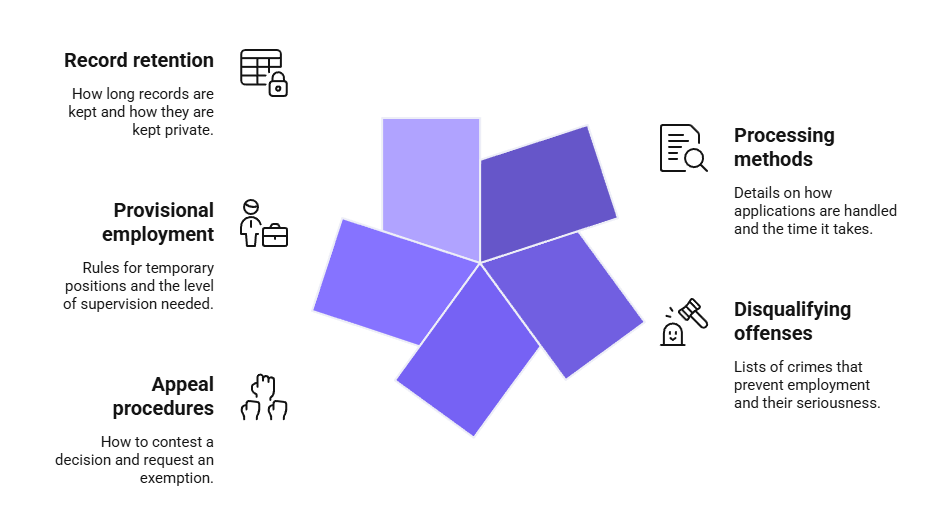
- Processing methods and timelines
- Disqualifying offense lists and severity classifications
- Appeal and waiver procedures
- Provisional employment rules and supervision requirements
- Record retention and confidentiality protocols
State-Specific Implementation Models
States use different operational models for conducting nursing home background check requirements. For example, some states operate centralized screening programs where the state itself processes applications and issues clearance decisions. In contrast, others delegate the responsibility to individual facilities, which must then submit fingerprints and criminal history authorization forms to designated state agencies.
Processing timelines range from a few days in states with automated systems to several weeks in jurisdictions with manual review processes or backlogs. Therefore, these timing variations create operational challenges for facilities, particularly those experiencing high turnover or urgent staffing needs.
Critical Role of Abuse Registry Checks
One of the most frequently misunderstood components of long term care facility background check protocols is the abuse registry requirement. Specifically, these registries maintain records of findings of abuse, neglect, or mistreatment of vulnerable persons made by state investigative agencies, even when no criminal charges were filed.
Registry Scope and Limitations
State abuse registries typically include findings from investigations conducted by Adult Protective Services, state health departments, or long-term care ombudsman offices. Notably, an individual may appear on an abuse registry without having been arrested or convicted of any crime. Furthermore, registry placement can result from substantiated findings in administrative investigations that meet a lower proof threshold than criminal prosecution.
Facilities must check both in-state and, where applicable, registries in states where the applicant previously worked or resided. However, not all states maintain publicly accessible registries, and access methods vary widely:
- Direct employer access: Facility submits inquiry and receives response
- Applicant-mediated access: Individual requests own record and provides to employer
- Reciprocal agreements: Limited interstate coordination in some regions
- Restricted access: Some jurisdictions limit searches to specific authorized entities
Registry Findings vs. Criminal Convictions
A criminal background check and an abuse registry check serve different purposes and may produce different results. For instance, an applicant with no criminal history may appear on an abuse registry based on an administrative finding. Conversely, someone with a criminal record may not appear on any abuse registry if their offense was unrelated to vulnerable persons.
Facilities that rely exclusively on criminal history checks without conducting abuse registry searches operate in non-compliance with most state requirements. Moreover, survey deficiencies related to incomplete registry checks are among the most common screening-related citations during state inspections.
Navigating Disqualifying Offenses and Individualized Assessment

Understanding what constitutes a disqualifying offense is central to compliant nursing home employee screening. Specifically, states maintain lists of crimes that either permanently bar employment in long-term care settings or trigger mandatory denial periods.
Common Disqualifying Offense Categories
Nursing home disqualifying offenses generally fall into several categories. The table below presents typical classifications, though specific state lists vary:
| Offense Category | Typical Treatment | Common Examples |
| Violence Against Persons | Permanent bar | Assault, battery, homicide, domestic violence |
| Sexual Offenses | Permanent bar | Sexual assault, rape, indecent exposure, child pornography |
| Abuse of Vulnerable Persons | Permanent bar | Elder abuse, child abuse, neglect, exploitation |
| Theft/Property Crimes | Variable (often permanent if involving vulnerable victims) | Theft from patients, burglary, robbery |
| Fraud | Permanent or lengthy bar | Healthcare fraud, Medicaid fraud, identity theft |
| Drug Offenses | Variable by state and offense type | Trafficking (typically permanent), possession (time-limited in some states) |
Treatment varies by state. Employers must verify specific requirements in their jurisdiction.
Drug-related convictions receive varied treatment across states. On one hand, some jurisdictions impose permanent bars for drug trafficking or distribution. On the other hand, they treat possession offenses as temporary disqualifiers subject to time limits. Additionally, other states require individualized assessment of all drug convictions.
Lookback Periods and Time-Based Restrictions
Many states impose lookback period limits that restrict how far back in an applicant's history a facility may consider for certain offense categories, typically misdemeanors. In particular, seven-year and ten-year lookback periods are common for these limited offense types. However, serious felonies, particularly those involving violence or vulnerable persons, often remain permanently relevant with no time limitation.
Lookback periods interact with record expungement, sealing, and set-aside provisions in complex ways. For example, some states prohibit consideration of expunged or sealed records entirely. In contrast, others allow facilities to see such records but restrict their use in employment decisions.
Individualized Assessment Requirements
Federal guidance and many state laws require individualized assessment of criminal history rather than blanket exclusion policies. Therefore, decision-makers must consider the nature and gravity of the offense, the time elapsed since the conviction or completion of sentence, and the nature of the position sought.
Documentation of individualized assessment is critical during survey inspections and unemployment or discrimination proceedings. As a result, facilities should maintain written records showing what factors they considered, how the offense relates to job duties, and what specific resident safety concerns justified the denial. Additionally, positions with different levels of resident access may warrant different standards.
Addressing the Question: Can You Work in a Nursing Home with a Felony?
The question of whether an individual can work in a nursing home with a felony conviction cannot be answered universally. Instead, the answer depends on multiple jurisdiction-specific factors and the specific circumstances of both the conviction and the position.
State-Specific Determinations
Some states maintain absolute bars for certain felony categories, meaning no waiver, appeal, or passage of time will permit employment in a licensed long-term care facility. Alternatively, other states allow individuals with specific felonies to seek employment after a waiting period, completion of rehabilitation programs, or demonstration of good conduct.
Waiver and appeal processes exist in many jurisdictions. Typically, these processes require the following steps:
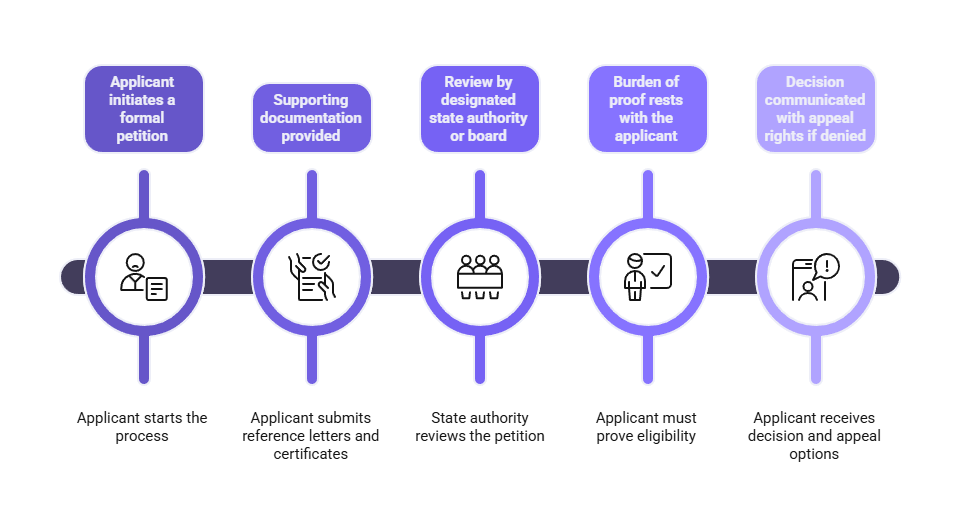
- Applicant initiates a formal petition
- Supporting documentation provided (reference letters, treatment completion certificates)
- Review by designated state authority or board
- Burden of proof rests with the applicant
- Decision communicated with appeal rights if denied
Facilities cannot override state-level disqualifications, even if they believe an applicant poses no risk. Therefore, employment decisions must align with state determinations, though facilities retain discretion to deny employment to applicants who are not affirmatively disqualified by state law.
Position-Specific Considerations
Some states differentiate between direct care positions and non-clinical roles. For example, an individual who is barred from working as a certified nursing assistant might be eligible for employment in dietary, laundry, or administrative positions with limited resident contact. However, the definition of "direct access" in many states is broad enough to encompass most positions within a facility.
Contract workers, agency staff, and vendors who enter the facility generally face the same screening requirements as direct employees. Consequently, facilities cannot circumvent background check requirements by using staffing agencies or independent contractors.
Multi-State Compliance Challenges
Operators managing facilities across multiple states face the complex task of reconciling differing requirements while maintaining operational consistency. Importantly, long term care facility background check protocols that satisfy one state's requirements may be insufficient or impermissible in another jurisdiction.
Fingerprinting and Biometric Requirements
Some states mandate fingerprint-based criminal history checks processed through state identification bureaus and the FBI. Meanwhile, others accept name-based checks conducted through commercial vendors or state court databases. Additionally, a few states require both methods. The following elements vary significantly across states:
- Technology infrastructure and biometric matching systems
- Processing timelines (ranging from days to weeks)
- Associated costs and fee structures
- Resubmission requirements for poor-quality prints
- Applicant notification and dispute procedures
Fingerprint requirements may extend to registry checks in states that use biometric matching for abuse registry searches. Therefore, these variations affect hiring timelines and administrative burden substantially.
Provisional Employment Provisions
Many states allow provisional or conditional employment while background checks are pending, subject to specific conditions. Specifically, these provisions recognize the staffing challenges facilities face and the processing delays inherent in some screening systems.
| Provisional Employment Element | Typical Requirements |
| Maximum Duration | 3 days to 120 days (varies by state) |
| Supervision | Direct, continuous supervision by fully screened employee |
| Duty Restrictions | No medication administration, financial transactions, or unsupervised resident contact |
| Documentation | Written supervision plan, daily logs |
| Termination Protocol | Immediate removal if disqualifying information surfaces |
Survey agencies scrutinize provisional employment practices closely, as inadequate supervision during provisional periods has been linked to abuse and neglect incidents.
Interstate Registry Coordination
Facilities hiring individuals who previously worked in other states must conduct registry checks in those jurisdictions. Unfortunately, this requirement creates practical challenges, as registries are not interconnected and search processes vary widely.
The lack of a national abuse registry means employers must conduct separate searches in each relevant state. Therefore, determining which states are "relevant" requires careful documentation of employment and residence history. Furthermore, gaps in an applicant's history should trigger follow-up questions to ensure all applicable states have been identified.
Compliance Process and Documentation Requirements
Implementing legally compliant nursing home employee screening requires structured processes and careful documentation. Specifically, facilities must satisfy both pre-employment authorization requirements and post-screening documentation obligations.
Authorization and Disclosure Obligations
Before conducting any background check, facilities must provide applicants with clear written disclosure that a check will occur and obtain written authorization. Moreover, these documents must comply with federal requirements under the Fair Credit Reporting Act when third-party screening companies are used, as well as any additional state-mandated disclosure language.
State-specific authorization forms often require particular wording, format, or accompanying documentation. As a result, using a generic national form may not satisfy jurisdiction-specific requirements. Additionally, applicants must be informed of their rights, including the right to receive a copy of the background check report and dispute inaccurate information.
Adverse Action Protocols
When a facility decides not to hire or to terminate an employee based wholly or partly on background check results, specific adverse action procedures apply. Typically, these procedures include the following steps:
- Pre-adverse action notice provided to applicant
- Copy of background check report furnished
- Summary of rights under applicable law included
- Reasonable waiting period for applicant response (typically 5 business days)
- Final adverse action notice issued if decision stands
- Information about dispute and appeal processes provided
Documentation of adverse action decisions should include the specific information considered, the rationale for the decision, evidence of individualized assessment, and proof that required notices were provided. Consequently, this documentation serves as the facility's defense in unemployment proceedings, discrimination claims, and regulatory surveys.
Record Retention Requirements
Facilities must retain background check records in compliance with both federal requirements and state record retention schedules. Furthermore, these requirements specify not only how long facilities must keep records but also how they must secure them to protect sensitive personal information.
Criminal history information faces strict confidentiality requirements. Therefore, access should be limited to personnel with a legitimate need to know, typically human resources staff and administrators involved in hiring decisions. Moreover, unauthorized disclosure of criminal history information can result in civil liability and regulatory penalties.
Technology-Assisted Screening and Emerging Tools
The nursing home employee screening landscape increasingly incorporates technology platforms designed to streamline compliance, reduce processing times, and improve accuracy. Specifically, these tools range from integrated applicant tracking systems with built-in background check ordering to artificial intelligence-assisted decision support systems.
Automated Compliance Monitoring
Some platforms offer continuous monitoring capabilities that alert facilities to new criminal charges or registry entries for current employees. In particular, this ongoing screening addresses the limitation of point-in-time background checks, which capture only an applicant's history at the moment of hiring. However, continuous monitoring raises legal and practical considerations:
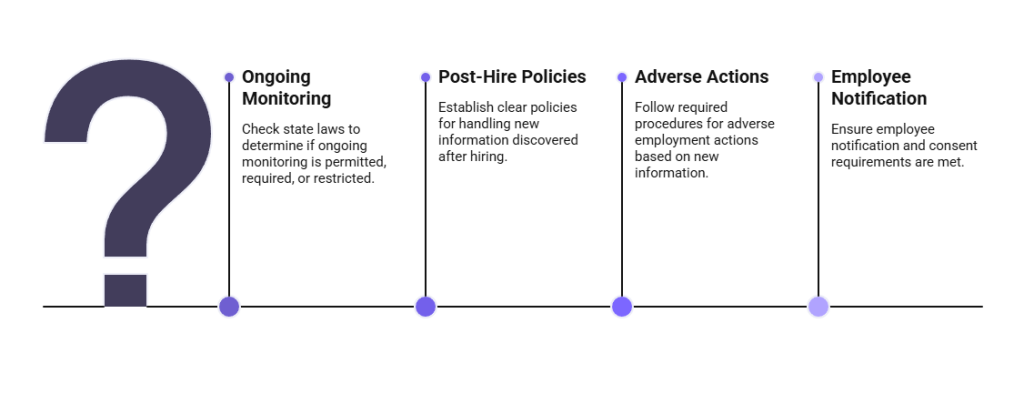
- State laws vary on whether ongoing monitoring is permitted, required, or restricted
- Clear policies must address how post-hire discoveries will be handled
- Adverse employment actions based on new information must follow required procedures
- Employee notification and consent requirements may apply
Data Aggregation and Multi-State Search Tools
Technology platforms that aggregate criminal records, professional license databases, and abuse registries across multiple jurisdictions can reduce administrative burden for multi-state employers. Specifically, these systems query multiple data sources simultaneously and compile results into unified reports.
However, automated systems are not perfect. Database coverage varies, update frequencies differ across jurisdictions, and matching algorithms may produce false positives or miss relevant records. Therefore, facilities remain responsible for the accuracy of information used in employment decisions, even when obtained through third-party platforms.
Artificial Intelligence and Risk Assessment Algorithms
Emerging tools incorporate artificial intelligence to assess patterns, flag potential risk indicators, and support decision-making. For example, these systems might analyze factors such as offense patterns, time elapsed since the last incident, or employment stability to generate risk scores.
Use of algorithmic decision support tools in employment screening is evolving legally and from a regulatory standpoint. Notably, concerns about algorithmic bias, transparency, and disparate impact have prompted increased scrutiny from civil rights enforcement agencies. Consequently, facilities considering such tools should carefully evaluate their methodology, validation, and compliance with anti-discrimination laws.
Survey Preparation and Ban-the-Box Compliance
State survey agencies evaluate background check compliance during routine inspections and complaint investigations. Additionally, ban-the-box laws in multiple jurisdictions restrict when criminal history inquiries may occur.
Common Survey Findings
Frequent deficiency citations include failure to conduct abuse registry checks, incomplete documentation of background check completion prior to employment start date, inadequate supervision of provisional employees, and use of screening processes that do not comply with state-specific requirements.
Surveyors typically review a sample of employee personnel files, examining them for presence of required background check documentation, timeliness of checks relative to hire dates, and evidence of appropriate action when disqualifying information was discovered. Furthermore, missing documentation, even for employees hired years ago, can trigger deficiency citations. Therefore, facilities should maintain checklists or tracking systems that document each step of the screening process for every employee.
Ban-the-Box Timing Restrictions
Ban-the-box laws typically prohibit asking about criminal history on initial employment applications. Instead, inquiry is generally permitted only after an initial screening, interview, or conditional offer of employment. However, the specific trigger point varies by jurisdiction.
Many ban-the-box laws include exceptions for positions involving vulnerable populations, including healthcare workers with access to elderly or disabled individuals. Nevertheless, these exceptions are not universal, and their scope varies. In fact, some exceptions permit earlier inquiry but still impose individualized assessment requirements and limitations on how information may be used.
Developing Compliant Multi-Layered Screening Protocols
Effective long term care facility background check programs integrate multiple verification components into a structured screening protocol that satisfies all applicable requirements while supporting operational needs.
A comprehensive screening protocol should include the following components:
- Criminal background checks at state and, where required, federal level
- Abuse registry checks for state of employment and prior work/residence states
- Professional license verification for clinical staff
- Prior employment verification for performance and separation information
- Reference checks for qualitative insights into character and reliability
Facilities should integrate screening into the hiring workflow at appropriate stages, with clear decision points and responsible parties identified. Specifically, application review, initial interview, conditional offer, background check ordering, results review, and final hiring decision should follow a consistent sequence. Additionally, checklists or workflow management tools help ensure no steps are missed and that timing requirements are satisfied.
Human resources personnel, administrators, and anyone involved in hiring decisions require training on background check requirements, adverse action procedures, documentation standards, and confidentiality obligations. Furthermore, facilities should review and update policy and procedure manuals regularly to reflect current legal requirements.
Conclusion
Long term care facility background check compliance demands attention to federal mandates, state-specific requirements, and abuse registry verification protocols that collectively protect vulnerable residents. Facilities must implement documented screening processes, maintain rigorous record-keeping, and conduct individualized assessments while navigating multi-state variations and evolving legal standards.
Frequently Asked Questions
What is included in a long term care facility background check?
A comprehensive screening includes state criminal history checks, abuse and neglect registry searches for all relevant states, employment verification, professional license verification for clinical staff, and reference checks. The specific components required vary by state, but criminal and registry checks are universally mandated for employees with direct resident access.
Can you work in a nursing home with a felony conviction?
Employment eligibility with a felony conviction depends on the nature of the offense, the state where the facility is located, and the time elapsed since conviction. Most states permanently bar individuals with felonies involving violence, abuse of vulnerable persons, or sexual offenses. Some states allow employment after specified waiting periods for other felonies, potentially with waiver processes available.
What are common nursing home disqualifying offenses?
Disqualifying offenses typically include violent crimes such as assault or homicide, sexual offenses, abuse or neglect of vulnerable persons, theft particularly from vulnerable victims, and fraud including healthcare fraud. Specific disqualifying offense lists vary significantly by state, and some jurisdictions impose time limitations for less serious offenses.
How long do nursing home background checks take to process?
Processing times vary from a few days to several weeks depending on the state's systems and current processing volumes. States with automated fingerprint-based systems often return results within days. States relying on manual review may require two to six weeks, and multi-state registry checks add additional time.
Are nursing home background check requirements different for contract workers?
Contract workers, temporary agency staff, and vendors with direct resident access face the same background check requirements as direct employees. Facilities remain responsible for ensuring all individuals with resident access have been appropriately screened. Contractual agreements should specify which party conducts checks and how compliance documentation will be verified.
What is provisional employment in nursing home hiring?
Provisional employment allows individuals to begin work while background checks are pending, subject to direct supervision by fully screened employees and restrictions from certain duties. State regulations specify maximum provisional periods, supervision requirements, and prohibited activities. Facilities must document supervision arrangements and establish immediate removal protocols if disqualifying information is discovered.
Do nursing home background checks include abuse registries?
Yes, abuse registry checks are mandated in most states and are among the most critical components of nursing home employee screening. These registries contain findings of abuse, neglect, or mistreatment that may not appear in criminal records. Facilities must check registries in the state of employment and states where the applicant previously worked or resided.
How far back do nursing home background checks go?
Lookback periods vary by state and offense type. Many states impose seven or ten-year limitations for certain misdemeanors. However, serious felonies, particularly those involving violence or vulnerable persons, typically remain relevant indefinitely. Some states prohibit consideration of expunged records, while others allow viewing but restrict their use in decisions.
Additional Resources
- CMS State Operations Manual: Appendix PP - Guidance to Surveyors for Long Term Care Facilities
https://www.cms.gov/Regulations-and-Guidance/Guidance/Manuals/downloads/som107ap_pp_guidelines_ltcf.pdf - FTC Guidance: Using Consumer Reports for Employment Decisions
https://www.ftc.gov/business-guidance/resources/using-consumer-reports-what-employers-need-know - EEOC Enforcement Guidance on the Consideration of Arrest and Conviction Records
https://www.eeoc.gov/laws/guidance/arrest_conviction.cfm - Department of Justice: National Crime Prevention and Privacy Compact
https://www.fbi.gov/services/cjis/compact-council - National Background Check Program (NBCP) Resource Page
https://www.justice.gov/opcl/national-background-check-program

ABOUT THE CREATOR
GCheck Editorial Team
Meet the GCheck Editorial Team, your trusted source for insightful and up-to-date information in the world of employment background checks. Committed to delivering the latest trends, best practices, and industry insights, our team is dedicated to keeping you informed.
With a passion for ensuring accuracy, compliance, and efficiency in background screening, we are your go-to experts in the field. Stay tuned for our comprehensive articles, guides, and analysis, designed to empower businesses and individuals with the knowledge they need to make informed decisions.
At GCheck, we're here to guide you through the complexities of background checks, every step of the way.