

Level 2 background checks for childcare represent the most comprehensive screening protocol mandated for professionals working with vulnerable populations, requiring FBI fingerprint analysis, state criminal history review, and child abuse registry verification. Unlike standard employment screening, these enhanced protocols automatically disqualify candidates with specific offenses regardless of rehabilitation evidence, creating legal obligations for childcare facilities that directly impact licensing status.
Key Takeaways Outline
- Level 2 background checks differ fundamentally from standard employment screening by incorporating FBI fingerprint verification, state-level criminal databases, and mandatory child abuse registry searches that standard checks do not include.
- Childcare facilities face immediate license revocation and potential legal liability when they fail to complete proper Level 2 screening before allowing staff, volunteers, or contractors to have unsupervised access to children.
- Certain criminal convictions create automatic permanent disqualifications for childcare employment regardless of time elapsed, including any crimes against children, violent felonies, and sexual offenses.
- Fingerprint-based FBI checks reveal criminal history across all U.S. jurisdictions and federal databases, identifying records that name-based searches consistently miss due to identity variations and incomplete reporting.
- Most states require Level 2 screening completion before the first day of work, though conditional employment pending results may be permitted with direct supervision requirements in specific jurisdictions.
- Processing times for Level 2 background checks range from 3-10 business days in most states, though delays occur when fingerprint quality issues require resubmission or when applicants have lived in multiple states.
- Employers must maintain screening documentation for regulatory inspection and implement recurring recheck protocols as required by state licensing authorities, with intervals typically ranging from 2-5 years depending on jurisdiction.
Understanding Level 2 Background Checks in Childcare Settings
Level 2 background checks represent the highest tier of employment screening required under state law for individuals working directly with vulnerable populations. In childcare contexts, these comprehensive investigations go substantially beyond standard pre-employment verification by incorporating multiple layers of criminal history review. Standard background checks simply cannot access the same depth of information.
The fundamental distinction lies in fingerprint-based FBI database searches. Standard employment background checks rely primarily on name-based queries of commercial databases and selected county court records. Level 2 screening submits actual fingerprints to the Federal Bureau of Investigation for comparison against the Integrated Automated Fingerprint Identification System (IAFIS). This biometric verification eliminates the identity confusion that plagues name-based searches and reveals criminal records across all U.S. jurisdictions.
State childcare licensing regulations mandate Level 2 screening specifically because the populations served cannot protect themselves from potential harm. Children in daycare facilities, preschools, and after-school programs depend entirely on adults for safety and supervision. Regulatory frameworks recognize this vulnerability by requiring enhanced due diligence.
The Multi-Layered Verification Architecture
Level 2 background checks for childcare workers incorporate at least three distinct verification components that function independently but collectively create comprehensive risk assessment:
- FBI Fingerprint Database Search: Generates federal criminal history covering all jurisdictions that have submitted records to the national database.
- State Criminal History Repository: Provides localized records that may include offenses not yet incorporated into federal systems.
- Child Abuse Registry Verification: Identifies individuals with substantiated reports of child maltreatment regardless of whether criminal charges resulted.
Additional screening layers may include sex offender registry verification, professional license checks, and educational credential verification. The screening architecture deliberately avoids single points of failure. An individual with no criminal convictions might still appear in child abuse registries based on substantiated reports investigated by social services.
How Level 2 Differs from Standard Employment Screening
| Screening Feature | Standard Background Check | Level 2 Background Check |
| Verification Method | Name-based database searches | FBI fingerprint biometric comparison |
| Geographic Scope | Selected counties/states where applicant lived | All U.S. jurisdictions in FBI database |
| Information Sources | Commercial database aggregators | FBI, state repositories, child welfare agencies |
| Child Abuse Registry | Not included | Mandatory component |
| Identity Verification | Name and date of birth matching | Biometric fingerprint matching |
Child abuse registry searches represent information categories completely absent from standard employment screening. These registries document substantiated findings from child protective services investigations regardless of whether criminal prosecution occurred. Many child maltreatment situations result in protective interventions without criminal charges, yet documented findings create disqualifications for childcare employment.
Regulatory Framework and Compliance Requirements
Federal law establishes baseline protections for children in care settings, though states implement the specific screening requirements that childcare facilities must follow. The Child Care and Development Block Grant Act requires states to have criminal background check provisions as a condition of receiving federal funding. Individual states define the exact parameters, disqualifying offenses, and procedural requirements.
Most states incorporate Level 2 screening requirements into childcare licensing regulations that define conditions for facility operation. These regulations typically specify that all employees, owners, operators, and household members over a certain age must complete screening before the facility receives or maintains licensure.
Timing Requirements and Conditional Employment
States vary in whether they permit conditional employment while background check results remain pending. Some jurisdictions strictly prohibit any childcare work before receiving clearance results. Other states allow new employees to begin work under direct supervision by a fully screened staff member, provided the screening process has been initiated.
Key timing considerations include:
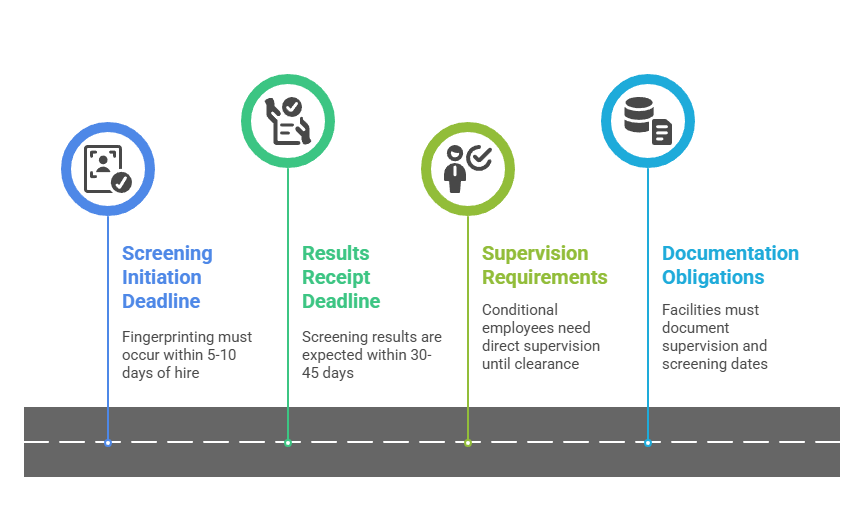
- Screening Initiation Deadline: Most states require fingerprinting within 5-10 days of hire or job offer acceptance.
- Results Receipt Deadline: Typical maximum timeframes range from 30-45 days for screening completion.
- Supervision Requirements: Conditional employees must remain under direct continuous supervision until results confirm clearance.
- Documentation Obligations: Facilities must document supervision arrangements and screening dates relative to the employee's start date.
Facilities that allow employees to work conditionally assume legal responsibility for ensuring proper supervision. Violations of supervision requirements during the conditional period can result in licensing sanctions equivalent to hiring unscreened workers.
Documentation and Record Retention Obligations
| Required Documentation | Retention Period | Inspection Purpose |
| FBI criminal history reports or clearance letters | Duration of employment + 3-7 years | Verify screening completion and results |
| State criminal history clearances | Duration of employment + 3-7 years | Confirm state-level record checks |
| Child abuse registry search results | Duration of employment + 3-7 years | Document registry clearance |
| Individualized assessment documentation | Duration of employment + 3-7 years | Support non-automatic disqualification decisions |
Licensing inspectors routinely review these files during facility inspections. Facilities that cannot produce required screening documentation face citations and potential license suspension regardless of whether proper screening actually occurred.
Disqualifying Offenses and Automatic Exclusions
Level 2 background checks for childcare reveal criminal history that creates either automatic permanent disqualifications or requires individualized assessment depending on the offense category. State laws typically identify specific crimes that bar employment regardless of how long ago the conviction occurred.
Crimes That Create Permanent Disqualification
Sexual offenses against children universally create permanent disqualification from childcare employment across all states:
- Child Sexual Abuse: Criminal sexual conduct with minors, regardless of the degree or specific statutory violation.
- Child Pornography: Possession, distribution, or production of child sexual abuse materials in any format.
- Sexual Exploitation: Any offense involving commercial sexual exploitation of children or sex trafficking of minors.
- Sex Offender Registration: Any crime requiring registration when the victim was a child.
Violent felonies typically create permanent bars, including murder, manslaughter, kidnapping, assault with serious injury, and armed robbery. Child abuse and neglect convictions automatically disqualify applicants permanently. Drug trafficking convictions commonly appear on permanent disqualification lists.
Offenses Requiring Time-Limited or Individualized Review
Certain criminal offenses create temporary disqualification periods rather than permanent bars. Misdemeanor assault charges that did not involve children might disqualify applicants for five to ten years after conviction. Drug possession charges may create three to seven-year lookback periods.
Individualized assessment protocols for offenses outside the automatic permanent disqualification category require facilities to evaluate:
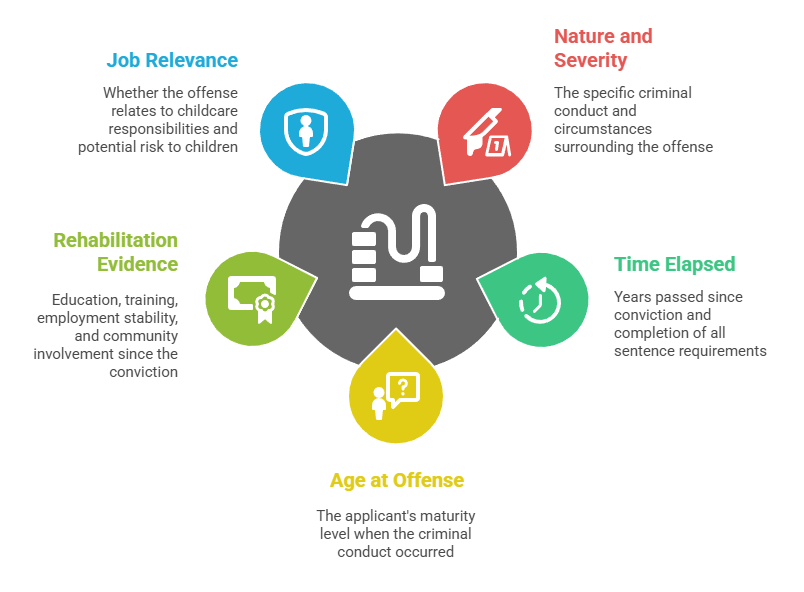
- Nature and Severity: The specific criminal conduct and circumstances surrounding the offense.
- Time Elapsed: Years passed since conviction and completion of all sentence requirements.
- Age at Offense: The applicant's maturity level when the criminal conduct occurred.
- Rehabilitation Evidence: Education, training, employment stability, and community involvement since the conviction.
- Job Relevance: Whether the offense relates to childcare responsibilities and potential risk to children.
Sealed and Expunged Records in Childcare Screening
Expunged records generally do not appear in background check results. However, some states maintain separate protocols for Level 2 screening that reveal certain expunged records when the position involves vulnerable populations. These exceptions reflect policy determinations that child protection interests outweigh individual privacy interests.
| Record Status | Appearance in Level 2 Childcare Screening |
| Expunged convictions | May appear in states with vulnerable population exceptions |
| Sealed juvenile records | May appear for serious offenses in some jurisdictions |
| Dismissed charges | Appears if arrest was fingerprinted but disposition not reported |
| Pending charges | Always appears in current state repository checks |
Applicants cannot assume that expunged or sealed records will remain invisible in Level 2 screening. Facilities that discover apparent inconsistencies should consult qualified legal counsel before making adverse employment decisions.
Fingerprint-Based FBI Background Checks
The fingerprint component of Level 2 screening provides the most comprehensive criminal history review available through legal channels. Fingerprint submission to the FBI generates a report based on biometric comparison against millions of fingerprint records associated with arrests and convictions.
The FBI Fingerprint Submission Process
Fingerprinting for childcare background checks occurs through authorized channelers. State law enforcement agencies, third-party screening vendors approved by the FBI, and designated fingerprinting service centers can capture prints. Applicants schedule appointments at approved locations where technicians capture fingerprints electronically using digital scanners.
The quality of fingerprint submission directly affects processing success. Poor fingerprint quality due to worn fingerprint ridges or improper technique can result in rejection. Multiple submission attempts may become necessary to achieve acceptable image quality.
Once captured, fingerprints are transmitted electronically to the FBI:
- Electronic Transmission: Digital fingerprints route directly to FBI systems within minutes of capture.
- FBI Database Comparison: The system compares submitted prints against millions of stored fingerprint records.
- Criminal History Compilation: When matches are identified, the FBI compiles a report documenting arrests, charges, and dispositions.
- Result Transmission: Completed reports return to the requesting agency or channeler.
Understanding FBI Criminal History Reports
FBI criminal history reports document arrests and prosecutions rather than providing risk assessments. The reports list dates and jurisdictions of arrests, charges filed, and final dispositions when available. Employers must interpret this raw criminal history data in light of state disqualification standards.
Reports frequently contain incomplete disposition information, showing arrests without final outcomes. This occurs because some jurisdictions do not consistently report case resolutions. Charges that were dismissed or resulted in acquittal may appear without clear indication of the favorable outcome.
Turnaround Time for Fingerprint Background Checks
Processing times for fingerprint-based FBI background checks typically range from three to ten business days from fingerprint submission to result availability. Electronic fingerprint submission significantly accelerates processing compared to traditional ink cards.
Factors that can extend processing include:
- Fingerprint Quality Issues: Rejected prints requiring resubmission add one to two weeks.
- Multi-State Criminal History: Applicants with records in multiple states may require additional compilation time.
- High Volume Periods: Processing times increase during busy hiring seasons.
Facilities planning hiring timelines should account for potential delays rather than assuming best-case processing speeds.
State Criminal History and Child Abuse Registry Searches
In addition to FBI fingerprint results, Level 2 background checks incorporate state-level criminal history and child abuse registry searches. These state components often reveal disqualifying information absent from FBI records.
State Criminal History Repositories
Each state maintains a criminal history repository receiving arrest and conviction reports directly from law enforcement agencies and courts. These repositories contain more current information about recent arrests than FBI databases may reflect.
Some states require applicants who have lived in other states within a specified lookback period to obtain criminal history checks from those previous states:
- Single-State Residents: State criminal history may effectively duplicate FBI results.
- Multi-State Residents: Must often obtain separate clearances from each previous state of residence.
- Lookback Period Variation: Requirements typically range from 5-10 years of prior residence history.
Child Abuse and Neglect Registry Checks
Child abuse and neglect registries maintained by state child welfare agencies document substantiated reports of child maltreatment investigated by child protective services. Unlike criminal databases, registry inclusion results from administrative findings in civil child welfare proceedings using a "preponderance of evidence" standard.
| Registry Component | Criminal Database | Child Abuse Registry |
| Standard of Proof | Beyond reasonable doubt | Preponderance of evidence |
| Decision Authority | Criminal courts | Child protective services investigators |
| Information Documented | Arrests, charges, convictions | Substantiated maltreatment findings |
| Criminal Charges Required | Yes, for inclusion | No, civil administrative process |
All states prohibit employing individuals who appear in child abuse registries in childcare positions involving unsupervised contact with children. Registry searches require separate applications distinct from criminal history checks. Processing times are generally faster than fingerprint checks, often producing results within one to five business days.
Special Considerations for Temporary and Substitute Workers
Childcare facilities frequently employ temporary workers, substitutes, and on-call staff to maintain required adult-to-child ratios. These temporary workers generally require the same Level 2 background screening as permanent employees if they will have unsupervised contact with children.
Screening Requirements for Substitute Staff
Most state licensing regulations make no distinction between permanent and temporary employees in background check requirements. Any individual who will be left alone with children must complete full Level 2 screening. This applies regardless of whether the employment relationship lasts one day or continues indefinitely.
Some states allow limited exceptions for emergency situations where properly screened coverage is not available. These emergency provisions typically permit an unscreened individual to work under direct supervision for one to three days. Facilities must document the circumstances that created the emergency and the specific supervision measures implemented.
Volunteer Screening Requirements
Volunteers who have regular unsupervised contact with children typically must complete the same Level 2 screening as paid employees. State regulations generally define "regular" contact as occurring on a predictable ongoing schedule.
The unsupervised contact criterion is essential:
- Physical Proximity: The supervising employee must maintain visual contact with the volunteer at all times.
- Separate Areas: Volunteers working in different classroom areas from the teacher may be considered unsupervised.
- Bathroom Assistance: Volunteers who assist with bathroom supervision typically require screening due to the private nature of the activity.
- Transportation: Volunteers who transport children usually require full screening even with staff present.
Navigating the Screening Process: Practical Implementation

Childcare facilities implementing Level 2 background check requirements should establish systematic procedures ensuring consistent compliance. Written policies should clearly define who requires screening, what screening elements are mandatory, and timing requirements.
Developing Comprehensive Screening Policies
Facility screening policies should identify all position categories requiring Level 2 checks. The policy should specify that screening requirements apply regardless of prior screening at other employers.
Policies should establish timelines for initiating screening:
- Immediate Initiation: Best practice requires fingerprinting within 5 business days of conditional offer acceptance.
- Conditional Employment Rules: Clear specification of whether the facility permits work pending results and supervision requirements.
- Maximum Timeframes: Definition of how long screening can remain pending before conditional employment must end.
Managing Turnaround Time and Hiring Timelines
| Planning Scenario | Advance Timeline Needed | Risk Mitigation Strategy |
| Predictable enrollment increases | 6-8 weeks before need | Begin recruiting early with multiple candidates |
| Regular employee departure | 4-6 weeks before separation | Start screening replacement immediately upon notice |
| Seasonal staffing changes | 8-10 weeks before season start | Conduct screening during off-season |
| Emergency coverage need | 1-3 days maximum | Implement direct supervision by screened staff |
Facilities should plan for a two to three-week turnaround to accommodate potential delays. Maintaining pools of pre-screened substitute workers provides flexibility for unexpected coverage needs.
Responding to Disqualifying Background Check Results
When Level 2 background check results reveal disqualifying information, facilities must follow appropriate procedures. The Fair Credit Reporting Act imposes specific requirements when employers take adverse action based on background check information.
FCRA Adverse Action Requirements
When an employer decides not to hire based on background check information, the FCRA requires:
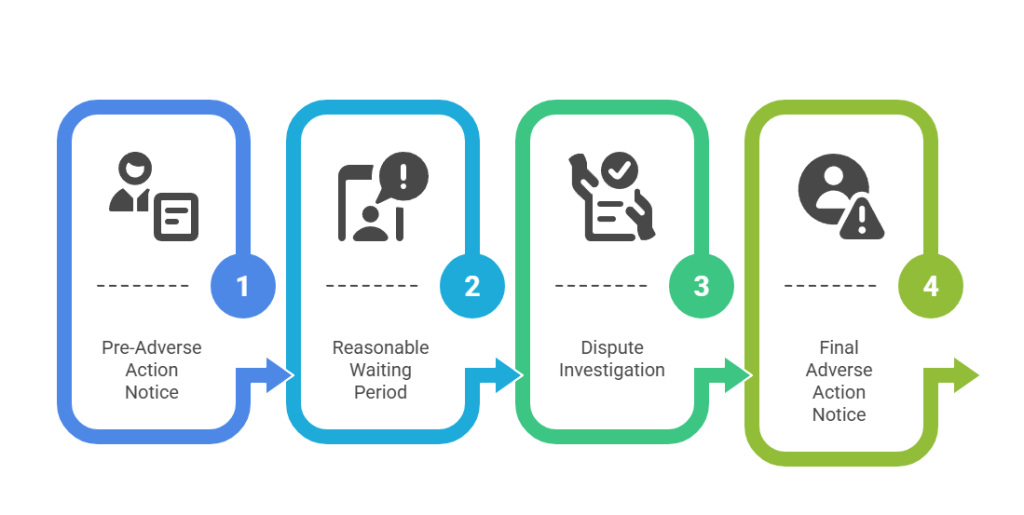
- Pre-Adverse Action Notice: Provide the applicant with a copy of the report and a document explaining rights under the FCRA.
- Reasonable Waiting Period: Allow five to ten business days for the individual to dispute any inaccuracies.
- Dispute Investigation: If the individual disputes information, delay final adverse action until resolved.
- Final Adverse Action Notice: Provide written notice including the screening company's contact information.
Handling Disputed or Incomplete Information
Background check reports sometimes contain errors requiring additional investigation. Common issues include records belonging to individuals with similar names, disposition information showing dismissals without clear indication, and outdated information about expunged records.
| Dispute Type | Investigation Process | Timeline |
| Wrong identity/name mix-up | Vendor contacts original jurisdiction to verify identity match | 5-15 business days |
| Missing favorable disposition | Vendor requests updated disposition from court | 10-20 business days |
| Expunged record appearing | Vendor verifies current record status with jurisdiction | 7-14 business days |
When applicants dispute accuracy, facilities should work with the screening vendor to investigate. Employers who conduct independent investigations may misinterpret legal records or violate confidentiality requirements.
Ongoing Compliance and Recheck Requirements
Level 2 background check obligations do not end once an employee is initially screened. Most states require periodic rescreening of childcare employees at intervals typically ranging from two to five years.
State Recheck Interval Requirements
States vary in their specified recheck intervals:
- Five-Year Full Rescreening: Some jurisdictions require complete FBI fingerprint resubmission every five years.
- Biennial Name-Based Checks: Other states mandate name-based state criminal history checks every two years.
- Annual Registry Verification: Several states require yearly child abuse registry rechecks.
Employers should implement tracking systems that identify when each employee's recheck becomes due. Allowing employees to work past their recheck due date creates licensing violations equivalent to employing unscreened workers.
Documentation Maintenance and Audit Readiness
Childcare facilities should maintain comprehensive documentation of all screening activities:
- Initial Screening Package: Copies of fingerprint confirmations, FBI reports, state clearances, and registry search results.
- Recheck Documentation: Complete records of each periodic rescreening with dates and results clearly documented.
- Individualized Assessments: Written evaluation of factors considered for non-automatically-disqualifying offenses.
State licensing inspectors routinely review background check files during facility inspections. Facilities should conduct internal audits periodically to identify missing documentation or approaching recheck deadlines.
Conclusion
Level 2 background checks represent comprehensive screening mandated for childcare workers to protect vulnerable children from foreseeable harm. Childcare facilities must implement systematic protocols incorporating FBI fingerprint checks, state criminal history searches, and child abuse registry verification while adhering to all timing, documentation, and procedural requirements.
Frequently Asked Questions
What is a Level 2 background check for childcare workers?
A Level 2 background check is the most comprehensive employment screening required for childcare workers, consisting of FBI fingerprint-based criminal history review, state criminal record searches, and child abuse registry verification. Level 2 checks use biometric fingerprint comparison to identify criminal records across all U.S. jurisdictions and include checks of state child welfare registries documenting substantiated child maltreatment reports.
How long does a Level 2 background check take for childcare employment?
Level 2 background checks typically require 3-10 business days from fingerprint submission to result availability in most states. Electronic fingerprint submission significantly reduces turnaround time. Delays occur when fingerprint quality requires resubmission or when applicants have criminal history in multiple states requiring comprehensive record compilation.
Do temporary childcare workers need Level 2 background checks?
Most states require temporary workers and substitute staff to complete the same Level 2 background checks as permanent employees if they will have unsupervised contact with children. The screening requirement applies regardless of employment duration because state licensing regulations typically make no distinction between permanent and temporary employees.
What criminal offenses permanently disqualify someone from working in childcare?
Sexual offenses against children, violent felonies including murder and kidnapping, child abuse and neglect convictions, and drug trafficking charges typically create permanent automatic disqualification. All states prohibit employing individuals with crimes against children including criminal sexual conduct with minors or child pornography offenses.
Can childcare facilities accept background checks from previous employers?
No, childcare facilities cannot rely on previous employer screening and must independently verify Level 2 background checks through appropriate state channels. Background check results belong to the requesting employer and reflect criminal history only as of the screening date.
Do volunteers at childcare facilities require Level 2 background checks?
Volunteers who have regular unsupervised contact with children typically must complete Level 2 background checks identical to paid employees. Most jurisdictions define regular contact as occurring on a predictable ongoing schedule rather than one-time occasional participation.
What should employers do when background checks reveal disqualifying information?
Employers must follow Fair Credit Reporting Act procedures including providing pre-adverse action notice with a copy of the report and summary of rights. Allow five to ten business days for the individual to dispute inaccuracies, then issue final adverse action notice if proceeding with the decision.
How often must childcare workers be rescreened?
Most states require periodic rescreening at intervals typically ranging from two to five years. Some states mandate full FBI fingerprint resubmission every five years, while others require annual or biennial name-based state criminal history checks.
Can someone with an expunged criminal record work in childcare?
Expungement generally removes records from consideration, but some states maintain separate protocols for Level 2 screening involving vulnerable populations that may reveal certain expunged records. The treatment varies substantially by jurisdiction.
What happens to facilities that fail to complete required background checks?
Childcare facilities that fail to complete required Level 2 background checks face immediate license suspension or revocation, fines, and potential legal liability. State licensing authorities consider background check compliance fundamental to child protection.
Additional Resources
- Fair Credit Reporting Act Requirements for Employment Screening
https://www.ftc.gov/business-guidance/resources/using-consumer-reports-what-employers-need-know - FBI Criminal Background Check Information and Channeler List
https://www.fbi.gov/how-we-can-help-you/need-an-identity-history-summary-background-check - Child Care and Development Block Grant Act Background Check Requirements
https://www.acf.hhs.gov/occ/law-regulation/background-checks - EEOC Guidance on Arrest and Conviction Records in Employment
https://www.eeoc.gov/laws/guidance/arrest-and-conviction-records

ABOUT THE CREATOR
GCheck Editorial Team
Meet the GCheck Editorial Team, your trusted source for insightful and up-to-date information in the world of employment background checks. Committed to delivering the latest trends, best practices, and industry insights, our team is dedicated to keeping you informed.
With a passion for ensuring accuracy, compliance, and efficiency in background screening, we are your go-to experts in the field. Stay tuned for our comprehensive articles, guides, and analysis, designed to empower businesses and individuals with the knowledge they need to make informed decisions.
At GCheck, we're here to guide you through the complexities of background checks, every step of the way.