


A level 2 background check extends beyond basic criminal history to include fingerprint-based FBI and state repository searches. These enhanced screenings are often mandated for positions involving vulnerable populations in healthcare, education, childcare, and financial services. Understanding what is a level 2 background check helps organizations balance thorough due diligence with efficient hiring while maintaining FCRA compliance.
Key Takeaways
- Level 2 background checks include fingerprint-based searches through FBI and state criminal databases for more comprehensive results.
- Healthcare facilities, K-12 education, childcare centers, and positions with vulnerable population access legally require these enhanced screenings.
- The comprehensive background screening process takes 3-10 business days but may extend beyond two weeks based on state processing times.
- Florida, Texas, California, New York, and Illinois have specific statutory frameworks defining level 2 screening requirements.
- Results include felony and misdemeanor convictions, arrest records (where permissible), sex offender registry status, and out-of-state criminal history.
- FCRA requirements apply to level 2 screenings, requiring written authorization, pre-adverse action procedures, and individualized assessments.
- Employers must evaluate whether enhanced screening matches job responsibilities while avoiding blanket disqualification policies.
- Emerging 2026 trends include continuous monitoring systems and digital identity verification supplementing traditional fingerprint methods.
Understanding Background Check Classification Systems
The Terminology Challenge
The term "level 2 background check" lacks universal legal definition across U.S. jurisdictions. This creates confusion for HR professionals navigating employment background check levels explained in various contexts. Florida statute specifically codifies Level 2 screening requirements under Florida Statutes Section 435.04. However, many states use different terminology like "enhanced background check," "fingerprint-based check," or "comprehensive criminal history screening."
Background screening classifications emerged through state-specific legislation rather than federal standardization. Organizations operating in multiple states must understand that "level 2" screening in one jurisdiction may carry a different name elsewhere. The actual screening components remain substantially similar.
Most frameworks separate basic name-based searches from enhanced fingerprint-based searches that query state and federal repositories directly. This fundamental difference in methodology determines result comprehensiveness and accuracy. Understanding this distinction helps HR professionals communicate requirements clearly regardless of local terminology.
Repository Searches Explained
Level 2 background checks access criminal history databases maintained by state law enforcement agencies and the FBI's National Crime Information Center (NCIC). Fingerprint-based repository searches access official records that law enforcement agencies maintain and update. Commercial database searches merely aggregate publicly available records.
Candidates submit fingerprints through authorized channels. The FBI's Integrated Automated Fingerprint Identification System (IAFIS) processes these biometric identifiers through the Next Generation Identification (NGI) system. This technology matches submitted prints against tens of millions of criminal history records maintained by law enforcement agencies nationwide. Name-based searches cannot achieve this level of identification certainty.
State repository searches query criminal history databases that state police agencies or departments of justice maintain. These state systems contain arrest and disposition information from local law enforcement agencies, courts, and correctional facilities. Level 2 screenings capture a more complete criminal history picture through combined federal and state repository access.
Enhanced Protocol Differences
Enhanced screening protocols incorporate multiple verification layers beyond fingerprint-based criminal searches. These typically include professional license verification, education credential confirmation, employment history documentation, and relevant exclusion list searches. Healthcare positions require searches of the Office of Inspector General's List of Excluded Individuals and Entities (LEIE).
The comprehensive background screening process addresses temporal limitations inherent in basic checks. Standard criminal database searches may reflect only recent history or records within specific boundaries. FBI repository searches can reveal criminal history from any U.S. jurisdiction where law enforcement captured fingerprints.
The fingerprint requirement serves as an identity verification measure. This virtually eliminates mistaken identity risks that occur with name-based searches when common names, similar birthdates, or data entry errors create false matches. Biometric certainty proves particularly important for positions of trust.
Legal and Regulatory Framework
Federal Requirements
No single federal statute mandates "level 2" background checks universally. Specific federal laws require enhanced screening for particular industries and positions. The FCRA governs how employers obtain and use consumer reports, including criminal background checks. This establishes baseline procedural requirements that apply regardless of screening depth.
Federal programs and funding streams impose fingerprint-based screening requirements as participation conditions:
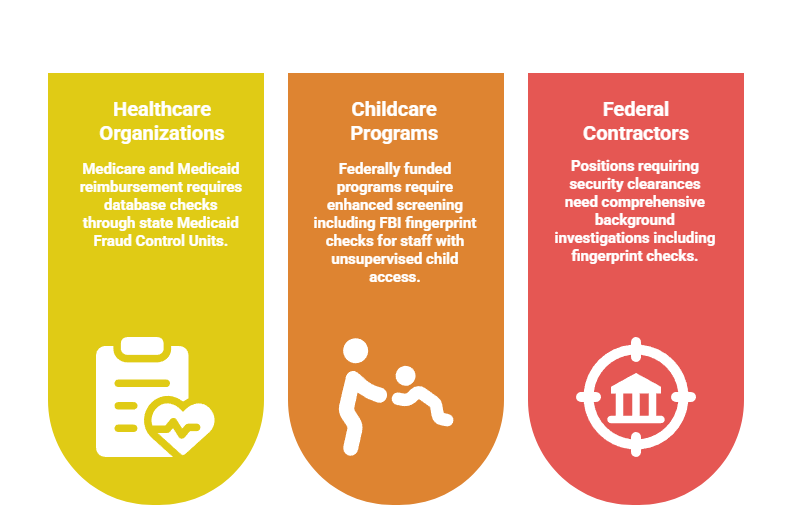
- Healthcare Organizations: Facilities receiving Medicare and Medicaid reimbursement must conduct database checks through state Medicaid Fraud Control Units.
- Childcare Programs: Federally funded programs require enhanced screening including FBI fingerprint checks for staff with unsupervised child access.
- Federal Contractors: Positions requiring security clearances need comprehensive background investigations including fingerprint checks.
The Adam Walsh Child Protection and Safety Act of 2006 established nationwide standards for background checks in organizations serving children. Implementation details vary by state, with the federal framework encouraging but not universally mandating FBI fingerprint checks.
State-Specific Mandates
State requirements for level 2 screening vary significantly in terminology, scope, and implementation. Multi-state employers must understand these variations when developing compliant screening programs.
The following table provides illustrative examples of state-specific requirements as of 2026. This is not an exhaustive list. Requirements change frequently through new legislation and regulatory updates. Organizations should consult with legal counsel or compliance specialists familiar with current requirements in each jurisdiction where they operate.
| State | Statutory Framework | Primary Industries | Key Requirements |
| Florida | Florida Statutes Ch. 435 | Healthcare, education, childcare | Fingerprint checks for vulnerable population access |
| California | Penal Code § 11105 | Healthcare, education, childcare | Live Scan required; arrest record restrictions |
| Texas | Health & Safety Code § 250.006 | Healthcare facilities | Fingerprint checks for direct patient access |
| New York | Social Services Law § 424-a | Childcare, education, healthcare | DCJS processing; extensive school requirements |
| Illinois | Various licensing statutes | Multiple regulated professions | Fingerprint checks for licensed professions |
Florida Statutes Chapter 435 defines Level 2 background screening for positions with vulnerable person access. California requires Live Scan fingerprinting for numerous positions with detailed regulations governing submission procedures and permissible uses.
Industry-Specific Requirements
Different industries face unique regulatory landscapes determining when enhanced screening becomes mandatory versus recommended.
Healthcare organizations face comprehensive screening mandates. The Centers for Medicare and Medicaid Services (CMS) require facilities to search the LEIE, National Practitioner Data Bank (NPDB), and state Medicaid exclusion lists. Many states add fingerprint-based criminal checks for clinical staff, administrators, and individuals with patient or controlled substance access.
Educational institutions navigate overlapping requirements from federal education laws, state education codes, and local policies. Most states require fingerprint-based criminal history checks for teachers and school employees. Many extend requirements to contractors, volunteers, and student teachers with unsupervised student contact.
Financial services employers face state banking regulations and federal law requirements. The Federal Deposit Insurance Act prohibits individuals with dishonesty, breach of trust, or money laundering convictions from working in FDIC-insured institutions without prior FDIC written consent. Many states require fingerprint checks for mortgage loan originators, insurance producers, and securities professionals.
Childcare facilities encounter the most stringent mandates. Federal Child Care and Development Block Grant (CCDBG) requirements compel states to conduct comprehensive background checks including FBI fingerprint checks, state criminal repository checks, sex offender registry searches, and child abuse registry checks.
Components and Scope of Level 2 Screening
Fingerprint-Based Process
The fingerprint submission process captures biometric data through traditional ink-and-paper methods or electronic Live Scan technology. Live Scan systems have become the standard in most jurisdictions. These systems use optical scanners to capture high-resolution fingerprint images transmitted electronically to state repositories and the FBI.
Candidates visit authorized fingerprinting locations including law enforcement agencies, private fingerprinting services, or employer facilities with proper equipment. The submission includes demographic information like name and date of birth to assist in record retrieval. The fingerprints themselves serve as the primary search parameter.
Automated matching algorithms compare submitted fingerprints against repository databases. The system flags potential matches for human review when automated confidence scores fall below certainty thresholds. This hybrid approach balances speed with accuracy.
Criminal History Results
What shows up on level 2 background check results depends on what records exist in queried repositories and how completely those repositories are populated. Repository search results may include the following, subject to state-specific reporting restrictions and existing database records:
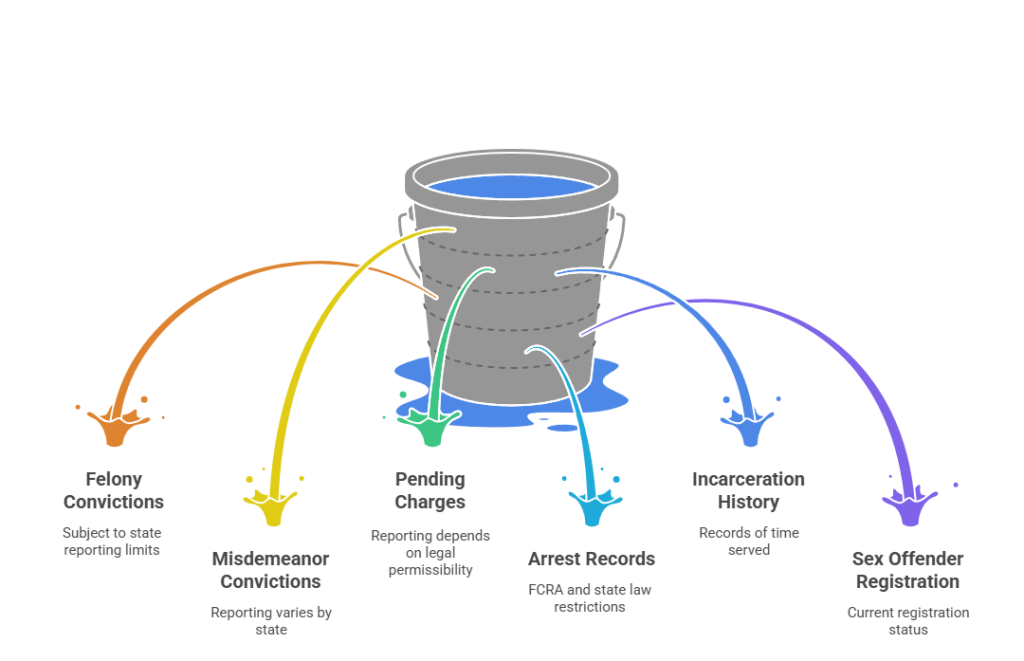
- Felony Convictions: All felony convictions on record in state and federal systems, subject to state reporting limitations.
- Misdemeanor Convictions: Misdemeanor records, though some states restrict reporting of older or less serious misdemeanors.
- Pending Charges: Current pending criminal charges where legally permissible to report.
- Arrest Records: Arrests not resulting in conviction may appear in some states, subject to FCRA and state law restrictions.
- Incarceration History: Records of time served in state or federal correctional facilities.
- Sex Offender Registration: Current registration status on state and national sex offender registries.
FBI databases contain arrests and prosecutions under federal jurisdiction, plus state and local records submitted through interstate information sharing. State repository searches access centralized criminal history databases that state law enforcement agencies maintain. Repository completeness varies based on reporting practices.
Supplementary Components
Enhanced protocols extend beyond criminal history to credential verification, professional license confirmation, and eligibility status across relevant databases. Specific supplementary components depend on industry requirements and position responsibilities.
For positions requiring professional licensure, enhanced screening typically includes:
- Professional License Verification: Active license confirmation through state licensing boards including license number, status, dates, and any disciplinary actions.
- Education Credential Verification: Degree, diploma, and certification confirmation through direct institution contact or authorized verification services.
- Employment History Verification: Previous position documentation including dates, job titles, and sometimes rehire eligibility through former employer contact.
- Exclusion List Searches: For healthcare positions, LEIE and state Medicaid exclusion database searches ensuring candidates aren't barred from federal healthcare programs.
- Sex Offender Registry Searches: National and state database queries maintained under federal sex offender registration requirements.
These components address resume fraud risks and confirm candidates possess represented qualifications. For healthcare positions, the LEIE search proves particularly critical. Employing an excluded individual can result in significant penalties and jeopardize federal healthcare program reimbursement ability.
FCRA Compliance Requirements
Authorization and Disclosure
The FCRA compliant background check process mandates clear disclosure that employers may obtain a consumer report for employment purposes. Employers must deliver this disclosure in a standalone document separate from employment applications. The document must be clear and conspicuous, avoiding extraneous information.
Employers must secure written authorization from candidates before obtaining background checks:
- Standalone Disclosure: A clear, separate document notifying candidates that employers may obtain a consumer report.
- Written Authorization: The candidate's informed, voluntary consent to screening.
- State-Specific Forms: Additional consent forms specific to fingerprint submission and repository searches may be required.
- Purpose Specification: Clear explanation of how information will be used in decision-making.
These requirements apply regardless of whether employers use third-party consumer reporting agencies or conduct screenings through direct government database access. Conservative compliance practice treats all screenings under FCRA requirements.
Adverse Action Procedures
When level 2 background check information leads to considering employment denial or other adverse action, FCRA requires a structured pre-adverse action process. Employers must complete this process before finalizing adverse decisions.
The pre-adverse action process consists of three required elements:
- Pre-Adverse Action Notice: Notification that employers are considering adverse action based on consumer report information.
- Copy of Consumer Report: A complete background check report copy containing information prompting adverse consideration.
- Summary of FCRA Rights: A standardized document explaining candidate rights under FCRA, including dispute rights.
This pre-adverse action period must be reasonable to allow candidates time to identify reporting errors and initiate disputes. FCRA does not specify an exact timeframe. Many employers provide five to ten business days. Some state laws mandate specific waiting periods.
After the pre-adverse action period concludes and dispute resolution completes, if employers proceed with adverse decisions, they must provide final adverse action notice. This notice informs candidates of the decision, identifies the consumer reporting agency that provided the report, and clarifies that the CRA did not make the adverse decision.
Individualized Assessment
EEOC enforcement guidance, which courts have relied upon in discrimination cases, requires employers to conduct individualized assessments when criminal history information leads to considering adverse action. Blanket exclusion policies based on conviction categories violate federal discrimination standards.
The individualized assessment framework considers three key factors:
| Assessment Factor | Evaluation Considerations | Documentation Requirements |
| Nature and Gravity | Crime type, violence involved, victims affected | Detailed offense description and legal classification |
| Time Elapsed | Years since conviction, sentence completion | Calculate from sentence completion, not conviction |
| Job Relationship | Direct offense-duty correlation, vulnerable population access | Written analysis connecting responsibilities to history relevance |
For level 2 screenings used in sensitive positions, the relationship between criminal history and job duties carries particular weight. Financial crime convictions may directly relate to banking positions while having little childcare role bearing. Certain violent offenses or crimes against children highly relate to positions involving vulnerable populations.
Employers should document individualized assessments, demonstrating they considered relevant factors rather than automatically disqualifying candidates. Some state laws, including those in California, New York, and Illinois, mandate individualized assessment procedures. These laws add compliance obligations beyond federal FCRA requirements.
Implementation Framework

Determining Appropriate Screening
Organizations should consult with legal counsel familiar with employment law in their operating jurisdictions when designing background screening policies. Requirements vary significantly by location and industry. Organizations should identify positions where level 2 screening is legally mandated by federal law, state statute, or industry-specific regulatory requirements.
Beyond legal mandates, employers should evaluate whether enhanced screening is warranted based on job responsibilities and risk factors, documenting business justification for applying enhanced screening to specific positions:
- Vulnerable Population Access: Positions involving unsupervised contact with children, elderly individuals, disabled persons, or patients.
- Financial Asset Handling: Roles with authority to execute financial transactions, access customer accounts, or manage organizational funds.
- Sensitive Information Access: Positions accessing personally identifiable information, protected health information, or confidential business data.
- Public Safety Responsibilities: Roles where employee conduct could directly impact public safety.
Employers must balance thoroughness against efficiency and candidate experience. Level 2 screenings take longer and require more candidate involvement than basic checks. These practical considerations should be weighed against risk mitigation benefits.
Vendor Selection
Organizations lacking direct fingerprint-based repository access must work with authorized channeling agencies or consumer reporting agencies facilitating fingerprint submission and results retrieval.
Key vendor evaluation criteria include:
- Authorization Status: Verification that vendors hold proper authorization from relevant agencies to submit fingerprints and receive results.
- Technology Infrastructure: Electronic submission capabilities, secure data transmission protocols, and applicant tracking system integration options.
- Processing Efficiency: Average turnaround times, escalation procedures for time-sensitive requests, and service level agreement track records.
- Compliance Support: Knowledge of FCRA requirements, state-specific regulations, and ability to provide compliant disclosure and authorization forms.
Process design should minimize candidate burden while ensuring accurate data collection. Providing clear instructions about fingerprinting requirements helps candidates navigate the process smoothly. Offering multiple convenient fingerprinting locations reduces logistical barriers.
State Compliance
HR professionals must map their organization's geographic footprint against state and local background check laws to identify applicable requirements. This compliance mapping exercise reveals jurisdiction-specific obligations that must be incorporated into screening procedures.
Ban-the-box laws in numerous states and municipalities restrict when criminal history inquiries may occur in the hiring process. Many require employers to delay background checks until after the conditional offer stage. Some prohibit criminal history questions on initial applications entirely.
State-specific record restrictions include:
- Massachusetts: Limits consideration of misdemeanor convictions over five years old and felony convictions over ten years old, with exceptions.
- California: Prohibits consideration of arrests not resulting in conviction, pretrial or post-trial diversion program participation, and sealed or dismissed convictions.
- New York: Restricts sealed record use, youthful offender adjudications, and requires Article 23-A analysis considering multiple factors.
- Hawaii: Prohibits consideration of arrests and court records not resulting in conviction, with conviction lookback period limits.
Screening procedures must account for these limitations through vendor-applied filtering or employer-side review protocols. Employers conducting final reviews must be trained on applicable restrictions.
Industry Applications
Healthcare Screening
Healthcare organizations face overlapping screening mandates from Medicare participation conditions, state healthcare facility licensing requirements, and professional credentialing standards.
Typical healthcare screening components include:
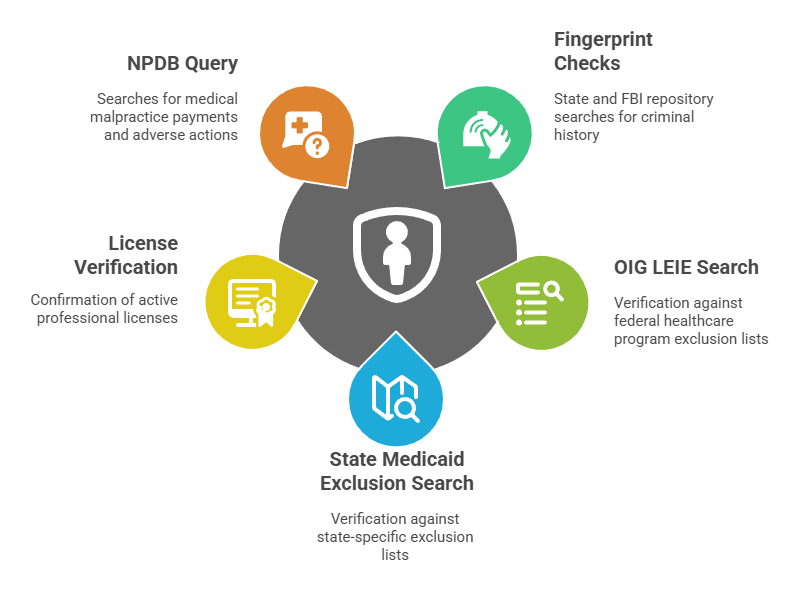
- Fingerprint-Based Criminal Checks: State and FBI repository searches identifying criminal history posing patient safety risks.
- OIG LEIE Search: Mandatory verification that candidates aren't excluded from federal healthcare program participation.
- State Medicaid Exclusion Search: Verification against state-specific exclusion lists potentially containing individuals not on the federal LEIE.
- License Verification: Active professional license confirmation through state boards.
- NPDB Query: For practitioners with prescribing or clinical privileges, searches identifying medical malpractice payments and adverse actions.
Hiring individuals with disqualifying backgrounds in healthcare settings has consequences extending beyond regulatory compliance to patient safety and organizational reputation. What constitutes a "disqualifying background" varies by position, applicable regulations, and organizational policy, requiring individualized assessment in most circumstances. Many healthcare employers conduct rescreening at regular intervals to identify new criminal activity or post-hire exclusions.
Education and Childcare
Educational institutions conduct enhanced background checks to protect students and maintain safe learning environments. State education codes typically require fingerprint-based criminal checks for teachers, administrators, coaches, and often contractors and volunteers with student contact.
State laws typically identify offense categories that may bar employment in educational or childcare settings, commonly including:
- Violent Crimes: Assault, battery, domestic violence, and other offenses involving violence against persons.
- Sex Offenses: Any sexual misconduct conviction, particularly offenses involving minors.
- Child Abuse or Neglect: Substantiated findings in state registries disqualifying individuals from working with children.
- Drug-Related Convictions: Manufacturing, distribution, or possession with intent to distribute controlled substances.
- Crimes Against Children: Any offense where a child was the victim.
Specific offenses resulting in employment bars, available waiver processes, and whether bars are permanent or time-limited vary significantly by state. Employers must consult applicable state education codes and licensing regulations.
Childcare facility screening faces the most comprehensive CCDBG Act requirements. These mandates include FBI fingerprint checks, state criminal checks, sex offender registry searches, and child abuse registry checks in each state where individuals resided during the preceding five years. Requirements apply to employees, volunteers, and household members in family childcare settings.
Financial Services
Financial institutions conduct enhanced screening to comply with regulatory requirements and protect against fraud, embezzlement, and breach of fiduciary duties.
The FDIC prohibition under Section 19 of the Federal Deposit Insurance Act bars individuals with dishonesty or breach of trust convictions from working in FDIC-insured institutions without advance written FDIC consent. Covered offenses include fraud, embezzlement, theft, forgery, bribery, and money laundering.
State financial services regulators often require fingerprint-based background checks as part of licensing processes:
| Professional Category | Typical Requirements | Regulatory Authority |
| Mortgage Loan Originators | FBI and state fingerprint checks through NMLS | State banking departments; SAFE Act |
| Insurance Producers | Fingerprint-based criminal history checks | State insurance departments |
| Securities Brokers | Form U4 disclosure; fingerprint checks in many states | FINRA; state securities regulators |
Beyond regulatory compliance, financial institutions screen to protect client assets and organizational reputation. Positions with customer account access, financial transaction execution authority, or financial reporting responsibility warrant enhanced scrutiny.
Best Practices
Timeline Management
The comprehensive background screening process for level 2 checks often requires three to ten business days from fingerprint submission to results receipt, though timelines can be significantly longer.
Factors affecting processing timelines include:
- State Processing Volumes: Higher submission volumes may create longer processing queues, particularly during peak hiring seasons.
- FBI Processing Capacity: Federal processing times fluctuate based on submission volumes from all states and other entities.
- Record Complexity: Candidates with criminal history in multiple jurisdictions require additional time for disposition retrieval.
- Fingerprint Quality: Poor-quality fingerprints requiring resubmission add 3-5 days to timelines.
Organizations should communicate realistic timelines to candidates and hiring managers. Building extended timelines into hiring plans prevents screening from creating unexpected delays. Some organizations conduct preliminary name-based checks while awaiting fingerprint results.
Accuracy and Disputes
Despite fingerprint-based search identification certainty, accuracy issues can still arise in level 2 background check results.
Common accuracy issues include:
- Incomplete Disposition Information: Arrest records appearing without corresponding court dispositions.
- Sealed or Expunged Records: Records that should have been removed from databases but remain visible.
- Identity Theft Victims: Criminal records resulting from someone else's use of the candidate's identity.
- Data Entry Errors: Incorrect dates, misspelled names, or wrong offense classifications.
When candidates dispute background check results, employers should pause adverse action procedures and work with their consumer reporting agency to investigate. The FCRA requires CRAs to reinvestigate disputed information within 30 days. For fingerprint-based checks, reinvestigation may involve contacting the state repository or FBI to verify record accuracy.
Building dispute resolution time into hiring timelines prevents candidates from being disadvantaged by reporting errors. Many employers extend conditional offers that remain open during dispute investigation.
Data Security
Background check records contain sensitive personal information requiring protection under various privacy laws and security standards. Organizations must establish record retention policies balancing legitimate business needs for documentation against privacy principles favoring minimal retention.
The EEOC recommends retaining all hiring records including background checks for at least one year from the employment decision date. Some industries face longer retention requirements.
Data security measures should include:
- Access Restrictions: Limit background check record access to HR personnel and hiring managers with legitimate review needs.
- Encryption Protocols: Encrypt electronic background check records in storage and during transmission.
- Secure Disposal: Shred physical documents containing criminal history information when retention periods expire.
- Audit Logs: Maintain logs of who accesses background check records and when.
- Training Programs: Train HR staff and hiring managers on confidentiality requirements and proper criminal history information handling.
Some jurisdictions impose specific security requirements for criminal history record information accessed through state repositories.
Emerging Trends
Continuous Monitoring
Continuous criminal monitoring services address point-in-time background check limitations that capture only historical information available at screening time. These services monitor court records, arrest databases, and sex offender registries for new criminal activity involving current employees.
Implementing continuous monitoring requires careful consideration:
- FCRA Authorization: Separate authorization for continuous monitoring should be obtained beyond pre-hire screening authorization.
- State-Specific Restrictions: Some states restrict employer access to certain post-hire criminal history information.
- Alert Investigation Protocols: Establish procedures for investigating monitoring alerts and conducting individualized assessments before taking action.
Industries with strict ongoing compliance requirements find continuous monitoring valuable. Healthcare organizations use monitoring to identify employees who become excluded from federal healthcare programs after hire. Educational institutions use monitoring to identify convictions that would have disqualified candidates at hire time.
Digital Identity Verification
Digital identity verification technology integration with traditional background screening enhances both security and efficiency. These technologies address identity fraud risks while accommodating increasingly remote hiring processes.
Key digital identity verification technologies include:
- Facial Recognition Matching: Comparing live photographs or videos of candidates against photo identification documents.
- Liveness Detection: Using motion-based challenges or depth sensing to distinguish live individuals from photographs or videos.
- Document Authentication: Analyzing security features, fonts, and layouts of identity documents to detect forgeries.
- Biometric Consistency Checking: Verifying that biometric data captured at different process points belong to the same individual.
These technologies address identity fraud risks inherent in name-based screening while complementing fingerprint check identity certainty. For organizations unable to require in-person fingerprinting, digital identity verification offers an alternative identity assurance layer.
Implementing digital identity solutions requires attention to privacy laws governing biometric data collection and storage. Illinois' Biometric Information Privacy Act (BIPA) imposes consent, disclosure, and data protection requirements for biometric identifiers. Organizations must ensure their identity verification vendors comply with applicable biometric privacy laws. As these technologies evolve rapidly, employers should regularly review vendor practices and contractual terms.
Conclusion
Level 2 background checks serve essential functions in protecting vulnerable populations and maintaining security in sensitive positions. HR professionals must navigate complex legal requirements, balance thoroughness against efficiency, and implement legally compliant and operationally sound processes. Staying informed about regulatory developments and industry best practices remains critical.
Frequently Asked Questions
What is the main difference between level 1 and level 2 background checks?
Level 1 checks use name-based searches of criminal databases and public records. Level 2 checks require fingerprint-based searches of state and FBI repositories. Fingerprints provide greater identification certainty and more comprehensive criminal history coverage across jurisdictions and time periods.
How long does a level 2 background check take?
Most level 2 checks complete within three to ten business days from fingerprint submission. Processing times vary by state and may extend beyond two weeks. Factors include repository volumes, criminal history complexity, and whether fingerprints need resubmission due to quality issues.
Are level 2 checks required by federal law for all healthcare positions?
Federal law does not universally mandate level 2 checks for all healthcare positions. Medicare conditions require OIG exclusion list checks. Many state healthcare facility licensing laws require fingerprint-based criminal checks for specific position categories. Requirements vary significantly by state and position type.
Can employers automatically disqualify candidates based on criminal history?
Employers generally cannot use blanket disqualification policies under EEOC guidance and many state fair chance laws. Employers must conduct individualized assessments considering offense nature and gravity, time elapsed since conviction, and the relationship between criminal history and specific job responsibilities.
What information appears on level 2 checks that basic checks miss?
Level 2 checks access official state and FBI repositories potentially containing records unavailable in commercial databases. This includes out-of-state criminal history, older records, federal offenses, and more complete disposition information. Fingerprint-based searches eliminate false matches that can occur with name-based searches.
Do candidates have rights to dispute inaccurate information?
Yes, candidates have the right to dispute inaccurate information under the FCRA. Employers must pause adverse action procedures while consumer reporting agencies reinvestigate by contacting the repository or court that provided the information. Agencies must correct or remove inaccurate or unverifiable information.
Are there state laws restricting how criminal history can be used?
Yes, numerous states and municipalities have laws restricting arrest record consideration, requiring individualized assessment before adverse action, and imposing lookback period limitations. Many mandate specific procedural steps before denying employment based on criminal records. Requirements vary significantly by jurisdiction.
Can level 2 checks be conducted on current employees?
Level 2 checks can be conducted on current employees, but employers must obtain proper authorization and comply with FCRA requirements including disclosure and authorization. Some industries require periodic employee rescreening. Continuous monitoring services provide ongoing alerts about new criminal activity, though separate authorization is required.
Additional Resources
- Fair Credit Reporting Act Summary of Rights
https://www.ftc.gov/legal-library/browse/statutes/fair-credit-reporting-act - EEOC Guidance on Use of Criminal History Information
https://www.eeoc.gov/laws/guidance/enforcement-guidance-consideration-arrest-and-conviction-records-employment-decisions - FBI Criminal Justice Information Services
https://www.fbi.gov/services/cjis - U.S. Department of Health and Human Services Office of Inspector General Exclusions Database
https://oig.hhs.gov/exclusions/ - National Sex Offender Public Website
https://www.nsopw.gov/

ABOUT THE CREATOR
GCheck Editorial Team
Meet the GCheck Editorial Team, your trusted source for insightful and up-to-date information in the world of employment background checks. Committed to delivering the latest trends, best practices, and industry insights, our team is dedicated to keeping you informed.
With a passion for ensuring accuracy, compliance, and efficiency in background screening, we are your go-to experts in the field. Stay tuned for our comprehensive articles, guides, and analysis, designed to empower businesses and individuals with the knowledge they need to make informed decisions.
At GCheck, we're here to guide you through the complexities of background checks, every step of the way.