



Level 1 and Level 2 background checks are not federally standardized classifications but represent common industry shorthand for screening depth, with Level 1 typically involving basic criminal records and identity verification, and Level 2 adding fingerprinting, extended database searches, or specialized checks. Employers must align screening tiers with role risk, regulatory mandates, and organizational policy while ensuring full compliance with the Fair Credit Reporting Act and applicable state and local laws.
Key Takeaways
- "Level 1" and "Level 2" are industry conventions, not legal definitions, meaning their scope varies widely by vendor, state agency, and organizational policy.
- Level 1 screening generally includes name-based criminal searches, identity verification, and employment or education checks, suited for non-sensitive, low-risk roles.
- Level 2 screening typically adds fingerprint-based FBI checks, extended lookback periods, or specialized databases, required or recommended for roles involving vulnerable populations, financial access, or regulatory oversight.
- Role risk assessment, not job title alone, should drive screening tier selection, weighing factors like access to minors, financial systems, controlled substances, or confidential data.
- FCRA compliance requires employers to obtain written authorization, provide pre-adverse and final adverse action notices, and conduct individualized assessments regardless of screening level.
- State and local laws impose additional restrictions, including ban-the-box rules, fingerprinting mandates, lookback period limits, and prohibitions on arrest-only records.
- Cost and turnaround time increase with screening depth, making tiered approaches a practical balance between risk mitigation and operational efficiency.
- Employers should document their tiered screening rationale in written policy to ensure consistency, defensibility, and compliance with equal employment opportunity principles.
Understanding Background Check Levels: Definitions and Industry Variance
What "Levels" Mean in Background Screening
The terms level 1 vs level 2 background checks are widely used shorthand in hiring and compliance discussions, but they lack universal legal or regulatory definitions. No federal statute, including the Fair Credit Reporting Act, prescribes a standardized "level" system. Instead, screening tiers emerged as a practical way for employers, consumer reporting agencies, and state licensing boards to categorize the scope and intensity of pre-employment investigations.
Level 1 refers to basic, name-based checks drawing from county criminal records, national databases, and identity verification sources in most contexts. Level 2 typically denotes deeper scrutiny, often incorporating fingerprint-based searches through the FBI's Next Generation Identification system, extended geographic or temporal reach, or specialized registries such as sex offender or healthcare sanctions databases. However, a Level 2 check in Florida's healthcare licensing framework may differ substantially from a Level 2 designation in California's education sector or a private employer's internal policy.
Why Terminology Varies by Jurisdiction and Industry
State agencies, professional licensing boards, and industry-specific regulators often impose their own background check requirements and may label them as "levels" or "tiers" for administrative clarity. For example, Florida Statutes define Level 1 and Level 2 screening for employees working with vulnerable populations, with Level 2 mandating fingerprinting and FBI record checks. Other states use different labels or integrate fingerprinting requirements into single-tier mandates without the "level" terminology.
| Jurisdiction/Context | Level 1 Characteristics | Level 2 Characteristics |
| Florida (vulnerable populations) | Name-based state criminal check | Fingerprint-based FBI and state check |
| California (education/childcare) | Varies by role; may include DOJ clearance | Fingerprinting required; FBI and DOJ review |
| Private employers (no mandate) | Employer-defined; often county/state records | Employer-defined; may add federal or specialized databases |
Private employers not subject to such mandates may adopt a tiered approach based on internal risk assessments, defining Level 1 for general hires and Level 2 for positions with fiduciary duties, access to sensitive information, or supervisory authority over minors. This flexibility allows organizations to tailor screening intensity to operational needs, but it also requires clear documentation and consistent application to avoid discrimination claims or compliance gaps.
In the world of HR, background screening is often viewed as a simple step in the hiring process. However, the consequences are far-reaching. Every screening decision is a reflection of the organization's approach to trust, risk, and fairness. When we focus less on labels and more on intent, we create hiring practices that protect the business while respecting the individual behind the application. Thoughtful screening, done correctly, is a key component of a safer workplace and a fairer chance for all.
The Role of Consumer Reporting Agencies and Vendor Offerings
Consumer reporting agencies compile and deliver background check reports under FCRA regulations, but the services they offer vary widely. Some vendors market packages labeled "Level 1" or "Level 2" to simplify purchasing decisions, yet the actual searches included in each package differ by provider.
Employers relying on vendor-defined levels must review the specific searches included in each tier and compare them against legal requirements and role-specific risks. Terminology alone does not ensure compliance or adequacy. Contracts with consumer reporting agencies should specify data sources, lookback periods, and geographic coverage, enabling employers to verify that the chosen screening level meets their obligations and risk management objectives.
Level 1 Background Checks: Scope, Use Cases, and Limitations
Typical Components of Level 1 Screening
A Level 1 background check commonly encompasses the following elements:
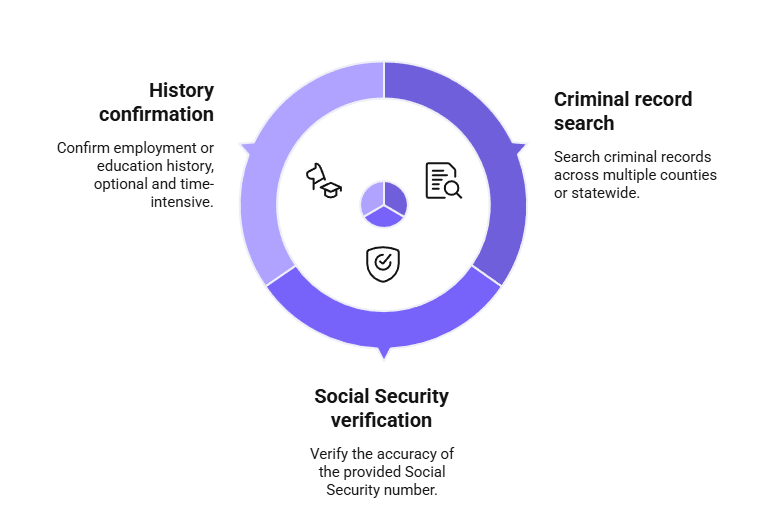
- Multi-county or statewide criminal record search
- Social Security number verification
- Employment or education history confirmation (optional, time-intensive)
These checks rely on name-based queries against court databases, proprietary criminal record aggregators, and public records indices. The search typically covers a seven-year lookback period, consistent with FCRA's default reporting limits for certain convictions, though some states impose stricter limits or prohibitions.
Identity verification confirms that the applicant's Social Security number, date of birth, and reported addresses align with government and credit bureau records, helping detect identity fraud or alias use. Employment and education verifications involve direct contact with former employers or educational institutions to confirm dates, titles, and degrees. These are often omitted from entry-level screenings due to cost and turnaround constraints.
When Level 1 Screening Is Appropriate
Level 1 checks suit roles with limited access to vulnerable populations, financial systems, or proprietary information, and where regulatory mandates do not require deeper scrutiny. Examples include retail associates, food service workers, warehouse personnel, and administrative support staff in non-sensitive environments. These positions typically involve supervised work, minimal financial authority, and infrequent interaction with minors or protected individuals.
Employers must still conduct individualized assessments if adverse information appears, considering the nature and gravity of the offense, the time elapsed, and the specific duties of the position. Blanket disqualification policies based on any criminal record violate Equal Employment Opportunity Commission guidance and may expose employers to disparate impact claims, even when using basic screening levels.
Limitations and Blind Spots in Level 1 Searches
Name-based searches depend on accurate name spelling, known aliases, and comprehensive database indexing, all of which introduce potential gaps. Applicants who have lived in multiple jurisdictions may have records that do not appear in aggregated databases if those counties do not report electronically or report with delays. Multi-state criminal searches offered by vendors compile data from varied sources with inconsistent update cycles. "Instant" databases often lag behind real-time court records.
Common exclusions in Level 1 screening include:
- Federal criminal records
- Military court-martial records
- Out-of-state convictions not captured by chosen search parameters
- FBI fingerprint databases
For roles requiring higher assurance, these limitations make Level 1 checks insufficient on their own.
Level 2 Background Checks: Enhanced Scrutiny and Regulatory Triggers
What Distinguishes Level 2 from Level 1 Screening
Level 2 background checks generally add fingerprint-based FBI record searches, expanded geographic or database coverage, and specialized registries relevant to the role. Fingerprinting captures an applicant's biometric data and submits it to the FBI's Criminal Justice Information Services division, which maintains the Interstate Identification Index, the primary repository of criminal history records. This method retrieves records linked to the individual's fingerprints across participating jurisdictions, reducing reliance on name spelling and alias detection. Access to additional FBI databases, such as the National Crime Information Center, may be included depending on the role and legal authorization.
Extended database searches in Level 2 screening may include:
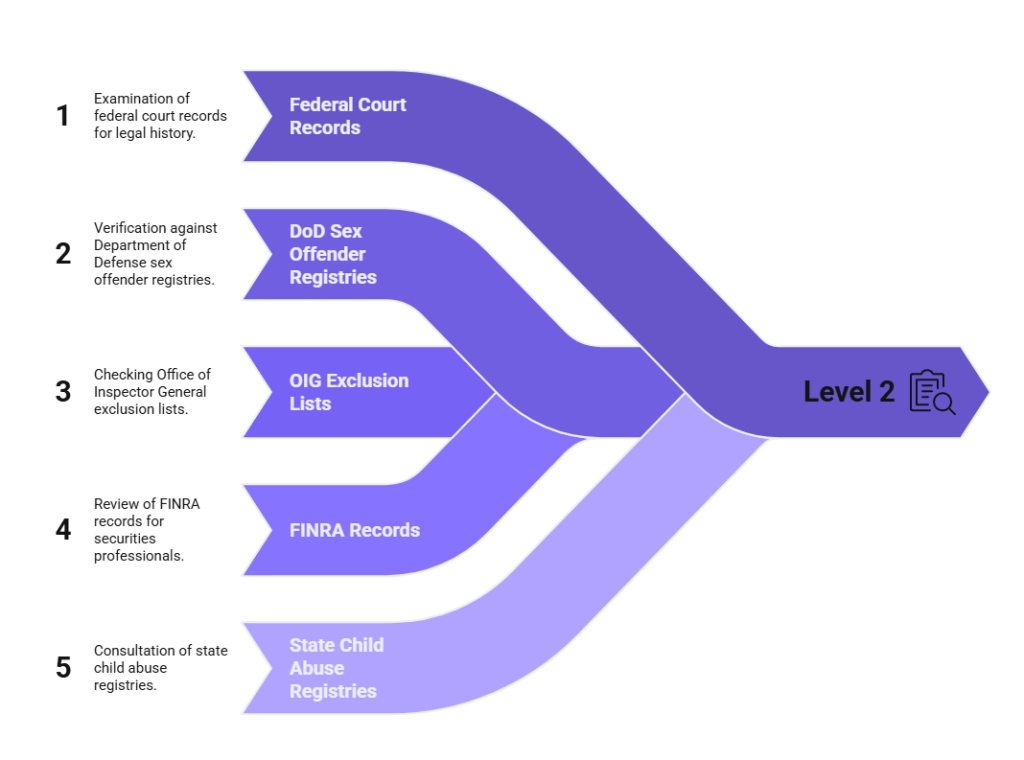
- Federal district court records
- Department of Defense sex offender registries
- Office of Inspector General exclusion lists for healthcare workers
- Financial Industry Regulatory Authority records for securities professionals
- State-specific repositories such as child abuse registries
The selection depends on the role's regulatory context and the populations or assets the employee will access.
Regulatory and Statutory Mandates for Level 2 Checks
Certain state laws and federal regulations require fingerprint-based or enhanced background checks for specific occupations. Florida law mandates Level 2 screening for employees and volunteers with direct contact with children, the elderly, or disabled persons in licensed facilities, including teachers, healthcare aides, and child care workers. California requires fingerprinting for various childcare, education, and healthcare roles, with results reviewed by the Department of Justice and FBI.
| Sector | Typical Regulatory Requirement | Authority |
| Education (K-12) | Fingerprint-based state and FBI checks | State education codes |
| Healthcare (licensed facilities) | OIG exclusion checks, fingerprinting | State health departments, CMS |
| Transportation/Security | TSA-mandated background checks | Federal aviation and port security laws |
| Financial services | FBI records review for certain positions | FDIC, state banking regulators |
Federal regulations impose similar requirements in contexts such as transportation security, healthcare (Medicare and Medicaid exclusion checks), and banking. Failure to comply with these mandates can result in licensure denial, civil penalties, or exclusion from government contracts.
Cost, Turnaround, and Operational Considerations
Fingerprinting adds logistical steps, including scheduling live-scan appointments or collecting ink fingerprint cards, transmitting prints to state and federal agencies, and awaiting responses that may take several days to weeks depending on agency workload and whether the applicant has prior records requiring manual review. This process increases both direct costs (FBI and state processing fees, fingerprinting service charges) and indirect costs (delayed start dates, administrative coordination).
Employers must weigh these costs against the risk reduction and compliance benefits. For high-risk roles, the investment is non-negotiable. For medium-risk positions, a hybrid approach may be practical, starting with Level 1 screening and escalating to Level 2 only when initial checks reveal gaps or when role responsibilities expand post-hire.
Matching Screening Depth to Role Risk: A Decision Framework
Risk Assessment Factors Beyond Job Titles
Job titles alone do not determine appropriate screening levels. Two "manager" roles in different departments may carry vastly different risk profiles. A hiring manager should evaluate the following factors:

- Access to vulnerable populations (children, elderly, disabled individuals, patients)
- Access to financial systems (cash handling, account access, procurement authority)
- Access to controlled substances (pharmaceuticals, laboratory chemicals)
- Access to confidential data (personnel records, trade secrets, customer information)
- Physical security authority (building access, alarm codes, key control)
Positions with supervisory authority over minors or authority to approve expenditures above defined thresholds warrant heightened scrutiny regardless of title. Roles requiring licensure (nursing, teaching, commercial driving) typically have statutory background check requirements that set a compliance floor, but employers may choose to exceed those minimums based on organizational risk tolerance.
Documenting Tiered Screening Policies
Employers should adopt written background check policies that define screening tiers, specify which roles fall into each tier, and explain the rationale. Documentation supports consistent application across hiring managers and departments, reduces the risk of discriminatory or arbitrary screening decisions, and provides a defensible basis if challenged by applicants or regulatory agencies.
Policies should reference applicable laws, such as state fingerprinting mandates or industry-specific regulations, and should be reviewed annually or when laws change. Training hiring managers and human resources staff on policy application, including how to escalate uncertain cases and how to conduct individualized assessments, is essential to effective implementation.
Balancing Cost, Speed, and Risk Mitigation
Tiered screening enables employers to allocate resources efficiently, reserving more expensive and time-consuming checks for roles where the risk justifies the investment. For high-volume, entry-level hiring, standardized Level 1 checks provide baseline assurance without delaying onboarding.
| Role Type | Recommended Tier | Rationale |
| Entry-level retail or food service | Level 1 | Low financial/access risk; supervised environment |
| Administrative staff (non-sensitive) | Level 1 | Limited data/system access |
| Financial or fiduciary roles | Level 2 | Access to funds, accounts, or purchasing authority |
| Healthcare or childcare roles | Level 2 (often mandated) | Regulatory compliance; vulnerable population contact |
| Security or facilities management | Level 2 | Building access; physical security responsibility |
Employers should also consider the competitive hiring environment. In tight labor markets, lengthy background check processes can cause candidates to accept other offers. Clear communication about expected timelines and reasons for screening helps manage candidate expectations and reinforces the employer's commitment to safety and compliance.
FCRA Compliance Across All Screening Levels
Authorization, Disclosure, and Consent Requirements
The Fair Credit Reporting Act requires employers to provide applicants with a clear and conspicuous written disclosure, separate from other documents, stating that a consumer report may be obtained for employment purposes. The applicant must then provide written authorization before the employer requests the report. These requirements apply equally to Level 1 and Level 2 checks, and to any screening that involves a consumer reporting agency.
Employers may not bury disclosure language in application forms, employee handbooks, or policy acknowledgments. The disclosure must be in a standalone document consisting solely of the disclosure, though it may include limited additional content directly related to the background check process, such as state-required notices or authorization language. Employers should consult legal counsel to ensure forms comply with FCRA's standalone disclosure requirement. Some states, such as California, impose additional disclosure requirements, including notice of investigative consumer report rights or salary history inquiry prohibitions, which must be integrated into compliant authorization forms.
Pre-Adverse and Final Adverse Action Notices
If an employer intends to take adverse action (declining to hire, rescinding an offer, terminating employment) based in whole or in part on information in a consumer report, FCRA mandates a two-step notice process:
Pre-Adverse Action Notice must include:
- A copy of the consumer report
- A summary of rights under FCRA
- Reasonable time for applicant to respond (typically 5–7 business days)
Final Adverse Action Notice must include:
- Name, address, and phone number of the consumer reporting agency
- Statement that the agency did not make the adverse decision
- Notice of the applicant's right to dispute the report's accuracy
- Notice of the right to obtain an additional free report within 60 days
After providing a reasonable period for the applicant to review the report, dispute inaccuracies, or provide context (typically five to seven business days, though some state laws specify longer periods), the employer may issue a final adverse action notice if the decision to take adverse action stands after considering any applicant response.
Individualized Assessment and Ban-the-Box Considerations
EEOC guidance instructs employers to conduct individualized assessments when criminal records appear, evaluating the nature and gravity of the offense, the time elapsed since conviction or completion of sentence, and the nature of the job sought. Automatic disqualification policies based on any conviction or arrest create disparate impact risks, as certain groups experience disproportionate contact with the criminal justice system.
Many states and municipalities have enacted ban-the-box laws that prohibit asking about criminal history on initial applications. Some jurisdictions also restrict the timing of criminal history inquiries, requiring employers to delay such questions until after an interview, a conditional offer, or another specified stage. Employers operating in multiple jurisdictions must comply with the most restrictive applicable law, verify the specific requirements in each jurisdiction where they hire, and train hiring personnel to avoid inadvertent inquiries during interviews or informal conversations.
State and Local Law Variations Affecting Screening Tiers
Fingerprinting Mandates and Exemptions
States vary widely in fingerprinting requirements. Some mandate fingerprinting for narrow categories (licensed healthcare providers, educators), while others require it for any role with access to vulnerable populations. Employers must identify applicable mandates by reviewing state occupational licensing statutes, child care regulations, and healthcare facility rules.
Exemptions sometimes apply to volunteers, temporary employees, or roles with limited contact hours, but relying on exemptions without legal review is risky. Misclassifying an employee as exempt can result in licensure violations, fines, or civil liability if an incident occurs and the screening deficiency contributed to the harm.
Lookback Period Limits and Conviction vs. Arrest Reporting
FCRA generally limits reporting of criminal convictions and other adverse information to seven years for positions with salaries under $75,000. For positions with salaries of $75,000 or more, there is no time limit on reporting convictions. FCRA limits reporting of arrests not resulting in conviction to seven years, subject to salary and other exceptions. Many states, including California, New York, and others, impose stricter rules, prohibiting reporting of arrests that did not result in conviction, dismissed charges, expunged records, or sealed records entirely, regardless of timeframe. Employers must ensure consumer reporting agencies comply with both FCRA and the most restrictive applicable state law.
Using a national vendor does not eliminate the employer's independent compliance obligations under FCRA and state law. Employers remain responsible for obtaining proper authorization, providing required notices, and ensuring they do not use reports containing information prohibited by applicable law. Consumer reporting agencies are separately responsible for maintaining reasonable procedures to ensure maximum possible accuracy and for excluding information that cannot legally be reported.
Credit Check and Salary History Prohibitions
Several states and cities restrict or ban employment-related credit checks except for roles with financial responsibilities or fiduciary duties. Where credit checks are part of a Level 2 screening package, employers must confirm that the role meets the statutory exception and that the applicant received the required notices.
Salary history inquiry bans, while not background checks per se, often intersect with application and screening policies. Employers designing tiered screening processes should integrate these prohibitions into overall hiring compliance frameworks to avoid piecemeal policy gaps.
Practical Implementation: Building a Compliant Tiered Screening Program
Engaging Consumer Reporting Agencies and Reviewing Service Offerings
Employers should solicit detailed service descriptions from prospective consumer reporting agencies, comparing not only price and turnaround but also data sources, accuracy measures, dispute resolution processes, and compliance support. A package from one vendor might include certain criminal record searches and identity verification, while another's offering may add employment verifications, education checks, or other searches. Employers must review the specific searches included in each package and compare them against legal requirements and role-specific risks. Contracts should specify which searches constitute each screening tier, define update frequencies for database searches, and allocate responsibility for adverse action notice generation and record retention.
Periodic audits of consumer reporting agency performance, including sample report reviews and accuracy checks, help identify data quality issues before they affect hiring decisions. Employers should also confirm that vendors carry adequate errors and omissions insurance and maintain compliance with industry standards, though care should be taken not to rely on third-party certifications as substitutes for independent due diligence.
Training Hiring Managers and HR Teams
Consistent policy application depends on training personnel who make screening decisions. Training should cover:
- The distinction between screening levels
- Legal requirements for each tier
- How to interpret common report elements (dispositions, case statuses, sealed records)
- How to conduct individualized assessments without bias
Scenario-based training helps hiring managers practice applying policy to ambiguous situations, such as old convictions for non-violent offenses, out-of-state records with incomplete information, or candidates who disclose criminal history proactively. Documenting training completion and updating materials when laws change supports both compliance and organizational learning.
Record Retention and Audit Trails
Employers must retain background check records, authorization forms, adverse action notices, and individualized assessment documentation in compliance with EEOC recordkeeping rules, which generally require retention of applicant records for one year from the date of hire or rejection, and employee records for one year from termination or as otherwise required if a discrimination charge is filed. State and industry-specific retention mandates may impose longer periods, and employers should verify applicable requirements. Organizing records by screening tier facilitates audits, litigation response, and policy reviews.
Audit trails should capture who requested each report, when authorization was obtained, which screening tier was applied, and the justification for any deviations from standard policy. This transparency supports defensibility in discrimination claims, regulatory inquiries, or negligent hiring lawsuits.
Conclusion
Background screening decisions play an important role in protecting organizations, as well as promoting fair hiring practices. With increasing diversity in workforce roles, it is important to consider a structured approach to designing background screening. Level 1 vs level 2 background checks represent a flexible, risk-based approach to employment screening, but their non-standardized nature requires employers to define tiers clearly, align them with role risks and regulatory mandates, and apply them consistently. Compliance with FCRA, state laws, and equal employment opportunity principles is mandatory at every screening level, demanding careful vendor selection, policy documentation, and personnel training.
Frequently Asked Questions
What is the main difference between level 1 and level 2 background checks?
Level 1 typically involves name-based criminal record searches, identity verification, and basic employment or education checks, while Level 2 generally adds fingerprint-based FBI record searches, extended database coverage, or specialized registries. These terms are not legally standardized, so definitions vary by employer, vendor, and jurisdiction.
Are level 1 and level 2 background checks legally defined terms?
No. Federal law, including the Fair Credit Reporting Act, does not define screening "levels." Some state agencies and licensing boards use these terms in regulations, but most employers adopt tiered screening frameworks based on internal risk assessments and industry practices.
When is a level 2 background check required?
Level 2 checks are typically required by state law or regulation for roles involving direct contact with vulnerable populations, such as children, elderly individuals, or patients in healthcare settings. Some industries, like transportation, banking, and education, also mandate fingerprinting or enhanced screening for specific positions.
Can an employer use different screening levels for different jobs?
Yes, provided the distinctions are based on legitimate, documented risk factors related to job duties and applied consistently. Employers should avoid using screening tiers in ways that create disparate impact on protected groups and must comply with FCRA and state anti-discrimination laws.
Do level 1 background checks include fingerprinting?
Typically no. Fingerprinting is most commonly associated with Level 2 or enhanced screening. Level 1 checks usually rely on name-based searches of criminal databases, which do not require biometric identification.
How long do level 2 background checks take?
Turnaround depends on fingerprint processing times, which vary by state and federal agency workload. Results may return in a few days for applicants with no record but can take several weeks if matches require manual review or if records are requested from multiple jurisdictions.
What are the cost differences between level 1 and level 2 background checks?
Level 2 checks cost more due to fingerprinting fees, FBI database access charges, and extended data source searches. Exact costs vary by vendor and jurisdiction, but employers should expect Level 2 screening to involve both higher direct fees and longer processing times.
Can job applicants dispute the results of level 1 or level 2 background checks?
Yes. Under FCRA, applicants have the right to dispute inaccurate or incomplete information in consumer reports. Employers must provide pre-adverse action notice with a copy of the report and allow applicants time to contest findings before making final hiring decisions.
Additional Resources
- A Summary of Your Rights Under the Fair Credit Reporting Act
https://www.ftc.gov/legal-library/browse/statutes/fair-credit-reporting-act - EEOC Enforcement Guidance on the Consideration of Arrest and Conviction Records
https://www.eeoc.gov/laws/guidance/arrest_conviction.cfm - FBI Criminal Justice Information Services Division
https://www.fbi.gov/services/cjis - U.S. Department of Labor: Background Checks and Your Job
https://www.dol.gov/general/topic/hiring/background-checks - National Conference of State Legislatures: Employment Background Checks State Laws
https://www.ncsl.org/research/labor-and-employment/background-checks.aspx

ABOUT THE CREATOR
GCheck Editorial Team
Meet the GCheck Editorial Team, your trusted source for insightful and up-to-date information in the world of employment background checks. Committed to delivering the latest trends, best practices, and industry insights, our team is dedicated to keeping you informed.
With a passion for ensuring accuracy, compliance, and efficiency in background screening, we are your go-to experts in the field. Stay tuned for our comprehensive articles, guides, and analysis, designed to empower businesses and individuals with the knowledge they need to make informed decisions.
At GCheck, we're here to guide you through the complexities of background checks, every step of the way.