

Organizations hiring interns face evolving compliance obligations that require structured background screening policies tailored to student candidates. Internship background check requirements depend on employment classification, role responsibilities, and jurisdictional regulations, with federal FCRA standards applying to most paid intern positions processed through consumer reporting agencies.
Key Takeaways
- Paid interns typically qualify as employees under FCRA, requiring full disclosure, authorization, and adverse action compliance when using third-party screening services.
- Unpaid interns may fall outside certain employment law definitions, but screening them still requires lawful basis, proportionate scope, and respect for state restrictions.
- Screening minors (under 18) introduces additional consent, record limitation, and state-specific requirements that differ materially from adult candidate processes.
- State and local laws, including Ban the Box ordinances and marijuana screening restrictions, apply to intern hiring and vary significantly across jurisdictions.
- Proportionate screening frameworks match check types to role risk, access level, and duration, avoiding over-screening for limited-term positions.
- Adverse action procedures are mandatory when background findings lead to offer rescission, regardless of intern status or offer informality.
- Operational integration requires embedding screening into compressed onboarding timelines, typically 2 to 4 weeks between offer acceptance and start date.
- Common misconceptions create compliance gaps and unnecessary risk exposure for organizations.
Understanding Internship Background Check Requirements Across Employment Types
The term "intern" encompasses multiple employment classifications, each carrying distinct legal implications for background screening. Organizations must differentiate between these categories to establish appropriate screening protocols and ensure compliance with applicable statutes.
| Intern Type | Compensation | Typical Employee Status | FCRA Applicability |
| Paid Intern | Wages or salary | Generally classified as employee | Yes, when using CRA |
| Credit-Bearing Intern | Academic credit only | Varies by jurisdiction and DOL test | Depends on classification |
| Unpaid Intern | None (meets DOL primary beneficiary test) | Typically not employee | May not apply, but other laws govern |
| Co-op Student | Paid during work rotation | Employee during work terms | Yes, when using CRA |
| Volunteer Intern | None (nonprofit setting) | Volunteer, not employee | Volunteer screening statutes apply |
Paid interns who receive wages or salary are generally classified as employees under federal and state labor laws, triggering full compliance obligations under the Fair Credit Reporting Act when screening is conducted through a consumer reporting agency. Unpaid interns participating in programs that satisfy DOL's primary beneficiary test for FLSA wage-and-hour purposes may not be classified as employees under federal labor standards, though their status under state employment laws, anti-discrimination statutes, and screening regulations varies by jurisdiction. Screening unpaid interns still requires a permissible purpose and adherence to applicable privacy and discrimination laws.
Determining Employment Status for Screening Purposes
Organizations should assess intern classification using both federal DOL guidance and applicable state law tests. The DOL's primary beneficiary test evaluates factors such as whether the intern displaces regular employees, whether the employer derives immediate advantage from intern activities, and whether the intern understands the position is unpaid. State labor departments may apply additional criteria. Employment status affects which laws govern the screening process, the scope of permissible inquiries, and the procedural requirements for authorization and notice.
Role Duration and Screening Proportionality
Internships typically last 8 to 12 weeks for summer programs, though some extend to full academic years or multiple terms. Duration influences proportionate screening decisions. Short-term positions may warrant streamlined screening focused on identity verification and role-specific risk factors. Extended internships often justify more comprehensive checks aligned with the depth of responsibilities. Year-long programs typically require screening comparable to entry-level employee protocols. Organizations should establish tiered screening protocols that account for position length, responsibility level, and data access.
FCRA Applicability to Intern Screening Programs
When an organization engages a third-party consumer reporting agency (CRA) to obtain background reports on intern candidates, FCRA compliance becomes mandatory. Internal checks conducted without using a CRA are not subject to FCRA but may be governed by state privacy, defamation, and anti-discrimination laws.
The statute requires employers to:
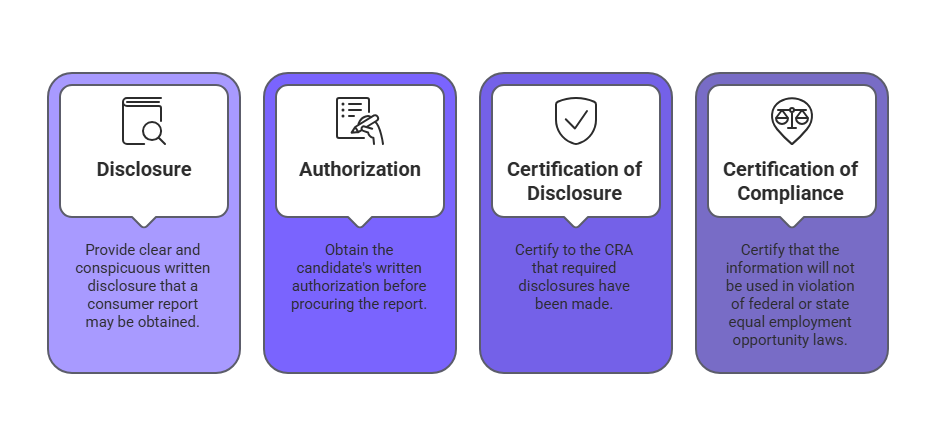
- Provide clear and conspicuous written disclosure that a consumer report may be obtained
- Obtain the candidate's written authorization before procuring the report
- Certify to the CRA that required disclosures have been made
- Certify that the information will not be used in violation of federal or state equal employment opportunity laws
The disclosure must be standalone, meaning it cannot be embedded in employment applications or combined with liability waivers, arbitration agreements, or other extraneous content. Many organizations violate this requirement inadvertently by including background check authorization language within broader onboarding packets. Authorization must be voluntary and informed.
Adverse Action Requirements Under FCRA
If background findings prompt an organization to take adverse action, such as rescinding an internship offer or terminating an intern, FCRA mandates a two-step process:
Pre-Adverse Action Phase:
- Provide copy of the consumer report
- Include summary of rights under FCRA
- Allow reasonable period (commonly five business days) for candidate to dispute inaccuracies
Final Adverse Action Phase:
- Specify that the action was taken based on the report
- Identify the CRA that furnished the report
- Clarify that the CRA did not make the decision
- Inform candidate of right to obtain additional free copy within 60 days
Organizations often mistakenly assume intern offers are informal enough to bypass adverse action procedures. This assumption is incorrect and exposes employers to regulatory enforcement and private litigation risk.
State FCRA Analogs and Enhanced Requirements
Several states have enacted consumer reporting statutes that impose requirements beyond federal FCRA. California's Investigative Consumer Reporting Agencies Act extends protections to investigative reports and includes specific disclosure and authorization requirements. New York's Article 23-A requires employers to consider enumerated factors before denying employment based on criminal history. Minnesota restricts the use of arrest records that did not result in conviction. Organizations operating multi-state intern programs must identify the most restrictive jurisdictional requirements and apply them consistently.
Paid Versus Unpaid Interns: Where Legal Obligations Diverge
The distinction between paid and unpaid interns affects not only wage and hour compliance but also the applicability of employment-related screening statutes.
| Obligation Category | Paid Interns | Unpaid Interns |
| FCRA Compliance | Required when using CRA | May not apply, depending on classification |
| Title VII Coverage | Generally covered (employers with 15+ employees) | May not be covered |
| State Fair Employment Laws | Typically apply | Often excluded, but varies by state |
| Ban the Box Requirements | Usually apply | Some jurisdictions extend to unpaid roles |
| Permissible Purpose Requirement | FCRA employment purpose | Still requires lawful justification |
Paid interns who receive monetary compensation are generally subject to FCRA when employers use consumer reporting agencies for screening. They may also be covered by state fair employment laws and, for employers with 15 or more employees, federal anti-discrimination statutes such as Title VII of the Civil Rights Act of 1964.
Establishing Permissible Purpose for Unpaid Intern Screening
Organizations must establish a lawful basis for obtaining background information, even when FCRA does not apply. Legitimate business interests generally provide sufficient justification, including protecting clients from foreseeable harm, safeguarding sensitive data, complying with industry regulations, or ensuring workplace safety. Organizations should document the rationale for screening unpaid interns, particularly when the screening scope includes criminal history or credit checks.
Volunteer and Intern Screening Statutes
Several states have enacted statutes authorizing or regulating background checks for volunteers, particularly those working with vulnerable populations. Florida Statutes Section 435 governs screening for personnel in positions of trust with vulnerable populations and may apply to certain unpaid interns in healthcare or social services settings. Pennsylvania's Child Protective Services Law requires background clearances for volunteers who have direct contact with children. Organizations should evaluate whether state volunteer screening laws apply based on role responsibilities and organizational sector.
State and Local Regulatory Variation in Intern Background Screening
Intern background screening is subject to a patchwork of state and local laws that limit the types of information employers may consider, mandate procedural steps, and impose recordkeeping obligations.
Key Regulatory Categories:
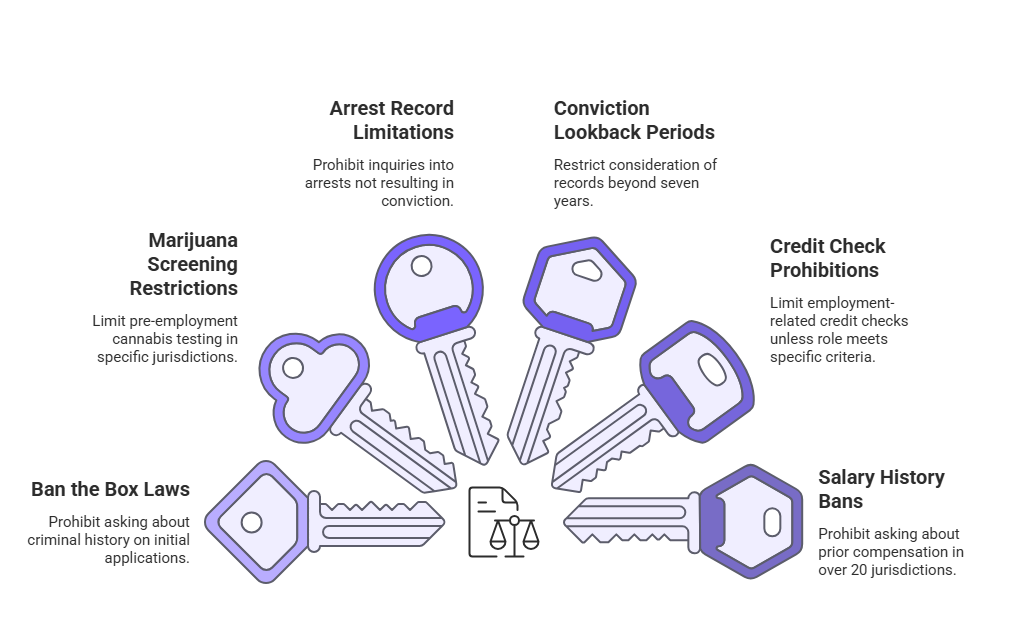
- Ban the Box laws: Prohibit asking about criminal history on initial applications in numerous states and municipalities
- Marijuana screening restrictions: Limit pre-employment cannabis testing in Nevada, New Jersey, New York City, and other jurisdictions
- Arrest record limitations: Prohibit inquiries into arrests not resulting in conviction in several states
- Conviction lookback periods: Restrict consideration of records beyond seven years in multiple jurisdictions
- Credit check prohibitions: Limit employment-related credit checks in at least 15 states unless role meets specific criteria
- Salary history bans: Prohibit asking about prior compensation in over 20 jurisdictions
Ban the Box laws, which prohibit asking about criminal history on initial applications, have been enacted in numerous states and municipalities across the United States. These laws vary significantly in scope, with some applying only to public employers and others extending to private-sector hiring, including internships.
Arrest Record and Conviction Limitations
Several states, including California, Hawaii, Massachusetts, and others, restrict or prohibit employer consideration of arrest records that did not result in conviction, with exceptions varying by jurisdiction and role type. Employers should verify current requirements in each state where they hire. Conviction record limitations vary widely. Philadelphia limits consideration of convictions more than seven years old unless the offense relates directly to job duties. New York requires individualized assessments under Correction Law Article 23-A.
Lookback Period Limits
The Fair Credit Reporting Act generally limits reporting of most adverse information to seven years. Federal FCRA permits criminal convictions to be reported indefinitely, but several states impose stricter lookback periods. Employers must comply with the more restrictive standard applicable in the candidate's jurisdiction. Organizations must confirm CRA compliance with applicable state lookback rules and ensure screening policies do not consider information beyond permissible timeframes.
Credit History and Salary History Bans
At least ten states, including California, Colorado, Connecticut, Hawaii, Illinois, Maryland, Nevada, Oregon, Vermont, and Washington, have enacted laws restricting employment-related credit checks as of recent legislative sessions. Employers should verify current law in each jurisdiction, as this area is subject to frequent legislative activity. Internships involving financial management, accounting, or access to payment systems may fall within permissible use categories, but organizations should evaluate each role individually. Salary history bans prohibit asking candidates about prior compensation and generally extend to intern candidates.
Marijuana Screening Restrictions
Nevada, New Jersey, and New York City have enacted laws restricting pre-employment marijuana testing, with exceptions that vary by jurisdiction and typically include safety-sensitive positions, federal contractors, and roles subject to DOT or other federal testing requirements. Employers should verify current law and applicable exceptions in each hiring location.
Screening Minors: Additional Requirements for Under-18 Interns
High school internship programs, early college initiatives, and summer youth employment programs often involve candidates under 18 years of age. Screening minors introduces additional consent, record limitation, and procedural requirements.
Key Compliance Considerations:
- Dual consent requirement: Most states require written authorization from both the minor applicant and a parent or legal guardian
- Juvenile record restrictions: Sealed or expunged juvenile adjudications are generally inaccessible and prohibited from consideration
- State-specific confidentiality protections: Juvenile records are subject to heightened privacy rules under state law
- Work permit verification: State-issued work permits may satisfy some screening objectives
Juvenile records are subject to heightened confidentiality protections under state law. Many jurisdictions seal or expunge juvenile adjudications automatically upon the individual reaching adulthood. Employers are generally prohibited from accessing or considering sealed juvenile records.
Child Labor Law Intersections
Federal and state child labor laws regulate the hours, conditions, and types of work minors may perform. While these laws primarily govern wage and hour compliance, they also affect screening decisions. State-issued work permits, required in many jurisdictions for minors under 18, serve as a form of preliminary eligibility verification. Organizations should integrate work permit verification into intern onboarding checklists rather than duplicating inquiries.
Parental Consent Best Practices
Organizations should develop minor-specific consent forms that clearly explain the types of information that will be obtained, how it will be used, and the rights of both the minor and the consenting parent or guardian. Consent forms should specify the parent or guardian's relationship to the minor and include signature lines for both parties. Consent must be obtained before initiating any background check.
Proportionate Screening: Matching Check Types to Intern Role and Access
Not every intern requires identical screening depth. Proportionate screening frameworks balance risk mitigation with candidate experience, cost efficiency, and legal compliance by tailoring check types to role-specific factors.
| Risk Level | Role Characteristics | Recommended Screening Components |
| Minimal Access | No confidential data, vulnerable populations, or financial systems | Identity verification, education enrollment confirmation |
| Moderate Access | Internal communications, HR administrative tasks, non-sensitive data | Identity verification, education confirmation, criminal history (relevant convictions only) |
| High Access / Sensitive | System administrator privileges, PHI access, financial responsibilities, minor interaction | Comprehensive screening: identity, education, criminal history, employment verification, reference checks |
Organizations should establish tiered screening protocols that categorize intern roles into risk levels. A marketing intern reviewing public-facing content presents different risk considerations than a finance intern accessing customer payment information or a healthcare intern interacting with patients.
Criminal History Screening Scope
Criminal history checks for interns should be narrowly tailored to risks directly related to role responsibilities. Blanket disqualification policies that automatically exclude candidates with any criminal history are legally problematic under EEOC guidance and state fair chance laws. Organizations should identify specific offense categories relevant to each role, such as fraud convictions for financial responsibilities, violence convictions for vulnerable population roles, computer crimes for data security roles, and DUI convictions for transportation duties.
Education Verification for Current Students
Education verification for intern candidates presents unique considerations because most interns are currently enrolled rather than degree holders. Verification should confirm current enrollment status, academic standing if relevant to eligibility requirements, and anticipated graduation date. Educational institutions typically require signed student consent before releasing academic records to third parties.
Adverse Action Procedures for Intern Candidates
When background screening reveals information that leads an organization to rescind an internship offer or terminate an intern, FCRA's adverse action requirements apply. Failure to follow these procedures exposes organizations to regulatory penalties and private litigation.
Required Pre-Adverse Action Elements:
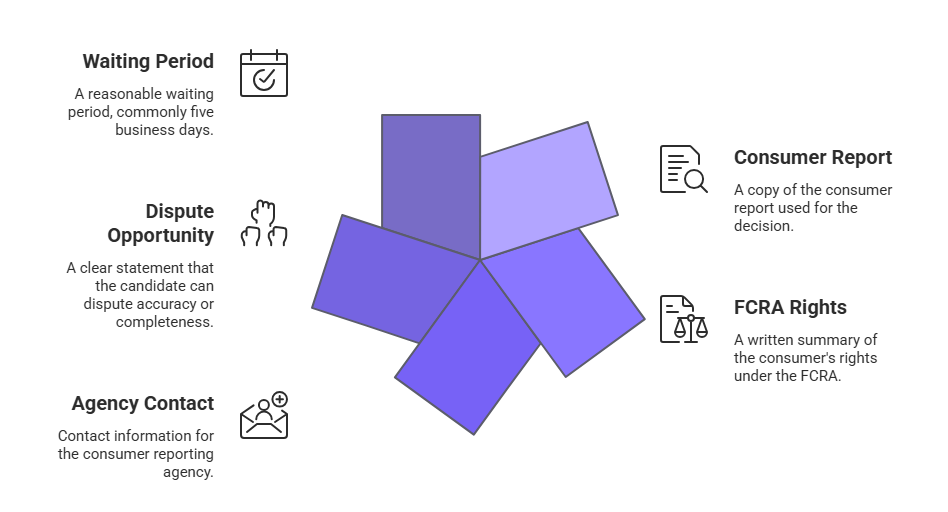
- Copy of the consumer report on which the decision is based
- Written summary of FCRA rights
- Contact information for the consumer reporting agency
- Clear statement that candidate has opportunity to dispute accuracy or completeness
- Waiting period of reasonable duration (commonly five business days)
Organizations must allow the waiting period for candidates to respond. This timeframe is mandatory and cannot be shortened or waived.
Individualized Assessments and EEOC Guidance
Equal Employment Opportunity Commission guidance issued in 2012 clarifies that blanket exclusions based on criminal history may result in disparate impact discrimination. Employers should conduct individualized assessments that consider the nature and gravity of the offense, the time elapsed since the conviction, and the nature of the job sought. While EEOC guidance applies to Title VII enforcement and interns may or may not be covered depending on employer size, applying individualized assessment principles reduces legal risk and aligns with fair chance laws in many states.
Operational Integration: Embedding Screening Into Intern Onboarding Workflows
Internship programs often operate on compressed timelines, with offers extended and accepted during campus recruiting events and start dates occurring within two to four weeks. Organizations must design onboarding workflows that account for realistic turnaround times, contingent start protocols, and fallback procedures when screening cannot be completed by the scheduled start date. Consent collection should occur immediately upon offer acceptance, ideally through electronic systems.
Turnaround Time Expectations
Typical background check completion timeframes vary based on check types and jurisdictional record access. Identity verification takes 1 to 2 business days. Education enrollment confirmation takes 3 to 7 business days, longer during peak academic periods. Criminal history checks using electronic databases take 2 to 5 business days, while manual courthouse retrieval takes 10 to 14 business days. International checks take 15 to 30 business days or longer. Organizations should establish realistic internal deadlines that account for potential delays.
Contingent Start Protocols
Some organizations implement contingent start protocols, allowing interns to begin work provisionally while background checks are in progress, provided certain lower-risk checks are complete. Contingent start policies must include clear terms regarding what happens if adverse information is discovered after the intern has started. These policies should comply with FCRA adverse action requirements. Contingent starts are generally inadvisable for roles involving access to sensitive data, vulnerable populations, or financial systems.
International Student Considerations
International students interning in the United States present additional verification challenges, including limited or no U.S. criminal history, foreign credential evaluation, and work authorization confirmation. U.S. education records for international students are protected under FERPA and require the student's written consent before release to employers. Organizations should coordinate background screening with I-9 employment eligibility verification and confirm that CRAs have capability to conduct international checks if deemed necessary.
Common Misconceptions and Policy Gaps in Intern Screening Programs
Several persistent misconceptions about intern background screening create compliance gaps and unnecessary risk exposure.
Widespread Misconceptions:
- Myth: Unpaid interns do not require background checks
- Reality: Lawful justification and compliance with privacy and discrimination laws still apply
- Myth: College students lack criminal history, making screening pointless
- Reality: Individuals aged 18 to 24 have among the highest rates of criminal justice system contact
- Myth: Education verification is redundant for current students
- Reality: Verification confirms major, graduation date, and detects resume fraud
- Myth: Adverse action procedures are unnecessary for informal intern offers
- Reality: FCRA requirements apply regardless of role duration, formality, or compensation
- Myth: A single national policy suffices for multi-state programs
- Reality: State and local law variation requires jurisdictional compliance review
Organizations running national intern programs often implement centralized policies that fail to account for state and local law variation. A single-policy approach may violate Ban the Box ordinances in some cities, marijuana testing restrictions in some states, and credit check limitations in others. Organizations should conduct jurisdiction-specific compliance reviews and implement location-based screening protocols or apply the most restrictive requirements universally.
Conclusion
Internship background check requirements have matured into a compliance discipline requiring structured policies, jurisdictional awareness, and proportionate risk assessment. Organizations must navigate FCRA obligations, state and local restrictions, and the practical realities of screening candidates with limited history while maintaining fair, transparent, and legally defensible processes.
Frequently Asked Questions
Do companies background check interns, or is screening limited to full-time employees?
Many organizations conduct background checks on interns, particularly for paid positions or roles involving data access, vulnerable populations, or financial responsibilities. Screening practices vary based on industry, risk assessment, and organizational policy. Internship status does not exempt candidates from background screening when justified by role requirements.
Are unpaid interns subject to the same background check requirements as paid employees?
Unpaid interns may not qualify as employees under certain statutes, but screening them still requires lawful justification, appropriate consent, and compliance with privacy and anti-discrimination laws. Some states extend employment screening protections to unpaid positions.
What types of background checks are appropriate for college student interns?
Appropriate check types depend on role responsibilities, access level, and risk factors. Common checks include identity verification, education enrollment confirmation, and criminal history limited to convictions relevant to workplace safety or data security. Organizations should tailor check scope to position-specific risks.
How do internship background check requirements differ for minors under 18?
Screening minors requires parental or guardian consent in most states. Organizations must comply with restrictions on accessing juvenile records, which are often sealed or confidential. Work permit verification should be integrated into screening workflows for under-18 interns.
What is the typical turnaround time for completing an intern background check?
Most background checks for interns are completed within three to seven business days, though timelines vary based on check types, jurisdiction, and record access. Organizations should allow sufficient time between offer acceptance and start date to accommodate potential delays.
Are adverse action procedures required if an internship offer is rescinded based on background check results?
Yes, FCRA adverse action requirements apply when an employer uses a consumer report obtained through a CRA to make an employment decision, including rescinding internship offers. Organizations must provide pre-adverse action notice, a copy of the report, a summary of rights, a reasonable waiting period, and final adverse action notice.
Can organizations use the same background check policy for interns in multiple states?
Organizations may use a single policy if it complies with the most restrictive state and local requirements applicable to their intern population. Alternatively, organizations can implement jurisdiction-specific protocols that account for varying state and local requirements.
What are the most common compliance mistakes employers make when screening interns?
Common mistakes include failing to provide standalone FCRA disclosure and authorization forms, omitting adverse action procedures, applying blanket disqualification rules without individualized assessment, and using uniform policies that violate state or local restrictions in some jurisdictions.
Additional Resources
- Fair Credit Reporting Act (FCRA) – Full Text and Summary
https://www.ftc.gov/legal-library/browse/statutes/fair-credit-reporting-act - Using Consumer Reports: What Employers Need to Know (FTC)
https://www.ftc.gov/business-guidance/resources/using-consumer-reports-what-employers-need-know - EEOC Guidance on Arrest and Conviction Records
https://www.eeoc.gov/laws/guidance/arrest-and-conviction-records - Department of Labor Fact Sheet: Internship Programs Under the FLSA
https://www.dol.gov/agencies/whd/fact-sheets/71-flsa-internships - State-by-State Ban the Box Laws and Fair Chance Hiring (National Employment Law Project)
https://www.nelp.org/ - Child Labor Provisions of the Fair Labor Standards Act (DOL)
https://www.dol.gov/agencies/whd/child-labor

ABOUT THE CREATOR
GCheck Editorial Team
Meet the GCheck Editorial Team, your trusted source for insightful and up-to-date information in the world of employment background checks. Committed to delivering the latest trends, best practices, and industry insights, our team is dedicated to keeping you informed.
With a passion for ensuring accuracy, compliance, and efficiency in background screening, we are your go-to experts in the field. Stay tuned for our comprehensive articles, guides, and analysis, designed to empower businesses and individuals with the knowledge they need to make informed decisions.
At GCheck, we're here to guide you through the complexities of background checks, every step of the way.