

Federal background checks for government positions generally range from approximately 30 days for basic suitability reviews to 18 months or longer for Top Secret clearances, though actual timelines vary based on individual circumstances and agency workload. Timeline variability is driven by investigative depth, applicant history complexity, and agency processing capacity. The Defense Counterintelligence and Security Agency (DCSA) has modernized significant portions of the process through continuous vetting and automated records checks. However, human-intensive verification stages remain the primary bottleneck affecting both government hiring and private sector contractors supporting federal missions.
Key Takeaways
- Standard federal employment background checks (Tier 1) typically complete within 30 to 45 days for straightforward applicant profiles without international history or credit complications.
- Secret clearance investigations often average 90 to 180 days, while Top Secret clearances frequently extend 12 to 18 months or longer depending on investigative complexity and DCSA workload.
- Continuous vetting programs introduced by DCSA have reduced reinvestigation burdens but do not accelerate initial clearance timelines for first-time applicants.
- Incomplete or inaccurate SF-86 forms represent the leading cause of clearance delays, often adding 60 to 90 days to processing timelines when investigators must request clarifications.
- Government contractors face dual-layer screening requirements including company-level employment checks and position-specific clearance investigations that run concurrently but complete on independent schedules.
- Private sector employers can adapt federal screening principles for their own processes, with many standard employment background checks completing within 7 to 14 days for routine cases, though timelines vary by screening scope and applicant history.
- Applicant transparency regarding foreign contacts, financial issues, and employment gaps measurably reduces investigation timelines by eliminating time-consuming clarification cycles.
- Federal agencies prioritize critical-need positions through expedited processing tracks. These remain limited to mission-essential roles with documented operational urgency.
Understanding Federal Background Check Tiers and Their Timelines
The Federal Investigative Standards Framework
Federal background checks operate under a tiered structure established by the Office of Personnel Management (OPM). The Defense Counterintelligence and Security Agency currently administers these for security clearances. Position sensitivity levels determine which tier applies and what the investigative scope will include.
Tier 1 investigations support basic employment suitability decisions for low-risk positions. These typically involve automated database checks against criminal records, credit history, and employment verification. Tier 3 investigations underpin Secret clearances, while Tier 5 investigations support Top Secret access.
| Tier Level | Clearance Type | Typical Timeline | Primary Use Cases |
| Tier 1 | Suitability Only | 30-45 days | Low-risk federal positions, administrative roles |
| Tier 3 | Secret | 90-180 days | Moderate-risk positions, classified information access |
| Tier 5 | Top Secret | 12-18 months | High-risk positions, extensive classified access |
Each tier requires specific investigative steps. These include the number of references contacted, geographic scope of records checks, and whether in-person interviews occur. Processing timelines connect directly to investigative depth rather than agency efficiency alone. Timelines shown represent general ranges based on recent reported averages and may vary significantly based on individual case factors, agency capacity, and investigative findings.
Position Risk Designation and Screening Depth
Federal positions receive risk designations based on potential damage from occupant misconduct. Low, Moderate, and High designations drive background check tier selection. These categories create processing differences across similar job titles.
Low-risk positions such as administrative support roles in non-sensitive agencies typically require Tier 1 investigations. High-risk positions involving national security information, law enforcement authority, or access to critical infrastructure mandate Tier 3 or Tier 5 investigations. Applicants cannot influence the designation system, but understanding these categories explains timeline variation between similar opportunities.
Private sector employers adapting federal screening models should consider similar risk-based approaches. Positions with financial authority, access to proprietary information, or regulatory compliance duties warrant more thorough screening. Entry-level roles with limited system access require less intensive review, even when timelines remain compressed compared to government standards.
The SF-86 Form and Its Impact on Processing Speed
Security clearance investigations begin with Standard Form 86 (SF-86). This detailed questionnaire documents 10 years of residences, employment, foreign contacts, and personal conduct. How complete and accurate this form is directly influences investigation timelines.
Incomplete forms trigger automatic returns to applicants. This adds 14 to 30 days before investigations formally start. When investigators find differences between SF-86 entries and their findings, clarification interviews become necessary, extending timelines by 60 to 90 days in complex cases. Common SF-86 errors include:
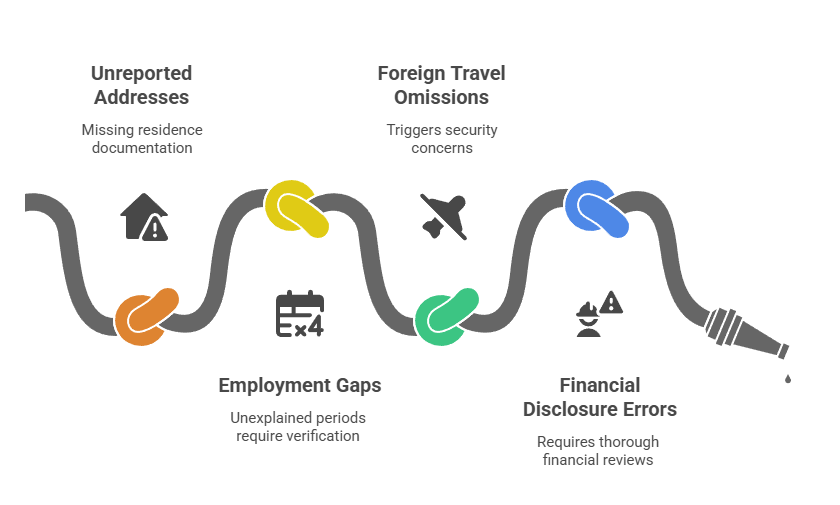
- Unreported addresses: Frequent relocations often result in missing residence documentation that investigators typically need to reconcile
- Employment gaps: Unexplained periods between jobs require detailed explanations and verification attempts for informal work arrangements
- Foreign travel omissions: Incomplete international travel records trigger security concerns requiring additional investigation
- Financial disclosure errors: Unreported debts, bankruptcies, or tax issues discovered during credit checks require thorough financial reviews
Applicants who carefully document their history and openly share potentially concerning information enable faster processing. Those who leave out details hoping to avoid scrutiny create delays when investigators discover gaps.
DOD Background Check and Security Clearance Timelines
Secret Clearance Processing Realities
Secret clearance investigations under Tier 3 standards have recently averaged between 90 and 180 days according to DCSA reporting, though individual cases vary considerably. The investigation includes national agency checks against FBI criminal databases and credit bureaus.
Written requests go to former employers and schools. Investigators interview listed references and verify five years of applicant history rather than the ten years required for Top Secret clearances. Timeline factors include where applicants lived, how quickly employers respond to verification requests, and whether references are available.
Applicants who lived at many addresses or worked for multiple employers face longer timelines. Companies that closed or lack working HR departments create verification delays. References who travel often or prove difficult to schedule extend interview phases.
Top Secret and Sensitive Compartmented Information Clearances
Top Secret clearances require Tier 5 investigations examining ten years of applicant history. In-person subject interviews, thorough reference interviews, and expanded records checks are mandatory. Recent DCSA performance data shows these investigations have averaged 12 to 18 months, with significant variation by case.
Applicants with extensive foreign travel, relatives abroad, major financial issues, or gaps in verifiable history routinely exceed 18 months. Adding Sensitive Compartmented Information (SCI) access requires additional security-focused screening conducted by individual agencies.
SCI processing adds 60 to 120 days beyond Top Secret clearance completion. The combined timeline for Top Secret/SCI access can approach 24 months for applicants with complex backgrounds. Extended timelines reflect the investigative thoroughness necessary for positions with access to highly classified information.
Continuous Vetting and Reinvestigation Modernization
DCSA's continuous vetting program monitors cleared personnel through automated checks. Criminal databases, financial records, and government systems are reviewed rather than conducting periodic reinvestigations every 5 to 10 years. This model reduces reinvestigation workload and spots concerning conduct in near-real-time.
However, continuous vetting applies only to personnel who already hold clearances. It does not speed up initial investigations for first-time applicants. Reinvestigations for existing clearance holders now occur on risk-based schedules rather than fixed intervals.
| Monitoring Type | Frequency | Applies To | Impact on Initial Clearance |
| Continuous Vetting | Real-time automated checks | Current clearance holders | Does not accelerate first-time applications |
| Periodic Reinvestigation | Risk-based (varies) | Cleared personnel with alerts | Reduces workload for clean records |
| Initial Investigation | One-time comprehensive | All new applicants | Standard timelines apply |
Individuals who trigger alerts through continuous vetting undergo focused reviews. Those with clean records extend beyond traditional 10-year reinvestigation cycles. This approach redirects investigative resources toward higher-risk cases.
Federal Background Check Timeline for Non-Clearance Positions
Suitability Determinations and Standard Processing
Federal positions not requiring security clearances still undergo suitability background checks. These assess character, conduct, and fitness for government employment. Tier 1 investigations generally complete within 30 to 60 days for straightforward cases.
Checks include FBI fingerprint reviews, employment verification for the most recent 3 to 5 years, and education credential confirmation. Agencies also review publicly available information and may conduct credit checks for positions with financial duties. Processing speed depends on how easy records are to access and whether any issues appear.
An applicant with a common name matching multiple criminal database entries requires extra time for identity confirmation. Credit reports flagged for identity theft or reporting errors need clarification before agencies finalize suitability decisions. Applicants should obtain personal background check reports before applying to identify and resolve potential issues early.
Fingerprint-Based Checks and Identity Verification

All federal applicants submit fingerprints for FBI criminal history checks. This is a required step regardless of position sensitivity. Fingerprint processing typically completes within 3 to 5 business days for applicants without criminal records.
Record hits trigger case-by-case reviews. Investigators obtain complete court records, verify outcomes, and assess relevance to position requirements. Common delays occur when applicants have arrests without convictions, cases dismissed or expunged, or records from jurisdictions with slow court record production.
Investigators must obtain certified court documents showing final outcomes before decision-makers can evaluate suitability impact. This process adds 2 to 6 weeks depending on court responsiveness. Identity verification has improved through biometric systems, reducing fraud risk and speeding processing for legitimate applicants.
Agency-Specific Variations and Special Requirements
Individual federal agencies maintain extra screening requirements beyond baseline tiers. The Department of Justice conducts enhanced criminal background reviews for law enforcement positions. Financial history receives more thorough examination at the Department of Treasury for positions involving fiscal duties.
Additional vetting for foreign national family members of diplomatic personnel is required by the Department of State. These agency-specific additions add 15 to 45 days to standard timelines. Applicants should review position-specific requirements in job announcements.
Timeline estimates provided during the conditional offer stage represent best-case scenarios. These assume straightforward applicant histories without records requiring extensive verification or clarification. Complex backgrounds routinely extend beyond stated estimates.
Background Check Requirements for Government Contractors
Contractor Personnel Security Requirements
Government contractors supporting federal missions face background check requirements determined by contract specifications. Contractors working on unclassified projects at contractor facilities typically undergo company-run employment background checks. Those requiring access to government facilities or information systems undergo the same clearance investigations as direct government employees.
This dual-layer system means contractor employees may complete company employment screening in 10 to 14 days. Yet they wait 6 to 18 months for security clearances required to begin work. Contracting companies often hire candidates contingent on clearance completion.
Some firms maintain staff in uncleared roles until clearances process. Others defer start dates until investigations complete. Contractors should clarify whether positions require active clearances at hire or accept interim clearances that allow work to begin while final investigations continue.
Facility Access and Common Access Card Processing
Contractors requiring regular access to federal facilities obtain Common Access Cards (CAC) or Personal Identity Verification (PIV) credentials. Cards are issued after completing initial background screening. CAC processing occurs separately from security clearance investigations.
Typical completion time is 2 to 4 weeks following favorable National Agency Check with Inquiries (NACI) results. CAC issuance allows facility access and system login but does not grant security clearance. Contractors with CACs may work in unclassified environments while clearance investigations continue for classified access.
This staged approach enables partial productivity but creates workflow complications. Contractors cannot access classified materials necessary for complete project participation. Private sector employers implementing facility access controls should consider similar staged approaches for new employees.
Reciprocity and Transfer of Existing Clearances
Federal contractors with active clearances from previous government or contractor positions can transfer clearances to new employers. Reciprocity processes significantly reduce onboarding timelines. Verification that existing clearances remain active and meet the level required for new positions must occur first.
This verification typically completes in 15 to 30 days. That timeline is far faster than starting new investigations. However, clearance reciprocity is not automatic:
- Employment gaps: Breaks in cleared employment exceeding 24 months end clearance eligibility and require new investigations
- Clearance level mismatches: Secret clearance holders accepting Top Secret positions undergo additional investigation regardless of active status
- Agency transitions: Changes in investigating agencies or decision-making standards sometimes trigger extra reviews
- Scope changes: Positions requiring different types of access require incremental investigations
Contractors should maintain clearance currency through continuous employment in cleared positions. The portability advantage of active clearances represents significant professional value, potentially reducing job transition timelines from 12+ months to under 30 days.
How Private Employers Can Adapt Federal Screening Standards
Applying Tiered Risk-Based Screening Models
Private employers can implement scaled background check protocols mirroring federal tier structures. Entry-level positions with limited access might require only criminal record checks and employment verification completing in 3 to 5 days. Mid-level roles with financial or supervisory duties could add credit checks and thorough reference interviews.
Senior positions with access to trade secrets or regulatory compliance duties might undergo investigative-depth screening. Professional license verification and civil court record searches complete within 14 days for these roles. This risk-based approach allocates screening resources proportionally to position sensitivity.
Not every position warrants exhaustive investigation. Critical roles justify thorough vetting that approaches federal standards for depth if not timeline duration. Employers should document the reasoning connecting position risk levels to screening tiers, ensuring consistent application and defensibility.
Systematic Reference Verification Processes
Federal investigators conduct structured reference interviews following standardized protocols. Private employers can adapt these approaches. Rather than quick reference calls confirming employment dates, systematic verification involves open-ended questions.
Investigators ask about applicant work quality, interpersonal skills, reliability, and circumstances surrounding employment separation. When possible, they speak with direct supervisors rather than HR departments providing only dates and titles. Private screening providers can conduct these expanded reference checks within 5 to 7 days.
The key difference from federal practice involves scope. Private employers typically verify 2 to 3 references covering recent employment rather than the 5 to 10 sources contacted during security investigations. Employers should require applicants to provide supervisor contact information and explicitly authorize reference contact in screening consent forms.
Financial and Credit Review Integration
Federal background investigations include credit checks for positions with financial duties or clearance requirements. Financial distress relates to security risk in government contexts. Private employers hiring for accounting, financial management, or fiduciary roles can implement similar reviews within Fair Credit Reporting Act (FCRA) requirements.
Credit checks typically complete within 24 to 48 hours. Results reveal patterns of financial responsibility or distress relevant to position suitability. However, employers must use credit information appropriately:
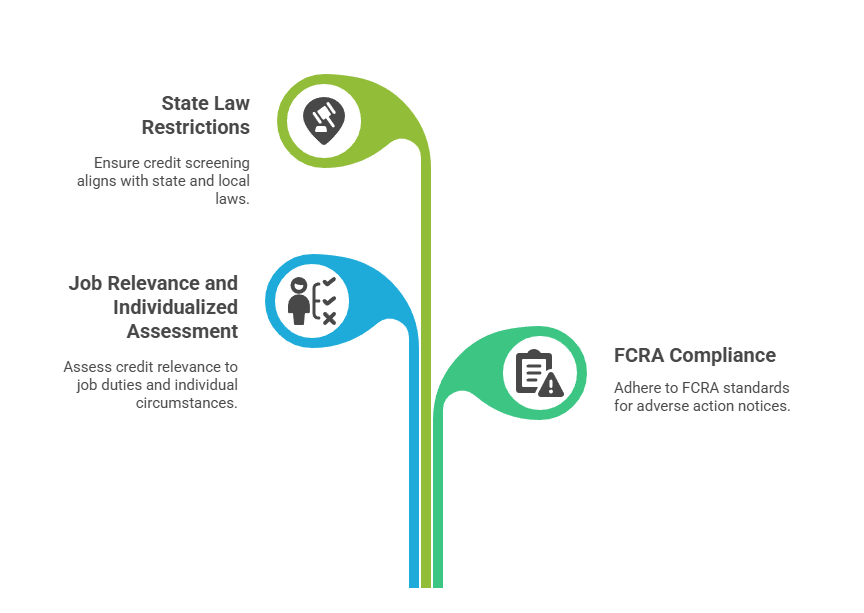
- Job relevance and individualized assessment: Employers must evaluate credit information in relation to specific job duties and consider individual circumstances rather than applying automatic rejection policies, as required under FCRA adverse action standards
- FCRA compliance: Employers must provide pre-adverse action notice with a copy of the consumer report and summary of rights before making an adverse decision, then issue final adverse action notice after the decision, allowing reasonable time for the applicant to dispute inaccuracies
- State law restrictions: Verify that applicable state and local laws permit credit screening for the specific position before implementation
Some jurisdictions restrict employment-related credit checks. Laws permit them only for positions with explicit financial duties or senior management roles. Employers should be prepared to show job-relatedness if challenged.
Factors That Influence Background Check Speed
Applicant History Complexity and Geographic Scope
Background check timelines connect directly to applicant history complexity. Candidates who lived at one address, worked for two employers, and attended one university over the past decade present straightforward verification targets. Investigators confirm limited data points quickly, completing checks in minimum timeframes.
In contrast, applicants with ten addresses across multiple states face longer processing. Eight employers including defunct companies and foreign firms require far more investigative effort. International education credentials involve coordination with foreign entities and potential language barriers.
Geographic distribution particularly affects timelines. Records requests to jurisdictions with slow court systems or unresponsive employers add weeks. International verifications extend timelines by 30 to 60 days in complex cases. Applicants cannot retroactively simplify their histories, but transparency about complexity helps employers set realistic expectations.
Accuracy of Application Information and Documentation
Inaccurate or incomplete application information represents the primary controllable factor extending background checks. Transposed digits in Social Security numbers, incorrect employment dates, or wrong employer names all trigger verification failures. These errors commonly add 7 to 14 days to private sector checks and 30 to 60 days to security clearances.
Applicants should compile personal employment timelines, address histories, and reference contact details before completing applications. Accuracy should take priority over relying on memory. Small differences between application data and background check findings require resolution even when clearly unintentional.
| Common Error Type | Verification Impact | Potential Additional Time |
| Incorrect SSN digits | Failed identity match requiring manual intervention | 5-10 days |
| Wrong employment dates | Employer verification mismatch requiring applicant clarification | 7-14 days |
| Missing addresses | Incomplete criminal jurisdiction coverage requiring extra searches | 10-20 days |
| Unreported name changes | Records under multiple names requiring consolidation and verification | 14-30 days |
Actual delays vary based on verification complexity and provider responsiveness. Employers can reduce accuracy-related delays by implementing pre-application information gathering. User-friendly application interfaces with clear instructions about required detail specificity also minimize errors that later complicate verification.
Third Party Database Quality and Responsiveness
Background check providers rely on commercial databases gathering criminal records, employment histories, and education credentials. Database quality varies significantly, with some providers maintaining more current information or better source relationships than others.
Providers completing checks in 48 hours may rely primarily on database searches without thorough manual verification, which can affect the completeness of results in complex cases. Complete databases enable faster completion with greater accuracy. When selecting background check providers, employers should consider database quality, provider responsiveness, and investigator experience rather than price alone.
Employers should also recognize that instant background checks covering only limited jurisdictions may satisfy compliance requirements without providing meaningful risk assessment. Thorough checks requiring 10 to 14 days deliver substantially better information quality than reports that search only national databases without verifying source records.
Managing Timeline Expectations and Candidate Communication
Setting Realistic Applicant Expectations
Employers should communicate background check timelines during offer stages. Distinguish between standard processing periods and worst-case scenarios. Stating that checks "typically complete within two weeks but may extend to four weeks for complex histories" prepares applicants for variability.
This communication should occur before candidates resign existing positions. It enables informed transition planning. Government employers issuing conditional offers pending clearance should provide timeline estimates specific to required clearance levels.
Candidates need this information to make informed decisions about accepting offers requiring extended waits. Some candidates decline opportunities requiring 12-month clearance timelines in favor of positions with faster onboarding. Transparency is essential for mutual fit assessment.
Interim Solutions and Conditional Start Arrangements
Some employers allow candidates to begin work in limited capacities while thorough background checks complete. Security clearances or specialized verifications often extend timelines beyond reasonable waiting periods. Arrangements might involve initial assignment to unclassified projects, restricted facility access, or supervised work pending final clearance.
Employment agreements for conditional starts should clearly document that final employment is contingent on satisfactory background check completion, and employers should consult legal counsel to ensure termination procedures comply with applicable employment laws if adverse findings emerge. However, conditional starts create complications if background checks ultimately reveal disqualifying information after employees have integrated into teams and projects.
Employers should assess whether position sensitivity permits conditional arrangements or whether security requirements mandate completion before access. Clear expectations and documentation protect both parties throughout the conditional employment period.
When to Escalate or Investigate Delays
Background check delays beyond stated timelines warrant investigation. Private sector checks exceeding 30 days without complex applicant histories may indicate provider capacity issues. Unresponsive sources or processing errors may require attention.
Employers should maintain direct provider communication channels for escalating delayed cases. Understanding specific bottlenecks helps determine whether intervention can speed resolution. For security clearances, applicants can check investigation status through DCSA's online portals.
Specific delay reasons often remain undisclosed due to investigation sensitivity. Delays beyond published average timelines may reflect investigative issues requiring applicant clarification. Questions like "Are there outstanding items requiring applicant input?" or "Can we provide additional documentation to speed verification?" often reveal specific barriers to completion.
Conclusion
Federal background check timelines range from one month to 18 months or longer depending on position sensitivity and required clearance levels. Investigative thoroughness rather than bureaucratic inefficiency drives duration. Private employers can adapt federal screening principles including tiered risk-based protocols and systematic verification while maintaining compressed timelines appropriate for competitive hiring markets.
Frequently Asked Questions
How long does a basic federal employment background check take without security clearance requirements?
Standard suitability investigations for federal positions not requiring security clearances typically complete within 30 to 60 days. Checks include fingerprint-based FBI criminal history reviews, employment verification for recent positions, and education credential confirmation. Timeline variations depend on applicant history complexity, with straightforward profiles clearing faster than those involving multiple states or former employers that are difficult to contact.
What is the current average timeline for Secret clearance processing?
Secret clearances under Tier 3 investigation standards have recently averaged between 90 and 180 days according to DCSA reporting. Individual cases vary considerably based on where applicants lived, employment history complexity, reference availability, and whether initial records checks reveal issues requiring additional investigation. Incomplete or inaccurate SF-86 submissions commonly extend timelines by 60 to 90 days when investigators must seek clarifications.
Can government contractors begin work before security clearances complete?
Many government contractors allow employees to begin work in unclassified roles or on unclassified projects while security clearance investigations continue. Interim Secret clearances may process within 30 to 60 days when granted, potentially enabling productivity during comprehensive investigation completion, though interim clearances are granted on a case-by-case basis. Contract requirements sometimes mandate final clearances before work starts, so contractors should clarify position-specific requirements.
Why do Top Secret clearances take over a year to complete?
Top Secret clearances require Tier 5 investigations examining ten years of applicant history through in-person subject interviews and thorough reference interviews. Investigators must contact numerous sources, obtain documents from multiple jurisdictions, and resolve any differences between applicant statements and source information. Applicants with extensive foreign travel, relatives abroad, or significant financial issues routinely extend beyond 18 months due to legitimate investigative complexity.
What causes the longest delays in federal background check processing?
Incomplete or inaccurate Standard Form 86 submissions represent the leading preventable cause of security clearance delays. These often add 60 to 90 days when investigators must seek clarifications. Unresponsive references and former employers create additional delays when investigators cannot complete required interviews within standard timeframes. Applicant histories involving foreign residence or employment abroad require coordination with overseas entities and additional security reviews.
How do continuous vetting programs affect reinvestigation timelines?
Continuous vetting monitors cleared personnel through automated checks against criminal databases, financial records, and government information systems. This approach reduces reinvestigation workload for employees with clean records while identifying concerning conduct in near-real-time. However, continuous vetting applies only to individuals who already hold clearances and does not speed initial investigation timelines for first-time applicants.
Can private employers conduct background checks as thorough as federal investigations?
Private employers can implement screening protocols approaching federal investigative depth through detailed criminal record searches, systematic employment and education verification, and structured reference interviews. However, most standard private sector employment background checks complete within 7 to 14 days because they examine shorter historical periods (typically 7 years versus 10 years for Top Secret clearances). Private checks do not include in-person investigative interviews and apply less rigorous verification standards for routine differences.
What information should applicants prepare before starting federal background checks?
Applicants should compile complete residential addresses with exact dates for the past 10 years and thorough employment timelines including supervisor names and contact information. Education institution details with attendance dates and degrees earned are essential. Foreign travel documentation including countries and approximate dates helps investigators verify international activities. Financial documentation showing resolved debts or payment plans for outstanding obligations helps investigators understand credit report entries.
Additional Resources
- Federal Investigative Standards
https://www.dcsa.mil/About/Federal-Investigative-Standards/ - Security Clearance Process Overview - Defense Counterintelligence and Security Agency
https://www.dcsa.mil/is/clearance-process/ - Fair Credit Reporting Act - Federal Trade Commission
https://www.ftc.gov/legal-library/browse/statutes/fair-credit-reporting-act - Standard Form 86: Questionnaire for National Security Positions
https://www.opm.gov/forms/standard-forms/ - Continuous Vetting Program Information - DCSA
https://www.dcsa.mil/is/cv/

ABOUT THE CREATOR
GCheck Editorial Team
Meet the GCheck Editorial Team, your trusted source for insightful and up-to-date information in the world of employment background checks. Committed to delivering the latest trends, best practices, and industry insights, our team is dedicated to keeping you informed.
With a passion for ensuring accuracy, compliance, and efficiency in background screening, we are your go-to experts in the field. Stay tuned for our comprehensive articles, guides, and analysis, designed to empower businesses and individuals with the knowledge they need to make informed decisions.
At GCheck, we're here to guide you through the complexities of background checks, every step of the way.