



Hotel seasonal staff background checks address the operational challenge of vetting high volumes of guest-facing workers within compressed spring hiring timelines. Effective screening balances speed with thoroughness, accounting for role-specific risk exposure, evolving state and local regulations, and the reputational consequences of inadequate vetting in hospitality environments.
Key Takeaways
- Seasonal hospitality hiring involves compressed timelines and high guest contact, requiring screening processes that differ from standard employment vetting.
- Guest safety and brand reputation depend on identifying risks such as theft, violence, fraud, and substance abuse before workers access property and guest information.
- Federal FCRA requirements apply universally, but state and local laws increasingly regulate timing, disclosure, and adverse action processes for background checks.
- Different hotel roles require different screening components, with front desk and guest services positions warranting more extensive vetting than back-of-house roles.
- Conditional offers and parallel processing help integrate screening into accelerated spring onboarding without creating bottlenecks.
- Common mistakes include treating seasonal workers as lower-risk, applying blanket disqualification policies, and underestimating jurisdiction-specific compliance requirements.
- Screening policies should reflect property type, role mix, regulatory environment, and organizational risk tolerance rather than generic industry standards.
- Returning seasonal workers may require rescreening based on elapsed time, role changes, or incidents during prior employment periods.
Understanding Seasonal Hospitality Hiring
Seasonal hospitality hiring refers to the temporary workforce expansion that hotels, resorts, and lodging properties undertake to meet predictable demand surges. Spring hiring cycles typically begin in late winter and accelerate through early spring, targeting workers who will fill roles from April through September or October.
What Defines Seasonal Hotel Employment
Seasonal hotel workers are W-2 employees hired for a predetermined period, often tied to occupancy trends, event calendars, or regional tourism patterns. Employment duration typically ranges from three to eight months, with some properties rehiring the same individuals across multiple seasons. Unlike gig or contract workers, seasonal employees integrate into standard operational workflows and operate under direct management supervision.
Scope of Seasonal Roles in Lodging Properties
| Role Category | Typical Positions | Primary Access |
| Guest Services | Front desk agents, concierge, guest relations | Payment systems, personal data, guest rooms |
| Housekeeping | Room attendants, laundry staff, housepersons | Guest rooms, personal belongings |
| Food & Beverage | Servers, bartenders, banquet staff | Guest interaction, alcohol service |
| Operations | Maintenance, groundskeeping, pool attendants | Property access, often unsupervised |
Each role carries distinct access privileges and risk exposure that should inform screening decisions.
Volume and Timeline Pressures
Mid-size hotels may hire 50 to 150 seasonal workers during spring cycles, while large resorts can onboard 300 to 500 or more. Hiring timelines are compressed, with most properties aiming to complete recruitment, screening, and onboarding within four to eight weeks. This volume and velocity create operational tension between thorough vetting and timely workforce deployment.
Why Screening Seasonal Workers Is Operationally Distinct
Background checks for seasonal hospitality workers require different operational considerations than screening for permanent positions. The combination of short employment duration, high guest contact, compressed hiring timelines, and elevated reputational risk creates a distinct screening challenge.
Short Tenure and High Guest Interaction
Seasonal workers may spend only 12 to 24 weeks on property, yet they interact with hundreds or thousands of guests during that time. A single incident involving theft, assault, harassment, or fraud can generate immediate reputational damage and liability exposure disproportionate to the employee's tenure.
Compressed Hiring Windows
Spring hiring timelines require rapid processing of large applicant pools. Properties competing for labor in tight markets face pressure to extend offers quickly or risk losing candidates. This urgency creates temptation to abbreviate screening steps, a decision that can expose the organization to preventable risk.
Access to Guest Spaces and Information
Many seasonal roles involve unsupervised access to guest rooms, personal belongings, payment information, and private spaces:
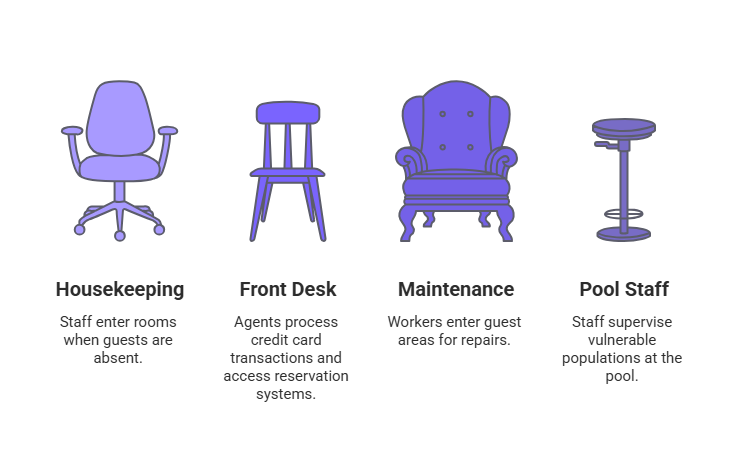
- Housekeeping staff enter rooms when guests are absent
- Front desk agents process credit card transactions and access reservation systems
- Maintenance workers enter guest areas for repairs
- Pool and recreation staff supervise vulnerable populations
These access privileges create opportunities for theft, privacy violations, and unauthorized data use.
Workforce Composition and Stability
Seasonal hiring pools often include younger workers, students, individuals with employment gaps, and applicants relocating temporarily. This composition increases the likelihood of incomplete employment histories, limited verifiable references, and transient address histories.
The fact that “Speed in hiring should never come at the cost of trust” really made me think about how seasonal hiring can sometimes force us to go fast, but the risks are still as big as they would be with a permanent hire. The thing that really stands out to me is the emphasis on being thoughtful with your screening, not just to get it done, but to get it done for the right reasons. Ultimately, it comes back to being able to find that balance.
Guest Safety and Brand Reputation Risk Factors
Hotel seasonal staff background checks function as a primary control against categories of risk that directly threaten guest safety, property security, and brand integrity.
Theft and Property Crime
Theft remains one of the most common risks associated with inadequate employee screening in hospitality settings. Workers with prior convictions for burglary, larceny, or theft-related offenses pose elevated risk when granted access to guest rooms, storage areas, or cash handling responsibilities.
Violence and Guest Safety
Violent criminal histories, including assault, domestic violence, and weapons offenses, indicate potential risk to guests and coworkers. Workers with documented patterns of violent behavior create liability exposure if incidents occur on property, particularly when those histories were discoverable through standard screening.
Sexual Offenses and Vulnerable Populations
Hotels and resorts frequently serve families, children, and other vulnerable populations. Workers with prior sex offense convictions create unacceptable risk in environments where children are present or where workers have access to private guest spaces. Sex offender registry checks are a low-cost, high-impact screening component for all guest-facing and room-access roles.
Fraud and Financial Crimes
| Risk Category | Relevant Offenses | High-Risk Roles |
| Financial Crimes | Fraud, embezzlement, identity theft | Front desk, reservations, accounting |
| Payment Fraud | Credit card fraud, check fraud | Cash handling, payment processing |
| Data Misuse | Unauthorized access, information theft | Positions with system access |
Roles involving cash handling, credit card processing, or financial transaction management require screening for these offense types.
Substance Abuse and Impairment
Drug and alcohol-related offenses, including DUI convictions and drug possession charges, may indicate current or recent substance abuse issues. Impaired employees pose safety risks in roles involving driving, equipment operation, pool supervision, or food service.
Reputational and Social Media Amplification
Guest complaints, negative reviews, and social media posts amplify the reputational consequences of hiring decisions. A single incident involving a seasonal worker can generate lasting brand damage, particularly for boutique properties and independent operators.
Regulatory and Compliance Landscape for Hospitality Screening
Hotel seasonal staff background checks operate within a multi-layered regulatory framework that includes federal baseline requirements, state-level modifications, and municipal ordinances.
Federal Baseline: Fair Credit Reporting Act
The Fair Credit Reporting Act (FCRA) governs the use of consumer reports, including background checks, for employment purposes. Employers must provide clear written disclosure, secure written authorization, and follow specific procedures if the report influences an adverse employment decision.
Adverse action procedures require providing a pre-adverse action notice, a copy of the report, a summary of rights, and a reasonable opportunity for the applicant to dispute inaccuracies. While the FCRA does not mandate a specific waiting period, employers typically provide at least five business days between the pre-adverse action notice and final decision.
State-Level Variations and Restrictions
States impose additional requirements that modify or expand FCRA obligations:
- Some states limit the use of arrest records that did not result in conviction
- Others restrict consideration of convictions beyond specific lookback periods, often seven or ten years
- States may require additional disclosures or mandate specific language in authorization forms
- Some regulate the timing of background check requests relative to application stages
Ban-the-Box and Timing Restrictions
Ban-the-box laws prohibit employers from inquiring about criminal history on initial applications or during early interview stages. Employers must determine which ban-the-box laws apply based on work location, not corporate headquarters location.
Individualized Assessment Requirements
Some jurisdictions require employers to conduct individualized assessments before disqualifying applicants based on criminal history. Individualized assessments consider the nature and gravity of the offense, time elapsed, and the relationship between the offense and job duties. Employers may not apply blanket disqualification policies.
Industry-Specific Considerations
| Role Type | Additional Requirements | Regulatory Source |
| Guest Transportation | DOT regulations, commercial driver licensing | Federal DOT |
| Childcare/Youth Programs | Enhanced child abuse and neglect checks | State child welfare agencies |
| Food Service | Health department clearances, certifications | State/local health departments |
Screening programs must identify which roles trigger industry-specific requirements.
Data Privacy and Sensitive Information Handling
State privacy laws increasingly regulate the collection, storage, and use of personal information, including background check data. Employers must limit collection to information necessary for employment decisions, store screening records securely, and restrict access to authorized personnel.
Types of Background Checks Relevant to Hotel and Resort Roles
Background checks for seasonal hospitality workers should reflect the specific risk exposure and access privileges associated with each role.
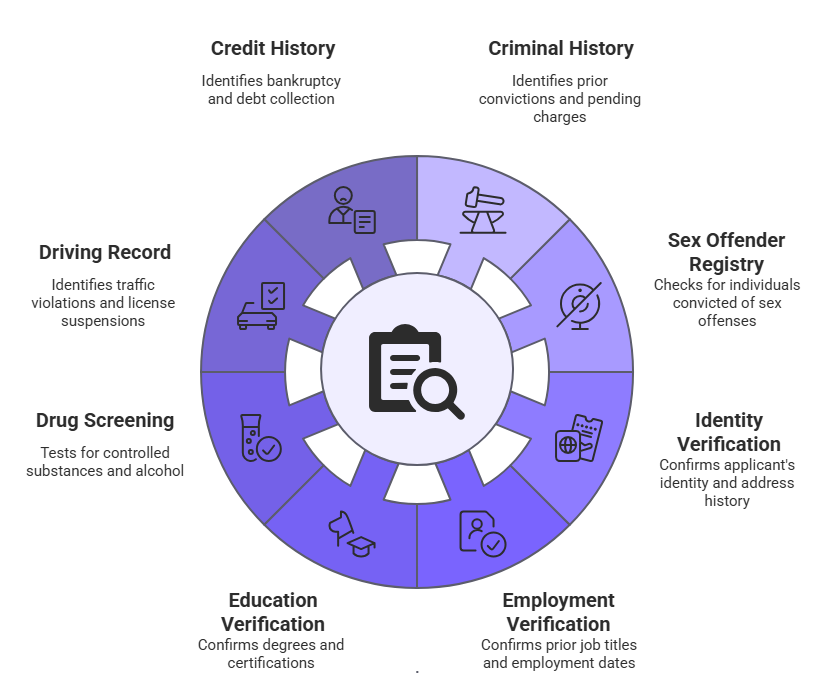
Criminal History Searches
Criminal history searches identify prior convictions and, in some jurisdictions, pending charges. These searches typically include county-level court records, statewide repositories, and federal databases. Multi-jurisdictional searches are necessary for applicants with residential or employment history in multiple locations.
Sex Offender Registry Checks
Sex offender registry checks query national and state databases for individuals convicted of sex offenses and subject to registration requirements. These checks are inexpensive, fast, and appropriate for all hospitality roles given the frequent presence of vulnerable populations on property.
Identity Verification
The purpose of identity verification is to confirm an applicant’s identity using Social Security number validation, government-issued identification, and address history analysis. Seasonal labor markets present elevated risk, as identity fraud and credential misrepresentation are more prevalent among candidates seeking to obscure past terminations or criminal records.
Employment Verification
Employment verification confirms prior job titles, dates of employment, and eligibility for rehire. This check identifies resume fabrication, misrepresented job responsibilities, and prior terminations for cause.
Education Verification
Education verification confirms degrees, diplomas, and certifications claimed by applicants. This check is less common for entry-level seasonal roles but may be relevant for supervisory positions.
Drug Screening
Drug screening tests for the presence of controlled substances or alcohol. Pre-employment drug tests are common for roles involving driving, equipment operation, or child supervision. Drug screening policies must comply with state laws.
Driving Record Checks
Driving record checks identify traffic violations, license suspensions, and DUI convictions. These checks are necessary for roles requiring operation of hotel shuttles, vans, or other vehicles.
Credit History Checks
To assess financial risk, employers may use credit history checks to identify bankruptcies, liens, judgments, and debt collection activity. This information is generally limited to positions involving cash handling or financial transaction processing, where credit history can be shown to be substantially related to core job duties.
Role-Based Screening Protocols
| Role Category | Criminal History | Sex Offender | Employment | Drug Screen | MVR | Credit |
| Housekeeping | ✓ | ✓ | Optional | Optional | — | — |
| Front Desk | ✓ | ✓ | ✓ | Optional | — | Where permitted |
| Shuttle Drivers | ✓ | ✓ | ✓ | ✓ | ✓ | — |
| Food Service | ✓ | ✓ | Optional | As required | — | — |
| Maintenance | ✓ | ✓ | Optional | ✓ | — | — |
This role-based approach allocates resources efficiently while maintaining appropriate risk controls.
Timing and Workflow Considerations for Spring Hiring Surges
Integrating background checks into compressed spring hiring timelines requires deliberate workflow design. Effective workflows balance speed, compliance, and candidate experience.
Conditional Offers and Screening Initiation
Best practice involves extending conditional offers of employment that become final only upon satisfactory completion of background checks. Conditional offer letters should clearly state that employment is contingent on background check results and specify the types of checks to be conducted.
Parallel Processing and Vendor Coordination
Parallel processing initiates multiple background check components simultaneously. Criminal history searches, sex offender registry checks, employment verification, and drug screening can proceed concurrently, reducing total turnaround time.
Managing Incomplete or Delayed Results
Some background check components may experience delays due to unresponsive references or court backlogs. Employers must decide whether to proceed with onboarding based on partial results or delay start dates. This decision should be documented in screening policies and applied consistently.
Applicant Communication and Transparency
Clear communication with applicants throughout the screening process reduces anxiety and improves completion rates. Employers should explain screening requirements during initial interviews and set realistic expectations for turnaround times.
Consequences of Skipping Steps Under Time Pressure
Properties facing acute staffing shortages may be tempted to abbreviate screening or allow workers to begin employment before checks are complete. This decision creates legal and operational risk. Incomplete screening also undermines insurance coverage, as some policies condition coverage on documented pre-employment vetting.
Technology and Automation Tools
Applicant tracking systems and background check platforms offer automation features that reduce manual coordination. Automated disclosure workflows, status dashboards, and adverse action tracking significantly compress turnaround times.
Common Mistakes and Misconceptions
Hospitality employers frequently misunderstand screening requirements or apply practices that create compliance risk.
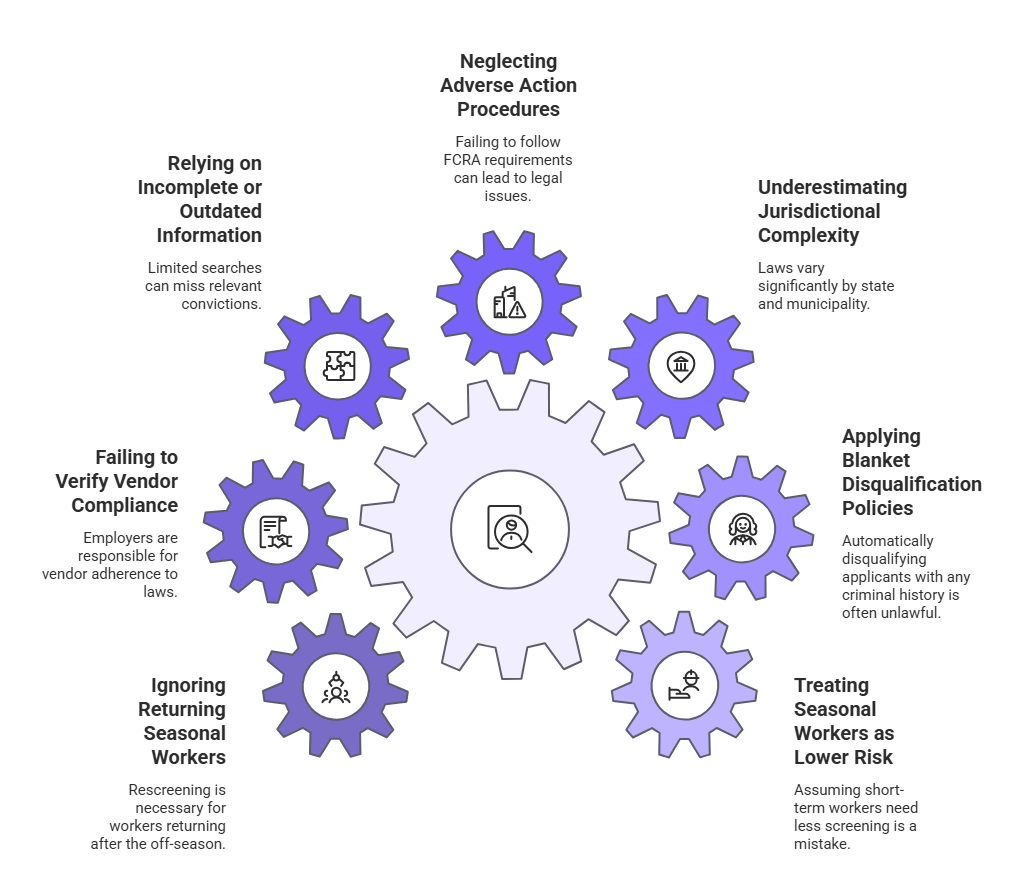
Treating Seasonal Workers as Lower Risk
Some employers assume that short-term employment duration justifies less thorough screening. This assumption is incorrect. Seasonal workers have the same access to guests, property, and information as permanent employees.
Applying Blanket Disqualification Policies
Blanket policies that automatically disqualify applicants with any criminal history violate individualized assessment requirements in many jurisdictions and may constitute unlawful discrimination. Employers must evaluate the relationship between the offense and job duties.
Underestimating Jurisdictional Complexity
Background check laws vary significantly by state and municipality, with differences in permissible lookback periods, arrest record use, timing restrictions, and disclosure requirements.
Neglecting Adverse Action Procedures
FCRA adverse action requirements are frequently misunderstood or incompletely followed. Employers must provide pre-adverse action notices, copies of the consumer report, summaries of rights, and reasonable opportunity for applicants to dispute inaccuracies.
Relying on Incomplete or Outdated Information
Some employers conduct limited criminal history searches, such as single-county checks, believing these are sufficient. Incomplete searches create gaps that may miss relevant convictions in other jurisdictions.
Failing to Verify Vendor Compliance
Employers remain legally responsible for FCRA compliance even when using third-party screening vendors. Employers must verify that vendor reports comply with applicable laws.
Ignoring Returning Seasonal Workers
Workers may have been convicted of offenses during the off-season or experienced changes in driving records. Rescreening policies should specify circumstances triggering new background checks.
Decision Framework: Building a Seasonal Screening Policy
Developing an effective screening policy for seasonal hospitality workers requires structured decision-making that accounts for property characteristics, role requirements, regulatory environment, and organizational risk tolerance.
Assess Property Type and Guest Demographics
Property type influences risk exposure and appropriate screening intensity. Luxury resorts face elevated reputational risk and may justify more extensive screening. Family-oriented properties require enhanced focus on sex offender registry checks and violent crime histories.
Map Role Categories and Access Levels
Employers should categorize seasonal roles based on guest interaction, property access, and information exposure. High-access roles such as housekeeping and front desk warrant comprehensive screening. Low-access roles like laundry need baseline screening.
Identify Applicable Regulatory Requirements
Screening policies must comply with federal FCRA requirements and applicable state and local laws. Multi-location employers may need jurisdiction-specific screening workflows or vendor configurations.
Determine Organizational Risk Tolerance
| Risk Tolerance Level | Screening Approach | Trade-offs |
| Low | Extensive checks, longer turnaround | Higher cost, slower hiring |
| Moderate | Role-based protocols, balanced scope | Balanced cost and speed |
| Higher | Baseline checks, rapid processing | Lower cost, residual risk |
Risk tolerance should be explicitly defined and documented.
Establish Screening Components by Role
Role-based screening protocols assign specific check types to job categories. Criminal history and sex offender registry checks apply to all roles, with employment verification, drug screening, and credit checks added based on role requirements.
Define Disqualification Criteria and Individualized Assessment Procedures
Screening policies should specify which offenses are disqualifying for each role and require individualized assessments for offenses that are potentially relevant but not automatically disqualifying.
Plan for Rescreening and Ongoing Monitoring
Policies should address rescreening for returning seasonal workers. Rescreening may be triggered by elapsed time since the prior check, typically one to three years, or by changes in job duties.
Document Policies and Train Decision-Makers
Written screening policies ensure consistent application. Training should cover legal requirements, policy procedures, and documentation expectations.
Ongoing Considerations and Post-Hire Monitoring
Background checks conducted at the time of hire provide a snapshot but do not guarantee ongoing suitability.
Rescreening Returning Seasonal Workers
Workers who return for multiple seasons may accumulate convictions or driving violations during the off-season. Rescreening policies specify circumstances under which returning workers undergo new background checks.
Incident Response and Investigation
Incidents involving theft, guest complaints, or safety violations may reveal information not discovered during pre-hire screening. Employers should investigate incidents promptly.
Continuous Monitoring Technologies
Some screening vendors offer continuous monitoring services that alert employers to new criminal convictions or driving violations. Employers must verify that continuous monitoring is legally permissible in their jurisdiction. Some states prohibit or restrict continuous monitoring absent fresh authorization or adverse action triggers.
Policy Review and Regulatory Updates
Background check laws evolve frequently. Employers should review screening policies annually or whenever significant regulatory changes occur.
Training and Accountability for Screening Compliance
Screening compliance depends on consistent execution by hiring managers and HR staff. Ongoing training reinforces legal requirements and policy procedures.
Balancing Screening Rigor and Operational Efficiency
Employers should periodically evaluate whether current screening intensity aligns with actual risk experience, regulatory requirements, and competitive hiring conditions.
Conclusion
Hotel seasonal staff background checks require operational discipline that balances compressed hiring timelines with thorough vetting of guest-facing workers. Effective screening reflects role-specific risk, evolving regulatory requirements, and organizational commitment to guest safety and brand protection. When processes are intentionally created, organizations may function at rapid speeds without compromising consistency and compliance. A structured approach may also help the team make informed hiring decisions without compromising the positive experience for the candidates and guests.
Frequently Asked Questions
What is the difference between screening seasonal workers and permanent employees?
Screening standards should reflect job duties and access levels rather than employment duration. Seasonal workers often hold the same guest-facing roles as permanent employees, creating equivalent risk exposure. Legal requirements, including FCRA compliance and state law obligations, apply equally to seasonal and permanent hires.
How long do background checks take during spring hiring surges?
Criminal history searches typically complete within one to five business days. Employment verification may take three to ten days. Drug screening results are often available within 24 to 48 hours. Comprehensive checks may require seven to fourteen days, though parallel processing can reduce total time.
Can employers automatically disqualify applicants with criminal records?
No. Many jurisdictions require individualized assessments that consider the nature and gravity of the offense, time elapsed, and the relationship between the offense and job duties. Blanket disqualification policies violate fair hiring laws.
Are background checks required for all hotel seasonal workers?
Legal requirements vary by jurisdiction and role. Federal law does not mandate background checks for most private-sector hospitality roles, but employers who choose to conduct checks must comply with FCRA and applicable state laws.
What types of criminal offenses are most relevant for hospitality screening?
Offenses involving theft, fraud, violence, sex crimes, and substance abuse are most relevant. Theft-related convictions indicate risk for roles with access to guest property. Violent offenses create safety concerns for guest-facing positions. Sex offense convictions are disqualifying for most hospitality roles.
Do background check requirements differ by state for hotel properties?
Yes. States impose varying restrictions on lookback periods, use of arrest records, credit check permissibility, timing of criminal history inquiries, and disclosure requirements. Multi-location hospitality employers must identify applicable laws for each property location.
How should employers handle background checks for returning seasonal workers?
Employers should establish rescreening policies that specify when returning workers require new background checks. Common triggers include elapsed time since the prior check, typically one to three years, and changes in job duties or access levels.
What is the role of drug screening in seasonal hospitality hiring?
Drug screening identifies substance use that may impair job performance or create safety risks. Pre-employment drug tests are common for roles involving driving, equipment operation, child supervision, or food service. Drug screening policies must comply with state laws.
Additional Resources
- Fair Credit Reporting Act (FCRA) Summary of Rights
https://www.ftc.gov/enforcement/statutes/fair-credit-reporting-act - EEOC Guidance on Use of Arrest and Conviction Records in Employment
https://www.eeoc.gov/laws/guidance/arrest-and-conviction-records - National Conference of State Legislatures: State Laws on Background Checks
https://www.ncsl.org/labor-and-employment/background-checks-and-employment - U.S. Department of Justice National Sex Offender Public Website
https://www.nsopw.gov/ - Society for Human Resource Management (SHRM): Background Checks Resource Center
https://www.shrm.org/topics-tools/tools/toolkits/background-checks

ABOUT THE CREATOR
GCheck Editorial Team
Meet the GCheck Editorial Team, your trusted source for insightful and up-to-date information in the world of employment background checks. Committed to delivering the latest trends, best practices, and industry insights, our team is dedicated to keeping you informed.
With a passion for ensuring accuracy, compliance, and efficiency in background screening, we are your go-to experts in the field. Stay tuned for our comprehensive articles, guides, and analysis, designed to empower businesses and individuals with the knowledge they need to make informed decisions.
At GCheck, we're here to guide you through the complexities of background checks, every step of the way.