


Drug testing policies for remote employees have evolved from pandemic-era improvisations into standardized compliance frameworks supported by mobile collection, digital chain-of-custody systems, and telehealth verification. Employers must now balance regulatory obligations with privacy expectations and talent retention in a competitive labor market where distributed workforces represent the operational norm rather than temporary arrangements.
Key Takeaways
- Drug testing policies for remote employees must account for federal regulations, state-specific laws, and industry requirements that vary significantly by jurisdiction and sector.
- Mobile drug testing services deliver on-site collection at remote worker locations, eliminating geographic barriers while maintaining chain-of-custody integrity.
- Digital verification tools streamline identity confirmation, sample tracking, and results reporting, though privacy safeguards remain essential to implementation.
- Pre-employment drug screening for distributed workforces requires clear communication about timing, logistics, and candidate rights before conditional offers become final.
- Safety-sensitive positions governed by the Department of Transportation or other federal mandates maintain consistent testing requirements regardless of work location.
- State and local laws restricting marijuana testing, ban-the-box protections, and disability accommodations apply equally to remote workers as to on-site personnel.
- Distributed workforce compliance depends on written policies that specify testing circumstances, substances screened, and procedural safeguards accessible to all employees.
- Strategic policy decisions should distinguish genuine risk-reduction needs from performative compliance activities that erode employer brand without measurable safety benefits.
Understanding Drug Testing Frameworks for Distributed Workforces
Drug testing policies for remote employees operate within the same regulatory architecture governing traditional workplace screening. Implementation differs substantially when employees work from homes, co-working spaces, or non-employer locations. Federal frameworks establish baseline requirements for specific industries. State and municipal laws impose additional restrictions or employee protections that employers must navigate regardless of where work occurs.
Federal Regulatory Foundations
The Drug-Free Workplace Act applies to certain federal contractors and grantees. It requires written drug-free workplace policies and employee awareness programs but does not mandate testing itself. Safety-sensitive industries face more stringent requirements.
Department of Transportation regulations govern specific worker categories through distinct testing protocols:
- Commercial drivers
- Pipeline operators
- Aviation personnel
- Railroad employees
- Maritime workers
These obligations persist regardless of whether administrative duties occur remotely. Testing protocols include pre-employment, random, reasonable suspicion, post-accident, return-to-duty, and follow-up examinations.
Nuclear Regulatory Commission licensees and Department of Defense contractors face additional testing mandates. These extend to personnel with access to sensitive information or systems, even when accessed remotely. Employers should verify whether their industry or contractual obligations create mandatory testing requirements before designing policies.
No longer is remote drug testing a mere ad hoc process, but rather an integral part of a compliance process that must be done thoughtfully and intentionally. As HR leaders, we must be thoughtful about why we test, not just how we test, particularly when dealing with remote workers across multiple jurisdictions. The real job, though, is creating policies based on actual risk reduction, privacy, marijuana, and the employee experience. When testing is based on role-based risk and supported by communication and process, compliance can be a sustainable state, not just a reaction.
State and Local Legal Variations
State laws create a patchwork of restrictions on when, how, and under what circumstances employers may conduct drug testing. Some states require reasonable suspicion or probable cause before testing current employees. Others permit random testing for safety-sensitive positions. Some states restrict employment discrimination based on lawful marijuana use, though protections vary significantly by jurisdiction.
Variations include whether protections apply only to medical cannabis users or extend to recreational use. They also differ in how safety-sensitive positions are defined. Restrictions may apply to pre-employment screening, current employee testing, or both. Specific state law review is necessary before making employment decisions based on marijuana test results.
Ban-the-box laws in certain cities and states limit pre-employment inquiries about criminal history. While these laws generally do not restrict drug testing itself, employers must be careful. They should ensure that adverse decisions based on failed drug tests do not trigger impermissible criminal history inquiries. Employers must also avoid conflating drug test results with arrest records, particularly in jurisdictions where arrests without convictions receive legal protections.
Disability discrimination laws, including the Americans with Disabilities Act and state equivalents, do not protect current illegal drug use. However, they may protect individuals with past substance use disorders who are in recovery or successfully rehabilitated. Employers must also accommodate employees with disabilities who use prescription medications as directed. Exceptions exist when doing so creates undue hardship or when the employee cannot perform essential job functions safely.
Privacy protections vary significantly by state. Some jurisdictions require specific notice periods, written consents, or limits on the types of substances that may be screened. Employers operating across multiple states must ensure policies comply with the most restrictive applicable law or implement location-specific protocols.
Industry-Specific Compliance Obligations
Healthcare organizations, financial services firms, manufacturing operations, and transportation companies face sector-specific testing expectations. These are shaped by regulatory bodies, liability concerns, and professional standards.
| Industry Sector | Typical Testing Drivers | Remote Worker Considerations |
| Healthcare | Patient safety, regulatory oversight, professional licensing requirements | Distinguish clinical roles from remote administrative or telehealth positions |
| Financial Services | Regulatory compliance, fiduciary responsibilities, fraud prevention | Assess risk profiles of back-office versus customer-facing personnel |
| Manufacturing | Workplace safety, equipment operation, quality assurance | Evaluate whether remote engineers or quality staff have safety-sensitive duties |
| Transportation | DOT mandates, public safety, vehicle operation standards | Apply consistent standards regardless of where administrative work occurs |
Testing requirements within each industry vary by specific employer type, regulatory jurisdiction, and role classification. Employers should verify which requirements apply to their specific operations and positions. They must balance sector imperatives with workforce privacy rights. This is particularly important for remote administrative personnel who never physically interact with patients, customers, or hazardous equipment.
Mobile Drug Testing Services and Collection Infrastructure
Effectively drug testing remote workers requires solving a core logistical challenge: specimen collection across a geographically dispersed workforce. To address this, mobile drug testing services have developed multiple service models designed to bring compliant collection directly to the employee rather than requiring travel to a fixed site.
Mobile Collection Service Models
Under this model, certified mobile collection technicians travel to residential addresses, co-working spaces, or other pre-approved locations. Collection may be observed or unobserved, depending on the testing protocol and employer requirements. From the moment of collection, technicians initiate full chain-of-custody documentation, verify photo identification, and use tamper-evident specimen containers that meet laboratory accreditation standards.
Quality mobile services demonstrate the following characteristics:
- Collectors trained in federal testing protocols
- Professional liability insurance coverage
- Laboratories certified by the Substance Abuse and Mental Health Services Administration for federally mandated testing
- Private accreditation for non-regulated screening
- Scheduling systems coordinating appointments across time zones
- Employee availability accommodation
- Confirmation of completed collections to employers
Scheduling systems coordinate collection appointments across time zones. They accommodate employee availability and provide employers with confirmation of completed collections.
National Collection Site Networks
An alternative to fully mobile services involves directing remote employees to established collection sites within a national network. Laboratory companies or third-party administrators often operate these facilities. Employees receive electronic or paper requisition forms specifying the testing panel. They then visit any participating location during business hours.
| Service Model | Primary Advantages | Primary Limitations |
| Mobile Collection | Employee convenience, geographic flexibility, immediate response capability | Higher per-test costs, scheduling complexity, limited rural availability |
| Collection Site Network | Lower costs, faster urban access, extended hours, weekend availability | Employee travel requirements, rural site gaps, transportation dependencies |
| Hybrid Approach | Cost optimization, accessibility balance, situation-appropriate deployment | Administrative complexity, dual vendor management, policy clarity needs |
Hybrid approaches combine scheduled collection site visits for routine pre-employment or random testing with mobile services. The mobile services are reserved for time-sensitive scenarios or employees in locations without convenient site access.
Digital Chain-of-Custody and Verification Tools
Technology platforms have modernized specimen tracking and identity verification for distributed workforce drug testing. Digital chain-of-custody systems replace paper forms with electronic documentation. They capture each transfer point from collection through laboratory receipt, analysis, and results reporting.
Identity verification incorporates the following elements:

- Photo capture at collection point
- Government ID scanning and validation
- Biometric confirmation in some implementations
- GPS timestamping of collection locations and times
- Audit trails for compliance verification
These technologies help verify the tested individual matches employer records. They significantly reduce but do not entirely eliminate the risk of specimen substitution or identity fraud.
Results portals deliver secure, access-controlled reporting to authorized personnel. They often integrate with applicant tracking systems or human resources information systems to streamline workflow. Medical review officers serve as independent physicians who review positive test results. They verify the identity of the donor and determine whether legitimate medical explanations exist for positive findings. MROs evaluate medical documentation for prescription medications before reporting verified positive results to employers. This protects employee medical privacy while ensuring testing integrity. MRO services are required for federally mandated testing and recommended for all employment screening. They operate remotely via telehealth platforms when specimens return positive.
Pre-Employment Drug Screening for Distributed Hiring
Pre-employment drug screening remains the most common testing circumstance for remote employees. Testing typically occurs after a conditional offer but before the first day of work. Implementing these screens for geographically distributed candidates requires clear communication, reasonable timeframes, and accommodation of logistical variables.
Timing and Conditional Offer Considerations
Employers should extend conditional offers explicitly stating that employment is contingent upon successfully completing a drug screen and other background checks. This sequencing helps demonstrate that testing occurs only after the employer has determined the candidate is otherwise qualified. It reduces the risk of discrimination claims based on protected characteristics.
Providing candidates with adequate time to complete testing acknowledges that remote workers may need to schedule appointments. They may need to visit collection sites or arrange mobile collection visits. Reasonable timeframes typically range from 48 hours to five business days, depending on location and service availability. Shorter windows may be appropriate when candidates reside in metropolitan areas with abundant collection sites. Rural candidates may require additional time.
Rescinding offers based on failed or refused drug tests should follow consistent processes aligned with legal counsel guidance and applicable state laws. Some jurisdictions require employers to provide candidates with copies of results. They must also offer opportunities to contest or explain findings before taking adverse action.
Communicating Testing Requirements to Candidates
Transparency about drug testing expectations should begin during the hiring process. Ideally, information is provided through job postings, application acknowledgments, or early interview stages. Candidates have the right to know testing is a condition of employment. They should know which substances will be screened and what specimen types may be collected.
Written communications accompanying conditional offers should include:
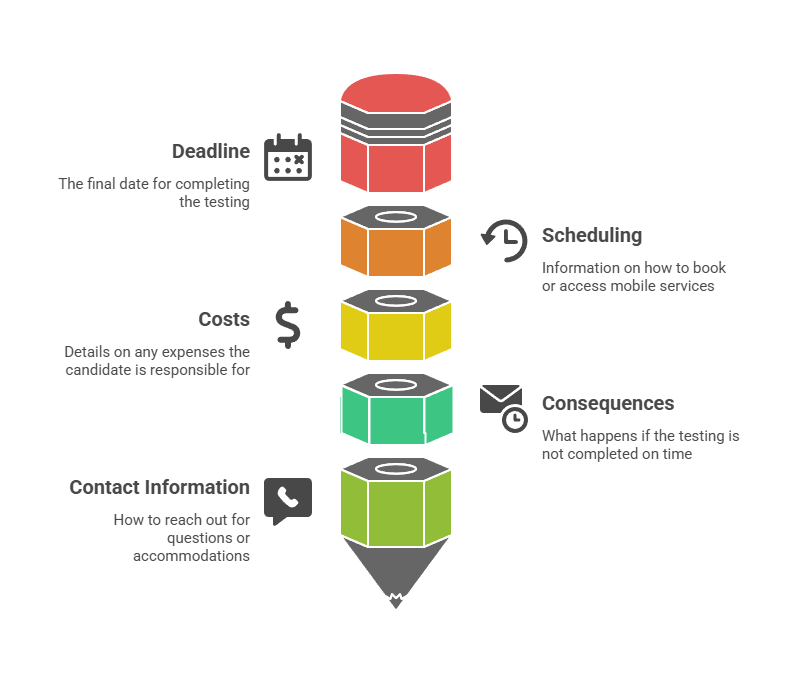
- Specific testing deadline
- Instructions for scheduling or accessing mobile services
- Clarification of any candidate-borne costs
- Consequences of failing to complete testing by the deadline
- Contact information for questions or accommodation requests
Accommodations may be necessary for candidates with disabilities affecting specimen provision. They may also be needed for religious objections to certain collection methods or language barriers requiring translated materials or interpreter access.
Interstate and International Remote Hiring Complications
Hiring remote employees across state lines introduces complexity when state laws governing the employee's work location differ from the employer's headquarters jurisdiction. Employers must generally comply with the employee's work location laws. For example, a California-based employer hiring a remote worker in New York must follow New York testing restrictions and notice requirements.
International remote employees present additional challenges. Drug testing practices considered standard in the United States may violate privacy laws or cultural norms in other countries.
Key international considerations include:
- European data protection regulations imposing strict limits on collecting, processing, and transferring health-related information
- Countries prohibiting employment-related drug testing altogether except in narrowly defined safety-sensitive roles
- Varying cultural expectations regarding employer intrusion into personal conduct
- Conflicting legal frameworks across jurisdictions
Employers hiring internationally should consult legal counsel in each jurisdiction before implementing testing requirements. They should verify whether testing is genuinely necessary for the role. It may represent an unnecessary friction point in global talent acquisition.
Testing Current Remote Employees: Random, Reasonable Suspicion, and Post-Incident
Beyond pre-employment screening, employers may conduct random drug testing or reasonable suspicion testing for current employees. Both approaches present unique challenges when the workforce is distributed.
Random Testing Program Design and Legal Limits
Random drug testing involves selecting employees for testing through unbiased, neutral methods such as computer-generated selection. Programs are typically expressed as a percentage of the workforce tested per year. For Department of Transportation-regulated employees, minimum random testing rates are set by regulation.
Non-regulated employers implementing random testing must ensure programs comply with state laws. Some of these laws permit random testing only for safety-sensitive positions. Others prohibit it entirely except in specific industries. Written policies should define the selection methodology, eligible employee population, testing frequency, and procedures employees must follow when selected.
For remote employees, the logistical challenge involves notifying selected individuals and ensuring timely specimen collection before substances clear the system. Employers typically require selected employees to complete testing within 24 hours or by the next business day. They use either nearby collection sites or expedited mobile services. Employees working from locations without accessible collection options present complications requiring advance planning.
Establishing and Documenting Reasonable Suspicion
Reasonable suspicion testing occurs when specific, observable facts and rational inferences suggest an employee is under the influence of drugs or alcohol. This standard requires more than hunches or rumors but less than certainty.
Supervisors must document observable behaviors such as:
- Slurred speech
- Coordination problems
- Unusual mood changes
- Conduct suggesting impairment
Remote work environments complicate reasonable suspicion determinations. Supervisors typically interact with employees via video calls, phone, or messaging platforms rather than in-person observation. Video conferences may reveal some impairment indicators like slurred speech or unusual behavior. However, many signs of intoxication are difficult to assess remotely.
Employers should train supervisors on recognizing remote impairment indicators. They need training on documenting observations objectively and following escalation procedures when suspicion arises. Policies should specify whether reasonable suspicion testing can be triggered by virtual interactions. They should also clarify how quickly employees must submit to testing once notified.
Legal risks increase when reasonable suspicion determinations are made without contemporaneous, objective documentation. Risks also increase when testing is applied inconsistently across the workforce. Employers should require trained supervisors to document specific, observable facts immediately when suspicion arises. They should use standardized forms that focus on behavior rather than assumptions. Inconsistent application may expose employers to discrimination or wrongful termination claims.
Post-Incident and Return-to-Duty Protocols
Post-incident testing occurs after workplace accidents or safety violations to determine whether substance use contributed to the event. Department of Transportation regulations mandate post-accident testing in specific circumstances. These include commercial vehicle crashes resulting in fatalities, injuries requiring immediate medical treatment, or disabling damage requiring vehicle towing.
| Testing Circumstance | Triggering Events | Remote Work Applications |
| Post-Incident | Injuries requiring medical treatment, property damage exceeding thresholds, critical safety violations | Vehicle accidents during employer business, injuries during documented work activities, security breaches suggesting impairment |
| Return-to-Duty | Previous policy violations, completion of substance abuse professional evaluation, reinstatement conditions | Negative test results, treatment plan compliance, follow-up testing schedules for defined periods |
For non-regulated employers, post-incident testing policies should define what constitutes a testable incident. Return-to-duty testing applies to employees who previously violated drug and alcohol policies. These individuals are seeking reinstatement or continued employment under a last-chance agreement. They typically must test negative, complete a substance abuse professional evaluation, follow prescribed treatment plans, and submit to follow-up testing for a defined period.
Balancing Compliance, Privacy, and Strategic Testing Decisions
Distributed workforce compliance with drug testing requirements must account for employee privacy expectations. These expectations have evolved alongside remote work normalization. Policies perceived as invasive, disproportionate to role risks, or inconsistently applied can damage employer brand. They can increase turnover and create legal vulnerabilities.
Privacy Considerations in Remote Testing
Drug testing inherently involves collecting sensitive health information. This information is subject to privacy protections under federal and state laws. Employers should collect only the information necessary for testing purposes. They should limit access to results on a need-to-know basis and store records separately from general personnel files.
Medical review officers serve as independent physicians who review positive test results. They determine whether legitimate medical explanations exist for positive findings. MROs evaluate medical documentation for prescription medications before reporting verified positive results to employers. This protects employee medical privacy while ensuring testing integrity.
Specimen collection methods raise additional privacy concerns. Observed collections are sometimes used for Department of Transportation testing or when adulteration is suspected. Direct observation involves a same-gender collector watching urine specimen provision. Many employees find this practice intrusive. Employers should limit observed collections to circumstances where required by regulation or clearly justified by evidence of previous cheating. Remote work increases privacy sensitivities because testing occurs in or near employees' homes rather than employer-controlled facilities.
Marijuana Testing in an Evolving Legal Landscape
Marijuana's changing legal status creates ongoing tension between employer testing policies and state laws protecting lawful off-duty use. As of 2026, numerous states have legalized medical marijuana, adult-use recreational marijuana, or both. Marijuana remains illegal under federal law.
Some states restrict employment discrimination based on lawful marijuana use. Protections vary significantly by jurisdiction. Variations include whether protections apply only to medical cannabis users or extend to recreational use. They also differ in how safety-sensitive positions are defined. Restrictions may apply to pre-employment screening, current employee testing, or both. Specific state law review is necessary before making employment decisions based on marijuana test results.
Employers in jurisdictions with such protections must decide whether to continue testing for marijuana metabolites. These metabolites may appear weeks after use. Alternatively, they can focus screening on substances indicating current impairment.
Testing methodologies affect this decision:
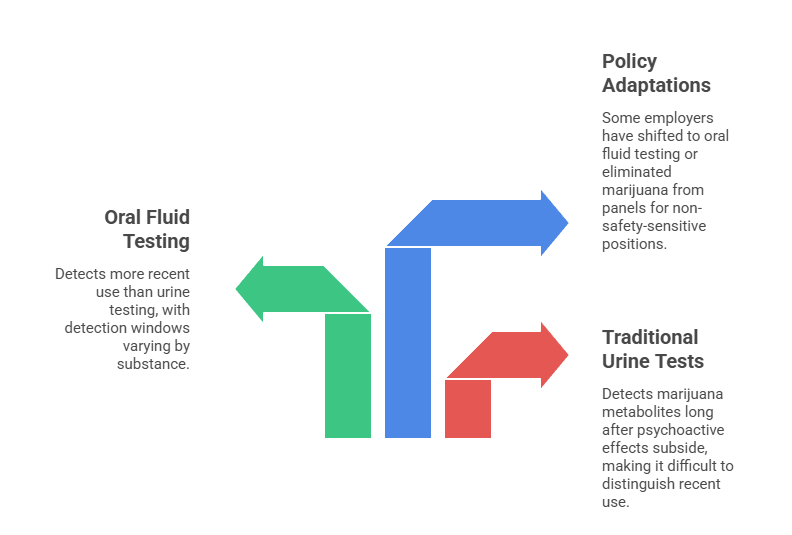
- Traditional urine tests: Detect marijuana metabolites long after psychoactive effects subside. This makes it difficult to distinguish recent use from consumption days or weeks earlier.
- Oral fluid testing: Generally detects more recent use than urine testing. Detection windows vary by substance and individual factors. For marijuana, detection typically occurs within 24 to 48 hours of use. Other substances may have different detection periods.
- Policy adaptations: Some employers have shifted to oral fluid testing. Others have eliminated marijuana from standard panels for non-safety-sensitive positions.
Employers subject to federal testing mandates must continue screening for marijuana regardless of state legalization. Those in safety-sensitive industries may maintain marijuana testing as part of risk management strategies. However, blanket marijuana testing for all remote positions represents a policy choice. This includes positions with minimal safety implications. Such testing increasingly requires business justification.
Assessing Genuine Testing Needs by Role
Safety-sensitive positions clearly justify drug testing. Impairment can result in injuries, fatalities, or catastrophic incidents. Commercial drivers, heavy equipment operators, healthcare providers with patient care responsibilities, and workers in hazardous environments present obvious testing rationales.
Remote employees performing administrative tasks, software development, customer service, or creative work from home offices present less clear-cut scenarios. While employers may prefer drug-free workforces as a general principle, testing employees whose impairment poses minimal risk primarily signals organizational values. It does not manage concrete dangers.
Strategic policy design begins with risk assessment. Employers should evaluate each position or position category. They should determine whether impairment would create safety hazards, compromise security, damage client relationships, or otherwise harm business interests. Positions failing to meet these criteria may warrant exclusion from routine testing programs. This reduces costs and administrative burden while focusing resources on genuinely risk-sensitive roles.
Implementing Compliant Remote Testing Programs

Employers who determine drug testing serves legitimate business needs must implement programs carefully. Programs must ensure legal compliance, operational effectiveness, and fair treatment of remote workers.
Written Policy Development and Legal Review
Comprehensive written policies should specify which employees are subject to testing. They should clarify under what circumstances testing occurs, what substances are screened, specimen types collected, and testing methods used. Policies should also outline consequences of positive results, refusals, or adulteration attempts.
Policies should address unique remote work considerations. These include collection logistics, timeframes for completing testing after notification, and procedures for employees in locations without collection site access. Privacy protections during in-home collection should also be addressed.
Legal counsel should review policies for compliance with federal requirements applicable to the employer's industry. They should verify compliance with state laws in all jurisdictions where employees work. Municipal ordinances may impose additional restrictions. Multi-state employers may need separate policies or location-specific provisions addressing jurisdictional variations.
Policy documents should be written in clear, accessible language avoiding legal jargon. Materials should be made available in languages spoken by the workforce. They should be provided to all employees through handbooks, onboarding materials, or compliance training.
Training and Program Oversight
Supervisors need training on recognizing signs of impairment. They require instruction on documenting observations objectively, following reasonable suspicion protocols, and treating employees respectfully throughout testing processes. Human resources personnel require understanding of applicable legal requirements. They need to know procedures for coordinating testing, confidentiality obligations, and how to handle complex scenarios. These include accommodation requests or contested results.
Training should address remote work complications. This includes assessing impairment through video calls and communicating with employees across time zones. Regular refresher training maintains knowledge currency as laws evolve. This is particularly important regarding marijuana legalization and state-specific restrictions.
Ongoing program oversight ensures policies are applied consistently. It verifies that testing serves intended purposes. Employers should track metrics including positive test rates, turnaround times from notification to specimen collection, and any complaints or legal challenges to testing practices. Periodic audits verify documentation completeness. They identify any procedural gaps or inconsistencies.
Conclusion
Drug testing policies for remote employees in 2026 require careful navigation of regulatory compliance, technological capabilities, privacy expectations, and strategic business objectives. Successful programs balance legitimate risk management with employee experience in ways that protect organizational interests without unnecessarily constraining talent acquisition in competitive markets. Organizations that regularly review and update their testing frameworks will be better positioned to respond to changing state laws and workforce expectations. A good policy will not only protect an organization against legal issues but also foster transparency, fairness, and trust among distributed teams.
Frequently Asked Questions
Can employers require drug testing for fully remote employees who never visit company facilities?
Yes, employers may generally require drug testing for remote employees when testing serves legitimate business purposes and complies with applicable laws. Federal regulations mandate testing for certain safety-sensitive positions regardless of work location. Non-regulated employers have broader discretion subject to state and local restrictions. Testing policies should be based on role-specific risk assessments rather than blanket application to all remote workers.
How quickly must remote employees complete drug tests after being notified of random selection?
Timeframes vary by employer policy and regulatory requirements. They typically range from same-business-day to within 24 to 48 hours of notification. Department of Transportation regulations require immediate or same-day testing for random selections when possible. Non-regulated employers should establish reasonable timeframes. These should account for collection site availability and employee location while preventing excessive delays that could allow substance detection windows to close.
What happens if a remote employee lives in a state where marijuana is legal but tests positive for cannabis metabolites?
Consequences depend on federal versus state law applicability, employer policy, and the employee's state of residence. Federally regulated employees remain subject to marijuana testing despite state legalization. For non-regulated employees, some states restrict discrimination based on lawful marijuana use with exceptions for safety-sensitive positions. Other states provide no such protections. Employers should consult legal counsel before taking adverse action in jurisdictions with marijuana protections.
Are mobile drug testing services more expensive than requiring employees to visit collection sites?
Mobile collection services typically cost more than collection site visits due to travel time, mileage, and individual appointment scheduling. However, mobile services may be necessary for employees in rural areas without nearby collection sites. They are also useful for reasonable suspicion situations requiring immediate testing. Some employers use mobile services selectively while directing most employees to collection sites.
Can employers observe employees during specimen collection for remote drug testing?
Observed collections are legally permissible in certain circumstances. These include when required by Department of Transportation regulations following specific violations. They may also occur when employers have evidence of previous adulteration attempts. However, observed collections raise significant privacy concerns, particularly in residential settings. Employers should limit observed collections to situations where clearly justified by regulation or documented cause. They must ensure same-gender observers maintain professionalism.
Do drug testing policies need to address prescription medications or only illegal substances?
Testing policies may address both illegal substances and legal medications that could cause impairment. Medical review officers evaluate positive results for legal prescriptions. They allow employees to provide documentation of legitimate medical use before results are reported to employers. Employers may not discriminate against employees with disabilities who use prescribed medications as directed. However, they may address safety concerns through fitness-for-duty evaluations or reasonable accommodations when impairment affects job performance.
How long should employers retain drug testing records for remote employees?
Retention periods vary by regulation and jurisdiction. Department of Transportation regulations under 49 CFR Part 40 require retaining records for five years for positive tests, refusals, and negative returns-to-duty tests. They require one to two years for negative pre-employment and random tests, depending on record type. Non-regulated employers should follow state-specific requirements. They should generally maintain records for at least the period necessary to defend potential legal challenges, often three to seven years.
What accommodations might employers need to provide for remote employees during drug testing processes?
Accommodations may be necessary for employees with disabilities affecting specimen provision. These include medical conditions preventing urine sample collection. In such cases, alternative specimen types like oral fluid or hair may be offered. Religious accommodations might address certain collection procedures. Language accommodations include providing instructions and forms in the employee's primary language or offering interpreter services. Employers should engage in interactive processes to determine effective accommodations that maintain testing integrity.
Additional Resources
- Drug-Free Workplace Advisor
https://www.dol.gov/general/topics/workplace-substance-abuse - DOT Drug and Alcohol Testing Regulations
https://www.transportation.gov/odapc - SAMHSA Drug Testing Resources
https://www.samhsa.gov/workplace - ADA and Substance Use Disorders Guidance
https://www.eeoc.gov/laws/guidance/addiction-and-substance-use-disorders-workplace - State Drug Testing Laws Overview
https://www.ncsl.org/labor-and-employment/drug-testing-laws

ABOUT THE CREATOR
GCheck Editorial Team
Meet the GCheck Editorial Team, your trusted source for insightful and up-to-date information in the world of employment background checks. Committed to delivering the latest trends, best practices, and industry insights, our team is dedicated to keeping you informed.
With a passion for ensuring accuracy, compliance, and efficiency in background screening, we are your go-to experts in the field. Stay tuned for our comprehensive articles, guides, and analysis, designed to empower businesses and individuals with the knowledge they need to make informed decisions.
At GCheck, we're here to guide you through the complexities of background checks, every step of the way.