


Institutional closures have become routine in higher education, creating persistent challenges in standard credential verification workflows. This guide provides HR professionals with systematic protocols for closed college degree verification, mapping state repository systems, custody transfer procedures, and compliant escalation frameworks when traditional verification channels fail.
Key Takeaways
- Institutional closure does not invalidate previously earned degrees, but it significantly complicates the verification process for employers and credential holders.
- Federal and state law require closed institutions to transfer student records to designated custodians, though enforcement and accessibility vary by jurisdiction.
- The National Student Clearinghouse, state education agencies, and specialized repositories serve as primary resources to verify degree from closed school credentials.
- Employers must document reasonable verification efforts to maintain compliance with FCRA requirements and demonstrate due diligence during audits.
- Verification workflows for closed institutions require multiple fallback protocols, including successor institution searches and third-party custodian inquiries.
- Legal validity of a degree differs fundamentally from verification feasibility, requiring HR teams to understand accreditation status before closure.
- State-by-state variance in record retention infrastructure necessitates jurisdiction-specific research when standard databases yield no results.
- Proactive verification timing and institutional health monitoring reduce the likelihood of encountering closed-school scenarios during critical hiring windows.
Understanding the Landscape of Institutional Closures
Over the past decade, numerous institutions have ceased operations, affecting substantial numbers of current students and alumni across multiple education sectors. The for-profit sector experienced particularly high closure rates, but traditional private colleges and smaller regional institutions have also shuttered due to enrollment declines, financial pressures, and accreditation losses.
These closures create immediate operational challenges for human resources professionals conducting employment verification. When an institution no longer operates, standard verification methods such as contacting registrars or using institutional verification portals become impossible. The candidate may possess authentic transcripts and diplomas, but without institutional confirmation, verification workflows stall.
The Scale and Pattern of Closures
Closure patterns reveal specific vulnerabilities. For-profit institutions subject to regulatory scrutiny or enrollment-dependent business models showed the highest closure rates. Small private liberal arts colleges with limited endowments and declining traditional-age student populations also faced existential threats. Regional public institutions serving rural or economically distressed areas experienced campus consolidations and program eliminations.
| Sector | Primary Closure Drivers | Impact on Verification |
| For-profit institutions | Regulatory scrutiny, enrollment decline | High volume, often abrupt closures with incomplete record transfers |
| Small private colleges | Financial constraints, limited endowments | Moderate frequency, variable record preservation quality |
| Regional public institutions | Budget cuts, consolidation | Lower frequency, typically orderly transitions to successor entities |
By 2026, closure is no longer an exceptional circumstance requiring special escalation. It represents a predictable element of verification workflows that demands systematic response protocols rather than case-by-case problem-solving.
Why Closures Complicate Verification
Traditional degree verification relies on direct institutional contact. Registrars confirm dates of attendance, degrees conferred, majors, and graduation dates. When that institutional infrastructure disappears, verification teams lose their primary confirmation source. Candidates cannot always provide comprehensive documentation. Transcripts may be lost, diplomas damaged, or academic records incomplete.
Even when candidates possess original documents, employers must independently verify authenticity to satisfy due diligence requirements and maintain hiring policy consistency.
What Happens to Academic Records When Institutions Close
Federal and state regulations require closing institutions to preserve and transfer student academic records. The Family Educational Rights and Privacy Act establishes baseline requirements for record custody and access, though specific transfer protocols vary by institution type, accreditation status, and state jurisdiction.
Legal Requirements for Record Transfer
Accredited institutions are generally expected to designate a records custodian as part of teach-out or closure agreements, though specific requirements vary by accrediting body. Accrediting bodies often require formal plans detailing how student records will be maintained, who will have custody, and how former students can access transcripts. These requirements aim to protect students' ability to continue education, transfer credits, or verify completed credentials.
State education agencies may assume custody when no successor institution or private custodian is identified. Some states maintain centralized repositories specifically designed to house records from closed institutions. Other states lack comprehensive infrastructure, resulting in fragmented or inaccessible records.
Common Custody Transfer Scenarios
Records typically transfer through one of several pathways:
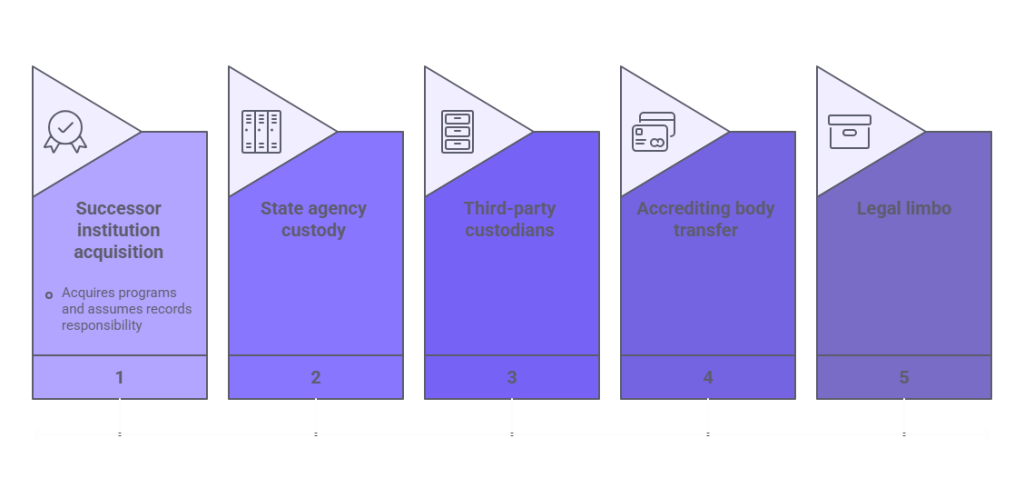
- Successor institution acquisition: A financially healthy institution acquires the closing school's programs and assumes records responsibility
- State agency custody: State education departments take direct custody, integrating records into existing repository systems
- Third-party custodians: Credential management companies contract to serve as permanent custodians, charging fees for transcript requests
- Accrediting body transfer: Records transfer to the closing institution's accrediting body or consortium arrangements
- Legal limbo: Records remain with liquidation trustees or bankruptcy administrators, creating access barriers
Each pathway presents distinct challenges for verification professionals seeking to confirm candidate credentials.
When Record Transfer Fails
Not all closures result in orderly record transfers. Abrupt closures, particularly those involving financial fraud or regulatory violations, may leave records in legal limbo. Physical records may be lost, damaged, or destroyed. Digital records may become inaccessible due to unpaid hosting fees or lost administrative credentials. These worst-case scenarios require alternative verification strategies that rely on indirect evidence, candidate-provided documentation, and risk-based decision frameworks.
Federal and State Repository Systems for Closed College Degree Verification
Multiple public and private databases provide pathways to verify degree from closed school credentials when direct institutional contact is impossible. Understanding which systems contain relevant data and how to access them forms the foundation of effective closed college degree verification.
National Student Clearinghouse
The National Student Clearinghouse maintains enrollment and degree records for institutions that participate in its verification services. Many closed institutions contributed data while operational. The Clearinghouse allows authorized users to request degree verification through its online portal, often returning results within days.
Coverage is not universal. Institutions must have participated before closure for records to exist in the system. Some schools never enrolled in Clearinghouse services, while others joined late in their operational period, resulting in incomplete historical data.
Department of Education Resources
The Federal Student Aid database contains enrollment information for students who received federal financial aid. While not designed as a degree verification tool, it can confirm enrollment dates and institutional attendance, providing corroborating evidence when degree confirmation is unavailable.
The Database of Accredited Postsecondary Institutions and Programs maintained by the Department of Education allows verification of institutional accreditation status at specific points in time. This helps determine whether an institution held recognized accreditation when a candidate attended, informing assessments of credential legitimacy.
State Higher Education Agencies
State education departments often maintain records for institutions authorized to operate within their jurisdictions. Many states have established formal repositories for closed institutions, with varying levels of completeness and accessibility:
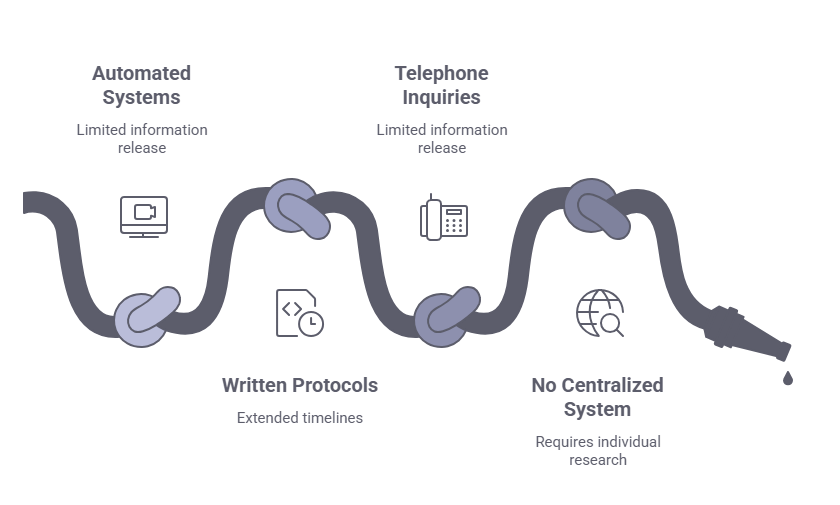
- Online request systems with automated processing
- Written request protocols with extended timelines
- Telephone inquiry systems with limited information release
- No centralized system, requiring individual custodian research
Identifying the appropriate state agency requires determining where the institution was headquartered and chartered, not necessarily where the candidate attended if multiple campuses existed.
Specialized Record Custodians
Organizations like Parchment, Credentials Solutions, and similar third-party services contract with closing institutions to maintain permanent records access. These custodians typically charge fees for transcript requests but provide reliable verification pathways when they hold relevant records.
Identifying which custodian holds specific institutional records requires research. The Department of Education sometimes publishes custodian information for closed schools, particularly those that participated in federal student aid programs.
Step-by-Step Process to Verify Degree From Closed School
Systematic workflows reduce verification delays and ensure consistent handling of closed institution scenarios. The following process provides a structured approach to how to get transcripts from closed college situations and confirm degree credentials when standard methods fail.
Step One: Confirm Institutional Closure
Verify that the institution has actually ceased operations rather than merged, renamed, or restructured. The Department of Education's database and state licensing boards provide definitive closure confirmation. Institutional websites may remain online after closure, creating confusion about operational status.
Step Two: Search National Databases
Query the National Student Clearinghouse first, as it provides the fastest results when records exist. If the candidate provided consent and necessary identifiers, requests typically process within two to five business days. Check Federal Student Aid databases to confirm enrollment periods and federal aid receipt. While not conclusive proof of degree completion, this establishes attendance and can corroborate candidate-provided information.
Step Three: Identify State Repository or Custodian
Contact the state higher education agency in the state where the institution operated. Many states publish lists of closed institutions and designated records custodians on their websites. Request information about records access procedures specific to the institution in question. If the state maintains a centralized repository, follow its specific request protocols. Processing times vary from weeks to months depending on system capacity and request volume.
Step Four: Contact Successor Institutions
If the closed school's programs are transferred to another institution through teach-out agreements or acquisitions, the successor may hold records. State education agencies or accrediting bodies can often identify successor relationships.
Step Five: Request Candidate-Provided Documentation
While not sufficient as sole verification, candidate-provided transcripts, diplomas, or other academic records serve as supporting evidence. Request official documents when possible, noting that candidates may face fees or delays when ordering from custodians.
Step Six: Document All Verification Attempts
Maintain detailed records of each verification attempt, including dates, contacts, responses received, and obstacles encountered. This documentation demonstrates reasonable effort and supports compliance with employment verification requirements.
When Standard Closed College Degree Verification Fails
Despite systematic efforts, some credentials cannot be definitively verified through traditional channels. These scenarios require risk-based decision frameworks that balance hiring needs against verification confidence levels.
Assessing Alternative Evidence
When direct verification is impossible, evaluate the totality of available evidence:
| Evidence Type | Reliability Level | Considerations |
| Candidate-provided official transcripts | Moderate to high | Difficult to authenticate without institutional contact |
| Unofficial transcripts or grade reports | Low to moderate | Support consistency of candidate claims |
| Professional licenses requiring degree | Moderate to high | Most licensing boards verify credentials before issuance, though processes and requirements vary by jurisdiction and profession |
| Previous employment verifications | Moderate | Prior employers may have completed verification |
| Faculty or classmate references | Low | Corroborating but not independently verifiable |
| LinkedIn or professional profiles | Low | Self-reported information without validation |
The combination of multiple moderate-reliability sources can collectively provide reasonable confidence when high-reliability verification is unavailable.
Risk-Based Decision Frameworks
Organizations should establish clear policies for proceeding when verification remains incomplete. Factors to consider include position sensitivity, regulatory requirements specific to the role, availability of alternative evidence, and organizational risk tolerance. For positions where specific degrees are legally required, such as licensed professions, inability to verify may necessitate disqualification regardless of other evidence.
For positions where degrees serve as general qualifications, alternative evidence combined with probationary periods or conditional offers may be appropriate.
Disclosure and Candidate Rights
Under the Fair Credit Reporting Act, employers using background check information for adverse employment decisions must provide specific notices and opportunities for candidates to dispute findings. When verification fails due to institutional closure rather than candidate misrepresentation, these distinctions matter significantly. Candidates should be informed about verification challenges and given opportunities to provide additional documentation or context. Denials based solely on inability to verify, rather than evidence of fraud, require careful handling to avoid legal exposure.
Documentation for Compliance and Audit
Incomplete verifications require enhanced documentation. Record all attempted verification pathways, correspondence with repositories and custodians, alternative evidence evaluated, and decision rationale. This record demonstrates reasonable effort and supports defensibility if hiring decisions are later scrutinized.
Navigating State-by-State Variance in Record Retention
Significant differences exist among state systems for maintaining records from closed institutions. Understanding these variations helps verification teams set appropriate expectations and identify jurisdiction-specific resources.
States With Centralized Repository Systems
Some states maintain robust, accessible repositories. These systems typically offer online request portals, reasonable processing times, and comprehensive coverage of institutions that closed after repository establishment. States with strong higher education oversight infrastructure and histories of institutional regulation tend to have better repository systems.
States With Limited Infrastructure
Other jurisdictions lack centralized systems, requiring case-by-case research to identify where specific institutional records are transferred. In these states, records may scatter among multiple custodians, remain with bankruptcy trustees, or become effectively inaccessible.
Special Cases and Exceptions
Federal institutions like military academies and tribal colleges may follow different closure and record retention protocols:
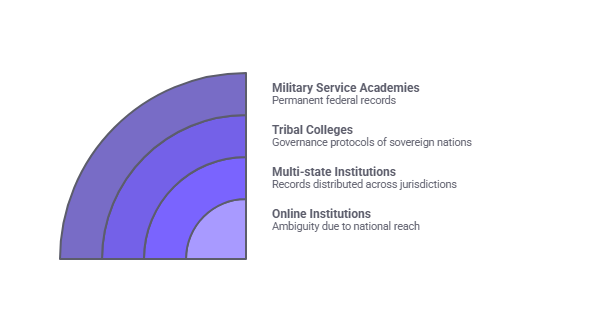
- Military service academies maintain permanent federal records
- Tribal colleges chartered by sovereign nations follow tribal governance protocols
- Multi-state institutions may have records distributed across several jurisdictions
- Online institutions chartered in one state but serving national populations create ambiguity
Each special case requires targeted research into applicable regulatory frameworks and records custodianship.
Legal Validity Versus Verification Feasibility
A common misconception holds that degrees from closed institutions lose validity. Understanding the distinction between a credential's legal standing and the practical ability to verify it is essential for appropriate decision-making.
Accreditation Status Before Closure
The critical factor in degree legitimacy is whether the institution held recognized accreditation at the time the degree was conferred. If a properly accredited institution later closes for financial reasons, degrees awarded while accredited remain valid credentials. Conversely, institutions that never held legitimate accreditation, operated as diploma mills, or lost accreditation before awarding specific degrees present genuine credential validity concerns independent of closure.
Determining Accreditation Status at Time of Conferral
The Department of Education's accreditation database includes historical information, though coverage varies and may be limited for institutions that closed prior to comprehensive digital record-keeping. Accrediting body websites may maintain archives of institutional membership. State education agencies often track accreditation status for oversight purposes. This research requires identifying when the candidate graduated and confirming institutional accreditation at that specific time.
Accreditation loss preceding graduation raises validity concerns, while post-graduation closure does not.
Implications for Credential Recognition
Employers should not automatically discount degrees from closed institutions. These credentials represent completed educational requirements and should be evaluated based on accreditation status during attendance, not institutional longevity. However, verification challenges may appropriately influence hiring decisions when degree confirmation is essential and alternative evidence is insufficient, provided decisions comply with applicable employment laws.
Documentation and Audit Trail Best Practices
Maintaining comprehensive records of verification processes protects organizations during audits, litigation, or regulatory review. This documentation demonstrates due diligence and supports consistent policy application.
Essential Documentation Components
Record initial verification requests, including dates, methods, and recipients. Preserve all responses received, whether confirmations, negative results, or no-response outcomes. Document research into repository systems, custodian identification efforts, and alternative verification attempts. Include copies of candidate-provided documentation with notes about authenticity indicators or concerns. Record decision rationale, especially when proceeding with incomplete verification or declining candidates.
Retention Periods and Storage
Employment verification records should be retained consistent with other hiring documentation, typically three to seven years depending on jurisdiction and organizational policy. Ensure records are stored securely and accessible for audit or legal discovery.
Standardizing Closed Institution Protocols
Develop written procedures specifying verification steps for closed institutions, escalation protocols, decision authority, and documentation requirements:
- Initial closure confirmation procedures
- Database search sequence and timelines
- State repository contact protocols
- Alternative evidence evaluation criteria
- Decision authority matrix based on position sensitivity
- Candidate notification templates
- Documentation retention requirements
Standardization ensures consistent handling regardless of which staff member encounters closure scenarios. Train verification staff on these protocols and update procedures as repository systems evolve or new resources become available.
Preventive Measures and Verification Timing Strategies
While institutional closures cannot be prevented, verification teams can reduce the likelihood of encountering closed-school scenarios during time-sensitive hiring decisions through proactive approaches.
Early-Stage Verification
Initiating education verification early in the hiring process, rather than waiting until offer stages, provides more time to navigate complex closed institution scenarios. This timing flexibility allows thorough research without delaying start dates.
Monitoring Institutional Health Indicators
Organizations conducting high-volume hiring may benefit from monitoring higher education sector news for institutions showing distress signals. Financial difficulties, accreditation warnings, enrollment declines, or leadership instability may predict closure. This information cannot prevent candidates from holding degrees from vulnerable institutions but allows preparation for potential verification challenges.
Setting Internal Policies for Incomplete Verifications
Establish clear organizational policies addressing how to proceed when verifications cannot be completed. Policies should account for position sensitivity, evidence thresholds for proceeding, approval requirements, and probationary period options. Written policies promote consistent decision-making and reduce legal exposure from perceived discriminatory application of verification requirements.
Balancing Verification Thoroughness With Hiring Efficiency
Closed college degree verification can consume significant time and resources. Organizations must balance verification thoroughness against hiring timeline pressures. Policies should specify when extended verification efforts are required versus when risk-based decisions with available information are acceptable.
Conclusion
Institutional closures represent a structural reality of modern higher education, requiring systematic verification protocols rather than ad hoc problem-solving. By understanding custody transfer requirements, utilizing federal and state repository systems, and implementing risk-based decision frameworks, HR professionals can navigate closed college degree verification challenges while maintaining compliance and hiring efficiency.
Frequently Asked Questions
Is a degree from a closed college still valid?
Yes, if the institution held recognized accreditation at the time the degree was conferred. Institutional closure affects verification processes but does not retroactively invalidate credentials earned while the school operated with proper accreditation. Employers should evaluate accreditation status before closure rather than current operational status when assessing credential legitimacy.
How can I verify a degree from a closed school if the college no longer exists?
Start with the National Student Clearinghouse database, then contact the state higher education agency where the institution operated. Many states maintain repositories for closed institution records or can identify designated custodians. Federal Student Aid databases may confirm enrollment periods, and successor institutions sometimes hold transferred records from teach-out agreements.
Where do college transcripts go when a school closes?
Records typically transfer to state education agencies, successor institutions, or third-party custodians depending on closure circumstances and state requirements. Accreditation agreements often mandate records preservation plans. The specific destination varies by institution, but state higher education departments can usually identify where particular schools' records were transferred.
What should employers do when they cannot verify a degree from a closed institution?
Document all verification attempts thoroughly, evaluate alternative evidence like candidate-provided transcripts or indirect confirmations, and apply risk-based decision frameworks consistent with organizational policy. Consider position sensitivity, regulatory requirements, and available supporting information. Ensure any adverse decisions comply with FCRA requirements and applicable employment laws.
How long do closed colleges keep records available?
Record retention requirements vary by state law and institutional type. Accreditation standards typically require permanent retention, though accessibility depends on custodian resources and state infrastructure. Some repositories provide indefinite access, while others face capacity constraints. Processing times range from days to months depending on the system and request volume.
Can candidates get their own transcripts from closed colleges?
Usually yes, though processes vary. Candidates should contact their state higher education agency to identify the records custodian, then follow that custodian's request procedures. Third-party custodians typically charge fees for transcript processing. Some state repositories provide free or reduced-cost access to former students, while processing times vary significantly.
What is the difference between accreditation status before closure and verification difficulty?
Accreditation status determines credential legitimacy, while closure affects verification feasibility. A degree from a properly accredited institution remains valid regardless of later closure. Verification challenges stem from unavailable institutional contacts, not invalid credentials. Employers should research historical accreditation rather than assuming closure indicates credential problems.
Are online databases reliable for verifying degrees from closed institutions?
The National Student Clearinghouse and Federal Student Aid databases provide reliable information when records exist, but coverage depends on institutional participation before closure. State repository systems vary in completeness and accuracy. Multiple sources should be consulted when possible, and negative results do not conclusively prove degrees were not earned.
Additional Resources
- Closed School Guide for Students
https://studentaid.gov/announcements-events/closed-school - Database of Accredited Postsecondary Institutions and Programs
https://ope.ed.gov/dapip/ - National Student Clearinghouse Degree Verification
https://www.studentclearinghouse.org/colleges/degreeverify/ - Family Educational Rights and Privacy Act Overview
https://www2.ed.gov/policy/gen/guid/fpco/ferpa/index.html - FTC Guidance on Background Checks and Employment
https://www.ftc.gov/tips-advice/business-center/guidance/background-checks-what-employers-need-know

ABOUT THE CREATOR
Charm Paz, CHRP
Recruiter & Editor
Charm Paz is an HR and compliance professional at GCheck, working at the intersection of background screening, fair hiring, and regulatory compliance. She holds both FCRA Core and FCRA Advanced certifications and supports organizations in navigating complex employment regulations with clarity and confidence.
With a background in Industrial and Organizational Psychology and hands-on experience translating policy into practice, Charm focuses on building ethical, compliant, and human-centered hiring systems that strengthen decision-making and support long-term organizational health.