



California employers navigate the nation's most complex background check regulatory environment, where state Fair Chance Act mandates intersect with county and municipal ordinances that impose additional disclosure, timing, and individualized assessment requirements. Compliance demands understanding which jurisdiction-specific rules apply to each hiring decision and implementing procedural frameworks that satisfy overlapping mandates without creating unlawful barriers to employment.
Key Takeaways
- California background check compliance requires satisfying state Fair Chance Act requirements plus any applicable county or city ordinances that may impose stricter standards.
- Individualized assessment obligations in California background check processes mandate employers evaluate specific contextual factors before taking adverse action based on criminal history.
- The California 7 year background check rule limits reporting of most criminal convictions, with exceptions for positions meeting specific salary thresholds or involving particular duties.
- Penalties for violating Fair Chance Act provisions include civil penalties, statutory damages, and potential private right of action claims filed by applicants or employees.
- AB 1008 background check requirements introduced standardized conviction history disclosure forms and eliminated inquiries into convictions older than seven years for most positions.
- Multi-jurisdiction employers must identify which California Fair Chance Act 2026 standards apply based on worksite location, employee count, and local ordinance provisions.
- Disclosure and authorization timing rules under California background check compliance frameworks differ from federal Fair Credit Reporting Act minimums in several material respects.
- Technology-assisted screening methods must incorporate the same individualized assessment California background check mandates require for manual review processes.
Understanding California's Multi-Layered Background Check Regulatory Framework
California background check compliance operates within a uniquely stratified legal environment. Employers must simultaneously satisfy federal Fair Credit Reporting Act requirements, state-level Fair Chance Act mandates, and potentially multiple county or municipal ordinances depending on where positions are located. This regulatory stacking creates scenarios where an employer with operations in Los Angeles County, the City of Los Angeles, and San Francisco must apply different procedural requirements to candidates based on worksite location, even when hiring for identical roles.
California is a good reminder that the background screening process is not just a step, it is a process that must be scrutinized under the fire. When state regulations and local ordinances compound, the best approach is to get clarity on where the job is performed and develop a process that manages timing, documentation, and individualized screening from the outset. I think the best teams approach compliance as an operations issue, not an afterthought once the results come in. The result is a hiring process that remains fair, objective, and defensible in the face of challenges.
| Regulatory Layer | Jurisdiction | Key Distinctions |
| Federal | Nationwide | FCRA disclosure, authorization, and adverse action notice requirements |
| State | California | Ban-the-box timing, individualized assessment mandates, seven-year reporting limits |
| County/Municipal | Los Angeles, San Francisco, Oakland, others | Enhanced notice content, extended response periods, additional assessment factors |
The state Fair Chance Act establishes baseline prohibitions and procedural requirements applicable to employers with five or more employees. These rules govern when criminal history inquiries may occur, what disclosure obligations exist, and how individualized assessments must be conducted. County and city jurisdictions have enacted their own fair chance hiring ordinances, many predating state legislation and several imposing requirements beyond state minimums.
Federal and State Law Interaction
Federal Fair Credit Reporting Act provisions set floor requirements for background check processes. These include disclosure, authorization, pre-adverse action notice, and final adverse action notice obligations. California background check compliance standards build upon these federal minimums by restricting when criminal history inquiries may occur, limiting what information may be considered, and mandating specific individualized assessment procedures before adverse action.
Employers must provide standalone disclosure documents before obtaining consumer reports, secure written authorization, and follow specific adverse action notice procedures under federal law. California adds temporal restrictions on when these processes may begin, content limitations on what background check reports may include, and procedural requirements for how findings must be evaluated. Where state and federal requirements overlap, employers must satisfy the more protective standard.
State Fair Chance Act Core Provisions
California's Fair Chance Act prohibits employers from inquiring into criminal history before making a conditional job offer for most positions. This ban-the-box requirement prevents application materials from requesting conviction information and restricts interview questions about criminal background. Exceptions exist for positions where federal or state law requires criminal history screening or disqualifies individuals with specific convictions.
After extending a conditional offer, employers may conduct background checks that include criminal history. If the report contains information the employer intends to use as basis for adverse action, individualized assessment California background check procedures become mandatory. These assessment requirements demand employers evaluate:
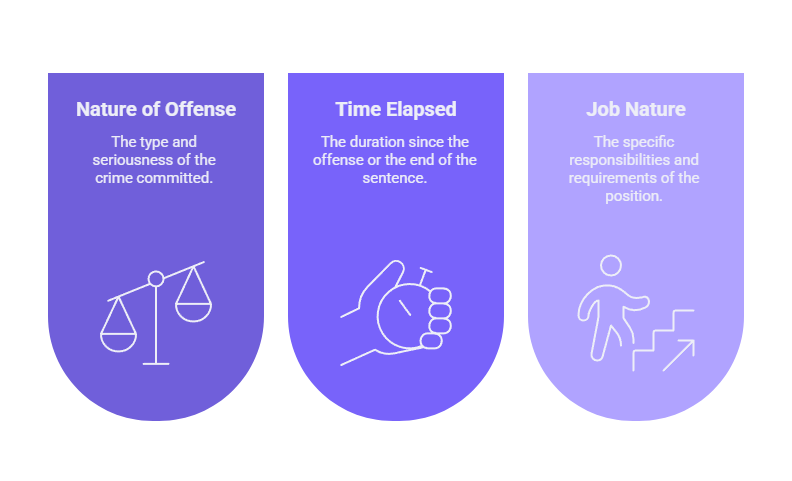
- The nature and gravity of the offense
- Time elapsed since the offense or completion of sentence
- The nature of the job sought
County and Municipal Ordinance Layers
Los Angeles County, the City of Los Angeles, San Francisco, and Oakland each maintain fair chance hiring ordinances with provisions that extend beyond state requirements in specific respects. These local ordinances may impose earlier disclosure timing, broader individualized assessment factor lists, longer waiting periods before adverse action, or expanded applicant rights including appeal procedures.
San Francisco's Fair Chance Ordinance applies to employers with five or more employees and, like state law, generally prohibits pre-offer criminal history inquiries. However, the ordinance includes specific notice content requirements and mandates employers provide applicants with copies of background check reports before taking adverse action, creating procedural steps beyond state minimums in certain scenarios.
Individualized Assessment Requirements in California Background Check Processes
Individualized assessment California background check obligations represent perhaps the most operationally complex compliance requirement employers face. When a background check reveals criminal history information the employer intends to use as a basis for adverse action, California law mandates a structured evaluation process examining specific contextual factors before denying employment.
Mandatory Assessment Factors
Employers must consider the nature and gravity of the offense or conduct, the time that has passed since the offense or conduct and completion of the sentence, and the nature of the job held or sought. This three-factor framework derives from legal standards developed in discrimination case law and has been codified into California's Fair Chance Act requirements.
The nature and gravity assessment requires examining the specific criminal conduct, not merely the conviction category. A theft conviction might involve circumstances ranging from shoplifting necessities during a financial crisis to sophisticated embezzlement schemes. California background check compliance demands employers evaluate the actual conduct underlying the conviction rather than applying categorical exclusions based on offense type.
Documentation and Process Requirements
Individualized assessments must be documented. While California regulations do not prescribe specific documentation formats, employers should maintain records demonstrating that required factors were evaluated for each adverse decision based on criminal history.
The assessment process should occur before issuing a pre-adverse action notice. Employers must:
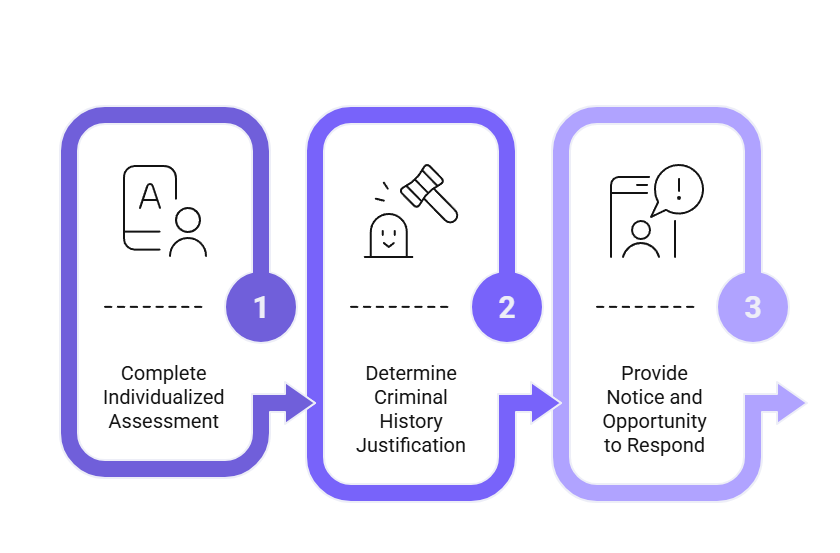
- Complete the individualized assessment
- Determine that criminal history information justifies adverse action after considering required factors
- Provide the applicant with notice and opportunity to respond
Conducting individualized assessment only after the applicant disputes findings reverses the required sequence and fails to satisfy California background check compliance standards. Some employers implement individualized assessment matrices or decision trees attempting to standardize evaluations. These tools may support consistency but cannot replace human judgment exercised on a case-by-case basis.
Incorporating Mitigating Information
Individualized assessment California background check procedures must account for mitigating information and rehabilitation evidence. Applicants have the right to present evidence of rehabilitation and other mitigating factors before final adverse action.
| Mitigating Evidence Type | Examples | Evaluation Considerations |
| Education/Training | Degree completion, vocational certificates, professional development | Demonstrates skill development and commitment to growth |
| Employment History | Stable work record post-conviction, positive references | Shows sustained productive behavior |
| Community Involvement | Volunteer service, mentorship, civic participation | Indicates rehabilitation and social reintegration |
| Formal Rehabilitation | Treatment program completion, counseling, certificates of rehabilitation | Provides structured evidence of changed circumstances |
Employers must provide applicants with a reasonable opportunity to submit such information and must consider it as part of individualized assessment. What constitutes reasonable opportunity depends on context, but employers typically provide at least five business days for applicants to respond to pre-adverse action notices and submit additional information.
California 7 Year Background Check Rule and Reporting Limitations
The California 7 year background check rule restricts what criminal conviction information may be included in consumer reports used for employment purposes. This limitation applies to reporting agencies preparing background check reports, but employers must understand the rule's parameters to ensure compliance when obtaining and using criminal history information.
Scope and Application of Seven-Year Limitation
California law generally prohibits consumer reporting agencies from reporting criminal convictions more than seven years old, calculated from the date of disposition, release, or parole. This limitation applies to conviction records included in background check reports obtained through consumer reporting agencies, creating a temporal boundary on what historical criminal information enters the hiring process.
The seven-year lookback period applies to convictions, not arrests. Arrests that did not result in convictions face even stricter reporting limitations and generally cannot be included in employment background checks under California law.
Exceptions to Seven-Year Limitation
The California 7 year background check rule includes significant exceptions based on position salary thresholds. When the position offers reasonably anticipated annual compensation exceeding statutory thresholds (currently $125,000 under California Civil Code § 1786.18, subject to periodic adjustment), the seven-year limitation does not apply, and older convictions may be reported. Employers should verify current threshold amounts as they may change based on inflation adjustments.
Certain positions are exempt from reporting limitations regardless of salary level:
- Positions in healthcare facilities
- Roles within law enforcement agencies
- Jobs involving access to controlled substances
- Positions subject to industry-specific regulatory requirements
These exceptions narrow California background check compliance advantages the seven-year rule otherwise provides.
Practical Implementation Considerations
Employers obtaining background checks through consumer reporting agencies should verify that reports comply with California reporting limitations. This includes confirming that conviction dates are properly calculated, arrests without convictions are excluded, and salary threshold exceptions are applied only when appropriate.
| Implementation Element | Required Action | Compliance Risk if Omitted |
| Report date verification | Confirm conviction dates calculated from disposition/release | Consideration of impermissible older convictions |
| Arrest exclusion | Ensure non-conviction arrests removed | FCRA and state law violations |
| Salary threshold validation | Apply exceptions only when position exceeds statutory threshold | Improper inclusion of older records |
| Position-specific exemptions | Verify regulatory requirements justify exemption | Unnecessary reliance on older information |
The seven-year limitation does not prevent employers from discovering older convictions through other means, such as courthouse searches conducted by employer staff or required disclosures under professional licensing schemes. However, California background check compliance standards that limit consideration of older convictions through individualized assessment requirements may effectively restrict using such information even when technically accessible.
AB 1008 Background Check Requirements and Standardized Disclosure Forms
AB 1008 background check requirements, effective since January 1, 2018, introduced standardized conviction history disclosure forms and created additional procedural obligations for California employers using criminal history in employment decisions. This legislation built upon existing Fair Chance Act foundations by establishing specific documentation formats and expanding prohibited practices.
Standardized Conviction History Form
AB 1008 mandated use of a standardized form when employers request applicants disclose conviction history information. The standardized form includes specific content requirements, explanatory language about applicants' rights, and formatting standards designed to prevent confusion about what must be disclosed.
The form specifies that applicants need not disclose:
- Arrests not resulting in conviction
- Convictions that have been sealed or expunged
- Participation in pre-plea diversion programs
This clarification addresses common applicant uncertainty about disclosure obligations and helps ensure California background check compliance by preventing applicants from over-reporting non-disclosable information that employers should not consider.
Enhanced Notice Requirements
AB 1008 background check requirements expanded notice obligations when employers intend to take adverse action based on conviction history. Employers must provide written notice of the disqualifying conviction, a copy of the conviction history report if obtained through a consumer reporting agency, and specific information about the applicant's right to respond.
This notice must occur before final adverse action and must allow applicants at least five business days to respond with evidence of inaccuracies or rehabilitation. The notice must identify which conviction or convictions form the basis for potential adverse action, enabling targeted applicant responses addressing the specific concerns driving the employer's preliminary decision.
Elimination of Older Conviction Inquiries
AB 1008 codified prohibition on inquiring about or considering convictions more than seven years old for most positions. While the California 7 year background check rule previously limited what consumer reporting agencies could include in reports, AB 1008 extended this limitation to direct employer inquiries, creating broader restriction on older conviction consideration.
This provision prevents employers from asking applicants to disclose convictions older than seven years even when the salary threshold exception might allow reporting agency inclusion. The restriction is subject to the same exceptions applicable to consumer reporting agency limitations, including positions exceeding salary thresholds or subject to regulatory requirements mandating broader criminal history consideration.
Penalties for Violating Fair Chance Act and Enforcement Mechanisms
Penalties for violating Fair Chance Act provisions create meaningful compliance incentives through civil enforcement, private rights of action, and potential damage awards. Employers must understand enforcement mechanisms and penalty structures to appropriately assess compliance risk and prioritize process improvements.
Civil Penalties and Government Enforcement
The California Civil Rights Department may enforce Fair Chance Act violations through civil penalty assessments. Penalties for violations are established by statute and may increase for repeat violations. Each affected applicant may constitute a separate violation, creating potential for substantial aggregate penalties when systematic non-compliance affects multiple individuals.
Government enforcement actions typically arise from applicant complaints filed with the Civil Rights Department. Complaints trigger investigations that may examine not only the specific complainant's situation but broader employer practices affecting other applicants.
Private Right of Action
California's Fair Chance Act includes private right of action provisions enabling affected applicants to file civil lawsuits for violations. This enforcement mechanism allows applicants to pursue remedies directly through court proceedings without relying on government agency investigation and prosecution.
| Remedy Type | Description | Typical Application |
| Compensatory Damages | Lost wages and economic harm | Calculated based on denied position's compensation |
| Emotional Distress | Non-economic harm | Available in cases involving egregious violations |
| Injunctive Relief | Court-ordered policy changes | Requires implementation of specific compliance procedures |
| Attorney Fees | Recovery of legal costs | Incentivizes counsel representation of applicants |
Private actions may seek compensatory damages, injunctive relief requiring policy changes, and attorney fees. Attorney fee provisions create incentive for counsel to represent applicants in Fair Chance Act cases, increasing enforcement likelihood.
Damages and Remedies Available
Courts may award various forms of relief in Fair Chance Act violation cases. Economic damages include lost earnings from the employment opportunity unlawfully denied, calculated based on the compensation the position would have provided. When violations involve particularly egregious circumstances, courts may award emotional distress damages compensating non-economic harm.
Injunctive relief may require employers to modify background check policies, implement training programs, or adopt specific procedural safeguards addressing compliance gaps that led to violations.
Intersection with Discrimination Claims
Fair Chance Act violations may support or accompany discrimination claims under California Fair Employment and Housing Act provisions. Using criminal history in ways that disproportionately affect protected classes creates potential disparate impact discrimination liability separate from and in addition to Fair Chance Act violations.
When employers apply criminal history policies inconsistently across demographic groups or use conviction information as pretext for discriminatory intent, both discrimination claims and Fair Chance Act violation claims may proceed simultaneously.
Practical Compliance Framework for Multi-Jurisdiction California Operations
Employers operating across multiple California jurisdictions need systematic frameworks ensuring each hiring decision complies with applicable state and local requirements. California background check compliance demands identifying which rules apply based on worksite location and implementing procedures satisfying the most protective standard applicable to each position.
Jurisdiction Mapping and Rule Identification
The first compliance step involves mapping operations to applicable ordinances. Employers should identify each California worksite location, determine which county and municipal jurisdictions govern each site, and research whether local fair chance hiring ordinances exist for those jurisdictions.
After identifying applicable local ordinances, employers must analyze each ordinance's specific requirements, comparing them to state Fair Chance Act provisions. Key comparison points include:
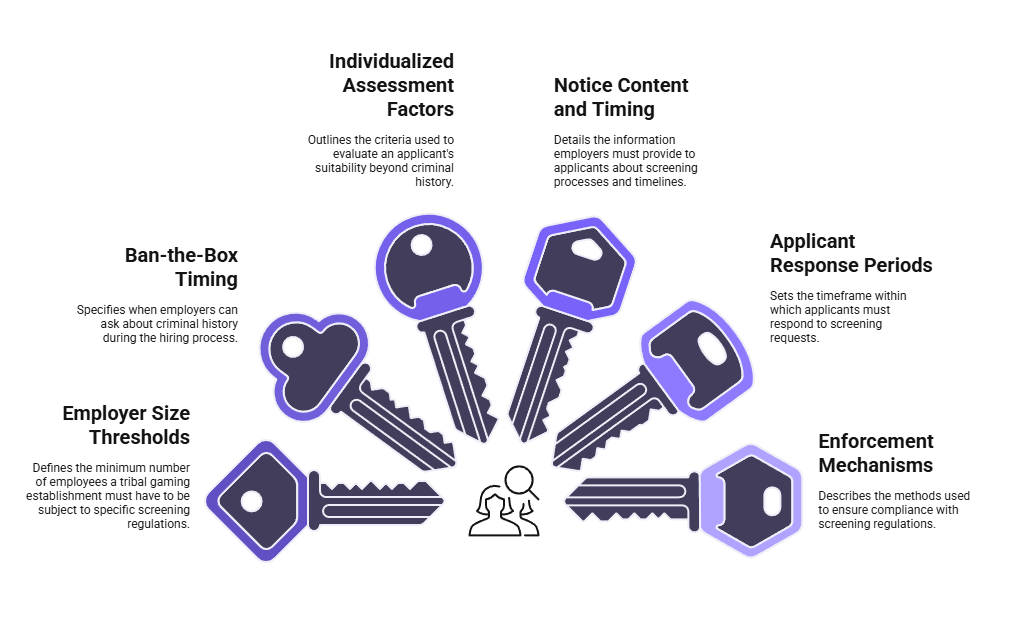
- Employer size thresholds
- Ban-the-box timing
- Individualized assessment factors
- Notice content and timing
- Applicant response periods
- Enforcement mechanisms
Differences between local and state requirements determine whether location-specific procedures are necessary or whether statewide procedures satisfying the most protective standard can apply uniformly.
Conditional Offer Timing and Criminal History Inquiries
California background check compliance requires ensuring criminal history inquiries occur only after conditional employment offers for positions subject to ban-the-box rules. Employers must define what constitutes a conditional offer and train hiring personnel to recognize when this threshold is reached.
A conditional offer communicates that the applicant is selected for the position subject only to background check results and potentially other non-subjective contingencies like reference checks or license verification. The offer must be definite enough that the applicant reasonably understands they will be hired absent disqualifying background check findings.
Individualized Assessment Implementation
Operationalizing individualized assessment California background check requirements demands procedural frameworks guiding hiring personnel through required factor evaluation. Many employers develop assessment worksheets or decision guides prompting consideration of mandatory factors and documentation of conclusions.
These tools should require evaluators to:
- Describe the specific criminal conduct, not merely the conviction category
- Calculate time elapsed since offense and sentence completion
- Identify specific job duties creating legitimate nexus to the criminal conduct
- Consider any mitigating information or rehabilitation evidence provided by the applicant
- Document the rationale supporting the final decision
Completed assessment documentation should be retained with other hiring records.
Notice and Response Procedures
California background check compliance procedures must incorporate required pre-adverse action notices and allow applicants adequate response time. Employers should develop standardized notice templates including all required content elements while allowing customization to identify the specific conviction or convictions forming the basis for preliminary adverse decision.
| Procedure Component | Timeline | Responsible Party | Documentation Required |
| Pre-adverse action notice delivery | Immediately after individualized assessment | HR/Hiring Manager | Notice copy, delivery confirmation |
| Applicant response period | Minimum 5 business days | Applicant | Response submission, evidence provided |
| Response review | Within 2-3 business days of receipt | HR/Compliance | Review notes, decision rationale |
| Final decision communication | After response review completed | HR/Hiring Manager | Final adverse action notice |
Response procedures should establish clear submission methods for applicants to provide rehabilitation evidence or challenge accuracy, designate personnel responsible for reviewing applicant responses, and set internal timelines ensuring responses receive meaningful consideration before final decisions.
Technology-Assisted Screening Integration
Employers utilizing technology-assisted screening tools, including artificial intelligence or algorithmic risk assessment platforms, must ensure these technologies incorporate required California background check compliance elements. Automated systems must apply California reporting limitations, trigger individualized assessment procedures when criminal history is identified, and generate required notices with appropriate content.
Technology vendors should provide documentation explaining how their systems implement California-specific requirements. Employers remain legally responsible for compliance even when utilizing third-party technology platforms, making vendor due diligence and contractual compliance representations important risk management elements.
Disclosure, Authorization, and Timing Requirements Under California Law
California background check compliance imposes specific timing and content requirements for disclosure and authorization documents that differ from federal minimums in several respects. Employers must ensure their background check procedures satisfy both federal Fair Credit Reporting Act standards and additional California requirements.
Standalone Disclosure Obligations
Federal law requires employers to provide clear and conspicuous disclosure that a consumer report may be obtained for employment purposes, delivered as a standalone document without extraneous information. California imposes additional content requirements for these disclosures, including specific language about applicants' rights under California law.
The disclosure must inform applicants that:
- Background check information cannot be used in violation of federal or state equal employment opportunity laws
- Applicants have rights under the California Investigative Consumer Reporting Agencies Act
- Applicants may request copies of any investigative consumer reports obtained
These content additions create California-specific disclosure requirements beyond federal minimums.
Written Authorization Standards
Employers must obtain written authorization before procuring consumer reports, meeting both federal and California form requirements. California law specifies that authorization documents cannot contain liability waivers or other provisions releasing employers or consumer reporting agencies from legal obligations.
Authorization timing aligns with ban-the-box requirements, meaning employers generally cannot request authorization until after extending conditional offers for positions subject to Fair Chance Act provisions.
Pre-Adverse Action Notice Requirements
When background checks reveal information the employer intends to use as basis for adverse action, California law requires providing the applicant with a copy of the consumer report and a summary of rights before taking final adverse action. This notice must occur after individualized assessment but before the employer's decision becomes final.
| Notice Element | Required Content | Timing |
| Report copy | Complete consumer report as received from CRA | Before final adverse action |
| Summary of rights | California-specific rights document | Concurrent with report copy |
| Disqualifying information | Identification of specific conviction(s) at issue | Concurrent with report copy |
| Response instructions | How to submit evidence, challenge accuracy | Concurrent with report copy |
| Response deadline | Minimum 5 business days from notice | Stated in notice |
The pre-adverse action notice period must allow applicants reasonable opportunity to respond, typically interpreted as at least five business days. During this period, applicants may challenge report accuracy, provide evidence of rehabilitation, or submit other mitigating information.
Final Adverse Action Notice Obligations
After completing the pre-adverse action notice and response process, if the employer proceeds with adverse action, final adverse action notice must be provided. This notice must include specific content elements required by federal Fair Credit Reporting Act provisions and any additional elements required by California law or applicable local ordinances.
The final notice must inform the applicant of the adverse decision, provide the consumer reporting agency's contact information, and explain that the consumer reporting agency did not make the adverse decision and cannot provide specific reasons for it.
Conclusion
California background check compliance requires navigating intersecting state and local requirements that create the nation's most complex fair chance hiring regulatory environment. Employers must implement procedural frameworks ensuring individualized assessment California background check mandates are satisfied, timing requirements are met, and jurisdiction-specific rules are applied based on worksite location. Ongoing monitoring of regulatory developments and systematic documentation of compliance processes provide essential protection against penalties for violating Fair Chance Act provisions while supporting equitable hiring practices that evaluate applicants based on qualifications and legitimate job-related factors.
Frequently Asked Questions
The fair chance and background check requirements of California create operational issues for employers because state regulations and local ordinances do not always work the same way. Operational issues can include timing, disclosure, and individualized assessment requirements. Below are some FAQs that answer some of the most common questions regarding timing of background checks, what can be considered during background checks, and best practices for operational workflow. They are intended to help employers apply the appropriate standards based on the job type and scope of regulations.
What does individualized assessment California background check compliance require?
Individualized assessment requires employers to evaluate the nature and gravity of the criminal offense, the time elapsed since the offense and completion of sentence, and the nature of the job sought before taking adverse action based on criminal history. Employers must document this analysis and consider any rehabilitation evidence or mitigating information provided by applicants before making final decisions.
How does the California 7 year background check rule affect what convictions can be considered?
The California 7 year background check rule generally prohibits consumer reporting agencies from including convictions more than seven years old in employment background check reports. Exceptions apply for positions with reasonably expected annual compensation exceeding statutory thresholds, subject to periodic adjustment, and for certain positions subject to regulatory requirements mandating broader criminal history screening.
What are penalties for violating Fair Chance Act requirements in California?
Penalties for violating Fair Chance Act provisions include civil penalties assessed by the California Civil Rights Department, potential private lawsuits filed by affected applicants seeking compensatory damages and attorney fees, and possible injunctive relief requiring policy modifications. Each affected applicant may constitute a separate violation, and penalties increase for repeat violations.
What specific changes did AB 1008 background check requirements introduce?
AB 1008 background check requirements, effective since January 1, 2018, mandated use of standardized conviction history disclosure forms with specific content and formatting, expanded notice obligations when employers intend to take adverse action based on convictions, and codified prohibitions on inquiring about or considering convictions more than seven years old for most positions. The legislation also clarified that applicants need not disclose arrests without convictions or sealed records.
When can employers ask about criminal history under California Fair Chance Act 2026 rules?
California Fair Chance Act provisions generally prohibit employers from inquiring about criminal history until after making a conditional employment offer. Applications cannot request conviction information, and interviewers cannot ask about criminal background until the applicant has been selected for the position subject only to background check results and similar non-subjective contingencies.
Do California background check compliance requirements apply differently based on employer size?
Yes, the state Fair Chance Act applies to employers with five or more employees. Smaller employers may not be subject to state-level ban-the-box and individualized assessment requirements, though they must still comply with federal Fair Credit Reporting Act provisions and any applicable county or municipal ordinances that may apply regardless of employer size.
How should employers handle background checks for employees working in multiple California locations?
Employers should apply California background check compliance standards based on the primary worksite location for each position. When employees regularly work across multiple jurisdictions with different local ordinances, employers should apply the most protective standard applicable to any regular worksite location to ensure compliance across all jurisdictions where work occurs.
What rehabilitation evidence must employers consider during individualized assessments?
Employers must consider any rehabilitation evidence applicants provide during the pre-adverse action notice response period. This may include educational or vocational training completion, employment history demonstrating stability, community service participation, reference letters, certificates of rehabilitation, or other evidence showing changed circumstances since the criminal offense.
Additional Resources
- California Fair Chance Act (Government Code Sections 12952)
https://leginfo.legislature.ca.gov/faces/codes_displaySection.xhtml?sectionNum=12952&lawCode=GOV - California Civil Rights Department - Fair Chance Act Resources
https://calcivilrights.ca.gov/fair-chance-act/ - California Investigative Consumer Reporting Agencies Act
https://leginfo.legislature.ca.gov/faces/codes_displayText.xhtml?lawCode=CC&division=3.&title=1.81.&part=4.&chapter=1.&article=2 - Federal Trade Commission - Fair Credit Reporting Act Guidance
https://www.ftc.gov/legal-library/browse/statutes/fair-credit-reporting-act - California Labor Commissioner's Office - Workplace Rights
https://www.dir.ca.gov/dlse/ - U.S. Equal Employment Opportunity Commission - Background Checks Guidance
https://www.eeoc.gov/laws/guidance/enforcement-guidance-consideration-arrest-and-conviction-records-employment-decisions

ABOUT THE CREATOR
GCheck Editorial Team
Meet the GCheck Editorial Team, your trusted source for insightful and up-to-date information in the world of employment background checks. Committed to delivering the latest trends, best practices, and industry insights, our team is dedicated to keeping you informed.
With a passion for ensuring accuracy, compliance, and efficiency in background screening, we are your go-to experts in the field. Stay tuned for our comprehensive articles, guides, and analysis, designed to empower businesses and individuals with the knowledge they need to make informed decisions.
At GCheck, we're here to guide you through the complexities of background checks, every step of the way.