



Background screening remote employees requires a structured approach that accounts for distributed workforces, varied jurisdictions, and evolving verification technologies. Organizations must balance compliance requirements with operational efficiency while adapting traditional screening frameworks to accommodate permanent remote hiring models.
Key Takeaways
- Remote employee screening extends traditional background check protocols to address geographic distribution, technology-enabled verification, and continuous monitoring needs.
- Identity verification for remote workers involves multiple authentication methods, including document validation, biometric confirmation, and knowledge-based authentication.
- Employers must navigate multi-jurisdictional compliance requirements when screening candidates across state and international boundaries.
- Remote hiring best practices include establishing consistent screening standards regardless of employee location while accounting for regional legal variations.
- Technology platforms can automate portions of the screening workflow, but human review remains essential for accuracy and compliance.
- Continuous verification practices help organizations maintain workforce integrity beyond the initial hiring checkpoint.
- International remote worker screening introduces additional complexity related to data privacy laws, credential validation, and cross-border information transfer.
- Documentation requirements for remote workers often exceed traditional in-office hiring due to the need for digital authentication and remote notarization alternatives.
The Evolution of Remote Workforce Screening
The transition from emergency remote work arrangements to permanent distributed workforce models has fundamentally altered how organizations approach employee screening. What began as temporary adaptations to traditional processes has matured into distinct operational frameworks designed specifically for geographically dispersed teams.
Remote hiring is no longer an exception requiring special accommodation. Organizations now build screening protocols that assume distributed workforces as the default condition. This shift requires rethinking verification methods, compliance frameworks, and technology integration strategies.
Understanding the Remote Screening Landscape
Background screening remote employees involves verifying candidate information when traditional in-person validation methods are unavailable or impractical. The process encompasses identity confirmation, credential verification, criminal record checks, employment history validation, and other standard screening components, all executed through remote-capable methods. Background screening for employment purposes constitutes a permissible purpose under federal law, but organizations must ensure screening activities align with legitimate employment-related needs and comply with all applicable regulations.
The fundamental challenge lies not in conducting individual screening elements remotely, but in establishing systematic approaches that maintain consistency, accuracy, and legal compliance across varied jurisdictions and candidate circumstances. Organizations must determine which screening components require adaptation for remote execution versus those that function identically regardless of candidate location.
I learned through remote hiring that trust isn’t something you feel; it’s something you construct. When your team isn’t in the same room, every authentication process is a thread in your culture, weaving a message about what you care about: your people, your data, your customers, and each other. I’ve witnessed how consent, consistency, and consideration can be a celebration of candidates while also being thorough. The goal is not to screen harder; it is to screen smarter, with technology handling the routine and humans owning the judgment. If done right, background screening processes can become more than a gate; they can be a vessel of fairness and safety from day one.
Distributed Workforce Considerations
Permanent remote workforce models introduce complexities absent from traditional hiring scenarios. Employees may reside in jurisdictions with different screening regulations, requiring organizations to maintain compliance with multiple legal frameworks simultaneously.
Candidates may hold credentials from various states or countries, each with distinct verification processes and access protocols. Technology infrastructure becomes critical when screening processes cannot rely on physical document presentation or face-to-face interaction. Organizations must establish digital verification pathways that provide equivalent reliability to in-person methods while maintaining appropriate security standards.
Identity Verification for Remote Workers
Identity verification represents the foundational element of remote employee screening. Without physical presence, organizations must employ alternative methods to confirm that candidates are who they claim to be and that submitted documents belong to the person under consideration.
Multi-Factor Authentication Approaches
Effective identity verification for remote workers typically involves layered authentication methods rather than single-point confirmation. The table below outlines common verification layers and their functions:
| Verification Method | Primary Function | Key Considerations |
| Document verification | Examines government-issued identification through digital submission | Analyzes security features, detects alterations, cross-references databases where permissible |
| Biometric verification | Compares biological markers against identity documents | Uses facial recognition, fingerprint scans, or other biometric data |
| Knowledge-based authentication | Presents questions derived from personal history | Tests whether candidates possess information consistent with claimed identity |
These methods work together to establish multi-layered confirmation that strengthens overall verification reliability beyond what any single approach provides. Biometric data collection may trigger specific legal requirements in certain jurisdictions, including consent standards, data protection obligations, and retention limitations. Organizations should evaluate applicable biometric privacy laws before implementing biometric verification methods.
Document Validation Protocols
Remote document validation requires establishing procedures that account for the inability to physically examine original credentials. Organizations typically request high-resolution images or scans of identity documents, educational certificates, professional licenses, and other relevant credentials.
Validation protocols should specify acceptable document formats, image quality standards, and submission security requirements. Some organizations employ third-party verification services that specialize in credential authentication, while others build internal capabilities using technology platforms designed for document analysis. Cross-referencing submitted documents against issuing authority databases provides additional validation where such access exists.
Continuous Identity Monitoring
Identity verification extends beyond the initial hiring checkpoint in mature remote workforce models. Continuous monitoring approaches help organizations detect identity-related issues that emerge post-hire, including credential expirations, license revocations, or identity theft indicators.
Automated systems can track credential renewal dates, monitor professional licensing databases for status changes, and alert organizations to potential identity compromise indicators. These capabilities prove particularly valuable for distributed workforces where periodic in-person verification is impractical.
Compliance Considerations for Multi-Jurisdictional Screening
Organizations screening remote workers across multiple jurisdictions face complex compliance requirements that vary by location. Federal regulations provide baseline standards, but state and local laws often impose additional restrictions, requirements, or procedural mandates.
Navigating Varied Regulatory Frameworks
The Fair Credit Reporting Act establishes federal requirements for employment screening conducted through consumer reporting agencies. Organizations must provide proper disclosures, obtain candidate authorization, and follow multi-step adverse action procedures mandated by federal law, which include providing pre-adverse action notice, a copy of the consumer report, a summary of rights, adequate time for the candidate to respond, and final adverse action notice. These requirements involve specific timing and content standards.
State-specific regulations introduce additional complexity:
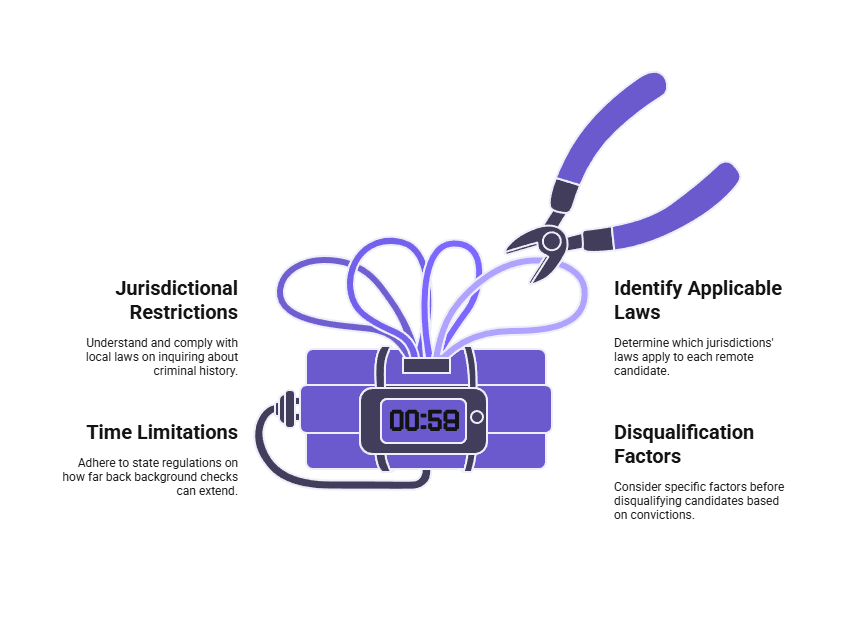
- Some jurisdictions restrict when and how employers may inquire about criminal history, with regulations varying from limitations on timing to outright prohibitions on considering certain types of records
- Certain states limit how far back background checks may extend
- Various locations require consideration of specific factors before disqualifying candidates based on conviction records
- Organizations must identify which jurisdictions' laws apply to each remote candidate
Municipal ordinances may impose further restrictions in certain cities and counties. These local regulations often address fair hiring practices, credit check restrictions, and other screening-related matters. Some jurisdictions also restrict salary history inquiries and other employment questions, though these may fall outside traditional background screening frameworks.
International Screening Complications
Remote worker screening becomes significantly more complex when candidates reside outside the United States. International screening must account for varied data privacy regulations, different criminal record systems, credential verification challenges, and cross-border data transfer restrictions.
Organizations must ensure their screening practices comply with applicable privacy laws in candidate jurisdictions, including data protection requirements that may restrict or prohibit certain information collection, processing, or cross-border transfers. International screening often requires specialized legal analysis and may necessitate data transfer mechanisms such as Standard Contractual Clauses or other approved safeguards.
Criminal record access varies dramatically by country. Some nations provide centralized criminal record databases accessible to employers, while others prohibit such disclosures entirely or limit access to specific circumstances. Verification timelines and costs often exceed domestic screening substantially.
Managing Consent and Authorization
Obtaining proper candidate consent represents a critical compliance requirement that requires careful attention in remote contexts. Under federal law, organizations must provide candidates with specific disclosures in a standalone document before obtaining authorization for background screening. Authorization forms and disclosure documents have distinct legal requirements that vary by jurisdiction. Organizations should consult legal counsel to ensure forms meet all applicable federal, state, and local requirements.
Remote authorization processes must ensure that forms are properly completed, understood, and legally valid without in-person execution. Electronic signature platforms that meet applicable legal standards provide one solution, though organizations should verify that such methods satisfy requirements in relevant jurisdictions. Documentation of consent becomes particularly important in remote scenarios where physical records may not exist. Organizations must establish data retention and disposal policies that comply with federal requirements for secure destruction of consumer report information and any applicable state or international data protection laws that mandate retention limits or data minimization practices.
Technology Integration and Workflow Automation
Screening distributed workforces efficiently requires technology infrastructure capable of managing complex, multi-step processes across varied jurisdictions and candidate circumstances. Automation can streamline routine tasks while maintaining necessary human oversight for judgment-dependent decisions.
Screening Platform Capabilities
Modern screening workflows typically involve platforms that coordinate multiple verification activities, manage candidate communication, track progress, and maintain compliance documentation. These systems integrate with criminal record databases, credential verification services, identity authentication tools, and other data sources necessary for comprehensive screening.
Effective platforms accommodate jurisdiction-specific requirement variations, automatically applying appropriate screening protocols based on candidate location and position requirements. Automated compliance checking helps prevent inadvertent violations by flagging potential issues before they result in prohibited actions.
Integration with HR Systems
Screening workflows function most efficiently when integrated with broader HR technology ecosystems. Consider the following integration points:
- Applicant tracking systems should trigger screening processes at appropriate hiring stages
- Human resource information systems benefit from screening data integration for ongoing compliance monitoring
- Automated alerts can notify relevant personnel when credentials near expiration or licenses require renewal
- Single sign-on capabilities and unified candidate databases reduce administrative burden
Consistent data formatting across platforms prevents errors and improves efficiency throughout the screening lifecycle.
Automation Boundaries and Human Review
While technology enables substantial workflow automation, human judgment remains essential for interpreting screening results, evaluating context, and making final employment decisions. Automated systems should flag results requiring review rather than making autonomous determinations about candidate suitability.
Criminal record evaluation exemplifies the necessity for individualized assessment. Automated systems can identify relevant records but cannot independently determine whether specific convictions relate to job responsibilities or consider mitigating circumstances. Organizations should establish clear escalation protocols that route complex situations to qualified personnel with authority and expertise to resolve them appropriately.
Remote Hiring Best Practices for Ongoing Screening
Effective remote employee screening extends beyond initial background checks to encompass continuous verification and periodic re-screening appropriate to position requirements and risk profiles.
Establishing Screening Standards
Organizations should develop clear screening policies that define what verification activities apply to different position categories, regardless of whether roles are remote, hybrid, or on-site. When background checks reveal adverse information, employers must conduct individualized assessments that consider the nature of the information, the time elapsed, and the nature of the job before making employment decisions. Consistent standards help ensure equitable treatment while satisfying legitimate business needs for workforce integrity.
| Screening Element | Application Approach | Rationale |
| Position-specific requirements | Reflect actual job responsibilities, access levels, and risk factors | Ensures screening relevance to role demands |
| Risk-based protocols | Higher-risk positions warrant more comprehensive or frequent verification | Aligns screening intensity with legitimate business concerns |
| Documentation standards | Clear records of screening standards and business justification | Provides protection if challenged, demonstrates defensible decision-making |
Position-specific screening requirements should reflect actual job responsibilities rather than applying uniform protocols to all roles.
Continuous Monitoring Strategies
Continuous monitoring involves ongoing surveillance of specific databases or records to detect changes affecting employee suitability or compliance status. Common monitoring targets include criminal record databases, professional licensing boards, motor vehicle records for driving positions, and sanctions lists for regulated industries.
Organizations must carefully consider what continuous monitoring is legally permissible, operationally necessary, and appropriate given privacy expectations. Not all screening elements suitable for initial background checks are appropriate for ongoing monitoring, and some jurisdictions restrict continuous surveillance activities. Candidate authorization for continuous monitoring requires explicit consent beyond initial screening permission.
Re-Screening Protocols
Periodic re-screening involves conducting fresh background checks at defined intervals rather than continuously monitoring for changes. This approach suits situations where continuous monitoring is impractical, prohibited, or unnecessary given the nature of information being verified.
Re-screening intervals should reflect how quickly relevant information might change and how significant such changes would be to job performance or organizational risk. Re-screening requires renewed candidate authorization and compliance with current legal requirements, which may have changed since initial hiring.
Addressing Remote Worker Screening Challenges
Distributed workforce screening presents distinct operational challenges that require proactive strategies and contingency planning.
Verification Delays and Timeline Management
Remote screening often takes longer than traditional processes due to geographic dispersion, varied jurisdiction response times, and technology-dependent workflows. Organizations should establish realistic timeline expectations and communicate them clearly to candidates.
Key considerations for timeline management include:
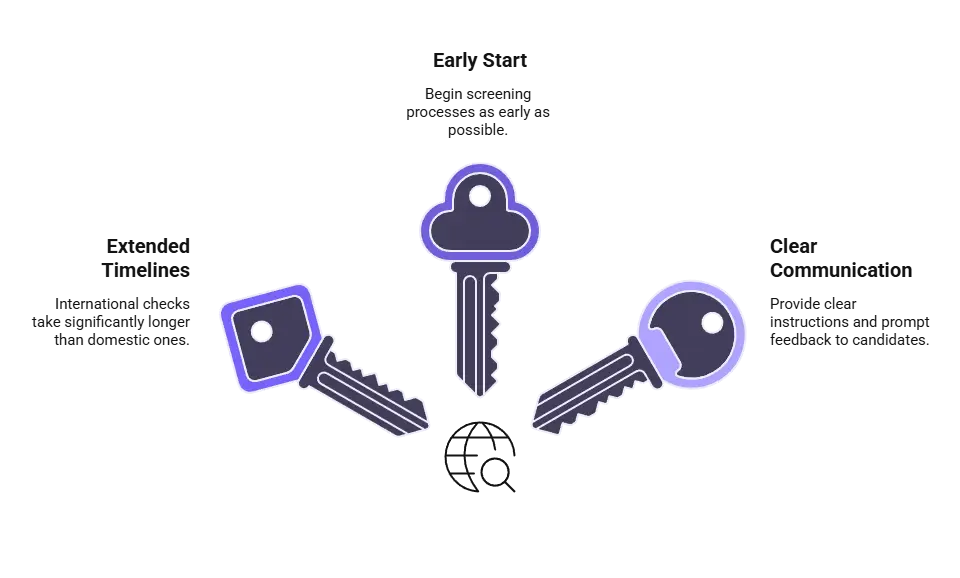
- International screening typically requires substantially more time than domestic checks, sometimes extending timelines by weeks or months
- Organizations hiring internationally should begin screening processes as early in the hiring pipeline as legally and practically feasible
- Clear initial instructions and prompt candidate communication about deficiencies help minimize time lost
Proactive timeline management reduces candidate anxiety and improves organizational hiring efficiency.
Managing Incomplete or Inconsistent Results
Screening distributed candidates sometimes produces incomplete results due to jurisdictional access limitations, record unavailability, or technical difficulties. Organizations must establish protocols for proceeding when complete information cannot be obtained despite good-faith efforts.
| Result Type | Assessment Approach | Decision Framework |
| Critical screening elements incomplete | Determine if missing information creates unacceptable uncertainty | Typically require resolution before employment proceeds |
| Less essential verifications incomplete | Evaluate if good-faith efforts encountered legitimate limitations | May continue post-hire without delaying start dates |
| Inconsistent information across sources | Investigate rather than take immediate adverse action | Provide candidates opportunities to explain or provide documentation |
Risk assessment frameworks help determine when incomplete screening results are acceptable versus when missing information prevents informed employment decisions.
Candidate Experience Considerations
Remote screening imposes substantial burden on candidates who must gather documents, complete forms, and navigate verification processes without in-person assistance. Organizations that minimize unnecessary complexity and provide clear guidance improve both candidate experience and screening efficiency.
Transparent communication about screening requirements, timelines, and progress helps candidates understand what to expect. Automated status updates, clear point-of-contact information, and responsive support improve candidate perception of organizational professionalism.
Conclusion
Background screening remote employees requires adapting traditional verification frameworks to accommodate distributed workforces, multi-jurisdictional compliance requirements, and technology-enabled processes. Organizations that establish systematic approaches balancing thoroughness with efficiency position themselves to build reliable remote teams while maintaining legal compliance and candidate trust.
Frequently Asked Questions
This document offers straightforward answers to the most common queries that HR departments face when interviewing virtual candidates. The answers provided in the FAQ section simplify intricate concerns about compliance, identity, and multi-jurisdictional concerns, making them applicable to real-life hiring situations. This resource is meant to assist both the development and improvement of a virtual hiring process, as well as its creation from scratch.
What makes screening remote employees different from traditional background checks?
Background screening remote employees differs primarily in verification methods and compliance complexity rather than fundamental screening components. Remote screening must employ document validation, identity verification, and credential confirmation processes that function without physical presence, often relying on technology-enabled authentication. Multi-jurisdictional compliance requirements become more prominent as distributed workforces span varied regulatory environments.
How can employers verify identity for remote workers without in-person document review?
Identity verification for remote workers typically employs multi-factor authentication combining document analysis, biometric comparison, and knowledge-based questions. Candidates submit high-resolution images of government-issued identification for examination of security features and authenticity indicators. Biometric verification compares facial recognition data or other biological markers against identity documents, while knowledge-based authentication tests whether candidates possess information consistent with claimed identity.
What compliance considerations apply when screening remote workers in multiple states?
Organizations must identify which jurisdictions' laws govern each remote worker and ensure compliance with all applicable requirements. Federal regulations provide baseline standards, but state-specific restrictions on criminal history inquiries, conviction consideration requirements, lookback period limitations, and procedural mandates vary substantially. Municipal ordinances may impose additional restrictions in certain locations.
Are continuous monitoring and re-screening legally permissible for remote employees?
Continuous monitoring and periodic re-screening are generally permissible when employers obtain explicit candidate authorization and comply with applicable regulations. However, not all screening elements appropriate for initial background checks are legally available for ongoing monitoring, and some jurisdictions restrict continuous surveillance activities. Organizations must clearly explain what ongoing verification will occur and obtain separate consent beyond initial screening authorization.
How long does international remote worker screening typically take?
International screening timelines vary dramatically based on candidate location, required verification types, and local record accessibility. While domestic screening often completes within days to two weeks, international verification commonly requires several weeks to several months. Criminal record access varies by country, with some nations providing relatively quick responses and others prohibiting employer access entirely.
What screening components require adaptation for remote workers versus standard processes?
Identity verification, document validation, and credential authentication require the most significant adaptation for remote workers due to inability to examine physical documents or confirm identity through face-to-face interaction. Criminal background checks, employment verification, education confirmation, and reference checks function similarly regardless of candidate location, though multi-jurisdictional considerations may complicate compliance.
How should employers handle incomplete screening results for remote candidates?
Organizations should establish risk assessment frameworks determining when incomplete results are acceptable versus when missing information creates unacceptable uncertainty. Critical screening elements essential to position requirements or regulatory compliance should typically require resolution before employment proceeds. Less essential verifications might continue post-hire without delaying start dates if incomplete information results from good-faith efforts encountering legitimate access limitations.
What technology capabilities are essential for efficient remote workforce screening?
Effective screening platforms should coordinate multiple verification activities, manage candidate communication, track progress across distributed applicants, and maintain compliance documentation. Jurisdiction-specific requirement accommodation, automated compliance checking, and integration with existing HR systems improve efficiency and reduce error risk. However, technology should support rather than replace human judgment in final employment decisions.
Additional Resources
- Fair Credit Reporting Act Overview
https://www.ftc.gov/legal-library/browse/statutes/fair-credit-reporting-act - EEOC Guidance on Arrest and Conviction Records
https://www.eeoc.gov/laws/guidance/arrest-and-conviction-records - Department of Labor Employment Law Guide
https://www.dol.gov/agencies/odep/publications/fact-sheets/employment-laws-assistance-for-workers-with-disabilities - FTC Background Checks: What Employers Need to Know
https://www.ftc.gov/business-guidance/resources/background-checks-what-employers-need-know - Consumer Financial Protection Bureau Consumer Reporting Resources
https://www.consumerfinance.gov/consumer-tools/credit-reports-and-scores/

ABOUT THE CREATOR
GCheck Editorial Team
Meet the GCheck Editorial Team, your trusted source for insightful and up-to-date information in the world of employment background checks. Committed to delivering the latest trends, best practices, and industry insights, our team is dedicated to keeping you informed.
With a passion for ensuring accuracy, compliance, and efficiency in background screening, we are your go-to experts in the field. Stay tuned for our comprehensive articles, guides, and analysis, designed to empower businesses and individuals with the knowledge they need to make informed decisions.
At GCheck, we're here to guide you through the complexities of background checks, every step of the way.