



Employers in 2026 navigate an evolving landscape of state-level background check regulations, including expanded cannabis protections, stricter ban-the-box provisions, and enhanced credit check restrictions, all layered atop existing FCRA requirements. Multi-state staffing operations must adopt scalable compliance frameworks that accommodate jurisdiction-specific mandates while maintaining consistent, audit-ready screening processes across their hiring footprint.
Key Takeaways
- Several states are considering cannabis employment protection laws that would restrict adverse action based solely on off-duty marijuana use in certain positions if enacted.
- Legislative trends suggest continued expansion of ban-the-box requirements, with multiple states considering provisions that would delay criminal history inquiries for private employers.
- New York has expanded restrictions on credit check use in employment, with New York City prohibiting most employers from using credit reports in hiring decisions.
- Illinois enacted a Clean Slate Act that will provide for automatic sealing of certain criminal records when fully implemented, affecting what information appears in background checks.
- FCRA adverse action protocols remain federally mandated regardless of state law variations, requiring pre-adverse notice, report copies, and summary of rights.
- Lookback period restrictions vary by state from three to ten years, requiring position-specific adjudication matrices aligned with local mandates.
Understanding the 2026 Regulatory Environment
The employment screening landscape entering 2026 reflects an accelerating trend toward state-level regulatory divergence. While the Fair Credit Reporting Act establishes baseline federal requirements for background checks, individual states continue enacting laws that create additional obligations for employers. This fragmentation presents operational challenges for staffing agencies and HR departments managing hiring across multiple jurisdictions.
Emerging legislative trends indicate three primary compliance themes for 2026 and beyond. First, cannabis employment protections expand as states with legal adult-use programs consider frameworks restricting adverse action based on lawful off-duty marijuana use. Second, ban-the-box restrictions continue extending into the private sector, with some jurisdictions considering prohibitions on criminal history questions until post-offer stages. Third, credit check and salary history limitations grow as more states restrict these practices in employment contexts.
These emerging mandates create layered compliance obligations. Employers must navigate federal FCRA requirements while simultaneously satisfying state-specific timing restrictions, disclosure enhancements, and individualized assessment protocols.
Being an HR Professional has been one of the few decisions that quietly builds culture before anyone even realizes how big an impact it will have. In this profession, I've witnessed how careful interviewing isn’t about lack of trust, but rather how to put people and businesses in a position to thrive from the start. More often than not, the consequences of shortcuts in hiring come back in the forms of morale, safety, and reputation issues.
The Federal Foundation: FCRA Requirements
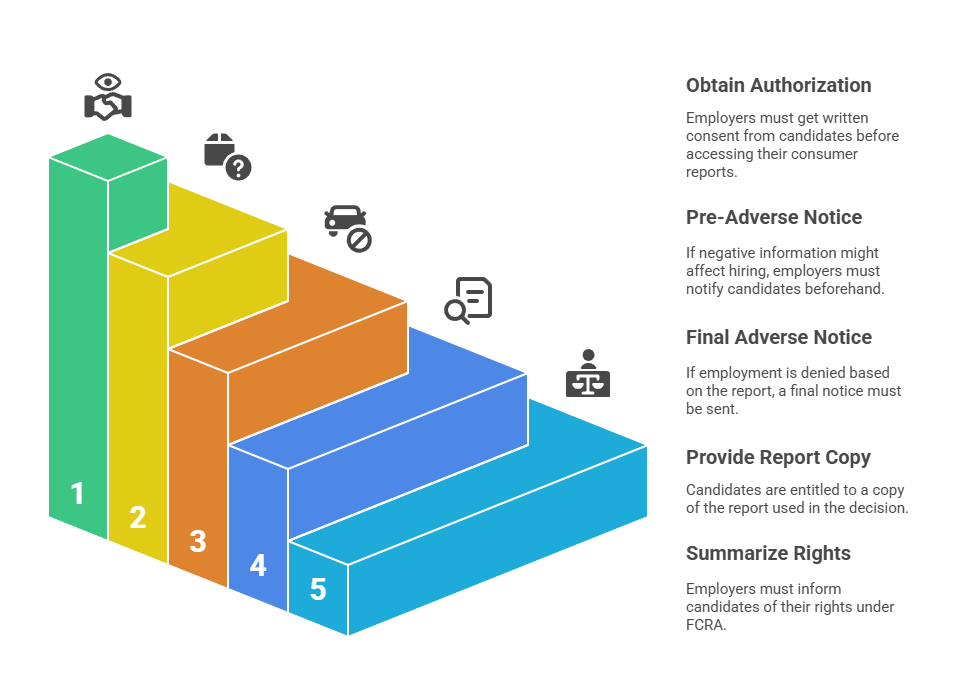
FCRA compliance requirements apply to employers using consumer reports for employment purposes. The statute defines permissible purposes for obtaining background information and establishes procedural requirements that apply nationwide. These federal mandates generally establish the baseline upon which state laws build additional protections.
FCRA requires several critical steps before taking adverse action. Employers typically must obtain written authorization before procuring consumer reports. They generally must provide pre-adverse action notices when negative information may influence hiring decisions. Finally, they must deliver final adverse action notices if employment is denied.
FCRA also requires providing candidates with copies of reports used in adverse decisions and summaries of their rights under federal law. State laws cannot reduce these federal protections, but they frequently add requirements beyond FCRA minimums. This creates a compliance environment where employers must satisfy both federal baselines and state-imposed enhancements simultaneously.
Recent Legislative Developments and Emerging Trends
State legislatures continue refining employment screening regulations to address evolving workforce policy priorities. Recent enactments and legislative activity in 2026 include several significant developments that multi-state employers may benefit from monitoring closely.
Cannabis Employment Protections Under Consideration
Multiple states are evaluating or have recently enacted cannabis employment protection frameworks. These proposals generally prohibit employers from discriminating against employees or applicants based on lawful off-duty cannabis use, with exceptions typically carved out for safety-sensitive positions, federally regulated roles, and situations involving workplace impairment.
States where cannabis employment legislation has been proposed, enacted, or is under consideration include Minnesota, Illinois, and Rhode Island, among others. However, effective dates, final provisions, and enforcement mechanisms vary significantly and may change during legislative and implementation processes. Organizations commonly monitor developments in jurisdictions where they operate rather than relying on projected timelines.
Common features of proposed cannabis protection laws include off-duty use protections, safety-sensitive carve-outs for positions affecting public safety, federal contractor exemptions for employers subject to drug-free workplace requirements, and impairment testing provisions allowing employers to address workplace impairment. These frameworks reflect policy efforts to balance employee privacy rights with legitimate employer safety concerns.
Ban-the-Box Legislative Activity
Several states continue considering ban-the-box expansions to private sector employers. Proposed legislation in various jurisdictions would prohibit criminal history questions on initial applications and delay background check inquiries until after interviews or conditional offers. However, many of these proposals remain pending or subject to modification.
States with active ban-the-box legislative discussions include Nevada, Ohio, and Indiana. The timing requirements, employer size thresholds, and position exceptions vary significantly among proposals. Organizations may benefit from verifying the current status of legislation in their operating jurisdictions before adjusting screening processes.
Existing ban-the-box jurisdictions demonstrate the range of approaches states adopt, including application-stage prohibitions on criminal history questions, interview-stage delays requiring waiting until first interviews, conditional offer requirements in the strictest jurisdictions, and position-based exceptions for roles involving vulnerable populations. These timing variations create operational complexity for employers using standardized application processes across multiple states.
Credit Check Restrictions Expand
New York has expanded restrictions on credit check use in employment. New York City prohibits most employers from using credit reports in hiring decisions, and employers should verify whether additional statewide restrictions apply. This development places New York among a growing number of states restricting credit report use in hiring contexts.
The expansion of credit check restrictions reflects legislative concerns that credit history does not reliably predict job performance for most positions. States with credit check limitations typically permit use only when employers can demonstrate substantial job-relatedness, such as positions involving financial fiduciaries, law enforcement roles, or positions with access to confidential financial information.
Organizations often review position descriptions to identify roles where credit checks remain permissible under applicable state laws. Documentation explaining why specific positions require credit screening becomes important for defensibility. Some organizations choose to eliminate credit checks entirely except where clearly required by regulation or demonstrably job-related.
Automatic Record Sealing Developments
Illinois enacted Clean Slate legislation that will provide for automatic sealing of certain criminal records after specified waiting periods when fully implemented. This type of legislation affects what information appears in background checks, as sealed records generally should not be reported or considered in employment decisions. Employers should monitor implementation timelines and verify how this affects background screening in Illinois.
Automatic sealing laws create compliance obligations for both employers and consumer reporting agencies. Consumer reporting agencies must implement systems to identify and exclude sealed records from reports. Employers should ensure screening policies account for records that may no longer be legally available. HR personnel need education on proper handling of sealed versus unsealed record information.
These developments align with broader fair chance hiring movements aimed at reducing barriers for individuals with criminal histories. Organizations may benefit from staying informed about record sealing laws in jurisdictions where they hire and ensuring background check processes comply with restrictions on sealed record use.
Local Ordinance Activity
Some localities have enacted anti-discrimination ordinances affecting employment screening practices. Municipal and county-level employment screening requirements often impose standards more stringent than state law, creating additional compliance layers for employers operating in multiple localities.
Organizations may benefit from monitoring not only state legislation but also county and municipal developments in areas where they maintain operations or hire employees. Local requirements may include enhanced disclosure obligations, stricter timing restrictions, or expanded protected categories beyond state and federal law.
FCRA Compliance in Multi-State Contexts
Based on FCRA as currently enforced, employers typically must follow uniform federal procedures regardless of state variations. However, understanding how FCRA protocols interact with state-specific mandates remains critical. Successful multi-state compliance requires processes that satisfy both federal minimums and state-imposed enhancements.
Disclosure and Authorization Standards
FCRA mandates clear, conspicuous disclosure before obtaining consumer reports for employment purposes. The disclosure must appear in a standalone document without extraneous information. Employers must secure written authorization from candidates, typically through signed acknowledgment of the disclosure document.
Some states impose requirements beyond FCRA's federal standard. Massachusetts requires specific language in authorization forms acknowledging state-level rights. California mandates additional disclosures about investigative consumer reports and imposes checkbox requirements for certain report types. New York requires separate authorizations for credit checks versus criminal background checks where credit checks remain permissible. Minnesota mandates an explanation of how background information will be used in hiring decisions.
Many compliance-focused employers implement authorization processes that incorporate the strictest applicable requirements. Using enhanced disclosure language that satisfies jurisdictions with detailed mandates may support compliance even when hiring across state lines. This approach can eliminate the need to maintain separate authorization documents for each jurisdiction.
Pre-Adverse Action Procedures
When background check information may lead to adverse employment decisions, FCRA requires a multi-step notice process. Employers must provide pre-adverse action notice including a copy of the consumer report and a summary of FCRA rights before finalizing negative decisions. This waiting period allows candidates to identify and dispute inaccurate information.
| FCRA Requirement | Federal Standard | State Variations |
| Pre-adverse action notice delivery | Before final decision | Some jurisdictions specify minimum waiting periods |
| Consumer report copy provision | With pre-adverse notice | Some states require enhanced investigative report disclosures |
| Summary of rights inclusion | With pre-adverse notice | Some states mandate state-specific rights addenda |
| Reasonable waiting period | Not specified federally | Verify requirements in applicable jurisdictions |
Note: Verify current requirements in applicable jurisdictions before implementing pre-adverse action procedures.
The pre-adverse action stage creates an opportunity for individualized assessment required by many state laws. During this period, employers often engage candidates regarding potentially disqualifying information, considering mitigating circumstances, rehabilitation evidence, and job-relatedness. Several states mandate specific waiting periods that should be verified in each jurisdiction.
After completing pre-adverse procedures and making final decisions, employers must provide adverse action notices identifying the consumer reporting agency, stating that the agency did not make the decision, and informing candidates of their right to dispute report accuracy. State laws sometimes require additional information in final notices, including specific reasons for disqualification or appeals procedures.
State-Specific Criminal History Restrictions
Criminal record use in employment decisions represents one of the most complex areas of state law variation. Employers must navigate lookback periods, consideration standards, and procedural requirements that differ significantly by jurisdiction. Laws change frequently, so verification of current requirements remains essential.
Lookback Period Limitations
Many states limit how far back employers can consider criminal records. California restricts most criminal history inquiries to seven years, with exceptions for positions paying over $75,000 annually. New York prohibits consideration of records older than ten years for most purposes.
Common lookback restrictions include California's seven-year lookback for most positions and ten years for high-salary roles, New York's ten-year general limit with narrow exceptions, Massachusetts' seven years for misdemeanors and ten years for felonies, Texas' seven-year restriction for records of arrest or conviction, and Washington's seven years from date of conviction or release. A conviction that falls within the permissible lookback period in one jurisdiction may be too old to consider under another state's law.
Sample state lookback restrictions. Laws change frequently and contain nuances not reflected in this summary. Verify current law in applicable jurisdictions.
Arrest Record Restrictions
Several states prohibit or severely limit the use of arrest records in employment decisions. California generally prohibits consideration of arrests not resulting in conviction. Hawaii restricts arrest record use to pending charges where conviction would disqualify employment. New York limits arrest record consideration to pending charges directly related to employment.
| State | Arrest Record Treatment | Pending Charges |
| California | Cannot consider arrests without conviction | May consider if directly related and charge pending |
| Hawaii | Prohibited except pending charges for disqualifying convictions | Permissible with job-relatedness requirement |
| New York | Limited to pending charges directly related to employment | Must demonstrate substantial relationship to position |
| Illinois | Cannot inquire about sealed or expunged arrests | Pending charges require individualized assessment |
General approaches to arrest records by state. Specific exceptions and nuances apply. Verify current requirements before making employment decisions.
These restrictions reflect policy judgments that arrests without conviction lack sufficient reliability for employment screening. Organizations may configure background check processes to exclude arrest information in jurisdictions where such data cannot legally influence decisions.
Conviction Consideration Standards
Beyond lookback periods and arrest restrictions, many states impose substantive standards for how employers evaluate criminal convictions. These laws typically require demonstrating direct relationships between convictions and job responsibilities before taking adverse action. The individualized assessment requirement represents a significant compliance obligation.
Common individualized assessment factors include evaluating offense severity relative to position requirements, considering longer periods that may demonstrate reduced recidivism risk, documenting direct relationship between conviction and essential job functions, allowing candidates opportunity to present treatment completion and references, and assessing work record after offense to demonstrate reliability. Philadelphia's fair chance hiring law and similar ordinances mandate these multi-factor assessments with documented analysis.
Building Scalable Compliance Frameworks

Multi-state staffing operations require systematic approaches to accommodate jurisdiction-specific requirements while maintaining operational efficiency. Compliance frameworks that balance legal obligations with practical hiring needs support both risk management and business objectives. However, no framework guarantees compliance across all circumstances, and legal counsel should review jurisdiction-specific implementations.
Adjudication Matrix Development
Standardized adjudication matrices can provide consistency in background check evaluation while accommodating legal variations. These matrices specify which offenses may disqualify candidates for particular position types, incorporating state-specific restrictions and job-relatedness assessments.
| Offense Category | Healthcare Positions | Financial Services | General Office | Lookback Considerations |
| Violent crimes | Evaluate for patient contact roles | Consider for job-relatedness | Individual assessment | Verify state-specific periods |
| Financial crimes | Individual assessment | Evaluate for fiduciary roles | Consider for finance access | Generally 7-10 years |
| Drug offenses | Consider with state cannabis laws | Individual assessment | Assessment often required | Varies by state and substance |
| Traffic violations | Evaluate for driving roles | Generally not considered | Typically not job-related | 3-5 years common |
Sample framework for illustrative purposes only. Not legal guidance for specific employment situations. Consult legal counsel when developing adjudication matrices.
Healthcare staffing matrices might address patient abuse convictions differently for direct care positions than for unrelated misdemeanors, while applying jurisdiction-specific lookbacks. Financial services matrices would emphasize fraud and theft convictions with consideration of regulatory requirements and state law limitations. Matrices should be reviewed regularly and updated as laws change.
Documentation Standards for Individualized Assessments
State fair chance hiring laws increasingly require documented individualized assessments before adverse action based on criminal history. These assessments should demonstrate that employers considered specific circumstances rather than applying blanket policies. Documentation quality may significantly influence legal defensibility if discrimination claims arise.
Comprehensive documentation commonly includes identifying the exact finding raising concerns with offense type and date, detailing core job responsibilities relevant to the assessment, explaining how the background element relates to job duties, documenting years since offense with rehabilitation indicators, and recording candidate-provided information about treatment completion and subsequent employment. Some employers implement structured protocols during pre-adverse action periods, asking candidates to explain circumstances and describe rehabilitation efforts.
Candidate Communication Protocols
Transparency requirements for background check processes continue expanding at state and local levels. Organizations often develop communication protocols that satisfy FCRA's federal mandates while meeting stricter state disclosure obligations. Effective communication may reduce legal risk and improve candidate experience, though these approaches support compliance efforts but do not eliminate legal risk.
Enhanced Disclosure Requirements
While FCRA requires standalone disclosure documents before obtaining consumer reports, several states mandate additional information in these disclosures. Minnesota requires explaining how background information will be used in hiring decisions. Nevada mandates disclosure of specific databases that will be searched.
Many compliance-focused employers enhance standard FCRA disclosure documents with purpose statements explaining how background information informs hiring decisions, scope descriptions identifying types of records searched, rights summaries providing both federal and state-specific protections, and contact information for compliance questions. This enhanced approach may support compliance across jurisdictions without maintaining separate disclosure documents for each state.
Pre-Adverse Action Engagement
The pre-adverse action period presents an opportunity for meaningful candidate engagement beyond minimum FCRA notice requirements. Several jurisdictions expect employers to conduct substantive discussions about potentially disqualifying information before finalizing adverse decisions.
Common approaches for pre-adverse action engagement include reaching out promptly after identifying potentially disqualifying information, providing candidates with details about which background elements raise concerns, allowing candidates to explain circumstances and provide rehabilitation evidence, creating written records of conversations and new information provided, and providing sufficient time before final decisions to satisfy state requirements. This enhanced engagement may support compliance with individualized assessment mandates in ban-the-box jurisdictions.
Managing Specialized Screening Types
Different screening components carry distinct compliance considerations. Organizations should understand how regulations apply to credit checks, social media screening, drug testing, and other specialized background check elements.
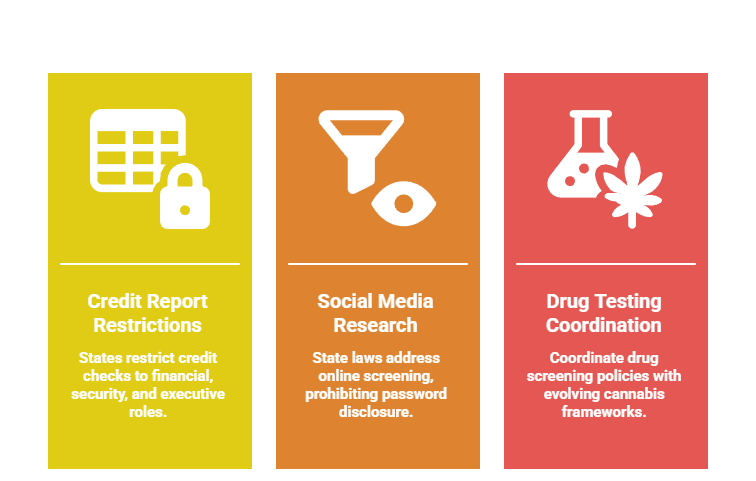
Credit Report Restrictions
The Fair Credit Reporting Act permits credit checks for employment purposes under specified permissible purposes, but many states restrict when employers can obtain credit information. States with credit check restrictions typically permit use only for financial fiduciaries with direct fund responsibility, law enforcement and security roles, executive positions with broad organizational authority, and positions where credit checks are mandated by regulation.
Organizations often maintain documentation explaining why specific positions require credit checks, including descriptions of financial responsibilities and regulatory requirements mandating financial screening. Position descriptions should specifically identify credit check requirements and business justification to support defensibility.
Social Media and Online Research
While FCRA does not directly regulate employer-conducted social media research, state laws increasingly address online screening practices. California prohibits requiring employees or applicants to disclose social media passwords or access private accounts. Illinois, Maryland, and over 20 other states have enacted similar protections.
When employers review publicly available social media content, they should avoid considering religious affiliation that cannot legally influence employment decisions, protected political speech and affiliations, health information discovered online, protected characteristics like race or disability, and lawful off-duty conduct that generally cannot justify adverse action. Some organizations establish protocols limiting who conducts social media research, while other employers prohibit social media screening entirely to avoid inadvertent discrimination.
Drug Testing Coordination
Pre-employment drug testing intersects with background check compliance where state laws address marijuana testing. Organizations should coordinate drug screening policies with evolving cannabis frameworks. Some states with legal adult-use cannabis have enacted or are considering protections that limit adverse employment action based on positive marijuana tests for off-duty use.
| State Approach | Testing Restrictions | Impairment Considerations |
| States with cannabis protections | Varied restrictions on adverse action for positive tests | Observable impairment often remains actionable |
| States permitting testing | May test and act on results | Positive tests may support adverse action |
| Federal contractor positions | Testing typically permitted under federal requirements | Federal drug-free workplace requirements apply |
General approaches based on various state frameworks. Specific state law provisions vary. Verify applicable requirements in your jurisdictions.
This creates operational complexity for employers in multiple states. Drug testing panels and result interpretation may need to vary by jurisdiction. Clear documentation of testing rationale and state-specific policies becomes important for defensibility.
Audit Preparation and Ongoing Compliance Monitoring
State enforcement agencies increasingly conduct employment screening audits, examining whether employers comply with ban-the-box requirements, lookback restrictions, and individualized assessment mandates. Proactive audit preparation may reduce legal risk and demonstrate compliance commitments.
Critical Compliance Documentation
Organizations preparing for potential audits typically maintain comprehensive documentation of background check processes and decisions. Essential records provide evidence of systematic compliance rather than ad hoc practices.
Commonly maintained documentation includes disclosure and authorization forms showing FCRA compliance, background check reports received from consumer reporting agencies, pre-adverse action notices with delivery confirmation, individualized assessment records documenting factors considered, and final adverse action notices with proof of delivery. These records should be organized systematically and retained according to applicable requirements. FCRA mandates retaining records for positions not filled for one year, while some states impose longer retention periods.
Vendor Management and Oversight
Employers using consumer reporting agencies for background checks retain legal responsibility for compliance. FCRA and state laws impose obligations on employers even when third parties conduct screening. Due diligence commonly includes efforts to verify vendor FCRA compliance capabilities, though no checklist guarantees full compliance or eliminates employer liability under applicable law.
Organizations often assess vendors on FCRA compliance including accuracy procedures and dispute resolution processes, state law accommodation capabilities for jurisdiction-specific restrictions, data security measures and information protection standards, service levels including turnaround times and communication protocols, and technology integration with applicant tracking systems. Regular vendor reviews may support ongoing compliance efforts.
Verify Current Law in Your Jurisdictions
This article reflects general compliance trends and common legal frameworks as they exist in early 2026. However, employment screening laws change frequently through legislation, regulation, and court interpretation. Before implementing screening policies or making employment decisions, organizations may benefit from verifying current legal requirements in each applicable jurisdiction through qualified legal counsel or authoritative legal resources.
Legislative activity continues at state and local levels throughout 2026. Organizations commonly establish monitoring systems for jurisdictions where they operate. Professional associations, legal update services, and employment counsel can provide timely information about new requirements and effective dates.
Conclusion
Background check compliance in 2026 requires sophisticated management of layered federal, state, and local requirements. Multi-state employers benefit from implementing scalable frameworks that accommodate jurisdiction-specific mandates while maintaining consistent screening processes. Success involves proactive monitoring of regulatory evolution, comprehensive documentation of individualized assessments, and ongoing investment in compliance infrastructure that adapts as laws continue changing.
Frequently Asked Questions
What are the most significant background check law trends for 2026?
Significant trends include states considering cannabis employment protections that would restrict adverse action based on off-duty marijuana use. Additionally, continued expansion of ban-the-box requirements delays criminal history inquiries in some jurisdictions. Credit check restrictions have grown with expanded New York limitations, and Illinois's Clean Slate Act will affect what criminal records appear in background checks when fully implemented.
How do FCRA requirements apply when state laws impose stricter standards?
FCRA establishes minimum federal requirements for employment background checks, including disclosure, authorization, and adverse action notice obligations. State laws cannot reduce these federal protections but may add requirements beyond FCRA minimums. Employers generally must satisfy both FCRA's federal standards and any stricter state-specific mandates applicable in jurisdictions where they hire.
What documentation supports individualized criminal history assessments?
Compliant individualized assessment documentation commonly includes the specific conviction under consideration, analysis of how the record relates to essential job functions, the timeframe since the offense occurred, and evidence of rehabilitation. Additionally, records of conversations with candidates about background information and clear explanation of decision rationale support compliance efforts.
Do ban-the-box laws prohibit all criminal history inquiries?
No, ban-the-box laws delay criminal history inquiries rather than prohibiting them entirely. These laws typically restrict questions about criminal records on initial applications or until specific hiring stages such as first interviews or conditional job offers. After the designated stage, employers may generally inquire about and consider criminal history, subject to other legal requirements.
How should employers handle background checks for positions in multiple states?
Multi-state positions may require applying the strictest relevant requirements among applicable jurisdictions. Organizations commonly identify all states where employees will work, determine which state and local laws apply, and implement screening processes designed to satisfy the most protective standards. Documenting the compliance analysis supports defensibility.
Can employers use blanket disqualification policies for certain criminal offenses?
Many states prohibit blanket disqualification policies, requiring individualized assessments that consider offense nature, time elapsed, rehabilitation evidence, and job-relatedness. Even for serious offenses, employers often must evaluate specific circumstances rather than automatically disqualifying all candidates with particular convictions. Limited exceptions may exist for positions involving vulnerable populations.
How do cannabis employment protections affect drug testing policies?
States considering or enacting cannabis employment protections may permit drug testing but restrict adverse action based on positive marijuana tests when the use was lawful and off-duty. Employers may retain the ability to prohibit workplace impairment and can typically take action when cannabis use affects job performance or safety. Policies should address impairment rather than solely positive test results where restrictions apply.
What are typical penalties for background check compliance violations?
Penalties vary significantly by violation type and jurisdiction. FCRA violations can result in actual damages, statutory damages per violation, punitive damages for willful violations, and attorney fees. State and local penalties vary widely by jurisdiction and violation type. Organizations may benefit from consulting legal counsel regarding specific penalty exposure in their operating jurisdictions.
Additional Resources
- Fair Credit Reporting Act Full Text and Official Guidance
https://www.ftc.gov/legal-library/browse/statutes/fair-credit-reporting-act - EEOC Enforcement Guidance on Criminal Records in Employment
https://www.eeoc.gov/laws/guidance/background-checks-what-employers-need-know - National Conference of State Legislatures Employment Background Checks Overview
https://www.ncsl.org/labor-and-employment/background-checks-for-employment - U.S. Department of Labor Fair Chance Hiring Resources
https://www.dol.gov/agencies/odep/topics/fair-chance - System for Award Management Federal Exclusions Database
https://sam.gov/content/exclusions

ABOUT THE CREATOR
GCheck Editorial Team
Meet the GCheck Editorial Team, your trusted source for insightful and up-to-date information in the world of employment background checks. Committed to delivering the latest trends, best practices, and industry insights, our team is dedicated to keeping you informed.
With a passion for ensuring accuracy, compliance, and efficiency in background screening, we are your go-to experts in the field. Stay tuned for our comprehensive articles, guides, and analysis, designed to empower businesses and individuals with the knowledge they need to make informed decisions.
At GCheck, we're here to guide you through the complexities of background checks, every step of the way.