


International freelancer verification involves navigating diverse legal frameworks, data privacy regulations, and fragmented verification infrastructure across jurisdictions. Effective cross-border screening requires understanding contractor classification nuances, matching verification depth to role-specific risk, and implementing compliance-conscious workflows that account for realistic timelines and regional limitations on accessible information.
Key Takeaways
- Contractor misclassification creates primary legal and tax risks that affect verification scope, requiring clear distinction between freelancers, independent contractors, and employees under local employment laws.
- International background checks lack the centralized databases common in domestic screening, relying instead on country-specific criminal record systems, manual document validation, and varied institutional cooperation levels.
- GDPR, LGPD, PIPL, and other regional privacy frameworks impose strict requirements on consent, lawful basis for processing, data transfer mechanisms, and permissible verification activities that vary significantly across jurisdictions.
- Criminal record accessibility ranges from readily available police certificates in some countries to complete prohibition of employment-related criminal checks in others, requiring jurisdiction-specific verification strategies.
- Education credential verification often depends on apostille processes, third-party validation services, or direct institutional outreach, with timelines extending from two to eight weeks depending on country and credential type.
- Employment history verification faces infrastructure limitations in many countries where former employers lack formalized reference processes or legal frameworks restrict information disclosure.
- Risk-based verification frameworks help organizations allocate resources proportionally, matching verification depth to factors such as data access, financial authority, and brand representation responsibilities.
- Realistic timeline planning accounts for document collection delays, translation requirements, government agency responsiveness variations, and multi-step authentication processes that characterize international verification workflows.
Understanding Freelancer, Contractor, and Employee Classifications
The terminology surrounding international work arrangements carries legal significance that directly affects verification obligations and permissible screening activities. Proper classification determines which labor laws, tax obligations, and screening regulations apply to the relationship.
Key Classification Factors:
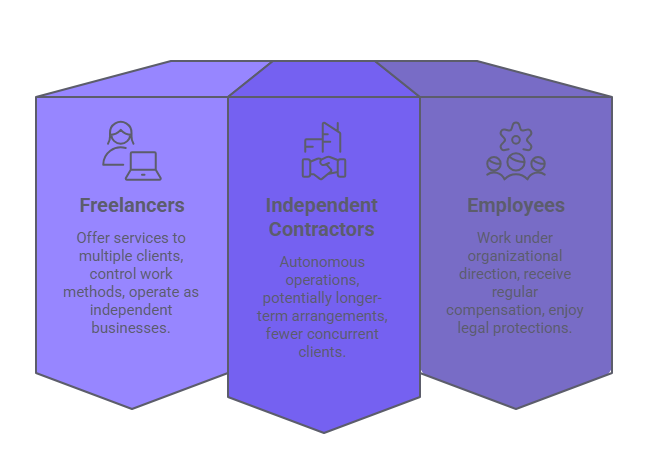
- Freelancers: Individuals offering services to multiple clients simultaneously, maintaining control over work methods and schedules, operating as independent business entities
- Independent Contractors: Workers with autonomous operations but potentially longer-term arrangements with fewer concurrent clients
- Employees: Individuals working under organizational direction and control, receiving regular compensation through payroll systems, enjoying legal protections under employment laws
Many countries impose stricter limitations on background checks for employees than for contractors, recognizing employees’ heightened vulnerability to employer power. Conversely, some jurisdictions require employers to conduct specific verification activities for employees while leaving contractor screening to organizational discretion. Misclassification creates exposure to back taxes, penalties, and legal claims that can far exceed the cost of proper verification.
The factors determining classification vary by jurisdiction but generally include degree of control over work performance, exclusivity of the relationship, provision of tools and equipment, payment structure, and duration of engagement. A worker classified as an independent contractor under one country’s laws may qualify as an employee under another’s, creating compliance complexity for organizations engaging international talent. Before designing verification workflows, organizations should determine classification status under relevant jurisdictions’ laws, as this classification affects permissible screening activities and legal obligations. Misclassification creates potential legal and tax exposure. Organizations may benefit from consulting legal and tax advisors regarding proper worker classification.
Conducting background checks is not just a back-end administrative duty but rather an essential hiring practice that can provide an advantage in the ever-evolving job market. This verification process helps mitigate the risk of fraudulent claims by candidates, which can negatively impact the organization. Fortunately, we have the technology to partner with in order to attain more efficient verification processes, empowering HR and decision-makers to make informed, data-driven decisions with confidence. �
Why International Verification Differs from Domestic Screening
Organizations accustomed to domestic background checks often underestimate the complexity of international freelancer verification. Most countries lack the centralized databases and standardized processes that create relatively efficient screening workflows in the United States, requiring verification requests to route through multiple agencies, regional offices, or local jurisdictions without coordinated information systems.
| Verification Challenge | Domestic (U.S.) Context | International Context |
| Criminal Record Access | Centralized databases with standardized searches | Country-specific systems, often requiring regional checks |
| Processing Timeline | Days via automated queries | Weeks for document collection, agency processing, translation |
| Data Privacy Framework | FCRA provides uniform requirements | GDPR, LGPD, PIPL create jurisdiction-specific obligations |
| Report Format | Standardized consumer report structure | Local language documents with varied legal terminology |
| Verification Cost | Predictable fee structures | Variable costs with translation, authentication, postal requirements |
Criminal record accessibility varies dramatically by country. Some nations maintain national police certificate systems that aggregate criminal history from regional jurisdictions and provide standardized reports to individuals who can share them with potential employers. Others require separate checks in each region where the individual resided, with no centralized coordination. Certain countries prohibit employment-related criminal checks entirely or restrict them to specific industries, viewing such screening as inconsistent with rehabilitation principles or privacy rights.
Data privacy frameworks create additional complexity. The General Data Protection Regulation in the European Union, the Lei Geral de Proteção de Dados in Brazil, the Personal Information Protection Law in China, and similar frameworks worldwide impose requirements on consent, data minimization, lawful processing bases, and cross-border data transfers. These regulations often include employment-specific provisions that limit permissible background check activities beyond general privacy principles.
Legal and Privacy Constraints by Region
International freelancer verification must comply with diverse data protection frameworks that vary significantly across jurisdictions. Understanding regional requirements prevents compliance violations and protects organizational liability exposure.
European Union and GDPR
The General Data Protection Regulation establishes stringent requirements for processing personal data, including background check information. GDPR provisions allow EU member states to adopt specific rules for employment-related data processing, creating variation across countries. Organizations should consult local legal requirements in each EU member state where they conduct background screening. Lawful bases for employment-related processing typically rely on legitimate interests or contractual necessity. Consent is generally not considered an appropriate lawful basis for most employment screening due to power imbalances that undermine voluntariness. Organizations should document legitimate interest assessments or contractual necessity justifications.
Key GDPR Principles Affecting Verification:
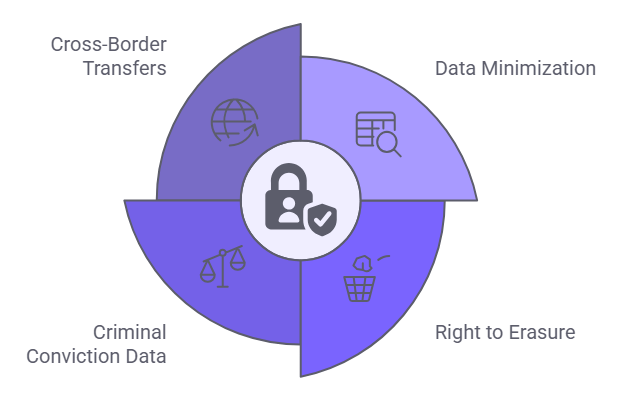
- Data Minimization: Organizations may collect only information necessary for specified purposes, limiting broad background check practices
- Right to Erasure: Individuals can request deletion of personal data under certain circumstances, subject to exceptions. Organizations may retain background screening records when necessary for compliance with legal obligations, establishment or defense of legal claims, or other specified grounds. Record retention policies should balance individual rights with organizational legal requirements and should be documented with appropriate legal consultation.
- Criminal Conviction Data: GDPR addresses criminal conviction information separately from other special category data, requiring that processing occur under control of official authority or be authorized by Union or Member State law providing appropriate safeguards. Organizations must verify specific legal authorization before processing criminal record information.
- Cross-Border Transfers: Data transfers from the EU require adequacy decisions, standard contractual clauses, binding corporate rules, or other approved mechanisms. Following recent European court decisions, organizations must also conduct transfer impact assessments to evaluate whether destination country laws undermine transfer mechanism protections and implement supplementary measures where necessary. Legal counsel should be consulted for cross-border transfer compliance.
Recent enforcement trends show regulators scrutinizing employment-related processing with increased attention to necessity and proportionality.
Latin American Frameworks
Brazil’s Lei Geral de Proteção de Dados (LGPD) follows GDPR principles with adaptations for Brazilian legal concepts. The law requires lawful bases for processing, recognizes legitimate interests as a basis subject to balancing tests, and imposes data subject rights including access and deletion. Employment verification must demonstrate necessity and proportionality, with criminal record checks particularly scrutinized absent specific legal authorization.
Asia-Pacific Requirements
China’s Personal Information Protection Law (PIPL) requires explicit consent for processing sensitive personal information, which includes criminal records, and imposes strict requirements on cross-border data transfers. Organizations conducting background checks on Chinese nationals must comply with PIPL requirements including obtaining appropriate consent for sensitive personal information and demonstrating necessity. Cross-border data transfers may trigger additional obligations including security assessments or certifications depending on data volume and sensitivity. Organizations should consult legal counsel regarding specific PIPL compliance requirements.
South Africa’s Protection of Personal Information Act (POPIA) regulates background screening with particular attention to criminal record checks, which require specific justification and proportionality assessment. The law limits retention periods, requires data subject notification, and imposes conditions on cross-border transfers.
Countries impose varying sector-specific or categorical restrictions on criminal record checks. Some European nations prohibit employment-related criminal checks except for positions involving vulnerable populations, national security, or financial services, while others permit broader access. Organizations must verify specific legal requirements in each jurisdiction where they conduct background screening.
What Can and Cannot Be Verified Internationally
Understanding which verification types are accessible across jurisdictions helps organizations design realistic screening workflows and set appropriate expectations. Verification feasibility varies significantly by country and information type.
Identity Verification
Identity verification serves as the foundation for international freelancer screening. Methods include:
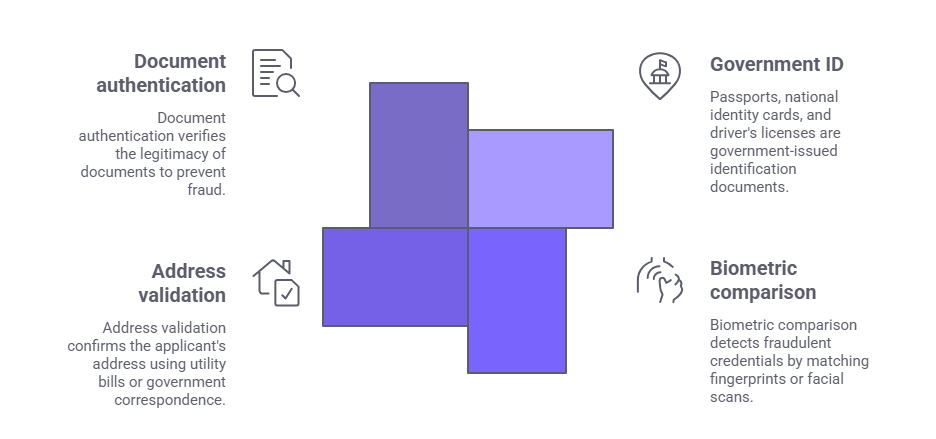
- Government-issued identification documents (passports, national identity cards, driver’s licenses)
- Biometric comparison to detect fraudulent credentials
- Address validation through utility bills or government correspondence
- Document authentication to verify legitimacy
Many countries maintain online systems for verifying identity document authenticity, though access varies by jurisdiction and requestor type.
Criminal Record Verification
| Country/Region | Access Method | Typical Timeline | Restrictions |
| United Kingdom | DBS check system | 3-8 weeks | Tiered by position sensitivity |
| Canada | RCMP criminal record check | 2-6 weeks | Provincial procedure variations |
| Australia | National police check | 1-2 weeks | Relatively streamlined access |
| India | Police verification certificate | 2-8 weeks | State-level variations |
| Philippines | NBI clearance | 2-4 weeks | In-person appearance required |
| Germany | Führungszeugnis (Certificate of Conduct) | 2-4 weeks | Restricted to certain positions |
| France | Limited availability | Varies | Prohibited for most employment |
Police certificate systems in countries like the United Kingdom, Australia, and Canada provide standardized criminal history reports that individuals obtain and share with employers. Some jurisdictions require that individuals appear in person at government offices to request certificates, while others allow online applications. Processing times range from days to months depending on country infrastructure and current demand.
Employment History Verification
Employment history verification faces infrastructure limitations in many countries. The United States and some other nations have developed third-party employment verification services and standardized reference processes. Many countries lack equivalent infrastructure, requiring direct outreach to former employers who may have no formal process for responding to verification requests. Language barriers, time zone differences, and cultural variations in reference-giving practices complicate international employment verification.
Some jurisdictions legally restrict information former employers may disclose, limiting verification to employment dates and job titles. Others have no such restrictions but lack cultural norms of providing detailed references.
Education Credential Verification
Education credential verification typically requires confirming that claimed institutions exist, that they granted the stated degree or certification, and that the documentation provided is authentic. The Hague Apostille Convention facilitates international document authentication among signatory countries, providing standardized certification that documents are genuine. Countries outside the convention require alternative authentication processes that may involve multiple government agencies and extended timelines.
Verification Methods:
- Direct institutional outreach through registrar offices
- Credential evaluation services (World Education Services, Educational Credential Evaluators)
- Apostille certification for document authentication
- Online verification systems (where available)
Credential evaluation services assess foreign educational qualifications and provide equivalency determinations relative to domestic education systems. Direct institutional verification through registrar offices provides the most authoritative confirmation but faces challenges including language barriers, institutions’ responsiveness variations, and lack of standardized processes.
Country and Region-Specific Considerations
Geographic variations in verification infrastructure, legal frameworks, and processing timelines require location-specific approaches. Understanding regional characteristics helps organizations design effective screening strategies.
South Asia: India and Philippines
India represents one of the largest sources of international freelance talent, particularly in technology and business process services. Indian verification typically includes police verification certificates available through local police stations, though processing times and procedures vary by state. Education verification requires outreach to Indian universities, which increasingly offer online verification systems but may have limited responsiveness. Employment verification depends heavily on former employer cooperation, as India lacks centralized verification infrastructure.
The Philippines maintains a National Bureau of Investigation clearance system that provides criminal record certificates, though processing times fluctuate based on demand and individuals must appear in person or use authorized representatives. Philippine education verification requires coordinating with the Commission on Higher Education or individual institutions. Professional licenses can be verified through the Professional Regulation Commission, which maintains online verification for many credential types.
Latin America: Mexico, Argentina, and Brazil
Latin American countries present diverse verification landscapes with distinct legal frameworks. Mexico offers criminal record certificates through state-level offices with varying accessibility. Brazil’s verification processes operate at federal and state levels depending on information type, with LGPD imposing detailed data protection requirements. Argentina maintains criminal record systems through the Registro Nacional de Reincidencia.
Each country has unique data privacy frameworks affecting permissible screening activities, with Brazil’s LGPD imposing particularly comprehensive requirements on consent, data minimization, and processing justification.
Eastern Europe: Poland, Ukraine, and Romania
Eastern European countries have become significant sources of technical and creative freelance talent. Poland maintains criminal record systems accessible through the National Criminal Register, with certificates available to individuals for employment purposes. Ukraine provides police certificates through the Ministry of Internal Affairs, though processing timelines vary. Romanian criminal records are available through police departments, with procedures differing for residents versus non-residents.
Each of these countries has joined the European Union or maintains data protection frameworks influenced by GDPR principles, imposing requirements on consent, data minimization, and processing justification. Verification activities must align with these frameworks regardless of where the hiring organization is located, as regulations apply to processing of EU residents’ data.
Developed Markets: UK, Canada, and Australia
The United Kingdom, Canada, and Australia maintain mature verification infrastructure including standardized police certificate systems, established education verification processes, and cultural norms supporting employment references. The UK’s Disclosure and Barring Service provides criminal record checks with levels of detail varying by check type and position sensitivity. Canada’s RCMP provides criminal record checks though procedures vary by province. Australia’s national police check system offers relatively streamlined access.
These countries maintain strong data protection frameworks including the UK GDPR, Canada’s Personal Information Protection and Electronic Documents Act, and Australia’s Privacy Act, requiring compliance with transparency, consent, and data handling requirements.
Workflow and Timeline Realities
Effective international freelancer verification requires structured workflows that accommodate jurisdiction-specific requirements and realistic processing timelines. Understanding typical steps and duration factors prevents project delays and manages stakeholder expectations.
Standard Verification Workflow
Verification begins with obtaining proper consent that satisfies applicable data protection requirements. Consent forms should clearly explain what information will be collected, how it will be used, who will access it, and how long it will be retained. The form must be provided in language the freelancer understands and should avoid bundling consent with other contractual terms. Documentation of consent is essential for compliance auditing.
Core Workflow Steps:
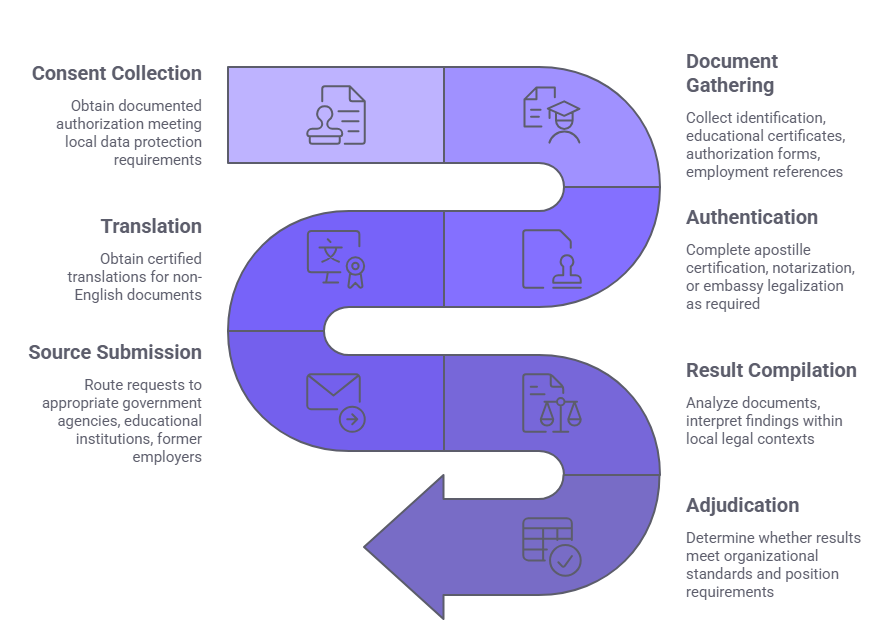
- Consent Collection: Obtain documented authorization meeting local data protection requirements
- Document Gathering: Collect identification, educational certificates, authorization forms, employment references
- Authentication: Complete apostille certification, notarization, or embassy legalization as required
- Translation: Obtain certified translations for non-English documents
- Source Submission: Route requests to appropriate government agencies, educational institutions, former employers
- Result Compilation: Analyze documents, interpret findings within local legal contexts
- Adjudication: Determine whether results meet organizational standards and position requirements
Document collection requires the freelancer to provide identification documents, authorization forms for background checks, and supporting materials such as educational certificates or employment references. Clear instructions, acceptable document formats, and accessible upload methods reduce collection delays. Organizations should anticipate that freelancers in some countries may need to visit government offices in person to obtain documents, requiring timeline flexibility.
Timeline Factors and Realistic Expectations
Document authentication and translation constitute significant timeline factors for international verification. Authentication may require apostille certification, notarization, or embassy legalization depending on the country and document type. Translation services must produce certified translations acceptable for legal purposes, not machine translations. These steps can add one to three weeks to verification timelines depending on document complexity and service availability.
| Verification Phase | Typical Duration | Common Delays |
| Consent and Document Collection | 3-7 days | Freelancer responsiveness, document availability |
| Authentication and Translation | 1-3 weeks | Apostille processing, notary scheduling, translation queues |
| Criminal Record Check | 2-8 weeks | Government agency backlogs, regional variations |
| Education Verification | 2-6 weeks | Institutional responsiveness, semester schedules |
| Employment Verification | 1-4 weeks | Former employer cooperation, reference availability |
| Result Compilation and Review | 3-5 days | Multiple language interpretation, legal context analysis |
Agency responsiveness varies significantly across countries and information types. Well-resourced government agencies in some countries process requests within days through online systems. Others operate with limited staff, manual processes, and backlogs that extend processing times to months. Educational institutions’ responsiveness depends on staff availability, established verification procedures, and request volumes during peak periods.
Realistic timelines for international freelancer verification typically range from two to eight weeks depending on country, information types, and complexity. Organizations should initiate verification processes early in the hiring pipeline rather than waiting until final selection, allowing time for completion without delaying project starts.
Risk-Based Verification Framework
Organizations benefit from calibrating verification depth to role-specific risk rather than applying uniform screening to all international freelancers. Strategic resource allocation ensures thorough vetting for high-risk positions while maintaining efficient processes for lower-risk roles.
Risk Tier Assessment
Entry-level freelancers with limited access to systems, data, or funds may warrant basic identity verification and education credential checks without extensive criminal or employment history verification. As roles increase in responsibility and organizational exposure, verification should expand proportionally.
High-Risk Categories Requiring Enhanced Verification:
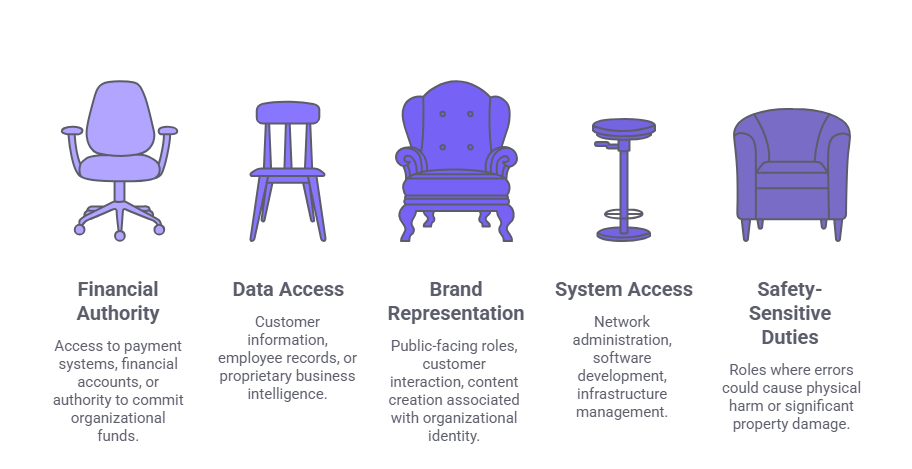
- Financial Authority: Access to payment systems, financial accounts, or authority to commit organizational funds
- Data Access: Customer information, employee records, or proprietary business intelligence
- Brand Representation: Public-facing roles, customer interaction, content creation associated with organizational identity
- System Access: Network administration, software development, infrastructure management
- Safety-Sensitive Duties: Roles where errors could cause physical harm or significant property damage
Financial authority creates significant risk categories. Freelancers with access to payment systems, financial accounts, or authority to commit organizational funds justify thorough verification including criminal record checks for financial crimes where legally accessible. Employment history verification focusing on integrity and financial trustworthiness becomes particularly relevant. Ongoing monitoring for subsequent issues may be appropriate for long-term engagements.
Access to customer or employee data requires verification addressing data protection reliability. Criminal history checks for fraud, identity theft, or privacy violations where available provide relevant risk information. Employment verification should explore the freelancer’s experience handling confidential information and any history of data security incidents.
Verification Scope by Risk Level
Lower-risk roles including time-limited projects, work with no sensitive data or system access, and roles with close supervision may warrant minimal verification. Basic identity confirmation, education credential checks for credentialing requirements, and reference calls may provide sufficient risk mitigation without the time and cost of comprehensive background screening. Organizations should document risk assessments supporting verification scope decisions to demonstrate thoughtful compliance with applicable regulations.
Continuous monitoring for long-term freelancer relationships offers ongoing risk management for high-risk roles. Periodic re-verification of credentials, searches for adverse news or legal actions, and check-ins for status changes in professional licenses provide alerts to developing issues. The frequency and depth of monitoring should align with role risk and relationship duration, balanced against privacy considerations and monitoring costs.
Common Pitfalls and Misconceptions
Understanding frequent errors in international freelancer verification helps organizations avoid compliance violations, wasted resources, and ineffective screening processes. Many organizations do not realize the complexity involved in cross border verification and think that processes applied in domestic recruitment are similar in international recruitment as well. Understanding these differences in a timely manner enables companies to develop more realistic approaches in screening freelancers in line with their global nature.
Operational Misconceptions
Many organizations assume international background checks constitute a single, standardized service deliverable by any provider. In reality, international verification requires country-specific expertise, established relationships with foreign information sources, and understanding of local legal frameworks. Verification capabilities vary dramatically across providers, with some maintaining direct access to foreign systems and others relying on third-party networks of varying quality.
Common Errors to Avoid:
- Treating all “international background checks” as equivalent services
- Assuming contractor status eliminates screening legal requirements
- Using consumer-grade people search tools for employment decisions
- Failing to document verification attempts for compliance audits
- Underestimating realistic timelines and delaying project starts
- Ignoring consent and disclosure requirements under local data protection laws
Ignoring consent and disclosure requirements creates compliance risks and potential legal liability. Background screening in most jurisdictions requires clear consent explaining what information will be collected and how it will be used. Some data protection frameworks impose additional requirements such as providing privacy notices, offering opportunities to review results before adverse decisions, and maintaining documentation of consent.
U.S.-based organizations must comply with Fair Credit Reporting Act requirements when using consumer reports for employment decisions, including providing pre-adverse action notice with a copy of the report and summary of rights before making adverse decisions, allowing reasonable time for candidate response, and providing final adverse action notice if the adverse decision proceeds. Organizations should verify whether their international verification providers qualify as consumer reporting agencies under FCRA.
Classification and Compliance Errors
Misunderstanding how contractor versus employee classification affects verification permissibility leads to compliance violations. Some organizations assume that classifying workers as contractors eliminates screening restrictions, when in fact many data protection frameworks apply based on the nature of processing rather than employment status. Conversely, some organizations assume employees require verification while contractors do not, missing contractual or regulatory obligations to verify contractors in certain contexts.
Using consumer-grade people search tools or general internet searches for employment decisions creates multiple legal risks. Such practices may violate data protection principles in many jurisdictions, create discrimination exposure by revealing protected characteristics, and potentially violate the Fair Credit Reporting Act if the tools constitute consumer reporting agencies under U.S. law. Organizations should use only verified information sources and documented screening procedures.
Failing to document verification attempts and results creates audit risks, particularly for organizations subject to regulatory oversight or client due diligence requirements. When regulators, auditors, or clients request evidence of contractor verification processes, organizations must produce documentation demonstrating reasonable diligence. Informal verification efforts without contemporaneous documentation leave organizations unable to demonstrate compliance, potentially resulting in sanctions, failed audits, or lost business.
Underestimating timelines creates project delays and damaged relationships. Organizations that initiate international freelancer verification days before planned project start dates face expensive delays or must choose between beginning work before clearance or losing talent to competitors. Realistic timeline planning accounts for document collection, government agency processing, translation, and potential complications requiring additional validation.
Evaluating Internal Versus Outsourced Verification
Organizations face decisions about conducting international freelancer verification internally or engaging specialized providers. Several factors inform this choice including verification volume, geographic diversity of freelancers, internal expertise availability, risk tolerance, and budget considerations.
When Internal Verification Makes Sense
Internal verification becomes feasible when organizations engage small numbers of international freelancers from limited geographic regions where the organization maintains local presence or expertise. If internal staff includes individuals familiar with local verification processes, possessing language capabilities, and understanding relevant legal frameworks, the organization may conduct basic verification without external assistance.
Low-risk roles requiring only basic verification such as identity confirmation and education credential checks may not justify professional verification service costs. Organizations can develop internal procedures for reviewing identification documents, contacting educational institutions, and conducting reference calls. However, authentication of foreign documents and interpretation of results in unfamiliar legal contexts may exceed internal capabilities.
When Outsourcing Provides Value
Outsourcing verification provides access to established foreign networks, country-specific expertise, and compliance knowledge that internal teams rarely possess. Professional verification services maintain relationships with foreign information sources, understand local legal requirements, and provide documented processes that support compliance auditing.
Outsourcing Advantages:
- Established relationships with foreign government agencies and institutions
- Country-specific legal and cultural expertise
- Documented compliance processes for regulatory audits
- Professional liability insurance and quality assurance programs
- Faster implementation than building internal international capabilities
- Scalability for organizations rapidly expanding international hiring
High-risk roles or regulated industries where verification errors create significant liability favor outsourcing to providers with professional liability insurance, documented quality processes, and established compliance programs. When verification must meet specific regulatory standards or client requirements, providers experienced with those frameworks offer greater assurance than internal teams developing processes through trial and error.
Provider Evaluation Criteria
When evaluating verification providers, organizations should assess country coverage and depth, not just breadth of geographic claims. Providers may list numerous countries while maintaining varying capabilities from direct access to foreign systems in some locations to informal third-party relationships in others. Requesting specific information about sources, processing times, and sample reports for priority countries reveals actual capabilities.
Turnaround time commitments should include detail about factors affecting timelines rather than single average numbers. Understanding how document collection delays, agency responsiveness, translation needs, and complicating factors affect timelines allows realistic planning. Provider willingness to discuss timeline variability rather than offering unrealistic guarantees suggests transparency and operational maturity.
Compliance documentation capabilities matter for regulated organizations or those subject to client audits. Providers should demonstrate understanding of relevant data protection frameworks, maintain documented consent processes, provide clear privacy notices, and support documentation requirements for compliance audits. Generic background screening expertise does not automatically translate to international data protection compliance knowledge.
Data handling and security practices require scrutiny given the sensitivity of background check information and cross-border data transfer regulations. Providers should maintain documented information security programs, demonstrate compliance with relevant data protection frameworks, implement appropriate technical and organizational safeguards, and maintain transparency about subprocessors and data locations. Contracts should specify data handling obligations and liability for security incidents.
Conclusion
International freelancer verification requires navigating fragmented information systems, diverse legal frameworks, and complex data protection requirements across jurisdictions. Success depends on understanding contractor classification nuances, matching verification depth to role-specific risk profiles, building realistic timelines into hiring workflows, and implementing compliance-conscious processes. Organizations that approach cross-border screening with jurisdiction-specific expertise and procedural rigor effectively manage risks while respecting legal obligations and freelancer privacy rights.
Frequently Asked Questions
How long does international freelancer verification typically take?
International background check timelines typically range from two to eight weeks depending on the country, verification types required, and specific circumstances. Factors affecting duration include government agency processing speeds, document collection from the freelancer, translation and authentication requirements, and institutional responsiveness for education or employment verification.
What consent requirements apply to international background checks?
Consent requirements vary by jurisdiction but generally require clear explanation of what information will be collected, how it will be used, who will access it, and retention periods. The consent must be provided in language the freelancer understands, offered voluntarily without coercion, and documented appropriately. GDPR and similar frameworks impose additional requirements including separate consent for sensitive data processing and the right to withdraw consent.
Can employers access criminal records for international freelancers?
Criminal record accessibility varies dramatically by country. Some nations maintain police certificate systems that individuals can obtain and voluntarily provide to employers. Others restrict criminal record disclosure to the individual only or prohibit employment-related criminal checks except for specific regulated industries. Organizations must verify legal permissibility in each specific country before requesting criminal history information.
How can organizations verify education credentials from foreign institutions?
Education credential verification typically involves confirming institutional legitimacy, contacting registrar offices directly, using credential evaluation services, or requiring apostille certification for official documents. Processes vary by country and institution, with some offering online verification systems while others require written requests. Timelines range from two to eight weeks depending on institutional responsiveness and authentication requirements.
What are the main differences between verifying employees versus contractors internationally?
Employment classification affects legal obligations for verification, permissible screening activities under local employment laws, data protection requirements, and organizational liability exposure. Some countries impose stricter background check limitations for employees than contractors, while others require specific employee verification. Organizations should determine proper classification under applicable jurisdictions’ laws before designing verification approaches.
Do GDPR requirements apply to background checks on freelancers outside the EU?
GDPR applies to processing personal data of individuals located in the EU regardless of where the organization conducting processing is located. If an organization screens EU-based freelancers, GDPR requirements apply including lawful basis for processing, data minimization, transparency, individual rights, and cross-border transfer restrictions. Some non-EU countries have adopted GDPR-influenced frameworks with similar requirements.
What red flags indicate potential credential fraud by international freelancers?
Potential fraud indicators may include reluctance to provide original documents or authorize direct institutional verification, documents with inconsistent formatting or authentication marks, claimed credentials from institutions that cannot be verified, employment history inconsistencies across sources, or evasiveness about experience details. These indicators warrant additional investigation rather than automatic disqualification, as legitimate candidates may exhibit some behaviors for valid reasons. Organizations should conduct individualized assessments considering candidate explanations and context.
Should organizations conduct ongoing monitoring for long-term international freelancers?
Ongoing monitoring appropriateness depends on role risk, relationship duration, and contractual terms. High-risk roles involving financial authority, sensitive data access, or critical system access may justify periodic re-verification of credentials, adverse news searches, or professional license status checks. Organizations should document risk-based rationales for monitoring decisions and ensure monitoring practices comply with applicable privacy frameworks.
Additional Resources
- U.S. Department of State: Authentication of Documents (Apostille)
https://travel.state.gov/content/travel/en/records-and-authentications/authenticate-your-document.html - European Commission: International Dimension of Data Protection
https://commission.europa.eu/law/law-topic/data-protection/international-dimension-data-protection_en - IRS: Independent Contractor vs. Employee Classification
https://www.irs.gov/businesses/small-businesses-self-employed/independent-contractor-self-employed-or-employee - World Education Services: Credential Evaluation Services
https://www.wes.org/ - SHRM: Managing and Retaining Global Remote Workers
https://www.shrm.org/resourcesandtools/hr-topics/organizational-and-employee-development/pages/managing-global-remote-workers.aspx

ABOUT THE CREATOR
Charm Paz, CHRP
Recruiter & Editor
Charm Paz is an HR professional at GCheck, specializing in background screening, fair hiring, and regulatory compliance. She holds from the Professional Background Screening Association (PBSA) and helps organizations navigate employment regulations with clarity and confidence.
With a background in Industrial and Organizational Psychology, she translates policy into practice to build ethical, compliant, human-centered hiring systems that strengthen decision-making over time.