



HR professionals increasingly recognize that choosing between continuous monitoring and traditional background checks is not a binary decision but a strategic question shaped by risk tolerance, regulatory obligations, and workforce characteristics. This guide provides an operationally grounded comparison framework to help employers determine which approach, or which combination, aligns with their organizational context.
Key Takeaways
- Continuous monitoring and traditional background checks serve different operational purposes and are not interchangeable substitutes.
- Traditional background checks are point-in-time assessments conducted at hire or rescreening intervals; continuous monitoring provides ongoing automated alerts for specific record changes.
- Continuous monitoring typically covers a narrower scope of records than comprehensive pre-employment background checks.
- Compliance obligations under the Fair Credit Reporting Act apply to both approaches but require different procedural workflows.
- Total cost of ownership depends on workforce size, turnover rate, and rescreening frequency rather than per-check pricing alone.
- Many organizations adopt hybrid models that combine traditional checks at hire with selective continuous monitoring for high-risk roles.
- Effective implementation requires clarity on consent requirements, alert thresholds, and employer response protocols.
- The decision framework should prioritize industry-specific risk factors, regulatory mandates, and operational capacity over generalized best practices.
Definitional Precision: What Each Approach Actually Is and Is Not
The comparison between continuous monitoring and traditional background checks often suffers from inconsistent terminology. Before evaluating which approach fits an organization, it is essential to define each method with precision.
A traditional background check is a point-in-time investigation conducted at a specific moment, most commonly during the pre-employment phase. It involves obtaining written consent from the candidate, submitting identifying information to a consumer reporting agency or screening provider, searching specified databases and records, and returning a report that reflects the status of those records as of the search date. The scope of a traditional check can include criminal records, employment history, education verification, credit reports, driving records, professional licenses, and other categories depending on the position and applicable law.
Continuous monitoring, by contrast, is an ongoing service that enrolls an individual after hire and generates automated alerts when new information appears in specified databases. It does not replace the initial background check. Rather, it extends surveillance beyond the hiring decision. Continuous monitoring typically focuses on a limited set of record types, most commonly criminal records at the county, state, and federal levels, motor vehicle records, and sanctions lists such as the Office of Foreign Assets Control or excluded party databases.
It is critical to distinguish continuous monitoring from periodic rescreening, which involves conducting new background checks at defined intervals such as annually or biennially. Periodic rescreening replicates the original background check process at scheduled points in time, while continuous monitoring operates through real-time or near-real-time database queries that trigger alerts when changes occur. Understanding the difference between continuous monitoring and background checks begins with recognizing that one is episodic and comprehensive, while the other is persistent and narrower in scope.
“Good hiring decisions are not just about what we check, but when and how we keep paying attention.” The thing that jumped out at me is the way that the conversation is often framed as one approach or the other, when in fact the conversation is about the different ways in which each approach fits into the overall process. There is a very natural progression from one form to the other, especially as the risks extend beyond the hiring process. It also makes me realize that there isn’t necessarily one approach that is sufficient on its own. It is the intentionality about the way in which the two work together. �
How Each Approach Works Operationally
The operational mechanics of traditional background checks and continuous monitoring differ significantly, and these differences shape cost, compliance burden, and employer action requirements.
Traditional Background Check Process
The traditional background check follows a linear workflow:
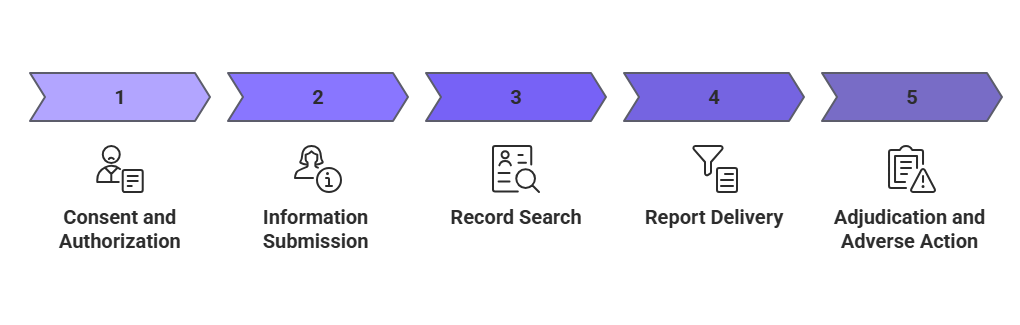
- Consent and Authorization: The employer provides a standalone disclosure and obtains written consent from the candidate or employee, as required by the Fair Credit Reporting Act.
- Information Submission: The employer or its consumer reporting agency collects identifying information such as name, date of birth, Social Security number, and addresses.
- Record Search: The consumer reporting agency queries criminal databases, verifies employment and education, checks driving records, and conducts other searches as specified by the employer.
- Report Delivery: The consumer reporting agency compiles findings into a consumer report and delivers it to the employer.
- Adjudication and Adverse Action: If the employer intends to take adverse action based on the report, it must provide a pre-adverse action notice, a copy of the report, and a summary of rights. The employer must then allow a reasonable period, typically at least five business days, for the individual to review the report and dispute any inaccuracies before proceeding with a final adverse action notice.
This process concludes when the report is adjudicated. Any subsequent information about the individual requires initiating a new background check.
Continuous Monitoring Process
Continuous monitoring operates through a different model:
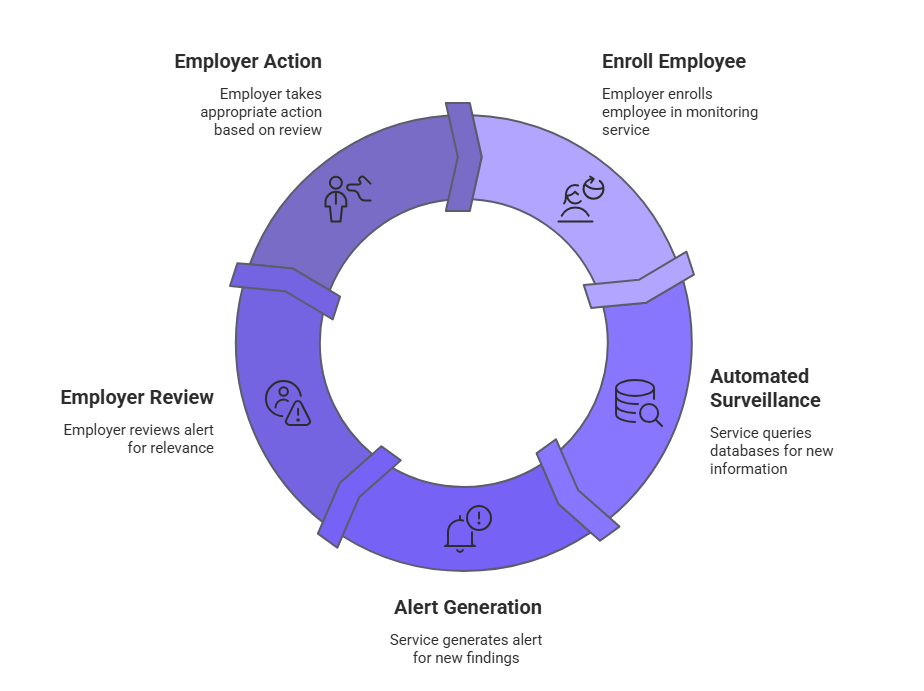
- Enrollment: After the initial background check and hiring decision, the employer enrolls the employee in a continuous monitoring service with separate written consent.
- Automated Surveillance: The service queries criminal databases, motor vehicle records, and other specified sources on a recurring basis, typically daily or weekly.
- Alert Generation: When new information appears, such as an arrest, conviction, license suspension, or sanctions list addition, the service generates an automated alert and delivers it to the employer.
- Employer Review and Action: The employer reviews the alert, determines whether it is relevant and accurate, and decides whether to take action. If adverse action is contemplated, the employer must follow Fair Credit Reporting Act procedures, including pre-adverse and final notices.
Importantly, continuous monitoring does not replace employer judgment. Verification, context, and individualized assessment remain essential before taking any action.
Multi-Dimensional Comparison Across Key Variables
The table below provides a structured comparison of continuous monitoring and traditional background checks across dimensions that matter to decision-makers.
| Dimension | Traditional Background Check | Continuous Monitoring |
| Timing and Frequency | Conducted at hire or at defined rescreening intervals | Ongoing automated surveillance with real-time or near-real-time alerts |
| Scope of Coverage | Comprehensive; can include criminal, employment, education, credit, licenses, and more | Narrower; typically criminal records, motor vehicle records, and sanctions lists |
| Cost Structure | Per-check fee at each search event | Subscription or per-employee-per-month fee for enrolled workforce |
| Compliance Obligations | Requires disclosure, consent, and adverse action process at each check | Requires separate consent for ongoing monitoring and adverse action process for each alert |
| Implementation Complexity | Established workflow; widely understood by HR teams | Requires alert triage protocols, escalation paths, and response training |
| Employer Action Requirements | One-time review and adjudication per check | Ongoing alert review, verification, and decision-making |
| Data Freshness | Reflects records as of search date; no updates after delivery | Provides updates as new records appear in monitored databases |
| Best Fit Use Cases | Pre-employment screening, periodic compliance checks, role changes | High-risk roles, industries with regulatory mandates, negligent retention mitigation |
This comparison clarifies that the two approaches are not equivalent alternatives but complementary tools with different operational profiles.
Compliance and Legal Framework Differences
Both traditional background checks and continuous monitoring are governed by the Fair Credit Reporting Act when conducted by a consumer reporting agency. However, the compliance obligations differ in timing, consent requirements, and procedural workflows.
Consent Requirements
The Fair Credit Reporting Act requires employers to provide a clear and conspicuous standalone disclosure and obtain written authorization before procuring a consumer report. For traditional background checks, this consent is typically obtained once per screening event. For continuous monitoring, employers must obtain separate, ongoing consent that clearly describes the nature of the monitoring, the frequency of database queries, and the types of records that will be monitored.
Some state laws impose additional consent requirements. For example, certain jurisdictions require that continuous monitoring consent be provided separately from initial background check consent and that employees be given the right to opt out or terminate monitoring under specified conditions.
Adverse Action Process
The Fair Credit Reporting Act mandates a two-step adverse action process when an employer takes action based on information in a consumer report. This process applies to both traditional checks and continuous monitoring alerts. However, the operational burden differs. In traditional background checks, the adverse action process occurs once per hiring or rescreening decision. In continuous monitoring, each alert that triggers a potential adverse action requires a new pre-adverse action notice, copy of the report, summary of rights, and final adverse action notice if the employer proceeds.
Employers must conduct individualized assessments when criminal record alerts are involved. Blanket disqualification policies based on arrest records or older convictions are strongly disfavored and typically violate Title VII of the Civil Rights Act or state fair chance hiring laws unless the employer can demonstrate that the exclusion is job-related and consistent with business necessity.
State and Local Law Variations
State and local laws increasingly regulate the use of criminal records in employment decisions. Ban-the-box laws, fair chance hiring ordinances, and lookback period restrictions vary by jurisdiction and may limit when and how employers can act on continuous monitoring alerts. Employers operating in multiple states must ensure their monitoring protocols comply with applicable state and local laws, which may vary based on the employee’s work location, the employer’s jurisdiction, and the nature of the adverse action. Legal counsel should be consulted to determine which jurisdiction’s laws apply in specific situations.
Scope and Coverage Limitations of Each Approach
One of the most common misconceptions about continuous monitoring is that it replicates the full scope of a traditional background check on an ongoing basis. In practice, continuous monitoring covers a subset of the record types included in comprehensive pre-employment screening.
What Continuous Monitoring Typically Covers
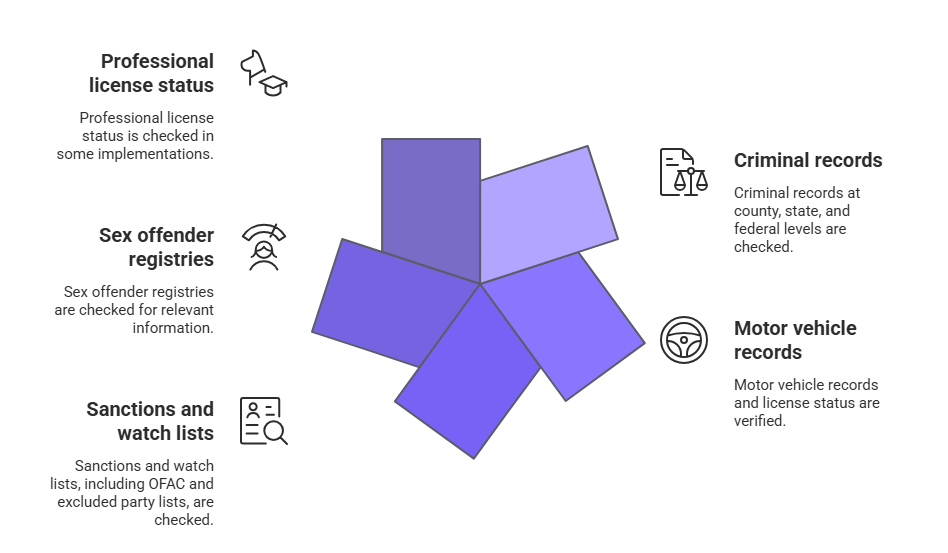
- Criminal records at the county, state, and federal levels
- Motor vehicle records and license status
- Sanctions and watch lists, including the Office of Foreign Assets Control, excluded party lists, and global sanctions databases
- Sex offender registries
- Professional license status in some implementations
What Continuous Monitoring Typically Does Not Cover
- Employment history verification
- Education and credential verification
- Credit reports and financial records
- Civil court records, including judgments and liens
- Social media or online reputation analysis
- Reference checks or character assessments
For roles that require verification of professional credentials, educational qualifications, or financial responsibility, continuous monitoring does not replace the need for periodic rescreening through traditional background checks.
Database Lag and Coverage Gaps
Continuous monitoring relies on the timeliness and completeness of the databases it queries. Not all criminal records are available in real time. Some jurisdictions update their systems weekly or monthly, and certain record types, such as arrests that do not result in charges, may not appear in all monitored databases. The availability and timeliness of records vary significantly by jurisdiction and database source. Employers should understand the limitations of data sources and avoid assuming that continuous monitoring provides complete visibility into all relevant records.
Cost Structure and Total Cost of Ownership Analysis
The question “Is continuous monitoring more expensive than traditional background checks?” cannot be answered with a single figure because the two approaches use fundamentally different cost models.
Traditional Background Check Cost Model
Traditional background checks are priced on a per-check basis. Costs vary depending on the scope of the search, the number of jurisdictions queried, and the types of verifications included. Employers incur costs at each hiring event and at each rescreening interval if periodic checks are conducted.
Total cost of ownership for traditional background checks depends on:
- Number of new hires per year
- Employee turnover rate
- Frequency of rescreening for existing employees
- Scope of each background check
For organizations with high turnover, the cumulative cost of traditional checks can be substantial.
Continuous Monitoring Cost Model
Continuous monitoring is typically priced on a subscription basis, either per employee per month or per employee per year. The cost is incurred for each enrolled employee regardless of whether alerts are generated.
Total cost of ownership for continuous monitoring depends on:
- Number of employees enrolled
- Duration of enrollment
- Volume of alerts requiring review and action
For organizations with stable, long-tenured workforces, continuous monitoring costs may accumulate over time, particularly if alerts are infrequent.
Comparative Cost Scenarios
Consider two illustrative scenarios:
| Scenario | Workforce Profile | Traditional Check Use | Continuous Monitoring Use | Cost Efficiency |
| Scenario A | 500 employees, 20% annual turnover, annual rescreening for all | 600 checks per year (100 new hires + 500 rescreens) | 500 employees enrolled continuously | Continuous monitoring may reduce per-employee cost |
| Scenario B | 100 employees, 50% annual turnover, no routine rescreening | 50 checks per year (new hires only) | 100 employees enrolled continuously | Traditional checks at hire may be more cost-efficient |
Employers should calculate total cost of ownership based on their workforce profile rather than relying on generalized comparisons.
Risk Scenarios: When Each Approach Succeeds and Fails
Abstract comparisons are less persuasive than concrete scenarios. The following examples illustrate when each approach mitigates risk effectively and when it falls short. By looking at real situations, it is possible to gain a clearer understanding of the impact of timing, scope, and context on the outcome of a situation, which cannot be fully captured through theory. It also enables organizations to better anticipate the gaps and make decisions regarding the structure of the screening.
Scenario 1: Post-Hire Arrest Not Detected Until Incident
An employee at a healthcare facility is arrested for domestic violence six months after hire. The arrest does not result in immediate conviction, and the employee does not self-report. The organization conducts background checks only at hire and does not use continuous monitoring. Three months later, the employee is involved in an altercation with a patient, prompting a review that reveals the prior arrest. The organization may face a negligent retention claim, depending on whether the arrest was relevant to the employee’s duties and whether the employer’s failure to detect it constituted a breach of duty.
Outcome with Traditional Checks: The arrest would not have been detected unless the organization conducted a scheduled rescreening during the intervening period.
Outcome with Continuous Monitoring: The arrest would have triggered an alert shortly after it occurred, allowing the employer to review the situation, conduct an individualized assessment, and take appropriate action if warranted.
Scenario 2: License Suspension in Transportation Role
A commercial driver’s license holder employed by a logistics company has their license suspended due to a DUI. The employee does not inform the employer. The organization conducts background checks at hire but does not monitor motor vehicle records post-hire. The employee continues driving company vehicles until a routine audit reveals the suspension months later.
Outcome with Traditional Checks: The suspension would remain undetected until the next rescreening or audit.
Outcome with Continuous Monitoring: The suspension would trigger an alert, allowing the employer to remove the employee from driving duties immediately and avoid liability exposure.
Scenario 3: Education Credential Fraud Discovered After Promotion
An employee is promoted to a senior role requiring a specific degree. During an internal audit, the organization discovers that the employee falsified their educational credentials. The organization uses continuous monitoring but does not conduct periodic rescreening of employment or education history.
Outcome with Traditional Checks: A periodic rescreening that included education verification could have detected the discrepancy earlier.
Outcome with Continuous Monitoring: Continuous monitoring does not cover education verification, so the fraud would remain undetected until discovered through other means.
These scenarios demonstrate that neither approach is universally superior. The effectiveness of each depends on the specific risk factors relevant to the role and organization.
Decision Framework: Determining the Right Approach for Your Organization
Employers evaluating continuous monitoring vs background check options should apply a decision framework organized around the following variables.
Industry and Regulatory Environment
Certain industries face heightened regulatory scrutiny or mandatory post-hire screening requirements. Healthcare, financial services, transportation, and childcare sectors often have explicit obligations to monitor employees for criminal activity, license status, or sanctions list additions. Employers in these industries should prioritize continuous monitoring for roles where regulatory mandates or client contracts require ongoing screening.
Organizations in industries with lower regulatory intensity may find that traditional background checks at hire and periodic rescreening intervals provide sufficient risk mitigation.
Workforce Size and Turnover Rate
Organizations with large, stable workforces and low turnover may benefit from continuous monitoring because the per-employee cost is spread over longer tenures, and the ongoing risk exposure justifies persistent surveillance.
Organizations with high turnover and smaller workforces may find that traditional background checks at each hiring event, combined with rescreening only for roles with elevated risk, offer better cost efficiency.
Role-Specific Risk Profiles
Not all roles warrant the same level of post-hire monitoring. Positions involving vulnerable populations, fiduciary responsibility, access to sensitive data, or operation of vehicles or machinery carry higher post-hire risk. Employers should segment their workforce and apply continuous monitoring selectively to roles where post-hire incidents would create significant liability or operational disruption.
For roles with lower risk profiles, traditional background checks at hire may be sufficient.
Organizational Capacity for Alert Triage
Continuous monitoring generates alerts that require review, verification, and decision-making. Organizations must have protocols in place to receive alerts, assess relevance, conduct individualized assessments, and take appropriate action. Employers without dedicated HR or compliance staff may struggle to manage alert volume effectively.
Organizations with established compliance functions and clear escalation paths are better positioned to implement continuous monitoring successfully.
Budget and Cost Tolerance
Employers should calculate total cost of ownership for both approaches based on their workforce profile and compare the results. Organizations with limited budgets may prioritize traditional checks at hire and reserve continuous monitoring for a subset of high-risk roles.
Hybrid Approach Considerations
Many organizations adopt hybrid models that combine traditional background checks at hire with continuous monitoring for specific roles or risk categories. This approach allows employers to balance comprehensive screening at the point of hire with targeted ongoing surveillance where it delivers the highest value.
Implementation Considerations for Transitioning or Combining Approaches
Employers who decide to add continuous monitoring to their screening program or transition from periodic rescreening to ongoing monitoring must address several operational and compliance considerations.
Obtaining Separate Consent
Continuous monitoring requires separate, clearly articulated consent that describes the ongoing nature of the service. Employers should not assume that initial background check consent covers continuous monitoring. The consent document should specify which record types will be monitored, the frequency of queries, and the duration of enrollment.
Some states have enacted laws requiring that employees be given the option to opt out of continuous monitoring or that consent be renewed at specified intervals. Employers should consult state-specific legal requirements to determine whether such obligations apply in their jurisdiction.
Establishing Alert Triage Protocols
Employers must define who receives alerts, how quickly they must be reviewed, and what criteria trigger escalation or action. Without clear protocols, alerts may be ignored, mishandled, or acted upon inconsistently.
Effective alert triage protocols include:
- Designated point of contact for alert receipt
- Verification procedures to confirm accuracy of reported information
- Individualized assessment criteria aligned with Title VII and state fair chance laws
- Documentation requirements for all decisions
- Adverse action workflow if employment action is contemplated
Training HR and Management Teams
Continuous monitoring introduces new responsibilities for HR teams and hiring managers. Training should cover consent requirements, alert interpretation, individualized assessment obligations, and adverse action procedures. Employers should also clarify that alerts are not automatic grounds for termination and that each situation requires context-specific evaluation.
Communicating with Employees
Transparency with employees about continuous monitoring is essential for trust and compliance. Employers should communicate the purpose of monitoring, the types of records being monitored, and the process for addressing alerts. Employees should understand that monitoring is not punitive but part of the organization’s risk management and compliance obligations.
Phased Rollout for Large Organizations
Employers with large workforces may benefit from a phased rollout that begins with high-risk roles or specific departments before expanding organization-wide. Phased implementation allows the organization to refine protocols, address operational challenges, and demonstrate value before committing to full-scale enrollment.
Conclusion
The choice between continuous monitoring and traditional background checks is not a binary decision but a strategic question shaped by industry requirements, workforce characteristics, and organizational capacity. Employers benefit from understanding the operational differences, compliance obligations, and cost structures of each approach. Many organizations will find that a hybrid model, combining comprehensive pre-employment screening with selective post-hire monitoring for high-risk roles, delivers the most effective balance of risk mitigation and resource efficiency.
Frequently Asked Questions
What is the difference between continuous monitoring and background checks?
A traditional background check is a point-in-time investigation conducted at hire or rescreening intervals, covering a wide range of records including criminal history, employment, education, credit, and licenses. Continuous monitoring is an ongoing service that generates automated alerts when new information appears in specific databases, typically limited to criminal records, motor vehicle records, and sanctions lists. Traditional checks are episodic and comprehensive; continuous monitoring is persistent and narrower in scope.
Is continuous monitoring more expensive than traditional background checks?
The cost comparison depends on workforce size, turnover rate, and rescreening frequency. Traditional checks are priced per search event, while continuous monitoring uses a subscription model charged per employee per period. For large, stable workforces with low turnover, continuous monitoring may be cost-effective compared to annual rescreening. For smaller organizations with high turnover, traditional checks at hire may be more economical.
What are the advantages of continuous monitoring over traditional rescreening?
Continuous monitoring provides real-time or near-real-time alerts when new criminal records, license suspensions, or sanctions list additions occur, allowing employers to respond promptly to post-hire risks. It eliminates the lag between rescreening intervals and reduces the administrative burden of scheduling and conducting periodic checks. Continuous monitoring is particularly valuable for roles where post-hire incidents could create significant liability.
When should employers rescreen employees instead of using continuous monitoring?
Employers should conduct traditional rescreening when they need to verify information that continuous monitoring does not cover, such as employment history, education credentials, professional licenses, or credit reports. Rescreening is also appropriate when compliance obligations or internal policies require periodic verification at defined intervals. Organizations without the capacity to manage ongoing alerts may find periodic rescreening more manageable.
Does continuous monitoring eliminate the need for pre-employment background checks?
No. Continuous monitoring does not replace the initial pre-employment background check. It extends surveillance beyond the hiring decision by monitoring a limited set of record types for changes. Pre-employment checks remain essential for comprehensive evaluation of a candidate’s history, including employment verification, education credentials, and other record types not covered by continuous monitoring.
What is negligent retention and how does continuous monitoring address it?
Negligent retention is a legal claim asserting that an employer knew or should have known about an employee’s unfitness for a position and failed to take appropriate action, resulting in harm to a third party. Continuous monitoring helps mitigate negligent retention risk by alerting employers to post-hire criminal activity, license suspensions, or other disqualifying events. However, receiving an alert does not automatically require termination; employers must conduct individualized assessments and follow applicable legal requirements.
Can employers use continuous monitoring in all states?
Employers can use continuous monitoring in any state, but they must comply with state-specific laws governing consent, use of criminal records, and adverse action procedures. Some states require separate consent for ongoing monitoring, impose lookback period limits on criminal records, or restrict the use of arrest records that did not result in conviction. Employers operating in multiple jurisdictions must ensure their monitoring protocols comply with the most restrictive applicable law.
What types of records does continuous monitoring typically cover?
Continuous monitoring typically covers criminal records at the county, state, and federal levels, motor vehicle records, license status, sanctions and watch lists such as the Office of Foreign Assets Control, excluded party databases, and sex offender registries. It does not typically include employment history, education verification, credit reports, civil court records, or social media analysis.
Additional Resources
- Fair Credit Reporting Act – Federal Trade Commission Summary
https://www.ftc.gov/legal-library/browse/statutes/fair-credit-reporting-act - EEOC Enforcement Guidance on the Consideration of Arrest and Conviction Records
https://www.eeoc.gov/laws/guidance/arrest_conviction.cfm - State Ban-the-Box Laws and Fair Chance Hiring – National Employment Law Project
https://www.nelp.org/campaign/ensuring-fair-chance-to-work/

ABOUT THE CREATOR
GCheck Editorial Team
Meet the GCheck Editorial Team, your trusted source for insightful and up-to-date information in the world of employment background checks. Committed to delivering the latest trends, best practices, and industry insights, our team is dedicated to keeping you informed.
With a passion for ensuring accuracy, compliance, and efficiency in background screening, we are your go-to experts in the field. Stay tuned for our comprehensive articles, guides, and analysis, designed to empower businesses and individuals with the knowledge they need to make informed decisions.
At GCheck, we're here to guide you through the complexities of background checks, every step of the way.