



Massachusetts employers in 2026 must navigate a complex compliance framework involving state CORI access rules, Boston’s ban-the-box ordinance, and federal FCRA requirements. Massachusetts law provides for Certificate of Good Conduct consideration in employment decisions, and employers must navigate disclosure timing requirements that may create operational challenges for HR teams managing multi-location hiring.
Key Takeaways
- Massachusetts background check laws operate through a three-tier system: state CORI regulations, municipal ordinances like Boston’s ban-the-box, and federal FCRA standards.
- CORI access levels determine what criminal record information employers may legally review based on job classification and regulatory requirements.
- Boston’s fair chance hiring ordinance prohibits criminal history inquiries until after conditional job offers for most positions.
- Certificates of Good Conduct provide a statutory framework for considering rehabilitation evidence in employment decisions.
- Massachusetts criminal record employment discrimination protections require individualized assessments rather than blanket disqualification policies.
- Employers must reconcile timing conflicts between state disclosure requirements and municipal ban-the-box restrictions.
- Compliance gaps frequently emerge in multi-location operations where Boston and non-Boston hiring processes differ.
- Documentation requirements vary significantly based on employer type, with healthcare and financial services facing enhanced verification obligations.
Understanding Massachusetts CORI Access Requirements
Massachusetts structures criminal record access through the Criminal Offender Record Information system, which sorts employer access into distinct levels. The appropriate access level depends on the nature of the position and specific regulatory mandates. Employers must apply for CORI access certification through the Department of Criminal Justice Information Services before conducting any criminal record checks.
| CORI Access Level | Information Available | Typical Qualifying Positions |
| Level 1 | Convictions only | General employment positions without vulnerable population contact |
| Level 2 | Convictions, pending cases, certain non-convictions | Healthcare, education, positions with children or elderly contact |
| Level 3 | Most complete access; sealed records available only in limited circumstances with specific statutory authorization | Law enforcement, positions with specific statutory requirements |
This certification process requires employers to show a clear need, which may include specific job duties involving vulnerable populations, relevant regulatory compliance obligations, or documented workplace safety requirements tied to the position’s duties and environment. State authorities subject access certifications to renewal requirements and may audit them to verify proper usage patterns. Employers should check current renewal timelines with the Department of Criminal Justice Information Services. The Massachusetts CORI reform framework stresses that access authorization does not equal permission to use all available information in employment decisions.
As an HR professional, I have come to realize that a background check is never just a check-the-box exercise. It is a delicate balance of fairness, safety, and trust, and every choice we make is a choice to help a real individual move forward in their life. Working through complex regulations like state and local laws, and federal regulations, I have come to realize that taking the time to assess risk and rehabilitation is key to responsible hiring, and responsible hiring is key to being human. Compliance is not a barrier to hiring; compliance is a tool to drive ethical decision-making. �
Job Classification and Access Eligibility
Certain position types automatically qualify for enhanced CORI access levels due to statutory requirements or vulnerable population contact. Healthcare facilities, educational institutions, financial services providers, and entities working with children or elderly populations typically need Level 2 or Level 3 access for compliance purposes.
Employers must document the business need for the requested access level during the certification application process. Generic claims of safety concerns or risk management typically prove insufficient. Specific regulatory citations, licensing board requirements, or detailed vulnerability analyses provide stronger support. Positions not falling into statutorily defined categories may qualify for Level 1 access after proper application and justification, limiting employers to conviction-based information for those approved positions.
Maintaining CORI Compliance Infrastructure
Organizations conducting background checks must set up documented policies that govern CORI access, storage, sharing, and destruction. These policies should specify who within the organization may access criminal record information, under what circumstances, and for what duration the organization may retain records.
State regulations typically require training for personnel with CORI access authorization. Employers should verify current training obligations based on their certification level and any applicable regulatory guidance. Documentation of training completion, policy acknowledgment, and regular compliance audits helps show good-faith adherence to regulatory standards during any investigation or challenge. Security protocols must protect CORI information from unauthorized disclosure. Physical records need secured storage, and electronic systems should use appropriate safeguards such as encryption, access controls, and audit trail capabilities consistent with current regulatory standards and data security best practices.
Boston Ban-the-Box Requirements for Employers
Boston’s fair chance hiring ordinance sets specific timing restrictions on when employers may ask about or consider criminal history information. The ordinance applies to employers with physical locations in Boston, regardless of where the applicant lives or where the work will take place.
Key Ban-the-Box Provisions:
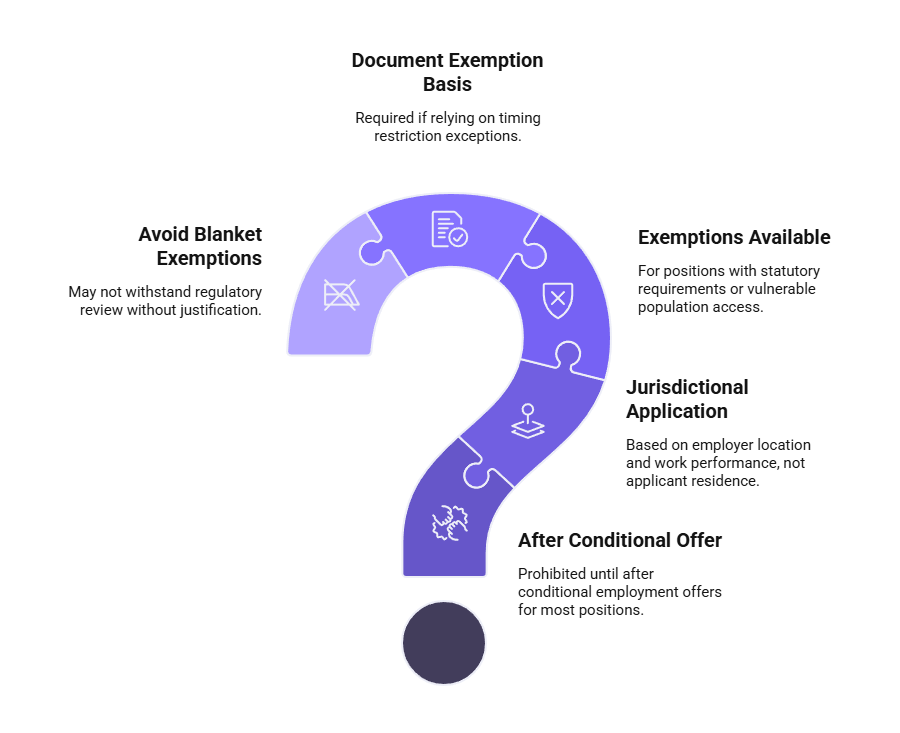
- Criminal history questions prohibited until after employers extend conditional employment offers for most positions
- Jurisdictional application based on employer location and work performance location, not applicant residence
- Exemptions available for positions with statutory background check requirements or vulnerable population access
- Employers must document specific exemption basis if relying on timing restriction exceptions
- Blanket exemption claims without supporting justification may not withstand regulatory review
Certain positions receive exemptions from ban-the-box timing restrictions based on statutory background check requirements, vulnerable population access, or law enforcement functions. However, employers must prepare to document the specific exemption basis if challenged.
Application and Interview Process Modifications
Complying with Boston ban-the-box requirements calls for revisions to standard application materials, interview scripts, and hiring stage documentation. Application forms used for Boston positions cannot include criminal history questions or checkboxes, even if the same forms apply to non-Boston roles.
Interview training becomes critical to prevent accidental violations. Hiring managers and recruiters must understand that they cannot discuss criminal history during initial screening stages, even if applicants volunteer such information. Standardized interview guides help maintain consistent compliance across hiring teams. Background check authorization forms need careful timing consideration to avoid triggering premature criminal history inquiry violations.
Post-Offer Criminal History Assessment Process
Once employers extend a conditional offer, Boston employers may conduct criminal background checks and consider the results within statutory limits. However, the fair chance hiring ordinance requires specific procedural protections before withdrawing an offer based on criminal history findings.
Employers must give applicants a copy of the background check report and allow time to respond before making a final adverse decision. This response period lets applicants contest accuracy, provide context about rehabilitation, or submit documentation such as Certificates of Good Conduct. The individualized assessment requirement bars automatic disqualification policies based on criminal history categories, with employers needing to evaluate offense nature and gravity, time elapsed, and job relevance.
Massachusetts Criminal Record Employment Discrimination Standards
Massachusetts law prohibits employment discrimination based solely on criminal record information without considering job-relatedness and individual circumstances. This protection operates independently of ban-the-box timing requirements and applies statewide regardless of municipal ordinances.
| Prohibited Practice | Required Alternative Approach |
| Automatic disqualification based on conviction categories | Individualized assessment considering offense nature, time elapsed, and job relevance |
| Blanket lookback period policies | Case-by-case evaluation incorporating rehabilitation evidence |
| Generic categorical exclusions | Job-specific risk analysis tied to actual duties and responsibilities |
| Disregarding Certificates of Good Conduct | Systematic consideration of rehabilitation presumption |
The Massachusetts Commission Against Discrimination enforces these protections and investigates complaints alleging criminal record discrimination. Employers who can show that their screening criteria and decision-making processes incorporate individualized assessment frameworks have stronger defensive positions in such proceedings.
Implementing Individualized Assessment Frameworks
Effective individualized assessment requires documented evaluation of specific factors relevant to each case. Employers should analyze the relationship between the offense conduct and the job responsibilities with specificity rather than broad categorical assumptions.
Essential Assessment Components:
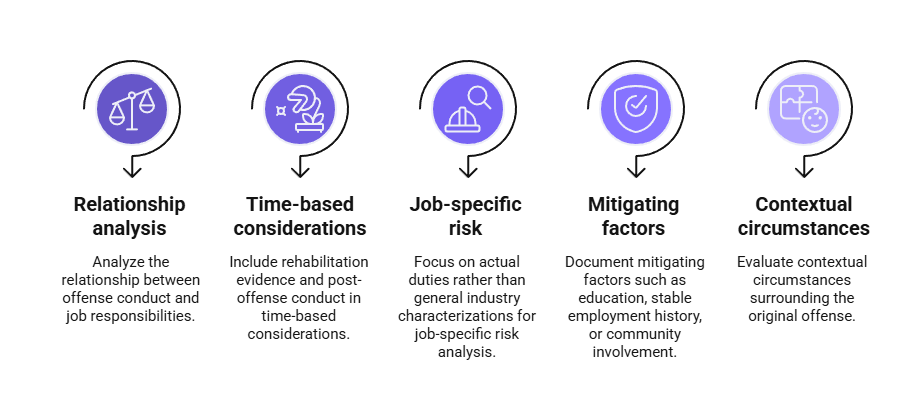
- Specific analysis of the relationship between offense conduct and job responsibilities
- Time-based considerations including rehabilitation evidence and post-offense conduct
- Job-specific risk analysis focused on actual duties rather than general industry characterizations
- Documentation of mitigating factors such as education, stable employment history, or community involvement
- Evaluation of contextual circumstances surrounding the original offense
Time-based considerations form a critical assessment component. Significant time passage between an offense and the employment decision, particularly when coupled with evidence of rehabilitation, education, stable employment history, or community involvement, may support a determination that the record does not present material risk.
Certificate of Good Conduct Consideration Requirements
Massachusetts law provides for Certificates of Good Conduct that the state issues to individuals showing rehabilitation following criminal convictions. These certificates create a rebuttable presumption of rehabilitation that employers must consider during the assessment process.
When an applicant presents a Certificate of Good Conduct covering relevant convictions, employers must consider the certificate’s significance and the rebuttable presumption of rehabilitation it creates. Disqualification based solely on the underlying conviction without documented consideration of the certificate may violate Massachusetts law. Employers should set up documented protocols for Certificate of Good Conduct evaluation, including who reviews such certificates, what additional information may be requested, and how the certificate factors into the final employment decision.
Federal FCRA Requirements and State Law Interactions
The federal Fair Credit Reporting Act requires specific disclosures and authorizations before employers obtain consumer reports for employment purposes. Employers must reconcile these FCRA requirements with Massachusetts CORI access procedures and Boston ban-the-box timing restrictions, creating layered compliance obligations.
| Compliance Requirement | Federal FCRA Standard | Massachusetts CORI Rule | Boston Ban-the-Box Timing |
| Initial disclosure timing | Before obtaining report | Before CORI access | After conditional offer (most positions) |
| Authorization format | Standalone written document | Certification-based access | Integrated with post-offer process |
| Pre-adverse action notice | Required with reasonable time to respond | Not specified separately | Overlaps with individualized assessment period |
| Adverse action notice | Required after final decision | Not specified separately | Required after assessment completion |
FCRA mandates that employers provide a clear and conspicuous standalone disclosure and obtain written authorization from the applicant before obtaining a consumer report for employment purposes. For Boston positions subject to ban-the-box, employers should not distribute these forms until the conditional offer stage to avoid triggering premature criminal history inquiry violations.
Pre-Adverse and Adverse Action Notice Procedures
When an employer intends to take adverse employment action based in whole or in part on information in a consumer report, FCRA requires a pre-adverse action notice process. Employers must give the applicant a copy of the report, a summary of rights under FCRA, and reasonable time to respond before they finalize the adverse action.
This federal pre-adverse action requirement operates alongside Massachusetts individualized assessment obligations and Boston’s post-offer response period. Employers must provide reasonable time for applicants to contest report accuracy, explain circumstances, or provide rehabilitation evidence before proceeding to a final adverse action. Providing at least five business days is generally considered reasonable, though specific circumstances may require longer periods. The final adverse action notice, which employers must send after they make the decision, must include information about the consumer reporting agency that provided the report, a statement that the agency did not make the decision and cannot explain it, and notice of the right to dispute report accuracy.
Permissible Purpose and Report Usage Limitations
FCRA permits consumer report use for employment purposes only when the applicant authorizes it and employers use it for legitimate employment decisions. Employers cannot repurpose reports obtained for one purpose for other uses without additional authorization. Employers must limit disclosure of consumer report information in accordance with FCRA permissible purpose requirements and should consult legal counsel about appropriate information sharing protocols.
Massachusetts CORI regulations impose additional usage restrictions beyond FCRA baselines. Employers may use CORI information only for the specific purpose for which they obtained access. Employers should destroy or securely retain CORI information in accordance with regulatory requirements once its initial purpose is fulfilled, unless continued retention is necessary for ongoing employment relationships, regulatory compliance, or legitimate business purposes. Retention policies must balance operational needs against regulatory mandates for timely disposition. Employers using third-party consumer reporting agencies for background checks should verify that the agency understands Massachusetts-specific CORI access rules, Boston ban-the-box timing requirements, and the integrated compliance framework.
Multi-Location Compliance Challenges in Massachusetts
Companies with locations both within and outside Boston must implement geographically aware hiring protocols that apply appropriate procedural requirements based on position location. This typically requires system-level controls that identify position location and trigger corresponding workflow rules.
Jurisdictional Determination Factors:

- Physical location where work will take place
- Employer operational presence in Boston versus non-Boston municipalities
- Position classification and statutory background check requirements
- Application of most restrictive standards when jurisdictional boundaries overlap
- Documentation methodology for remote or multi-location position elements
Jurisdictional determinations typically depend on where the work will take place and where the employer maintains operations, rather than applicant residence. However, specific circumstances such as staffing agency relationships or multi-location arrangements may create additional considerations requiring legal review. A candidate living outside Boston applying for a Boston-based position remains subject to Boston’s ban-the-box requirements, while Boston residents applying for non-Boston positions do not trigger municipal ordinance provisions.
Standardization Versus Location-Specific Protocols
Many employers prefer standardized hiring processes for operational efficiency and consistency. However, Massachusetts’ layered compliance framework makes complete standardization challenging when operations span multiple jurisdictions with varying requirements.
One approach involves adopting the most restrictive standard across all locations. For example, applying Boston’s ban-the-box timing requirements to all Massachusetts positions simplifies administration and eliminates jurisdictional tracking complexity, though it may delay screening for positions where earlier inquiry would be allowed. Alternative approaches maintain location-specific workflows with system controls and training that ensure proper protocol application, maximizing flexibility while requiring more sophisticated compliance infrastructure.
Healthcare and Financial Services Special Considerations
Certain industries face regulatory background check requirements that may conflict with general ban-the-box timing restrictions. Healthcare facilities subject to licensing board mandates or federal funding requirements may need to conduct criminal background checks at earlier hiring stages than municipal ordinances typically permit.
Boston’s ban-the-box ordinance and similar municipal regulations typically provide exemptions when background checks are required by law or regulation. Employers should verify specific exemption criteria applicable in each jurisdiction where they operate. However, employers must document the specific statutory or regulatory requirement mandating early screening rather than relying on industry practice or general safety concerns. Financial services employers subject to FINRA rules, FDIC requirements, or other regulatory mandates should similarly document the specific compliance obligation necessitating background checks.
Practical Implementation for HR Teams
Complete background check policies should address CORI access procedures, Boston ban-the-box compliance for applicable positions, individualized assessment protocols, Certificate of Good Conduct consideration, FCRA notice requirements, and records retention schedules. These policies provide operational guidance and show systematic compliance efforts.
| Policy Component | Required Documentation | Review Frequency |
| CORI access procedures | Certification basis, access level justification, security protocols | Annually or upon regulation change |
| Position-specific screening criteria | Job-relatedness analysis, individualized assessment factors | At job description update |
| Ban-the-box compliance protocols | Jurisdictional determination methodology, timing controls | Quarterly or upon expansion |
| Certificate of Good Conduct evaluation | Review process, decision-maker designation, documentation standards | Annually |
| FCRA notice procedures | Disclosure templates, timing controls, response period standards | Annually or upon format change |
Employers should document position-specific screening criteria with job-relatedness justifications for any criminal history considerations. These criteria must allow for individualized assessment rather than creating automatic disqualification categories, and employers should review them regularly for continued appropriateness and legal compliance.
Training and Audit Protocols
All personnel involved in hiring decisions should receive training on Massachusetts background check laws, including CORI access rules, ban-the-box timing requirements, individualized assessment obligations, and FCRA compliance procedures. Training frequency depends on regulatory change pace and personnel turnover rates.
Regular compliance audits should review a sample of background check files to verify proper disclosure and authorization documentation, appropriate timing of criminal history inquiries for Boston positions, individualized assessment documentation for adverse decisions, and proper FCRA pre-adverse and adverse action notice procedures. Audit findings should drive corrective action plans, additional training, or policy changes as needed.
Vendor Management and Oversight Responsibilities
Employers using consumer reporting agencies for background checks retain compliance responsibility even when outsourcing operational tasks. Vendor selection should include evaluation of the agency’s understanding of Massachusetts-specific requirements and ability to support compliant workflows.
Service agreements should specify compliance obligations, including FCRA requirements, Massachusetts CORI regulations, accuracy standards, dispute resolution procedures, and liability allocation for regulatory violations. Agreements should also address data security, retention, and destruction protocols. Regular vendor performance reviews should assess report accuracy, turnaround times, responsiveness to dispute requests, and compliance with contractual obligations.
Conclusion
Massachusetts employers in 2026 must integrate state CORI access rules, municipal ban-the-box ordinances, and federal FCRA requirements into cohesive compliance frameworks. Organizations should document position-specific screening criteria, implement individualized assessment protocols, train hiring personnel on jurisdictional requirements, and audit processes regularly to identify and address gaps.
Frequently Asked Questions
What is the difference between Massachusetts CORI access levels?
CORI access levels determine what criminal record information employers may review. Level 1 provides conviction-only access, Level 2 includes pending cases and certain non-convictions, and Level 3 offers the most complete access including sealed records when statutorily authorized. The appropriate level depends on job responsibilities and regulatory requirements, with employers needing certification before conducting any CORI checks.
When can Boston employers ask about criminal history?
Boston’s fair chance hiring ordinance generally prohibits criminal history inquiries until after employers extend conditional employment offers. Exemptions exist for positions with statutory background check requirements or vulnerable population access. Employers must document specific exemption bases and cannot rely on blanket industry claims to avoid timing restrictions.
Are employers required to consider Certificates of Good Conduct?
Massachusetts law creates a rebuttable presumption of rehabilitation when applicants present valid Certificates of Good Conduct. Employers must incorporate certificate evidence into individualized assessments and cannot automatically disqualify based solely on underlying convictions without documenting specific reasons that overcome the rehabilitation presumption.
How do FCRA requirements interact with Massachusetts background check laws?
FCRA mandates disclosure and authorization before employers obtain consumer reports, plus pre-adverse and adverse action notice processes when taking negative employment actions. Employers must layer these federal requirements with Massachusetts CORI procedures and Boston ban-the-box timing restrictions, requiring careful sequencing of disclosures, authorizations, checks, and decision communications.
What is an individualized assessment in employment screening?
Individualized assessment requires evaluating criminal history within the specific context of the job sought and the individual’s circumstances. Employers must consider the nature and gravity of offenses, time elapsed, rehabilitation evidence, and job relevance rather than applying blanket disqualification policies. Documentation of this analysis is essential for compliance demonstration.
Do Massachusetts background check laws apply to remote positions?
Jurisdictional application typically depends on where the employer maintains operations and where work will take place, not employee residence. Boston ban-the-box requirements apply to positions based in Boston regardless of where candidates live. Employers should document their jurisdictional determination methodology for positions with remote or multi-location elements.
How long can employers retain criminal background check information?
Retention periods depend on the information source and applicable regulations. Employers should destroy or retain CORI information in accordance with regulatory requirements once its initial purpose is fulfilled. FCRA does not mandate specific retention limits but requires reasonable procedures to ensure accuracy, and employers should establish documented retention schedules consistent with both operational needs and legal obligations.
What training should HR personnel receive on Massachusetts background check laws?
HR training should cover CORI access rules and certification requirements, Boston ban-the-box timing restrictions and exemptions, individualized assessment obligations, Certificate of Good Conduct consideration, FCRA disclosure and notice procedures, and documentation requirements. Training frequency should reflect regulatory changes and personnel turnover, with regular refreshers ensuring continued compliance awareness.
Additional Resources
- Massachusetts Criminal Offender Record Information (CORI) System Overview
https://www.mass.gov/info-details/cori-criminal-offender-record-information - Boston Fair Chance Hiring Ordinance Official Text
https://www.boston.gov/departments/boston-employment-commission/fair-chance-act - Federal Trade Commission Fair Credit Reporting Act Guidance
https://www.ftc.gov/legal-library/browse/statutes/fair-credit-reporting-act - Massachusetts Commission Against Discrimination Employment Guidelines
https://www.mass.gov/orgs/massachusetts-commission-against-discrimination - U.S. Equal Employment Opportunity Commission Criminal Record Guidance
https://www.eeoc.gov/laws/guidance/consideration-arrest-and-conviction-records-employment-decisions-under-title-vii

ABOUT THE CREATOR
GCheck Editorial Team
Meet the GCheck Editorial Team, your trusted source for insightful and up-to-date information in the world of employment background checks. Committed to delivering the latest trends, best practices, and industry insights, our team is dedicated to keeping you informed.
With a passion for ensuring accuracy, compliance, and efficiency in background screening, we are your go-to experts in the field. Stay tuned for our comprehensive articles, guides, and analysis, designed to empower businesses and individuals with the knowledge they need to make informed decisions.
At GCheck, we're here to guide you through the complexities of background checks, every step of the way.