



Texas imposes limited state-level background screening mandates on private construction employers, but federal contracts, client specifications, insurance requirements, and liability considerations create a layered compliance environment. This guide clarifies mandatory versus voluntary screening practices, examines federal and contractual obligations, and provides a decision framework for construction employers navigating multi-state operations and risk mitigation in a high-growth industry.
Key Takeaways
- Texas does not mandate background checks for most private construction workers, but federal contracts and client specifications frequently impose them.
- Employers must comply with the Fair Credit Reporting Act when using third-party screening providers to obtain consumer reports.
- Lookback periods, permissible disqualifiers, and individualized assessment requirements vary by jurisdiction and contract type.
- Multi-state construction contractors face overlapping state laws, including ban-the-box ordinances and arrest record restrictions.
- Insurance carriers and bonding companies often require background screening as a condition of coverage or underwriting.
- Subcontractor compliance verification is a growing area of contractual and regulatory exposure for general contractors.
- Federal contracts frequently trigger additional screening requirements, including E-Verify participation and credentialing rules.
- Effective screening programs balance legal compliance, operational efficiency, and workplace safety objectives within a documented policy framework.
Understanding Texas Construction Background Check Requirements
Texas construction background check requirements reflect a framework where state law imposes minimal direct mandates on private employers, yet federal regulations, contractual obligations, and industry standards create substantial de facto requirements. Unlike states with prescriptive screening laws, Texas delegates most employment screening decisions to private employers, subject to federal law and contractual terms.
| Requirement Type | Source | Applicability |
| State-mandated screening | Texas statutes | Limited to licensed trades only |
| Federal contract requirements | Agency-specific rules | All tiers of federal contractors |
| Client specifications | Contract terms | Project-specific, varies widely |
| Insurance/bonding conditions | Underwriting standards | Coverage-dependent |
This creates flexibility but also complexity, particularly for firms operating across multiple jurisdictions or pursuing public contracts.
In the world of HR, background screening isn’t typically an exercise in perfect records; it’s an exercise in good decision-making. The best way to describe this process is to say that the real work happens in the gray areas. Screening done well involves consistency and context, which makes it less of a barrier to opportunity and more of a tool for good hiring practices. At its best, it’s a reflection of organizational values and policies.
State-Level Regulatory Framework
Texas does not require private construction employers to conduct background checks on most workers. There is no statute equivalent to those in some states mandating criminal history screening for specific occupations. However, certain regulated roles within the construction sector may trigger verification requirements.
Licensing requirements apply to the following trades:
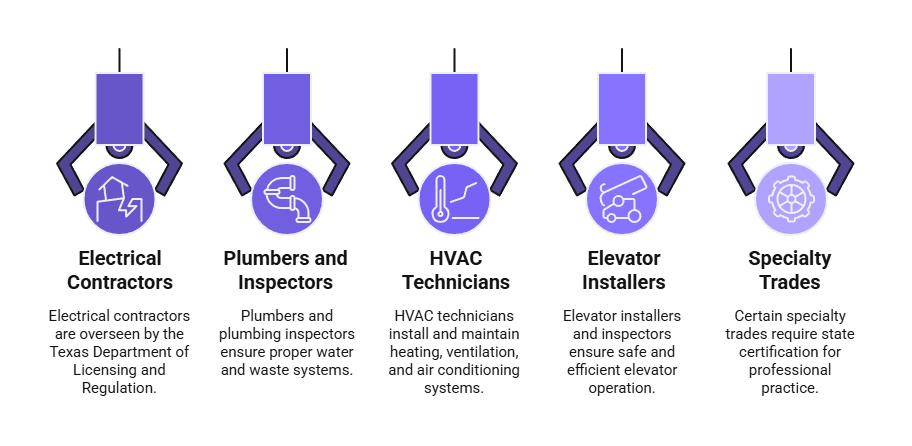
- Electrical contractors (Texas Department of Licensing and Regulation oversight)
- Plumbers and plumbing inspectors
- HVAC technicians and specialists
- Elevator installers and inspectors
- Certain specialty trades requiring state certification
For example, electrical contractors must hold licenses issued by the Texas Department of Licensing and Regulation. Licensing requirements and any associated background review requirements vary by trade and should be verified directly with the licensing authority.
Private employers retain broad discretion to establish screening policies, but that discretion is bounded by federal law, particularly the Fair Credit Reporting Act. When an employer engages a third-party provider to compile a background report, the FCRA applies.
Federal Contract Triggers
Federal construction projects introduce a distinct set of requirements. Contracts awarded by federal agencies, including those funded through the Infrastructure Investment and Jobs Act or Department of Defense construction programs, typically require contractors and subcontractors to verify eligibility through E-Verify. This federal system cross-references employee information against Social Security Administration and Department of Homeland Security records to confirm work authorization.
Security clearance requirements apply particularly for work on military installations, secure facilities, or sensitive infrastructure. The Transportation Worker Identification Credential, issued by the Transportation Security Administration, is required for workers accessing port facilities, maritime construction sites, and certain transportation infrastructure projects. These credentials involve fingerprint-based criminal history checks conducted through the Federal Bureau of Investigation.
Client Specifications and Contractual Obligations
Construction contracts frequently specify background screening requirements as a condition of award or performance. These specifications may originate from public sector clients, private developers, or institutional owners such as hospitals, schools, or financial institutions.
Contractual screening mandates may include specific lookback periods, disqualifying offenses, and verification methods. Employers must review contract terms carefully, as failure to comply with these provisions may constitute breach of contract and result in financial penalties, contract termination, or disqualification from future bidding opportunities.
Compliance with the Fair Credit Reporting Act
The Fair Credit Reporting Act governs background screening when employers use third-party consumer reporting agencies to obtain reports. The statute establishes a series of procedural requirements designed to protect applicants and employees from inaccurate or misused information.
| FCRA Stage | Required Action | Timing |
| Pre-screening | Standalone written disclosure and authorization | Before report requested |
| Pre-adverse action | Report copy, notice, summary of rights | Before final decision |
| Final adverse action | Notice with CRA contact information | After decision finalized |
Compliance failures can result in individual and class action litigation, statutory damages, and regulatory enforcement by the Federal Trade Commission or Consumer Financial Protection Bureau.
Authorization and Disclosure Requirements
Before obtaining a consumer report, employers must provide a clear and conspicuous written disclosure, in a standalone document, informing the individual that a report may be obtained. The applicant must then provide written authorization.
These requirements apply regardless of whether the screening occurs pre-hire or post-hire, and they extend to periodic rescreening programs. Authorization forms must not be embedded within employment applications or bundled with liability waivers or other unrelated disclosures.
Pre-Adverse Action Process
When information obtained from a third-party consumer reporting agency may lead to an adverse employment decision, such as withdrawal of a job offer or termination, the employer must follow the FCRA's pre-adverse action process. This includes providing the individual with a copy of the consumer report, a written notice explaining the potential adverse action, and a summary of rights under the FCRA.
The employer must allow a reasonable period for the individual to review the report and dispute any inaccuracies before finalizing the decision. What constitutes reasonable depends on the circumstances and varies by case. Employers should consult legal counsel to determine appropriate timeframes for their specific situations.
Final Adverse Action Notice
If the employer proceeds with the adverse action after the pre-adverse action period, a final adverse action notice must be delivered. This notice must include the following elements:
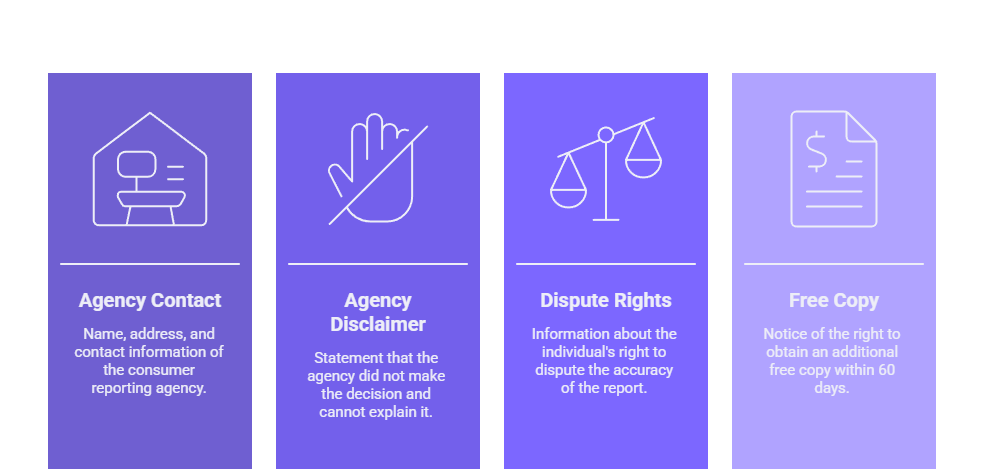
- Name, address, and contact information of the consumer reporting agency that provided the report
- Statement that the agency did not make the decision and cannot explain it
- Information about the individual's right to dispute the accuracy of the report
- Notice of the right to obtain an additional free copy within 60 days
State-Specific Overlay
While Texas does not impose additional procedural requirements beyond the FCRA for most private employers, construction firms operating in multiple states must account for varying state laws. California requires a separate notice before adverse action and mandates a minimum five-business-day waiting period. New York City's Fair Chance Act restricts inquiry into criminal history until after a conditional offer and requires detailed written analysis when criminal history is considered. Employers with multi-state operations should implement policies that satisfy the most stringent applicable jurisdiction to ensure consistent compliance.
Lookback Periods and Permissible Use of Criminal History
Determining how far back construction background checks can review criminal history depends on the type of record, the jurisdiction, and the purpose of the screening.
| Record Type | Federal FCRA Limit | Texas Limit | Notes |
| Convictions | No limit | No limit | Multi-state employers must check other jurisdictions |
| Civil judgments | 7 years | No state limit | Unless salary exceeds $75,000 |
| Bankruptcies | 10 years | No state limit | Chapter 7 and Chapter 11 filings |
| Arrest records | Reportable but risky | No state limit | EEOC guidance limits use significantly |
Federal and state laws impose varying restrictions on the use of arrest records, conviction records, and non-conviction data.
Federal Restrictions
The FCRA prohibits consumer reporting agencies from reporting civil suits, civil judgments, paid tax liens, accounts placed for collection, and most other adverse information more than seven years old. Bankruptcy information may be reported for up to ten years. However, these restrictions apply only to consumer reports provided by third-party agencies, not to records obtained directly by employers from public sources or government databases.
Convictions may be reported indefinitely under federal law, but certain states impose shorter lookback periods. The FCRA does not prohibit reporting of arrest records, but Equal Employment Opportunity Commission guidance cautions that reliance on arrests without convictions may result in discriminatory impact and requires close scrutiny.
Texas-Specific Rules
Texas law does not impose a statutory lookback limit for criminal convictions in private employment. Employers may consider convictions from any point in an applicant's history, subject to federal anti-discrimination principles. Considerations of relevance, recency, and rehabilitation may inform defensible decision-making under Title VII of the Civil Rights Act.
Arrests not resulting in conviction present greater legal risk. The EEOC has stated that arrest records alone are generally insufficient to justify adverse action, as they do not establish that criminal conduct occurred. Employers may investigate the underlying conduct and make determinations based on credible evidence, provided the inquiry is job-related and consistent with business necessity.
Multi-State Considerations
Construction firms operating in multiple states must navigate a patchwork of lookback restrictions:
- California: Seven-year limit for most convictions under the Investigative Consumer Reporting Agencies Act
- New York: Restrictions on convictions more than ten years old, with exceptions for certain offenses
- Massachusetts: Prohibition on inquiry into misdemeanor convictions more than three years old for first offenders
- Pennsylvania: Seven-year lookback in certain employment contexts; multiple exceptions apply. Verify current requirements.
Employers should apply the most restrictive applicable standard or implement jurisdiction-specific protocols.
Ban-the-Box and Fair Chance Hiring Laws
Ban-the-box laws restrict the timing and manner in which employers may inquire into criminal history. These laws aim to provide individuals with criminal records a fair opportunity to compete for employment based on qualifications before criminal history is considered.
Texas Local Ordinances
Texas does not have a statewide ban-the-box law applicable to private employers. However, certain municipalities have enacted local ordinances. Austin and San Antonio have enacted ordinances that may restrict criminal history inquiries by certain city contractors and service providers. Coverage depends on contract value, entity type, and other factors. Employers working on municipal projects in these jurisdictions should review applicable ordinances or consult legal counsel to determine specific requirements.
Federal Contractor Requirements
Federal contractors and subcontractors are subject to certain fair chance hiring principles through executive orders and agency-specific guidance. While these do not constitute a blanket prohibition on criminal history inquiries, they encourage individualized assessment and prohibit blanket disqualification policies based solely on the existence of a criminal record.
Multi-State Compliance Complexity
States such as California, Colorado, Illinois, Massachusetts, New Jersey, New York, Oregon, and Washington have enacted comprehensive ban-the-box or fair chance laws. These laws typically require employers to delay criminal history inquiries until after an initial interview or conditional offer.
Some jurisdictions also mandate the following protections:
- Individualized assessment procedures using specific legal criteria
- Written notices explaining the basis for adverse decisions
- Opportunities for applicants to provide mitigating information
- Appeal or reconsideration mechanisms
Construction employers operating across state lines must implement flexible screening workflows capable of accommodating these variations.
Individualized Assessment and Risk-Based Decision Frameworks
The Equal Employment Opportunity Commission's Enforcement Guidance on the Consideration of Arrest and Conviction Records states that blanket exclusions based on criminal history can violate Title VII of the Civil Rights Act when they produce a disparate impact on protected groups, unless the employer demonstrates the exclusion is job-related and consistent with business necessity.
| Green Factor | Assessment Focus | Example Considerations |
| Nature and gravity of offense | Severity and harm potential | Violent vs. non-violent, victim impact, legal classification |
| Time elapsed | Recency and recidivism risk | Years since conviction, completion of sentence, supervision status |
| Nature of job | Relevance to duties | Access to vulnerable populations, financial responsibility, equipment operation |
The guidance encourages individualized assessment using a three-factor framework derived from Green v. Missouri Pacific Railroad.
The Green Factors
Employers should consider the nature and gravity of the offense, the time elapsed since the offense or completion of sentence, and the nature of the job sought or held. This framework requires analysis of whether the criminal conduct is relevant to the specific duties and responsibilities of the position. A conviction for financial fraud may be highly relevant to a role involving payroll or financial management, but less relevant to a general laborer position.
Documentation and Consistency
Employers should document the individualized assessment process in writing. This includes identifying the specific job duties implicated, the relationship between the criminal conduct and those duties, and any mitigating or aggravating circumstances considered. Consistent application of assessment criteria across similar positions and candidates reduces the risk of discriminatory impact and provides a defensible basis for employment decisions.
Opportunity to Respond
Providing applicants an opportunity to present mitigating information enhances the fairness and legal defensibility of the process. Relevant mitigating evidence may include the following:

- Evidence of rehabilitation or behavior change
- Character references from employers, counselors, or community leaders
- Certificates of relief from disabilities or pardons
- Completion of education, treatment, or reentry programs
Some state and local laws require this opportunity as a procedural safeguard. Even where not mandated, it is a recommended practice that may reduce litigation risk and improve hiring outcomes.
Insurance, Bonding, and Liability Considerations
Insurance carriers and surety companies frequently impose background screening requirements as a condition of coverage or bonding. These requirements reflect underwriting standards designed to manage risk exposure related to employee conduct, workplace accidents, and contractual performance.
General Liability and Workers Compensation
Insurance underwriters may require proof of background screening programs as part of the application process for general liability and workers compensation policies. Insurers evaluate whether an employer's hiring practices contribute to loss exposure, particularly in high-risk environments such as construction. Employers with documented screening policies may qualify for more favorable premium rates or broader coverage terms.
Surety Bonds
Surety bonds, required for public construction projects and many private contracts, involve a three-party relationship in which the surety guarantees the contractor's performance.
| Bond Type | Common Threshold | Screening Relevance |
| Bid bond | 5–10% of bid amount | Pre-qualification underwriting |
| Performance bond | 100% of contract value | Workforce stability and capability |
| Payment bond | 100% of contract value | Financial controls and management oversight |
Sureties assess the contractor's financial stability, operational capacity, and risk management practices, including workforce screening. Demonstrating a consistent background check program can strengthen bonding capacity and support higher contract limits.
Contractual Indemnification
Construction contracts often include indemnification clauses requiring contractors to defend and hold harmless the project owner or general contractor from claims arising out of the contractor's work. Negligent hiring claims, which allege that an employer failed to exercise reasonable care in selecting employees, can trigger indemnification obligations. A documented screening program provides evidence of reasonable care and may mitigate exposure under these provisions.
Subcontractor Compliance Verification
General contractors increasingly face contractual and legal obligations to verify that subcontractors comply with applicable employment screening requirements. This trend reflects heightened enforcement activity, contractual risk allocation, and client expectations regarding workforce safety and security.
Contractual Flow-Down Provisions
Prime contractors on federal or public projects typically include flow-down clauses requiring subcontractors to comply with all applicable laws and contract terms, including background check requirements. Failure by a subcontractor to comply can result in contract default, termination, or liability for the general contractor.
Prime contractors should include explicit screening requirements in subcontract agreements and require written certification or evidence of compliance.
Verification Methods
Verification methods may include the following approaches:
- Requiring subcontractors to submit copies of screening policies
- Providing attestations of compliance signed by authorized representatives
- Allowing audit of screening records upon reasonable notice
- Implementing pre-qualification programs that assess subcontractor screening practices before award
Technology platforms that centralize credentialing and compliance documentation can streamline this process and provide audit trails.
Liability Allocation
Courts have recognized that general contractors may be held liable for negligent hiring or supervision by subcontractors in certain circumstances, particularly when the general contractor exercises control over subcontractor personnel or the worksite. Clear contractual provisions allocating responsibility and requiring indemnification can mitigate this exposure, but they do not eliminate the need for proactive compliance verification.
Multi-State Contractor Compliance Strategies
Construction firms operating across state lines face the challenge of navigating inconsistent legal requirements, contractual standards, and operational constraints.
| Strategy Element | Implementation Approach | Risk Mitigation Benefit |
| Unified core policy | Apply most restrictive jurisdiction standard | Consistent baseline compliance |
| Jurisdiction addenda | Document state-specific variations | Scalable customization |
| Centralized oversight | Legal or compliance team review | Error reduction and quality control |
| Integrated technology | Automated workflows and alerts | Efficiency and audit trail creation |
Effective compliance strategies require flexible policies, centralized oversight, and scalable systems.
Policy Design
Employers should develop a core background screening policy that satisfies the most stringent applicable jurisdiction. This approach reduces complexity and ensures baseline compliance across all operations. The policy should identify prohibited inquiries, establish lookback periods, define disqualifying offenses by job category, and prescribe individualized assessment procedures. Jurisdiction-specific addenda can address unique state or local requirements without requiring wholesale policy revision.
Technology and Workflow Integration
Integrating background screening workflows with applicant tracking systems, human resources information systems, and project management platforms enhances compliance and efficiency. Automated systems can flag jurisdiction-specific requirements, enforce waiting periods, generate required notices, and maintain audit trails. However, technology must be configured to reflect current legal requirements and should be reviewed periodically to ensure accuracy.
Training and Oversight
Human resources personnel, hiring managers, and compliance officers should receive training on applicable legal requirements, company policies, and individualized assessment procedures. Training should address recognizing prohibited inquiries, conducting Green factor analyses, documenting decision rationale, and escalating complex cases. Centralized oversight, such as through a dedicated compliance function or legal review process, ensures consistency and reduces risk of isolated compliance failures.
Emerging Trends and Considerations for 2026
The construction industry continues to evolve in response to regulatory developments, workforce dynamics, and technological innovation. Employers should monitor emerging trends that may affect Texas construction background check requirements and related compliance practices.
Legislative Activity
State legislatures periodically consider bills expanding or restricting criminal history inquiries, establishing new fair chance requirements, or creating industry-specific mandates. Employers should monitor legislative developments in Texas and other jurisdictions where they operate and assess the potential impact on screening policies and workflows.
Data Privacy and Security
State data privacy laws, including comprehensive statutes modeled on the California Consumer Privacy Act and the European Union's General Data Protection Regulation, may impose additional obligations regarding collection, storage, and use of background check information. Employers should review data handling practices to ensure compliance with evolving privacy standards and contractual obligations.
Technological Tools
Advances in screening technology, including automated record retrieval, artificial intelligence-based assessment tools, continuous monitoring systems, and blockchain credentialing, offer potential efficiency gains but raise complex legal questions. These tools may implicate FCRA requirements for permissible purpose, accuracy, maximum reasonable procedures, and adverse action. Continuous monitoring may require specific ongoing authorization and trigger repeated notice obligations. Employers considering these technologies should conduct thorough legal review before implementation and ensure vendor contracts allocate compliance responsibilities appropriately.
Workforce Development Initiatives
Public and private workforce development initiatives increasingly emphasize fair chance hiring and reentry support. Employers participating in these programs may benefit from tax incentives, grant funding, and access to trained candidates. Participation requires screening policies that accommodate individualized assessment and support successful reintegration of individuals with criminal histories.
Conclusion
Texas construction background check requirements are shaped by a combination of minimal state mandates, extensive federal and contractual obligations, and evolving industry standards. Employers must design screening programs that balance legal compliance, risk mitigation, and operational efficiency. A documented policy framework, individualized assessment procedures, and proactive monitoring of regulatory developments position construction firms to navigate this complex environment effectively. In practice, the most sustainable programs are those that balance screening with actual job risk while still showing respect for the workforce behind the project. Hiring processes not only reduce risk but also help build credibility with clients, insurers, and employees.
Frequently Asked Questions
Are background checks required for construction workers in Texas?
Texas does not mandate background checks for most private construction workers. However, federal contracts, client specifications, and insurance requirements frequently impose screening obligations. Employers retain discretion to establish voluntary screening policies but must comply with the Fair Credit Reporting Act and applicable anti-discrimination laws when conducting checks.
How far back do construction background checks go in Texas?
Federal law permits reporting of criminal convictions indefinitely, but limits most other adverse information to seven years. Texas does not impose a statutory lookback period for private employment. Multi-state contractors must comply with more restrictive state laws where applicable, such as California's seven-year limit for most convictions.
What offenses can disqualify a construction worker in Texas?
Texas law does not specify disqualifying offenses for private construction employment. Employers must determine relevance using the nature of the offense, time elapsed, and job duties. Federal contracts and client specifications may define specific disqualifiers. Blanket exclusions may violate federal anti-discrimination principles and require individualized assessment.
Do Texas construction employers need to comply with ban-the-box laws?
Texas does not have a statewide ban-the-box law for private employers. Some municipalities, such as Austin and San Antonio, impose restrictions on city contractors. Multi-state contractors must comply with ban-the-box laws in jurisdictions where they hire or perform work, which may delay criminal history inquiries until after a conditional offer.
What is required under the Fair Credit Reporting Act?
The FCRA requires employers to provide written disclosure and obtain authorization before obtaining a consumer report from a third-party provider. When adverse action may result, employers must provide the applicant with a copy of the report, a pre-adverse action notice, a summary of rights, and a reasonable opportunity to dispute findings before finalizing the decision.
Can Texas construction employers use arrest records?
Federal guidance cautions that arrests without convictions are insufficient to justify adverse action, as they do not establish guilt. Employers may investigate the underlying conduct and make determinations based on credible evidence, provided the inquiry is job-related and consistent with business necessity. Some states prohibit or restrict use of arrest records.
Are subcontractors required to conduct background checks in Texas?
Subcontractors may be required to conduct background checks based on contractual flow-down provisions from general contractors or project owners. Federal contracts typically impose screening requirements on all tiers of contractors and subcontractors. General contractors should include explicit requirements in subcontract agreements and verify compliance.
Do insurance companies require background checks for construction workers?
Insurance carriers and surety companies may require proof of background screening programs as a condition of coverage or bonding. These requirements reflect underwriting standards designed to manage risk exposure. Employers with documented screening policies may qualify for more favorable premium rates or broader coverage terms.
Additional Resources
- Fair Credit Reporting Act Full Text and Summary
https://www.ftc.gov/legal-library/browse/statutes/fair-credit-reporting-act - EEOC Guidance on Arrest and Conviction Records
https://www.eeoc.gov/laws/guidance/consideration-arrest-and-conviction-records-employment-decisions-under-title-vii - Texas Department of Licensing and Regulation
https://www.tdlr.texas.gov/ - E-Verify Program Overview
https://www.e-verify.gov/ - Transportation Worker Identification Credential (TWIC)
https://www.tsa.gov/for-industry/twic

ABOUT THE CREATOR
GCheck Editorial Team
Meet the GCheck Editorial Team, your trusted source for insightful and up-to-date information in the world of employment background checks. Committed to delivering the latest trends, best practices, and industry insights, our team is dedicated to keeping you informed.
With a passion for ensuring accuracy, compliance, and efficiency in background screening, we are your go-to experts in the field. Stay tuned for our comprehensive articles, guides, and analysis, designed to empower businesses and individuals with the knowledge they need to make informed decisions.
At GCheck, we're here to guide you through the complexities of background checks, every step of the way.