



Colorado’s background check framework combines state-level hiring protections, municipal ordinances, and federal FCRA requirements into a multi-layered compliance system that requires timing-based controls and jurisdiction-specific documentation. Employers operating in Colorado must navigate criminal history inquiry restrictions, marijuana employment protections, and pay transparency intersections that vary significantly between state and local jurisdictions.
Key Takeaways
- Colorado’s Chance to Compete Act restricts criminal history inquiries until after a conditional job offer in most circumstances, with narrow exceptions for specific roles.
- Denver’s ban the box ordinance imposes stricter requirements than state law, including individualized assessment documentation and additional notice obligations.
- Marijuana use, though legal in Colorado, creates employer obligations that differ from other substance policies and interact with federal contractor requirements.
- FCRA requirements operate independently of Colorado law, meaning employers must satisfy both federal adverse action procedures and state individualized assessment mandates.
- Pay transparency rules require salary range disclosure at the application stage, creating potential interaction with background check timing restrictions.
- Municipal jurisdictions including Denver, Aurora, and Boulder County maintain separate criminal history inquiry frameworks that may exceed state protections.
- Employers must document individualized assessments considering job-relatedness, time elapsed, and rehabilitation evidence before adverse employment decisions based on criminal history.
- Compliance failures trigger enforcement from multiple agencies including the Colorado Civil Rights Division, local human rights commissions, and the Consumer Financial Protection Bureau for FCRA violations.
Understanding Colorado’s Tiered Background Check Framework
Colorado background check laws 2026 enforcement reflects a mature regulatory environment where state statutes, municipal ordinances, and federal consumer protection laws create distinct but overlapping obligations. Employers must identify which jurisdiction’s rules apply based on work location, not just company headquarters or incorporation state. This multi-layered system requires procedural coordination across different regulatory frameworks.
Colorado is a good example of a state that has created a workflow issue with background checks as opposed to a compliance issue. Between the state law, the local ordinances, and the FCRA, there are a lot of moving parts that must come together as the hiring process begins. Then add the issue of marijuana use and the requirement that wages must be transparent, and it’s easy to see that a one-size-fits-all solution isn’t going to work here. The teams that are getting this right are the ones that think of compliance as a system design issue.
Colorado State Law Foundation
The Colorado Chance to Compete Act establishes baseline restrictions on when and how employers may inquire about criminal history. This state-level framework prohibits initial application inquiries about criminal records for most positions, delaying such questions until after a conditional offer.
Key provisions include:

- Universal coverage: Applies to employers with one or more employees in Colorado
- Timing restrictions: Criminal history questions prohibited until conditional offer stage
- Limited exceptions: Positions where federal or state law disqualifies individuals with specific criminal histories
- Vulnerable populations: Roles involving unsupervised access to protected groups
- Licensure requirements: Positions requiring specific professional licenses that consider criminal history
The Colorado Chance to Compete Act provides limited exceptions for positions where federal or state law specifically disqualifies individuals with particular criminal histories, roles involving unsupervised access to vulnerable populations as defined by statute, and positions requiring licensure where licensing authorities consider criminal history. Employers should document the specific legal requirement supporting any exception claim and may need to verify exception applicability with legal counsel or the Colorado Civil Rights Division before applying exceptions.
Municipal Overlay Requirements
Denver’s ban the box ordinance creates additional obligations beyond state law, including mandatory individualized assessment procedures, written notices to applicants, and complaint investigation cooperation. Denver employers must provide applicants with copies of their individualized assessment analysis before final adverse decisions.
| Jurisdiction | Employer Coverage | Key Requirements Beyond State Law | Enforcement Agency |
| Denver | 10+ employees in Denver | Written assessment copies to applicants, specific notice timelines | Agency for Human Rights and Community Partnerships |
| Aurora | 10+ employees | Enhanced procedural timelines for assessments and notifications | Aurora Human Rights and Community Relations Commission |
| Boulder County | County contractors and unincorporated area employers | Contract-specific compliance documentation | Boulder County Human Resources |
The Denver ban the box ordinance vs state law comparison reveals that municipal rules impose documentation standards and procedural timelines not specified in the Colorado Chance to Compete Act. Employers operating in multiple Colorado jurisdictions must apply the most protective rule applicable to each position’s work location.
Federal FCRA Requirements
FCRA and Colorado state law generally address different aspects of the background check process, with FCRA governing consumer report procedures and Colorado law controlling criminal history inquiry timing and assessment requirements. Employers should coordinate both frameworks to ensure compliance with federal consumer reporting obligations and state hiring protection standards. Complex situations may require consultation with legal counsel familiar with both frameworks.
Colorado law’s individualized assessment mandate operates in addition to FCRA adverse action procedures. Employers must complete both federal notice sequences and state assessment documentation, even though these processes serve different compliance purposes and involve different enforcement agencies. Coordination between these parallel requirements prevents applicant confusion and documentation gaps.
Criminal History Inquiry Timing Requirements
Colorado background check laws 2026 compliance depends primarily on correct inquiry timing rather than information source selection. Employers face different restrictions at application, interview, conditional offer, and post-offer stages. Understanding these temporal boundaries prevents early-stage violations that trigger regulatory scrutiny.
Application Stage Restrictions
Initial job applications, whether paper or electronic, cannot include questions about criminal history, conviction records, or arrest records for most positions.
Prohibited practices include:
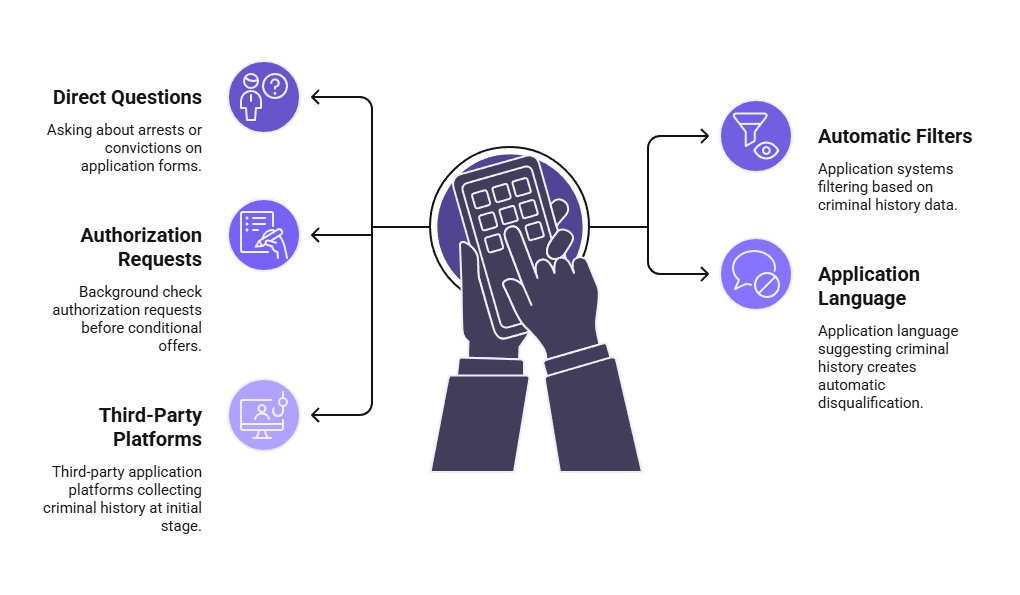
- Direct questions about arrests or convictions on application forms
- Automatic application system filters based on criminal history data
- Background check authorization requests before conditional offers
- Application language suggesting criminal history creates automatic disqualification
- Third-party application platforms that collect criminal history at initial stage
The restriction applies to direct employer inquiries, third-party application platforms, and background check authorization forms presented before a conditional offer. Employers may not use application language suggesting criminal history will disqualify candidates, as such statements create implied pre-offer inquiries.
Conditional Offer Triggers
Criminal history inquiries become permissible after extending a conditional job offer. A conditional offer should clearly identify the position, specify compensation or compensation range, and explain that employment is contingent on background check results and other pre-employment requirements. Employers should document offer communications to demonstrate that criminal history inquiries occurred only after the offer stage. Specific offer content requirements may evolve through enforcement guidance and should be verified against current Colorado Civil Rights Division standards.
| Required Offer Elements | Documentation Method | Timing Standard |
| Position title | Offer letter, email confirmation, or ATS record | Before background check authorization |
| Compensation details | Written or electronically documented | Must precede inquiry request |
| Start date | Specific or conditional date | Confirmed before screening |
| Essential job functions | Job description or offer language | Available to applicant at offer |
| Contingency statement | Clear language identifying background check dependency | Explicit in offer documentation |
Verbal offers meet the conditional offer standard if documented contemporaneously. Email confirmations, offer letters, and applicant tracking system records provide documentation that the offer preceded the background check authorization request.
Post-Offer Assessment Procedures
After obtaining criminal history information through any method, employers must conduct individualized assessments before adverse decisions. This assessment considers the nature and gravity of criminal conduct, time elapsed since the offense and completion of sentence, and the nature of the job sought.
Documentation requirements include written analysis of how specific criminal history relates to specific job duties, consideration of rehabilitation evidence provided by the applicant, and explanation of why the relationship between conviction and position justifies the adverse decision. Generic templates without case-specific detail fail to satisfy legal standards even when technically completed.
Marijuana Legalization and Employment Screening
Colorado’s lawful off-duty activities statute (C.R.S. § 24-34-402.5) has been interpreted by Colorado courts to permit employer adverse actions based on marijuana use, as marijuana remains federally illegal under the Controlled Substances Act. While some local ordinances and pending legislative proposals may expand protections, employers should verify current case law and jurisdiction-specific requirements before making employment decisions involving marijuana use. Positions involving safety-sensitive functions, federal contractor requirements, or specific regulatory mandates may have additional considerations.
Lawful Activity Protections
The interpretation of Colorado’s lawful activity statute as it applies to marijuana continues to evolve through case law and potential legislative changes. Employers should monitor current legal standards and enforcement guidance when developing policies addressing marijuana use.
Protected categories and limitations:
- Off-duty recreational use: Court interpretations and local ordinances vary regarding protections
- Medical marijuana patients: Additional considerations may apply under disability accommodation frameworks
- Workplace conduct exclusions: No protection for on-duty possession, use, or impairment
- Safety-sensitive positions: Employers may restrict based on documented safety justifications
- Federal contractor positions: Federal requirements may override state considerations for specific roles
Employers may maintain drug-free workplace policies that address impairment and workplace conduct. The protection covers off-duty consumption but does not prevent employers from prohibiting workplace possession, on-duty use, or working while impaired.
Drug Testing Policy Considerations
Pre-employment drug testing remains permissible in Colorado, but employment decisions based on marijuana test results should consider current legal standards and position-specific requirements. Employers must demonstrate that the specific position justifies marijuana-related restrictions based on safety functions, federal regulations, or contractual obligations with federal agencies.
| Position Type | Testing Permissibility | Result Implications | Documentation Requirements |
| Safety-sensitive | Permitted | May support adverse decisions with documented safety nexus | Written safety justification per position |
| Federal contractor | Permitted | May support adverse decisions based on federal requirements | Contract provisions and federal mandate documentation |
| General positions | Permitted | Decisions should reflect current legal standards | Job-specific analysis if used for decisions |
| Remote workers | Permitted | Subject to same standards as on-site | Location does not alter applicable standards |
Testing methods that detect only active impairment rather than past use provide stronger documentation for marijuana-related employment decisions. Employers should document the job-relatedness of any marijuana restrictions in position-specific policy language rather than blanket company-wide prohibitions.
Federal Contractor Conflicts
Employers with federal contracts should review specific contract provisions and Drug-Free Workplace Act applicability to determine whether federal requirements apply to specific positions, entire worksites, or the entire organization. Federal contractor obligations vary by contracting agency, contract type, and specific terms. Legal counsel or contract compliance specialists can help identify which positions are subject to federal drug-free workplace mandates.
Documentation distinguishing positions subject to federal requirements from other roles helps demonstrate that restrictions result from legal obligation rather than general employer policy. Legal guidance specific to federal contract requirements may be necessary for compliant policy design.
Individualized Assessment Documentation Standards
Colorado background check laws 2026 enforcement increasingly focuses on individualized assessment quality rather than mere completion. Employers must create documented analysis that demonstrates genuine consideration of required factors. Superficial or template-based assessments face heightened scrutiny during investigations and litigation.
Required Assessment Factors
The individualized assessment must address the relationship between specific criminal offenses and specific job duties. Generic statements that certain crimes indicate poor character or judgment fail to meet the job-relatedness standard.
Essential analysis components:

- Nature of offense: Specific criminal conduct and circumstances
- Gravity of conviction: Severity level and legal classification
- Job duty connection: Which essential functions create risk based on offense nature
- Time since offense: Years elapsed since criminal conduct occurred
- Sentence completion: Time since probation, parole, or incarceration ended
- Rehabilitation evidence: Treatment completion, education, employment history, community involvement
- Recidivism factors: Subsequent criminal activity or sustained law-abiding conduct
Employers should identify which essential functions create risk based on the nature of the criminal conduct. Colorado state law does not establish specific lookback periods limiting criminal history consideration, though individualized assessments must consider time elapsed as a key factor. Some municipal ordinances may establish lookback limitations. Federal equal employment opportunity guidance suggests that older convictions with significant time elapsed and no subsequent criminal activity generally should not support adverse decisions, and Colorado’s individualized assessment framework requires consideration of such rehabilitation evidence.
Documentation Best Practices
Written individualized assessments should include the specific conviction at issue, the specific job duties that create concern, the analysis of how the conviction relates to those duties, the time factors considered, any rehabilitation evidence provided by the applicant, and the conclusion reached with supporting reasoning.
| Assessment Element | Documentation Standard | Common Deficiencies |
| Conviction details | Specific offense, date, jurisdiction, disposition | Generic crime categories without specifics |
| Job duty analysis | Essential functions with risk explanation | Boilerplate language about “trust” or “character” |
| Nexus reasoning | Direct connection between offense and duties | Unsupported conclusions without logical link |
| Time consideration | Exact calculations with milestone dates | Vague references to “recent” without dates |
| Rehabilitation review | Specific evidence considered with evaluation | No documentation of opportunity provided |
| Final conclusion | Reasoned decision with supporting factors | Predetermined outcome without genuine analysis |
Templates that prompt fact-specific analysis for each required element may support consistent documentation when properly designed and used. Templates should include sufficient space for detailed, case-specific reasoning and should be accompanied by training emphasizing that individualized assessments require genuine analysis of each applicant’s circumstances rather than checkbox completion. Assessment documentation should be retained with other hiring records according to recordkeeping requirements under federal and state employment laws.
Notice Requirements to Applicants
Before implementing adverse decisions based on criminal history, employers must provide applicants with copies of the background check report under FCRA requirements and notification of the individualized assessment under Colorado law. Denver’s ordinance requires providing copies of the written assessment analysis itself.
Employers should provide applicants with reasonable time to respond with additional information, typically at least five business days or as specified by applicable municipal ordinances. Some jurisdictions establish specific response periods in local regulations. The FCRA requires reasonable time for applicants to respond to pre-adverse action notices, which enforcement guidance suggests should generally be at least five business days. Employers should track response deadlines carefully and document all communications with applicants during this period.
Municipal Jurisdiction Compliance Variations
Colorado employers must identify applicable local ordinances based on where positions will be physically performed, not where the company maintains headquarters or processes hiring decisions. Multi-location employers may apply different procedures to positions in different municipalities. Geographic analysis becomes a necessary first step in establishing compliant hiring workflows.
Denver-Specific Requirements
Denver’s ban the box ordinance applies to employers with ten or more employees in Denver and creates requirements beyond state law.
Core Denver obligations include:
- Removal of criminal history questions from initial applications
- Delay of criminal inquiries until after conditional offers
- Documented individualized assessments using required factors
- Written notices to applicants before final adverse decisions
- Provision of assessment analysis copies to affected applicants
- Cooperation with complaint investigations
- Record retention demonstrating timeline and procedural compliance
Denver requires employers to provide applicants with copies of the written individualized assessment before final adverse decisions. This requirement exceeds state law and FCRA notice obligations by mandating disclosure of the employer’s analysis itself rather than just the background report data. The ordinance includes complaint investigation provisions requiring employer cooperation with Denver’s Agency for Human Rights and Community Partnerships.
Aurora and Boulder County Frameworks
Aurora’s ban the box ordinance covers employers with ten or more employees and establishes criminal history inquiry restrictions similar to state law but with specific procedural timelines for individualized assessments and applicant notifications. Boulder County’s ordinance applies to county contractors and establishes requirements for positions performed within unincorporated Boulder County.
| Compliance Element | Denver | Aurora | Boulder County |
| Application stage | No criminal history questions | No criminal history questions | No criminal history questions for covered positions |
| Timing trigger | After conditional offer | After conditional offer | After conditional offer |
| Assessment documentation | Written with copy to applicant | Written with enhanced timelines | Written for contractor positions |
| Notice requirements | Pre-decision with assessment copy | Jurisdiction-specific timelines | Contract compliance documentation |
| Enforcement agency | Agency for Human Rights and Community Partnerships | Human Rights and Community Relations Commission | County Human Resources |
Both jurisdictions maintain enforcement mechanisms through local human rights agencies that investigate complaints and may impose penalties for violations. Compliance procedures should account for jurisdiction-specific filing deadlines and investigation cooperation requirements. Employers should verify whether specific work locations fall within municipal boundaries or unincorporated county jurisdiction. Jurisdictional determinations may require consultation with local government offices or legal counsel when addresses fall near municipal boundaries or in areas with overlapping local regulations.
Multi-Jurisdiction Employer Strategies
Employers hiring for positions in multiple Colorado municipalities may choose between jurisdiction-specific procedures and unified company-wide policies that meet the most restrictive applicable requirements. Unified policies simplify administration but may apply unnecessary restrictions to positions in less-regulated jurisdictions.
Position-specific compliance procedures require clear documentation of work location and applicable ordinance for each role. Applicant tracking systems should flag which municipality’s requirements apply based on position location rather than relying on hiring managers to determine applicable rules. Regular audits verify that geographic coding remains accurate as work locations or municipal boundaries change.
FCRA Colorado State Law Differences and Overlap
FCRA Colorado state law differences require employers to satisfy both federal consumer reporting requirements and state criminal history inquiry restrictions through coordinated but distinct compliance procedures. These parallel frameworks create layered obligations that operate simultaneously rather than alternative pathways.
Authorization and Disclosure Timing
FCRA requires written authorization before obtaining consumer reports, but this authorization request cannot occur until after a conditional job offer under Colorado law for criminal history checks.
Coordination requirements include:
- Conditional offer first: Complete offer documentation before background check authorization
- FCRA disclosure: Separate standalone disclosure document as required federally
- Authorization timing: Request occurs in post-offer sequence, not at application
- Electronic systems: Configure to prevent authorization submission before conditional offer generation
- Documentation sequence: Clear records showing offer preceded authorization request
The authorization form should appear in the conditional offer documentation sequence rather than in initial application materials. Electronic authorization systems must prevent submission of background check requests before conditional offer documentation is generated. System configuration should enforce proper sequencing rather than relying on user compliance.
Adverse Action Procedure Coordination
FCRA adverse action procedures require pre-adverse action notices with report copies and reasonable time for applicant response before final notices. Colorado’s individualized assessment may occur during the FCRA pre-adverse action period, with the assessment considering any information the applicant provides in response to the pre-adverse notice.
| Procedure Step | FCRA Requirement | Colorado Requirement | Coordination Strategy |
| Initial notice | Pre-adverse action notice with report copy | N/A at this stage | Send FCRA pre-adverse notice first |
| Response period | Reasonable time (typically 5+ business days) | Applicant opportunity to provide evidence | Use same period for both frameworks |
| Assessment | N/A under FCRA | Individualized assessment with documentation | Complete during FCRA response period |
| Additional notice | N/A under FCRA alone | Notice of assessment (Denver requires copy) | Provide before final decision |
| Final notice | Adverse action notice with specific information | Final decision communication | Combined or sequential final notices |
Employers should structure combined procedures that satisfy both the FCRA notice sequence and Colorado’s assessment and notice requirements without creating redundant or confusing communications to applicants. Timeline planning should account for both federal and state response periods to avoid premature final decisions.
Enforcement and Liability Sources
FCRA violations create liability through Consumer Financial Protection Bureau enforcement actions and private litigation with statutory damages and attorney’s fees. Colorado Chance to Compete Act violations create liability through Colorado Civil Rights Division administrative proceedings and potential private actions.
Municipal ordinance violations trigger local human rights agency enforcement with separate investigation procedures and remedies. Employers face potential simultaneous proceedings in multiple forums for the same hiring decision, as FCRA claims, state law claims, and municipal ordinance claims involve different legal standards and enforcement agencies. Each framework maintains independent complaint filing procedures, investigation timelines, and remedy structures.
Pay Transparency and Background Check Timing Intersections
Colorado’s Equal Pay for Equal Work Act requires salary range disclosure in job postings and at application, creating potential interaction with background check timing restrictions when compensation depends on background check results. These intersecting requirements demand careful position description drafting.
Compensation Disclosure Requirements
Job postings must include salary ranges or hourly compensation ranges for Colorado positions. These ranges must reflect genuine compensation possibilities rather than artificially wide ranges that obscure actual pay levels. When background check results affect compensation, such as positions where certain credentials command premium pay, employers must determine whether to disclose the full possible range or only the range available to candidates without those credentials.
Key disclosure principles:
- Good faith ranges: Reflect actual compensation possibilities for the position
- Credential-based variation: May specify ranges contingent on verified qualifications
- Criminal history exclusion: Cannot condition pay ranges on criminal history absence
- Application stage timing: Disclosure required when application opportunity exists
- Remote position coverage: Colorado applicants protected regardless of position location
Employers should not reduce compensation based on criminal history status, as such practices may violate Colorado’s individualized assessment requirements and anti-discrimination principles. If compensation varies based on verified credentials, professional licenses, or demonstrated qualifications that are independently assessed through background verification processes, employers should ensure such variations connect to objective qualification differences rather than criminal history presence. Legal counsel review is advisable for compensation structures involving background check contingencies.
Background Check Contingent Compensation
If compensation varies based on professional license verification or educational credential confirmation through background checks, employers should disclose the full range with explanation that final placement within the range depends on credential verification.
| Compensation Variable | Disclosure Approach | Criminal History Considerations | Legal Risk Level |
| Professional licensure | Full range with credential contingency note | Permissible if license itself has criminal history requirements | Low if transparent |
| Educational credentials | Full range with verification contingency | Cannot reduce pay based on criminal history separate from credentials | Low if credential-focused |
| Experience validation | Range reflecting experience levels | Cannot use criminal history as experience disqualifier | Moderate without clear policy |
| Skills verification | Range based on demonstrated skills | Skills assessment must be objective and criminal-history-neutral | Low if properly structured |
| Criminal history status | Not permissible basis for pay variation | Creates discrimination risk and violates individualized assessment principles | High |
Application materials should explain that compensation may depend on credential verification, experience validation, or other factors confirmed through background checks without suggesting criminal history affects pay. Any compensation variation based on background check results should connect to objective qualifications rather than criminal history presence or absence.
Application Stage Information Coordination
Because both pay transparency and criminal history inquiry restrictions operate at the application stage, employers must coordinate compliance through clear position descriptions that specify compensation ranges and explain any contingencies without making impermissible criminal history inquiries.
Application materials should explain that compensation may depend on credential verification, experience validation, or other factors confirmed through background checks without suggesting criminal history affects pay. Language should focus on objective qualifications being verified rather than screening outcomes determining pay levels. Regular review of job posting templates ensures continued alignment with both transparency and timing requirements.
Conclusion
Colorado background check laws 2026 compliance requires coordinated procedures addressing state criminal history inquiry timing, municipal ordinance variations, federal FCRA requirements, marijuana employment protections, and pay transparency rules. Employers must implement location-specific procedures with documented individualized assessments and coordinated notice sequences that satisfy all applicable frameworks. Regular policy review ensures alignment with evolving enforcement interpretations and municipal ordinance amendments as Colorado’s regulatory environment continues maturing. However, it is equally important to ensure the automatic enforcement of timing rules in hiring systems and partnerships, rather than relying on manual intervention. It is also important to note that, in a state of layered regulation, defensible compliance is not based on one-off policy updates.
Frequently Asked Questions
When can Colorado employers ask about criminal history during the hiring process?
Criminal history inquiries generally cannot occur until after extending a conditional job offer under the Colorado Chance to Compete Act. Exceptions apply for positions where federal or state law requires criminal history consideration or roles involving unsupervised access to vulnerable populations. Denver and other municipalities may impose additional restrictions beyond state law requirements.
How does Colorado’s marijuana legalization affect employment background checks?
Colorado’s lawful off-duty activities statute has been interpreted by Colorado courts to permit employer adverse actions based on marijuana use, as marijuana remains federally illegal. Employers should verify current case law and jurisdiction-specific requirements before making employment decisions involving marijuana use. Positions involving safety-sensitive functions, federal contractor requirements, or specific regulatory mandates may have additional considerations.
What is an individualized assessment under Colorado background check laws?
An individualized assessment requires written analysis of how specific criminal history relates to specific job duties before making adverse employment decisions. The assessment must consider the nature and gravity of the offense, time elapsed since the conviction and sentence completion, and evidence of rehabilitation. Employers must provide applicants an opportunity to submit additional information and must document their analysis with specific reasoning rather than generic statements.
Do Denver background check rules differ from Colorado state law?
Denver’s ban the box ordinance creates additional requirements beyond state law, including mandatory provision of written individualized assessment copies to applicants and specific notice procedures. Denver applies to employers with ten or more employees in Denver and establishes enforcement through the Agency for Human Rights and Community Partnerships. Employers must comply with both state and Denver requirements for positions located in Denver.
How do FCRA requirements interact with Colorado background check laws?
FCRA and Colorado state law generally address different aspects of the background check process, with FCRA governing consumer report procedures and Colorado law controlling criminal history inquiry timing and assessment requirements. Employers should coordinate both frameworks to ensure compliance with federal consumer reporting obligations and state hiring protection standards. Complex situations may require consultation with legal counsel familiar with both frameworks.
What recordkeeping is required for Colorado background check compliance?
Employers should retain documentation of conditional offer timing, background check authorization dates, individualized assessment analysis, notices provided to applicants, applicant responses and rehabilitation evidence, and final decision reasoning. Denver requires specific retention of written individualized assessments. Records should be maintained according to federal and state employment law retention requirements and should be sufficient to demonstrate compliance if administrative complaints or litigation arise.
Can Colorado employers have blanket disqualification policies for certain convictions?
Blanket disqualification policies without individualized assessment violate Colorado law except where federal or state law specifically prohibits hiring individuals with particular convictions for specific roles. Employers must conduct case-by-case analysis considering job-relatedness, time factors, and rehabilitation evidence even when certain convictions create strong concerns. Policy language should describe assessment procedures rather than automatic disqualification rules.
How should multi-state employers handle Colorado-specific background check requirements?
Multi-state employers should implement location-specific procedures for Colorado positions that address state and applicable municipal requirements. Options include creating Colorado-specific hiring workflows in applicant tracking systems or adopting company-wide policies that meet Colorado’s standards for all locations. Position-specific approaches require clear documentation of work location and applicable rules, while unified policies simplify administration but may impose unnecessary restrictions in less-regulated jurisdictions.
Additional Resources
- Colorado Chance to Compete Act Overview
https://cdle.colorado.gov/civil-rights - Denver Ban the Box Ordinance Information
https://www.denvergov.org/Government/Agencies-Departments-Offices/Agencies-Departments-Offices-Directory/Human-Rights-and-Community-Partnerships - Federal Trade Commission FCRA Guidance
https://www.ftc.gov/business-guidance/resources/using-consumer-reports-what-employers-need-know - Consumer Financial Protection Bureau Background Screening Resources
https://www.consumerfinance.gov/compliance/compliance-resources/other-applicable-requirements/background-screening/ - Colorado Equal Pay for Equal Work Act Resources
https://cdle.colorado.gov/equalpaytransparency - Colorado Department of Labor and Employment
https://cdle.colorado.gov/

ABOUT THE CREATOR
GCheck Editorial Team
Meet the GCheck Editorial Team, your trusted source for insightful and up-to-date information in the world of employment background checks. Committed to delivering the latest trends, best practices, and industry insights, our team is dedicated to keeping you informed.
With a passion for ensuring accuracy, compliance, and efficiency in background screening, we are your go-to experts in the field. Stay tuned for our comprehensive articles, guides, and analysis, designed to empower businesses and individuals with the knowledge they need to make informed decisions.
At GCheck, we're here to guide you through the complexities of background checks, every step of the way.